



The Ultimate Guide to Filing Multiple Years of Corporate Taxes Efficiently & Affordably
Multi-year corporate tax filing is simplified with Gondaliya CPA, specializing in catch-up tax returns and back taxes for businesses in Mississauga. Our corporate tax preparation services include accurate T2 filing and assistance with CRA voluntary disclosure to keep your records up to date.
The Ultimate Guide to Filing Multiple Years of Corporate Taxes Efficiently & Affordably
If your incorporated small or medium business (SMB) missed filing corporate taxes for several years, don’t worry. Multi-year corporate tax filing helps you get back on track. Catch-up tax returns fix those overdue filings. They lower penalties and keep you in line with CRA rules.
Here’s what you need to know:
- Filing taxes for multiple years at once saves time and hassle.
- Catch-up tax returns update your records and avoid fines.
- Corporate tax services offer expert help through the whole process.
- A business tax accountant checks your work, making sure it’s right and finding deductions.
Summary
- Multi-Year Corporate Tax Filing is for businesses that skipped filing for a few years.
- Catch-Up Tax Returns help fix missed filings fast.
- Corporate Tax Services give you expert support to handle tricky tax rules.
- Business Tax Accountant makes sure everything’s correct and finds ways to save you money.
Quick Comparison Table: Which Option Fits Your Needs?
| Situation/Trigger | Best Next Step | Why | Risk Level | Typical Timeline | Source/Note |
|---|---|---|---|---|---|
| Behind on multiple years of filings | Engage a CPA | CPA knows tax laws, cuts down errors | High | Depends on complexity | Consult a CPA |
| Got CRA audit notice recently | Voluntary Disclosure Program | Acting fast reduces penalties | Medium | Must act quickly | Consult a CPA |
| Want to find max deductions | Business Tax Accountant review | Finds all eligible expenses | Low | Ongoing |
Who This Service Is For / Not For
Who this fits:
- Incorporated SMBs that missed one or more corporate tax deadlines.
- Businesses needing help with old corporate taxes to avoid CRA problems.
Who this might not fit:
- Sole proprietors or unincorporated businesses looking for personal income tax advice.
- Companies already up-to-date with their filings who don’t need catch-up help.
If your business falls behind on corporate taxes, these services can help clear things up. Getting professional help often means less stress and fewer fees from the CRA.
What Is Multi-Year Corporate Tax Filing and Catch-Up Tax Returns?
Multi-year corporate tax filing means getting your corporate tax returns ready and sent for several past years you missed. This helps small and medium businesses (SMBs) in Canada who forgot or skipped their yearly filings with the Canada Revenue Agency (CRA). Catch-up tax returns are a kind of multi-year filing that focus on updating overdue corporate taxes.
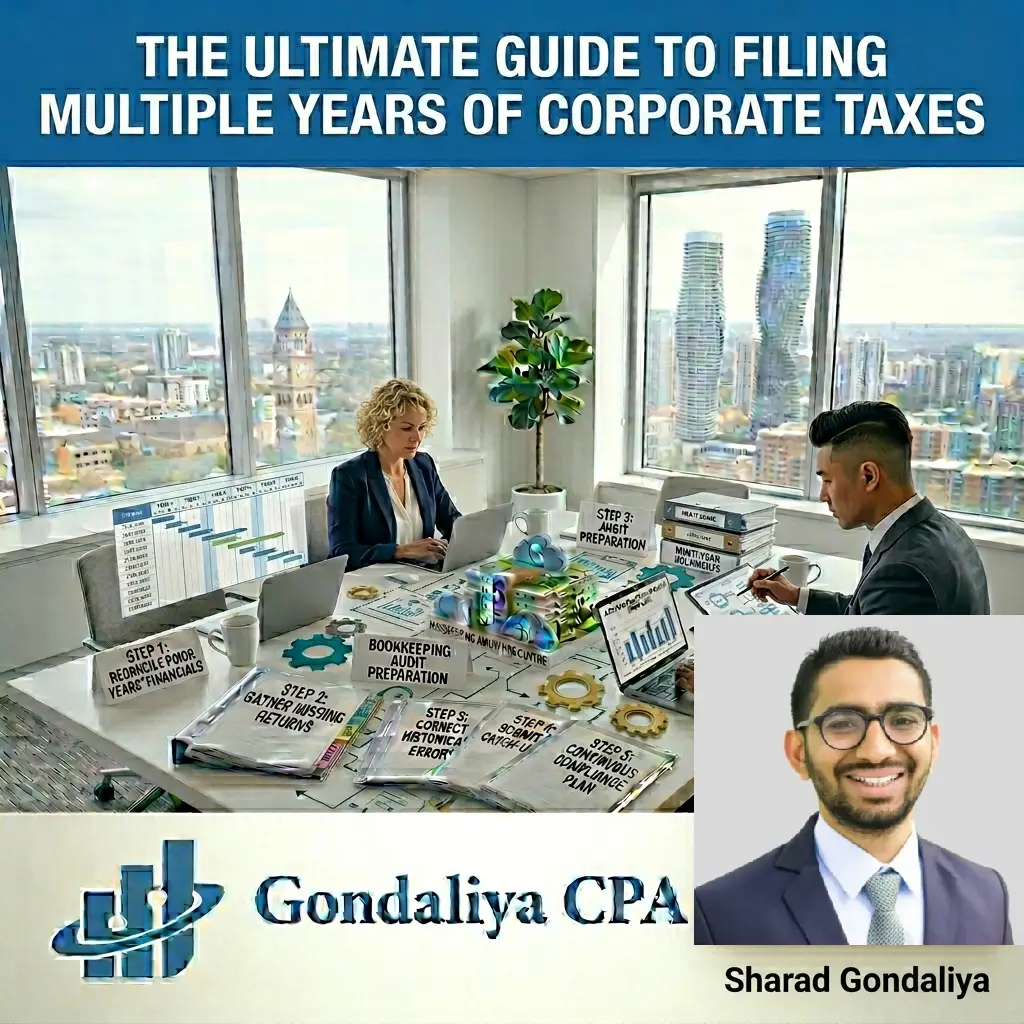
Many business owners fall behind because of late bookkeeping, management changes, or tricky money matters. Filing catch-up returns quickly stops penalties, interest, and possible CRA audits from growing worse.
Corporate tax services cover many things tied to Canadian tax laws at federal and provincial levels. They include:
- Preparing T2 corporate income tax returns
- Planning to lower taxes legally
- Representing clients during CRA checks or disputes
- Giving ongoing advice for incorporated businesses
Hiring a skilled business tax accountant helps make sure income, expenses, deductions, credits, and other info are reported right for all past years. It also gives peace of mind when dealing with new rules for companies in Ontario and across Canada.
Definitions Table
| Term | Definition | Why It Matters |
|---|---|---|
| Business Tax Accountant | A Registered CPA who prepares corporate taxes for businesses and follows CRA rules closely. | Helps file correctly and be ready if CRA audits happen. |
| CRA Compliance | Following all rules from the Canada Revenue Agency, like filing on time and paying taxes owed. | Avoids penalties and interest; keeps good standing with CRA. |
| T2 Corporate Tax Return | The official form Canadian corporations use every year to report income taxes. | Required to show taxable income and deductions properly. |
This simple guide explains why multi-year corporate tax filing matters when catching up on missed filings. It also shows why trusted corporate tax services from experienced accountants matter for staying within the law.
When You Need Multi-Year Corporate Tax Filing in Canada
Multi-year corporate tax filing, or catch-up tax returns, help small and medium businesses (SMBs) that missed one or more T2 corporate tax filings. These services fix overdue corporate tax returns and keep you in good standing with the CRA. Many business owners hire a business tax accountant or use corporate tax services to handle this tricky process.
You might need multi-year corporate tax filing in several cases:
- You miss filing annual T2 returns.
- You get CRA notices about overdue returns or audits.
- Your new business doesn’t file on time after incorporation.
- Ownership changes or restructuring cause gaps in your filings.
- Bookkeeping shows income or expenses that weren’t reported.
- Banks want CRA clearance certificates before lending money.
- You want to use the Voluntary Disclosure Program for old tax debts.
- You want to claim missed tax credits or deductions for past years.
Here’s a simple table showing common reasons for catch-up filings and what can happen if you don’t act, plus what a CPA does and what you need to prepare first:
| Scenario | What Can Go Wrong | CRA/Compliance Touchpoint | What a CPA Changes | What to Prepare First |
|---|---|---|---|---|
| Missing one or multiple annual T2 corporate tax returns | Penalties, interest, audit risks | Overdue notices from CRA | Prepares missing returns correctly; lowers penalties | Prior year financials; bookkeeping |
| Receiving notices from CRA about overdue returns or audits | More scrutiny; reassessments | Audit letters; compliance checks | Handles audit representation; manages responses | All CRA letters received |
| Incorporation of new business entities without timely filings | Late penalties; bad standing | Filing deadlines post-incorporation | Sets up accounting systems; files initial returns | Incorporation papers |
| Changes in business ownership or restructuring causing filing gaps | Confusion on reporting; lost deductions | CPA coordinates multiple entities; Updated shareholder agreements & transaction docs | CPA coordinates multiple entities; Updated shareholder agreements & transaction docs | Updated shareholder agreements & transaction docs |
| Discovery of unreported income or expenses during bookkeeping reviews | Risk of reassessment | Compliance problems if caught by CRA | Adjusts books and filings accurately; Bank statements & receipts | |
| Financial institutions requiring CRA clearance certificates for financing | Loans denied if taxes unresolved | Clearance delayed until filings done | Speeds up return submissions | Most recent financial reports & past clearance certificates (if any) |
| Preparation for voluntary disclosure to manage outstanding tax debts | Reduced penalties but full disclosure needed | Manages Voluntary Disclosure Program application | Guides on rules & needed documents; History of unpaid taxes & related letters | |
| Need for tax credit claims/deduction optimization for prior years | Missed credits/refunds if late | Reviews past eligibility; Maximizes credits and deductions allowed | Expense records & invoices |
When you know why multi-year corporate tax filing matters, you can avoid big fines and keep your corporation compliant with CRA rules. A good business tax accountant makes this easier and lowers the chance of trouble from late filing.
If your SMB faces any of these situations, act quickly. Getting help from pros stops penalties from growing. Plus, being ready with correct documents speeds things up when dealing with the CRA.
Handling multi-year corporate tax filing or catch-up tax returns can feel tricky. Many Canadian small and medium businesses struggle with rules that change a lot. You need to be accurate, follow CRA rules, and plan your taxes right. You have three main choices: do it yourself (DIY), hire a Registered CPA firm like Gondaliya CPA, or use a non-CPA provider. Each one comes with pros and cons you should know.
Accuracy & Compliance
DIY: Filing corporate taxes for several years on your own is risky. Tax laws in Canada keep changing, especially for corporations. If you don’t know the details, you might make errors—like missing deductions or using wrong forms. These mistakes can cause CRA audits or fines.
CPA Firm: Registered CPAs stay updated on tax rules. They file your taxes carefully and make sure everything follows CRA standards. They check all details closely to reduce errors and risks.
Non-CPA Provider: These folks might charge less but often lack formal accounting training. They may miss some corporate tax details, which can lead to errors or incomplete filings. That could cost you more later.
CRA Audit Representation
DIY: If the CRA audits you after self-filing, you handle all talks yourself. This can be stressful and confusing, without much chance of success.
CPA Firm: Registered CPAs can represent you during an audit. Their professional status helps them communicate well with the CRA and find solutions if problems come up.
Non-CPA Provider: Most cannot officially represent clients in audits due to licensing rules. This limits their ability to defend you when CRA reviews your returns.
Tax Planning Expertise
DIY: When filing many years yourself, you usually focus just on catching up. Planning ahead for tax savings rarely happens.
CPA Firm: CPAs offer more than just filing—they provide tax planning advice too. They help maximize deductions, manage carryforwards, and clean up bookkeeping so your cash flow improves over time.
Non-CPA Provider: Usually, they only prepare tax returns without offering much advice or planning for the future.
Accountability & Licensing
| Factor | DIY | CPA Firm | Non-CPA Provider |
|---|---|---|---|
| Licensing | None | Registered by CPA Ontario | Varies; mostly unlicensed |
| Professional Standards | N/A | Follow strict ethical codes | Limited accountability |
| Liability Coverage | None | Insured against mistakes | Often none |
Registered CPAs must meet high professional standards set by bodies like CPA Ontario. This means they answer for their work and follow strict rules.
Pricing Transparency
Pricing differs a lot between options:
- DIY: Costs the least upfront but mistakes might cause big penalties later.
- CPA Firms: Offer clear pricing—flat fees or yearly packages—so no surprise bills pop up.
- Non-CPA Providers: Often seem cheaper first but fee structures can be unclear; extra charges may come if they find errors to fix.
Technology & Integration
| Factor | Minimal Use | Extensive (QuickBooks/Xero/Wagepoint integration) | Limited |
|---|---|---|---|
| Technology Use | Minimal | Extensive (QuickBooks/Xero/Wagepoint integration) | Limited |
| Data Security | Fully client-controlled | Firm-managed secure systems | Potentially less secure |
| Workflow Efficiency | Potential delays/errors | Smooth workflows reduce bottlenecks | Varying efficiency |
Good CPA firms use tech to collect data smoothly, clean up books, coordinate payroll, track GST/HST—and then prepare accurate T2 returns even when catching up multiple years at once.
Choosing between doing it yourself, hiring a Registered business tax accountant like Gondaliya CPA, or going with a non-certified provider depends mostly on what matters most to you: how much risk you can take, how messy your past records are (“catch-up bookkeeping”), and if you want ongoing advice or just one-time help.
Here’s a quick comparison table of key points:
| Factor | DIY | CPA Firm | Non-CPA Provider |
|---|---|---|---|
| Accuracy & Compliance | Low | High | Medium |
| CRA Audit Representation | None | Full Support | Limited/None |
| Tax Planning Expertise | Minimal | Comprehensive | Basic |
| Accountability & Licensing | None | Registered + Regulated | Variable/Unlicensed |
| Pricing Transparency | Clear Upfront Costs | Possible Hidden Fees | Unclear Fee Structure |
| Technology & Integration | Basic Tools | Advanced Systems | Limited Tech Use |
Picking the right option helps protect your company from costly errors and lets you get some savings by using expert advice meant for incorporated SMBs dealing with late filings.
How the Service Works at Gondaliya CPA (Process + Timeline)
Filing several years of corporate taxes can be tricky and slow. At Gondaliya CPA, we make multi-year corporate tax filing easy for small and medium incorporated businesses in Canada. We take care of catch-up tax returns fast while following CRA rules.
We gather your info, check everything carefully, and keep you in the loop to avoid stress and mistakes. Here’s how we work:
Step 1: Initial Consultation & Engagement
We start with a free talk to learn about your business, which tax years need filing, and your needs for catch-up returns. This helps us plan exactly what to do.
- You: Give us basic company info and point out missing filings.
- CPA: Check if catch-up filings apply; explain timelines and rules.
- Watch out: Not having clear docs from past years slows things down.
- Tip: Bring any CRA letters or financial reports before we chat.
Step 2: Document & Data Collection
Then, we ask for all financial records for each year you need to file. This means bank statements, bookkeeping files like QuickBooks or Xero, payroll reports from Wagepoint or ADP, sales data from Stripe or Amazon, invoices, receipts, and old tax returns if you have them.
- You: Send digital or paper copies quickly and organized.
- CPA: Check if anything’s missing; ask for it early.
- Watch out: Missing receipts or bad bookkeeping cause delays.
- Tip: Keep good records even when catching up on filings.
Step 3: Data Review & Cleanup
Our team checks accounts carefully across the years. We spot odd stuff like mixing personal with business expenses or missing transactions that mess up reports.
- You: Explain unusual entries when we ask.
- CPA: Fix books if needed; make clean trial balances per year.
- Watch out: Different bookkeeping systems over time make cleanup hard.
- Tip: Start early to avoid last-minute fixes.
Step 4: Tax Return Preparation
We use the checked data for each year to prepare T2 returns following CRA standards. This includes all schedules that fit your industry.
We also adjust taxable income carefully to lower penalties but stay within the rules.
Step 5: Internal Quality Assurance & Client Review
Before sending returns:
- Senior CPAs check all numbers for accuracy across years—readying you for any CRA questions later.
- We send you draft copies highlighting key figures so you understand everything before approving.
Step 6: Filing Returns & Follow-Up Support
After you approve:
- We file all T2 returns electronically via CRA portals.
- If needed, we help set up payment plans or sort out any CRA debts related to late filings using proven methods made for Canadian SMBs.
We keep supporting you by answering questions or dealing directly with CRA if they contact you about these filings.
| Phase | Typical Duration | You Do | CPA Does | Output | Common Delays & Tips |
|---|---|---|---|---|---|
| Initial Consultation | 1–3 business days | Share company info | Assess needs | Engagement plan | Delay giving info → Prepare ahead |
| Document Collection | 1–3 weeks | Submit financial records | Check completeness | Confirm checklist | Missing docs → Organize files early |
| Data Review & Cleanup | 2–4 weeks | Reply quickly | Reconcile accounts | Cleaned trial balances | Incomplete books → Keep good records |
| Tax Return Preparation | 1–3 weeks per year | Approve drafts | Prepare T2 returns | Draft return packages | Late approvals → Respond quickly |
| QA & Client Review | Up to 7 days | Confirm numbers | Senior review | Signed-off drafts |
We stay open and clear every step so things move smoothly till the end.
What We Need From You (Checklist Preview)
To help with your multi-year corporate tax filing right away, we need some important documents and info upfront.
Here’s a quick checklist that speeds things up:
| Document / Information | Reason |
|---|---|
| Past Financial Statements | To check what was reported before |
| Bank Statements | For matching transactions in missed years |
| Bookkeeping Files (QuickBooks/Xero) | Helps import data fast |
| Payroll Records (Wagepoint/ADP) | Shows correct payroll taxes |
| Sales Reports (Stripe/Amazon/FBA) | Captures all income |
| Prior Corporate Tax Returns | Helps reduce extra work |
| Receipts/Invoicing Docs | Prove expenses claimed are real |
| CRA Notices on Filings/Debts | Shows urgent items to fix |
Sending these docs neatly and digitally makes us faster.
Clients often ask which docs cause most delays—usually missing receipts or invoices come first, then messy bookkeeping spread across several softwares.
Getting these ready cuts back-and-forth emails so your Business Tax Accountant at Gondaliya CPA can focus on actual tax work instead of chasing papers.
Here’s a summary table of what we usually need:
| Item | Reason |
|---|---|
| (Past) Financial Statements | Check past revenue/expenses |
| Bank Statements | Match transactions |
| Bookkeeping Files | Import accurate data |
| Payroll Records | Verify payroll deductions |
| Sales Reports | Capture full income from sales channels |
| Prior Corporate Tax Returns | Reference point lowers errors |
| Receipts/Invoicing Docs | Confirm deductible expenses |
| CRA Notices on Filings/Debt | Highlight urgent filing needs |
Having these ready makes every phase smoother.
This fits right into our clear process for timely delivery without cutting corners—a key part of our Corporate Tax Services done by Business Tax Accountants who know Canadian rules well.
Following this simple plan plus your checklist gives you a clear idea about what happens next—and what you must have ready—to fix multi-year corporate taxes at Gondaliya CPA Professional Corporation serving Toronto/Ontario businesses everywhere in Canada.
Deliverables + What You Get
When you hire someone for multi-year corporate tax filing or catch-up tax returns, you get more than just tax forms done. A business tax accountant offers solutions that fit your small or medium incorporated business.
Here’s what you usually get:
- Complete T2 Corporate Tax Returns: All overdue years filed the way CRA wants.
- Reconciliation of Financial Records: Fixes in bookkeeping to make financial statements accurate.
- CRA Compliance Review: Finds and fixes problems with back taxes.
- Tax Planning Recommendations: Tips to get the best deductions and credits, even for past years if possible.
- CRA Representation Support: Help during any CRA checks or audits because of late filings.
These services help your company get back in good standing with CRA and cut down risks from late filings. Extras like payroll reconciliation, GST/HST returns for missed periods, or cleaning up bookkeeping might be added if needed.
| Deliverable | Description | Who Uses It | When Delivered | Client Input Needed |
|---|---|---|---|---|
| Multi-Year T2 Tax Returns | Corporate income tax returns for several years | Business owners & accountants | After each fiscal year is done | Financial records, prior notices |
| Reconciled Financials | Corrected books showing true transactions | Accountants & management | Before finishing tax returns | Bank statements, invoices |
| Compliance Summary Report | Shows compliance status and any risks fixed | Management & CPA firm | After all filings are done | None |
| Tax Planning Advice | Ideas to improve future tax filings | Business owners | After filing consultation | Talk about how business runs |
| CRA Audit Support (Optional) | Help if CRA audits due to late submissions | Business owners & lawyers | When needed | Documents CRA asks for |
Pricing: What Affects the Cost of Multi-Year Corporate Tax Filing (Canada)
Costs for filing multiple years of corporate taxes vary a lot. It depends on each business’s unique situation.
Things that affect price include:
- How many years you need to file
- How complex things are with lots of transactions or mixed personal and business expenses
- How clean and complete your bookkeeping is
- How many companies are involved (like holding companies)
- If payroll or GST/HST returns must be included
- Deadlines or pressure from CRA that speed up work
- How much advice beyond basic filing you want
Knowing these factors helps businesses expect costs without surprises.
| Driver | Impact on Cost | How To Manage Efficiently |
|---|---|---|
| Maximum number of years | More years means more work | Minimize backlog yearly; keep filings current |
| Required bookkeeping cleanup | Cleaning up adds hours | Get organized docs early; use digital tools |
| Number of entities involved | More companies mean separate filings | Simplify structure if possible |
| Integration with payroll and GST/HST | Extra reconciliations add complexity | Coordinate record keeping across systems |
| Urgency of the filing | Rush jobs cost more | Plan ahead; avoid last-minute filing requests |
| Advisory depth | More planning raises fees | Set clear scope before starting |
A skilled business tax accountant can help manage costs by working smart while keeping things correct.
Risks, CRA Compliance, and Common Mistakes
Filing corporate taxes late over several years has real risks. You might face penalties, interest charges, audits, or damage your reputation with the Canada Revenue Agency (CRA). Knowing common mistakes can save money and stress.
Some usual errors are:
- Missing important documents that cause incomplete reports
- Mixing personal expenses with company ones that disallow deductions
- Not using penalty relief options when they apply
- Ignoring CRA messages after filing
- Forgetting provincial rules that matter in places like Ontario
A good CPA lowers these risks by checking everything carefully under Canadian rules:
How CPAs help reduce risk:
- They match bank statements and invoices to avoid missing info
- They keep personal and business expenses separate
- They apply for penalty waivers when possible
- They handle deadlines and talk with CRA to stop bigger issues
This table shows key risks with ways CPAs deal with them:
| Risk Area | Description | How CPAs Deal With It |
|---|---|---|
| Penalties/Interest Charges | Late payments cause growing fines hitting cash flow | CPA asks for relief when allowed |
| Incomplete Documentation | Leads to wrong returns raising audit chances | CPA checks all documents before filing |
| Personal Expense Misclassification | Disallows deductions risking penalties | Clear expense rules checked during prep |
| Missed Deadlines Post-Filing Contact | Can cause stronger enforcement like wage garnishments | CPA talks with CRA quickly |
| Provincial Rule Noncompliance | Provincial rules affect taxable income | Experts ensure correct handling |
Avoiding these mistakes keeps your company’s money safe and fixes standing fast.
Checklist: What to Prepare Before You Start
Getting your documents ready upfront speeds up multi-year corporate tax filing a lot. It also stops mistakes from missing info.
Here’s a simple checklist for small incorporated businesses working with a business tax accountant:
| Item | Why Needed | Where To Find | Common Mistakes | CPA Tip | |
|---|---|---|---|---|---|
| 1 | Prior Year Notices from CRA | Shows what issues or balances need fixing | Company mail/email archives | Missing letters delay process | Collect all mails before starting |
| 2 | Bank Statements (All Accounts) | Checks revenue and expenses are right | Bank online portals or paper copies | Missing months slows work down | Ask banks for e-copies |
| 3 | Sales Invoices / Receipts / Contracts | Proves revenue earned | Accounting software or folders | Lost receipts increase audit risk | Use cloud storage apps like Hubdoc |
| 4 | Payroll Records / T4 Slips | Makes sure payroll numbers match | Payroll provider websites/reports | Wrong employee info causes trouble | Double-check employee types |
| 5 | Previous Years’ Filed Returns | For comparing and making consistent reports | Past electronic files/folders | Old versions lead to mistakes | Send digital copies if you can |
| 6 | General Ledger Exports / Trial Balances | Core financial data base | Export from accounting system QuickBooks/Xero | Partial exports cause errors | Export full periods needing catchup |
Having these ready saves time in meetings so work focuses on tricky stuff instead of hunting docs later.
What are the key CRA requirements for multi-year corporate tax filing in Ontario?
CRA requires accurate T2 returns filed for each missed year. Filings must follow provincial rules. Penalties increase with delays.
How does Gondaliya CPA assist with catch-up corporate tax filing services?
Gondaliya CPA reviews your records, prepares missing returns, and negotiates with CRA for penalty relief and payment plans.
Can a Registered CPA firm provide audit representation for corporate tax filings?
Yes, Registered CPAs represent clients during CRA audits, communicate with auditors, and help resolve issues effectively.
What is the role of bookkeeping cleanup in business tax planning?
Bookkeeping cleanup ensures all transactions are accurate and complete. It supports correct deductions and reduces audit risks.
How does voluntary disclosure assistance work for overdue corporate taxes?
Voluntary disclosure lets you report past errors before CRA detects them. This can reduce penalties and avoid prosecution.
What small business deductions should I consider in multi-year filings?
Consider CCA claims, eligible expenses, SR&ED credits, and provincial incentives to lower taxable income.
Are GST/HST returns and payroll remittances included in catch-up corporate tax filing services?
Generally, GST/HST and payroll filings are separate services but can be coordinated for accuracy if needed.
How do payment plans help manage outstanding CRA tax debts?
Payment plans let businesses pay back taxes over time, easing cash flow pressure while staying compliant.
What challenges do holding companies face with multiple entities’ tax filings?
Multiple entities need separate returns. Complex ownership structures require careful coordination to avoid errors.
Why choose a Registered CPA firm over a non-CPA provider or DIY approach?
CPAs offer professional expertise, audit representation, strategic tax planning, and accountability not found elsewhere.
Important Points on Corporate Tax Compliance & Risk Management
- CRA Clearance Certificates: Required by financial institutions before loans. Ensure no outstanding taxes exist.
- Corporate Resolutions & Shareholder Loan Statements: Key documents needed during audits or restructuring.
- Financial Statements Reconciliation: Ensures accurate income reporting across years for compliance.
- Summary of Tax Credits & Deductions: Maximizes benefits like CCA and SR&ED credits for all filing years.
- Reconstructed Financial Statements: May be necessary when past records are incomplete or inaccurate.
Technology & Integration Benefits in Multi-Year Filing
- Use QuickBooks or Xero to organize bookkeeping data seamlessly.
- Wagepoint and ADP help verify payroll accuracy for remittances.
- Hubdoc assists in capturing receipts digitally to reduce missing documents.
- Stripe and Amazon FBA sales reports ensure full income is reported accurately.
Common Compliance Risks & Mistakes to Avoid
- Procrastination leads to escalating penalties and interest charges.
- Non-disclosure of related entities causes reassessment risks from CRA.
- Ignoring bookkeeping discrepancies raises audit chances.
- Not optimizing deductions loses potential savings on tax returns.
Additional Services Often Needed Beyond Corporate Tax Filing
- GST/HST retroactive filings where missed periods exist (add-on).
- Payroll filing adjustments to match remittances with returns (add-on).
- Legal incorporation or restructuring advisory (not included but available separately).
- T3 trust and estate tax return preparation when applicable to corporate structures.
How Gondaliya CPA Handles CRA Correspondence & Audit Readiness
We manage all CRA communications promptly to avoid escalation. Our team prepares you thoroughly if an audit notice arrives using clear strategies for defense and documentation support.
Strategic Tax Planning Tips for Incorporated SMBs
Plan ahead using capital cost allowances (CCA) effectively each year. Take advantage of available small business deductions to minimize taxes owed while maintaining full compliance with CRA policies at both federal and provincial levels.
Why Multi-Entity Filings Require Expert Coordination
Complex ownership structures involve multiple T2 returns that affect one another’s reporting accuracy. We ensure integrated financial systems reflect true activity across all entities to avoid costly errors or missed deadlines.
This information helps Canadian businesses stay compliant while optimizing their multi-year corporate tax filings through expert guidance from Gondaliya CPA Professional Corporation serving Toronto and Ontario clients nationwide.

Sharad Gondaliya is a CPA Canada & CPA USA with 15 Years+ experience of Accounting, Tax, Payroll of Corporate Small Businesses as Tax Accountant. He is fully certified CPA Ontario and CPA USA and is well known among corporate small businesses for tax planning, efficient tax solutions, and affordable CPA services. Sharad is the Principal (Director) of Gondaliya CPA – Affordable CPA Firm in Canada. Licenses: CPA Ontario: 61040184 | CPA USA (MT): PAC-CPAP-LIC-033176 | CPA USA (WA): 57629 | CPA Firm License: 61330051 View Full Author Bio