



Corporate Tax Filing Services for Ontario Corporations
A corporation does not file one return a year. It files a set of them, each with its own deadline and its own CRA program account. The T2 is due six months after year-end, and GST/HST returns follow your reporting period. Payroll remittances run all year, and T4 and T5 slips are due by the end of February. The Ontario annual return is due within six months after year-end, and the owners’ personal returns by April 30. When two filings report different figures for the same item, CRA can ask the corporation to explain why. Our corporate tax filing services prepare the filings in your engagement from one set of year-end books.

1450+
5-Star Google Reviews
At a glance
- What we filethe T2 return and its schedules, GST/HST returns, and T4, T4A and T5 slips with their summaries (plus T5018 slips for a construction business), all prepared from one set of year-end books. We also check that your Ontario annual return is on the Ontario Business Registry.
- What you sendbank and credit card statements, access to your accounting software, payroll and dividend records, contractor details and last year’s returns.
- What you receivethe filed returns and slips with CRA’s confirmation numbers, the reconciliations behind them, a payment schedule and next year’s filing calendar. Compiled financial statements and the owners’ personal returns are included where your engagement letter lists them.
- How the fee worksone fixed flat fee, set before the work starts, covering the filings listed in your engagement letter.
Corporate tax filing is mandatory for incorporated businesses and critical for staying compliant while minimizing tax costs in Canada. At Gondaliya CPA, we provide professional, affordable corporate tax filing services for Toronto and GTA small and medium‑sized corporations.
Our CPAs handle every part of your T2 corporate tax return—financial statement review, tax adjustments, and accurate electronic filing in line with current CRA rules. Correct, on‑time filing helps you avoid penalties and keeps your corporation in good standing.
We focus on affordability without sacrificing quality or responsiveness. Each return is carefully reviewed to identify eligible deductions, credits, and expenses, helping reduce your corporate tax bill and support long‑term business growth.
CPA Ontario Registered Firm, ID 61330051
1450+ ★★★★★ Google Reviews
Will cover personal tax filing for Directors & Families
Weekend and evening support until 9 PM
Just a call away when you need us
- AFFORDABLE + CPA Ontario Registered Firm
- Business and Corporate Tax Expert
- Small & Medium Business Expert
- Accounting, bookkeeping, and tax filing
- Certified CPA
- 1450+ 5-stars Google reviews
- 30-Day Money-Back Guarantee
- 60-Day Fees Matching Policy
Accurate corporate tax filing is essential for keeping your corporation fully compliant with CRA rules and avoiding costly penalties, interest, or reassessments on your T2 return. When your T2 is prepared correctly, you can also maximize tax savings by claiming every eligible deduction and credit your business qualifies for, so more profit stays in the company.
Professional corporate tax filing support frees up hours of administrative work, letting you focus on running and growing your business instead of worrying about deadlines, forms, and CRA notices. With accurate projections and timely filing, you know your corporate tax bill in advance, which helps maintain clear, predictable cash flow and prevents unpleasant year‑end surprises.
T2 Corporate Tax Return Preparation
Cost-effective preparation of precise and compliant T2 corporate tax returns.
Review of Corporate Tax Deductions & Credits
Affordable expert review to maximize claimable deductions and credits.
Electronic Filing & Deadline Management
Timely electronic CRA filing to avoid fines, included at no extra cost.
Amendments & Re-filings
Prompt help with amendments or corrections without surprise fees.
CRA Correspondence & Audit Support
Cost-conscious representation for CRA communications and audits.
Year-Round Compliance & Advisory Support
Affordable ongoing advisory to keep your corporate taxes in order.
Corporate Tax Filing Services in Ontario
Practitioner-level T2 corporate tax return preparation, CRA corporate tax filing, and corporate tax advisory services for Ontario corporations — built around correct GIFI coding, every schedule CRA cross-checks, and AFFORDABLE flat-fee pricing with no surprise fees.
T2 Corporate Tax Return Preparation
Complete T2 corporate tax return preparation for Ontario corporations, including the federal T2 and the Ontario CT23 combined filing. Every active and inactive corporation must file a T2 within six months of fiscal year-end, even with no income, and accurate GIFI coding determines how CRA reads your return.
- We map your full trial balance to the correct GIFI codes on Schedule 100 (balance sheet) and Schedule 125 (income statement), so your T2 corporate tax return reconciles to your financial statements line by line before CRA's automated system ever reviews it.
- We reconcile accounting net income to taxable income on Schedule 1, adding back non-deductible items such as 50% of meals, club dues, and accounting reserves, then deducting amounts like CCA and the eligible portion of capital gains for an accurate corporate tax filing Ontario corporations can rely on.
- We complete Schedule 50 to report each shareholder owning 10% or more of any share class, with name, SIN or business number, and shareholding percentage — a disclosure CRA matches against personal returns during corporate tax compliance Ontario reviews.
- We calculate the Small Business Deduction on Schedule 7, applying the 9% federal and 2.2% Ontario small business rate to active business income up to the $500,000 limit, and reduce that limit where taxable capital exceeds $10 million.
- We claim Capital Cost Allowance on Schedule 8 across the correct asset classes and track the undepreciated capital cost pool forward each year, so depreciation on equipment and vehicles is never lost or double-claimed in your corporate tax preparation services file.
Review of Corporate Tax Deductions & Credits
A focused review of every corporate tax deduction and credit your Ontario corporation is entitled to claim. Most missed savings come from overlooked credits, unclaimed losses, and deductions filed in the wrong year — this review recovers them before your T2 corporate tax return is finalized.
- We apply non-capital loss carryforwards on Schedule 4, using losses within the 20-year window against current taxable income, and elect the optimal year to claim them so corporate tax deductions Canada rules allow your corporation to smooth tax across profitable and lean years.
- We identify and document SR&ED (Scientific Research & Experimental Development) eligible expenditures on Form T661, claiming the 35% refundable Investment Tax Credit available to Canadian-controlled private corporations on the first $3 million of qualified spending.
- We claim the Ontario Made Manufacturing Investment Tax Credit and apprenticeship-related credits where your corporation qualifies, mapping each to the correct line of the T2 and supporting schedules for a defensible corporate tax filing.
- We review associated corporation status under section 256, since associated corporations must share the single $500,000 Small Business Deduction limit — an allocation we file on Schedule 23 to prevent CRA from reassessing an over-claim.
- We test eligibility for the dividend refund through the RDTOH (Refundable Dividend Tax On Hand) pools, ensuring refundable tax on investment income is recovered when taxable dividends are paid — a benefit included in our service at no surprise fee.
Electronic Filing & Deadline Management
CRA corporate tax filing through certified EFILE software, with every deadline tracked so your corporation never triggers an avoidable penalty. The T2 is due six months after year-end, but the balance due date is earlier — and missing either has a direct dollar cost we manage for you.
- We EFILE your T2 corporate tax return through CRA-certified software with a confirmation number recorded in your file, meeting the mandatory electronic filing requirement that applies to corporations with annual gross revenue over $1 million.
- We calculate and schedule your monthly or quarterly CRA instalments, since corporations with tax payable over $3,000 must remit instalments and CRA charges instalment interest plus a potential 50% additional charge on deficient amounts.
- We track the corporate tax balance due date — two months after year-end for most corporations, three months for CCPCs claiming the Small Business Deduction — so interest at the prescribed rate never accrues unnoticed on your balance.
- We prevent late-filing penalties of 5% of unpaid tax plus 1% per month for up to 12 months, which escalate to 10% plus 2% per month where CRA issued a demand to file — a cost-effective safeguard built into our deadline management.
- We coordinate your Ontario Annual Return filing, now separated from the T2 and filed through the Ontario Business Registry, so your corporation stays in good standing for corporate tax compliance Ontario purposes alongside its CRA filing.
Amendments & Re-Filings
Correcting a previously filed T2 corporate tax return when income, deductions, or schedules were reported wrong. CRA allows amendments, but the procedure, the time limits, and the supporting documentation must be exact — otherwise the change is rejected or invites a closer look at the original filing.
- We file T2 adjustment requests with a clear reconciliation of the original and corrected figures, refiling the affected schedules rather than the entire return where CRA's procedures permit, so your correction is processed without reopening unrelated lines.
- We amend prior-year CCA claims on Schedule 8 where assets were misclassified or the half-year rule was misapplied, restoring undepreciated capital cost balances that flow correctly into every subsequent corporate tax filing.
- We correct shareholder loan reporting under subsection 15(2), where amounts drawn and not repaid within one fiscal year after the year of the loan must be included in income — a reassessment trigger we resolve before CRA acts.
- We carry losses back up to three years using Schedule 4 and Form T2, applying a current-year non-capital loss against tax already paid in a prior profitable year to generate a refund through corporate tax advisory services.
- We refile within the normal reassessment period — three years from the original Notice of Assessment for a CCPC — and prepare a waiver only where genuinely required, protecting your corporation from open-ended exposure.
CRA Correspondence & Audit Support
Direct handling of CRA letters, review requests, and audits on your behalf as your authorized representative. Most corporate enquiries are document-matching reviews, not full audits — answered correctly and on time, they close quietly. Answered poorly, they expand. We manage the full exchange.
- We respond to CRA pre-assessment and post-assessment review letters within the stated deadline, supplying the exact schedule, ledger detail, or GIFI breakdown requested so the enquiry on your corporate tax return closes without escalation.
- We act under a signed Authorization on Form AUT-01 and through Represent a Client, so CRA corresponds with us directly and your corporation is never left interpreting a technical letter alone.
- We defend Capital Cost Allowance, intercorporate management fees, and shareholder benefit positions during a corporate audit with source documentation and the supporting Income Tax Act provisions, presented by a corporate tax accountant Toronto businesses can put forward to CRA.
- We file a Notice of Objection on Form T400A within 90 days of a Notice of Reassessment, preserving your appeal rights and preventing the reassessed balance from becoming final and collectible.
- We apply for penalty and interest relief under the Taxpayer Relief Provisions using Form RC4288 where circumstances beyond your control caused a filing or payment delay, with transparent pricing and no surprise fees on the application.
Year-Round Compliance & Advisory Support
Corporate tax advisory services that run through the full year, not only at filing time. The decisions that lower your T2 — compensation mix, asset timing, instalment planning — are made months before the return is prepared. We keep your corporation positioned so the year-end filing simply confirms the plan.
- We design your salary-versus-dividend compensation mix annually, balancing personal and corporate tax, CPP contributions, and RRSP room, then document the supporting T4 and T5 slips so the position holds on your corporate tax return.
- We monitor taxable capital across associated corporations against the $10 million and $50 million thresholds, since exceeding them grinds down the Small Business Deduction and changes your effective rate on active business income.
- We track passive investment income against the $50,000 annual limit, because investment income above it reduces the small business limit by $5 for every $1 of passive income over $50,000 under the adjusted aggregate investment income rules.
- We time major equipment and vehicle purchases before fiscal year-end to claim CCA and the Accelerated Investment Incentive in the current year, lowering taxable income through corporate tax preparation services planned in advance.
- We maintain your corporate minute book, dividend resolutions, and intercorporate loan documentation throughout the year, so every transaction is supported when the T2 corporate tax return is filed — affordable, year-round, and included in our service.
Free Corporate Tax Filing Consultation for Businesses
Problem: A Mississauga-based tech startup faced high corporate taxes due to unclaimed deductions and inconsistent bookkeeping.
Solution: Implemented full-service bookkeeping with Xero, optimized their professional corporation setup, and applied proactive corporate tax planning tailored to startups.
Results:
✅ Saved $22K/year in corporate taxes
✅ Reduced monthly tax preparation time by 10 hours
✅ Prepared clean, audit-ready CRA corporate filings
Problem: A Brampton manufacturing company was overpaying corporate taxes because financial records were scattered and tax credits were not fully utilized.
Solution: Streamlined bookkeeping using QuickBooks Online, restructured the professional corporation for tax efficiency, and executed detailed corporate tax planning.
Results:
✅ Saved $18K/year in corporate taxes
✅ Reduced monthly tax prep time by 12 hours
✅ Ensured accurate, CRA-compliant corporate filings
Problem: A Toronto retail business struggled with high corporate taxes and inefficient reporting systems, creating cash flow pressure.
Solution: Implemented tailored corporate tax strategies, organized bookkeeping specifically for tax purposes, and optimized corporate structure for maximum tax savings.
Results:
✅ Saved $25K/year in corporate taxes
✅ Cut monthly tax prep time by 15 hours
✅ Delivered clean, audit-ready CRA corporate filings
At Gondaliya CPA, our tax accountants make tax filing straightforward and stress-free. Our streamlined 4-step process ensures accuracy, maximizes your refunds, and saves you valuable time. From initial consultation to final filing, we handle everything with professional expertise and personalized attention.
Start with a free, no-obligation consultation to review your business’s tax filing needs and outline our affordable corporate tax solutions in Toronto.
Receive a comprehensive checklist and securely provide the required financial records and documents.
Our tax accountant carefully prepare your tax return, identify all applicable deductions and credits, and conduct thorough reviews.
We file your corporate tax return electronically with the Canada Revenue Agency (CRA) on time and provide post-filing support.

We prepare your corporate tax return with precision, ensuring full compliance with current CRA and Ontario rules while claiming every allowable deduction.

Among Toronto’s most cost‑effective CPA firms for corporate tax filing, with clear, fixed fees and no surprise bills.

From small corporations to holding companies, we tailor filing strategies to your structure and goals so you legally minimize tax and keep more profit.

Support doesn’t stop after filing. We’re available year‑round to answer questions, respond to CRA notices, and adjust your tax approach as your business grows.









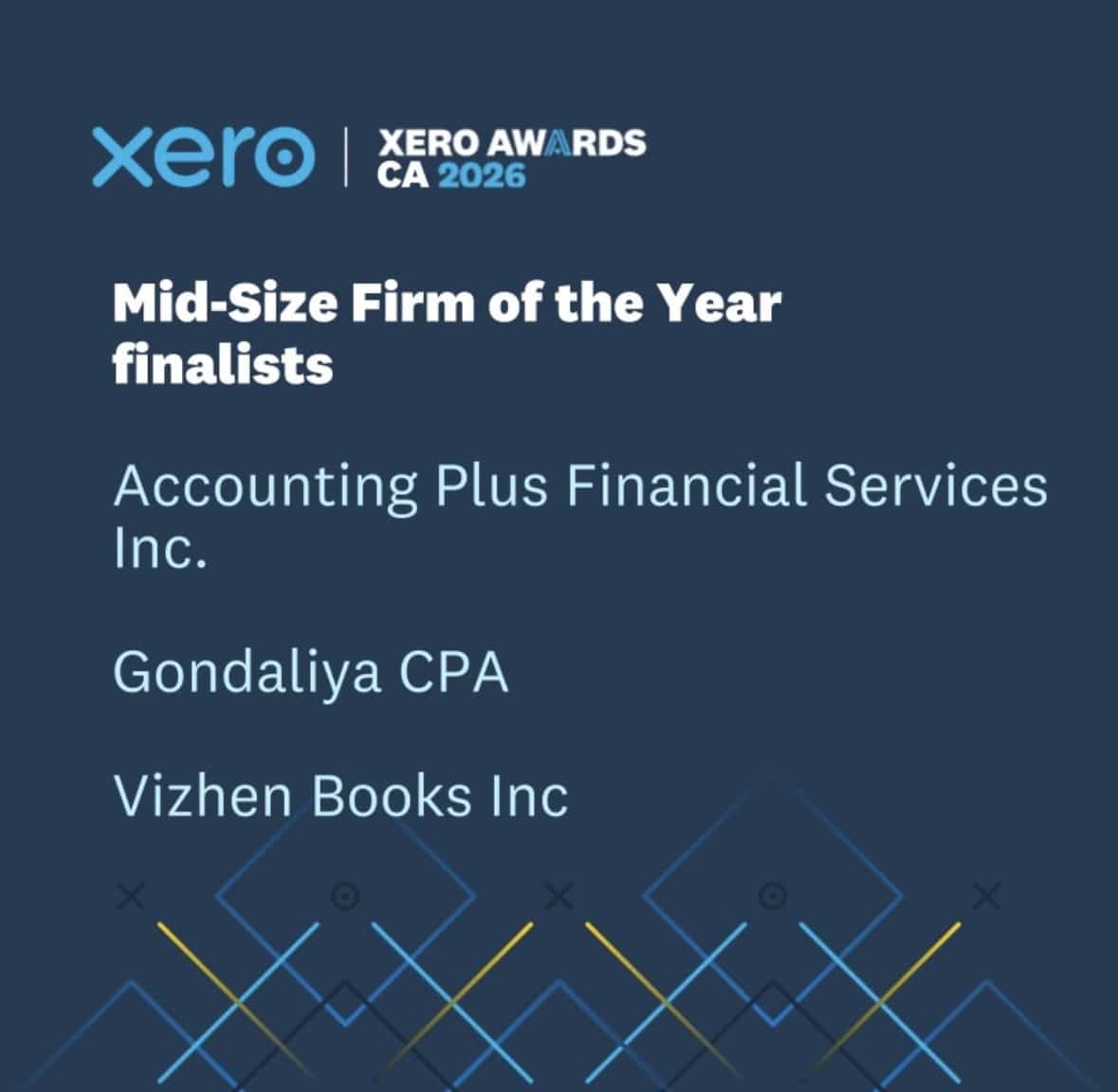
Xero Awards Canada 2026 Finalist
Proud Finalist – Mid-Size Firm of the Year
Gondaliya CPA has been recognized as a finalist for the Xero Awards Canada 2026 in the Mid-Size Firm of the Year category, reflecting our commitment to innovation, cloud accounting excellence, and exceptional client service.
We believe in clear, upfront pricing so you know exactly what to expect.
- Corporate Tax Preparation & Filing (T2): From $300
Tax Compliance Audit – FREE CRA audit support for our clients
Corporate Tax Filing Fees: Gondaliya CPA vs Industry Average
Based on 2026 CPA fee survey data across Ontario accounting firms.
| Service | Industry Average | Gondaliya CPA | You Save |
|---|---|---|---|
| Corporate Tax (T2) Filing | $1,200 | From $300 | $900+ |
| All fees include HST. No hourly billing. No hidden charges. 60-Day Fees-Matching Policy: if you find the same service cheaper from a licensed Ontario CPA, we match it. | |||
Our CPA team provides reliable corporate tax filing services to businesses throughout the Ontario. We understand local tax requirements, industry regulations, and CRA compliance needs specific to each region we serve. Corporate tax filing is available in-person at our Toronto office and virtually to corporations across Ontario and Canada
Toronto (ON)
55 Queen St E Ste 1205, Toronto, ON M5C 1R6, Canada
+1 (647) 212-9559
9:00 AM – 8:30 PM (Mon – Sun)
Mississauga (ON)
2100 Camilla Rd #716, Mississauga, ON L5A 2J8, Canada
+1 (647) 212-9559
9:00 AM – 8:30 PM (Mon – Sun)
Brampton (ON)
4 Starhill Crescent, Brampton, ON L6R 2P9, Canada
+1 (647) 212-9559
9:00 AM – 8:30 PM (Mon – Sun)
Scarborough (ON)
24 Clementine Square, Scarborough, ON M1G 2V7, Canada
+1 (647) 212-9559
9:00 AM – 8:30 PM (Mon – Sun)
Vaughan (ON)
19 Cabinet Crescent, Woodbridge, ON L4L 6H9, Canada
+1 (647) 212-9559
9:00 AM – 8:30 PM (Mon – Sun)
Oshawa (ON)
210 Durham St, Oshawa, ON L1J 5R3, Canada
+1 (647) 212-9559
9:00 AM – 8:30 PM (Mon – Sun)
Ottawa (ON)
2090 Neepawa Ave a314, Ottawa, ON K2A 3L6, Canada
+1 (647) 212-9559
9:00 AM – 8:30 PM (Mon – Sun)
Etobicoke (ON)
60 Stevenson Rd #1601, Etobicoke, ON M9V 2B4, Canada
+1 (647) 212-9559
9:00 AM – 8:30 PM (Mon – Sun)
Hamilton (ON)
70 Starling Dr, Hamilton, ON L9A 0C5, Canada
+1 (647) 212-9559
9:00 AM – 8:30 PM (Mon – Sun)
Guelph (ON)
1155 Gordon St, Guelph, ON N1L 1S8, Canada
+1 (647) 212-9559
9:00 AM – 8:30 PM (Mon – Sun)
Windsor (ON)
4387 Guppy Ct, Windsor, ON N9G 2N8, Canada
+1 (647) 212-9559
9:00 AM – 8:30 PM (Mon – Sun)
North York (ON)
150 Graydon Hall Dr #912, North York, ON M3A 3B2, Canada
+1 (647) 212-9559
9:00 AM – 8:30 PM (Mon – Sun)
Industry-Specific CPA Handling
Industry-Specific CPA Handling. Your corporate tax filing file is matched with a team member who has worked with businesses in your industry, whether you run a dental or medical practice, restaurant, construction company, e-commerce store, trucking company, real estate holding company or consulting firm. Industry details such as revenue streams, HST treatment, payroll structure and equipment classes are handled by someone who knows them. A CPA reviews your corporate tax filing work before anything is filed with CRA or sent to your bank.
Corporate Tax Filing for Startups
Specialized startup tax & accounting
Corporate Tax Filing for Healthcare
Specialized healthcare tax & accounting
Corporate Tax Filing for Consultants
Specialized consulting tax & accounting
Corporate Tax Filing for Small Businesses
Specialized small business tax & accounting
Corporate Tax Filing for Restaurants
Specialized restaurant tax & accounting
Corporate Tax Filing for Franchises
Specialized franchise tax & accounting
Corporate Tax Filing for Self-Employed
Specialized self-employed tax & accounting
Corporate Tax Filing for Manufacturing
Specialized manufacturing tax & accounting
Corporate Tax Filing for Grocery Stores
Specialized grocery tax & accounting
Corporate Tax Filing for Import & Export
Specialized import/export tax & accounting
1. Corporate Filing Deadlines: Your Annual Calendar
- Key dates. For a December 31, 2026 year-end, we calendar the tax balance for February 28, 2027 (on time if received March 1) or March 31 under the three-month rule, T4 and T5 slips for March 1, the annual GST/HST return for March 31, personal returns for April 30, and the T2 and Ontario annual return for June 30.
- Non-December year-ends. A corporation with a year-end other than December 31 runs on two clocks. Corporate deadlines follow the fiscal year, while payroll slips, T5 slips and the owners' personal returns follow the calendar year. We map both clocks, so the February slip deadlines that fall in the middle of a June 30 company's fiscal year are on its calendar.
- Four CRA accounts. Each filing lands in a program account under one business number: RC for corporate income tax, RT for GST/HST, RP for payroll deductions and RZ for information returns such as T5 and T5018. We build the calendar account by account and check each account's statement, so every open account has its due dates and balance checked.
- First-year set-up. A new corporation needs only the program accounts its activities require: RT once it is no longer a small supplier or chooses to register, and RP when it starts a payroll. We confirm each account, the GST/HST reporting period CRA has on file and the first year-end date, then calendar each first return.
- Next year's calendar. Each engagement ends with a calendar for the next twelve months: the balance-due date, instalment dates where required, the GST/HST filing dates for your reporting period, the slip deadlines, the T2 date and the Ontario annual return. Every deadline for the filings in your engagement is listed in one place.
Key dates for a December 31, 2026 year-end:
| Date | What is due |
|---|---|
| February 28, 2027 (on time if received Monday, March 1), or March 31 if the three-month rule applies | Corporate tax balance |
| March 1, 2027 (February 28 is a Sunday) | T4, T4A and T5 slips and summaries |
| March 15, 2027 | Ontario EHT annual return, if Ontario payroll is over the exemption |
| March 31, 2027 | Annual GST/HST return and payment |
| April 30, 2027 | Owners' personal returns and balances owing |
| June 30, 2027 | T2 return and Ontario annual return |
2. Year-End Bookkeeping Close Before Anything Is Filed
- Monthly reconciliations. Every bank and credit card account is reconciled to its statements month by month. An unreconciled month can hide a duplicate entry, a missed deposit or a personal charge, any of which changes revenue, GST/HST or the shareholder loan. When only the books and statements are needed, our corporate year-end accounting service handles the close.
- Year-end cut-off. A January invoice for December work belongs in December revenue on the T2, but the GST/HST on it follows the Excise Tax Act timing rules, generally the earlier of the invoice date and payment. We review January's sales and bills, move income and expenses into the right year and record each entry's GST/HST effect separately.
- Accruals and prepaids. Accruals for professional fees, wages and interest, and prepaids such as insurance, are recorded so each expense falls in the year it relates to. A bonus accrued at year-end is deductible that year only if paid within 180 days, under subsection 78(4), so each accrual's payment date goes on the schedule we keep.
- Inventory. For a corporation that holds inventory, the year-end count or perpetual records are agreed to the general ledger and to cost of sales. We review the valuation, generally the lower of cost and net realizable value under Accounting Standards for Private Enterprises (ASPE), because a change in closing inventory changes taxable income dollar for dollar.
- Shareholder account. Owner withdrawals, personal costs paid by the company and owner deposits are posted to the shareholder account before T2 work starts. The year-end balance shows how much you must repay, or cover by salary or a dividend, by the subsection 15(2.6) deadline: one year after the end of the tax year in which the loan was made.
3. Year-End Financial Statements
- Compilation (CSRS 4200). The T2 reports financial data as General Index of Financial Information (GIFI) codes, but lenders and investors may ask for financial statements. Where included in your engagement, we prepare the balance sheet, income statement and notes compiled under CSRS 4200, the standard that replaced the Notice to Reader for periods ending on or after December 14, 2021.
- One locked trial balance. One locked trial balance produces the financial statements, the GIFI schedules filed with the T2 and the revenue used in the GST/HST reconciliation. We lock it only after every close adjustment is posted, and record any later entry in all three, so anyone comparing the filings finds the same figures.
- Notes from source documents. The notes disclose the basis of accounting, amounts owed to and by shareholders, related-party transactions and long-term debt terms. Each disclosure has to agree with a source document, so we draft the notes from the loan agreements and the shareholder ledger, not from last year's notes.
- Lender requirements. A lender or investor may require comparative figures, a set format, or a review or audit instead of a compilation. A review or audit is a different engagement, which we do not perform, so we confirm the requirement with you before year-end. Schedule 141 of the T2 reports the type of engagement actually performed.
- Prior-year errors. Comparative figures are restated when last year's statements contained an error found during the close. We show the correction in the statements and decide whether the prior year's T2 also needs a reassessment request, so the T2 and the statements show the same figures.
4. Matching the T2 to Your GST/HST, T4 and T5 Filings
- T2 preparation. Slips and an annual GST/HST return fall due months before the T2, so a difference found in T2 work can mean amending a filed slip or return. We file those amendments first, then e-file the T2, as most corporations must for tax years starting after 2023. Schedule-by-schedule detail is on our Corporate Tax Return Filing (T2) page.
- Revenue vs GST/HST. Revenue reported on the T2 through GIFI is compared with the sales reported on the year's GST/HST returns. A gap is not always an error, since exempt and zero-rated sales and timing differences exist, but we document every difference before filing so it can be explained in one letter if CRA asks.
- Wages vs T4s. Salaries deducted on the T2 can differ from the T4 Summary, because T4s report pay in the calendar year paid while the T2 deducts it in the fiscal year earned. We reconcile the two by pay date and list each reconciling item, such as a bonus accrued one year and paid the next.
- Dividends vs T5s. Dividends on Schedule 3 of the T2 are matched to the T5s and resolutions, allowing for Schedule 3 using the fiscal year and T5s the calendar year. Once the T5 is filed, a dividend recorded without a T5, or a T5 for a dividend never recorded, is fixed by an amended T5 or a correcting entry.
- Investment slips. Investment income on the T2 is matched to the T5 and T3 slips issued to the corporation, and securities sales on Schedule 6 to its T5008 slips. CRA receives those slips too, so we reconcile them to the general ledger instead of relying on the brokerage's annual summary alone.
5. GST/HST Returns and Year-End Reconciliation
- Reporting period. The reporting period follows annual taxable supplies: annual filing up to $1.5 million, quarterly over $1.5 million up to $6 million, and monthly above $6 million, with the option to file more often. We confirm the period on file in My Business Account, and corporations that need only their returns filed can use our HST return filing service.
- Due dates and instalments. Monthly and quarterly GST/HST returns are due one month after the period, and an annual return three months after year-end. An annual filer whose previous year's net tax was $3,000 or more generally owes quarterly instalments, unless this year's net tax falls below $3,000. We test both years from the filed returns and the current ledger.
- ITC invoices. Input tax credits need proper invoices: the supplier's GST/HST registration number from $100 and, at $500 or more, the buyer's name, the terms of payment and a description of the supply. We review large purchase invoices before claiming, since CRA can deny an input tax credit that lacks the required invoice details.
- Year-end reconciliation. The GST/HST payable account is reconciled at year-end to the RT statement of account, listing unfiled periods and payments in transit. We decide how each difference is fixed: a missed input tax credit can be claimed on a later return within the time limit, while under-reported tax is corrected by adjusting the original period's return.
- Out-of-province sales. Under the general place-of-supply rule, services are taxed at the rate of the province of the customer's address, so an Ontario business charges 5% GST alone, not 13% HST, to an Alberta client. We review the customer list by province and confirm the rate on each invoice, checking sales of goods under their own rules.
6. Payroll Year-End: T4 Slips, PD7A Remittances and PIER
- T4 slips. A T4 that leaves out taxable benefits understates employment income. We prepare the T4 slips and the T4 Summary from the payroll register and add the taxable benefits recorded in the general ledger, such as an automobile standby charge. More than five slips of one type must be filed electronically; filing 6 to 50 on paper costs $125.
- T4s vs remittances. The T4 Summary totals for CPP, EI and income tax are reconciled to the payroll remittances (PD7A) made during the year. Any difference becomes a balance owing or a credit on the payroll account, so we find the cause, such as a missed pay period or a remittance posted to the wrong month, before filing.
- PIER review. After T4s are filed, CRA's Pensionable and Insurable Earnings Review (PIER) checks the CPP and EI on each slip. A shortfall comes back as a PIER report with the amount owing and 30 days to reply; without a reply or payment by day 45, CRA assesses. We check deductions slip by slip before filing.
- Owner EI status. Owner-managers are treated differently from other staff. An owner who controls more than 40% of the voting shares is generally not in insurable employment, so no EI is deducted, while CPP still applies to salary. We confirm each shareholder-employee's status rather than letting payroll software apply EI by default.
- Remittance dates. Source deductions are due by the 15th of the month after payday for regular remitters, with earlier deadlines for larger employers. Late remittances cost 3% to 10% of the late amount over $500, depending on how late, so we compare remittance dates on the RP account with each pay period.
7. Dividends, T5 Slips and Shareholder Records
- T5 amounts. Each T5 reports both the actual and the taxable amount of a dividend, in separate boxes for eligible and other than eligible dividends, and the corporation files a T5 Summary with its slips. We prepare both from the dividend register and the bank records, so each owner's return uses the taxable amount and the matching dividend tax credit.
- Paid vs declared. A dividend is reported in the year it is paid, not the year it was declared. When a dividend is declared in December and paid in January, we report it on the following year's T5 and check that the T2 and the minute book record the same timing.
- Eligible dividends. An eligible dividend needs written notice to each shareholder at or before payment under subsection 89(14), such as a letter or, where every shareholder is a director, a note in the minutes. A designation above the general rate income pool (GRIP) on Schedule 53 attracts 20% Part III.1 tax on the excess, so we check both first.
- Share register. A share transfer during the year changes several records at once. We compare the share register and the directors' resolutions with the shareholders paid on the T5 slips and those listed on Schedule 50 of the T2, correcting the minute book first, so the minute book, the T5 slips and Schedule 50 agree.
- Non-resident shareholders. Residence, not whether a shareholder has a SIN, decides how a dividend is reported. A dividend paid to a non-resident shareholder is subject to Part XIII withholding of 25% unless a treaty reduces it, and goes on an NR4 slip instead of a T5. We confirm residence before payment, so the right amount is withheld and remitted.
Not sure which of these filings your corporation needs? Book a consultation to go over them, or see your fixed fee first.
8. Contractor Slips: T4A and T5018
- Contractors (T4A). Fees paid to self-employed contractors go in box 048 of a T4A when payments to one person total more than $500 for the year, and the T4A is due by the last day of February. Collecting each contractor's legal name, address and business number or SIN when the work starts means the slips are ready before the deadline.
- Construction (T5018). A corporation whose primary business is construction reports payments of more than $500 to each subcontractor on T5018 slips. The return is due six months after the end of the reporting period, which can be the calendar year or the fiscal year. We pull the payments from the vendor ledger and exclude goods-only purchases.
- Non-resident vendors. Payments to non-residents for services performed in Canada can require 15% withholding under Regulation 105, reported on a T4A-NR slip rather than a T4A. We review foreign vendors in the ledger each year, identify work actually performed in Canada and hand off the withholding and slips to our NR4, NR6 and withholding tax compliance service.
- Late slip penalties. A late T4, T4A or T5 return costs $100 for 1 to 5 slips, $5 a day up to $500 for 6 to 10 slips and $10 a day up to $1,000 for 11 to 50 slips, for up to 100 days; CRA is not currently assessing box 048 penalties except for certain trucking payments. We prepare those returns together and calendar each T5018 separately.
- Slips vs expenses. Information returns are matched to the T2: contractor fees reported on T4A or T5018 slips should agree with subcontract and professional fee expenses in the general ledger. We reconcile the totals, so an expense deducted on the T2 is supported by the slips CRA already holds.
9. Ontario Filings: Annual Return and Employer Health Tax
- Annual return. A missed annual return is an offence under sections 13 and 14 of the Corporations Information Act, and a corporation in default with unpaid fines or penalties cannot maintain an Ontario court action without leave. We check the Ontario Business Registry for each return, due within six months after year-end, and compare its directors with the minute book.
- Dissolution risk. A corporation that fails to file its annual returns can face dissolution under Ontario’s Business Corporations Act. When returns have lapsed, we check the corporation’s status on the registry before preparing other filings and tell you which returns are outstanding, or whether it shows as dissolved.
- EHT exemption. Ontario Employer Health Tax applies to total Ontario remuneration, with the first $1 million exempt for eligible employers in 2026 and no exemption once an associated group's Ontario payroll is over $5 million. Associated employers share one exemption, so we confirm how it is allocated among the owners' companies before the annual EHT return is filed.
- EHT return. Employers whose Ontario payroll exceeds the exemption file the annual EHT return by March 15, and monthly instalments apply once annual payroll is over $1.2 million. We reconcile EHT remuneration to the T4 totals and document each difference before either return is filed, since the two figures can legitimately differ.
- WSIB. WSIB premiums in Ontario are calculated on insurable earnings, which are not the same as T4 employment income. We reconcile the payroll used for WSIB reporting to the T4 Summary, explaining each difference, so the year-end WSIB reconciliation and the T4 slips can be compared line by line.
10. Owners' Personal Returns
- Filing dates. Where your engagement letter includes the owners' personal returns, we confirm each owner's dates. June 15 applies only when the owner, or a spouse or common-law partner, carried on an unincorporated business; an owner paid only salary and dividends files the 2026 return by April 30, 2027, and any balance is due April 30 either way.
- Salary and dividends paid. Salary creates RRSP contribution room and CPP contributions, while dividends do not. We report the mix of salary and dividends actually paid, from the T4 and T5 slips, on each owner's return and in the corporate filings. Choosing next year's mix is a separate question, handled by our corporate tax planning service.
- Shareholder loans. A shareholder loan that misses its repayment deadline is included in the owner's income for the year it was received, which can mean amending a filed personal return. A later repayment is deductible under paragraph 20(1)(j) in the year repaid, unless part of a series of loans and repayments. We track both years on the shareholder ledger.
- Personal instalments. Personal instalments, due March 15, June 15, September 15 and December 15, apply when net tax owing is more than $3,000 in the current year and in either of the two previous years. Dividends have no tax withheld at source, so dividend income can cross that threshold; those dates go on the corporation's calendar.
- Taxable benefits. A personal expense the corporation pays for an owner has three possible treatments: a debit to the shareholder account that the owner repays, a taxable employment benefit on the T4, or a shareholder benefit under subsection 15(1), taxable to the owner and generally not deductible to the corporation. We decide which applies during the close.
11. Tax Instalments and Payment Planning
- Corporate instalments. A corporation whose tax payable for both the current and the previous year is more than $3,000 pays instalments, monthly by default or quarterly for a small Canadian-controlled private corporation (CCPC) that qualifies. We combine them with any GST/HST instalments, and the owners' personal instalments where their returns are included, into one payment schedule.
- Interest. Arrears interest on late taxes and short instalments is charged at CRA's prescribed rate for overdue taxes, which CRA resets every quarter: 7% for October 1 to December 31, 2026, compounded daily. Interest runs from each missed due date, so every instalment and balance-due date goes on your payment schedule.
- Right account, right period. Each payment must reach the correct program account and period, whether it is paid through online banking, My Business Account or a pre-authorized debit. We give the exact account and period for every payment, because a payment applied to the wrong period can trigger interest even when the money was sent on time.
- Credits and balances. For October 1 to December 31, 2026, CRA pays corporations 3% interest on overpayments, less than half its rate on overdue tax. A credit left on one program account while another carries a balance costs money, so we review all the corporation's accounts together and ask CRA to transfer the credit to the account that owes.
- Year-end tax estimate. At year-end we estimate the corporation's tax for the year from the closing trial balance and compare it with the instalments already paid. When your year-end records reach us before the balance-due date, you get that estimate in time to plan the payment, instead of learning the balance when the T2 is filed.
12. My Business Account, Authorization and CRA Letters
- Authorizing us. A corporation authorizes its accountant online, in My Business Account or by confirming a request submitted through Represent a Client, while Form AUT-01 by mail gives offline access only. We use the online methods wherever a director can sign in to My Business Account, and confirm which program accounts and access level each authorization covers.
- CRA letters. A review letter's response deadline runs from the date on the letter, not from the day someone reads it. We confirm the corporation's notification settings in My Business Account, so you are alerted to new correspondence, and ask that every CRA letter, online or by post, be forwarded to us when it arrives.
- CRA document requests. When CRA asks for documents to support a return we prepared, we answer with the specific records requested, organized by the line or schedule involved, and ask in writing for more time before the deadline when needed. A full audit moves to CRA audit support and representation for our tax clients.
- Notices of assessment. GST/HST and payroll notices of assessment arrive separately from the T2 notice, and each can differ from the filed return. We compare every notice with the return for its program account and explain each difference. The 90-day objection period runs from the notice date, so a disputed item goes to our CRA objections and appeals service.
- Address records. A corporation's address is held in two places: CRA's business number records and the Ontario Business Registry, which is updated separately. We update both after a move, together with direct deposit for business refunds in My Business Account, so demands to file, notices of assessment and refunds reach the corporation rather than a former office.
13. Switching Accountants, Including Mid-Year
- Carryforward balances. A new engagement starts with last year's financial statements, the T2 with all schedules and the notice of assessment. We also take over the carryforward balances, namely non-capital losses, undepreciated capital cost by class, GRIP, the capital dividend account and refundable tax balances, and compare each with CRA's records.
- Opening balances. Closing balances from the prior year must equal opening balances in the new year's books. We reconcile retained earnings, the shareholder account and GST/HST payable across the changeover, because an error in the opening balances otherwise carries into your current year's return.
- Records and access. With your written authorization, we ask the previous accountant for copies of the prior year's records, the signed T183CORP for each e-filed T2, which the corporation keeps for six years after filing, and any working papers they agree to share. Once our authorization is in place, you can remove their access in My Business Account.
- Mid-year switch. A mid-year switch starts from CRA's own records. We pull the RT and RP statements of account from My Business Account to see which GST/HST returns and payroll remittances the previous accountant has already filed for the year and what is outstanding, then pick up from the last filed period, so nothing is filed twice or missed.
- Prior-year corrections. Errors found in prior years are corrected by a reassessment request where they affect tax, and noted in the file where they do not. A CCPC's normal reassessment period runs three years from the date its original notice of assessment was sent. We explain each correction, with its likely tax, interest or refund, before it is requested.
14. Late or Missed Corporate Filings and Penalties
- Triage by program. For a corporation behind on several programs, we list each overdue T2, GST/HST return, remittance and slip return by account and period. Returns holding back refunds, and slip returns penalized even with no balance owing, go first; a late T2 with no unpaid tax has no late-filing penalty, but its refund is lost after three years.
- Late GST/HST return. Overdue GST/HST returns are rebuilt from the sales and purchase records for each missed period, claiming each input tax credit backed by a proper invoice. The late-filing penalty is 1% of the amount owing plus 0.25% for each complete month, up to 12 months, and not filing after a CRA demand adds a further $250.
- Payroll catch-up. Before late T4 slips are filed, we reconcile what was withheld, what was remitted and what was reported, so the corrected filings agree with each other. Late remittance penalties apply to the amount over $500, and a second failure in the same calendar year made knowingly or with gross negligence is charged at 20%.
- Penalty relief. Penalties and interest on any program account, including GST/HST and payroll, can be covered by a taxpayer relief request on Form RC4288 or in My Business Account, within 10 years from the end of the calendar year or fiscal period concerned. Relief is at CRA's discretion, so we support each request with dated records by account and period.
- Several years behind. Several years of unfiled returns are handled through our Catch-Up Corporate Tax Filing service. Where amounts were never reported and CRA has not yet contacted the corporation, a Voluntary Disclosures Program application may reduce penalties and interest under the program rules CRA revised on October 1, 2025. We decide which route fits before any return is filed.
What We Need From You
- Bank and credit card statements for every corporate account for the full year, plus access to your accounting software, such as QuickBooks Online or Xero.
- Sales invoices or revenue reports, and purchase invoices, especially for equipment, vehicles and any purchase of $500 or more.
- The GST/HST returns filed during the year and the RT statement of account from My Business Account.
- Payroll registers, PD7A remittance confirmations and the date any year-end bonus was paid.
- Contractor names, addresses and business numbers or SINs, and the amounts paid to each.
- Loan, line of credit and lease statements showing year-end balances.
- Brokerage, investment and foreign account statements, and any T5, T3 or T5008 slips issued to the corporation.
- Minute book records for the year: the current share register, the signed resolution for each dividend and bonus, and any share transfer or change of directors.
- Last year's financial statements, T2, notice of assessment and any CRA letters received during the year.
- For owners' personal returns, where included in your engagement letter: each owner's slips, RRSP receipts and last year's notice of assessment.
- If the corporation holds inventory, the year-end count or inventory report; if it owns or leases vehicles, the logbook of business and personal kilometres for the year.
- WSIB and Employer Health Tax statements for the year, and the confirmation of your last Ontario annual return from the Ontario Business Registry.
What You Receive
Depending on the filings listed in your engagement letter, you receive:
- Where included in your engagement, compiled year-end financial statements with a CSRS 4200 compilation engagement report.
- The T2 return, filed electronically with CRA's confirmation number, and the working paper agreeing its revenue, wages and dividends to the GST/HST returns, the T4 Summary and the T5 Summary.
- GST/HST returns for the year and a year-end reconciliation of revenue and GST/HST payable to the RT account.
- T4, T4A and T5 slips and summaries, plus T5018 slips for a construction corporation, filed electronically where required and reconciled to the T2 and to remittances.
- A shareholder account reconciliation showing the date by which any amount you owe the corporation must be repaid to avoid an income inclusion under subsection 15(2).
- A payment schedule showing each balance due and instalment on the corporate and GST/HST accounts, and on the owners' personal accounts where their returns are included.
- Next year's filing calendar with the federal and Ontario deadlines for the filings we prepare or check.
- A year-end estimate of the corporation's tax balance, and a check of each notice of assessment against the return as filed.
- A check that the Ontario annual return has been filed and that the registry's directors and registered office match your minute book.
- Where included in your engagement letter, the owners' personal returns prepared from the same slips.
Catch-up work for earlier years (overdue GST/HST returns, payroll catch-up, prior-year reassessment requests, RC4288 relief requests and Voluntary Disclosures Program applications) and non-resident withholding filings are quoted separately in your engagement letter.
How it works
- See your fixed fee in our online pricing calculator, or book a consultation to go over your filings first.
- Sign the engagement letter, which lists every filing the fee covers.
- Authorize us in My Business Account, or confirm our Represent a Client request, and send the records listed under What We Need From You.
- We close the books, prepare each return and slip, and reconcile them to each other. A CPA reviews the work before anything is filed with CRA.
- Before we transmit the T2, an authorized signing officer of your corporation signs Form T183CORP, which CRA requires when someone else e-files the return.
- You receive the filed returns and slips, the reconciliations, your payment schedule and next year’s filing calendar.
Want to know what your corporation’s filings will cost? See your fixed fee, or book a consultation to go over your year-end first.
Illustrative Example: A Year of Filings
This example is hypothetical. It shows how the filings connect; it does not describe a client or a result.
An Ontario CCPC with one owner-employee and two employees, annual GST/HST filing and $900,000 of taxable sales for the year ended December 31, 2026.
- Revenue check. The general ledger shows $900,000 of sales, but the annual GST/HST return as drafted reports $880,000. The $20,000 difference is a December invoice recorded in the books but missed in the GST/HST working paper, so HST of $2,600 (13% of $20,000) is added before the return is filed.
- GST/HST return. HST collected is $117,000 (13% of $900,000). Input tax credits on $350,000 of taxable purchases and expenses are $45,500 (13% of $350,000), so net tax for the year is $71,500, which is $117,000 minus $45,500. The return and the balance owing, less any instalments paid, are due March 31, 2027, three months after year-end.
- GST/HST instalments for 2027. Because 2026 net tax of $71,500 was $3,000 or more, quarterly instalments generally apply in 2027. Using the prior-year method, each is $17,875 (one quarter of $71,500), due April 30, July 31 and October 31, 2027 and January 31, 2028.
- Payroll. T4 employment income of $210,000 is agreed to the payroll register, and the CPP, EI and income tax on the T4 Summary, including the employer’s share, are agreed to $58,300 of PD7A remittances. The owner holds 100% of the voting shares, so no EI is deducted on the owner’s salary.
- Dividends. A $40,000 non-eligible dividend paid on December 15, 2026 is reported on a T5 by March 1, 2027 and on Schedule 3 of the T2. If a second dividend were declared on December 20 and paid on January 10, 2027, it would go on the 2027 T5.
- Remaining dates. The corporation’s tax balance is due March 31, 2027 if it qualifies for the three-month balance-due date, or February 28, 2027 (on time if received Monday, March 1) if it does not. The owner’s personal return follows on April 30, 2027, and the T2 and the Ontario annual return are due by June 30, 2027.
Book Your Free Corporate Tax Filing Consultation
Frequently Asked Questions About Corporate Tax Filing
What filings does an Ontario corporation have to make each year?
At a minimum, a T2 corporate income tax return and an Ontario annual return on the Ontario Business Registry. A corporation registered for GST/HST also files GST/HST returns, and one that pays salaries remits source deductions through the year and files T4 slips by the end of February. Dividends paid require T5 slips, contractor payments may require T4A or T5018 slips, and an Ontario payroll above the exemption brings Employer Health Tax. The owners’ personal returns follow on April 30.
Is corporate tax filing the same as filing a T2?
No. The T2 is the corporate income tax return, but it is one of several filings a corporation makes. Our corporate tax filing engagement covers the T2, GST/HST returns, and payroll, dividend and contractor slips, plus year-end financial statements where included, and we check that the Ontario annual return has been filed. If you only need the T2 itself, our Corporate Tax Return Filing (T2) page explains that service schedule by schedule.
How much does corporate tax filing cost?
We work on fixed flat fees for business clients, set before the work starts. Fees are quoted before tax, and GST/HST is charged separately. Our online pricing calculator works out the fee for your corporation from the details you enter, and your engagement letter lists exactly which returns, slips and statements that fee covers. If a filing you need is not listed, ask us before you sign, so the fee and the scope match.
Can you file my corporation’s taxes and my personal taxes together?
Yes, for owners of the corporations we serve, where included in your engagement letter. Your T4 and T5 slips are checked against the corporate books before your personal return relies on them. Salary, dividends, the shareholder account and any taxable benefits are then reported the same way on both returns. Personal returns are due April 30 for owners paid only salary and dividends.
What documents do I need for corporate tax filing?
You’ll typically need financial statements, bank records, invoices, expense receipts, and any prior year tax returns. At Gondaliya CPA, we make the process easier by providing a clear checklist during onboarding so you know exactly what to gather. This ensures nothing is missed and allows your business tax accountant to prepare your return efficiently while keeping your corporation fully compliant with CRA requirements.
What services are included in your tax filing?
Our tax preparation and filing services cover everything from recording daily transactions to preparing in-depth financial reports. We ensure regulatory compliance, accurate record-keeping, and offer customized solutions for each business.
How long does it take to prepare and file a tax return?
Most corporate tax returns are completed within 1–2 weeks once all documents are received. Most corporate tax returns are completed within 1–2 weeks once all documents are received.
How does outsourcing my tax preparation and bookkeeping save time?
Outsourcing these tasks allows you to focus on core business activities and growth initiatives. Our team handles all bookkeeping, accounting, and compliance requirements, freeing you from the time-consuming aspects of financial management.
What types of businesses do you work with?
We work with businesses of all sizes and across a wide range of industries. Whether you’re a start-up just getting off the ground, a small business looking to grow, or a larger corporation with complex financial needs, our team of experienced tax accountants can provide the guidance and support you need.
We focus on tailoring our services to meet your unique goals, helping you manage your taxes efficiently, stay compliant with regulations, and identify opportunities to save and optimize your finances. No matter the size or stage of your business, we’re here to provide professional, personalized tax solutions that make a real difference.
Do you provide audit support if CRA reviews my return?
Yes — we offer FREE audit support for our tax clients. Our CPAs represent you directly with CRA.
Can you help reduce my corporate taxes legally?
Yes — our CPAs and experienced tax accountants work closely with businesses of all sizes to identify eligible deductions, credits, and strategic tax planning opportunities designed to reduce your overall tax liability. As your dedicated business tax accountant, we take the time to understand your unique financial situation and goals, ensuring that every decision aligns with both compliance and efficiency.
Whether you’re a start-up, a growing small business, or a larger corporation, our team provides tailored guidance to help you maximize savings, plan for the future, and navigate the complexities of business taxes with confidence.
Does my corporation need to file GST/HST returns if sales are under $30,000?
Not while it is unregistered and remains a small supplier, meaning its taxable supplies, including those of its associates, are $30,000 or less in a single calendar quarter and over the last four consecutive calendar quarters. Once a corporation is registered, voluntarily or not, it must file a return for every reporting period, even a nil return, until the registration is cancelled. Whether to register or cancel is handled by our GST/HST registration service.
When are T4 and T5 slips due?
T4, T4A and T5 slips and their summaries are due by the last day of February after the calendar year, which for 2026 slips is Monday, March 1, 2027 because February 28 is a Sunday. Copies must reach employees, contractors and shareholders by the same date. A corporation filing more than five slips of one type must file them electronically. T5018 slips for construction subcontractors are different: they are due six months after the end of the chosen reporting period.
How long does a corporation have to keep its tax records?
Generally six years from the end of the last tax year the records relate to, under subsection 230(4) of the Income Tax Act, or six years from the filing date when a return is filed late. GST/HST records follow the same six-year rule under section 286 of the Excise Tax Act, and payroll records must be kept for at least six years. Electronic records must stay readable, and destroying records early needs CRA permission.
Can I switch accountants in the middle of the year?
Yes. We start from your last filed financial statements, T2 and notice of assessment, and confirm what has already been filed for the current year, such as GST/HST returns and payroll remittances. You authorize us in My Business Account or by confirming our Represent a Client request. Switching before year-end is easier than switching between year-end and the T2 deadline, because the close can be planned from the start. If you plan to switch, book a consultation before your year-end.
Does an inactive corporation still have to file GST/HST, payroll and Ontario returns?
Yes, and the T2 is only one of them. An inactive corporation still files a T2 every year and an Ontario annual return on the Ontario Business Registry. If it remains registered for GST/HST, a return is still due for each reporting period, even with nothing to report. A payroll account it no longer uses should be closed, and closing the program accounts it no longer needs ends their filing obligations.
What documents do I need to send for year-end?
Send the bank and credit card statements for every corporate account and give us access to your accounting software. Add your sales and purchase invoices, the GST/HST returns filed during the year, payroll registers and remittance confirmations, and contractor details. Include loan statements, investment slips and the minute book records for any dividends or share changes. The full list is in the What We Need From You section above.
How do I schedule a consultation?
You can schedule a free consultation call directly through our website, or contact us via our Contact Us page, and our team will reach out to discuss your business needs.
Get Every Corporate Filing Done From One Set of Books
We handle corporate tax filing for incorporated businesses across Ontario from our office at 55 Queen St E, Suite 1205, Toronto.
If your corporation needs only its T2 return prepared, our Corporate Tax Return Filing (T2) page covers that service on its own.
Book a consultation to go over your year-end and the filings your corporation makes, or see your fixed fee first.
This page explains general filing rules for 2026 and 2027 deadlines. Provincial items are Ontario’s; a corporation in another province follows that province’s rules. It is not advice for a specific corporation: how each rule applies to yours is confirmed only after your records are reviewed.
Written and reviewed by Sharad Gondaliya, CPA. Gondaliya CPA Professional Corporation, CPA Ontario Firm ID 61330051. Last reviewed: October 28, 2026.
Meet Your Corporate Tax Filing Experts


Google Reviews
See all on Google
Google Reviews
See all on Google


 Trustindex verifies that the original source of the review is Google.
 Trustindex verifies that the original source of the review is Google.
 Trustindex verifies that the original source of the review is Google.
 Trustindex verifies that the original source of the review is Google.
 Trustindex verifies that the original source of the review is Google.
 Trustindex verifies that the original source of the review is Google.
 Trustindex verifies that the original source of the review is Google.
 Trustindex verifies that the original source of the review is Google.
 Trustindex verifies that the original source of the review is Google.
 Trustindex verifies that the original source of the review is Google.
 Trustindex verifies that the original source of the review is Google.
 Trustindex verifies that the original source of the review is Google.
 Trustindex verifies that the original source of the review is Google.
 Trustindex verifies that the original source of the review is Google.
 Trustindex verifies that the original source of the review is Google.
 Trustindex verifies that the original source of the review is Google.
 Trustindex verifies that the original source of the review is Google.
 Trustindex verifies that the original source of the review is Google.
 Trustindex verifies that the original source of the review is Google.
 Trustindex verifies that the original source of the review is Google.
 Trustindex verifies that the original source of the review is Google.
 Trustindex verifies that the original source of the review is Google.
 Trustindex verifies that the original source of the review is Google.
 Trustindex verifies that the original source of the review is Google.
 Trustindex verifies that the original source of the review is Google.
 Trustindex verifies that the original source of the review is Google.
 Trustindex verifies that the original source of the review is Google.
 Trustindex verifies that the original source of the review is Google.
 Trustindex verifies that the original source of the review is Google.
 Trustindex verifies that the original source of the review is Google.
 Trustindex verifies that the original source of the review is Google.
 Trustindex verifies that the original source of the review is Google.
 Trustindex verifies that the original source of the review is Google.
 Trustindex verifies that the original source of the review is Google.
 Trustindex verifies that the original source of the review is Google.
 Trustindex verifies that the original source of the review is Google.
 Trustindex verifies that the original source of the review is Google.
 Trustindex verifies that the original source of the review is Google.
 Trustindex verifies that the original source of the review is Google.
 Trustindex verifies that the original source of the review is Google.
 Trustindex verifies that the original source of the review is Google.
 Trustindex verifies that the original source of the review is Google.
 Trustindex verifies that the original source of the review is Google.
 Trustindex verifies that the original source of the review is Google.
 Trustindex verifies that the original source of the review is Google.
 Trustindex verifies that the original source of the review is Google.
 Trustindex verifies that the original source of the review is Google.
 Trustindex verifies that the original source of the review is Google.
 Trustindex verifies that the original source of the review is Google.
 Trustindex verifies that the original source of the review is Google.
 Trustindex verifies that the original source of the review is Google.
 Trustindex verifies that the original source of the review is Google.
 Trustindex verifies that the original source of the review is Google.
 Trustindex verifies that the original source of the review is Google.
 Trustindex verifies that the original source of the review is Google.
 Trustindex verifies that the original source of the review is Google.
 Trustindex verifies that the original source of the review is Google.
 Trustindex verifies that the original source of the review is Google.
 Trustindex verifies that the original source of the review is Google.
 Trustindex verifies that the original source of the review is Google.
 Trustindex verifies that the original source of the review is Google.
 Trustindex verifies that the original source of the review is Google.
 Trustindex verifies that the original source of the review is Google.
 Trustindex verifies that the original source of the review is Google.
 Trustindex verifies that the original source of the review is Google.
 Trustindex verifies that the original source of the review is Google.
 Trustindex verifies that the original source of the review is Google.
 Trustindex verifies that the original source of the review is Google.
 Trustindex verifies that the original source of the review is Google.
 Trustindex verifies that the original source of the review is Google.
 Trustindex verifies that the original source of the review is Google.
 Trustindex verifies that the original source of the review is Google.
 Trustindex verifies that the original source of the review is Google.
 Trustindex verifies that the original source of the review is Google.
 Trustindex verifies that the original source of the review is Google.
 Trustindex verifies that the original source of the review is Google.
 Trustindex verifies that the original source of the review is Google.
 Trustindex verifies that the original source of the review is Google.
 Trustindex verifies that the original source of the review is Google.
 Trustindex verifies that the original source of the review is Google.
 Trustindex verifies that the original source of the review is Google.
 Trustindex verifies that the original source of the review is Google.
 Trustindex verifies that the original source of the review is Google.
 Trustindex verifies that the original source of the review is Google.
 Trustindex verifies that the original source of the review is Google.
 Trustindex verifies that the original source of the review is Google.
 Trustindex verifies that the original source of the review is Google.
 Trustindex verifies that the original source of the review is Google.
 Trustindex verifies that the original source of the review is Google.
 Trustindex verifies that the original source of the review is Google.
 Trustindex verifies that the original source of the review is Google.
 Trustindex verifies that the original source of the review is Google.
 Trustindex verifies that the original source of the review is Google.
 Trustindex verifies that the original source of the review is Google.
 Trustindex verifies that the original source of the review is Google.
 Trustindex verifies that the original source of the review is Google.
 Trustindex verifies that the original source of the review is Google.
 Trustindex verifies that the original source of the review is Google.
 Trustindex verifies that the original source of the review is Google.
 Trustindex verifies that the original source of the review is Google.
 Trustindex verifies that the original source of the review is Google.
 Trustindex verifies that the original source of the review is Google.
 Trustindex verifies that the original source of the review is Google.
 Trustindex verifies that the original source of the review is Google.
 Trustindex verifies that the original source of the review is Google.
 Trustindex verifies that the original source of the review is Google.
Insights Relevant to Corporate Tax Filing






File Your T2 Return Within Six Months
Your T2 corporate tax return is due six months after fiscal year-end. Missing this CRA filing deadline triggers a 5% penalty on unpaid tax plus 1% per month for up to 12 months. Filing on time keeps thousands inside your corporation.
Pay Corporate Tax Balance Early
CCPCs claiming the Small Business Deduction must pay corporate tax within three months of year-end; others within two months. Late payment triggers CRA prescribed interest at roughly 9%, compounded daily and non-deductible. Paying early protects margins on every T2 return.
Maximize the Small Business Deduction
Claim the full $500,000 Small Business Deduction limit on Schedule 1 by reviewing every associated corporation relationship under ITA section 256. Mistakes here cost you up to 17% in extra corporate tax. We allocate the SBD across your group correctly.
Use Accelerated CCA on Schedule 8
Apply the Accelerated Investment Incentive on new equipment, vehicles, and Class 50 computer hardware through Schedule 8. This front-loads capital cost allowance, defers corporate tax for years, and improves cash flow without changing the long-term position of your T2 corporate tax return.
Track Capital Dividend Account Balance
File Form T2054 alongside your T2 corporate tax return to distribute the non-taxable portion of capital gains as completely tax-free capital dividends. Most corporate tax filings miss this entirely. We reconcile your CDA balance every year so shareholders extract retained earnings without personal tax.
Map GIFI Codes Accurately
Your trial balance must map cleanly to GIFI codes on Schedule 100 and Schedule 125. Mismatched corporate deductions, revenue, or balance sheet items trigger CRA review letters within weeks of T2 filing. Clean GIFI mapping reduces your audit risk substantially.
Reconcile Shareholder Loans Annually
Schedule 50 must show every shareholder loan accurately. Under subsection 15(2), unpaid balances become taxable personal income if not repaid within one year of your corporation's year-end. We track loan dates so your T2 corporate tax return avoids this costly trap.
Split Income Through Reasonable Salaries
Pay your spouse or adult children a reasonable salary for genuine work performed in the corporation. Salaries are deductible on Schedule 1, escape TOSI rules that hit dividends, and lower combined family tax. CRA accepts this when documentation supports the role and hours.
Claim Every Eligible Corporate Deduction
Home office, business-use vehicle, 50% meals, cell phone, and software subscriptions are all deductible against corporate income. Each missed deduction directly increases your T2 tax bill. We review the full general ledger before filing so nothing legitimate is left on the table.
Plan Loss Carrybacks on Schedule 4
If your corporation has a non-capital loss this year, Schedule 4 lets you carry it back three years and recover corporate tax already paid to the CRA. Going forward, the loss carries 20 years. This is real cash refunded back to your business.
Browse Our Affordable CPA Services
Corporate Tax Services
Accounting & Bookkeeping
- Accounting & Bookkeeping
- Bookkeeping Services
- Bookkeeping for Small Businesses
- Catch-Up Bookkeeping Services
- CPA Compilation Report
- Management Accounting and Reporting
- Past Account Clean-Up Services
- Accounting Advisory Services
- Accounting Services for Medium-Sized Businesses
- Cloud Accounting Setup & Support
- Cloud and Virtual Bookkeeping Services
- Virtual Accounting Services
- Accounts Receivable & Invoicing Support
- Accounts Payable Services
- QuickBooks Online Setup & Support
- Xero Setup & Support
- Accounting Systems Design & Implementation
- Accounting Workflow Automation
Incorporation & Business Setup
Payroll Services
International & Non-Resident Tax
CRA Audit & Tax Resolution
| CPA Ontario Membership Number | 61040184 |
| CPA Firm Registration Number | 61330051 |
| Verify Member | Verify on CPA Ontario |
| Verify Firm | Verify on CPA Ontario |
At a glance
- What we filethe T2 return and its schedules, GST/HST returns, and T4, T4A and T5 slips with their summaries (plus T5018 slips for a construction business), all prepared from one set of year-end books. We also check that your Ontario annual return is on the Ontario Business Registry.
- What you sendbank and credit card statements, access to your accounting software, payroll and dividend records, contractor details and last year’s returns.
- What you receivethe filed returns and slips with CRA’s confirmation numbers, the reconciliations behind them, a payment schedule and next year’s filing calendar. Compiled financial statements and the owners’ personal returns are included where your engagement letter lists them.
- How the fee worksone fixed flat fee, set before the work starts, covering the filings listed in your engagement letter.