



Corporate Tax Filing for Dormant and Inactive Corporations in Canada: Do You Still Need to File a T2 Return?
Dormant corporation tax filing Canada requires careful attention to T2 return filing obligations, including completing nil corporate tax returns and submitting the General Index of Financial Information (GIFI) to meet CRA filing requirements. Gondaliya CPA helps inactive corporations avoid late filing penalties by ensuring proper electronic filing, GST/HST account closure, and compliance with tax deadlines and director liability rules.
Quick Summary
Every resident corporation files a T2 return every year, dormant or not, six months after the fiscal year-end. A nil return still needs the GIFI schedules, still has to be filed electronically, and still attracts penalties if it is late. Please note the loss carryforwards and capital dividend account balances you are protecting are exactly what a missed filing puts at risk.
| Aspect | Details |
|---|---|
| The obligation | A T2 return every year, whether or not there was any activity. |
| The deadline | Six months after the fiscal year-end. |
| What goes in it | Nil return with Schedules 100, 125, 141 and 50, filed electronically. |
| What is at stake | Loss carryforwards, the CDA, director liability, and dissolution. |
Reading time: 27 minutes.
Table of Contents
- Understanding T2 Filing Obligations for Dormant and Inactive Corporations in Canada
- Important Deadlines and Payment Requirements for T2 Corporate Tax Returns
- How to Prepare and File a T2 Corporate Tax Return for Dormant Corporations
- Managing Compliance Risks and Penalties Related to Dormant Corporation Filings
- Additional Corporate Tax Considerations for Dormant and Inactive Entities
- How Gondaliya CPA Supports Dormant Corporation Tax Filing and Compliance
- FAQs on Dormant Corporation Tax Filing and Compliance
- Key Compliance Points for Dormant Corporations in Canada
- Industry Spotlights: Sectors We Represent
- Professional Guidance and Quick Reference
What Doing Nothing Costs
This article covers Canada, with Ontario and Toronto context, and reflects CRA rules current to 2026. It assumes a corporation that is dormant or inactive but not yet dissolved. Any masked engagement notes end with “Figures changed for privacy.” This is educational information only and not tax, legal, or financial advice. Penalty, filing, and dissolution rules change and differ by province, so please confirm your own situation with a Registered CPA before acting.
Understanding T2 Filing Obligations for Dormant and Inactive Corporations in Canada
Understanding T2 Filing Obligations for Dormant and Inactive Corporations in Canada
The Obligation
Dormant and Inactive Corporations: Definitions and Tax Filing Requirements
In Canada, a dormant corporation doesn’t do any business or earn income during the year. An inactive corporation might have small activities but hardly makes any money. Both still have to follow tax rules.
If you run a resident corporation, you must file a T2 corporate tax return every year. It doesn’t matter if you made no money or didn’t work at all. This keeps things clear with the Canada Revenue Agency (CRA). Dormant companies just file a nil return saying no money came in or went out.
An owner had let a holding company sit idle for four years believing no income meant no filing. Four nil returns were outstanding, each carrying its own penalty exposure, and the fix took an afternoon per year once the records were assembled. Figures changed for privacy.
Legal Obligation to File a T2 Return for All Resident Corporations
Every resident corporation in Canada has to send in a T2 return yearly. Even if it stayed dormant the whole time, filing is required by law.
The CRA wants records on all active and inactive businesses. Not filing can mean penalties and extra charges on taxes or late paperwork. Knowing this helps you avoid costs and keep your business clean with the authorities.
Filing Requirements for Non-Resident Corporations and Treaty Exemptions
Non-resident corporations that do business or earn Canadian income usually must file a T2 corporate tax return.
But some countries have treaties with Canada that can excuse companies from filing if they meet certain rules. If your company works across borders, check with experts who understand international tax laws before filing anything.
Nil Corporate Tax Returns and T2 Short Return Eligibility for Inactive Corporations
Some inactive corporations can file simpler forms like a nil corporate tax return or use a T2 Short Return.
To qualify, the company must have assets under $1 million during the last year and fit CRA’s rules about being inactive. This option helps small firms with little activity stay legal without lots of paperwork.
A shelf company with a single bank account and no transactions qualified for the short return, so the annual filing became a routine task rather than a full corporate return exercise. Figures changed for privacy.
Consequences of Not Filing a T2 Return for Dormant Corporations
Skipping your T2 return can bring big problems like fines from CRA. Some dormant companies think they don’t have to file because they don’t do business—but that’s wrong!
You might lose the chance to carry forward losses for future savings or face personal risks if disputes start over missing filings. Directors could even face legal trouble or company dissolution if things go on too long without fixing this.
That’s why filing on time matters, even when your company is quiet or barely active now.
A startup paused for three years and lost the ability to rely on earlier non-capital losses because the annual returns were never filed. The losses themselves were real; the filings that preserved them were not made. Figures changed for privacy.
Key Stat: Non-capital losses can be carried forward up to 20 years, but only if the T2 return is filed every year. A dormant corporation skipping filings is not saving effort; it is quietly writing off an asset it already owns.
Important Deadlines and Payment Requirements for T2 Corporate Tax Returns
Important Deadlines and Payment Requirements for T2 Corporate Tax Returns
The Deadlines
Key Tax Filing Deadlines for Dormant and Active Corporations
All Canadian resident corporations must file a T2 corporate tax return every year. This includes both active and dormant companies. The deadline is six months after the fiscal year ends. For example, if your fiscal year ends on December 31, your T2 return is due by June 30 the next year. This rule applies to all corporations, no matter if they have income or not.
Dormant corporation tax filing Canada rules say you have to file even if your company made no money or did not operate. Missing this deadline can cause penalties, whether or not you owe taxes.
Inactive corporation T2 returns share the same deadlines as active ones because CRA treats all resident companies the same way for filing. Mark these dates clearly to avoid problems.
Here’s a quick look at key deadlines:
- T2 Return Filing: Six months after fiscal year-end (for all resident corporations)
- Balance-Due Day: Two months after fiscal year-end (three months if you are an eligible CCPC)
An owner assumed the T2 followed the April personal deadline and filed in late April for a December year-end. The return was two months early that year and, the following year when the fiscal year moved, two months late. Figures changed for privacy.
Instalment Payment Due Dates and Balance-Due Day Explained
Corporations often pay taxes in instalments during their fiscal year. These payments break up the tax bill instead of paying it all at once at balance-due day.
Balance-due day is when the final tax payment must be made. Usually, it’s two months after the fiscal year ends. But small Canadian-controlled private corporations (CCPCs) get three months before payment is due without penalty.
Instalment payments usually happen quarterly. CRA bases them on last year’s taxes or current estimates. Dormant companies usually don’t have instalment payments if they show no taxable income, but sometimes instalments still apply if they had income before dormancy.
To avoid extra charges:
- Pay instalments on time each quarter
- Make sure full payment is done by balance-due day
A corporation went dormant mid-year but instalments had been set from the prior profitable year. Nobody stopped them, so the company paid amounts it did not owe and waited months for the refund. Figures changed for privacy.
Impact of Filing Late or Missing Payments on Penalties and Interest
Filing a T2 return late triggers penalties immediately from CRA—even if no tax is owed. The penalty starts at 5% of unpaid taxes plus 1% for each full month late, up to ten months.
If you miss filing more than once in three years, CRA adds a 10% penalty plus monthly fees on top.
Missing instalment payments doesn’t cause a specific penalty but leads to daily interest charges until paid off.
If you ignore CRA’s demand-to-file notices, penalties increase and legal action can follow.
Here’s a quick summary:
- Late-Filing Penalty: 5% plus 1% per month (up to 12%)
- Repeated-Failure Penalty: Additional 10% plus monthly add-ons
- Demand-to-File Penalty: Higher fines and possible court steps
Filing on time—even if your return shows no tax—avoids these fees and keeps your company in good standing.
A dormant corporation ignored two demand-to-file notices on the view that a nil return could not attract a penalty. The demand-to-file exposure applied regardless, and the file moved from routine to enforced. Figures changed for privacy.
Statutory Exceptions and Special Cases Affecting Filing and Payment Dates
Non-resident dormant corporations formed in Canada must file a T2 return yearly unless officially closed through provincial or federal rules. They follow the same deadlines as resident corporations but might need extra reports based on treaties or foreign ties.
Some special cases let companies ask for extensions—like disaster relief—but these are rare exceptions, not regular rules.
Companies changing between active and dormant status should watch their filings carefully. Changes can affect other accounts like GST/HST registration even when income stays zero.
For expert guidance tailored specifically for Toronto-area businesses managing dormant company filings under evolving regulatory standards contact Gondaliya CPA at info@gondaliyacpa.ca or call 647‑212‑9559 for a free consultation today.
Risk Warning: A nil return is still a return, and the late-filing clock starts on the same day it would for a profitable company. Please diarize the six-month date the moment the fiscal year-end is set, because a dormant corporation has nothing else in the year to prompt anyone to remember it.
How to Prepare and File a T2 Corporate Tax Return for Dormant Corporations
How to Prepare and File a T2 Corporate Tax Return for Dormant Corporations
The Process
In Canada, every resident corporation must file a T2 corporate tax return. This includes dormant corporations with no income or activity. Filing your T2 return on time helps you stay in good standing with the CRA. You need to gather some corporate info, fill out key schedules, and submit everything electronically using certified software.
Required Corporate Information and Financial Statements for Filing
Even if your company didn’t do any business during the year, you still must provide accurate financial info. The CRA uses something called the General Index of Financial Information (GIFI) to keep things standardized.
Here’s what you’ll need:
- Schedule 100 – Balance Sheet: Shows assets, liabilities, and equity at year-end.
- Schedule 125 – Income Statement: Lists revenues and expenses. For dormant corporations, these are usually zero.
You should enter zeros where needed to meet CRA rules. Also, make sure your shareholder information is up to date for Schedule 50.
Completing Essential CRA Schedules Including Schedule 100, 125, 141, and 50
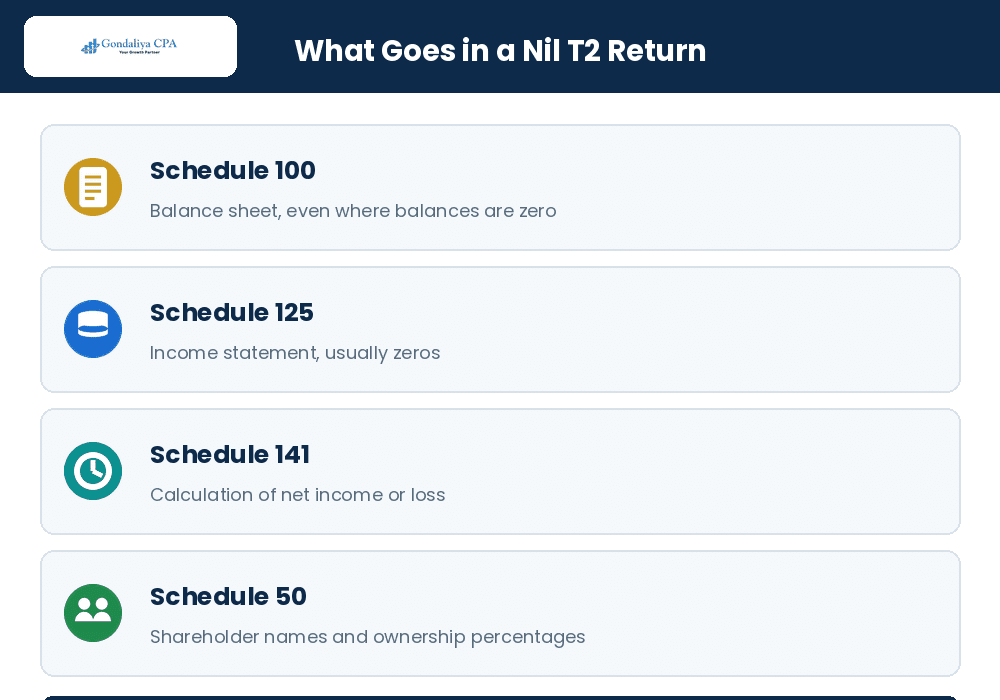
The main schedules you need for a dormant corporation’s T2 return are:
| Schedule | Purpose | Notes |
|---|---|---|
| Schedule 100 | Balance Sheet | List all accounts even if balances are zero |
| Schedule 125 | Income Statement | Usually shows zero revenue and expenses |
| Schedule 141 | Calculation of Net Income(Loss) | Summarizes net income or loss; mostly zeros for dormant |
| Schedule 50 | Shareholder Information | Includes names and ownership percentages |
Fill these carefully to avoid triggering any unnecessary reviews from CRA.
A nil return was filed with Schedule 50 carried forward unchanged after a share transfer two years earlier. The shareholder information no longer matched reality, which is exactly the mismatch a review looks for. Figures changed for privacy.
Using Certified Tax Preparation Software and Electronic Filing Options
Starting in 2026, Canada requires all T2 returns to be filed electronically. That includes returns from dormant corporations too. If you don’t file electronically, the CRA will charge a $1,000 penalty per late return.
Certified tax software approved by CRA makes filing simpler and helps reduce mistakes. These programs auto-fill GIFI codes on each schedule based on your input.
Filing electronically also means faster processing and instant confirmation once you submit your return.
Step-by-Step Process for Filing a T2 Return Electronically with CRA Auto-fill and Internet Filing
- Check Eligibility: See if your corporation qualifies for the T2 Short Return option. This is allowed if your gross revenues stay below $250K yearly.
- Gather Your Data: Collect financial statements made using GIFI-compliant software and shareholder info for Schedule 50.
- Use Certified Software: Enter your info into authorized tax software that connects directly with CRA.
- Try Auto-fill: If you filed before or are in areas like Toronto/Ontario served by Gondaliya CPA Professional Corporation (“Gondaliya CPA”), auto-fill can bring in prior-year data from CRA securely.
- Review & Submit: Double-check everything then submit online through secure channels inside your software.
- Save Confirmation: Keep the receipt after submission as proof in case of future questions or penalties.
Filing online with auto-fill cuts down errors while meeting Canada’s strict deadlines for dormant corporations.[3][4]
Alternatives to Electronic Filing: Paper Returns and Limited Cases
Paper filing still exists but only in rare cases starting 2026 because e-filing is mandatory nationwide.
You might be allowed paper submissions if:
- You can’t access electronic services due to unusual circumstances.
- You get special permission from CRA agents after a formal request.
Keep in mind:
- Paper returns take longer for CRA to process.
- Late penalties apply even if you send paper forms.
- Non-compliance with mandatory e-filing rules means extra $1,000 fines.
Most small businesses running dormant in places like Toronto or Mississauga find it easier to work with experts like Gondaliya CPA who know digital filing well — avoiding costly delays that come with paper forms.[5]
References
- CRA – General Index of Financial Information (GIFI) Accessed June 2026
- CRA – Mandatory E-Filing Penalty Accessed June 2026
- CRA – About the T2 Short Return Accessed June 2026
- CRA – Internet File Transfer System Accessed June 2026
- CRA – Exceptions To Mandatory E-Filing Accessed June 2026
A dormant corporation was paper-filed out of habit in the first year the electronic rule applied. The return itself was correct and on time; the filing method alone created the penalty. Figures changed for privacy.
Managing Compliance Risks and Penalties Related to Dormant Corporation Filings
Managing Compliance Risks and Penalties Related to Dormant Corporation Filings
The Risks
Even if a corporation is dormant, it still needs to follow CRA rules in Canada. Every resident corporation must file a T2 corporate tax return every year. This applies even if the company didn’t do any business during that time. Skipping this filing can lead to penalties and interest charges that pile up fast.
The biggest risk comes from missing the T2 filing deadline. Corporations must submit accurate nil returns when there’s no income or expenses. Messing up these filings can trigger CRA audits or cause reassessments.
Many companies forget they still have duties while dormant. They need to keep records up-to-date and update shareholder info on Schedule 50. Ignoring these rules can hurt things like loss carryforwards or capital dividend accounts needed later.
Good corporate tax filing Canada habits mean filing on time with the right forms, such as GIFI (Schedules 100, 125, 141). Hiring a tax expert who knows inactive corporation T2 returns helps reduce mistakes and makes compliance easier.
Penalties Specific to Non-Compliance with Mandatory Electronic Filing
Starting in 2026, all Canadian corporations—including dormant ones—must file their T2 returns electronically. CRA does not accept paper returns except in rare cases.
If an inactive corporation misses e-filing by the deadline, it faces a penalty called the mandatory electronic filing penalty. This fine begins at $250 per month and can reach $3,000 per year until fixed.
This rule adds another level of risk beyond normal late-filing penalties for dormant corporation tax filing Canada tasks. Using certified software or professional help makes electronic filing smoother for inactive companies.
Consequences of False Statements, Omissions, and Misrepresentations
Giving false info or leaving stuff out on a dormant company’s T2 return is serious. It breaks CRA rules and can cause big trouble for directors and officers.
CRA watches for mismatches between what companies report and outside data sources like GST/HST filings. Even small mistakes might bring reassessments with penalties based on how much tax was understated.
Directors need to be sure shareholder info (Schedule 50), financial summaries (GIFI), and loss details (Schedule 4) are correct each year. The nil balances reported should honestly show no activity during the fiscal period.
A corporation filed nil T2 returns while its GST/HST account continued reporting small taxable sales. The two filings contradicted each other, and the mismatch, not the amounts, is what prompted the review. Figures changed for privacy.
Director Liability and Administrative Dissolution Risks for Non-Filing Corporations
Not filing on time affects more than just fines. Directors may face personal liability if they ignore annual federal or provincial requirements.
CRA sends demand-to-file notices when companies don’t comply. After that, late-filing penalties start at $100 daily on top of monthly fees.
Provincial registries might also dissolve corporations that skip annual returns alongside federal filings on time. Dissolution ends the company’s legal status but doesn’t erase debts directors owe from non-compliance times.
People holding shelf companies or paused startups should consider these risks carefully before deciding to catch up with filings or close down properly.
| Risk Area | Impact | Prevention |
|---|---|---|
| Demand-to-file penalty | Daily increasing fines | Submit returns on time using e-file |
| Repeated failure penalty | Additional percentage fines | Work with CPA firm tracking dates |
| Administrative dissolution | Loss of legal status | File all annual returns promptly |
| Director personal liability | Possible financial responsibility | Keep accurate records & disclosures |
A provincial registry dissolved a corporation for missed annual returns while the owner was overseas. Reviving it and bringing the federal filings current took weeks, and the debts from the non-filing period stayed exactly where they were. Figures changed for privacy.
Options for Penalty Relief Through the Voluntary Disclosures Program
Corporations facing penalties from missed dormant corporation tax filing Canada duties can ask CRA for help through the Voluntary Disclosures Program (VDP).
VDP lets companies fix past mistakes before CRA starts enforcement actions without facing usual penalties—if they qualify:
- Disclosure must be voluntary (not triggered by audit)
- Full honest facts need to be shared
- Payment is made promptly once terms agree
Making a voluntary disclosure request can cut down late-filing fees and interest charges. It also helps avoid repeat failure penalties and brings back lost benefits like non-capital loss carryforwards used for future profits.
Hiring skilled pros speeds up preparing VDP applications tailored to inactive corporations. This helps avoid delays caused by incomplete paperwork asked by CRA agents.
An owner came forward with five unfiled years before any CRA contact, and the disclosure was accepted. A client in the same position who waited until a demand letter arrived had no voluntary route left. Figures changed for privacy.
Additional Corporate Tax Considerations for Dormant and Inactive Entities
Additional Corporate Tax Considerations for Dormant and Inactive Entities
The Details
When you have a dormant corporation in Canada, you still need to handle tax filings carefully. Filing an inactive corporation T2 return is not just about submitting papers. You also need to manage your GST/HST accounts, keep records, and think about what happens if you dissolve or revive the corporation. Plus, there are special rules for loss carryforwards and capital dividend accounts. Different industries also have their own needs. Staying on top of these details helps you follow corporate tax filing rules in Canada without surprises.
GST/HST Account Closure Procedures for Dormant Corporations
If your corporation is dormant but still has an active GST/HST account, you must file nil returns regularly. This means submitting returns that show no sales or tax collected. The CRA requires this even if your business isn’t making money right now.
Here’s what you should know:
- File nil returns on time to avoid penalties.
- If you don’t expect sales for a long time, ask the CRA to close your GST/HST account.
- To close the account, submit Form RC145 after settling all liabilities.
- Keeping an active GST/HST account without sales can cause problems if returns are missed.
Closing your GST/HST account when it’s no longer needed makes things simpler and reduces risks under dormant corporation tax filing Canada rules.
A dormant corporation kept its GST/HST account open for three years with no sales and no returns filed. Closing it took one form; the outstanding nil GST/HST returns had to be brought current first. Figures changed for privacy.
Record Retention Requirements and Keeping Financial Documentation for CRA
Even if your corporation doesn’t do any business, you must keep all financial records for six years after the last tax year they cover. This includes documents supporting your T2 corporate tax return filings.
Here’s why it matters:
- The CRA may ask to see your records during audits or if they send demand-to-file notices.
- You must organize and store these records safely but make sure they’re easy to access.
- Failing to keep proper documents can lead to penalties and more trouble with late filings.
Good record retention protects you from extra costs and helps maintain compliance while your corporation stays inactive.
Handling Corporate Dissolution and Revival from a Tax Compliance Perspective
Dissolving a dormant corporation stops its federal tax filing duties but involves steps with both the CRA and provincial registries like Ontario’s Ministry of Government Services.
Some points to keep in mind:
- Registry dissolution happens when annual returns aren’t filed; however, federal T2 filing duties stay until official confirmation.
- Reviving a dissolved company means catching up on missed T2 returns and possibly applying for penalty relief.
- Deciding whether to keep a company dormant or dissolve it depends on several factors:
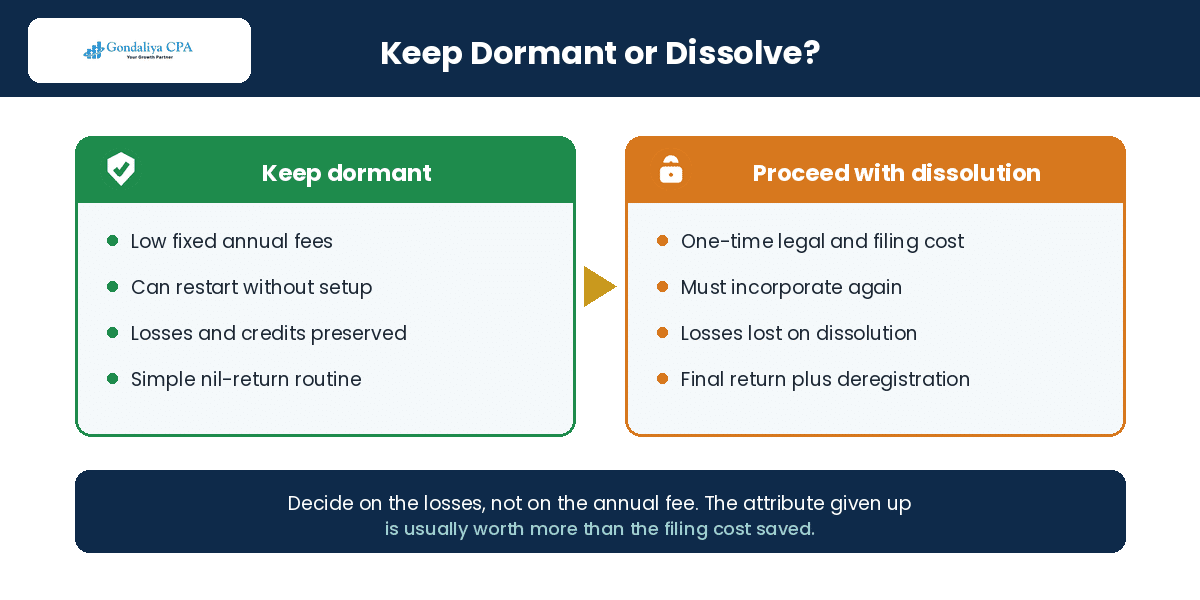
| Decision Factor | Keep Dormant | Proceed With Dissolution |
|---|---|---|
| Annual maintenance cost | Low fixed fees | One-time legal/filing expenses |
| Future use | Can restart easily without setup | Must incorporate again |
| Losses & credits preservation | Keep through continuous status | Lose upon dissolution |
| Compliance complexity | Simple nil-return routine | Final return plus deregistration |
Think carefully before choosing so you don’t lose benefits like loss carryforwards by dissolving too soon.
An owner nearly dissolved a corporation holding several years of non-capital losses to save the annual filing cost. Keeping it dormant preserved the losses for a business the owner restarted two years later. Figures changed for privacy.
Treatment of Non-Capital Loss Carryforwards and Capital Dividend Accounts
Non-capital losses can carry forward up to 20 years after they occur—if you file your T2 corporate tax returns every year, even if nil.
Watch out for these issues:
- Missing those annual filings causes loss carryforwards to expire just because of non-compliance.
- Capital dividend accounts (CDA) require yearly reporting too. Without it, you risk losing CDA balances permanently.
Filing consistent nil T2 returns protects these financial assets during periods when your company is inactive or dormant.
Industry-Specific Considerations Including Professional Corporations and Holding Companies
Dormant corporation filing rules differ across industries we work with at Gondaliya CPA. Here are examples:
- Medical Doctors & Physician Professional Corporations: May pause operations; must file nil T2s while OHIP billing is suspended.
- Dentists & Dental Practices: Need strict compliance even during breaks due to RCDSO regulations.
- Daycare & Childcare Providers: Face extra reports because of programs like CWELCC despite temporary closures.
- Real Estate Investors & Holding Companies: Often hold assets quietly; tracking losses is key amid rental changes.
- Property Developers & Builders: Have seasonal project gaps requiring careful accounting of inactive times.
- Construction Contractors & Skilled Trades: Downtime between projects means filing zero-revenue submissions properly.
- Technology Startups & SaaS Firms: Pauses still require electronic e-filing as per 2026 CRA rules.
- E-commerce Retailers: Must distinguish clearly between active business and dormancy during inventory changes.
- Restaurants/Food Service Operators: Temporary shutdowns make correct status classification important post-pandemic.
- Transportation/Logistics Owner-Ops: Layoffs cause short-term inactivity needing specialized bookkeeping attention.
Each sector faces unique tax challenges tied to inactivity or dormancy. Following proper CRA requirements helps balance compliance with strategic business decisions about keeping or closing incorporated entities.
For questions about dormant corporation tax filing Canada or preparing an inactive corporation T2 return, contact our Toronto office at info@gondaliyacpa.ca or call 647‑212‑9559 for advice tailored to your situation.
Pro Tip: Decide deliberately between keeping the corporation dormant and dissolving it, and make the decision on the losses rather than on the annual fee. Please price both routes before choosing, because the fee saved by dissolving is usually smaller than the tax attribute given up.
How Gondaliya CPA Supports Dormant Corporation Tax Filing and Compliance
How Gondaliya CPA Supports Dormant Corporation Tax Filing and Compliance
Our Work
Gondaliya CPA helps with dormant corporation tax filing Canada. We make sure inactive corporations follow all CRA rules on time. Our team prepares inactive corporation T2 return forms and offers full corporate tax filing Canada services for companies with no income or business activity.
Customized T2 Filing Services for Dormant and Inactive Corporations
Filing an inactive corporation T2 return takes care and attention. We create custom dormant corporation tax filing Canada plans that fit your company’s inactivity. This means making nil returns and filling out forms like Schedule 100 (Balance Sheet) and Schedule 125 (Income Statement). We check your company’s dormancy according to CRA rules.
Our service matches your company type, whether it’s a holding company or a startup on pause. We keep things simple so your filing shows zero business activity without confusion. This lowers mistakes that could cause the CRA to send demand-to-file notices or late-filing penalties.
Benefits of Professional Assistance for Electronic Filing and GIFI Preparation
The CRA requires electronic filing for all T2 corporate tax returns, even if the company is dormant[1]. Missing this rule can lead to mandatory electronic filing penalty fees. Gondaliya CPA files your T2 corporate tax return electronically through trusted systems, so you avoid these charges.
We also handle the General Index of Financial Information (GIFI) forms. These show detailed financial data, even when the return shows no activity[2]. Correct GIFI reports help if the CRA audits your file later. Our team makes sure you follow all rules without extra stress.
Flat Fee Pricing and Service Options Tailored to Small Business Needs
Corporate tax filing Canada fees depend on how complex your case is. But we offer clear flat-fee pricing designed for small businesses with dormant corporations[3]. Here’s what our flat fee covers:
- Nil Return Preparation — including usual schedules
- Electronic Filing — required by law since 2026
- Loss Carryforward Tracking — optional, extra cost if needed
- GST/HST Account Review — optional service
This pricing stops surprise bills that come with hourly rates. It fits incorporated small businesses in Ontario areas like Toronto, Mississauga, Vaughan, Brampton, Scarborough, Ottawa, Hamilton, North York, Windsor—and beyond.
Expert Guidance on Closing Business Accounts and Avoiding Penalties
Many dormant companies keep GST/HST accounts open long after they stop working[4]. Gondaliya CPA guides you on how to close these accounts properly. This avoids more paperwork or sudden audits.
We also help prevent demand-to-file penalties when the CRA asks for missing returns[5]. Late-filing penalties pile up every month until you fix things. Our team acts fast to send filings on time and check documents carefully.
We watch payroll accounts too. Closing them quickly stops extra problems during dormancy periods. These steps keep directors safe from personal liability tied to breaking Canadian tax laws.
A corporation went dormant but left its payroll account open, so nil remittance obligations kept running against an account with no employees. Closing the account removed a recurring source of notices. Figures changed for privacy.
Steps to Get Started with Gondaliya CPA for Your Corporate Tax Filing Needs
- Talk With Us: Chat by phone or email about your company status.
- Send Documents: Give us last year-end dates, past T2 returns (if any), shareholder info (Schedule 50), bank statements showing no transactions.
- Check Records: We review federal/provincial registries and active business numbers.
- Confirm Dormancy: Verify nil filings eligibility based on zero income or activity proof.
- Prepare T2 Return: Fill all forms including GIFI electronically.
- E-File & Confirm: Submit using certified software; then send you confirmation papers.
- Support & Reminders: Annual follow-ups plus advice if you want to restart or close the business fully.
Call us at 647-212-9559 or email info@gondaliyacpa.ca for a free talk about making inactive corporation T2 return filing easy in Toronto/Ontario areas.
A client sent bank statements showing a single monthly account fee and nothing else. That one line was the evidence that supported dormancy, and it made the nil filing straightforward to prepare and defend. Figures changed for privacy.
FAQs on Dormant Corporation Tax Filing and Compliance
FAQs on Dormant Corporation Tax Filing and Compliance
FAQ
What is the difference between a Nil T2 Return and a T2 Short Return?+
A Nil T2 Return reports zero income and expenses for dormant corporations. A T2 Short Return is a simplified form for small inactive corporations with revenues under $250K.
Who is Sharad Gondaliya and how does he help Canadian businesses?+
Sharad Gondaliya, CPA (Canada & USA), assists hundreds of Canadian business owners in Ontario and Toronto. He offers expert guidance on dormant corporation tax filing and compliance.
What are the consequences of the Repeated-Failure Penalty and Demand to File Penalty?+
Repeated-Failure Penalties add 10% plus monthly fees for repeated late filings within three years. Demand to File Penalties are daily fines increasing until returns are filed.
How does Directors Liability Exposure affect dormant corporations?+
Directors may face personal financial risks if annual returns or T2 filings are missed, especially with demand-to-file notices from CRA.
What is the role of Provincial Annual Returns in maintaining corporate compliance?+
Provincial Annual Returns maintain legal status with registries. Missing them can cause Registry Dissolution even if federal filings continue.
How can a Voluntary Disclosure Request reduce penalties for missed filings?+
The Voluntary Disclosure Program lets corporations correct past errors without penalties if disclosures are voluntary, complete, and timely.
Do Non-Resident Dormant Corporations have filing obligations in Canada?+
Yes. Non-resident dormant corporations must file T2 returns if they have Canadian ties unless treaty exemptions apply.
What happens during Registry Dissolution for non-filing corporations?+
Registry Dissolution ends a corporation’s legal status at provincial level but does not erase federal tax obligations or director liabilities.
What is the typical cost range for T2 filing services with Gondaliya CPA?+
T2 filing costs vary by complexity. Gondaliya CPA offers flat-fee pricing tailored for small businesses with dormant or inactive corporations.
How do Shelf Corporations impact dormant corporation compliance?+
Shelf corporations may have missed filings or liabilities from prior owners. Proper catch-up filing is essential to avoid penalties.
Can Wound-Down Operating Companies avoid annual tax filings?+
No. Even wound-down companies must file nil T2 returns until officially dissolved federally and provincially.
Are Paused Startups required to file corporate tax returns annually?+
Yes. Paused startups must submit nil returns yearly to maintain CRA compliance and protect tax attributes like loss carryforwards.
Key Compliance Points for Dormant Corporations in Canada
Key Compliance Points for Dormant Corporations in Canada
Quick Reference
- Annual Corporate Return: File both federal T2 and provincial annual returns on time to avoid dissolution risks.
- Director Obligations: Directors must ensure all filings are completed to prevent personal liability exposure.
- Non-Capital Loss Carryforward Expiry Period: File annually to preserve loss carryforwards up to 20 years.
- Corporate Tax Filing 2026: Mandatory electronic filing starts this year; missing it triggers $1,000 penalties per return.
- Late Filing Interest Charges: CRA charges interest on outstanding taxes plus late-filing penalties even on nil returns if late.
- Demand-to-File Notices: Ignoring these increases fines and may lead to legal actions or forced company dissolution.
- T2 Filing Cost: Compare DIY, CPA, and non-CPA providers; professional help reduces errors and penalty risks.
- Dormant Corporation Compliance Affordability: Flat fees from firms like Gondaliya CPA make compliance cost-effective for small businesses.
- Catch-Up Years of Unfiled T2 Returns: Address past missing filings promptly through voluntary disclosure to reduce penalties.
- DIY vs CPA vs Non-CPA Provider Comparison: CPAs offer expertise in electronic filing, GIFI preparation, and penalty relief options.
- Best Ways to Keep Dormant Corporation Compliant: Timely nil returns, updating shareholder info, closing unused GST/HST accounts.
- How to Choose the Right CPA Firm in Toronto/Ontario: Look for experience with dormant companies, transparent fees, local knowledge.
For personalized support with your inactive corporation’s tax filing needs, contact Gondaliya CPA at info@gondaliyacpa.ca or call 647‑212‑9559 today.
A client with six unfiled years asked which to file first. Filing from the oldest year forward preserved the loss continuity, where filing the newest year first would have left every earlier balance unsupported. Figures changed for privacy.
Industry Spotlights: Sectors We Represent
Industry Expertise
Dormancy looks different in each sector, and so does the filing that comes with it. Here are ten sectors and the version we see in each.
| Industry | The Dormancy Angle |
|---|---|
| Medical doctors & physician professional corporations | Nil T2s while billing is paused |
| Dentists & dental practices | Regulator conditions continue through a break |
| Daycare, childcare & CWELCC services | Programme reporting continues through closures |
| Real estate investors, landlords & holding companies | Quiet asset holding with losses to protect |
| Property developers & builders | Project entities idle between developments |
| Construction, contractors & skilled trades | Zero-revenue years between contracts |
| Technology startups & SaaS | Paused ventures still filing electronically |
| E-commerce & online retailers | Active or dormant, decided by inventory movement |
| Restaurants & food and beverage | Temporary closures needing correct classification |
| Transportation, logistics & trucking | Short-term inactivity between hauling seasons |
| Consulting firms | Incorporated consultants pausing between engagements |
- Medical doctors & physician professional corporations: A professional corporation that pauses still files, and the nil years are the ones most often forgotten because nothing else in the year prompts a reminder.
- Dentists & dental practices: Regulator obligations do not pause with the practice, so the corporate filings and the certificate conditions both continue through a break.
- Daycare, childcare & CWELCC services: Funded programme reporting can continue even where the centre is closed, so dormancy for tax purposes is not the same as dormancy in practice.
- Real estate investors, landlords & holding companies: Holding companies are the classic dormant filer, and the losses and capital dividend account balances inside them are exactly what the annual return protects.
- Property developers & builders: Project entities sit idle between developments for years, and each one carries its own filing obligation until it is formally dissolved.
- Construction, general contractors & skilled trades: A zero-revenue year between contracts is still a filing year, and the return has to say so properly rather than being skipped.
- Technology startups & SaaS: A paused venture usually holds the losses a founder will want later, which makes the nil filing the cheapest insurance on the balance sheet.
- E-commerce & online retailers: Whether a year counts as dormant turns on whether inventory moved, so the classification has to be settled before the return is prepared.
- Restaurants & food and beverage: A temporary closure is not automatically dormancy, and getting the status right decides which return and which accounts stay open.
- Transportation, logistics & trucking: Owner-operators often pause for a season, and the corporation keeps filing while the truck sits.
- Consulting Firms: Incorporated consultants between engagements are the most common dormant filer we see, and a compliance calendar is what keeps the years from stacking up.
A developer client held four project corporations, three of them idle for years with no filings. Bringing all three current together cost less than the penalties that had already accumulated on one of them. Figures changed for privacy.
Professional Guidance and Quick Reference
Guidance
Professional Guidance in Dormant Corporation Filing: How Gondaliya CPA Supports Canadian Owners
Dormant corporation filing can get technical quickly. You need to know whether the corporation is genuinely dormant, which schedules a nil return still requires, whether the short return applies, and which other accounts have to be closed or kept nil. Gondaliya CPA provides corporate filing services built for inactive corporations, and we focus on owners holding companies that are quiet rather than closed.
We help with the work that decides the outcome: confirming dormancy, preparing the nil return with its GIFI schedules, filing electronically, keeping the shareholder information current, protecting loss carryforwards and capital dividend account balances, and dealing with GST/HST and payroll accounts that should be closed.
Our team follows CRA practice closely and builds the plan around your own facts rather than a template. Whether you are one year behind or several, whether you intend to restart the business or wind it up, we give clear advice based on the current rules, including the electronic filing requirement that applies from 2026.
Quick Answers: Key Numbers & Concepts at a Glance
At a Glance
- T2 filing deadline: Six months after the fiscal year-end
- Balance-due day: Two months after year-end, three for an eligible CCPC
- Late-filing penalty: 5% plus 1% per month, even on a nil return
- Repeated-failure penalty: Additional 10% plus monthly add-ons
- Mandatory electronic filing penalty: $1,000 per late return
- Non-capital loss carryforward: Up to 20 years, if you keep filing
- Record retention: Six years after the last tax year covered
- T2 Short Return: Assets under $1 million and gross revenues below $250K
- GST/HST closure: Form RC145, after settling all liabilities
- Key schedules: 100 balance sheet, 125 income statement, 141 net income, 50 shareholders
Who This Is For / Not For
Fit Check
- For: Owners of dormant or inactive Canadian corporations, holders of shelf companies, paused startups, wound-down operating companies, and anyone with unfiled nil years to bring current.
- Not For: Corporations already formally dissolved federally and provincially with all final filings complete, and unincorporated sole proprietors, whose reporting sits on a personal return rather than a T2.
People Also Ask
Quick Answers
Does a corporation with no bank account still file a T2?+
Yes. The filing obligation attaches to the corporation’s existence rather than to whether it holds an account or moved any money. A nil return is still required until the corporation is formally dissolved.
Is it cheaper to dissolve a dormant corporation than to keep filing?+
Sometimes, but rarely once the losses are counted. Dissolution costs less each year but gives up loss carryforwards and any capital dividend account balance, and reincorporating later means starting from nothing.
What happens if a dormant corporation has been unfiled for years?+
The years are brought current, usually from the oldest forward so the balances carry through. Where the CRA has not yet made contact, the Voluntary Disclosures Program may reduce or cancel the penalties.
Glossary of Key Terms
Plain-English Definitions
- Dormant corporation: A corporation that does no business and earns no income during the year.
- Inactive corporation: A corporation with small activities but hardly any income.
- Nil T2 return: A corporate return reporting zero income and zero expenses.
- T2 Short Return: The simplified return available to small, eligible corporations.
- GIFI: The General Index of Financial Information, the CRA’s standardized financial data format.
- Schedule 100: The balance sheet schedule, completed even where balances are zero.
- Schedule 125: The income statement schedule, usually zeros for a dormant corporation.
- Schedule 141: The calculation of net income or loss.
- Schedule 50: The shareholder information schedule, with names and ownership percentages.
- Balance-due day: The date the final tax payment is due, before the filing deadline.
- Demand-to-file notice: The CRA letter requiring an outstanding return, after which penalties escalate.
- Mandatory electronic filing penalty: The penalty for filing on paper where electronic filing is required.
- Non-capital loss carryforward: A loss carried forward up to 20 years against future income.
- Capital dividend account: The account tracking tax-free amounts payable to shareholders as capital dividends.
- Registry dissolution: The provincial cancellation of a corporation for missed annual returns.
- Voluntary Disclosures Program: The CRA programme allowing corrections before enforcement begins.
Dormant Corporation Filing Check
This quick self-check flags what your dormant corporation is likely to need. Please answer the six questions below.
Dormant Corporation Filing Check
Six quick questions on your inactive corporation. No fee shown.
Items to address:
This is a general prompt, not tax or legal advice or a quote. Your position depends on your full facts. For a real review, please book a free consultation.
Want a checklist to work from? You can download our free dormant corporation filing checklist before your consultation.
File the nil return every year, on time, electronically, with the GIFI schedules and current shareholder information, and close the accounts you no longer need. Those five habits cost very little each year and protect losses, the capital dividend account, and the directors personally.
2026 Update — what is current: Electronic filing is required for T2 returns, including nil returns from dormant corporations. The six-month filing deadline and the two-month balance-due day are unchanged, three months for an eligible CCPC. Non-capital losses still carry forward up to 20 years where the returns are filed, and records must be kept six years after the last tax year covered.
Dormant Corporation Tax Filing Canada: Inactive Corporation T2 Return, CRA Requirements, and Corporate Tax Compliance with Gondaliya CPA
Corporation sitting idle? We keep it filed, compliant, and worth restarting
Gondaliya CPA confirms dormancy, prepares the nil T2 with its GIFI schedules, files electronically, closes the accounts you no longer need, and brings unfiled years current, on flat-fee pricing with a one-business-day response. Please book a free consultation.
Next Steps
A dormant corporation costs almost nothing to keep compliant and a great deal to neglect. Please contact us at 647-212-9559 or info@gondaliyacpa.ca, gather your last year-end date and any prior returns, and let us confirm what is outstanding before a demand-to-file notice decides the timing for you. If our content helps, please add gondaliyacpa.ca as a preferred source on Google.
Published: July 30, 2026 · Last updated: July 30, 2026
Editorial policy: We research against CRA and Ontario sources, fact-check the figures, and Sharad Gondaliya, CPA, reviews the content, which we update as the rules change.
Disclaimer: This article is educational information only and is not tax, legal, or financial advice. It reflects CRA rules current to 2026, including the six-month T2 filing deadline, the two-month balance-due day with three months for an eligible CCPC, the late-filing penalty of 5% plus 1% per month, the repeated-failure penalty, the mandatory electronic filing requirement, the 20-year non-capital loss carryforward, and the six-year record retention requirement. Penalty and dissolution rules change and differ by province, and outcomes depend on your specific facts. Please consult a Registered CPA before acting.

Sharad Gondaliya is a CPA Canada & CPA USA with 15 Years+ experience of Accounting, Tax, Payroll of Corporate Small Businesses as Tax Accountant. He is fully certified CPA Ontario and CPA USA and is well known among corporate small businesses for tax planning, efficient tax solutions, and affordable CPA services. Sharad is the Principal (Director) of Gondaliya CPA – Affordable CPA Firm in Canada. Licenses: CPA Ontario: 61040184 | CPA USA (MT): PAC-CPAP-LIC-033176 | CPA USA (WA): 57629 | CPA Firm License: 61330051 View Full Author Bio