



Preventing CRA Audit Risk With Proper Bookkeeping and Past Account Cleanup Services by Gondaliya CPA
Quick Summary
Understanding how bookkeeping affects CRA audit risk matters a lot for business owners. Poor bookkeeping often leads to tax problems. These problems can make a CRA audit more likely. Doing past account cleanup helps fix mistakes before they cause bigger issues.
| Aspect | Details |
|---|---|
| What It Is | Past account cleanup means checking old financial records carefully to fix mistakes and follow tax rules. |
| Why It’s Important | Good bookkeeping lowers audit risk by keeping records accurate. This stops discrepancies that attract CRA attention. |
| Who It’s For | Business owners with poor bookkeeping or those expecting an audit will find past account cleanup helpful. |
| Who It’s Not For | Businesses with clean records might not need it now but should still check their books regularly to stay compliant. |
Table of Contents
- What Is Past Account Cleanup?
- How Poor Bookkeeping Increases CRA Audit Risk
- Common Bookkeeping Mistakes That Trigger CRA Reviews
- GST/HST, Payroll, and Tax Filing Errors
- Warning Signs Your Records Need Cleanup
- DIY vs CPA vs Non-CPA Approaches to Cleanup
- Past Account Cleanup Process
- How Cleanup Helps Reduce Audit Risk
- Financial Reconciliation and Record Corrections
- Pricing Factors for Past Account Cleanup
- Risks & CRA Compliance
- Past Account Cleanup Checklist
- Audit Risks by Industry: Specific Concerns
- How to Choose a CPA for Past Account Cleanup
- Why Trust Gondaliya CPA for Your Cleanup Needs
- FAQs on CRA Audit Risk & Tax Compliance
Key Audit-Risk Numbers
What Is Past Account Cleanup?
Fix Old Records Before Audit
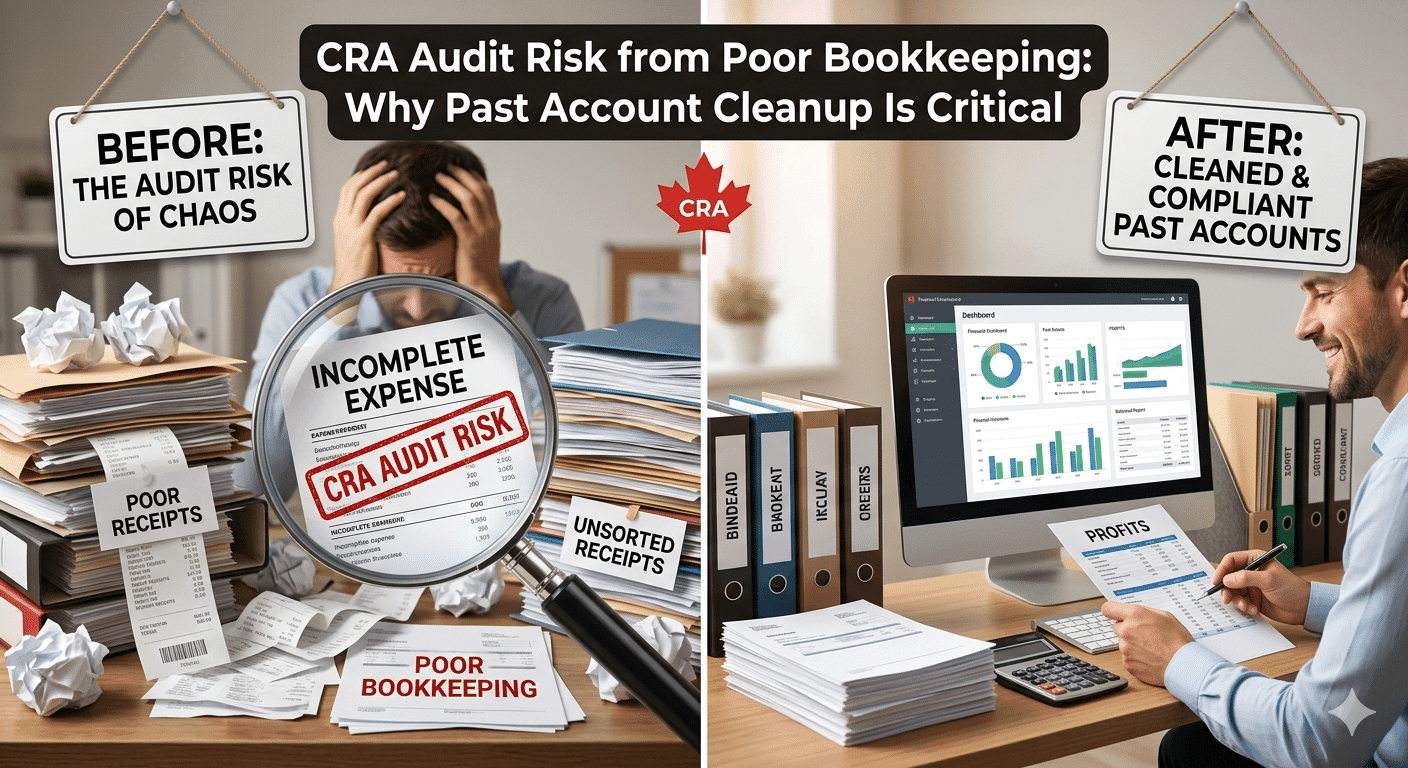
Past account cleanup means going back through old financial records to find and fix bookkeeping errors. This step helps businesses stay on top of tax compliance, especially if the CRA might audit them soon.
The main goals are:
- Make sure financial data shows the true business activities.
- Fix errors so the business is ready if an audit happens.
Some common fixes include:
- Missing transactions
- Wrong expense entries
- Mistakes in GST/HST calculations
- Payroll problems
- Other bookkeeping errors that hurt tax filings
This process helps keep your records solid and ready for any tax checks.
How Poor Bookkeeping Increases CRA Audit Risk
Spot The Audit Red Flags
Poor bookkeeping raises the chances of a CRA audit because it creates lots of red flags, like:
- Inconsistent records: When reports don’t match bank statements, auditors notice.
- Missing transactions: Leaving out income or expenses can make profits look off, which looks suspicious.
- GST/HST mistakes: Wrong sales tax numbers can cause penalties if found.
- Payroll errors: Wrong employee pay info can lead to questions about taxes and labor laws.
These errors invite closer looks from auditors. They want to find where numbers don’t add up. Knowing this helps businesses avoid trouble by keeping books accurate and cleaning up past accounts on time. That way, finances stay clear and honest, lowering the chance of audits.
Common Bookkeeping Mistakes That Trigger CRA Reviews
Common Errors To Catch
Poor bookkeeping raises your CRA audit risk. When records are incomplete or wrong, the CRA might want to take a closer look. Knowing common bookkeeping errors can help you avoid big problems and stay on the right side of tax rules.
Missing Transactions and Their Impact: Missing transactions cause many problems in your books. When you don’t record income or expenses, gaps appear that the CRA notices quickly. Unrecorded income is a big risk. It changes reported revenue and tax amounts. Even small slips can start an audit if your bank deposits, sales, and taxes don’t match. If you miss transactions, it’s hard to track expenses well or balance your accounts. This makes tax reporting tricky and ups your chance of being reviewed.
To lower this risk:
- Check bank statements against your books often.
- Use good software to track transactions automatically.
- Look over daily sales records carefully.
Skipping missing transactions puts you in hot water with the CRA. You could face fines or reassessments if an audit finds problems.
Expense Tracking Errors and Documentation Gaps: Mistakes in tracking expenses happen a lot. People mix up categories, enter duplicates, or forget receipts. These errors make deductions less reliable on tax returns. Incorrect expense categorization—like mixing personal and business costs—can get claims denied during a review. Not having proper receipts or invoices also hurts your case. Missing documents make it unclear if expenses are real business costs. The CRA wants proof for every claim. Without it, you’ll get extra attention.
Common trouble spots include:
- Putting non-deductible items as business expenses
- Forgetting petty cash spending
- Losing digital copies of bills
Keep tidy files with clear notes to show the CRA your records are solid.
GST/HST, Payroll, and Tax Filing Errors
GST/HST, Payroll & Filing
Mistakes with GST/HST reporting, payroll work, and filing taxes often cause CRA reviews. These need careful math and timely paperwork based on rules.
GST/HST Reporting Inaccuracies: GST/HST errors happen when input credits or collected taxes are wrong or remittances come late. The CRA’s systems catch these mismatches fast.
Typical problems include:
- Claiming too many input tax credits without proof
- Paying GST/HST late
- Wrongly using exemptions or zero-rated supplies
These errors affect what you owe and raise flags with the government.
To stay clean:
- Keep detailed purchase invoices showing eligible taxes.
- File returns on time using approved software.
- Check with your CPA or the CRA for tricky cases.
Payroll Discrepancies and Compliance: Payroll mistakes cause headaches during audits because they’re complex. Employee pay needs careful reporting on forms like T4 slips.
Common payroll errors include:
- Reporting wages too low
- Leaving out taxable benefits
- Making T4 slips with wrong info
These slip-ups can lead to fines under employment laws and bring more CRA scrutiny. Avoid problems by regularly matching payroll records to pay stubs.
Tax Filing Corrections and Their Importance: You need to fix tax filings when there are mistakes—like missed deductions or wrong incomes—that change what you owe. Fixing filings early cuts penalties and shows the CRA you’re cooperating. It also lowers future chances of audits from lingering errors. Make amendments carefully with help from a CPA who knows Canadian small business tax laws. Bad bookkeeping raises your chances of a CRA review through messy records in these areas: missing data entries; bad expense tracking; wrong GST/HST handling; payroll slip-ups; plus missed chances to correct past filings. Fixing these helps cut audit risk and keeps you playing by the rules.
Warning Signs Your Records Need Cleanup
Know The Warning Signs
If your bookkeeping is poor and your financial records are a mess, you raise your CRA audit risk a lot. It pays to catch warning signs early to avoid tax filing corrections or penalties. Look out for repeated bookkeeping mistakes, missed tax deadlines, penalty notices from the CRA, unreconciled bank or credit card statements, and disorganized records in general.
Frequent errors tracking expenses or GST/HST filings show your books need fixing. If your business misses tax deadlines or gets letters about late payments or mismatches, these are red flags calling for cleanup now. Unreconciled accounts happen when bank statements don’t match your records. These often hide missing transactions or payroll mistakes. Messy files make audit prep tough and increase chances of missed compliance problems.
Indicators of Unorganized or Non-Compliant Books: Poor bookkeeping shows itself in some common ways:
- Transactions recorded inconsistently
- Missing receipts or invoices
- Frequent fixes during month-end closing
- Errors in expense categories
- No regular account reconciliations
These bookkeeping errors make daily tasks harder and cause CRA to watch you more closely. Businesses with messy books look like they might be hiding income or wrongly claiming expenses. Keeping neat books helps you report finances right and get ready for audits smoothly.
Preparing for Potential CRA Audits: CRA audit triggers come from poor bookkeeping like unexplained differences between income reported and bank deposits. Claiming too much GST/HST without proof, payroll mix-ups, and strange expense claims also raise alarms. To prepare for an audit, you need clean records that back up what’s on your tax return. Cleaning up past accounts cuts audit risks by fixing errors before things get serious. Check your books often to spot gaps early. Fix them quickly rather than facing fines after the CRA starts checking.
DIY vs CPA vs Non-CPA Approaches to Cleanup
| Approach | Advantages | Limitations | Best For |
|---|---|---|---|
| DIY Cleanup | Cheaper; you control everything | Takes time; easy to miss errors | Small biz with simple finances |
| Non-CPA Bookkeeper | More professional; better accuracy | Less know-how on complex tax rules | Routine reconciliations & basic fixes |
| CPA-Led Cleanup | Expert knowledge; full compliance | Costs more upfront | Complex cases needing detailed fixes |
Which way you go depends on how big your biz is, how messy the books are, your budget, and how much risk you want from half-done cleanup.
Evaluating Options for Financial Record Correction: Tax compliance needs sharp error detection beyond usual bookkeeping chores. DIY may catch missing entries or wrong expense categories but can miss tricky issues like GST/HST mistakes or payroll errors under Canadian law. CPAs dig deeper and check everything against rules. A CPA-led cleanup makes sure your reports pass CRA checks without problems. This lowers future risks from bad accounting while making sure deductions are right and backed up properly.
Past Account Cleanup Process
Seven-Step Cleanup Workflow
- Initial Assessment: Look over docs for problems like unreconciled accounts or mixed-up entries.
- Data Gathering: Find missing receipts or invoices needed to prove transactions.
- Reconciliation: Match bank/credit card statements to ledger entries and fix unmatched stuff.
- Error Correction: Fix wrong postings including GST/HST claims and payroll based on verified info.
- Tax Filing Corrections: Change old tax returns if needed to reflect cleaned-up numbers.
- Documentation Preparation: Organize proof ready in case of an audit.
- Final Review by CPA: Confirm everything is fixed and follows CRA rules fully.
Following this plan improves record accuracy. It cuts penalty risk tied to sloppy bookkeeping and gets you ready if an audit pops up suddenly.
How Cleanup Helps Reduce Audit Risk
Lower Your Audit Risk
Poor bookkeeping raises CRA audit risk by leaving gaps and errors in your financial records. Past account cleanup fixes these mistakes. It helps improve tax compliance and cuts down the chances of getting audited. When you fix problems early, you can show clear and reliable info that meets CRA rules.
Strengthening Tax Compliance and Accuracy: Good bookkeeping is key for tax compliance. Missing transactions or wrong expense entries cause trouble. They may mean you report less income or claim too many deductions. That makes the CRA suspicious.
Past account cleanup helps by:
- Checking all financial entries against receipts or invoices.
- Making sure GST/HST filings match actual sales and purchases.
- Matching payroll records with wages reported and taxes paid.
This process cleans up your data. It lowers errors that trigger audits. Accurate books also make future tax filing easier and help you pay on time.
Proactive Measures for Audit Preparation: Don’t wait for a CRA audit notice—that can stress you out and give little time to fix stuff. Past account cleanup prepares your business before problems get worse.
By reviewing old accounts carefully, you spot weak spots early, such as:
- Fixing bookkeeping errors from past years.
- Updating incomplete or wrong tax info.
- Organizing papers to back up claims on returns.
Doing this shows you’re responsible if audited. It lowers your audit risk and gives peace of mind by making sure you comply better.
Financial Reconciliation and Record Corrections
Match Every Dollar
Bookkeeping errors happen when bank statements, invoices, receipts, payroll, and ledgers don’t match up. Comprehensive reconciliation finds these mismatches during past account cleanup.
The Role of Comprehensive Reconciliation: Financial reconciliation means comparing your books with outside records like bank statements or supplier bills. It finds problems such as:
- Transactions missing from the books.
- Duplicate entries inflating costs or income.
- Timing differences that affect which period gets reported.
Reconciliation makes sure every dollar is tracked correctly across all records. This step cuts bookkeeping errors that increase audit risk.
Correcting Discrepancies in Business Records: Poor bookkeeping causes conflicting numbers inside your business records. This hurts trust with managers and the CRA alike.
Past account cleanup deals with this by looking closely at issues like:
- Income not matching deposits received.
- Payroll amounts that differ from pay stubs or tax slips.
- GST/HST collected but not declared right on returns.
Fixing these means changing journal entries only when backed by proof — not guesses. This rebuilds trust in your financial statements and lines them up with regulations.
Pricing Factors for Past Account Cleanup
| Pricing Factor | Description |
|---|---|
| Volume of Transactions | More transactions take longer to check |
| Complexity of Records | Multiple error types (like GST/HST, payroll) make work harder |
| Period Covered | Longer periods mean more work |
| Quality of Existing Documentation | Messy files slow down the process |
| Level of Professional Expertise Required | CPAs might charge more due to their expertise |
Understanding Cost Determinants for Professional Services: Costs for past account cleanup change based on those factors above because each case is different. Records in bad shape take more time. Skilled CPAs can do a better job fixing things but usually cost more since they know how to lower CRA audit risk through proper compliance.
Risks & CRA Compliance
Penalties You Can Avoid
| Risk Category | Potential Consequences | Mitigation Through Cleanup |
|---|---|---|
| Inaccurate Bookkeeping | Higher chance of audits; penalties | Accurate reconciliation avoids triggers |
| Late/Missing Tax Filings | Fines and interest charges | Fixes keep filings current |
| Misclassified Expenses | Deductions denied | Proper sorting prevents disputes |
| Payroll Reporting Errors | Penalties and legal trouble | Verified payroll matches submissions |
Potential Consequences of Non-Compliance: Not keeping clean books puts businesses at big risk. The CRA can hit you with steep penalties if audits find mistakes. This goes beyond losing money—it hurts how people see your business too.
Achieving Regulatory Adherence: Regular past account cleanup keeps your records following Canadian tax laws for small businesses. It builds trust when dealing with tax authorities by showing you play by the rules.
Past Account Cleanup Checklist
Seven-Point Checklist
Cleaning up your past accounts helps lower CRA audit risk and keeps your taxes in check. Bookkeeping errors often bring audits, so fixing them is key.
| Task | Purpose | Impact on CRA Audit Risk |
|---|---|---|
| Reconcile bank statements | Check that all transactions are logged | Stops missing or unrecorded entries |
| Review GST/HST filings | Fix any errors in reports and payments | Avoids GST/HST mistakes |
| Validate payroll records | Make sure T4 slips and deductions are right | Cuts payroll-related audit triggers |
| Identify missing transactions | Find any sales or expenses not recorded | Lowers financial mismatches |
| Correct expense categorization | Classify costs correctly | Boosts accuracy of tax claims |
| Adjust shareholder loans | Properly document to prevent errors | Reduces related-party transaction risks |
| Update capital cost allowance (CCA) schedules | Calculate depreciation properly | Lower CCA miscalculation flags |
Doing these tasks makes your books cleaner and cuts down chances of costly CRA reviews.
Audit Risks by Industry: Specific Concerns
Risks By Your Industry
Each industry faces different bookkeeping problems that hike CRA audit risk. Knowing what’s tricky lets you fix the risky spots better.
Doctors: Practice Management and Revenue Recording: Doctors must keep practice income straight and document shareholder loans well. Poor bookkeeping here often brings audits. Undocumented loans might be seen as taxable benefits, which raises tax bills.
Dentists: Patient Billing and Expense Categorization: Dentists often mess up payroll, like wrong T4 reports, and struggle with GST/HST tracking. Expense mix-ups also cause trouble with tax filings, upping audit chances.
Daycare: Subsidy Tracking and Operating Costs: Daycares have to record subsidies right along with expenses. Payroll errors like bad T4 slips happen a lot. Missing transactions make the books look worse than they really are.
Real Estate: Commission Structures and Transaction Records: Real estate folks can miscalculate capital cost allowance (CCA) on rental or investment properties. Lost receipts, commission mistakes, or wrong expense categories also raise red flags.
Property Developers & Builders: Project Costs and Revenue Recognition: Subcontractor payments need clear records because CRA watches them closely. CCA miscalculations risk grows if project costs aren’t split correctly by phase.
Construction & Skilled Trades: Job Costing and Subcontractor Payments: Payroll mistakes like incorrect T4s and wrong GST/HST payments happen a lot here. Job costing needs detail; if not done right, expenses look inflated or income seems less than actual.
Startups: Initial Setup and Growth-Phase Transactions: Startups sometimes miss early transactions or mess up expense categories during fast growth. This boosts bookkeeping errors and raises CRA audit chances if not fixed quickly.
E-commerce: Sales Tax Collection and Online Transaction Volumes: Online stores deal with tricky sales tax rules across provinces. Many get GST/HST reports wrong. High transaction volume means missed sales can easily slip in unnoticed.
Restaurants: Cash Sales and Inventory Management: Cash sales create risks for unreported income. Payroll mistakes add to concerns about employee pay accuracy. Errors in GST/HST filings pile on more audit worries for these cash-heavy businesses.
Transportation: Fuel Costs and Vehicle Maintenance Records: Fuel costs must be logged correctly since they affect deductions claimed on taxes. Unreliable payroll records also threaten compliance because employee pay info becomes sketchy. These issues draw more attention from auditors.
Numeric Example: Audit Risk Before vs After Cleanup Take a mid-size retail business with lots of bookkeeping issues before cleanup:
Before Cleanup:
- 15% of monthly revenue missing in transactions
- Payroll errors causing many T4 fixes
- Wrong GST filings leading to penalty letters
- Estimated CRA audit chance over next year about 35%
After Cleanup:
- Bank reconciliations done; no missing entries found
- Payroll reviewed; all slip issues fixed before filing
- Correct GST returns filed every quarter
- New estimate drops future CRA audit chance under 10%
This shows how cleaning up books with care cuts your audit risk big time and makes tax filings much more accurate.
How to Choose a CPA for Past Account Cleanup
Choosing The Right CPA
Picking the right CPA for past account cleanup matters a lot. It helps lower your CRA audit risk and keeps your taxes in check. Messy bookkeeping or missed errors can cause big fines or audits. A skilled CPA knows Canadian tax law well and understands what triggers CRA audits. They can spot bookkeeping mistakes and fix them fast.
Criteria for Selecting a Qualified Professional: Look for these things when choosing your CPA:
- Good knowledge of Canadian tax law: Your CPA should know federal and provincial rules inside out.
- Experience with CRA audit compliance: Find someone who knows common audit flags like GST/HST slip-ups, payroll mix-ups, missing transactions, or expense issues.
- Skill fixing bookkeeping errors: They need to catch hidden mistakes quickly.
- Focus on tax compliance: Make sure they aim for accurate filing to avoid penalties or extra charges.
Check if they hold the Chartered Professional Accountant (CPA) designation. Also, see if they get the accounting challenges faced by Ontario small businesses.
The Value of Expertise in Accounting Cleanup: Letting a CPA handle your cleanup beats doing it yourself or using amateurs.
- Full reconciliation: CPAs compare bank records, invoices, receipts, payroll info, and tax documents thoroughly.
- Spotting & fixing errors: They find weird mismatches you might miss — like unreported expenses or wrong income classifications — and correct them.
- Fixing financial statements: Adjusting past reports makes your numbers trustworthy and preps you better for audits.
This know-how helps bring back trust in your books while meeting CRA rules fully.
Why Trust Gondaliya CPA for Your Cleanup Needs
Flat-Fee, 30-Day Refund, 60-Day Match
Gondaliya CPA focuses on cleaning up past accounts mainly for Ontario’s small businesses. We know how poor bookkeeping raises CRA audit risks. Here’s why clients choose us:
- Flat-fee pricing — no surprise charges
- 30-day refund if you’re not happy
- 60-day fee match guarantee versus other firms
Our senior CPAs Sharad Gondaliya & Vandana Goel have handled many tough bookkeeping fixes that directly cut audit risk.
Gondaliya CPA’s Approach to Financial Record Correction: First, we check your records closely to find issues with GST/HST returns, payroll mismatches, missing entries, or unreconciled accounts. Then we do a full reconciliation and fix records based on what your business needs. We keep you updated at each step so you see how corrections improve compliance and lower future risks from bad or late filings.
Ensuring Tax Compliance and Peace of Mind: Filing taxes right matters. It saves you from interest or penalties caused by old bookkeeping mistakes. Our work includes:
- Checking taxable amounts match across all ledgers
- Fixing GST/HST input/output errors before deadlines
- Sorting payroll deductions properly
Putting this in expert hands makes messy books reliable again, giving you peace about staying compliant.
Client Success with Gondaliya CPA: Our clients get smart advice plus advanced audit methods we’ve refined through many tough cases flagged by the CRA. We help make your financial statements truthful so audits don’t bring surprises.
| Question | Answer |
|---|---|
| What is past account cleanup? | Reviewing old financial records carefully and fixing errors that affect tax amounts owed or refunded. |
| How does poor bookkeeping increase audit risk? | Missing or wrong data raises red flags that lead CRA to dig deeper into your finances. |
| Can I do cleanup myself? | You might fix simple stuff but complex reconciliations need a skilled CPA. |
| What are common CRA audit triggers? | Typical problems include GST/HST calculation errors; payroll issues; missing transactions. |
Common Inquiries Regarding Financial Record Services: Clients often ask about problems we find during cleanups like:
- GST/HST input credits claimed too much
- Payroll amounts not matching actual payments
- Sales recorded outside main systems causing revenue gaps
- Bank accounts not balanced hiding cash flow problems
We handle all of these carefully during our review.
Next Steps For Financial Clarity: Lower your chance of CRA audits now. Keep good records with help from pros who get your business size and sector needs right. Please contact Gondaliya CPA today. Please schedule a free consult — take charge of your books before problems grow larger.
Take Charge of Your Books Before Problems Grow
FAQs on CRA Audit Risk & Tax Compliance
Your Questions Answered
What bookkeeping records does the CRA expect a Canadian small business to keep?+
How can a business lower the chance of CRA penalties and reassessments?+
What is audit sampling and how does it affect my business?+
Does the quality of my records affect how quickly I get audited?+
What is an audit trail and why does the CRA care about it?+
Which bookkeeping and audit software does Gondaliya CPA work with?+
How do data analytics reduce CRA audit risk?+
What does a CPA sign-off on cleanup work actually give me?+
Does Gondaliya CPA provide ongoing support after the cleanup is done?+
How long does a past account cleanup usually take?+
Can cleaning up old books trigger a CRA audit by itself?+
Key Insights on Advanced Audit Techniques & Professional Judgement
- Computer-assisted audit techniques improve error detection speed during record reviews.
- Professional judgement guides prioritizing issues that increase audit triggers most significantly.
- Transparent, flat-fee pricing from Gondaliya CPA ensures no hidden costs in cleanup projects.
- Investment in expert cleanup offers high ROI by lowering penalties and costly audits later.
Pricing Factors for Past Account Cleanup
| Factor | Description |
|---|---|
| Volume of Transactions | More entries require extra time and effort |
| Complexity of Records | GST/HST, payroll issues add to project difficulty |
| Period Covered | Longer history increases workload |
| Documentation Quality | Well-organized files speed up the process |
| Expertise Level Needed | CPAs charge more but provide thorough compliance |
Audit Risks by Industry: Summary Table
| Industry | Common Audit Triggers |
|---|---|
| Healthcare | Revenue recording, shareholder loans |
| Real Estate | Commission tracking, CCA errors |
| Construction | Payroll slips, subcontractor payments |
| E-commerce | Sales tax collection inaccuracies |
| Restaurants | Cash sales reporting, inventory mistakes |
Gondaliya CPA’s Refund Policy & Fee Match Guarantee:
- 30-day full refund if not satisfied with services provided.
- 60-day fee match guarantee against other comparable CPA firms.
Closing — How to Engage Gondaliya CPA
If your books are behind, your last filing felt rushed, or a CRA letter has you worried, the most cost-effective move is to act before a review begins. Our team reviews your records, tells you plainly where the risk sits, and gives you a flat-fee scope for bringing everything current and audit-ready. Getting started takes one short conversation, and there is no obligation to proceed.
Schedule a Free Consultation with Gondaliya CPA

Sharad Gondaliya is a CPA Canada & CPA USA with 15 Years+ experience of Accounting, Tax, Payroll of Corporate Small Businesses as Tax Accountant. He is fully certified CPA Ontario and CPA USA and is well known among corporate small businesses for tax planning, efficient tax solutions, and affordable CPA services. Sharad is the Principal (Director) of Gondaliya CPA – Affordable CPA Firm in Canada. Licenses: CPA Ontario: 61040184 | CPA USA (MT): PAC-CPAP-LIC-033176 | CPA USA (WA): 57629 | CPA Firm License: 61330051 View Full Author Bio