



How Often Does Your Business Need a CPA Compilation Report in Canada?
Quick Summary
A CPA compilation report, still called a Notice to Reader by many owners, is normally an annual deliverable for a private Canadian corporation. A Registered CPA assembles your bookkeeping into year-end financial statements under CSRS 4200, once per fiscal year, to support your T2 and your lender’s annual review. Some businesses need an extra report mid-year when a financing event demands current numbers.
| Aspect | Details |
|---|---|
| Standard frequency | Once per fiscal year, at year-end, to support the T2 filing and the bank’s annual review. |
| When more often | An extra, current-dated compilation is prepared when a lender, landlord, or investor requests interim statements for a specific event. |
| Who it’s for | Incorporated small and medium businesses whose bank, CRA filing, or stakeholders rely on CPA-prepared year-end statements. |
| Who it’s not for | Businesses whose lender requires a review or audit, or sole proprietors who only file a personal T1 return. |
Reading time: 21 minutes.
Table of Contents
- What Is a CPA Compilation Report?
- How Often Does Your Business Need One?
- Annual vs Event-Driven Compilation
- DIY vs CPA vs Non-CPA Provider
- How Does the Compilation Process Work?
- What Deliverables Do You Get Each Cycle?
- How Much Does It Cost in Canada?
- Risks, CRA Compliance & Mistakes
- What to Prepare Before Each Cycle
- How It Applies Across 10 Industries
- A Realistic Numeric Walkthrough
- How to Choose the Right CPA Firm
- Why Trust Gondaliya CPA
- People Also Ask
- Frequently Asked Questions
- Glossary of Key Terms
Frequency at a Glance
This article covers Canada, with Ontario context, and reflects CRA rules and CSRS 4200 in effect for the 2026 period. Any figure marked “figures changed for privacy” is masked from a real engagement. This is educational information only and not tax, legal, or financial advice.
What Is a CPA Compilation Report?
Definition & Scope
A CPA compilation report is a set of financial statements a Registered CPA assembles from your records and presents under CSRS 4200 with no assurance attached. The standard took effect for periods ending on or after December 14, 2021, replacing the old Section 9200 Notice to Reader. The CPA does not audit or review the numbers; the report states plainly that no assurance is given.
Most incorporated businesses keep their books in QuickBooks or Xero, but raw bookkeeping output is not a presentable financial statement. Lenders, landlords, and CRA reviewers want a balance sheet and income statement organized to a recognized basis of accounting, with a CPA’s name attached. The compilation report is what turns your year of bookkeeping into that document.
Key Stat: CSRS 4200 has governed every Canadian compilation engagement since December 14, 2021, and it requires a basis-of-accounting note the old Notice to Reader never carried.
We took on an incorporated retailer that had filed three years of statements its owner built in a spreadsheet. Its new bank would not accept them. We assembled one compilation under CSRS 4200, attached the engagement report and the basis-of-accounting note, and the file was accepted for the annual review. Figures changed for privacy.
How Often Does Your Business Need One?
The Core Answer
Once a year is the answer for most incorporated businesses: one compilation at each fiscal year-end. The annual cycle exists because your corporation files a T2 every year and your bank usually reviews your file once a year. You only move beyond once a year when a specific event, such as new financing, forces a current-dated set of statements before your next year-end.
The table below maps the common situations to how often a compilation is actually needed, so you can see where you fall.
| Your situation | Typical frequency | Why | Risk if skipped | Timeline |
|---|---|---|---|---|
| Active corporation, annual T2 | Once per year | Statements support the yearly T2 filing | Medium | 5 to 10 business days |
| Bank line reviewed annually | Once per year | Lender refreshes its credit file yearly | Medium | 5 to 10 business days |
| New loan or refinance mid-year | One extra report | Lender wants current-dated numbers | High | 5 to 10 business days |
| Commercial lease signing | One extra report | Landlord verifies stability | Medium | 5 to 10 business days |
| Investor or buyer due diligence | One extra report | Data room needs CPA statements | High | 1 to 2 weeks |
| Holdco plus operating company | One per entity per year | Each corporation files its own T2 | Medium | 5 to 10 business days each |
| Dormant or inactive corporation | Often once per year | Even nil activity may need a year-end file | Low | 3 to 5 business days |
Pro Tip: Treat one compilation a year as the default and book it right after your year-end. The businesses that get caught short are the ones a lender surprises mid-year with a request for current statements.
A services corporation engaged us for a single annual compilation at its December year-end. In June its bank asked for current-dated statements to support a new equipment loan, so we prepared one additional report that quarter. That year it needed two, the year before and after just one. Figures changed for privacy.
Annual vs Event-Driven Compilation
The Top Comparison
Annual compilation is your baseline; event-driven compilation is the extra report you add only when a financing event needs current numbers. The two are the same engagement under CSRS 4200, just triggered differently: one by your year-end, the other by a lender, landlord, or investor asking for an up-to-date file.
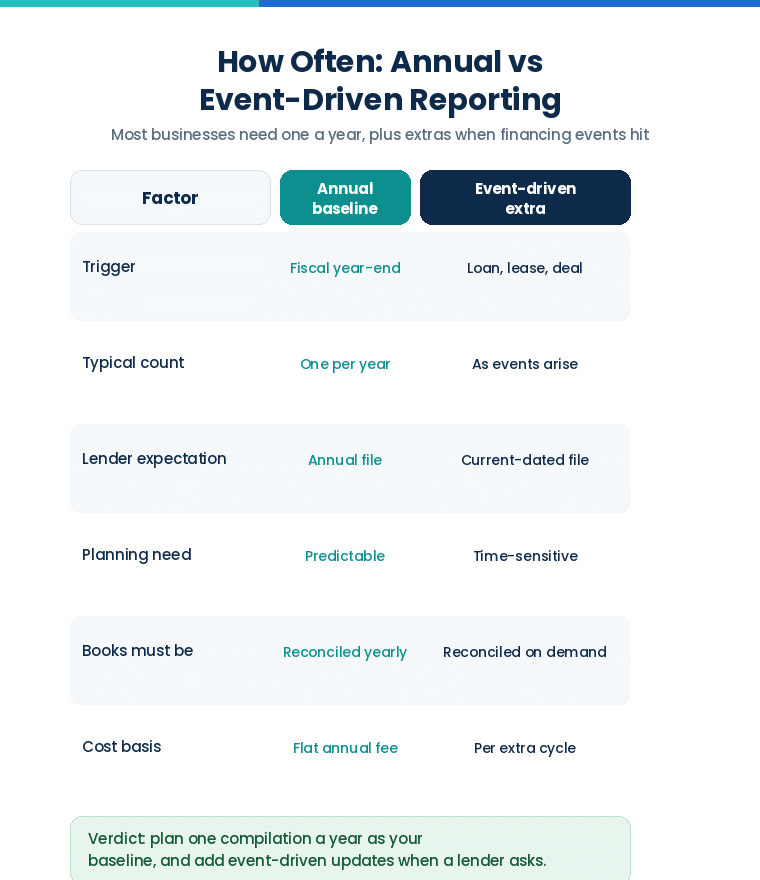
| Factor | Annual (baseline) | Event-driven (extra) |
|---|---|---|
| Trigger | Fiscal year-end | Loan, lease, or deal |
| Typical count | One per year | As events arise |
| Lender expectation | Annual file | Current-dated file |
| Planning | Predictable and scheduled | Time-sensitive |
| Books must be | Reconciled yearly | Reconciled on demand |
| Cost basis | Flat annual fee | Quoted per extra cycle |
Plan one compilation a year as your baseline, and add an event-driven report only when a lender or investor asks for current-dated statements. Paying for quarterly statements no one requested wastes money.
Our Take: The cleanest setup is monthly reconciled books plus one scheduled annual compilation. Then any event-driven request becomes a quick assembly rather than a scramble, because the underlying records are always ready.
A holding company with two operating subsidiaries assumed it needed four compilations a year. After reviewing its lender covenants, we confirmed each entity needed only one annual report, three in total, with no interim requirement. We right-sized the engagement and removed reports it was not obligated to produce. Figures changed for privacy.
DIY vs CPA vs Non-CPA Provider
Compare The Routes
Only a Registered CPA can issue a compilation engagement report, so DIY and non-CPA providers cannot produce the document lenders want, no matter how often you need it. The real choice each cycle is a CPA firm versus the slower, riskier alternatives. Under CSRS 4200, a compilation is part of the practice of professional accounting.
| Factor | DIY | CPA firm | Non-CPA provider | Best for |
|---|---|---|---|---|
| Lender acceptance | Low | High | Varies | CPA firm |
| Compilation report under CSRS 4200 | Not available | Yes | Not permitted to issue | CPA firm |
| Accountability | None | Registered and regulated | Limited | CPA firm |
| CRA-readiness | Low | High | Medium | CPA firm |
| Repeatable each year | Slow | Scheduled and reliable | Varies | CPA firm |
For any incorporated business that needs financials a bank or CRA will rely on, year after year, a Registered CPA firm is the only route that produces a valid compilation engagement report.
An owner self-prepared statements for two years to save money, then a lender declined them at renewal because no CPA stood behind the numbers. We issued a compilation at a flat fee and the renewal proceeded; the DIY route had cost weeks on a time-sensitive file. Figures changed for privacy.
How Does the Compilation Process Work?
Seven-Step Workflow
Our compilation runs through seven defined steps each cycle, so you always know what comes next. Each stage has client actions and CPA actions, and most delays trace back to incomplete records, which we flag early.
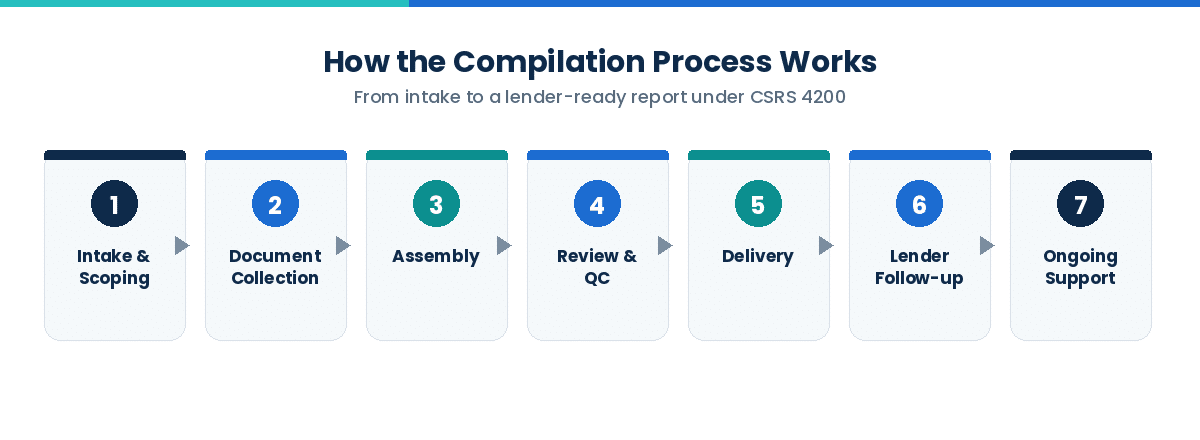
- Intake and scoping: confirm intended users and that CSRS 4200 conditions are met, then issue the engagement letter.
- Document and data collection: share bank statements, ledgers, and prior-year statements.
- Assembly: we compile the financial statements from your records.
- Review and quality control: a second-level review checks the draft.
- Delivery: the compilation engagement report is issued and dated to your approval.
- Lender follow-up: we clarify the basis of accounting where the bank asks.
- Ongoing support: we keep your records ready for the next cycle.
| Phase | Duration (illustrative) | Client actions | CPA actions | Outputs |
|---|---|---|---|---|
| Intake and scoping | 1 business day | Confirm intended users | Confirm CSRS 4200 conditions | Engagement letter |
| Document collection | 2 business days | Share statements and ledgers | Request missing items | Checklist complete |
| Assembly | 3 business days | Answer queries | Compile statements | Draft statements |
| Review and QC | 1 business day | None | Second-level review | Reviewed draft |
| Delivery | 1 business day | Approve statements | Issue compilation report | Final report |
Pro Tip: Keep your books reconciled monthly so each cycle is assembly, not cleanup. Cleanup is what drives most of the cost and most of the delay, whether you need one report a year or three.
A restaurant corporation with reconciled books engaged us on a Monday for its annual compilation. Intake and collection took three days, assembly and review four days, and we delivered the report the following Wednesday, eight business days end to end. The next year, with books current, it moved even faster. Figures changed for privacy.
What Deliverables Do You Get Each Cycle?
Tangible Outputs
Each cycle you receive a complete, standardized financial statement package, not loose bookkeeping output. The core deliverable is the financial statements plus the compilation engagement report required under CSRS 4200, which names management and practitioner responsibilities and references the basis-of-accounting note.
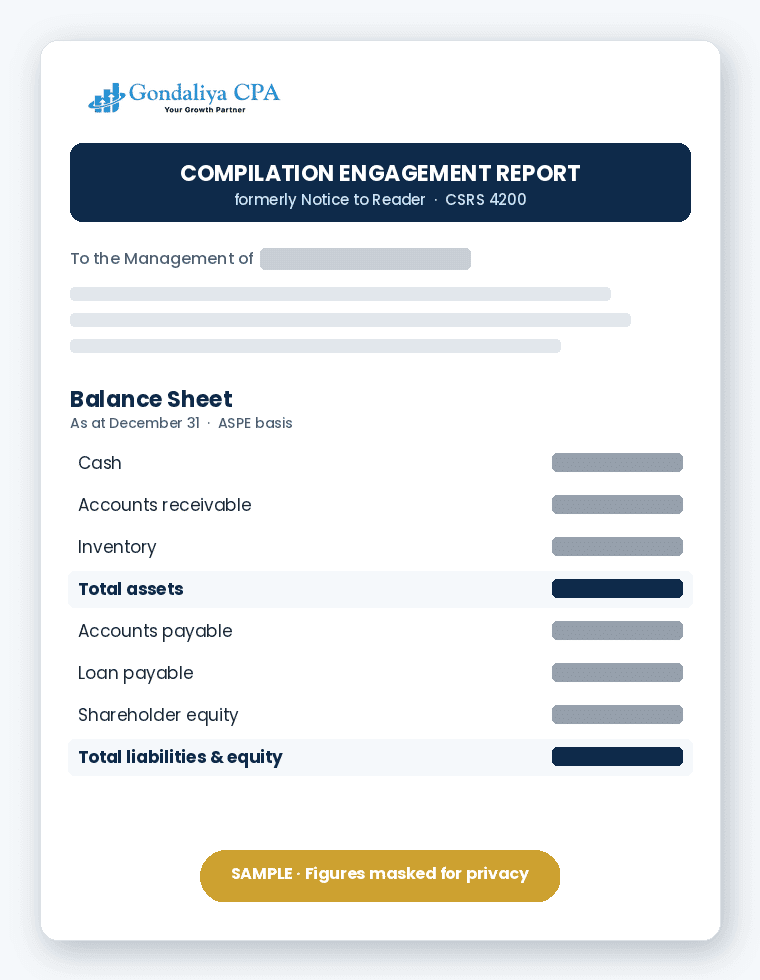
| Deliverable | What it is | Who uses it | When delivered |
|---|---|---|---|
| Balance sheet | Snapshot of assets, liabilities, equity | Lenders, owners | At delivery |
| Income statement | Revenue and expenses for the year | Lenders, CRA | At delivery |
| Basis-of-accounting note | Required CSRS 4200 disclosure | All users | At delivery |
| Compilation engagement report | The CPA report replacing the old NTR | Banks, lenders | At delivery |
| Lender package (optional) | Statements plus cover note | Bank credit team | On request |
Pro Tip: Ask for a short lender cover note with your statements; it answers the bank’s basis-of-accounting question up front and shortens the approval back-and-forth on every cycle.
A SaaS corporation received from us a balance sheet, an income statement, the basis-of-accounting note, and the compilation engagement report for its year-end. When its lender asked one follow-up question, the cover note we had attached already answered it, so the credit team cleared the file without delay. Figures changed for privacy.
How Much Does a CPA Compilation Report Cost in Canada?
Transparent Pricing
Gondaliya CPA prepares a compilation (Notice to Reader) financial statement starting at $282.50 per year including HST ($250 plus 13% HST), at a flat fee with no surprise invoices. Because most businesses need one report a year, that flat annual fee is usually your whole compilation cost; an event-driven extra report in the same year is quoted separately so nothing is a surprise.
| Driver | What increases cost | How to keep it efficient | Ask the firm |
|---|---|---|---|
| Bookkeeping state | Months of unreconciled data | Close books monthly | Is cleanup quoted separately? |
| Reporting frequency | Extra event-driven reports | Bundle to year-end where possible | Is each extra cycle quoted up front? |
| Transaction volume | High monthly transaction count | Use connected bank feeds | Is volume a fee factor? |
| Number of entities | Holdco plus operating companies | Keep separate clean files | Are holdcos billed separately? |
| Timeline | Rush turnaround | Book before deadlines | What is standard turnaround? |
You can estimate the corporate tax that flows from your compiled statements with our corporate tax calculator.
Compilation Frequency Estimator
Answer four quick questions to estimate how many compilation reports your business likely needs in a year.
Baseline:
This tool gives a general estimate, not a quote. For your flat annual fee, please book a free consultation.
Two corporations engaged us the same month. One had clean books and needed a single annual report, a straightforward flat fee. The other had nine months of unreconciled data and a mid-year refinance, so its total was higher only because cleanup and one extra report came first. The annual compilation fee itself was identical. Figures changed for privacy.
Risks, CRA Compliance & Common Mistakes
Mistakes To Avoid
The biggest frequency mistakes are ordering too few reports and missing a lender request, ordering too many you do not need, and forgetting that a compilation never replaces your tax filing. A compilation supports your T2 but is not the return itself.
Risk Warning: Skipping your annual compilation to save a fee can stall a loan renewal when the bank asks for a current file and your books are not ready. The delay usually costs more than the report.
| Risk area | What happens if missed | CPA mitigation |
|---|---|---|
| No annual report on file | Lender review stalls | Schedule one compilation each year |
| Wrong engagement type | Lender rejects the report | Confirm intended users up front |
| Missing basis-of-accounting note | Non-compliant statements | Standard CSRS 4200 disclosure |
| Unreconciled accounts | Statements that don’t tie out | Reconcile before assembly |
| Statements not tying to the T2 | Filing errors and queries | Tie statements to the return |
For background only: your annual compilation supports the T2, which the CRA requires to be filed within six months of the fiscal year-end (Canada Revenue Agency, canada.ca). The compilation itself has no separate CRA filing date.
A corporation skipped a year-end compilation to cut costs, then its bank asked for current statements during a covenant review and its books were three months behind. We completed cleanup and a compilation, but the review was delayed two weeks. The next year it booked the annual report on schedule. Figures changed for privacy.
What to Prepare Before Each Cycle
Six-Point Checklist
Gather six things before each compilation cycle and the engagement moves straight to assembly. Preparation is the single biggest factor in a fast, predictable turnaround, whether you need one report a year or an extra mid-year.
| Item | Why needed | Common mistake | CPA tip |
|---|---|---|---|
| 12 months bank statements | Reconcile cash | Missing a month | Download all accounts |
| Credit card statements | Capture expenses | Forgetting personal cards used for business | Separate cards |
| QuickBooks or Xero access | Source of the books | Stale data | Reconcile before sharing |
| Prior-year statements | Opening balances | Not provided | Always include |
| Loan and lease agreements | Liabilities | Omitted | Provide full terms |
| Intended-user note | CSRS 4200 condition | Vague answer | Name the lender |
Want this as a one-pager? You can download the free compilation report prep checklist and bring it to your first call.
A transportation corporation sent us all 12 months of statements for its accounts before we started its annual cycle. Document collection took one day instead of the usual two, and we delivered the report in six business days. Because its books stay reconciled, every year since has run the same way. Figures changed for privacy.
How It Applies Across 10 Industries
Industry Spotlights
A compilation report works across sectors, but how often each one needs it depends on financing patterns and stakeholders. Below are ten industries we serve and how the annual-plus-event cadence tends to play out for each.
| Industry | What drives frequency | How the compilation helps |
|---|---|---|
| Physician professional corporations | Annual filing, occasional financing (OHIP, RCPSC) | Year-end statements for clinics |
| Dentists and dental practices | Equipment loans add event cycles (RCDSO) | Statements for practice loans |
| Daycare and CWELCC services | Annual subsidy reporting | Clean funding presentation |
| Real estate investors and holdcos | Refinances trigger extra reports | Balance sheet for refinancing |
| Property developers and builders | Project draws need current files | Statements for construction lenders |
| Construction and skilled trades | Bonding renewals are periodic | Statements for bonding and credit |
| Technology startups and SaaS | Funding rounds add cycles | Investor and lender statements |
| E-commerce and online retailers | Credit-line reviews are annual | Statements for credit lines |
| Restaurants and food and beverage | Mostly annual, leases add cycles | Lender-ready year-end statements |
| Transportation and logistics | Fleet financing adds event reports | Statements for fleet financing |
Related services, please: see our CPA compilation report service page for the full engagement, corporate tax filing for your T2, bookkeeping cleanup to get your books ready first, GST/HST filing to stay compliant, and CRA audit resolution if the CRA contacts you.
A dental corporation needed only its annual compilation for two years, then refinanced an equipment loan and needed one current-dated report that year. We presented the equipment at cost, the loan balance, and retained earnings, and the lender approved the refinance using the CPA-compiled package. Figures changed for privacy.
A Realistic Numeric Walkthrough
Flagship Engagement
Here is one engagement across a full year: a Toronto incorporated e-commerce business needed its annual compilation, then one extra report when it refinanced mid-year. Figures are masked.
| Assumptions | Value |
|---|---|
| Entity type | Incorporated CCPC |
| Annual revenue | $640,000 |
| Monthly transactions | 950 |
| Employees | 3 |
| Bank and credit accounts | 4 |
| Year-ends per year | 1 |
| Financing event | One mid-year refinance |
| Compilations needed that year | 2 (annual plus one event-driven) |
| Outputs / Deliverables | Detail |
|---|---|
| Annual compilation | Year-end statements for the T2 and bank review |
| Event-driven compilation | Current-dated statements for the refinance |
| Balance sheet | Cash $52,000; inventory $74,000; equity $61,000 |
| Income statement | Revenue $640,000; net income $58,000 |
| Basis-of-accounting note | ASPE disclosed on both |
| Turnaround | 8 business days each, books current |
Schedule the annual compilation right after year-end, keep books reconciled monthly so the mid-year refinance report is a quick assembly, confirm the lender’s exact dating requirement in writing, and keep both reports tied to the T2 for filing.
This walkthrough reflects a real Toronto engagement we completed: one annual compilation at year-end and one current-dated report for a refinance, both ASPE, both dated to the owner’s approval, and both accepted by the bank. The owner budgeted for two that year and one the next. Figures changed for privacy.
How to Choose the Right CPA Firm
Buyer’s Guide
Choose a CPA firm on four things: licensing, lender acceptance, fixed pricing, and reliable scheduling year after year. Because a compilation is part of the practice of professional accounting under CSRS 4200, you want a Registered firm whose statements lenders and CRA will rely on every cycle.
| Your situation | Complexity (1–5) | Recommended option | Next step |
|---|---|---|---|
| Clean books, one corporation, annual only | 2 | Standard annual compilation | Book intake |
| Annual plus a mid-year financing event | 3 | Annual plus one event-driven report | Flag the event date |
| Holding company plus operating company | 4 | One compilation per entity per year | Scope both entities |
| Lender requires assurance | 5 | Review or audit firm | Confirm lender wording |
| Behind on reconciliations | 3 | Cleanup then compilation | Request cleanup quote |
Questions to ask on a free consultation: Are you a Registered CPA firm in Ontario? Will my statements be a compilation engagement report under CSRS 4200? Is your fee a flat annual amount with no surprise invoices? How do you price an extra event-driven report? Is cleanup quoted separately? What is your standard turnaround? Do you work in QuickBooks and Xero? Will the statements tie to my T2? Can you provide a lender cover note? How do I verify your licence?
An owner compared us against an hourly competitor. We quoted a flat annual fee, with any extra event-driven report priced up front; the other firm quoted an open-ended hourly rate. The owner chose us to keep each year’s cost predictable and avoid a surprise bill. Figures changed for privacy.
Why Trust Gondaliya CPA
Verifiable Trust Signals
Gondaliya CPA is a fully Registered Ontario CPA firm that works only with incorporated SMBs, on a flat annual fee with no surprise invoices. We compile under CSRS 4200, file corporate tax, and represent clients with CRA, year after year.
| Trust signal | What it means for clients |
|---|---|
| Registered Ontario CPA firm | Statements lenders and CRA rely on |
| Business-only focus | Deep incorporated-SMB expertise |
| 1300+ 5-star Google reviews | Consistent client experience |
| 30-Day Money-Back Guarantee | Lowered engagement risk |
| 60-Day Fees-Matching Policy | Fair pricing assurance |
| Flat, fixed annual pricing | No surprise invoices |
| CRA representation | Support on reviews |
Verify our firm registration on the CPA Ontario public firm directory. Editorial policy: this article was researched against primary Canadian sources, principally CRA and CPA Canada, fact-checked for current standards, reviewed by a CPA, and updated when rules change.
A prospective client weighed our single flat annual quote against an hourly competitor whose estimate kept moving. Because our fee was fixed and our firm registration is publicly verifiable on CPA Ontario, the client engaged us with confidence on both price and credentials. Figures changed for privacy.
People Also Ask
Adjacent Questions
How often does a small business need financial statements in Canada? Most incorporated small businesses need financial statements once a year, prepared at fiscal year-end to support the T2 filing and the bank’s annual review. Extra statements are prepared only when a lender, landlord, or investor requests current-dated numbers for a specific event.
Do I need a compilation report every year? Usually yes if your corporation is active and a bank, the CRA filing, or a stakeholder relies on your statements. An active corporation files a T2 each year, and a current annual compilation keeps your file ready for the lender’s yearly review.
Does a dormant corporation need a compilation report? Often a simple annual file is still useful, even with nil activity, if a bank or shareholder wants confirmation of the position. The engagement is faster and lighter, but the once-a-year cadence usually still applies.
Can one compilation cover two corporations? No. Each corporation files its own T2 and needs its own compilation, so a holding company and its operating company are two separate annual reports, not one combined report.
How long is a compilation report valid for a lender? Lenders usually want current year-end statements, sometimes two years. An older compilation may not satisfy a fresh credit decision, which is why a mid-year financing event often triggers one extra current-dated report.
Is a Notice to Reader the same as a compilation report? Effectively yes. The Notice to Reader was the old name under Section 9200; since periods ending on or after December 14, 2021, CSRS 4200 replaced it with the compilation engagement report.
How fast can I get a compilation report? With current, reconciled books, many engagements deliver within five to ten business days. The main delay is bookkeeping cleanup, which is quoted separately from the compilation.
Do I still file a T2 if I have a compilation report? Yes. A compilation is financial statements, not a tax return. Every Canadian corporation must file a T2, and the compilation supports that filing rather than replacing it.
A client with a holding company and an operating company asked whether one compilation could cover both. We explained each entity files its own T2 and needs its own annual report, prepared two compilations, and both were accepted by the bank for the group’s review. Figures changed for privacy.
Frequently Asked Questions
Your Questions Answered
A compilation report is structured financial statements a CPA assembles under CSRS 4200 with no assurance, usually once a year. The questions below cover the frequency points owners ask us most.
How often does my business really need a compilation report?+
When would I need more than one in a year?+
Can I use last year’s compilation for this year’s loan?+
Does a holding company need its own compilation each year?+
How do I keep the cost predictable across cycles?+
How fast can I get a compilation report?+
Is a compilation cheaper than a review or audit?+
What basis of accounting will my statements use?+
An owner asked us, plainly, how many compilations they would pay for each year. We reviewed their single corporation, their annual T2, and their bank’s once-a-year review, and confirmed one report a year unless a financing event arose. Setting that expectation up front removed the guesswork from their budget. Figures changed for privacy.
Map Your Compilation Reporting Cadence
Book a free consultation and we will confirm how often your business needs a compilation and what each cycle costs. Weekend and evening support available. Call 647-212-9559 or email info@gondaliyacpa.ca.
Glossary of Key Terms
Plain-English Definitions
- Compilation engagement: A CPA assembles financial statements without assurance under CSRS 4200.
- CSRS 4200: The Canadian standard governing compilation engagements since periods ending on or after December 14, 2021.
- Notice to Reader (NTR): The former name for a compilation, replaced by the compilation engagement report.
- Annual compilation: The once-a-year, year-end compilation that supports the T2 and the bank’s annual review.
- Event-driven compilation: An extra, current-dated report prepared for a loan, lease, or deal between year-ends.
- Basis of accounting: The accounting framework used, now disclosed in a required note.
- ASPE: Accounting Standards for Private Enterprises, a common basis for SMB statements.
- Assurance: An audit or review opinion; a compilation provides none.
- Intended users: The third parties, such as a lender, the CPA confirms before accepting the engagement.
- T2: The annual corporate income tax return every Canadian corporation must file.
Next Steps — How to Engage Gondaliya CPA
If your bank or lender expects accountant-prepared statements, confirm how often you need them and gather twelve months of bank statements so we can move quickly. Getting started takes one short conversation, with no obligation. Call 647-212-9559 or email info@gondaliyacpa.ca.

Sharad Gondaliya is a CPA Canada & CPA USA with 15 Years+ experience of Accounting, Tax, Payroll of Corporate Small Businesses as Tax Accountant. He is a CPA Ontario member (61040184) and holds US CPA licences in Washington and Montana and is well known among corporate small businesses for tax planning, efficient tax solutions, and affordable CPA services. Sharad is the Principal (Director) of Gondaliya CPA – Affordable CPA Firm in Canada. Licenses: CPA Ontario: 61040184 | CPA USA (MT): PAC-CPAP-LIC-033176 | CPA USA (WA): 57629 | CPA Firm License: 61330051 View Full Author Bio