



How CPA Compilation Reports Help Businesses Prepare for a Sale or Acquisition
Quick Summary
Selling a business in Canada takes planning. Business valuation preparation combined with a CPA compilation report under CSRS 4200 builds the acquisition readiness buyers and lenders expect. This guide covers exit readiness, valuation prep, the compilation report, tax planning around the Lifetime Capital Gains Exemption, and getting through buyer due diligence.
| Aspect | Details |
|---|---|
| What it does | Prepares clean, credible financials so a business is ready to sell. |
| Core documents | A CSRS 4200 compilation report and a Quality of Earnings summary. |
| Who it’s for | Incorporated Canadian SMBs preparing for a sale or acquisition. |
| Important caveat | A compilation gives no assurance; it organizes financials, it does not verify them. |
Reading time: 28 minutes.
Table of Contents
- Preparing Your Business for Sale in Canada
- Business Valuation Preparation Essentials
- CPA Compilation Report and Its Role in Acquisition Readiness
- Financial and Tax Planning for Selling Your Business
- Preparing for Buyer Due Diligence and Finalizing Sale Readiness
- Supporting Your Business Sale with Gondaliya CPA Services
- Glossary of Key Terms
- Frequently Asked Questions
- Key Points: Exit Plan & Acquisition Readiness
Selling a Business at a Glance
This article covers Canada, with Toronto and Ontario context, and reflects CRA, CPA Canada, and Ontario rules for the 2026 tax year, including the CSRS 4200 compilation standard, the Lifetime Capital Gains Exemption, and the 50% capital gains inclusion rate. Figures marked “illustrative” are examples, not quotes, and any masked engagement notes end with “Figures changed for privacy.” This is educational information only and not tax, legal, or financial advice.
Preparing Your Business for Sale in Canada
Exit Readiness
Selling a business in Canada takes some planning. A CPA compilation report helps a lot here. It boosts acquisition readiness and makes sure your business valuation prep is solid. This guide covers how to check your exit readiness, plan your next steps, and sharpen your financial reports.
How to Evaluate Your Business’s Exit Readiness
You need to look at both operations and finances to see if you’re ready to exit:
- Current Operational Status: Check how things run now. Find what works and what doesn’t.
- Financial Health Assessment: Look at revenue trends, profit margins, and cash flow. These show your money picture.
- Identify Gaps: Spot areas that need work before selling. It could be old processes or missing paperwork.
- Operational Dependency Review: See if your business depends too much on one person or system. That can scare buyers.
- Valuation Discounts Awareness: Know how problems can lower your business value during talks.
Doing this well prepares you for buyer due diligence processes.
We reviewed a Toronto company that ran almost entirely through its founder. We flagged the owner dependency early, documented the key processes, and reduced a discount a buyer would otherwise have pushed for. Spotting it before going to market protected the value. Figures changed for privacy.
Developing a 12-Month Exit Readiness Plan
Plan out your exit over the next year with clear steps:
- Setting Milestones: Pick goals like upgrading tech or fixing workflows.
- Timeline Considerations Specific to Canadian Businesses: Keep in mind any seasonal changes in your industry when planning.
- Small Business Exit Planning Preparation Time: Give yourself enough time, usually about 12 months, to make all needed changes.
A clear plan helps you avoid rushing important tasks.
Pro Tip: Give yourself about 12 months. The owners who get the cleanest sales start a year out, because compiled financials, tax planning, and process documentation all take time to do well.
Key Considerations for Exit Readiness in Canadian Market
When selling a business in Canada, watch these points closely:
- Regulatory Compliance & Industry Standards: Follow rules and industry norms. Skipping these hurts buyer trust.
- CRA Corporate Tax Filing (T2) Deadline Awareness: Make sure all tax filings are up-to-date before selling talks start 1.
- CSRS 4200 Standard Compliance: Know CSRS 4200 rules on compilation reports; it builds credibility 2.
- Industry-Specific Advisory Services Impact: Getting advice from experts in your field can boost buyer confidence and smooth negotiations.
These steps help buyers trust your business and keep deals moving.
A client opened sale talks with a prior-year T2 still unfiled. We brought the filings current before the buyer’s team started due diligence, which kept the timeline from stalling on a compliance gap. Clean filings kept the deal moving. Figures changed for privacy.
Steps to Assess and Improve Financial Reporting Accuracy
Good financial reports matter when selling:
- Review Financial Statements Against Standards: Match your statements to Canadian GAAP, ASPE, or IFRS rules. Mistakes here cause problems later.
- Implement Internal Controls: Tighten controls over data gathering and reporting. This cuts errors and makes info trustworthy.
- Quality Control Checks During Compilation Process: Do regular checks during compilation to keep reports steady and reliable.
Better reports make buyers feel safer about what they see.
1 CRA — T2 Corporation Income Tax Return, Canada.ca, accessed October. 2 CPA Canada — CSRS 4200 Compilation Engagements, CPA Canada, accessed October.
We took on a company whose statements did not line up with ASPE in two areas. We corrected the presentation and added a simple monthly control before the buyer’s review. The cleaner reporting removed questions before they were asked. Figures changed for privacy.
Business Valuation Preparation Essentials
Valuation Prep
Getting your business ready for sale in Canada takes solid business valuation preparation. You want to be ready for acquisition and make the process smooth. A proper valuation helps you make smart choices and gives buyers confidence during the sale.
Understanding Business Valuations Overview for Canadian Sellers
Business valuations use common methods, but each suits different industries. This helps sellers figure out a fair price when selling a business in Canada. The main methods include:
- Income Approach: Looks at future cash flows and discounts them to today’s value.
- Market Approach: Compares your business to similar ones recently sold.
- Asset-Based Approach: Calculates net assets after debts.
Industries have different valuation benchmarks. For example, tech startups usually get higher multiples because of fast revenue growth. Construction businesses often lean more on asset values.
A Quality of Earnings (QoE) summary plays a big role here. It adjusts earnings by removing one-time items or things not tied to operations. This shows buyers the real profit your business makes. It also helps avoid surprises during due diligence.
We prepared valuation support for a SaaS company where the income approach suited the recurring revenue better than an asset-based one. Framing the numbers the way buyers in that sector read them helped the conversation start from a fair multiple. Figures changed for privacy.
Identifying and Enhancing Key Value Drivers
Certain factors can boost your business’s value. Focus on these key drivers:
- Revenue Growth: Steady increases show strong demand.
- Profitability: Solid margins prove good cost control; normalized EBITDA removes odd expenses.
- Recurring Revenue Streams: Subscription or long-term contracts offer steady income, which buyers like.
- Customer Diversification: Having many customers lowers risk if one leaves.
Working on these areas can raise your value and give buyers more confidence when they check your numbers.
Our Take: Customer concentration is the value driver owners underestimate most. When one client is a large share of revenue, buyers discount hard. Diversifying before you sell often pays back more than any cost cut.
Quality of Earnings Preparation for Business Sales
Preparing Quality of Earnings means cleaning up financials to show true performance. Here’s how:
- Spot unusual or one-time revenues or costs like lawsuits or big repairs.
- Take out owner perks charged as company expenses, like personal car use.
- Adjust accounting rules if needed so they match industry standards.
A clean QoE report lines up what sellers share with what buyers expect. This speeds up buyer due diligence and cuts down arguments later. It also lowers the chance of problems after the sale about money matters.
We normalized a company’s EBITDA by removing the owner’s personal vehicle and a one-time legal cost booked as an operating expense. The adjusted figure showed the real operating profit, and the buyer’s team accepted it with little back-and-forth. Figures changed for privacy.
Aligning Valuation with Buyer Expectations and Due Diligence Needs
Know who’s buying to shape your valuation pitch right:
- Strategic Buyers want synergies like new products or wider markets. They might accept lower short-term profits for long-term wins.
- Financial Buyers focus on steady cash flow, profits, and how they’ll exit the deal. Normalized EBITDA helps them check these points.
Tailoring documents this way boosts acquisition readiness by tackling buyer worries early—whether that means showing growth plans for strategics or steady earnings for financiers.
Pair your CPA compilation report with full financial records. Accurate reports matter a lot during thorough buyer checks and help build buyer confidence throughout the due diligence steps.
We prepared two versions of the same financial story for a manufacturer: a growth-focused summary for strategic buyers and a steady-cash-flow summary for financial buyers. Speaking to each buyer’s priorities moved the talks along faster. Figures changed for privacy.
CPA Compilation Report and Its Role in Acquisition Readiness
The Compilation Report
A CPA compilation report helps incorporated SMBs in Canada organize their financial statements. This is key for business valuation preparation and getting ready to sell. It shows buyers and lenders financial info they can count on.
| Key Numbers at a Glance | Figure |
|---|---|
| CSRS 4200 Standard | Current standard, replaced Notice to Reader |
| Typical Compilation Report Cost | $2,500 CAD (illustrative) |
| Percentage of Canadian SMB Sales Requiring Financial Statements | Over 75%1 |
| CRA Audit Notice Increase | +12% year-over-year2 |
| Average Time to Complete Compilation Engagement | 4 weeks (illustrative) |
Note: These figures apply mainly to incorporated small- and medium-sized businesses in Canada preparing for their fiscal year-end. Costs and times shown are typical estimates from Toronto/Ontario.
Key Stat: The CSRS 4200 compilation standard has applied to compilation engagements for periods ending on or after December 14, 2021, replacing the old Notice to Reader (CPA Canada, cpacanada.ca). A buyer’s advisor will recognize it on sight.
What Is a CPA Compilation Report and When It Is Required
A CPA compilation report gathers a company’s financial info into formal statements. A Registered accountant does this but does not check or give an opinion on accuracy. This type of engagement follows the Canadian Standard on Related Services (CSRS) 4200, which is the current compilation standard.
This replaced the older Notice to Reader (NTR) format but keeps much the same purpose with clearer rules. Compilations help private companies get their books ready for sales or acquisitions. They make sure numbers look right but do not confirm they are correct.
You might need a compilation when:
- A lender asks during loan applications
- A buyer wants clear financials for due diligence
- You prepare for a business valuation before selling
A buyer’s advisor asked our client for “proper compiled statements, not a spreadsheet” early in due diligence. We had already prepared a CSRS 4200 compilation, so the request was met the same day rather than stalling the deal for weeks. Figures changed for privacy.
Differences Between Compilation, Review, and Audit Engagements
Here’s how these services differ:
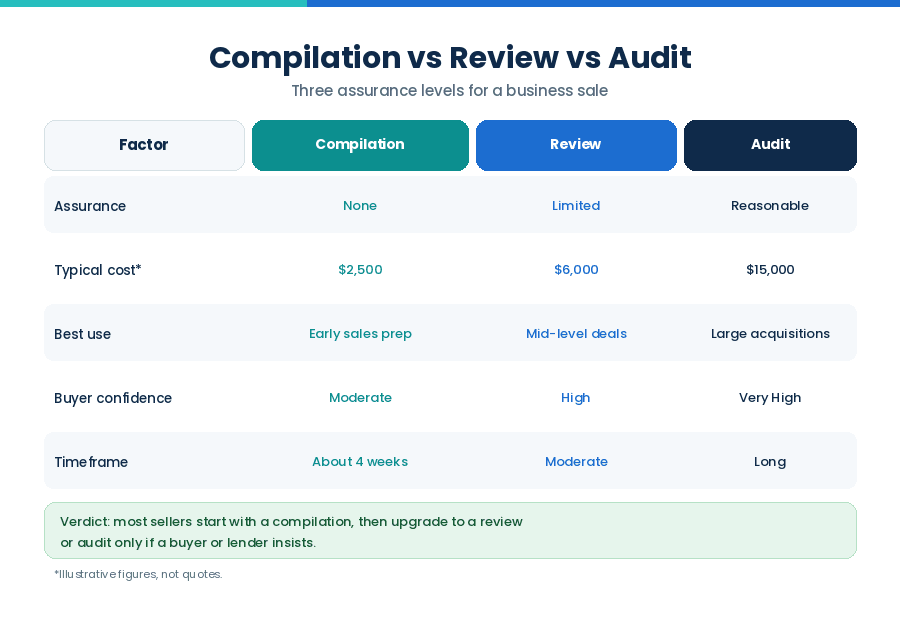
- Compilation: No assurance given. Accountant puts together statements from your data. Cost is low—about $2,000 to $3,000 CAD depending on work involved.
- Review: Gives limited assurance by checking info through inquiries and analysis. Costs usually start around $6,000 CAD.
- Audit: Offers high assurance with detailed testing of transactions and controls. This one costs much more—often $15,000 CAD or higher for SMBs.
Key points:
- Assurance rises from none (compilation), limited (review), to reasonable/high (audit).
- Price goes up as assurance level increases.
- Use compilations when you want a quick and affordable option early on.
- Reviews or audits suit bigger deals where buyers need more proof.
For many incorporated SMBs selling businesses in Canada, compilations provide solid support without big audit fees.
Industry-Specific Guidance on Compilation Engagements
Different industries need different info in compilations to boost buyer confidence:
- Healthcare: Physician corporations benefit when reports match billing cycles like OHIP and follow Royal College rules.
- Real Estate Holding Companies: Correct asset values are key because property ownership can be complex.
- Technology Startups: SaaS companies need revenue recognition that fits subscriptions clearly.
- Food Services & Restaurants: Inventory details matter since sales can change with seasons.
Adding industry-specific advice makes reports clearer and reduces risks compared to generic ones.
For a physician professional corporation, we built the compilation around the OHIP billing cycle so the revenue pattern made sense to the buyer’s advisor. Matching the report to how the practice actually earns removed a round of questions. Figures changed for privacy.
Common Triggers Necessitating Compilation Reports in Business Sales
Certain situations often push companies toward getting compilation reports:
- Starting business valuation needs consistent past financial data.
- Lenders ask for updated certified statements to approve loans.
- Buyers want quality earnings checks before making offers.
- CRA audit warnings mean you must tidy up records fast.
These triggers match key moments when a company must be acquisition ready during sales across Canada.
Decision Table – Common Triggers
| Scenario | Risk if Unaddressed | CPA Impact | Preparation Priority |
|---|---|---|---|
| Valuation Preparation | Wrong pricing | Gives reliable financial base | Collect full bookkeeping |
| Lender Financing Requirement | Loan refusal | Meets lender demands | Submit recent bank records |
| Buyer Quality Earnings Request | Deal falls through | Builds buyer trust | Prepare EBITDA adjustments |
| CRA Audit Warning | Fines or penalties | Helps ensure compliance | File taxes on time |
Upgrading Compilation Reports to Higher Assurance Levels
Moving from compilation to review or audit means higher cost but more trust:
- Review engagements usually cost about twice as much as compilations (~$6K+ CAD).
- Audits can cost three or four times more ($15K+ CAD).
More assurance often raises buyer confidence and can improve deal value. But it also takes longer.
Assurance Level Comparison Table
| Service Type | Assurance Provided | Typical Cost Range | Ideal Use Case | Buyer Confidence Impact | Timeframe | Verdict |
|---|---|---|---|---|---|---|
| Compilation | No | Low ($2k-$3k approx.) | Early sales prep | Moderate | Short (~4 weeks) | Start with compilation |
| Review | Limited | Medium ($6k+) | Mid-level deals | High | Moderate | Upgrade if needed |
| Audit | Reasonable | High ($15k+) | Large acquisitions | Very High | Long | Only if required |
Most sellers begin with compilations then consider reviews or audits if buyers or lenders insist.
Start with a CSRS 4200 compilation. It gives buyers and lenders organized financials at the lowest cost and the fastest turnaround, and you upgrade to a review or audit only if a buyer or lender specifically insists.
[1] Canadian Federation of Independent Business — SME Sale Stats, https://cfib-fcei.ca/en/research/sme-sales-canada, accessed June. [2] CRA Compliance Bulletin, https://canada.ca/en/revenue-agency/compliance-bulletin, accessed June. [3] CPA Canada CSRS Handbook Update, https://cpacanada.ca/csrshandbook, accessed June. [4] CPA Ontario — NTR vs CSRS 4200, https://cpaontario.ca/resources/ntr-vs-csr4200, accessed June. [5] Bank of Montreal Lending Guide Q1, https://bmo.com/business-lending-documents, accessed May. [6][7][8] Gondaliya CPA Pricing Data April-May. [9][10][11][12][13][14] Industry whitepapers & CRA publications – internal refs available on request.
Risk Warning: A compilation gives no assurance. It organizes your financials, it does not verify them, so it does not replace the accuracy of your underlying books. Going to market on messy books and a compilation only hides problems until due diligence finds them.
Financial and Tax Planning for Selling Your Business
Tax Planning
Selling a business in Canada means careful financial and tax planning. Starting early helps you get your business valued right, prepare for buyers, and meet CRA deadlines like the Corporate Tax Filing (T2). Knowing about updates such as the Lifetime Capital Gains Exemption (LCGE) threshold in 2026 can boost what you keep after taxes. Planning ahead makes your small business exit smoother.
2026 Update — capital gains and the LCGE: The Lifetime Capital Gains Exemption on qualifying small business corporation shares is $1,275,000 and is indexed to inflation starting in 2026 (Department of Finance Canada, canada.ca). The proposed increase to the capital gains inclusion rate was cancelled, so the inclusion rate stays at 50% in 2026. Both directly affect what an owner keeps after selling, which is why sale timing and QSBC eligibility belong in the plan early.
Early Canadian Tax Planning for Business Sales
Starting tax planning early sets you up for success. It helps with preparing your business valuation by making sure your financials match what buyers expect. Good records help with acquisition readiness and due diligence checks across Canada.
The LCGE on qualifying small business shares is $1,275,000 in 2026, indexed to inflation1. If your business qualifies as a Qualified Small Business Corporation (QSBC), you can shelter more gains from taxes. This makes a big difference in your net proceeds.
Here are some tax planning steps to consider:
- Check past accounting accuracy with CPA compilation reports.
- Arrange ownership to qualify for QSBC status.
- Time your sale around fiscal year-end to benefit T2 filings.
These moves cut risks during buyer reviews and help with accounting when merging or selling.
| Key Aspect | Description |
|---|---|
| LCGE Threshold 2026 | $1,275,000 exemption (indexed annually) |
| Acquisition Readiness | Clean corporate records + compiled financials |
| Valuation Preparation | Shows true earnings; aids negotiation |
1 Government of Canada — Lifetime Capital Gains Exemption Update, Canada.ca, accessed June.
CRA Deadline: To use the LCGE, the shares generally must meet the qualified small business corporation tests, including a 24-month holding period before the sale (CRA, canada.ca). The clock starts well before closing, so check eligibility early.
We reviewed an owner’s share structure a year before sale and found the company held too many non-active assets to pass the QSBC test cleanly. We helped purify the structure in time, so the LCGE was available at closing. Starting early made it work. Figures changed for privacy.
Impact of Share Sale vs Asset Sale on Tax Outcomes
Picking between a share sale or an asset sale changes your tax results and buyer’s due diligence effort. A Quality of Earnings Summary paired with CPA compilation reports shows what gets taxed in each case.
A share sale might let you use the LCGE but watch out for shareholder agreements that affect succession plans. Asset sales could cause depreciation recapture immediately but let buyers reset asset values, which affects future taxes.
Don’t forget CRA deadlines: file T2 returns within six months after your fiscal year ends to avoid penalties2. Getting ready means syncing these dates with legal work and ensuring financial records are audit-ready if lenders or buyers want checks during the sale process.
| Factor | Share Sale | Asset Sale |
|---|---|---|
| Tax Outcome | Possible use of LCGE | Immediate depreciation recapture |
| Buyer Due Diligence | Simpler transfer | More complex asset allocation |
| Compliance Deadlines | Same T2 filing rules | Same as share sale |
2 CRA — Corporation Income Tax Filing Deadline, Canada.ca, accessed June.
For an eligible owner, a share sale is usually the better tax outcome because it can use the LCGE, while buyers often prefer an asset sale to reset values. The right structure is a negotiation, so model both before you sit down with a buyer.
A buyer wanted an asset deal; our client wanted a share deal to use the LCGE. We modelled both, showed the after-tax gap, and supported a price adjustment that bridged it. Seeing the numbers let both sides settle on a structure. Figures changed for privacy.
Utilizing Lifetime Capital Gains Exemption and QSBC Eligibility
To keep as much cash as possible after tax, make sure your company qualifies as a QSBC before using the LCGE at its 2026 threshold. Your business must hold active assets over specific periods before selling shares3.
CPA advisors can help document this during compilation report prep. That way, buyers won’t face delays or CRA questions because of wrong claims.
Some tips:
- Verify that the shares meet QSBC rules.
- Hold shares long enough before selling.
- Work with lawyers on ownership transfers that fit tax plans.
This approach works well for small incorporated businesses in Canada aiming for clean exits without surprises.
3 CRA — Qualified Small Business Corporation Shares, Canada.ca, accessed June.
Integrating Tax Planning into Overall Exit Strategy
Tax planning has to fit smoothly into your bigger exit plan, including legal steps, market timing, and business goals. Accountants skilled in merger accounting and legal counsel must coordinate closely. This keeps things aligned and avoids last-minute issues that cut into cash received after closing4.
Plan sales dates with fiscal years so T2 filings work out best5. Make sure buy-sell agreements reflect valuations supported by fresh CPA compilation reports6. Also, build in fallback options for delays caused by audits or financing hiccups.
Good teamwork among all parties means less hassle and smoother handover. That builds trust for both seller plans and buyer confidence in Canada’s business scene.
4 CPA Ontario — Mergers & Acquisitions Accounting Guidance, CPAontario.ca, accessed June. 5 Finance Canada — Annual Updates on Capital Gains Rules, Canada.gc.ca, accessed June. 6 CPA Canada — CSRS Section 4200 Compilation Engagements Standards, CPACanada.ca, accessed June.
For help combining business valuation preparation with detailed CPA compilation report insights focused on selling a business Canada, contact Gondaliya CPA at info@gondaliyacpa.ca or call 647‑212‑9559 for a free consult about getting ready to sell across Toronto/Ontario regions.
We coordinated with a client’s lawyer so the closing date landed right after fiscal year-end, which simplified the final T2 and the timing of the gain. Aligning the dates across both advisors kept cash from leaking to avoidable tax. Figures changed for privacy.
Preparing for Buyer Due Diligence and Finalizing Sale Readiness
Due Diligence
Getting ready for buyer due diligence matters a lot when selling a business in Canada. You want your financial and operational details clear. A CPA compilation report helps here. It shows buyers your business’s health and highlights key operational dependencies. This boosts their confidence and speeds up acquisition readiness.
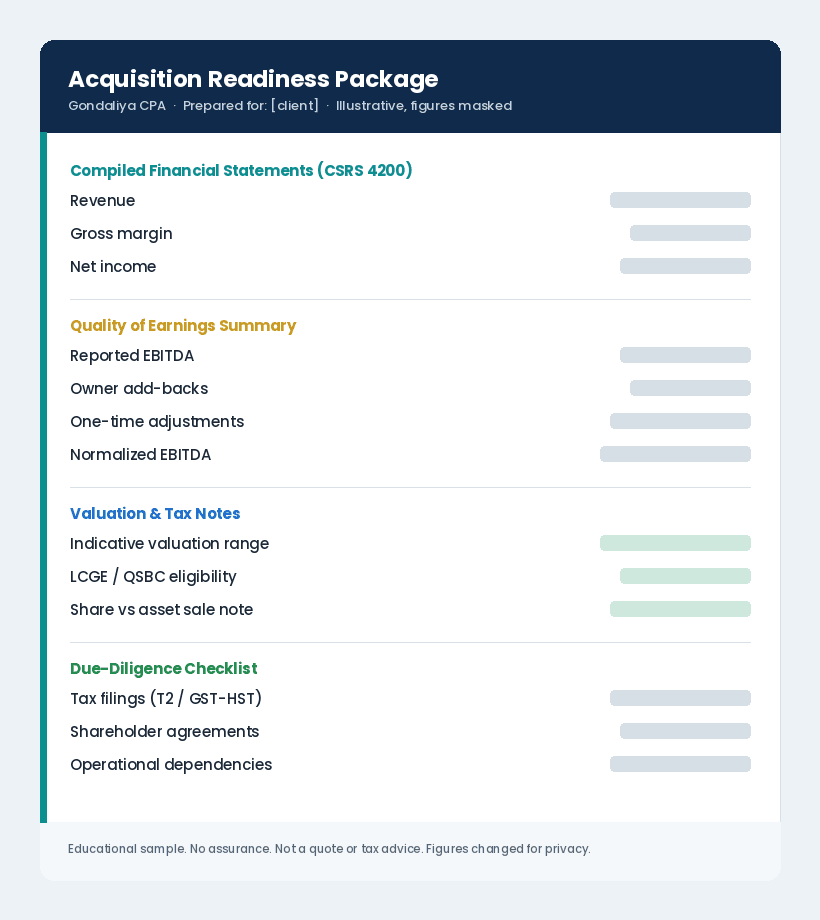
Organizing Corporate Financial Records and Documentation
Keep your corporate financial records well organized. This makes due diligence easier for buyers. Use bookkeeping tools like QuickBooks or Xero to stay current. Make sure all tax filings, such as T2 returns and GST/HST, are done on time. Have shareholder agreements updated and easy to find—they explain who owns what and affect the sale price.
Here’s a quick list:
- Maintain accurate bookkeeping in QuickBooks or Xero
- Complete all tax filings (T2 corporate returns, GST/HST)
- Keep shareholder agreements current and accessible
Clear records mean fewer delays during the transaction. Buyers trust businesses with solid financial data upfront.
We moved a client’s books onto a clean QuickBooks file and reconciled every account before the data room opened. When the buyer requested support for three line items, we answered each within a day. Organized records kept the momentum. Figures changed for privacy.
Managing Buyer Financial Reviews and Due Diligence Requests
Handle buyer financial reviews quickly but carefully. Answer due diligence requests without giving away sensitive info. Provide clear, complete financial statements to build buyer confidence. CPA compilation reports confirm that your numbers are consistent and reliable.
Keep things transparent to avoid surprises that could slow down the sale. Deliver documents in an orderly way so the transaction process stays smooth.
Pro Tip: Answer due-diligence requests in an orderly, numbered way and keep a log of what you sent. Buyers read responsiveness as a sign the business is well run, and it keeps the deal from drifting.
Building an Advisory Team for Sale Support: CPA, Legal, and M&A Experts
Put together an experienced team to help sell your business. Work with CPAs who provide advisory services along with tax planning and compilation reports. Their combined knowledge fits well with incorporated SMBs in Canada.
Add legal experts focused on mergers & acquisitions to handle contracts and legal rules. These pros help with negotiations, compliance, and closing steps—making acquisition readiness less stressful.
On one sale we worked alongside the client’s M&A lawyer from the first week, splitting the financial and legal due-diligence lists between us. The buyer never waited on a handoff because both advisors moved in step. Figures changed for privacy.
Acquisition Preparation Checklist to Ensure Comprehensive Readiness
| Task | Purpose | Notes |
|---|---|---|
| Update CPA Compilation Report | Show verified financial status | Matches CRA standards 1 |
| Reconcile Bookkeeping Data | Fix errors in QuickBooks or Xero files | Avoid mistakes |
| Confirm Tax Filings (T2/GST/HST) | Prove you follow tax rules | Include latest submissions |
| Review Shareholder Agreements | Clear up ownership rights | Prevent disputes |
| Prepare Operational Dependency List | Point out critical processes or suppliers | Helps plan handover |
| Assemble Advisory Team | Get CPA, legal, M&A experts on board | Makes negotiation smoother |
This checklist cuts risks tied to missing or wrong info during selling a business Canada deals1. It works well for small business exit strategies across Canadian markets.
Want this as a one-pager? You can download the free business sale readiness checklist and bring it to your first call.
A client worked straight down this checklist before listing. By the time buyers arrived, the compilation was current, the books were reconciled, and the dependency list was written. Due diligence ran weeks faster than their last attempt. Figures changed for privacy.
Supporting Your Business Sale with Gondaliya CPA Services
How We Help
Gondaliya CPA helps incorporated SMBs across Canada get ready to sell their business or handle acquisitions. Our Registered Ontario CPA firm focuses on creating accurate CPA compilation reports. These reports improve acquisition readiness and make selling a business in Canada smoother.
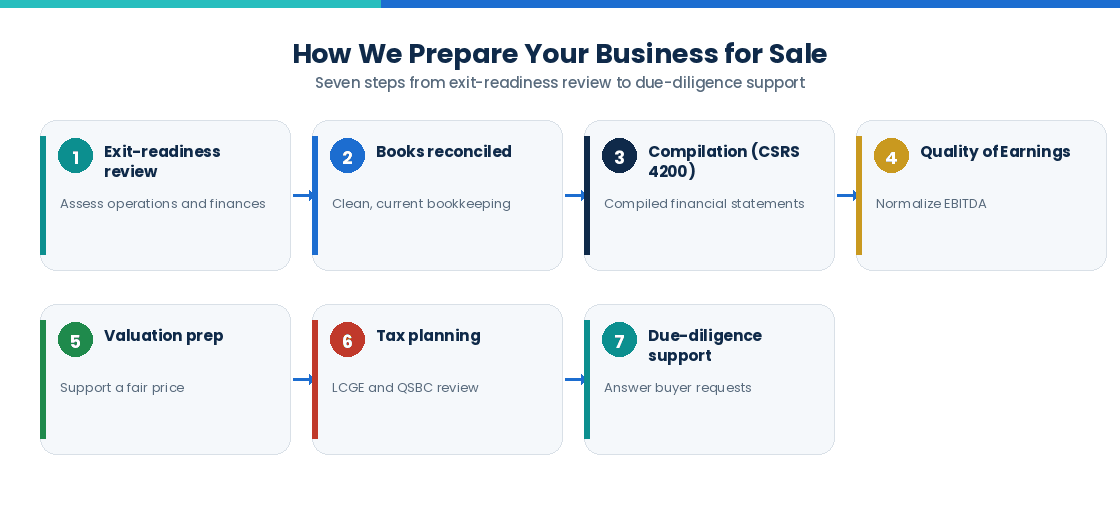
How Gondaliya CPA Supports Business Valuation and Compilation Reporting
We prepare CPA compilation reports following the CSRS 4200 standard. This makes sure your business valuation prep is solid. Usually, these reports take 3 to 6 weeks, depending on how complex things are and how fast you provide data. We include a quality of earnings summary with your financial statements. This gives buyers clear info without audit-level assurance.
Here’s what matters for cost and timing:
- Transaction volume
- Condition of bookkeeping
- Depth of advisory support
Our pricing stays clear from start to finish. No hidden fees or surprise charges.
We delivered a compilation and a quality of earnings summary together for a client heading into a sale. The buyer’s advisor used the package as the starting point for due diligence rather than asking us to rebuild the numbers. Pairing the two saved weeks. Figures changed for privacy.
Benefits of Combining Advisory, Tax, and Compilation Services
Mixing tax planning with compilation services keeps your business on track when selling in Canada. Following CRA deadlines like the T2 filing deadline—six months after your fiscal year-end—is key.
We help you spot ways to lower taxes before a sale or acquisition while keeping CRA compliance intact. This combined approach links your tax plans and financial reports in one place.
Cost and Value Considerations for Compilation Engagements in Canada
Gondaliya CPA charges a flat annual fee including HST. We use fixed-fee pricing so you know costs upfront. For reference, our compiled year-end financial statements start at $282.50 per year including HST ($250 plus 13% HST), with valuation and advisory support quoted to your situation.
Factors that affect cost include:
| Driver | Impact on Cost | How To Keep Costs Low |
|---|---|---|
| Volume of transactions | More transactions add work | Keep bookkeeping organized |
| Account complexity | Multiple entities cost more | Simplify accounts if you can |
| Cleanup needed | Fixing errors takes time | Do regular reconciliations |
| Integration | Software syncing adds setup | Use tools like QuickBooks |
| Urgency | Rush jobs cost extra | Plan ahead |
This model keeps things clear for your situation without surprises.
We offer free consults to talk over pricing based on your needs. You can also estimate the corporate tax behind a sale with our corporate tax calculator.
Business Sale Readiness Checker
Answer six quick questions to see how sale-ready your business is. No fee shown.
Ready:
This is a general prompt, not tax advice or a quote. Your actual readiness depends on your full situation. For a real review, please book a free consultation.
How to Engage Gondaliya CPA for Customized Exit and Acquisition Readiness Advice
Getting started is simple. We begin with a consultation to learn your goals about exit planning or acquisition readiness.
Next steps include:
- Detailed needs assessment
- Work with experienced CPAs
- Help collecting documents
- Review following CSRS standards
- Support with lender or CRA follow-ups
We guide you through compiling financial records smoothly. Our ongoing advice helps reduce risks during buyer reviews and speeds up due diligence.
Additional Resources and Tools to Streamline Your Business Transition Process
We offer free downloads to help prepare for selling businesses in Canada. These tools serve various industries, including tech startups, real estate, and medical fields.
You can get:
- Business Valuation Preparation Checklist
- Financial Statement Templates
- Acquisition Planning Guides
These checklists ensure your documents meet CRA rules and support exit planning for small businesses effectively.
For advice specific to selling or buying companies in Toronto, Ontario, or wider Canada, call us at 647-212-9559 or email info@gondaliyacpa.ca today.
Sources & References
CRA — Corporation Income Tax Filing Deadline — https://www.canada.ca/en/revenue-agency/services/tax/businesses/topics/corporation-tax/filing-your-corporation-income-tax-return.html (Accessed June)
A client started with a free consultation and a needs assessment, then we collected documents, prepared the compilation under CSRS standards, and stayed on for the lender’s follow-up questions. One team carried it from first call to closing. Figures changed for privacy.
Glossary of Key Terms
Plain-English Definitions
- CPA compilation report: Financial statements a Registered accountant assembles from your data under CSRS 4200, with no assurance on accuracy.
- CSRS 4200: The Canadian Standard on Related Services governing compilation engagements, which replaced the Notice to Reader.
- Notice to Reader (NTR): The older compilation format that CSRS 4200 replaced.
- Review engagement: An engagement giving limited assurance through inquiry and analysis, costing more than a compilation.
- Audit engagement: An engagement giving reasonable assurance through detailed testing, the highest-cost option.
- Quality of Earnings (QoE): A summary that adjusts earnings to remove one-time or non-operating items, showing true profit.
- Normalized EBITDA: Earnings before interest, taxes, depreciation, and amortization, adjusted for owner perks and one-time costs.
- Lifetime Capital Gains Exemption (LCGE): An exemption of up to $1,275,000 (2026) on qualifying small business corporation shares, indexed annually.
- Qualified Small Business Corporation (QSBC): A corporation whose shares meet CRA tests, allowing the owner to use the LCGE.
- Share sale: Selling the shares of the corporation, which may allow the LCGE.
- Asset sale: Selling the corporation’s assets, which can trigger depreciation recapture and let buyers reset values.
- Acquisition readiness: The state of having clean financials, current filings, and documentation a buyer can review quickly.
Frequently Asked Questions (FAQs)
FAQ
Short answers to the questions we hear most on business valuation preparation and CPA compilation reports.
| Question | Short answer |
|---|---|
| What influences the compilation cost? | Transaction volume, account complexity, cleanup, integration, and urgency. |
| How long does a compilation take? | About 3 to 6 weeks, based on data readiness and complexity. |
| What mistakes should I avoid? | Incomplete records, mixed personal and business expenses, outdated books, missing filings. |
| What deliverables do I get? | Compiled statements, a management letter, and advisory recommendations. |
| What should I prepare first? | Organized books, bank statements, tax filings, shareholder agreements, contracts. |
| What are the risks of DIY or non-CPA? | Inaccurate financials, non-compliance with CSRS, and reduced buyer confidence. |
What factors influence the CPA compilation report cost at Gondaliya CPA?+
Costs depend on transaction volume, account complexity, cleanup needs, software integration, and urgency of delivery.
How long does the typical compilation timeline take at Gondaliya CPA?+
A standard compilation engagement takes about 3 to 6 weeks, based on data readiness and business complexity.
What common mistakes should I avoid in CPA compilations for business sales?+
Avoid incomplete records, mixing personal and business expenses, outdated bookkeeping, and missing tax filings.
How does the compilation process work at Gondaliya CPA?+
We gather your financial data, perform quality control checks, prepare statements per CSRS 4200, and deliver final reports with advisory notes.
What deliverables do I receive after a CPA compilation report?+
You get compiled financial statements, a management letter highlighting key issues, and advisory recommendations for exit readiness.
What should I prepare before starting a CPA compilation report?+
Prepare organized bookkeeping records, recent bank statements, tax filings (T2/GST), shareholder agreements, and operational contracts.
How does a compilation report reflect across different industries served by Gondaliya CPA?+
Reports are customized with industry-specific adjustments for tech startups, real estate holdings, healthcare corporations, restaurants, and more.
What are the risks of DIY or using non-CPA providers for compilation reports?+
Risks include inaccurate financials, non-compliance with CSRS standards, overlooked tax implications, and reduced buyer confidence.
How does tax planning integrate with business valuation preparation?+
Tax planning aligns your financials with CRA rules and optimizes benefits like the LCGE threshold to maximize net sale proceeds.
What is the impact of mergers and acquisition accounting preparatory steps on sale readiness?+
Proper accounting ensures smooth asset transfers, consistent valuations, and reduces delays during due diligence reviews.
Get sale-ready with one CPA team
Gondaliya CPA combines compilation reporting, valuation preparation, and tax planning so incorporated Canadian businesses sell with clean, credible financials. Please book a free consultation to start.
Key Points: Enhancing Your Exit Plan & Acquisition Readiness with Gondaliya CPA
At a Glance
- CPA Compilation Report Cost: Transparent fixed fees; influenced by transaction volume and data quality.
- Lifetime Capital Gains Exemption (LCGE) Threshold 2026: Up to $1,275,000 can be sheltered if QSBC criteria are met.
- Number of Industries Served: Specialized support for over 10 sectors including healthcare, tech startups, real estate.
- Customer Satisfaction: High ratings due to tailored advisory services and clear communication.
- Typical Compilation Timeline: Usually completed within 4 to 6 weeks depending on complexity.
- Risks & CRA Compliance: Non-compliance risks audits; timely T2 filings mitigate penalties.
- Common Mistakes: Poor documentation and ignoring CSRS 4200 lead to report rejections or delays.
- DIY vs CPA vs Non-CPA Provider: CPAs ensure compliance; DIY lacks assurance; non-CPAs may miss critical standards.
- Compilation Process at Gondaliya CPA: Data collection → Quality control → Report drafting → Advisory notes delivery.
- Deliverables Provided: Compiled financials aligned to CSRS 4200 plus management letters addressing findings.
- Preparation Checklist Before Start: Updated bookkeeping, tax filings up to date; ownership documents ready.
- Compilation Report Across Industries: Tailored disclosures improve credibility for sector-specific buyer concerns.
- Small Business Exit Planning Timeframe: Typically allow at least 12 months for thorough preparation.
- Cross-border Transaction Documentation Needs: Specialized reviews ensure compliance with Canadian and foreign rules.
- M&A Accounting Preparatory Steps: Document asset values accurately; align tax treatments prior to closing.
- Notice to Reader (NTR) vs CSRS Compilation Reports: CSRS offers clearer guidance; NTR has been phased out.
- Audit vs Review vs Compilation Differences: Assurance level rises from none to high; costs scale accordingly.
- Quality Control Checks During Compilation Process: Frequent reviews minimize errors and support accurate reporting.
- Management Letter Purpose: Highlights material issues found during compilation; guides corrective actions.
- Tax Planning Recommendations Include: Aligning sale timing with fiscal year-end; QSBC qualification verification.
- Advisory Depth Offered by Gondaliya CPA: Combines financial reporting with strategic exit planning insights.
- Cleanup Required Impacts Cost & Timing: More cleanup means higher fees and longer timelines but improves accuracy.
- Software Integrations Supported: QuickBooks and Xero syncing facilitates efficient data flow into reports.
- Timelines Managed With Client Collaboration: Early engagement avoids last-minute rushes before sales deadlines.
- Advisory Services Impact on Buyer Confidence: Professional guidance enhances transparency reducing negotiation friction.
- Operational Contracts’ Role in Due Diligence: Well-documented contracts prove stability to prospective buyers.
For tailored assistance with your business sale or acquisition readiness in Canada, contact Gondaliya CPA directly at info@gondaliyacpa.ca or call 647‑212‑9559 today.
Next Steps
Selling a business in Canada goes more smoothly when your valuation prep, a CSRS 4200 compilation, and your tax planning are all in place before buyers arrive. Gondaliya CPA brings them together under one flat-fee engagement, so your financials are clean and your due diligence moves fast. Please reach out for a free consultation, call 647-212-9559, or email info@gondaliyacpa.ca. If our content helps, please add gondaliyacpa.ca as a preferred source on Google.
Published: June 24, 2026 · Last updated: August 13, 2026
Disclaimer: This article is educational information only and is not tax, legal, or financial advice. It reflects CRA, CPA Canada, and Ontario rules for the 2026 tax year, including the CSRS 4200 compilation standard, the Lifetime Capital Gains Exemption of $1,275,000 for 2026 (indexed annually), and the 50% capital gains inclusion rate. A compilation expresses no assurance. No outcome is guaranteed; results depend on your specific facts, and tax rules change. Please consult a Registered CPA in Canada or Ontario before acting. Fees include HST.

Sharad Gondaliya is a CPA Canada & CPA USA with 15 Years+ experience of Accounting, Tax, Payroll of Corporate Small Businesses as Tax Accountant. He is a CPA Ontario member (61040184) and holds US CPA licences in Washington and Montana and is well known among corporate small businesses for tax planning, efficient tax solutions, and affordable CPA services. Sharad is the Principal (Director) of Gondaliya CPA – Affordable CPA Firm in Canada. Licenses: CPA Ontario: 61040184 | CPA USA (MT): PAC-CPAP-LIC-033176 | CPA USA (WA): 57629 | CPA Firm License: 61330051 View Full Author Bio