



How to Prepare Your Business Records for Corporate Tax Filing After Years of Neglected Bookkeeping
Corporate tax preparation Canada is made simple with Gondaliya CPA, offering reliable bookkeeping cleanup services and expert CPA tax filing support to keep your business records accurate. Our past account cleanup brings your financial data up to date, helping you meet Canadian tax requirements without stress.
Quick Summary
Preparing neglected books for filing means gathering every document, reconstructing and reconciling the transactions, correcting the errors, and building statements the T2 can rest on. Do it methodically, oldest year first, and even several missed years become filable and defensible. Please start with the documents, not the deadline panic.
| Aspect | Details |
|---|---|
| The situation | Multiple years of missing or messy books before a T2. |
| The fix | Gather, reconstruct, reconcile, correct, and file. |
| Why it matters | Accurate catch-up avoids penalties, interest, and audits. |
| The order | Work oldest year first so balances carry forward correctly. |
Reading time: 27 minutes.
Table of Contents
- What Years of Neglect Really Costs
- Gather the Documents
- The Catch-Up Process, Step by Step
- The Errors to Fix Before You File
- Deadlines, Penalties, and Catching Up
- Cloud Setup and Staying Current
- How Gondaliya CPA Helps
- Industry Spotlights: Sectors We Represent
- Glossary of Key Terms
- Frequently Asked Questions
- People Also Ask
Catch-Up at a Glance
This article covers Canada, with Toronto and Ontario context, and reflects CRA and accounting rules current to 2026. It assumes an incorporated business filing a T2 under ASPE, with catch-up delivered as a professional past account clean-up that restores accurate records for filing. Items marked “illustrative” are examples, not quotes, and any masked engagement notes end with “Figures changed for privacy.” This is educational information only and not tax, legal, or financial advice. Fees include HST. Please confirm your own situation with a Registered CPA before acting.
What Years of Neglect Really Costs
The Stakes
Neglected books are not just untidy; they carry real cost. Unrecorded transactions, unreconciled accounts, and unfiled years distort your results and raise your risk with every month that passes.
Penalties, Audits, and Missed Deductions
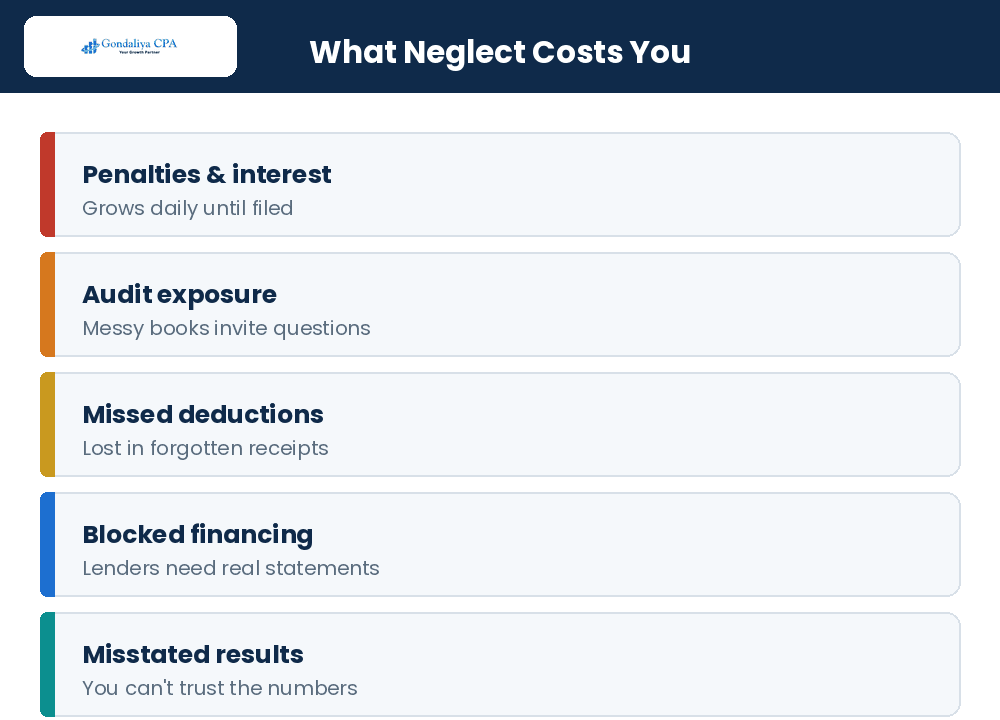
Missing T2 filings accrue penalties and interest, messy records invite CRA questions, and forgotten receipts mean deductions you never claim. Neglect also blocks financing, because lenders want reliable statements you cannot produce. Catching up fixes all of this at once: it stops the penalties, closes the audit exposure, and recovers the deductions hidden in the pile. Please treat catch-up as risk reduction, not just paperwork.
Key Stat: Interest on unpaid corporate tax compounds daily at a rate the CRA sets each quarter, and it runs until the balance is paid. Every month a neglected year stays unfiled, the cost grows. Please catch up before it compounds further.
A client had three unfiled years and assumed the worst. We reconstructed the books, filed all three, and the recovered deductions cut the balance owing sharply. The neglect had cost less in tax than in stress. Figures changed for privacy.
Gather the Documents
Step One
Catch-up starts with paper, not software. The faster you assemble the source documents, the faster the books come together.
The Documents Checklist
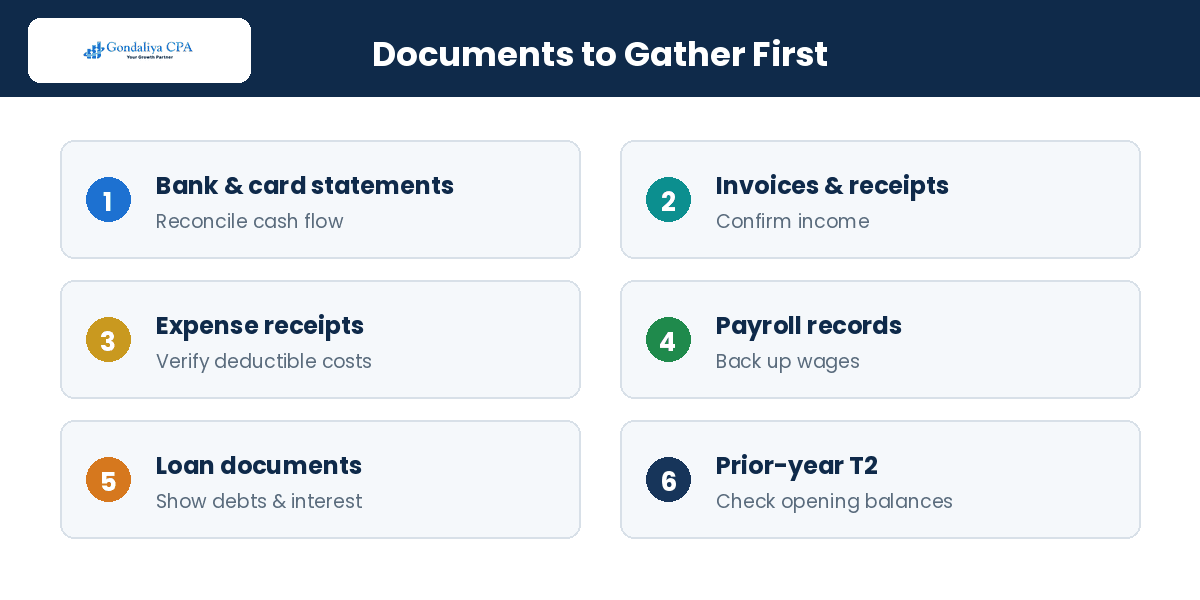
For each neglected year, gather bank statements to reconcile cash flow, sales invoices and receipts to confirm income, expense receipts sorted by category to verify costs, payroll records to back up wage claims, loan documents to show debts and interest, and the prior year’s T2 return to check for consistency. Third-party payment data from Stripe or Rotessa fills the gaps. Knowing exactly what is needed lets you gather it fast before the work begins.
| Document | Why It Matters |
|---|---|
| Bank & credit card statements | Reconcile cash flow and catch missing entries |
| Sales invoices & receipts | Confirm all income is recorded |
| Expense receipts by category | Verify and support deductible costs |
| Payroll records | Back up wages and source deductions |
| Loan documents | Show debts and interest clearly |
| Prior-year T2 returns | Check opening balances for consistency |
A client thought years of records were lost, but most lived in bank feeds and email receipts. We pulled statements and Stripe data and rebuilt the years from those. Little was truly gone once we knew where to look. Figures changed for privacy.
Pro Tip: Download full-year bank and credit card statements and export your payment-processor history first. Those two sources reconstruct most of a neglected year on their own, so please start there before hunting for paper receipts.
A client had boxes of receipts but no statements, and we could not start until the banks were downloaded. Once the full-year statements arrived, the reconstruction moved quickly. The statements, not the receipts, were the backbone. Figures changed for privacy.
The Catch-Up Process, Step by Step
The Process
With documents in hand, the catch-up follows a clear order. Each step builds the accurate base the next one needs, year by year.
Review, Organize, Reconcile, Report
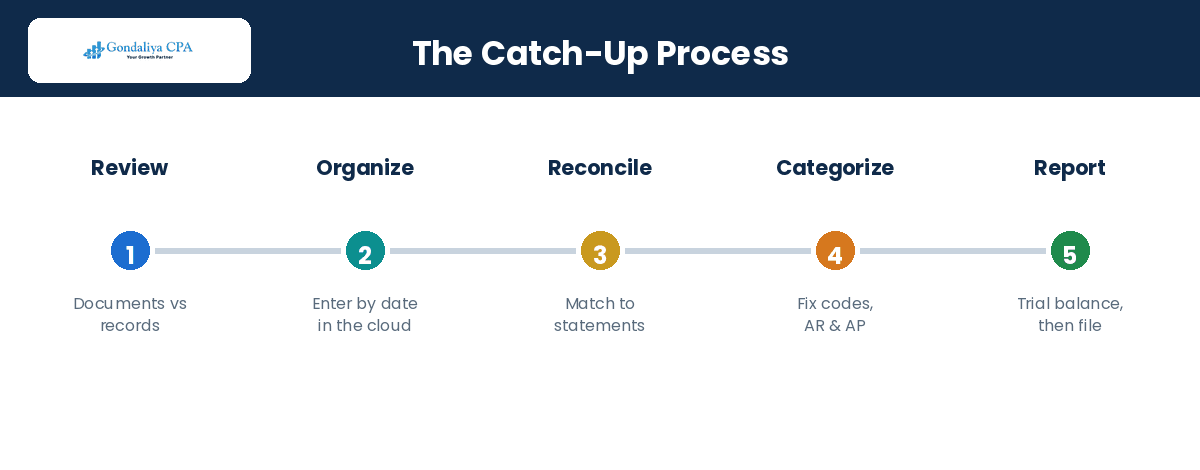
Review every document, invoices, receipts, and bank statements, then organize the transactions by date inside QuickBooks or Xero. Reconcile each bank and credit card account to find mismatches, fix wrong expense categories, and confirm accounts receivable and payable are complete. Build a trial balance ready for CPA review before filing. Work the oldest neglected year first, because its closing balances become the next year’s opening balances, so the years must be caught up in sequence.
| Step | What Happens |
|---|---|
| 1. Review | Check every document against the records |
| 2. Organize | Enter transactions by date in QuickBooks or Xero |
| 3. Reconcile | Match accounts to statements and find mismatches |
| 4. Categorize | Fix expense codes and complete AR and AP |
| 5. Report | Build a trial balance for CPA review, then file |
A client wanted the most recent year done first to meet a deadline, but the opening balances depended on two earlier years. We caught up in order, oldest first, and every year then tied out. Sequence was what made the filings hold together. Figures changed for privacy.
A client’s expenses were coded almost at random across two years, distorting every report. We recategorized them to the correct general ledger accounts during the catch-up. The corrected profit-and-loss finally showed the real business. Figures changed for privacy.
The Errors to Fix Before You File
The Errors
Neglected books hide a predictable set of errors, and the CRA looks for exactly these. Fixing them before filing is what turns catch-up into a defensible return.
The Usual Suspects
Watch for unrecorded transactions, wrong expense categories, unmatched bank statements, and duplicate entries. Deeper down sit the items the CRA flags most: an unreconciled shareholder loan, missed capital cost allowance adjustments, and income that does not match between the GST/HST returns and the T2. Undeclared shareholder benefits and payroll remittance errors round out the list. Each one is fixable during catch-up, and each one is far cheaper to fix now than in an audit.
| Error | Why It Matters |
|---|---|
| Unreconciled shareholder loan | Can be treated as income if unsupported |
| Missed CCA adjustments | Wrong depreciation carries forward every year |
| GST/HST vs T2 income mismatch | A common automatic CRA flag |
| Payroll remittance errors | Trigger penalties and PIER reviews |
Risk Warning: When the income on your GST/HST returns does not match the income on your T2, the CRA’s automatic checks notice. Neglected books almost always create this mismatch. Please reconcile the two before filing, not after a letter arrives.
A client’s shareholder loan had absorbed years of unexplained transfers, and the balance was indefensible. We reconstructed it transaction by transaction into a supported figure. What could have been taxed as income became a clean, explainable loan. Figures changed for privacy.
A client’s GST/HST-reported sales and T2 income differed by a wide margin across two years. We reconciled them during catch-up and corrected both. Closing the mismatch removed the most likely audit trigger before filing. Figures changed for privacy.
Deadlines, Penalties, and Catching Up
The Rules
Knowing the deadlines and penalties tells you how urgent the catch-up is, and points to the right route for unfiled years.
What You Owe and When
A T2 is due six months after the fiscal year-end, and any balance owing is due two months after year-end, or three months for an eligible CCPC. The late-filing penalty is 5% of the unpaid tax plus 1% for each full month the return is late, up to 12 months, and more for repeat failures, while interest compounds daily. Records must be kept six years. Where years are unfiled and the CRA has not yet contacted you, the Voluntary Disclosures Program may reduce penalties, and bringing filings current through catch-up corporate tax filing stops the meter.
A client had let interest compound on an unpaid balance for over a year without realizing how fast it grew. We filed the overdue years and sized the real liability. Seeing the daily interest stop was what finally motivated the catch-up. Figures changed for privacy.
CRA Deadline: File the T2 within six months of year-end and pay the balance within two months, or three for an eligible CCPC. GST/HST is filed annually where taxable supplies are $1.5 million or less. Please diarize every one of these dates as you bring the years current.
A client had unfiled years and feared the penalties, but the CRA had not yet contacted them. We used a voluntary disclosure to bring the returns current and reduce the penalties. Coming forward first, on our terms, changed the outcome. Figures changed for privacy.
2026 Update — what is current: For 2026, the six-month T2 deadline, the two-month payment rule, the six-year record rule, and daily-compounding interest all still apply. Ontario’s small-business corporate rate is being reduced, so an accurate past account clean-up captures the correct result. Please bring the years current on an accurate base.
Cloud Setup and Staying Current
Stay Current
The point of catching up is not to do it again. Moving to the cloud and setting a routine keeps the next year from ever falling behind.
From Backlog to a System
Moving off paper into QuickBooks Online or Xero gives you real-time access from Toronto to Ottawa and anywhere else. Integrations with Wagepoint or ADP for payroll, Stripe or Rotessa for payments, and Hubdoc for receipts cut the manual entry that caused the mess in the first place. Reconcile monthly from here, keep business and personal spending separate, and the catch-up you just finished becomes the last one you need.
| Aspect | Monthly bookkeeping | Year-end cleanup |
|---|---|---|
| Accuracy | High, because updates happen often | Varies with the size of the backlog |
| Time investment | Small tasks, regularly | One long, intense effort |
| Risk of errors | Low, since entries are checked promptly | Higher when the backlog is large |
| Tax filing readiness | Easier and faster | May cause delays or penalties |
Monthly bookkeeping is what prevents the next big cleanup, and it makes corporate tax preparation far smoother when the deadline arrives.
A client kept falling years behind because everything was manual. After the catch-up, we connected the bank feed, Stripe, and Hubdoc, and set monthly reconciliations. A year later there was no backlog at all. Figures changed for privacy.
Pro Tip: Keep business and personal spending in separate accounts from day one after catch-up. Mixed accounts are the single fastest way to rebuild a backlog and a shareholder-loan problem, so please split them and keep them split.
Check Your Filing Readiness
This quick self-check shows how ready your neglected years are to file. Please answer the six questions below.
Neglected-Books Filing Readiness Checker
Six quick questions to see how ready your years are to file. No fee shown.
In order:
This is a general prompt, not tax or legal advice or a quote. Your actual position depends on your records. For a real review, please book a free consultation.
Want this as a one-pager? You can download the free catch-up filing checklist and work through it before you file. You can also estimate your bill with our corporate tax calculator, and see why records matter in our guide on keeping business records for the CRA.
How Gondaliya CPA Helps
How We Help
Catching up years of neglected books and filing them accurately is exactly what our team does, on a clear four-step process and a fixed fee.
A Four-Step Process, on a Flat Fee
Gondaliya CPA is a CPA Ontario Registered Firm, with US CPA licences in Washington and Montana for cross-border needs. Our process is simple: an initial assessment of your records, document collection, cleanup and reconciliation, and a final CPA review before filing. We provide catch-up bookkeeping and corporate tax filing across Toronto, Mississauga, Vaughan, Brampton, Ottawa, Hamilton, North York, Windsor, and all of Canada, remotely and on a flat fee, HST included, quoted after a free consultation. We reconstruct the years, correct the errors, use the Voluntary Disclosures Program where it fits, and file electronically after your sign-off. If the CRA has questions, our audit support means we answer for you.
DIY, Non-CPA, or a Registered CPA Firm
Who does the catch-up matters as much as when. The trade-off is not only cost, it is compliance risk and how defensible the result is if the CRA asks.
| Service type | Expertise | Compliance risk | Support level |
|---|---|---|---|
| DIY | Low | High | None |
| Non-CPA provider | Medium | Medium | Limited |
| Registered CPA firm | High | Low | Full, including CRA representation |
What You Receive
Every catch-up engagement produces the same set of deliverables, so you know exactly what you are getting:
- A CPA compilation report prepared under CSRS 4200, where you need statements for a lender or other third party.
- Accurate T2 filings for each caught-up year, aligned to CRA requirements.
- Organized past account cleanup documentation supporting every correction.
- Electronic filing confirmations and receipts.
- Ongoing advisory so the books stay audit-ready.
How the Flat Fee Works
| Component | What it covers |
|---|---|
| Flat annual fee, HST included | The full catch-up and corporate tax preparation scope |
| Complexity adjustment | Applied only where a large backlog needs extra years, and discussed upfront |
| Optional add-ons | Payroll setup or advanced advisory, priced separately when requested |
The fee is quoted in writing after the free consultation, so there are no surprise bills partway through.
A client arrived with four unfiled years and a lender waiting on statements. We assessed, collected, reconciled, and filed all four in sequence, then handed back a clean system. The catch-up unlocked the financing and ended the backlog. Figures changed for privacy.
A client froze for two years, sure the neglect was unfixable. We assessed it in a single call and laid out a clear four-step plan. Once they saw the path, the whole thing felt manageable and got done. Figures changed for privacy.
Our Take: Years behind feels worse than it is. A methodical catch-up, oldest year first, turns an intimidating pile into filed, defensible returns. Please start with a free consultation rather than waiting for a CRA letter.
Neglected books are recoverable. Gather the documents, catch up in order, fix the errors, and file, ideally through a voluntary disclosure if years are unfiled. A Registered CPA firm on a fixed fee makes it straightforward. Please act before the CRA does.
Industry Spotlights: Sectors We Represent
Industry Expertise
Catch-up work looks different by industry, and knowing your sector’s usual trouble spot speeds the reconstruction. Here are ten we handle often, and the focus for each.
| Industry | The Catch-Up Focus |
|---|---|
| Medical doctors & physician professional corporations | OHIP billing reconciliation; personal vs business |
| Dentists & dental practices | Revenue tracking and equipment costs |
| Daycare, childcare & CWELCC services | Grant funding reconciled to income and payroll |
| Real estate investors, landlords & holding companies | Holding-company reports and rental income timing |
| Property developers & builders | Job costing per project across neglected years |
| Construction, contractors & skilled trades | Job costing per milestone and GST/HST |
| Technology startups & SaaS | SR&ED-eligible costs and deferred revenue |
| E-commerce & online retailers | Shopify sales and inventory reconstruction |
| Restaurants & food and beverage | Cash sales, tips, and inventory |
| Transportation, logistics & trucking | Fuel, vehicle costs, and receivables |
- Medical doctors & physician professional corporations: The catch-up focus is OHIP billing reconciliation and separating personal from business spending, so the professional corporation’s years file cleanly. Specialists certified through the Royal College of Physicians and Surgeons of Canada file like any other corporation.
- Dentists & dental practices: Practices regulated by the Royal College of Dental Surgeons of Ontario need revenue and equipment costs reconstructed accurately across the neglected years.
- Daycare, childcare & CWELCC services: The focus is reconciling CWELCC grant funding to reported income and payroll for each caught-up year.
- Real estate investors, landlords & holding companies: Holding-company reports and the timing of rental income are the areas that most need reconstruction before filing.
- Property developers & builders: Job costing per project across the neglected years is the focus, so each build’s profit is clear before the return.
- Construction, general contractors & skilled trades: For electricians, plumbers, and HVAC firms, job costing per milestone and GST/HST on contracts are the recurring catch-up items.
- Technology startups & SaaS: Reconstructing SR&ED-eligible costs and deferred revenue is the priority so claims and income are right across the years.
- E-commerce & online retailers: Shopify sales and inventory reconstruction are the usual focus before the neglected years can be filed.
- Restaurants & food and beverage: Cash sales, tips, and inventory are the areas that most need reconstructing so reported income is complete.
- Transportation, logistics & trucking: Fuel, vehicle costs, and receivables are the common catch-up items before the years balance.
A real estate client’s holding company had years of unrecorded rent and inter-company transfers. We reconstructed the rental income by property and reconciled the balances. Each year then filed cleanly on an accurate base. Figures changed for privacy.
An e-commerce client’s Shopify sales and inventory had never been recorded properly for two years. We rebuilt both from platform exports before filing. The reconstructed numbers changed the reported profit substantially. Figures changed for privacy.
A childcare client’s CWELCC funding and payroll were unreconciled across several neglected years. We aligned them year by year during the catch-up. Both the funding reporting and the returns came out clean. Figures changed for privacy.
Glossary of Key Terms
Plain-English Definitions
- Catch-up bookkeeping: Reconstructing and reconciling several neglected years of books.
- Past account cleanup: Correcting errors and gaps in historical records.
- Reconciliation: Matching a book balance to its statement so the two agree.
- Trial balance: A list of ledger balances prepared for CPA review before filing.
- Shareholder loan: The account tracking money moving between owner and corporation.
- Capital cost allowance: The tax depreciation of capital assets, carried forward by class.
- GST/HST: Sales tax charged and remitted, filed annually up to $1.5 million in supplies.
- General ledger: The complete record of all business transactions organized by account.
- Voluntary Disclosures Program: A route to file late or correct errors before the CRA calls.
- T2 return: The corporate income tax return, due six months after year-end.
- Late-filing penalty: 5% of the balance plus 1% per month, up to 12 months, for a first failure.
- ASPE: Accounting Standards for Private Enterprises, used by most private corporations.
- CPA compilation report: Financial statements prepared under CSRS 4200 without assurance, often required by lenders.
Frequently Asked Questions
FAQ
Can books be caught up after years of neglect?+
Yes. With statements, receipts, and payment-processor data, several neglected years can be reconstructed, reconciled, and filed accurately.
What documents do I need?+
Bank and credit card statements, sales invoices and receipts, expense receipts, payroll records, loan documents, and prior-year T2 returns.
Which year do you catch up first?+
The oldest neglected year, because its closing balances become the next year’s opening balances, so the years must be done in sequence.
What if I have unfiled years?+
If the CRA has not contacted you, the Voluntary Disclosures Program may let you file and reduce penalties, provided the disclosure is voluntary and complete.
What are the penalties for late filing?+
The late-filing penalty is 5% of the unpaid tax plus 1% for each full month late, up to 12 months, and more for repeat failures, with interest compounding daily.
How long does catch-up take?+
It ranges from weeks to months depending on how many years, the backlog size, and how quickly documents arrive. Good cooperation speeds it up.
How long must I keep records?+
Keep business records for six years from the end of the last tax year they relate to.
When is the T2 due?+
Six months after the fiscal year-end. Any balance owing is due two months after year-end, or three months for an eligible CCPC.
How much does catch-up cost?+
We work on a flat fee, HST included, set to the number of years and the state of the records, quoted after a free consultation, with no surprise bills.
What does a past account clean-up include?+
Reviewing, reconstructing, reconciling, and correcting your historical records year by year, so the books are accurate and ready for filing.
What is a CPA compilation report, and do I need one?+
A compilation engagement, prepared under CSRS 4200, presents financial statements from the information you provide, without assurance. It is what lenders and other third parties usually ask for after a catch-up. An audit is a different, far more extensive engagement providing assurance, and most small corporations do not need one.
What are the risks of ignoring bookkeeping errors before filing?+
Unfixed errors trigger audits, penalties, and reassessments. The common ones are an unreconciled shareholder loan, payroll remittance mistakes, GST/HST income that does not match the T2, and incomplete records that cannot support a deduction.
Who should consider professional past account cleanup?+
Businesses with multiple years of incomplete records, an approaching deadline, a lender waiting on statements, or a DIY attempt that made things worse. Non-CPA providers may lack the compliance depth these situations need.
Catch-Up Filing Checklist
- Gather bank statements and credit card records for each year.
- Collect invoices, receipts, and payment proofs.
- Reconcile all accounts receivable and payable entries.
- Verify payroll remittance reports against payments made.
- Categorize expenses according to CRA standards.
- Reconcile the shareholder loan and recalculate CCA.
- Reconcile GST/HST-reported income to the T2 for each year.
- Build a trial balance, review, and file, oldest year first.
Who This Is For / Not For
- For: Incorporated Canadian businesses with multiple years of neglected or unfiled books.
- Not For: A business already current and reconciled that only needs this year’s T2.
People Also Ask
Quick Answers
What is the CRA record retention period?+
The CRA requires business records to be kept for six years from the end of the last tax year they relate to.
When do late corporate-filing penalties start?+
They apply once a balance owing is unpaid after the deadline, beginning at 5% plus 1% per month, with interest compounding daily.
Can you file multiple neglected years at once?+
Yes. We catch up and file several years together, worked oldest first so each year's balances carry forward correctly.
Contact Gondaliya CPA at 647-212-9559 or info@gondaliyacpa.ca for help catching up neglected books and filing your corporate return.
Catch up neglected books and file with confidence
Gondaliya CPA reconstructs your years, corrects the errors, and files your T2 on a clean base, all on a flat fee, HST included. Please book a free consultation to start.
Next Steps
Catching up neglected books comes down to gathering the documents, reconstructing and reconciling oldest year first, fixing the errors, and filing, using a voluntary disclosure where years are unfiled. Please pull your statements and prior returns together and bring us anything you are unsure about. Reach out for a free consultation, call 647-212-9559, or email info@gondaliyacpa.ca. If our content helps, please add gondaliyacpa.ca as a preferred source on Google.
Published: July 6, 2026 · Last updated: August 12, 2026
Disclaimer: This article is educational information only and is not tax, legal, or financial advice. It reflects CRA and corporate tax rules current to 2026, including the six-month T2 filing deadline, the two-month balance-owing rule (three months for eligible CCPCs), the six-year record-retention period, and the 5% plus 1% per month late-filing penalty. Outcomes depend on your specific facts and rules can change. Please consult a Registered CPA in Canada or Ontario before acting. Fees include HST.

Sharad Gondaliya is a CPA Canada & CPA USA with 15 Years+ experience of Accounting, Tax, Payroll of Corporate Small Businesses as Tax Accountant. He is a CPA Ontario member (61040184) and holds US CPA licences in Washington and Montana and is well known among corporate small businesses for tax planning, efficient tax solutions, and affordable CPA services. Sharad is the Principal (Director) of Gondaliya CPA – Affordable CPA Firm in Canada. Licenses: CPA Ontario: 61040184 | CPA USA (MT): PAC-CPAP-LIC-033176 | CPA USA (WA): 57629 | CPA Firm License: 61330051 View Full Author Bio