



Past Account Clean-Up Checklist: Documents and Records Your CPA Needs to Fix Your Books
A detailed bookkeeping cleanup checklist is essential for accounting records cleanup and effective business document organization, including reviewing bank reconciliation records, missing invoices, and financial statements. Gondaliya CPA specializes in CPA bookkeeping services to fix your books, manage payroll records cleanup, and organize tax documents with precision.
Quick Summary
A past account clean-up needs the right documents: statements, invoices, receipts, payroll, GST/HST, and prior filings. Gather them, review the reconciliations and reports, then fix the missing entries, wrong categories, and stale accounts. Please assemble the paperwork first, because it decides how fast and how cleanly the rest goes.
| Aspect | Details |
|---|---|
| What it is | The documents and records a CPA needs to fix your books. |
| The core | Statements, invoices, receipts, payroll, and GST/HST records. |
| The review | Reconciliations, financial statements, and the chart of accounts. |
| The payoff | Accurate books, audit readiness, and smoother tax filing. |
Reading time: 27 minutes.
Table of Contents
- Why the Clean-Up Checklist Matters
- The Documents to Gather
- Bank Reconciliation and Financial Statements
- Missing Invoices, Receipts, and AP/AR
- Payroll Records Clean-Up and Compliance
- Chart of Accounts, Old Transactions, and Assets
- Tools, Automation, and When to Call a CPA
- Industry Spotlights: Sectors We Represent
- Glossary of Key Terms
- Frequently Asked Questions
- People Also Ask
The Checklist at a Glance
This article covers Canada, with Toronto and Ontario context, and reflects CRA and accounting rules current to 2026. It assumes an incorporated business keeping records under ASPE, with clean-up delivered as a professional past account clean-up that restores accurate records for filing. Items marked “illustrative” are examples, not quotes, and any masked engagement notes end with “Figures changed for privacy.” This is educational information only and not tax, legal, or financial advice. Fees include HST. Please confirm your own situation with a Registered CPA before acting.
Why the Clean-Up Checklist Matters
The Basics
A past account clean-up sorts out messy or incomplete accounting records so your books match reality and meet CRA rules. Without it, financial information gets unreliable fast, and you cannot see where the business truly stands. A checklist is what keeps the clean-up complete instead of piecemeal.
The Challenges It Solves
The usual trouble spots are predictable: missing invoices or receipts that leave the picture incomplete, bank statements that do not match the records, and duplicate or wrong transaction categories that throw off profit and confuse reports. Incomplete expense records make tax filing a headache. Spotting these early keeps the books accurate and review-ready. Organized documents then make everything downstream easier, T2 filing, on-time GST/HST returns, and correct payroll, so please treat the checklist as the backbone of the whole job.
Key Stat: The CRA requires business records to be kept for six years from the end of the last tax year they relate to. A clean-up that gathers and organizes those years is what makes an audit quick instead of painful. Please build the six-year view as you go.
A client’s books looked hopeless until we worked a document checklist section by section. Each gap we closed made the next one obvious. Structure, not heroics, was what fixed the mess. Figures changed for privacy.
The Documents to Gather
Step One
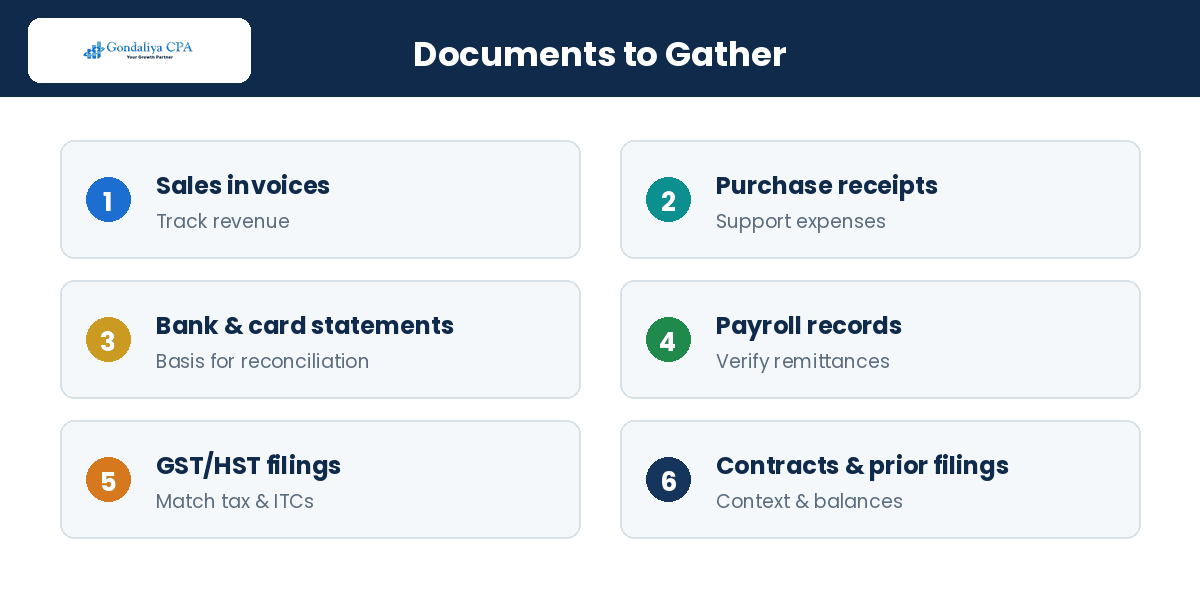
Gather every bookkeeping document for the period first: sales invoices, purchase receipts, bank and credit card statements, payroll records, GST/HST filings, and contracts. Good document organization stops the data gaps that cause errors or CRA questions.
What to Collect and Why
Sales invoices track revenue from clients, so make sure none are missing. Purchase receipts confirm expenses from vendors, and missing ones can lead to audit trouble. Bank statements give the monthly record needed for reconciliation. Payroll records from providers like ADP verify CRA remittance accuracy. GST/HST filings need special care: gather every sales invoice with tax charged and every receipt supporting an input tax credit claimed. Keeping digital copies in Hubdoc, QuickBooks, or Xero avoids lost files and speeds up the work.
| Document | Why It Matters |
|---|---|
| Sales invoices | Track revenue; confirm nothing is missing |
| Purchase receipts | Support expenses and deductions |
| Bank & credit card statements | The basis for reconciliation |
| Payroll records | Verify wages and CRA remittances |
| GST/HST filings | Match tax charged and input tax credits |
| Contracts & prior filings | Provide context and opening balances |
A client handed us a shoebox and assumed it was all there, but the bank statements told a fuller story. Downloading full-year statements surfaced dozens of unrecorded transactions. The statements anchored everything else. Figures changed for privacy.
Pro Tip: Download full-year bank and credit card statements and export payment-processor history from Stripe or Rotessa before hunting for paper. Those sources rebuild most of a period on their own, so please start there.
Bank Reconciliation and Financial Statements
The Review
Reconciliation confirms that what you recorded matches actual bank activity. Reviewing those records finds missed fees or payments that distort your cash-flow numbers.
Match the Records to Reality
Review the financial statements too, income statement, balance sheet, and cash flow, and check them against source documents. Cleaning up QuickBooks or Xero keeps transactions aligned with the chart of accounts. Doing this consistently cuts the errors that trigger CRA questions on the T2. Automated matching helps, but a person still needs to catch what the software misses. Please reconcile every account, not just the main one.
A client trusted the software’s automatic matching completely, but it had mis-coded a run of transfers as income. A manual review caught it before filing. Automation is a tool, not the final check. Figures changed for privacy.
A client had never reconciled a second bank account, and it held months of unrecorded income. Reconciling every account, not just the main one, surfaced it before filing. The full reconciliation was what made the books complete. Figures changed for privacy.
Risk Warning: An unreconciled account hides both missed income and missed deductions, and the CRA’s automatic checks are built to notice the resulting mismatches. Please reconcile before you file, not after a letter arrives.
Missing Invoices, Receipts, and AP/AR
The Gaps
Missing invoices distort revenue tracking, and lost receipts undermine expense claims allowed under Canadian tax law. Finding and managing these gaps is central to the checklist.
Find the Gaps, Then Close Them
To find missing paperwork, compare sales logs with payments from Stripe or Rotessa, and set reminders for clients or vendors about overdue documents before deadlines pass. If an original cannot be found, note every attempt to get it, which helps in an audit. Then review accounts payable and receivable: match vendor bills against payment records and confirm receivables are complete, because AP and AR errors distort reports and create cash-flow problems. A central digital store reduces lost files and speeds up report preparation.
| Item | What to Check |
|---|---|
| Missing invoices | Compare sales logs to processor payments |
| Lost receipts | Document every attempt to recover them |
| Accounts payable | Match vendor bills to payment records |
| Accounts receivable | Confirm all revenue is invoiced and tracked |
A client could not locate several vendor receipts, so we matched the payments through the bank and processor records and documented each attempt to recover the originals. The trail held up when the CRA asked. Documentation beat panic. Figures changed for privacy.
A client’s receivables were understated because several invoices were never recorded. We reconciled deposits to sales and found the gap. Correcting it changed both revenue and the tax owing. Figures changed for privacy.
Payroll Records Clean-Up and Compliance
Payroll
Payroll errors are expensive, including penalties for late CPP or EI remittances. Payroll clean-up confirms that hours match pay and that deductions are correct.
Match Pay, Deductions, and Slips
Using Wagepoint, ADP, or a similar system linked to your accounting software, confirm employee pay and deductions, then match the payroll ledger to the T4 slip rules the CRA requires each year. Sorting employees from contractors matters, because it affects taxable benefits and the corporate tax owed. Clean payroll files avoid costly reassessments and PIER reviews, and make GST/HST returns easier when claiming employment-related credits. Please reconcile what was remitted against what the slips report for every year in scope.
A client had missed several payroll remittance deadlines and the penalties had stacked up. We reconciled the payroll and brought the remittances current during clean-up. Catching it in the books stopped the bleeding. Figures changed for privacy.
CRA Deadline: T4 and T4A slips are due to employees and the CRA by the last day of February each year, and source deductions are remitted on the schedule the CRA sets for your payroll. GST/HST is filed annually where taxable supplies are $1.5 million or less. Please diarize each of these as you clean up.
A client had paid several workers as contractors who should have been employees, creating a remittance gap. We corrected the classification and reconciled the slips during clean-up. Fixing it early avoided a far larger reassessment. Figures changed for privacy.
Chart of Accounts, Old Transactions, and Assets
The Fixes
The final part of the checklist tidies the structure itself: the chart of accounts, old transactions, inventory, and assets, then updates the reports and organizes the tax file.
Tidy the Structure, Verify the Assets
Clean the chart of accounts by removing outdated categories and grouping similar codes so reports stay consistent and comparable over time. Review old transactions, watching for entries past their retention with no backup, such as expired vendor contracts still sitting on the trial balance, because those inflate assets and mislead lenders. Count inventory and verify assets so book values match real items, which matters for statements that follow Canadian GAAP and for the T2. Organize purchase orders, stock logs, supplier contracts, and depreciation schedules together.
Update the Reports and the Tax File
After the fixes, update the financial statements so they show true results, refresh the balance sheet with verified asset values, and reconcile the trial balance so debits equal credits. Then organize the tax documents: confirm GST/HST reported matches the source ledgers, keep CRA letters and remittance slips handy, and use clear file names with digital backups. This is what makes both filing and any audit straightforward.
A client’s trial balance still carried assets that no longer existed, overstating the balance sheet a lender relied on. We wrote them off with support during clean-up. The corrected statements were both accurate and defensible. Figures changed for privacy.
A client’s chart of accounts had grown to dozens of overlapping categories, so no report made sense. We consolidated and aligned it to CRA categories during clean-up. The tidied structure finally produced comparable reports. Figures changed for privacy.
2026 Update — what is current: For 2026, the six-year record rule, the six-month T2 deadline, and annual GST/HST filing up to $1.5 million in taxable supplies all still apply. Ontario’s small-business corporate rate is being reduced, so accurate clean-up captures the correct result. Please align the chart of accounts and reports to current CRA categories as you go.
Tools, Automation, and When to Call a CPA
Getting It Done
The right tools speed the clean-up, and knowing when to bring in a CPA keeps it accurate. Both belong on the checklist.
The Tools That Help
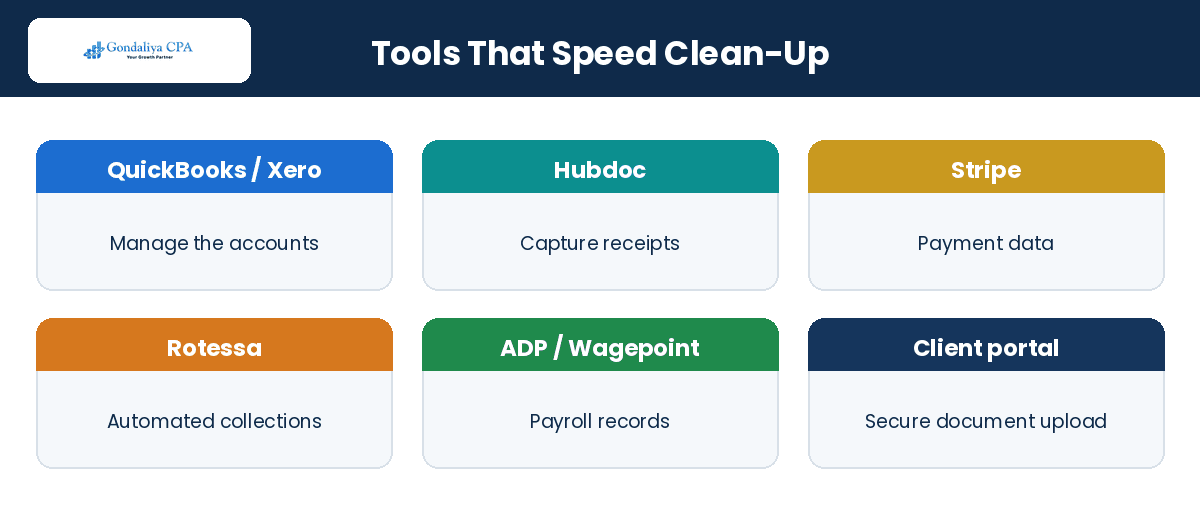
QuickBooks and Xero manage the accounts, Hubdoc captures receipts automatically, Stripe and Rotessa feed payment data straight into the books, and ADP or Wagepoint handle payroll. Client portals let you upload documents securely and review files in real time, and online banking downloads transactions directly into the accounting system. Used together, they cut manual entry, reduce errors, and free time for the careful review the work demands.
When to Call a CPA, and DIY vs CPA vs Non-CPA
Call a CPA when records are messy or incomplete, when a T2 or GST/HST deadline is near, or when a CRA audit or review is underway. DIY suits minor errors with simple records, but the time cost is real. A Registered CPA firm handles complex cases needing regulatory knowledge and audit readiness, on a fixed fee, HST included. A non-CPA provider may cost less but can lack full compliance expertise and accountability. Please weigh risk and time, not just the sticker price.
Setting the Scope Before You Start
Decide which years need fixing before any work begins, particularly if a T2 or GST/HST deadline is close. A defined scope keeps the project focused instead of drifting. Please prioritise what actually matters, missing invoices and unreconciled accounts first, rather than older expense categorisation, unless a lender or regulator has specifically asked for it. Clients also get a 30-day money-back guarantee if early expectations are not met, and a 60-day fees-matching policy on competitive pricing, so the commitment is low at the point where the scope is still being set.
| Option | Best Fit and Risk |
|---|---|
| DIY | Minor errors, simple records; high time cost and risk |
| CPA firm | Complex clean-ups and audit readiness; low risk, fixed fee |
| Non-CPA provider | Lower fees; variable accountability and compliance depth |
A client tried a DIY clean-up first and made the categorization worse before calling us. Starting from their attempt cost more than a clean start would have. Bringing a CPA in earlier would have been the cheaper path. Figures changed for privacy.
A client set up a secure portal and dropped documents in as they found them, and Hubdoc captured the receipts automatically. The steady flow kept the clean-up moving without email chaos. The tools cut the admin in half. Figures changed for privacy.
A checklist-driven clean-up, gather, review, fix, and update, restores books you can trust and file from. For anything beyond minor errors, a Registered CPA firm on a fixed fee is the dependable route. Please start with a free consultation.
Routine Delegation or Emergency Clean-Up
Incorporated SMBs usually choose between handing off the daily bookkeeping or calling for an emergency clean-up once big errors surface, and we handle both. Routine delegation keeps documents organized and cuts future risk: QuickBooks or Xero for tracking, Wagepoint and ADP for payroll, Hubdoc for receipts, Stripe for payments, Rotessa for collections. An emergency clean-up fixes a large mess quickly so the books meet CRA rules without stopping daily work. Which you need depends on how far behind the records are, and mixing regular care with occasional deeper help often works best.
Keeping the Books Clean Afterwards
A clean-up is worth far more when it is the last one you need. Please set daily or weekly habits once the books are current:
- Automate bank feeds in QuickBooks or Xero to cut manual entry mistakes.
- Use Hubdoc to capture missing invoices or receipts as they arrive.
- Clean payroll records regularly so employee pay reports stay accurate.
- Reconcile bank statements against the ledgers monthly so you never fall behind.
- Review the chart of accounts annually so expense tracking stays aligned to CRA categories.
These habits keep GST/HST reviews simple because the transactions are already correct, and they keep deductions supported if you are ever audited.
What Clean Books Actually Give You
Tidy books save real time at T2 preparation, because an accountant finds what they need immediately instead of reconstructing a year. They cut the mistakes that force corrections after filing, and with them the CRA penalties tied to late or wrong GST/HST returns. Audits get easier because every transaction has support behind it, so an auditor spends less time digging. And steady records let you actually see cash flow, which makes budgeting possible rather than guesswork.
How Gondaliya CPA Helps
Gondaliya CPA is a CPA Ontario Registered Firm, with US CPA licences in Washington and Montana for cross-border needs. We provide past account clean-up and bookkeeping for incorporated SMBs across Toronto, Mississauga, Vaughan, Brampton, Ottawa, Hamilton, North York, Windsor, and all of Canada, remotely and on a flat fee, HST included, with a one-business-day response. We work in QuickBooks and Xero with Hubdoc, track GST/HST input tax credits, keep digital backups, and support SaaS and Shopify sellers. Our page on what happens if you do not keep business records explains why this matters, and our DIY versus CPA comparison lays out the trade-offs. Beyond the clean-up itself, we advise on mergers, acquisitions, and business restructuring, and we prepare compilation engagements under CSRS 4200 where a lender or third party needs formal statements.
Our Take: A clean-up feels overwhelming until it is a checklist. Gather, review, fix, and update, in that order, and messy books become filable. Please pair the clean-up with a monthly routine so it is the last one you need.
Check Your Clean-Up Readiness
This quick self-check shows which documents you already have and which to chase. Please answer the six questions below.
Past Account Clean-Up Document Checker
Six quick questions to see which records your CPA still needs. No fee shown.
Ready:
This is a general prompt, not tax or legal advice or a quote. Your actual position depends on your records. For a real review, please book a free consultation.
Want this as a one-pager? You can download the free past account clean-up checklist and gather as you go. You can also estimate your bill with our corporate tax calculator, and if the CRA is already asking questions, see our CRA audit support.
Industry Spotlights: Sectors We Represent
Industry Expertise
The clean-up checklist shifts by industry, and knowing your sector’s trouble spot speeds the work. Here are ten we handle often, and the record that needs the most care for each.
| Industry | The Record That Needs Care |
|---|---|
| Medical doctors & physician professional corporations | Billing reconciliation; personal vs business |
| Dentists & dental practices | Revenue records and equipment costs |
| Daycare, childcare & CWELCC services | Grant funding reconciled to income and payroll |
| Real estate investors, landlords & holding companies | Holding-company records and rent tracking |
| Property developers & builders | Project cost records across builds |
| Construction, contractors & skilled trades | Job-cost records and GST/HST on contracts |
| Technology startups & SaaS | Deferred revenue and platform records |
| E-commerce & online retailers | Shopify and Amazon sales and inventory |
| Restaurants & food and beverage | Daily sales, tips, and inventory |
| Transportation, logistics & trucking | Fuel, vehicle costs, and receivables |
- Medical doctors & physician professional corporations: The record that needs care is billing reconciliation and separating personal from business spending, so the professional corporation’s books are clean. Specialists certified through the Royal College of Physicians and Surgeons of Canada gather the same documents as any corporation.
- Dentists & dental practices: Practices regulated by the Royal College of Dental Surgeons of Ontario need accurate revenue records and equipment-cost documentation gathered for clean-up.
- Daycare, childcare & CWELCC services: The focus is reconciling CWELCC grant funding to reported income and payroll, with the supporting records kept together.
- Real estate investors, landlords & holding companies: Holding-company records and rent tracking are the documents that most need organizing before the books balance.
- Property developers & builders: Project cost records across each build are the focus, so profit per project is clear in the cleaned books.
- Construction, general contractors & skilled trades: For electricians, plumbers, and HVAC firms, job-cost records and GST/HST on contracts are the documents to pull together.
- Technology startups & SaaS: Deferred revenue and platform records are the areas where careful document gathering pays off.
- E-commerce & online retailers: Shopify and Amazon sales exports plus inventory records are the documents that most need reconstructing.
- Restaurants & food and beverage: Daily sales, tips, and inventory are the records that must be complete for accurate books.
- Transportation, logistics & trucking: Fuel, vehicle costs, and receivables are the documents to gather before the accounts reconcile.
An e-commerce client’s Shopify and Amazon sales had never been reconciled to deposits, and inventory was guesswork. We rebuilt both from platform exports during clean-up. The corrected records changed the reported profit substantially. Figures changed for privacy.
A trades client’s job-cost records were scattered across texts and paper. We gathered and organized them by project during clean-up. Clear per-job costs finally showed which work paid. Figures changed for privacy.
A childcare client’s CWELCC funding records and payroll were never reconciled to income. We aligned them during the clean-up and kept the support together. Both the funding reporting and the books came out clean. Figures changed for privacy.
Glossary of Key Terms
Plain-English Definitions
- Past account clean-up: Correcting errors and gaps in historical records to restore accurate books.
- Bookkeeping checklist: The list of documents and records needed to fix the books.
- Reconciliation: Matching a book balance to its statement so the two agree.
- Chart of accounts: The organized list of accounts used to record transactions.
- Trial balance: A list of ledger balances where debits must equal credits.
- Accounts payable: Amounts the business owes to vendors and suppliers.
- Accounts receivable: Amounts customers owe the business.
- Input tax credit: GST/HST paid on purchases that offsets tax collected.
- General ledger: The complete record of all transactions organized by account.
- T4 slip: The annual statement of employment income and deductions filed with the CRA.
- T2 return: The corporate income tax return, due six months after year-end.
- ASPE: Accounting Standards for Private Enterprises, used by most private corporations.
- CSRS 4200: The standard governing compilation engagements, the report lenders most often request.
Frequently Asked Questions
FAQ
What is included in a past account clean-up checklist?+
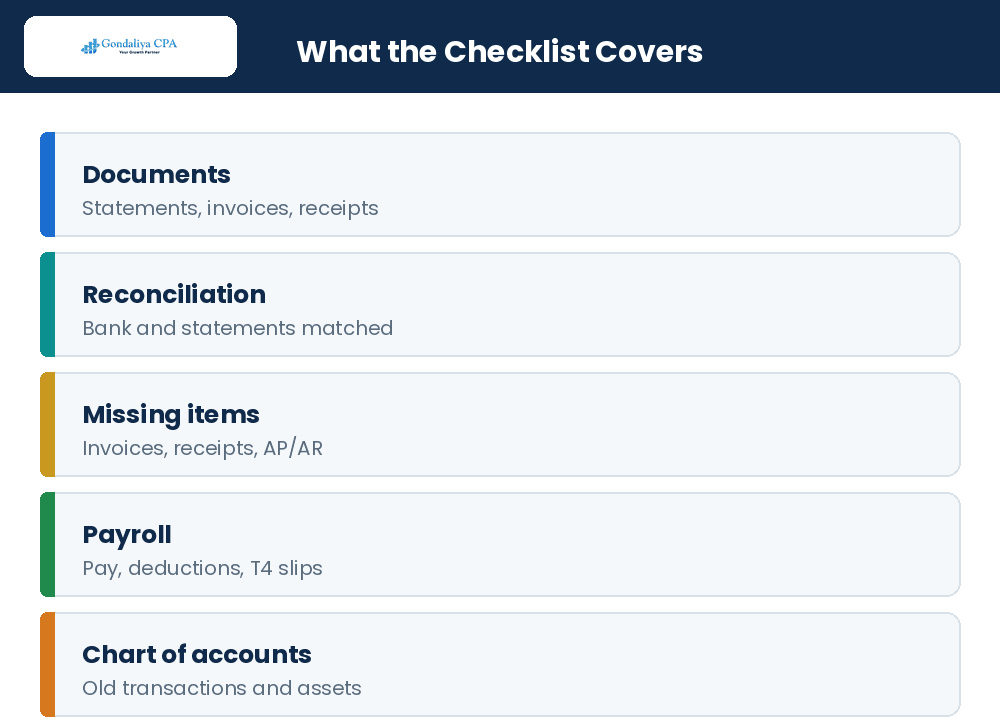
Payroll remittances, bank reconciliations, missing invoices, chart-of-accounts review, tax-document organization, and financial-statement verification.
What documents does my CPA need first?+
Bank and credit card statements, sales invoices, purchase receipts, payroll records, GST/HST filings, and any prior tax filings and contracts.
How long does a clean-up take?+
It ranges from weeks to months depending on the backlog and how quickly documents arrive. Good cooperation speeds it up.
How do payroll remittances affect the clean-up?+
Correct remittances prevent CRA penalties. Clean-up verifies that employee pay and deductions match the T4 slips and payroll summaries.
What if I cannot find some receipts?+
Match the payments through bank and processor records and document every attempt to recover the originals, which helps if the CRA asks.
Why does the chart of accounts need cleaning?+
Removing outdated categories and grouping similar codes keeps reports consistent and comparable, and aligns expenses with CRA categories.
How does clean-up help at tax time?+
Organized records make T2 filing faster, keep GST/HST returns accurate, and back up deductions if you are audited.
When should I hire a CPA instead of doing it myself?+
DIY suits minor errors with simple records. For complex clean-ups, deadlines, or a CRA audit, a Registered CPA firm is the safer choice.
What does it cost?+
A flat fee, HST included, set to the number of years and the state of the records, quoted after a free consultation, with no surprise bills.
What tools do you use?+
QuickBooks and Xero, with Hubdoc for documents, and connections to Stripe, Rotessa, Wagepoint, and ADP.
What is the role of a CPA compilation report in a clean-up?+
A compilation engagement, prepared under CSRS 4200, presents financial statements from the information you provide once the books are corrected. It is what lenders and other third parties usually ask for, and it gives the cleaned-up records a formal, presentable output.
Why should incorporated SMBs in Ontario consider a professional clean-up?+
Clean books reduce compliance risk, remove the inconsistencies that trigger CRA questions, improve your chances with lenders, and make T2 filing straightforward rather than a scramble.
How do you keep the books current with 2026 CRA changes?+
We track the CRA and accounting updates that affect record keeping and reporting, and align your chart of accounts and statements to the current categories as part of the clean-up.
Past Account Clean-Up Checklist
- Gather bank statements and credit card records for the period.
- Collect sales invoices, purchase receipts, and payment proofs.
- Reconcile all accounts receivable and payable entries.
- Verify payroll remittance reports against payments made.
- Categorize expenses according to CRA standards.
- Review and clean the chart of accounts and old transactions.
- Organize tax documents and confirm GST/HST matches source ledgers.
- Verify financial statements and reconcile the trial balance.
Who This Is For / Not For
- For: Incorporated Canadian businesses with messy or incomplete books that need fixing before filing.
- Not For: A business already current and reconciled with organized records and no backlog.
People Also Ask
Quick Answers
What is the CRA record retention period?+
The CRA requires business records to be kept for six years from the end of the last tax year they relate to.
Which industries do you clean up books for?+
Ten sectors including medical, dental, childcare, real estate, developers, trades, tech and SaaS, e-commerce, restaurants, and transportation.
Do the money-back and fees-matching policies apply?+
Yes. We offer a 30-day money-back guarantee if early expectations are not met, and a 60-day fees-matching policy for competitive pricing.
Contact Gondaliya CPA at 647-212-9559 or info@gondaliyacpa.ca to gather your records and fix your books.
Gather the records and let us fix your books
Gondaliya CPA works a clear document checklist, reconciles and corrects, and gets your books ready to file, all on a flat fee, HST included, with a one-business-day response. Please book a free consultation to start.
Next Steps
A past account clean-up comes down to gathering the documents, reviewing the reconciliations and reports, fixing the gaps and stale accounts, and updating the file. Please pull your statements, invoices, payroll, and prior filings together and bring us anything you are unsure about. Reach out for a free consultation, call 647-212-9559, or email info@gondaliyacpa.ca. If our content helps, please add gondaliyacpa.ca as a preferred source on Google.
Published: July 6, 2026 · Last updated: August 12, 2026
Disclaimer: This article is educational information only and is not tax, legal, or financial advice. It reflects CRA and accounting rules current to 2026, including the six-year record-retention period, the six-month T2 filing deadline, the last-day-of-February T4 deadline, and annual GST/HST filing up to $1.5 million in taxable supplies. Outcomes depend on your specific facts and rules can change. Please consult a Registered CPA in Canada or Ontario before acting. Fees include HST.

Sharad Gondaliya is a CPA Canada & CPA USA with 15 Years+ experience of Accounting, Tax, Payroll of Corporate Small Businesses as Tax Accountant. He is a CPA Ontario member (61040184) and holds US CPA licences in Washington and Montana and is well known among corporate small businesses for tax planning, efficient tax solutions, and affordable CPA services. Sharad is the Principal (Director) of Gondaliya CPA – Affordable CPA Firm in Canada. Licenses: CPA Ontario: 61040184 | CPA USA (MT): PAC-CPAP-LIC-033176 | CPA USA (WA): 57629 | CPA Firm License: 61330051 View Full Author Bio