



Common Reasons Compilation Reports Get Rejected by Banks
Quick Summary
A bank rejected compilation report almost always traces back to one of two things: the lender wanted a different engagement level entirely, or the statements were missing something the standard requires. Neither is about the quality of your business, and both are usually fixable. The single most important first step is to find out whether you have a document problem or a credit decision, because they need completely different responses.
| Aspect | Details |
|---|---|
| Most common reason | The lender’s policy required a review or an audit, not a compilation. |
| Second most common | A missing element: the basis of accounting note or the report itself. |
| The key distinction | A rejected report is a document problem; a declined loan is a credit decision. |
| The fix | Get the reason in writing, then reissue or move to a different engagement. |
Reading time: 18 minutes.
Table of Contents
- Report Rejected or Loan Declined?
- The Wrong Engagement Level
- The Missing Basis of Accounting Note
- No Compilation Engagement Report Attached
- Statements That Do Not Reconcile to the T2
- Stale Dates and Missing Comparatives
- Unexplained Shareholder and Related-Party Balances
- The Reasons at a Glance
- How to Fix a Rejected Report
- Industry Spotlights: Sectors We Represent
- Glossary and Frequently Asked Questions
- People Also Ask
The Rejection at a Glance
This article covers compilation engagements for incorporated businesses in Canada, with Ontario and Toronto context, current to 2026. It assumes statements prepared under CSRS 4200 and submitted to a Canadian lender. Whether any specific lender accepts a compilation depends on that lender’s own credit policy and the size and type of financing. Items marked “illustrative” are examples, not quotes, and any masked engagement notes end with “Figures changed for privacy.” This is general information, not accounting, tax, or lending advice for your specific situation. Fees include HST. Please confirm your lender’s exact requirement with them and your CPA before ordering anything.
Report Rejected or Loan Declined?
First Question
The distinction matters before you panic. A rejected report is a document problem. A declined loan is a credit decision. They arrive in similar-sounding emails and they need completely different responses. Before anything else, find out which conversation you are actually in.
If the underwriter says the statements are not acceptable, cannot be relied on, or are missing required elements, that is a document problem. Your CPA can usually resolve it, sometimes in a single reissue.
If the underwriter accepted the statements and then declined the facility on leverage, coverage, or cash flow, that is a credit decision. No amount of reissuing changes it, because the numbers themselves are the objection.
Please ask the lender to put the reason in writing. “We need something else” is not a reason you can act on, and the wording usually tells your CPA exactly what to do.
A client forwarded us a one-line rejection email in a panic, sure the deal was dead. The underwriter had simply not received the report page. We resent the complete package the same day and the file moved on. The reason in writing saved a week of worry. Figures changed for privacy.
Another client assumed a reissue would fix things, but the lender had accepted the statements and declined on cash-flow coverage. No new report would have changed the number. Naming which problem it was let us redirect the conversation to the credit itself. Figures changed for privacy.
The Wrong Engagement Level
Most Common
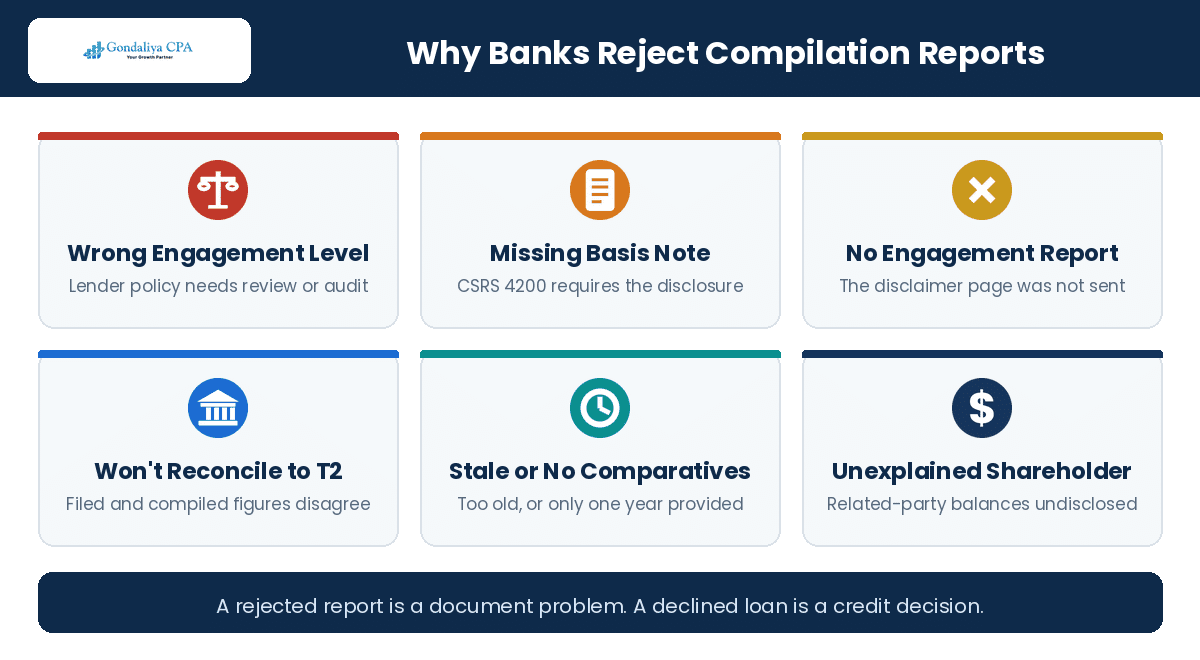
This is the most common reason by a wide margin, and the most frustrating, because nothing was wrong with the report.
A compilation engagement provides no assurance. Your CPA assembles the information management provides — there is no testing of balances, no confirmation with your bank, no analytical work challenging the numbers. A review engagement under CSRE 2400 provides limited assurance. An audit provides reasonable assurance.
When a lender’s credit policy requires assurance for a facility of a given size or risk, a compilation cannot satisfy it no matter how well prepared it is. The report was not rejected for being poor. It was rejected for being the wrong instrument.
Risk Warning: “Compiled” and “reviewed” are not interchangeable, and lender staff sometimes use them loosely. Please confirm the exact engagement the lender requires in writing before ordering anything — discovering the difference after the statements are issued costs you a second engagement and the delay.
A business ordered a compilation because a lender’s form said “financial statements.” The credit policy actually required a review for that facility size. One call to the underwriter, made before the next engagement, confirmed it and saved paying for the wrong instrument twice. Figures changed for privacy.
The Missing Basis of Accounting Note
The Standard
This one catches businesses whose statements were prepared to an outdated format.
CSRS 4200 replaced the former Notice to Reader standard, effective for compiled financial information for periods ending on or after December 14, 2021, and it requires the financial information to include a note describing the basis of accounting used to prepare it. That note is not decoration. It tells the reader what the numbers mean — whether they follow a cash or accrual basis, and what that implies.
Statements issued without it are incomplete under the current standard. An underwriter who knows what to look for will send them back, and an underwriter who does not may simply be unable to interpret them.
A new client brought us statements a previous preparer had issued in the old Notice to Reader format, with no basis of accounting note. The lender had rejected them as incomplete. Reissuing under CSRS 4200 with the note resolved it. The old format is a fast rejection. Figures changed for privacy.
No Compilation Engagement Report Attached
The Package
The statements and the report are one package. Sending the first without the second is a common, avoidable rejection.
Under CSRS 4200 the engagement produces a Compilation Engagement Report, which identifies management’s responsibility for the information and states plainly that no assurance is expressed. That disclaimer is precisely what the lender wants to see, because it tells them what weight to place on the document.
The report should also identify the CPA firm clearly enough that the lender can verify the licence. A set of statements from an unnamed or unverifiable preparer gives an underwriter nothing to rely on.
Pro Tip: Send the complete PDF exactly as your CPA issued it — report, statements, and notes together. Forwarding a spreadsheet of the numbers, or a screenshot from your accounting software, is not a compilation, and no lender will treat it as one.
A client exported the financials from their accounting software and emailed those to the bank instead of the issued PDF. Without the report page and the firm’s identification, the lender had nothing to rely on. We sent the proper package and it cleared. Figures changed for privacy.
Statements That Do Not Reconcile to the T2
Credibility
Lenders cross-check. It is the fastest credibility test they have.
Your compiled statements should agree to the T2 corporate tax return filed for that year, and to the Notice of Assessment the CRA issued. When the revenue on the statements does not match what was filed, the underwriter stops reading and starts asking — and an unanswered question at that stage reads as a red flag.
The same applies internally: the balance sheet has to balance, the statements have to agree with each other, and the comparative figures have to match last year’s issued statements. Small inconsistencies do disproportionate damage, because they suggest the file was not checked.
An underwriter flagged that the revenue on a client’s compiled statements did not match the filed T2. The gap was a late adjustment never carried through. Reconciling the two and reissuing removed the red flag. Lenders check this first, so it has to tie. Figures changed for privacy.
A client’s comparative column did not match the prior year’s issued statements because a reclassification had not been carried back. It was a small inconsistency, but it stalled the file while the underwriter queried it. We corrected the comparatives so the set was internally consistent. Figures changed for privacy.
Stale Dates and Missing Comparatives
Timing
Two timing problems, both easy to avoid.
Lenders assess a moving business, so most want statements reasonably close to the application date, and some ask for interim figures alongside the year-end set. Statements from a year-end long past may be rejected simply for age, regardless of how good they are.
Lenders also read trends rather than snapshots. A request for two or three years of comparative statements is routine, and a single year in isolation often gets sent back. Where earlier years were prepared under the retired format, please tell your CPA up front so the package is presented consistently.
A client applied with statements from a year-end well over a year old and the lender wanted something current. We added interim figures alongside the year-end set, and the application moved forward. Age alone can trigger a rejection, regardless of quality. Figures changed for privacy.
A lender asked for three years of comparatives, but the two earlier years sat in the old Notice to Reader format. Presenting all three consistently, so the trend read cleanly, was what the underwriter needed. Consistency across years matters as much as any single year. Figures changed for privacy.
Unexplained Shareholder and Related-Party Balances
Owner-Managed
On an owner-managed corporation, this is the balance an underwriter turns to first.
A large or unexplained shareholder loan raises an obvious question: is money leaving the business, and will it keep leaving once the loan is advanced? The balance itself is rarely the problem. The absence of an explanation is.
The same applies to related-party transactions — management fees to a sister company, rent paid to a corporation you also own, intercompany balances. Disclosed clearly, they are ordinary. Left unexplained, they look like something being obscured, and the file stalls while the underwriter works out which.
A large shareholder loan on an owner-managed file stalled an application, not because the balance was wrong, but because nothing explained it. A short disclosure note on how it arose and how it would be handled cleared the underwriter’s question. Disclosure, not the amount, was the fix. Figures changed for privacy.
Rent paid to a corporation the same owner controlled looked, undisclosed, like value leaving the business. Once the related-party relationship was disclosed clearly, it read as the ordinary arrangement it was. Clarity turned a red flag back into a routine line. Figures changed for privacy.
Bank Rejected Compilation Report: The Reasons at a Glance
Summary Table
| Reason | What it means | Can your CPA fix it? |
|---|---|---|
| Wrong engagement level | The lender’s policy requires a review or an audit | No — a different engagement is needed |
| Missing basis of accounting note | CSRS 4200 requires it; the statements are incomplete | Yes — reissue |
| No compilation engagement report | The disclaimer page was not sent with the statements | Yes — resend the full package |
| Does not reconcile to the T2 | Filed figures and compiled figures disagree | Yes — investigate and correct |
| Stale dated | The year-end is too far from the application date | Yes — interim or current-year statements |
| Missing comparatives | Only one year provided; the lender wants a trend | Yes — compile the prior years |
| Unexplained shareholder balance | Large related-party amounts without disclosure | Yes — reconcile and disclose |
| Unverifiable preparer | The lender cannot confirm the CPA licence | Yes — issued by a Registered firm |
A lender could not verify the preparer of a set of statements a client brought from a non-CPA bookkeeper, so it would not rely on them. Reissuing the compilation through a Registered CPA firm, verifiable on the public register, was what the underwriter needed. Verifiability is part of the value. Figures changed for privacy.
A client submitted a single year of statements and the lender wanted a trend. Because we also held the two prior years, we compiled them consistently and presented all three together, and the file moved forward. One year in isolation is a routine rejection. Figures changed for privacy.
How to Fix a Rejected Report
The Fix
Work through it in this order, because the first answer determines everything after it.
Get the reason in writing. Ask the underwriter to state what is missing or what level of engagement is required. One sentence from them saves weeks of guessing.
Separate the document from the decision. If the credit itself was declined, a new report changes nothing, and your time is better spent on the underlying numbers.
Send it back to your CPA with the wording. Where the defect is a missing note, an absent report page, or an inconsistency, the fix is a reissue rather than a new engagement. Where the lender requires assurance, you need a review or an audit, and that is a different scope and fee.
Confirm the intended user before reissuing. CSRS 4200 asks your CPA to consider who will read the statements, so telling them which lender is reviewing the file is not a formality — it shapes the engagement.
Most rejections are not about your business at all. They are about sending the wrong document, or sending an incomplete one. Confirm what the lender needs before the engagement starts, and the rejection never happens.
2026 Update — what is current: CSRS 4200 remains the governing standard for compilation engagements, replacing the former Notice to Reader for periods ending on or after December 14, 2021. A compilation still provides no assurance, so where a lender’s policy requires assurance, a review or an audit is needed. Confirm the requirement in writing before ordering.
Check Whether Your Package Is Lender-Ready
This quick self-check flags the things that most often get a compilation sent back. Please answer the six questions below.
Lender-Ready Compilation Check
Six quick questions on what gets a compilation sent back. No fee shown.
In good shape:
This is a general prompt, not accounting or lending advice. Whether a lender accepts a compilation depends on their own policy. For a real review, please book a free consultation.
Want a checklist to work from? You can download our free lender-ready compilation checklist before you submit to the bank.
Industry Spotlights: Sectors We Represent
Industry Expertise
Lender expectations for a compilation shift a little by sector, usually because of what the lender is financing and what the balance sheet holds. Here are ten sectors and where the rejection risk tends to sit.
| Industry | Where the Rejection Risk Sits |
|---|---|
| Medical doctors & physician professional corporations | Shareholder-loan disclosure on the PC |
| Dentists & dental practices | Equipment-loan files wanting current figures |
| Daycare, childcare & CWELCC services | Subsidy income reconciling to the statements |
| Real estate investors, landlords & holding companies | Intercompany balances across entities |
| Property developers & builders | Project financing wanting a clean trend |
| Construction, contractors & skilled trades | Related-party rent and equipment disclosure |
| Technology startups & SaaS | Covenants that may require a review, not a compilation |
| E-commerce & online retailers | Inventory figures agreeing with the T2 |
| Restaurants & food and beverage | Franchisor and lender both wanting statements |
| Transportation, logistics & trucking | Fleet finance wanting recent comparatives |
- Medical doctors & physician professional corporations: A professional corporation almost always carries a shareholder loan, so the single biggest rejection risk here is leaving that balance undisclosed. A short note on how it arose usually clears the underwriter.
- Dentists & dental practices: Equipment financing is the common trigger, and lenders in this space tend to want figures close to the application date, so a stale year-end is the risk to watch.
- Daycare, childcare & CWELCC services: Where subsidy income runs through the books, the rejection risk is that the compiled figures do not tie to the funding reported, so clean reconciliations matter.
- Real estate investors, landlords & holding companies: With a holding-and-operating structure, intercompany balances are the first thing an underwriter probes, so each entity’s statements have to disclose them clearly.
- Property developers & builders: Project and construction financing leans on a clean multi-year trend, so missing comparatives are the common reason a package gets sent back.
- Construction, general contractors & skilled trades: For electricians, plumbers, and HVAC firms, related-party rent and equipment held in a second company are ordinary, but they must be disclosed or they read as value leaving the business.
- Technology startups & SaaS: Investor and lender covenants sometimes demand limited assurance, so the rejection risk is the wrong engagement level; confirm whether a review is required before ordering a compilation.
- E-commerce & online retailers: Inventory drives the balance sheet, so the risk is inventory figures that do not agree with the filed T2, which an underwriter will catch on the cross-check.
- Restaurants & food and beverage: Leases, lenders, and franchisors may all want statements, and each may expect a different level, so confirming what each requires up front avoids a rejection.
- Transportation, logistics & trucking: Fleet and equipment finance want recent comparatives, so the risk is stale statements or a single year in isolation rather than a readable trend.
A physician’s professional corporation had a lender query on a shareholder loan that had never been explained on the statements. A short disclosure note on how the balance arose cleared the question without any change to the underlying numbers. Figures changed for privacy.
An online retailer’s compiled inventory did not agree with the amount on the filed T2, and the underwriter caught it on the cross-check. Reconciling the two and reissuing the statements removed the flag. Inventory-heavy files live or die on that reconciliation. Figures changed for privacy.
Glossary and Frequently Asked Questions
Definitions & FAQ
- Compilation engagement: An engagement where a CPA assembles management’s financial information into statements, with no assurance.
- Compilation Engagement Report: The report attached to compiled statements under CSRS 4200, stating no assurance is expressed.
- CSRS 4200: The Canadian standard governing compilation engagements since December 14, 2021.
- Notice to Reader: The former name for the compilation report, replaced by the Compilation Engagement Report.
- Basis of accounting: The note describing the framework used to prepare the statements, required under CSRS 4200.
- Assurance: A CPA’s conclusion on whether statements are fairly presented; a compilation gives none.
- Review engagement: An engagement providing limited assurance under CSRE 2400.
- Audit: An engagement providing reasonable assurance through detailed testing.
- Shareholder loan: A balance owed between the corporation and its owner, closely read by lenders.
- Comparatives: Prior-year figures shown beside the current year so a lender can read the trend.
Why did the bank reject my compilation report?+
Usually one of two things. Either the lender’s policy required a review engagement or an audit, and a compilation provides no assurance, or the statements were missing something CSRS 4200 requires — most often the basis of accounting note or the compilation engagement report itself. Other common causes are figures that do not reconcile to the filed T2, stale dates, missing comparatives, and unexplained shareholder balances.
Do all banks accept compilation reports?+
No. Many Canadian lenders accept them for smaller credit facilities, but this varies by lender and by the size and type of financing. Larger or higher-risk facilities frequently require a review engagement or an audit instead. Please confirm the requirement in writing before ordering anything.
Can a compilation report be fixed and resubmitted?+
Often yes. If the problem is a missing note, an absent report page, or an internal inconsistency, your CPA can correct and reissue. If the lender requires assurance, no reissue will help — that needs a review or an audit, which is a different engagement.
Does a rejected report mean my loan is denied?+
Not necessarily. A rejected report is a document problem and is usually fixable. A declined loan is a credit decision about your numbers. They are different outcomes, so please ask the lender which one you are dealing with.
How do I stop this happening again?+
Ask the lender for their exact requirement in writing before the engagement starts, tell your CPA who will be reading the statements, and keep your bookkeeping reconciled so the compiled figures agree with the T2 you filed.
Lender-Ready Compilation Checklist
- Confirm in writing whether the lender needs a compilation, a review, or an audit.
- Make sure the basis of accounting note is included under CSRS 4200.
- Send the full issued PDF, with the compilation engagement report page.
- Reconcile the statements to your filed T2 and Notice of Assessment.
- Check the balance sheet balances and the statements agree with each other.
- Provide recent statements, with two or three years of comparatives.
- Disclose shareholder loans and related-party balances clearly.
- Have the statements issued by a Registered CPA firm the lender can verify.
Who This Is For / Not For
- For: Incorporated Canadian businesses whose compiled statements a lender has sent back, or who want to submit lender-ready statements the first time.
- Not For: Businesses a lender specifically requires to obtain a review or an audit; those need a different engagement, which we are glad to quote.
People Also Ask
Quick Answers
Is a compilation the same as audited financial statements?+
No. A compilation provides no assurance; an audit provides reasonable assurance through detailed testing. If a lender asks for audited statements, a compilation will not satisfy them, no matter how well prepared.
Will fixing the report speed up my loan?+
It removes the document obstacle, so the file can move to the credit review. Whether the loan is then approved is a separate decision about your numbers, which the report cannot change.
Can one CPA firm handle the compilation and the T2 together?+
Yes. Having one firm prepare both is the simplest way to make sure the compiled statements agree with the filed T2, which is exactly the reconciliation lenders check first.
Contact Gondaliya CPA at 647-212-9559 or info@gondaliyacpa.ca if a lender has sent your statements back, for a flat fee, HST included, quoted in writing before any work starts. For the fee itself, see our flat-fee breakdown for compilation engagements, and to choose the right level, our guide to compilation report versus review engagement.
Had your statements sent back? We will tell you honestly why
Gondaliya CPA reads the rejection, tells you whether it is a document fix or a different engagement, and quotes a flat fee, HST included, in writing before any work starts, with a one-business-day response. Please book a free consultation.
Conclusion
A bank rejected compilation report is rarely a verdict on your business. It is usually a mismatch — the wrong engagement level for the lender’s policy, or a package missing an element the standard requires. Both are avoidable with one question asked early: what exactly does this lender need? Get the answer in writing, hand it to your CPA before the work starts, and the statements arrive fit for purpose the first time.
If a lender has sent your statements back, please book a free consultation with Gondaliya CPA. We will read the rejection, tell you honestly whether it is a document fix or a different engagement, and quote a flat fee, HST included, in writing before any work starts — call 647-212-9559 or email info@gondaliyacpa.ca. Our CPA compilation report service covers the full engagement. If our content helps, please add gondaliyacpa.ca as a preferred source on Google.
Published: July 20, 2026 · Last updated: July 20, 2026
Disclaimer: This page is general information, not accounting, tax, or lending advice for your specific business. It reflects CSRS 4200, the Canadian standard for compilation engagements effective for periods ending on or after December 14, 2021, which replaced the former Notice to Reader. A compilation engagement provides no assurance. Whether a particular lender accepts a compilation depends on that lender’s own credit policy and the size and type of financing. Our fees are flat and include HST; the final fee is quoted in writing after a free consultation. Please consult a Registered CPA before acting.

Sharad Gondaliya is a CPA Canada & CPA USA with 15 Years+ experience of Accounting, Tax, Payroll of Corporate Small Businesses as Tax Accountant. He is a CPA Ontario member (61040184) and holds US CPA licences in Washington and Montana and is well known among corporate small businesses for tax planning, efficient tax solutions, and affordable CPA services. Sharad is the Principal (Director) of Gondaliya CPA – Affordable CPA Firm in Canada. Licenses: CPA Ontario: 61040184 | CPA USA (MT): PAC-CPAP-LIC-033176 | CPA USA (WA): 57629 | CPA Firm License: 61330051 View Full Author Bio