



CPA Compilation Report vs Review Engagement in Canada: Which Financial Statement Service Do You Need?
Gondaliya CPA performs compilation engagements under CSRS 4200. We do not perform review engagements or audits.
A CPA compilation report and a review engagement are common approaches for preparing financial statements in Canada, helping businesses meet corporate reporting options and lender financial statement requirements. Gondaliya CPA offers reliable CPA services Canada-wide, ensuring compliance with CPA reporting standards and supporting small business needs through clear accountant prepared financial statements and advisory services.
Quick Summary
A compilation report organizes your numbers with no assurance under CSRS 4200. A review engagement adds limited assurance under CSRE 2400 through inquiry and analysis. Compilations suit internal use, CRA filing, and many lender requests, and this is the work we perform. Reviews suit lenders or investors who want independent comfort, and we refer that work to a Registered public accountant. This guide covers the standards, the procedures, and how to identify which one applies to you.
| Aspect | Details |
|---|---|
| Compilation | No assurance under CSRS 4200; organizes management’s data into clear statements. Performed by Gondaliya CPA. |
| Review | Limited assurance under CSRE 2400; adds inquiry and analytical procedures. Referred to a Registered public accountant. |
| Who it’s for | Incorporated Canadian SMBs identifying the right level for lenders, the CRA, or owners. |
| Important caveat | Neither is an audit. A compilation gives no assurance; a review gives limited assurance. |
Reading time: 22 minutes.
Table of Contents
- Compilation Reports and Review Engagements in Canada
- Defining Each Service Under Canadian CPA Standards
- A Closer Look at Compilation Engagements
- A Closer Look at Review Engagements
- Side-by-Side Comparison and Who Performs Each
- A Decision Framework for Identifying What You Need
- Common Mistakes and How We Help
- Glossary of Key Terms
- Frequently Asked Questions
- People Also Ask
Compilation vs Review at a Glance
This article covers Canada, with Toronto and Ontario context, and reflects CRA, CPA Canada, and CPA Ontario rules current to 2026, including CSRS 4200 for compilations and CSRE 2400 for reviews. A compilation expresses no assurance; a review expresses limited assurance. Gondaliya CPA performs compilations only and refers review engagements to a Registered public accountant. Any masked engagement notes end with “Figures changed for privacy.” This is educational information only and not tax, legal, or financial advice.
Compilation Reports and Review Engagements in Canada
The Basics
In Canada, many businesses need financial reports to meet rules. Two common types are the CPA compilation report and the review engagement. Both help small and medium-sized incorporated businesses present their financial statements, and knowing the difference makes it much easier to identify what your lender or the CRA actually expects.
Why Financial Statements Matter for Canadian Businesses
Financial statements show how a business is doing. They include the balance sheet, income statement, cash flow statement, and statement of changes in equity. These keep companies transparent and help them meet the law. Lenders in Canada want specific details before they approve loans, and those requirements change with the loan type. Businesses also need records that satisfy CRA rules, which keeps them safe from penalties during audits.
Good financial statements do more than satisfy outsiders. They guide owners by showing profit trends and how well operations run, and they make raising money from lenders far smoother.
An incorporated client kept clean books all year but had never had statements formally prepared. When their bank asked for year-end financials, we turned a compilation around quickly because the bookkeeping was already tidy. Good records made the engagement simple. Figures changed for privacy.
CSRS 4200 and CSRE 2400 in Plain Terms
CPA Canada sets the standards. CSRS 4200 covers compilation engagements, and CSRE 2400 covers review engagements. Both sit alongside CSQM 1, the quality management standard that requires firms to manage risk through quality checks across their accounting work. Together they push for consistent, trustworthy reporting and more accountability from the accountant.
Understanding which standard applies helps any business that depends on these services. A compilation organizes data; a review tests it through inquiry and analysis. The standard you fall under shapes the timeline, how much comfort the report gives a reader, and which practitioner is able to sign it.
Key Stat: CSRS 4200 has governed compilation engagements for periods ending on or after December 14, 2021, replacing the old Notice to Reader (CPA Canada, cpacanada.ca). Review engagements follow CSRE 2400, and a clear basis-of-accounting note is required on a compilation.
How Our CPA Services Support Your Reporting
A Registered Ontario CPA firm helps incorporated businesses in three ways: preparation, producing accurate compilation reports; compliance, meeting CRA documentation needs; and advice, giving practical guidance from the financial analysis to support decisions. When owners work with CPAs who know the local rules for corporate tax and GST/HST, they spend less time on paperwork and more on running the business. Where a review engagement is required, we say so directly and refer the file to a Registered public accountant.
A founder came to us unsure whether their lender wanted a compilation or a review. We read the bank’s terms together and confirmed a compilation was enough, so we handled it. Had the bank required a review, we would have referred it out. One question up front settled the file. Figures changed for privacy.
Defining Each Service Under Canadian CPA Standards
The Standards
A CPA compilation report means putting together financial statements from information given by management, with no assurance. It falls under the Canadian Standard on Related Services (CSRS) 4200 and is still widely called a Notice to Reader engagement. The accountant organizes the data into clear statements but does not verify or audit it. This is the service Gondaliya CPA provides.
A review engagement gives limited assurance that the statements are free of material misstatement. It follows CSRE 2400 and uses analytical procedures and inquiry, which is less work than an audit but more than a compilation. Reviews carry more credibility than compilations. We do not perform review engagements; we refer them to a Registered public accountant.
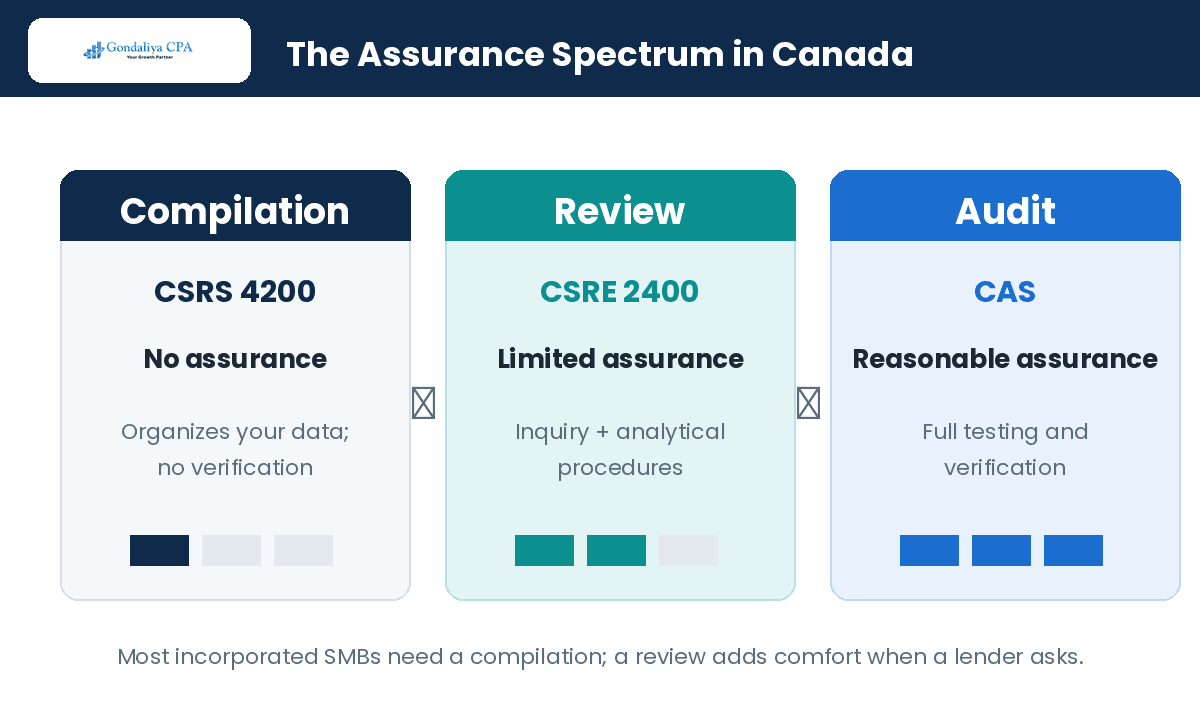
Applicability and Scope of CSRS 4200
CSRS 4200 sets the rules for CPAs doing compilation engagements in Canada. It makes clear who is responsible, the accountant or the client, and what is included. It applies when preparing historical financial information without giving any assurance. The report must state that no audit or review opinion is given and that accuracy is not guaranteed. The accountant compiles data from management into a usable format for internal use or for sharing under agreed terms.
Key points under CSRS 4200 include clear disclaimers about no assurance, no verification tasks, and the client owning responsibility for the accuracy of the information. These rules protect both the accountant and the client while matching current reporting requirements across Canada1.
A client assumed a compilation meant we had checked every number. We walked through the no-assurance disclaimer before starting so expectations were set. Clarity up front prevented a misunderstanding at delivery. Figures changed for privacy.
Review Engagements and CSRE 2400
A review engagement offers limited assurance through inquiry-based checks under CSRE 2400. Unlike a compilation that organizes data, a review includes analytical tests to spot possible material issues. The result is a limited-assurance set of financial statements, and the practitioner’s conclusion says nothing came to their attention suggesting the statements are materially misstated. This level sits between a compilation with no assurance and an audit with reasonable assurance2.
Regulators and lenders accept review reports as valid support for loans, for filings beyond a simple return, and for building stakeholder trust. A review must be performed by a practitioner holding the appropriate licence, and the required steps under CSRE 2400 are set: plan the inquiries, perform analytical procedures, and document the work before concluding3.
A growing client was told by their lender that a review was needed. We explained what the review would involve, then referred them to a Registered public accountant and stayed on for the bookkeeping and corporate tax. Being clear about our scope kept the file moving. Figures changed for privacy.
Compilation vs Review: The Core Differences
| Feature | Compilation Report (CSRS 4200) | Review Engagement (CSRE 2400) |
|---|---|---|
| Assurance Level | No assurance | Limited (negative) assurance |
| Independence Requirement | Not mandatory | Required |
| Procedures Performed | Assemble data; no verification | Inquiry and analytical procedures |
| Reporting | Notice to Reader format | Review report with a conclusion |
| Suitable For | Incorporated SMBs needing basic reporting | Businesses needing more credibility |
| Who Performs It | Gondaliya CPA | Referred to a Registered public accountant |
| Use Cases | Internal use; CRA compliance; lender info | Lender approvals; investor relations |
Put simply: a compilation presents basic information without outside checks, and a review adds independent checking to boost trust. We prepare the first and refer the second4.
CPA Canada – CSRS 4200 Compilation Engagements Accessed June 2026 · CPA Canada – CSRE 2400 Reviews of Financial Statements Accessed June 2026 · CPA Ontario – Guide to Reviews Accessed June 2026 · CRA – Financial Statement Requirements Accessed June 2026
A Closer Look at Compilation Engagements
Compilations
A CPA compilation report presents financial statements with no assurance, built for incorporated SMBs and prepared under CSRS 4200. It is still often called a Notice to Reader engagement. The statements help with internal decisions, CRA compliance, and lender needs when an audit or review is not required. This is the engagement we perform.
What the CPA Does in a Compilation
At Gondaliya CPA, the process starts by gathering data from the client’s accounting system, usually QuickBooks or Xero. Good bookkeeping makes the compilation faster. The CPA reviews the source documents but does not test transactions; the job is to organize the information into financial statements that meet the standard. The main steps are: understand the client’s business, collect trial balances, bank reconciliations, and invoices, document the accounting system details, draft the compiled statements, and run a quality review before delivery.
One client’s books mixed personal and business spending all year. Before the compilation, we separated the two so the statements made sense. The cleanup took longer than the compilation itself, which is common. Figures changed for privacy.
Disclosures, Basis of Accounting, and Engagement Acceptance
CSRS 4200 requires the basis of accounting to be stated clearly, usually cash or accrual, and requires a note that no assurance is provided. Management signs a form confirming the information is accurate and complete, and an engagement letter is approved that explains the work before anything begins. These steps protect both sides and make clear how limited a compilation really is.
Pro Tip: Decide your basis of accounting before the engagement starts. Switching from cash to accrual midway forces rework and can change how your statements read to a lender, so settle it early.
Advantages and Limits for SMBs
Compilation reports suit smaller incorporated businesses, and they meet CRA compliance needs without the added scope of an audit or review. The advantages are clear: faster results at year-end and acceptance by many lenders that need basic proof of past performance. The limit is just as clear: no assurance, so investors or complex financing will often call for a review instead, which is when we refer you out.
A small e-commerce corporation needed statements only for its own planning and a small operating line. A compilation gave them exactly what they needed. A review would have been more than the situation called for. Figures changed for privacy.
Risk Warning: Do not hand a lender a compilation if they specifically asked for a review. The file will bounce back and you lose time. Confirm the required level before the work starts, not after. If it is a review, we will point you to a Registered public accountant straight away.
A Closer Look at Review Engagements
Reviews
Review engagements provide limited assurance under CSRE 2400. Unlike compilations, they use analytical procedures that spot material errors by asking questions and testing relationships rather than performing a full audit. Reviews build more trust than compilations but are less detailed than audits. This section is explanatory. Gondaliya CPA does not perform review engagements and refers them to a Registered public accountant.
Analytical Review and Inquiry Procedures
In a review, the practitioner applies analytical procedures alongside questions to management about unusual transactions or patterns found in the analysis. Typical steps are: plan the analytical checks based on industry norms, run ratio analyses comparing current and prior periods, ask management about any odd differences, and weigh the answers against other evidence before concluding.
A manufacturing client wanted to know what a review would ask of them before committing. We walked through the inquiry and ratio steps so they could prepare their records, then referred the engagement out. Knowing what was coming made their year-end smoother. Figures changed for privacy.
What Negative Assurance Really Means
Negative assurance means the practitioner did not find anything suggesting material misstatement after the inquiry and analytical work. It is not the full guarantee an audit gives; it says nothing came to their attention pointing to a major error. Lenders often accept reviewed statements with negative assurance because they offer moderate comfort, more than a compilation that draws no conclusion on accuracy.
Our Take: Negative assurance is easy to oversell. A review is comfort, not a guarantee. We say that plainly to clients before they decide, even though the engagement itself goes to another firm.
Benefits and Constraints Versus Compilations
A review takes more work than a compilation because of the analytical tests and the documentation required under CSRE 2400. The benefits are better credibility for smoother loan approvals and a higher chance of catching issues before a lender does. The constraint is the added scope and time. The right answer depends on lender needs and the value of independent comfort to your stakeholders.
A client expanding into a larger credit facility was told a compilation would not be enough. We referred them to a Registered public accountant for the review and kept their bookkeeping and corporate tax in-house. The bank approved the facility without further questions. Figures changed for privacy.
A compilation covers statements for internal use, CRA filing, and many lender requests, and we prepare those. A review is for when a lender, investor, or buyer wants independent comfort, and we refer that to a Registered public accountant. When in doubt, confirm the required level with the reader before you commit.
Side-by-Side Comparison and Who Performs Each
Comparison
A compilation and a review serve different roles. A compilation assembles statements from management’s information with no assurance. A review adds analytical procedures and inquiry to give limited assurance under CSRE 2400. Businesses use compilations when they want accountant-prepared statements without detailed checks, and reviews when they need the extra trust a lender or regulator often wants.
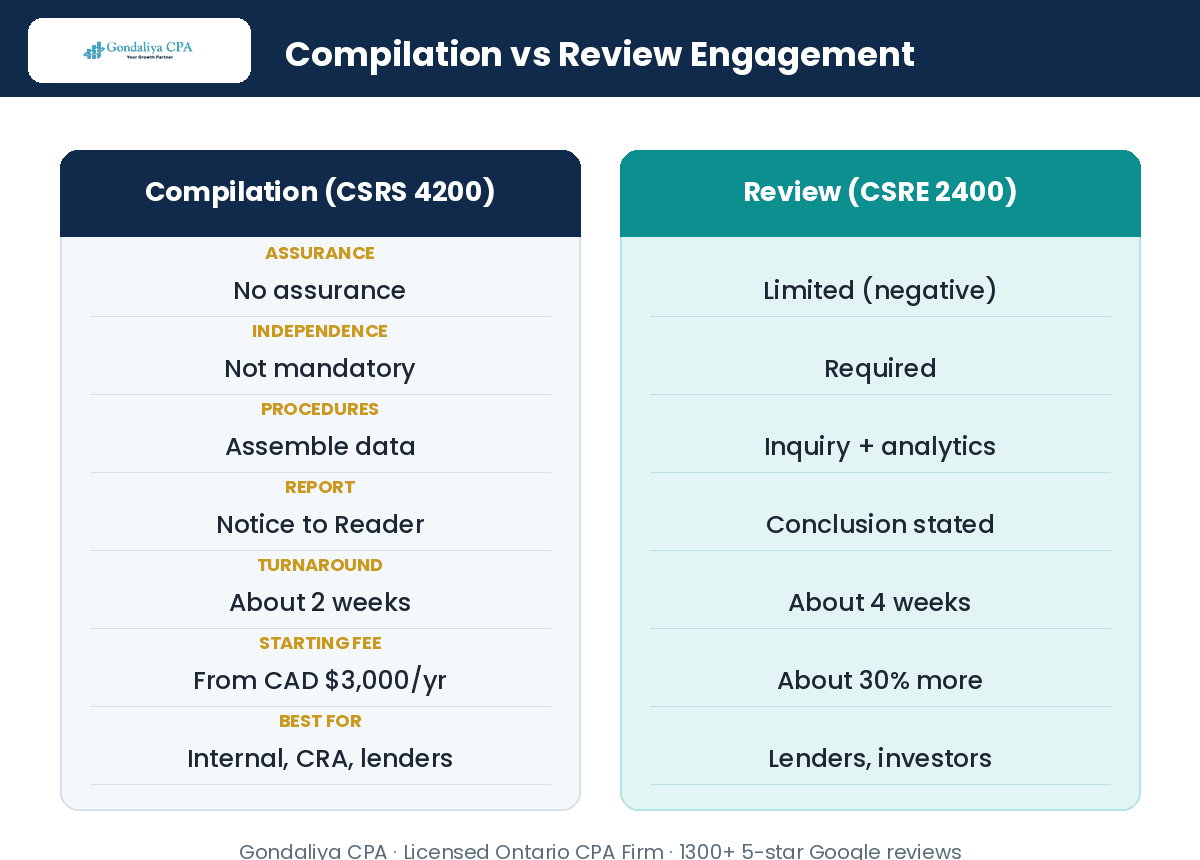
Assurance, Independence, and Reporting
The key differences are assurance and independence. A compilation gives no assurance; a review gives limited, negative assurance through questions and analysis. A review requires independence, so the practitioner must avoid conflicts that hurt objectivity; for a compilation, independence is not mandatory under CSRS 4200. A compilation uses a Notice to Reader style that states no audit or review was done, while a review produces a formal report with a conclusion about whether material changes are needed. Both disclose the basis of accounting used, which meets Canadian standards for transparency.
A client insisted a compilation needed an independence letter like a review. We showed where the two standards differ, so the file stayed correct and the scope stayed right. Matching the report to the right standard avoided unnecessary work. Figures changed for privacy.
Scope and Timing
| Item | Compilation Report | Review Engagement |
|---|---|---|
| Standard | CSRS 4200 | CSRE 2400 |
| Assurance | None | Limited (negative) |
| Independence | Not mandatory | Required |
| Performed by Gondaliya CPA | Yes | No, referred to a Registered public accountant |
| Typical turnaround | About two weeks after complete data | Set by the Registered public accountant |
The factors that affect a compilation timeline are volume and complexity, cleanup needs, the number of entities, system integration, and deadlines. Planning ahead keeps things moving. You can also estimate the corporate tax behind your numbers with our corporate tax calculator.
A client with two related corporations expected one engagement to cover both. Because each entity needed its own statements, we set them up separately and explained why up front. No surprise at delivery kept the relationship strong. Figures changed for privacy.
CRA Deadline: Your T2 corporate return is due six months after your fiscal year-end, and balances owing are generally due sooner (CRA, canada.ca). Book your compilation early so the statements are ready well before the filing date.
Use the Readiness Checker
Before you book, a quick self-check shows whether your records are ready and which engagement likely fits. Answer the six questions below.
Compilation vs Review Readiness Checker
Six quick questions to see if your records are ready and which engagement likely fits.
Records ready:
This is a general prompt, not tax or legal advice. Your actual needs depend on your lender and your books.
Want this as a one-pager? You can download the free readiness checklist and bring it to your first call.
A Decision Framework for Identifying What You Need
Choosing
Identifying whether you need a compilation or a review depends on what your business really needs. A compilation gives statements with no assurance, good for internal use or simple lender requests. A review gives limited assurance through analytical checks and inquiry, which gives more confidence. Think about who will use the statements, the rules under CSRS 4200 and CSRE 2400, and what your lender accepts.
Identify Who Will Read Your Statements
Different users want different things. Lenders want proof the business is solid and sometimes ask for a review. CRA auditors look for accurate tax information in accountant-prepared statements. Management needs quick reports for decisions, and a compilation often works well. Buyers in a business sale want reliable documents showing steady performance and usually prefer a review or an audit. Knowing who reads your numbers helps you land on the right report while staying ready for the CRA.
An owner planning to sell within two years asked what the buyer would expect. We explained a buyer would likely want a review and gave them a referral to a Registered public accountant early. Looking ahead saved a scramble later. Figures changed for privacy.
Assess Lender and Stakeholder Requirements
Lenders set rules about financial statements. Many Canadian banks want a compilation or, in some cases, a review before lending. Missing their standard can slow or stop an approval because they need proof of your year-end numbers. Investors and partners may also want a certain assurance level depending on risk. Ask your lender early which formats they accept, so you do not redo the work.
| Requirement | Compilation Report | Review Engagement | Impact |
|---|---|---|---|
| Lender Acceptance | Often accepted | Accepted where required | Faster loan approval |
| Loan Application Delays | Possible | Less likely | Reduced processing time |
| Assurance Level | No assurance | Limited assurance | Higher stakeholder confidence |
| Where to Go | Gondaliya CPA | Registered public accountant, on our referral | Right practitioner from the start |
A client almost arranged a review on a guess. One email to the lender confirmed a compilation met their terms. Asking first kept the work in scope and saved a step. Figures changed for privacy.
Timelines and Agreements
Preparing early avoids a rush at year-end, especially in Toronto and Ontario, and a short call with a CPA can clarify timing. Shareholder and partnership agreements often state which reports a company must provide and which accounting methods to use, so check those against CSRS 4200 and CSRE 2400 to avoid disputes over transparency. If your agreement calls for a review, please plan for a Registered public accountant well ahead of your year-end.
Two partners disagreed on whether a review was required. Their shareholder agreement settled it: a review was needed each year. We referred them out and kept the bookkeeping. Reading the agreement first ended the debate. Figures changed for privacy.
Gondaliya CPA prepares compilation engagements under CSRS 4200 for incorporated Canadian businesses. If your lender, investor, or shareholder agreement calls for a review engagement, please tell us early and we will refer you to a Registered public accountant. We can continue with your bookkeeping, corporate tax, GST/HST, and payroll either way.
Common Mistakes and How We Help
Avoiding Pitfalls
Many businesses stumble preparing financial statements, and the errors cause delays or fail lender requirements. A common mix-up is confusing a Notice to Reader compilation with a review engagement. Other times, statements go out without a signed management acknowledgment, or the wrong basis of accounting is chosen. Both can cause trouble with CRA compliance. Incomplete or inaccurate client data is another frequent problem, and skipping required disclosures creates issues during CRA review or lender checks.
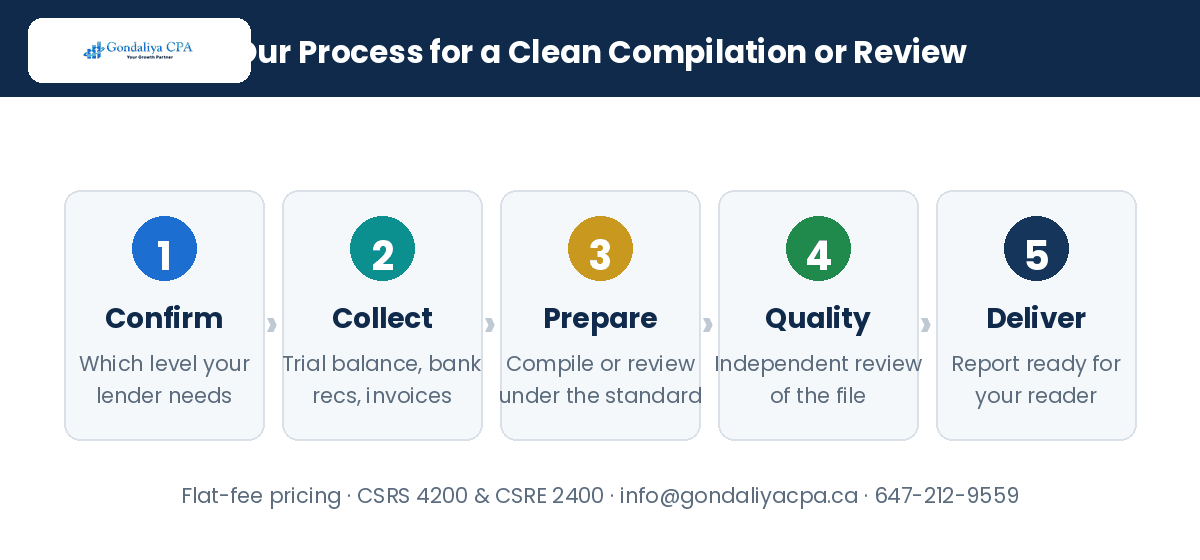
Practical Tips to Stay Compliant
Stick to CSRS 4200 for compilations. Always get a signed management acknowledgment before issuing a report. Pick the right basis of accounting early. Keep thorough records to show CRA audit readiness. Use checklists covering all required disclosures, work with reliable tools like QuickBooks or Xero, and flag data issues well before deadlines. This cuts down mistakes like leaving out liabilities or misclassifying expenses. If the engagement turns out to be a review, get it to a Registered public accountant early rather than late.
A new client’s prior provider had issued statements without a signed representation letter. We fixed the process on the first engagement so the file was complete and defensible. Small steps protect everyone. Figures changed for privacy.
How Gondaliya CPA Supports You
Gondaliya CPA is a Registered Ontario CPA firm working with incorporated SMBs across Toronto, Mississauga, Vaughan, Ottawa, Brampton, Scarborough, and all of Canada. We perform compilation engagements under CSRS 4200, and we move quickly using efficient workflows and tools like QuickBooks, Hubdoc, Xero, and Rotessa. We do not perform review engagements or audits, and we refer that work to a Registered public accountant. Clients get personal support from intake through final delivery, with documents that meet both CRA rules and lender expectations.
Industries We Prepare Compilations For
We prepare compilation engagements across a range of sectors, each with its own reporting quirks: medical professionals with OHIP billing, dentists regulated by the RCDSO, real estate investors and holding companies, e-commerce sellers on Shopify and Amazon FBA, technology companies making SR&ED claims, and childcare operators under CWELCC. Knowing the sector shortens the engagement because we know which questions to ask first. Gondaliya CPA is a CPA Ontario Registered Firm.
DIY, a Non-CPA Provider, or a Registered CPA Firm
Preparing statements yourself keeps costs down but produces documents no lender treats as accountant-prepared. A non-CPA bookkeeping provider can assemble numbers but cannot issue a compilation report under CSRS 4200, so the output carries no professional standing. A Registered CPA firm issues the report under the standard, carries professional accountability for it, and tells you plainly when your situation calls for a review instead.
How the Engagement Runs
- Book a free consultation to confirm which engagement your reader actually requires.
- Send preliminary bookkeeping data, including a trial balance export.
- Agree the scope in writing based on your complexity.
- Receive an engagement letter setting out the work under CSRS 4200.
- Return the signed management acknowledgment form.
- Receive your completed financial statements within the agreed turnaround.
Where to Read More
For the underlying rules, CPA Canada publishes guidance on the CSRS 4200 compilation standard, the CRA sets out documentation and audit-readiness requirements, and the CPA Ontario firm directory lets you verify any firm’s licensing before you engage them. Please check the directory for us as well; the link is in the author box.
One More Mistake Worth Naming
Beyond the errors above, two recur. Firms that do not update their processes when a standard changes end up issuing reports in a superseded format. And engaging an unlicensed provider removes the accountability that makes a compilation worth having in the first place, since the report only carries weight when a licensed practitioner stands behind it.
2026 Update — what is current: For 2026, CSRS 4200 remains the governing compilation standard and CSRE 2400 the governing review standard (CPA Canada, cpacanada.ca). Both sit under the CSQM 1 quality management framework. Plan your year-end around which level your lender accepts, since that choice drives both the timeline and which practitioner handles the file.
A client switched to us mid-year after a missed deadline elsewhere. We mapped their fiscal year-end to the T2 due date and built the compilation with weeks to spare. A simple timeline removed the stress. Figures changed for privacy.
Glossary of Key Terms
Plain-English Definitions
- Compilation report: Accountant-prepared financial statements built from management’s data under CSRS 4200, with no assurance.
- Review engagement: A limited-assurance service using analytical procedures and inquiry under CSRE 2400, performed by a Registered public accountant.
- CSRS 4200: The Canadian Standard on Related Services governing compilation engagements, which replaced the Notice to Reader.
- CSRE 2400: The Canadian Standard on Review Engagements governing reviews of financial statements.
- Notice to Reader: The common Canadian term for a compilation report, including the no-assurance disclaimer.
- Negative assurance: A conclusion that nothing came to the practitioner’s attention suggesting material misstatement, short of full audit assurance.
- No assurance: The accountant organizes the numbers and discloses how, without auditing or reviewing them.
- Limited assurance: The moderate comfort a review provides, between no assurance and the reasonable assurance of an audit.
- Basis of accounting: The framework used, such as cash, accrual, ASPE, or a tax basis, disclosed in the statements.
- Independence: Freedom from conflicts that could affect objectivity; required for a review, not mandatory for a compilation.
- Management representation letter: A signed letter confirming the information given is accurate and complete.
- Registered public accountant: A practitioner holding a public accounting licence, which is required to perform review engagements and audits.
- CSQM 1: The Canadian Standard on Quality Management requiring firms to manage engagement risk through quality controls.
Frequently Asked Questions
FAQ
Does Gondaliya CPA perform review engagements?+
No. We perform compilation engagements under CSRS 4200. Review engagements are referred to a Registered public accountant.
How long does a compilation report take?+
Usually about two weeks after we receive your complete data and documents.
What is the difference between a compilation and a review?+
A compilation organizes management’s information into statements with no assurance. A review adds inquiry and analytical procedures to give limited assurance under CSRE 2400.
Are compilation reports accepted for lending in Canada?+
Many lenders accept a compilation. Some ask for a review or an audit depending on loan size and risk, so please confirm your lender’s requirement first.
What business size usually uses compilation reports?+
Small and medium-sized incorporated businesses often choose a compilation for straightforward, compliant statements.
What standards govern these reports in Canada?+
Compilations follow CSRS 4200 and reviews follow CSRE 2400. Both sit under the CSQM 1 quality management framework and meet CRA policies.
Does a compilation give any assurance?+
No. A compilation organizes your numbers and discloses the basis of accounting, but it gives no assurance. A review gives limited, negative assurance.
Why choose Gondaliya CPA for your compilation?+
We are a Registered Ontario CPA firm with 15+ years of experience serving incorporated businesses across Canada, and we are clear about our scope from the first call.
Which industries do you prepare compilations for?+
Medical professionals with OHIP billing, dentists regulated by the RCDSO, real estate investors and holding companies, e-commerce sellers on Shopify and Amazon FBA, technology companies claiming SR&ED, and childcare operators under CWELCC.
Can a bookkeeper prepare my compilation report?+
No. A compilation report under CSRS 4200 must be issued by a licensed practitioner. A non-CPA provider can assemble numbers, but the resulting statements carry no professional standing with a lender.
What does the engagement process look like?+
A free consultation to confirm the right engagement, then your trial balance and records, an agreed scope, an engagement letter under CSRS 4200, your signed management acknowledgment, and delivery of the statements.
What You Should Prepare Before Starting
- Complete trial balances and bank reconciliations from QuickBooks or Xero.
- A signed management representation letter acknowledging accuracy.
- Invoices, receipts, and loan agreements for the reporting period.
- Your chosen basis of accounting: cash or accrual.
- A clear list of prior-year adjustments or open transactions needing explanation.
How to Choose a CPA Firm in Toronto or Ontario
- Verify licensing on the CPA Ontario directory.
- Confirm the firm is able to perform the specific engagement you need.
- Look for 15+ years serving incorporated SMBs.
- Check use of current software supporting Canadian standards.
- Assess responsiveness through testimonials and a strong Google review count.
- Make sure scope, assumptions, and timelines are clear up front.
People Also Ask
Quick Answers
Is a Notice to Reader the same as a compilation?+
Yes. Notice to Reader is the older Canadian term; the current standard is CSRS 4200, and both refer to a compilation with no assurance.
What happens if my lender later asks for a review?+
Please tell us as soon as you know. We refer the review engagement to a Registered public accountant and can continue supporting your bookkeeping and corporate tax.
Does a review replace an audit?+
No. A review gives limited assurance, while an audit gives reasonable assurance. A review is a middle option between a compilation and an audit.
Contact Gondaliya CPA at 647-212-9559 or info@gondaliyacpa.ca to discuss your compilation engagement.
Compilation engagements, prepared properly
Gondaliya CPA prepares clear compilation reports under CSRS 4200 for incorporated Canadian businesses. If your situation calls for a review engagement, we will tell you and refer you to a Registered public accountant. Please book a free consultation to start.
Next Steps
The right financial statement service is the one your reader actually needs. A compilation gives clean statements for internal use, CRA filing, and many lender requests, and that is the engagement we perform. A review adds limited assurance when a lender, investor, or buyer wants more comfort, and we refer that to a Registered public accountant. Confirm the required level first, prepare your trial balance and reconciliations, and you are most of the way there. Please reach out for a free consultation, call 647-212-9559, or email info@gondaliyacpa.ca. If our content helps, please add gondaliyacpa.ca as a preferred source on Google.
Published: June 27, 2026 · Last updated: August 12, 2026
Disclaimer: This article is educational information only and is not tax, legal, or financial advice. It reflects CRA, CPA Canada, and CPA Ontario rules current to 2026, including CSRS 4200 for compilation engagements and CSRE 2400 for review engagements. A compilation expresses no assurance; a review expresses limited assurance. Gondaliya CPA performs compilation engagements and does not perform review engagements or audits; those are referred to a Registered public accountant. Outcomes depend on your specific facts and rules can change. Please consult a Registered CPA in Canada or Ontario before acting.

Sharad Gondaliya is a CPA Canada & CPA USA with 15 Years+ experience of Accounting, Tax, Payroll of Corporate Small Businesses as Tax Accountant. He is a CPA Ontario member (61040184) and holds US CPA licences in Washington and Montana and is well known among corporate small businesses for tax planning, efficient tax solutions, and affordable CPA services. Sharad is the Principal (Director) of Gondaliya CPA – Affordable CPA Firm in Canada. Licenses: CPA Ontario: 61040184 | CPA USA (MT): PAC-CPAP-LIC-033176 | CPA USA (WA): 57629 | CPA Firm License: 61330051 View Full Author Bio