



Signs Your Business Needs Corporate Tax Cleanup Before Filing Another Tax Return
Gondaliya CPA provides comprehensive past account clean-up services and bookkeeping cleanup across Canada, designed to help small businesses correct financial records and maintain accurate bookkeeping. Our accounting cleanup services give you a dependable route to financial clarity and support business growth.
Quick Summary
Corporate tax cleanup means correcting the errors in your books and prior returns before you file the next one. The signs are usually clear: accounts that do not reconcile, personal and business money mixed together, a shareholder loan no one can explain, opening balances that do not tie to the last filed return, and CRA letters. Please fix the base first, because every balance carries forward.
| Aspect | Details |
|---|---|
| What it is | Correcting books and prior filings before the next T2. |
| Why it matters | Retained earnings and balances carry forward, so errors repeat. |
| Common signs | Unreconciled accounts, mixed expenses, shareholder loan mess. |
| The fix | Reconcile, correct, adjust prior returns, and prevent a repeat. |
Reading time: 27 minutes.
Table of Contents
Cleanup at a Glance
This article covers Canada, with Toronto and Ontario context, and reflects CRA and corporate tax rules current to 2026. It assumes an incorporated business that files a T2 return under ASPE. Items marked “illustrative” are examples, not quotes, and any masked engagement notes end with “Figures changed for privacy.” This is educational information only and not tax, legal, or financial advice. Fees include HST. Please confirm your own situation with a Registered CPA before acting.
What Corporate Tax Cleanup Is
The Basics
Corporate tax cleanup is the work of correcting your bookkeeping and your prior corporate returns so the next filing rests on accurate numbers. It covers reconciling accounts, fixing misclassified transactions, sorting out the shareholder loan, recalculating depreciation, and reconciling GST/HST and payroll to what was actually filed. Done properly, it also means requesting adjustments to prior returns where the errors changed the tax.
Why It Comes Before the Next Return
A corporate return is not a fresh start each year. The closing balances of one year become the opening balances of the next, so an error in the books flows straight into the new T2. Cleaning up first means you file once, correctly, instead of filing a wrong return and correcting it later under pressure. Please treat cleanup as the step that makes the filing routine.
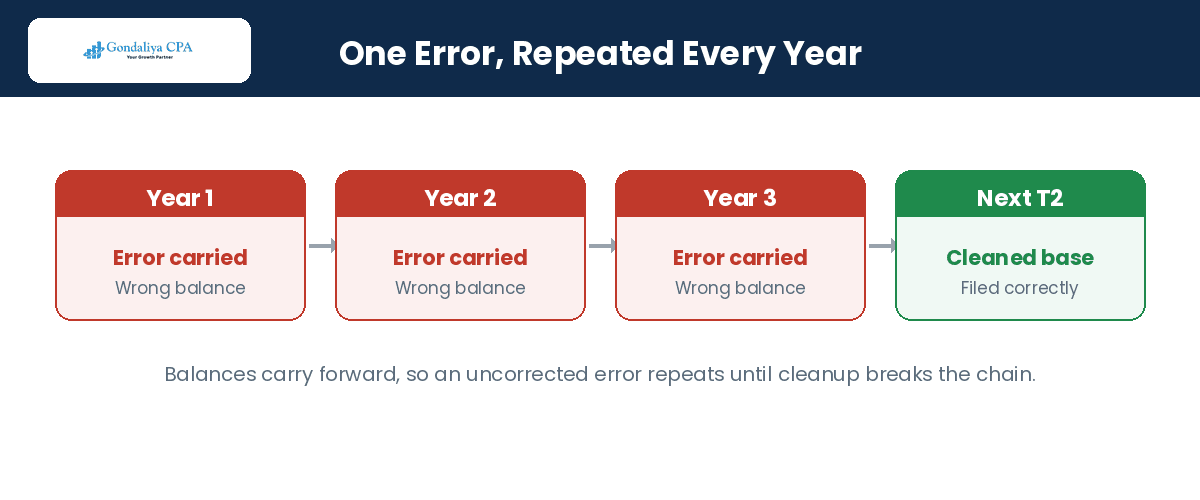
Key Stat: Retained earnings and every account balance carry forward, so a single uncorrected error repeats on every future return until someone fixes it. That is why one messy year quietly becomes several. Please break the chain before you file again.
A client filed three years in a row on books that never reconciled, carrying the same errors forward each time. We cleaned the base once and the fourth filing was straightforward. The problem was never the return; it was the foundation under it. Figures changed for privacy.
Signs in Your Books
Sign One
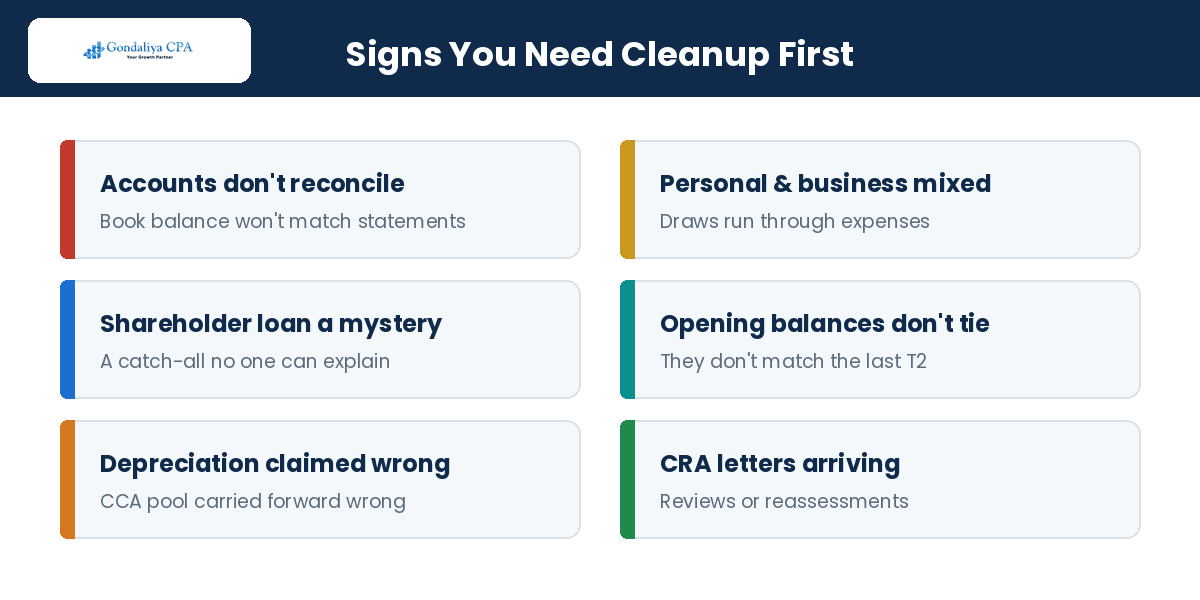
The clearest signals come from the bookkeeping itself. If any of these are true, the books need work before they feed a return.
Accounts That Do Not Reconcile
Every bank and credit card account should tie to its statement at year-end. When the book balance and the statement do not agree, transactions are missing, duplicated, or miscoded, and the income and expenses on the return are wrong as a result. Unreconciled accounts are the single most common reason a set of books is not ready to file. Please reconcile every account before anything else.
Personal and Business Mixed Together
When personal costs run through the business or business costs are paid personally, taxable income is distorted and the shareholder loan account drifts. This is one of the fastest ways to draw a CRA question, because personal-looking expenses stand out. Separating the two is core cleanup work. Please run personal spending out of the business and record it properly.
A Shareholder Loan No One Can Explain
The shareholder loan account tracks money moving between the owner and the corporation. When it is a catch-all for anything that did not fit elsewhere, it stops reflecting reality. A loan to a shareholder that is not repaid within one year of the corporation’s year-end can be added to the shareholder’s income, so the balance matters. Please reconcile it so it shows what is truly owed each way.
Risk Warning: A misused shareholder loan is one of the most reassessed items in a small corporation. If the balance is really personal draws dressed up as a loan, the CRA can treat it as income. Please get the account reconciled and supported before you file on it.
A client’s shareholder loan had become a dumping ground for everything uncertain, and no one could say what it represented. We rebuilt it transaction by transaction into a supportable balance. The account went from a liability in every sense to a clean number. Figures changed for privacy.
A client paid personal and business costs from one account for a year, and the books mixed the two throughout. We separated them and recorded the personal portion correctly. Taxable income dropped to its true figure, and the risky-looking expenses disappeared. Figures changed for privacy.
Signs in Your Prior Returns
Sign Two
The second place to look is the returns you have already filed. Errors there carry forward and often need a formal adjustment.
Opening Balances That Do Not Tie
The opening retained earnings and balance sheet figures on this year’s return must equal last year’s closing figures. When they do not tie, something was changed, missed, or filed wrong, and the GIFI schedules no longer reflect the real business. A break in the carry-forward is a clear sign a prior return needs correcting. Please confirm the opening balances match the last filed T2.
Depreciation Claimed Wrong
Capital assets are deducted over time as capital cost allowance on Schedule 8, and each class carries an undepreciated capital cost forward. If CCA was over- or under-claimed, or an asset was expensed that should have been capitalized, the wrong balance flows into every later year. Recalculating the classes puts the depreciation and the pool back on track. Please review the fixed-asset schedule against what was claimed.
Unfiled Years and Prior-Preparer Errors
Missing T2 returns accrue penalties and interest, and returns prepared without full records often carry misclassified GIFI codes or missed deductions. Both are cleanup items. Where errors or unfiled years are involved and the CRA has not yet contacted you, the Voluntary Disclosures Program may let you come forward and reduce penalties. Bringing filings current, through catch-up corporate tax filing where needed, stops the meter.
A new client’s opening retained earnings did not match the prior filed return, off by a restated adjustment no one had carried through. We traced it, corrected the schedules, and reconnected the carry-forward. The return finally tied to reality. Figures changed for privacy.
A client’s CCA pool had been overstated by a prior preparer, so the undepreciated balance was wrong every year after. We recalculated each class and carried the corrected pool forward. One fix cleaned up several returns at once. Figures changed for privacy.
CRA Deadline: A T2 is due six months after the fiscal year-end, and any balance owing is due two months after year-end, or three months for an eligible CCPC. The late-filing penalty is 5% of the balance plus 1% for each month late, up to 12 months, and more for repeat failures. Please diarize these dates as you catch up.
Signs From the CRA
Sign Three
Sometimes the signal comes in the mail. CRA contact is a clear message that the base needs cleanup, and how you respond matters.
Letters, Reviews, and Reassessments
A request to verify a figure, a pre-assessment review, or a reassessment all point to something the CRA could not reconcile from your filing. Ignoring the letter does not make it go away; the CRA can reassess on its own assumptions, which are rarely in your favour. Clean books let you answer with support instead of guesses. Please treat any CRA letter as a prompt to get the records in order.
A client received a review letter questioning several expense lines and had no organized records to answer it. We reconciled the year, supported the legitimate claims, and responded on time. A tidy file turned an anxious letter into a short exchange. Figures changed for privacy.
A client had ignored two CRA letters, and the account was reassessed on the CRA’s own assumptions. We reconciled the year and filed a supported response to correct it. Answering early with clean records would have avoided the whole detour. Figures changed for privacy.
Pro Tip: When a CRA letter arrives, please note the deadline first and reconcile before you reply. A fast, unsupported answer often creates more questions than a measured one backed by clean records.
Why Filing on a Messy Base Is Risky
The Core Risk
The reason cleanup comes first is simple: a corporate return builds on the year before it, so errors compound rather than reset.
Errors Compound, and Interest Runs
A wrong opening balance, an overstated CCA pool, or a mislabelled shareholder loan does not stay in one year; it feeds the next return and the one after. If the errors understated tax, interest compounds daily on the shortfall at a rate the CRA sets each quarter, and it keeps running until the balance is paid. Filing again without cleanup locks in the mistake and grows the cost. Please correct the base before it multiplies.
A client’s overstated depreciation pool had understated tax across several years, and interest had been quietly compounding the whole time. We recalculated the classes and corrected the affected returns. Catching it stopped the bleed and sized the real liability. Figures changed for privacy.
2026 Update — what is current: For 2026, the T2 filing and payment deadlines and the six-year record rule are unchanged, and CRA interest still compounds daily at a rate reset each quarter. Ontario’s small-business corporate rate is being reduced, which makes an accurate base worth even more, since the tax is calculated on figures that must be right. Please clean up before you file to capture the correct result.
The Cleanup Process, Step by Step
The Process
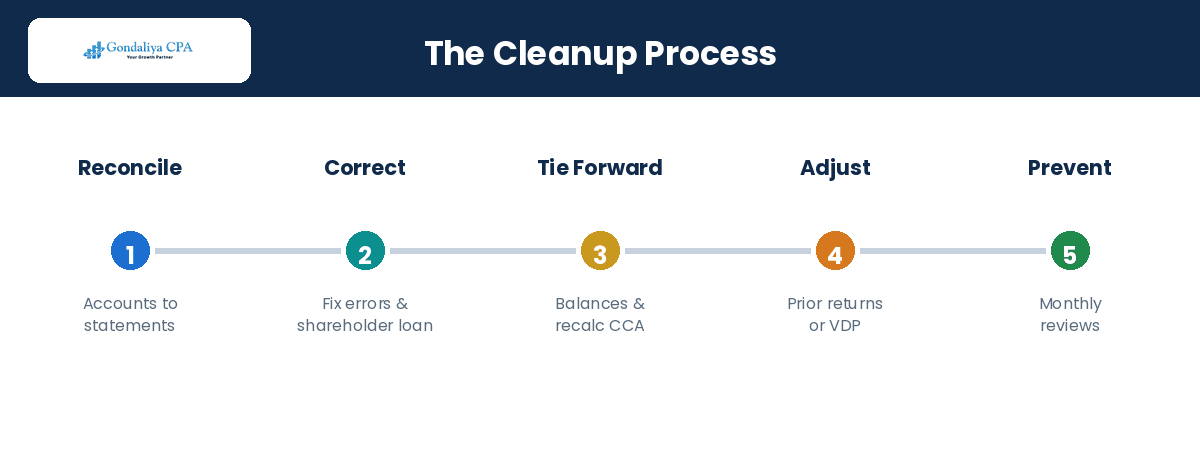
Cleanup follows a clear order. Each step depends on the one before it, which is why doing them in sequence matters.
Reconcile, Correct, Adjust, Prevent
First, reconcile every bank, credit card, GST/HST, and payroll account to its statements and filings. Next, correct the misclassifications, separate personal from business, and rebuild the shareholder loan. Then confirm opening balances tie to the last filed return and recalculate CCA. Where prior returns were wrong, request a T2 adjustment so the CRA reassesses on correct figures; where years are unfiled or errors are material and the CRA has not called, consider the Voluntary Disclosures Program. Finally, put controls in place so it does not happen again.
| Step | What Happens |
|---|---|
| 1. Reconcile | Tie every account to statements and to GST/HST and payroll filings |
| 2. Correct | Fix misclassifications, split personal and business, rebuild the shareholder loan |
| 3. Tie forward | Confirm opening balances match the last filed T2 and recalculate CCA |
| 4. Adjust or disclose | Request T2 adjustments, or use the Voluntary Disclosures Program where it fits |
| 5. Prevent | Monthly reconciliations and reviews so the errors do not return |
A client with several years of tangled books wanted to file immediately. We reconciled and corrected in order, adjusted the two years that were wrong, and only then filed the current one. Working in sequence turned a mess into a clean, defensible set of returns. Figures changed for privacy.
A client had unfiled years and feared the worst. Because the CRA had not yet contacted them, we brought the returns current through a voluntary disclosure and reduced the penalties. Coming forward first, on our terms, changed the outcome. Figures changed for privacy.
Cleanup is not optional busywork; it is what makes a return accurate and defensible. Reconcile, correct, tie the balances forward, adjust what was wrong, and prevent a repeat. Please do it in that order and file once, correctly.
Check Your Cleanup Readiness
Before you file again, this quick self-check shows whether the base is ready. Please answer the six questions below.
Corporate Tax Cleanup Readiness Checker
Six quick questions to see whether your books are ready to file. No fee shown.
In order:
This is a general prompt, not tax or legal advice or a quote. Your actual position depends on your records. For a real review, please book a free consultation.
Want this as a one-pager? You can download the free corporate tax cleanup checklist and work through it before filing. You can also estimate your bill with our corporate tax calculator, and weigh the options with our DIY versus CPA cost comparison.
How Gondaliya CPA Helps
How We Help
Cleanup is detailed, sequential work, and it is exactly what our team does before every return we file. We fix the base and stand behind the result.
Full Cleanup, Then a Clean Filing
Gondaliya CPA handles corporate tax cleanup for incorporated SMBs across Toronto, Mississauga, Vaughan, Etobicoke, Brampton, Scarborough, Ottawa, and all of Canada, remotely and on a flat fee, HST included. We reconcile the accounts, correct the misclassifications, rebuild the shareholder loan, recalculate CCA, tie the opening balances forward, request adjustments to prior returns, and use the Voluntary Disclosures Program where it fits, then file the current year on a clean base. We work in QuickBooks and Xero so the books stay right after we hand them back.
Where a Compilation Report Fits
Once the base is clean, many owners need presentable statements for a lender, an investor, or a shareholder. A compilation engagement, prepared under CSRS 4200, presents financial statements from the information you provide, without assurance. It is a cost-effective alternative to an audit for a small corporation, and it is the report most lenders actually ask for. An audit is a far more extensive engagement, and most incorporated SMBs do not need one.
How We Keep Your Records Secure
Cleanup means handling sensitive financial data, so please know how it is protected:
- Documents move through encrypted portals rather than open email.
- Staff access is limited by role, so only the people working your file can see it.
- Our handling follows Ontario and Canadian privacy requirements, and we review it regularly.
Our Commitments to You
The engagement is backed by a 30-day money-back guarantee if early expectations are not met, and a 60-day fees-matching policy on competitive pricing. We respond to client messages within one business day, and the flat fee, HST included, is quoted in writing after a free consultation so there are no surprise bills. Gondaliya CPA is a CPA Ontario Registered Firm, with US CPA licences in Washington and Montana for cross-border needs, and we also serve Oshawa, Guelph, Hamilton, North York, and Windsor alongside the cities listed above.
What to Prepare Before We Start
Gathering these first makes the cleanup considerably faster:
- Bank statements, credit card reports, invoices, and receipts for the years in scope.
- Previous tax filings and GST/HST returns for cross-verification.
- Payroll records, where the corporation has employees.
- Your general ledger or accounting software backup.
- A short list of the discrepancies you have already noticed day to day.
A client came to us with several years of unreconciled books and a filing deadline looming. We reconciled, corrected, adjusted the wrong years, and filed the current one on time. The cleanup fixed the past; the monthly process we left behind protects the future. Figures changed for privacy.
A client dreaded every filing because the books never felt trustworthy. After one thorough cleanup and a monthly process, filing became a routine step instead of a scramble. Confidence in the numbers changed how they ran the business. Figures changed for privacy.
Our Take: The cheapest corporate return is the one filed correctly the first time. Cleanup up front costs less than reassessments, interest, and re-filings later. Please fix the base before you file, not after the CRA does.
Industry Spotlights: Sectors We Represent
Industry Expertise
Cleanup issues cluster differently by industry, and knowing where your sector usually goes wrong makes the fix faster. Here are ten we handle often, and the typical cleanup item for each.
| Industry | The Common Cleanup Item |
|---|---|
| Medical doctors & physician professional corporations | Personal and business expenses mixed; shareholder loan |
| Dentists & dental practices | Equipment CCA classes and associate payments |
| Daycare, childcare & CWELCC services | Grant funding reconciled to income and payroll |
| Real estate investors, landlords & holding companies | Capital vs income and inter-company balances |
| Property developers & builders | Work-in-progress and project cost allocation |
| Construction, contractors & skilled trades | Subcontractor costs, T5018, and equipment CCA |
| Technology startups & SaaS | Deferred revenue and SR&ED-eligible costs |
| E-commerce & online retailers | Inventory, platform fees, and multi-province HST |
| Restaurants & food and beverage | Cash sales, tips, and inventory reconciliation |
| Transportation, logistics & trucking | Fuel, vehicle CCA, and owner-operator balances |
- Medical doctors & physician professional corporations: The usual cleanup is separating personal from business spending and reconciling the shareholder loan, so the professional corporation’s income is right. Specialists certified through the Royal College of Physicians and Surgeons of Canada also need family compensation to hold up under the tax-on-split-income rules.
- Dentists & dental practices: Practices regulated by the Royal College of Dental Surgeons of Ontario often need equipment sorted into the correct CCA classes and associate payments classified properly before filing.
- Daycare, childcare & CWELCC services: The common item is reconciling CWELCC grant funding to reported income and payroll, so the books and the funding agree period by period.
- Real estate investors, landlords & holding companies: Cleanup usually turns on the capital-versus-income treatment of a property and reconciling inter-company balances across a holding structure.
- Property developers & builders: Work-in-progress and the allocation of costs across projects are the balances most often needing correction before a return.
- Construction, general contractors & skilled trades: For electricians, plumbers, and HVAC firms, subcontractor costs and T5018 reporting, plus equipment CCA, are the recurring cleanup items.
- Technology startups & SaaS: Deferred revenue recognition and identifying SR&ED-eligible costs are the entries that most often need cleaning before filing.
- E-commerce & online retailers: Inventory valuation, platform and payment-processor fees, and multi-province HST are the usual reconciliations before a return is ready.
- Restaurants & food and beverage: Cash sales, tips, and inventory are the areas that most often need reconciling so the reported income is complete and accurate.
- Transportation, logistics & trucking: Fuel and expense records, vehicle CCA classes, and owner-operator balances are the common cleanup items before filing.
A real estate client held several properties in one corporation with inter-company balances that never tied out. We reconciled the balances and settled the capital-versus-income treatment before filing. The return finally reflected the real structure. Figures changed for privacy.
An e-commerce client’s inventory and platform fees were a year out of reconciliation, distorting both income and HST. We rebuilt the inventory and matched the fees before the T2. Clean numbers changed the reported profit meaningfully. Figures changed for privacy.
A childcare client’s CWELCC grant funding did not reconcile to income or payroll, risking both reports. We aligned the funding period by period before filing. The cleanup made both the grant and the return straightforward. Figures changed for privacy.
Glossary of Key Terms
Plain-English Definitions
- Corporate tax cleanup: Correcting books and prior returns before filing the next one.
- T2 return: The corporate income tax return, due six months after the fiscal year-end.
- Reconciliation: Matching a book balance to its statement or filing so they agree.
- Shareholder loan: The account tracking money moving between owner and corporation.
- Retained earnings: Accumulated profits carried forward, whose opening balance must tie.
- GIFI: The coded financial statements filed with the T2 as Schedules 100 and 125.
- CCA: Capital cost allowance, the tax depreciation of assets on Schedule 8.
- Undepreciated capital cost: The remaining balance of a CCA class carried forward.
- T2 adjustment: A request to the CRA to reassess a prior return on corrected figures.
- Voluntary Disclosures Program: A route to correct errors or file late before the CRA calls.
- Reassessment: The CRA’s revised assessment of a return, normally within three years for a CCPC.
- ASPE: Accounting Standards for Private Enterprises, used by most private corporations.
- Compilation report: Financial statements prepared under CSRS 4200 without assurance, often required by lenders.
Frequently Asked Questions
FAQ
What is corporate tax cleanup?+
It is correcting your bookkeeping and prior corporate returns so the next T2 is filed on accurate numbers, including reconciliations, misclassifications, the shareholder loan, and CCA.
How do I know my business needs it?+
Common signs are accounts that do not reconcile, personal and business money mixed, an unexplained shareholder loan, opening balances that do not tie, and CRA letters.
Why fix the books before filing again?+
Because balances carry forward. An uncorrected error repeats on every future return until it is fixed, and interest compounds on any shortfall.
Can prior returns be corrected?+
Yes. Where a filed return was wrong, you request a T2 adjustment and the CRA reassesses on the corrected figures, normally within the reassessment window.
What if I have unfiled years?+
Bring them current. If the CRA has not contacted you, the Voluntary Disclosures Program may let you file and reduce penalties, provided the disclosure is voluntary and complete.
What is a shareholder loan problem?+
When the account becomes a catch-all, it stops reflecting reality. A loan not repaid within a year of the corporation’s year-end can be added to the shareholder’s income.
How long do I keep records?+
Keep corporate records for six years after the end of the year they relate to.
When is a T2 due?+
Six months after the fiscal year-end. Any balance owing is due two months after year-end, or three months for an eligible CCPC.
How much does cleanup cost?+
We work on a flat fee, HST included, set to the number of years and the state of the records, with the scope confirmed up front before we start.
Will cleanup stop a CRA audit?+
It cannot guarantee that, but clean, reconciled books let you answer any CRA question with support, which is the best defence.
What is a CPA compilation report, and when do I need one?+
A compilation engagement, prepared under CSRS 4200, organizes your financial data into statements without audit assurance. You need one when applying for a loan, presenting figures to a shareholder or investor, or giving a third party a credible financial snapshot without the cost of a full audit.
What guarantees do you offer?+
A 30-day money-back guarantee if early expectations are not met, and a 60-day fees-matching policy on competitive pricing. We also respond to client messages within one business day.
What should I prepare before the cleanup starts?+
Bank statements and credit card reports, invoices and receipts, previous tax filings and GST/HST returns, payroll records, your accounting software backup, and a list of discrepancies you have already noticed.
Corporate Tax Cleanup Checklist
- Reconcile every bank and credit card account to year-end statements.
- Separate personal spending from business and record it correctly.
- Reconcile the shareholder loan account into a supportable balance.
- Confirm opening retained earnings and balances tie to the last filed T2.
- Recalculate CCA and the class balances on Schedule 8.
- Reconcile GST/HST and payroll to what was actually filed.
- Request adjustments for prior returns that were wrong.
- Catch up any unfiled years, using the Voluntary Disclosures Program where it fits.
Who This Is For / Not For
- For: Incorporated Canadian businesses with messy books or prior-year errors who want a clean filing.
- Not For: A corporation with fully reconciled books and no prior-year issues, which is already ready to file.
People Also Ask
Quick Answers
Does a wrong opening balance really matter?+
Yes. Opening balances must tie to the last filed return. A break means a prior figure was wrong and the error carries into the new return.
Can Gondaliya CPA clean up several years at once?+
Yes. We reconcile and correct multiple years in sequence, adjust the returns that were wrong, and file the current one on a clean base.
What software do you work with?+
We work in QuickBooks and Xero so your books stay reconciled after the cleanup is done.
Contact Gondaliya CPA at 647-212-9559 or info@gondaliyacpa.ca for help cleaning up your books before you file another corporate return.
Clean up before you file the next return
Gondaliya CPA reconciles, corrects, and adjusts your prior filings, then files the current year on a clean base, all on a flat fee, HST included. Please book a free consultation to start.
Next Steps
Before you file another return, please check the base: reconcile the accounts, separate personal from business, sort the shareholder loan, tie the opening balances forward, and catch up anything unfiled. Bring us the messy years and we will clean them up in order. Reach out for a free consultation, call 647-212-9559, or email info@gondaliyacpa.ca. If our content helps, please add gondaliyacpa.ca as a preferred source on Google.
Published: July 6, 2026 · Last updated: August 12, 2026
Disclaimer: This article is educational information only and is not tax, legal, or financial advice. It reflects CRA and corporate tax rules current to 2026, including the six-month T2 filing deadline, the two-month balance-owing rule (three months for eligible CCPCs), the normal three-year CCPC reassessment window, and the six-year record retention period. Outcomes depend on your specific facts and rules can change. Please consult a Registered CPA in Canada or Ontario before acting. Fees include HST.

Sharad Gondaliya is a CPA Canada & CPA USA with 15 Years+ experience of Accounting, Tax, Payroll of Corporate Small Businesses as Tax Accountant. He is a CPA Ontario member (61040184) and holds US CPA licences in Washington and Montana and is well known among corporate small businesses for tax planning, efficient tax solutions, and affordable CPA services. Sharad is the Principal (Director) of Gondaliya CPA – Affordable CPA Firm in Canada. Licenses: CPA Ontario: 61040184 | CPA USA (MT): PAC-CPAP-LIC-033176 | CPA USA (WA): 57629 | CPA Firm License: 61330051 View Full Author Bio