



The Ultimate Guide to Past Account Clean-Up Services for Small Businesses in Canada
For small businesses in Canada, Gondaliya CPA provides thorough bookkeeping cleanup and accounting cleanup services to resolve past account discrepancies and keep records up to date. Our support with past account clean-up and small business bookkeeping lets you focus on growth while staying compliant.
Quick Summary
Past account clean-up is the work of fixing a backlog of messy books: correcting errors, reconciling every account, sorting receivables and payables, fixing GST/HST and payroll, and rebuilding financial statements you can rely on. Done properly, it makes your business CRA-ready and gives you numbers you can actually use. Please clean up the backlog before it becomes a filing problem.
| Aspect | Details |
|---|---|
| What it is | Correcting and reconciling a backlog of business books. |
| What it covers | Errors, reconciliations, AR and AP, GST/HST, payroll, statements. |
| Why it matters | CRA compliance, better decisions, and lender confidence. |
| Typical timeline | Two to eight weeks, depending on the backlog. |
Reading time: 27 minutes.
Table of Contents
Cleanup at a Glance
This article covers Canada, with Toronto and Ontario context, and reflects CRA and accounting rules current to 2026. It assumes an incorporated small business keeping records under ASPE, with cleanup delivered as a compilation, not an audit or review. Items marked “illustrative” are examples, not quotes, and any masked engagement notes end with “Figures changed for privacy.” This is educational information only and not tax, legal, or financial advice. Fees include HST. Please confirm your own situation with a Registered CPA before acting.
What Past Account Clean-Up Is
The Basics
Past account clean-up, also called bookkeeping cleanup, is the work of bringing a neglected or error-filled set of books back to accurate, current, and compliant. It corrects wrong entries, clears backlogs, reconciles accounts to statements, and rebuilds reliable financial statements. The goal is books you can trust for tax filing, lending, and running the business.
Why Accurate Records Matter
Clean records do three things. They keep you compliant, since the CRA expects a business to keep clear records and can audit or penalize when they are missing. They let you make good decisions, because budgeting and planning need real numbers. And they build trust, since investors, lenders, and customers rely on accurate statements. Please treat clean books as infrastructure, not paperwork.
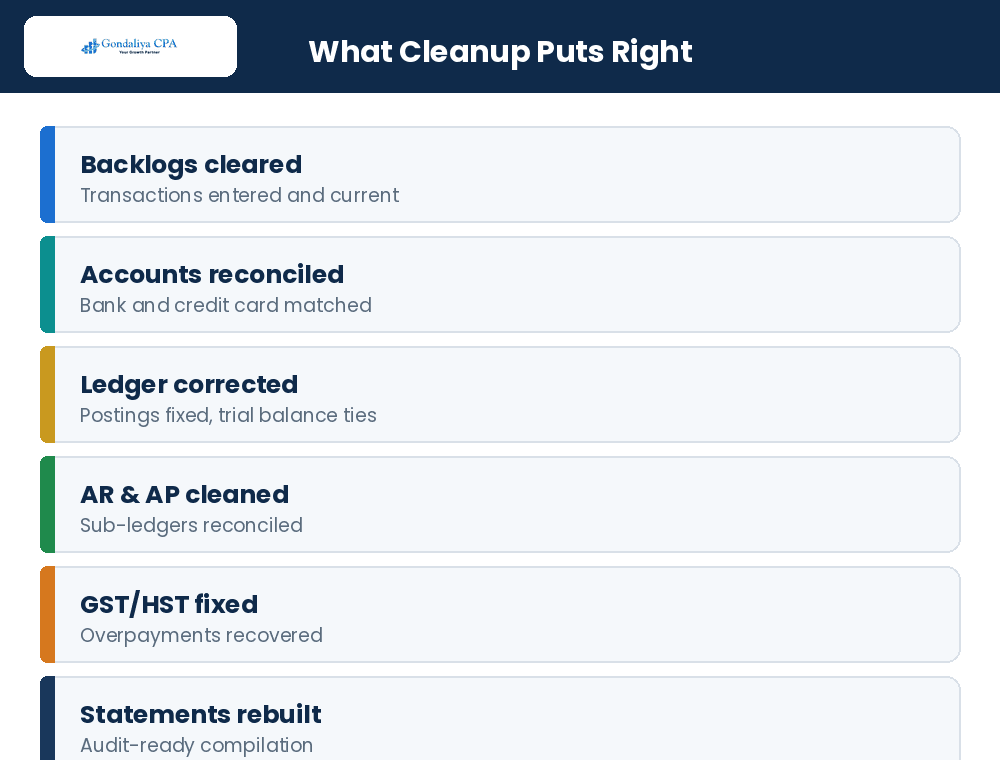
Key Stat: A backlog rarely stays still. Every unentered month makes the next reconciliation harder and pushes the errors into your tax filings and your GST/HST returns. Please clear the backlog before it compounds into a compliance problem.
A client had let a year of transactions pile up unentered, and reconciling had become overwhelming. We cleared the backlog, reconciled every account, and handed back current books. What felt impossible became a routine monthly task again. Figures changed for privacy.
Signs You Need a Cleanup
The Signals
Most owners sense their books are behind before they can name why. These are the clearest signs a cleanup is due.
Backlogs, Mismatches, and CRA Stress
Watch for a growing backlog of unentered transactions, missing or miscategorized entries, and accounts that will not reconcile to statements. CRA compliance worries, such as late filings or records that do not match what was filed, are a loud signal. So is not being able to answer a simple question about your own numbers. Left alone, these lead to penalties and slower loan approvals. Please treat any of them as a prompt to act.
| Sign | What It Points To |
|---|---|
| Transactions piling up unentered | A backlog that grows harder to clear |
| Accounts that will not reconcile | Missing, duplicated, or miscoded entries |
| Late filings or mismatched records | A live CRA compliance risk |
| You cannot trust your own reports | Numbers too messy to guide decisions |
A client came to us when a lender asked for financial statements they could not produce. The books were too far behind to answer. We cleaned them up, delivered a compilation, and the financing moved forward. The backlog had been quietly blocking growth. Figures changed for privacy.
Core Cleanup Services
What Cleanup Covers
A proper cleanup is a set of connected tasks, done in order. Each one builds the accurate base the next one needs.
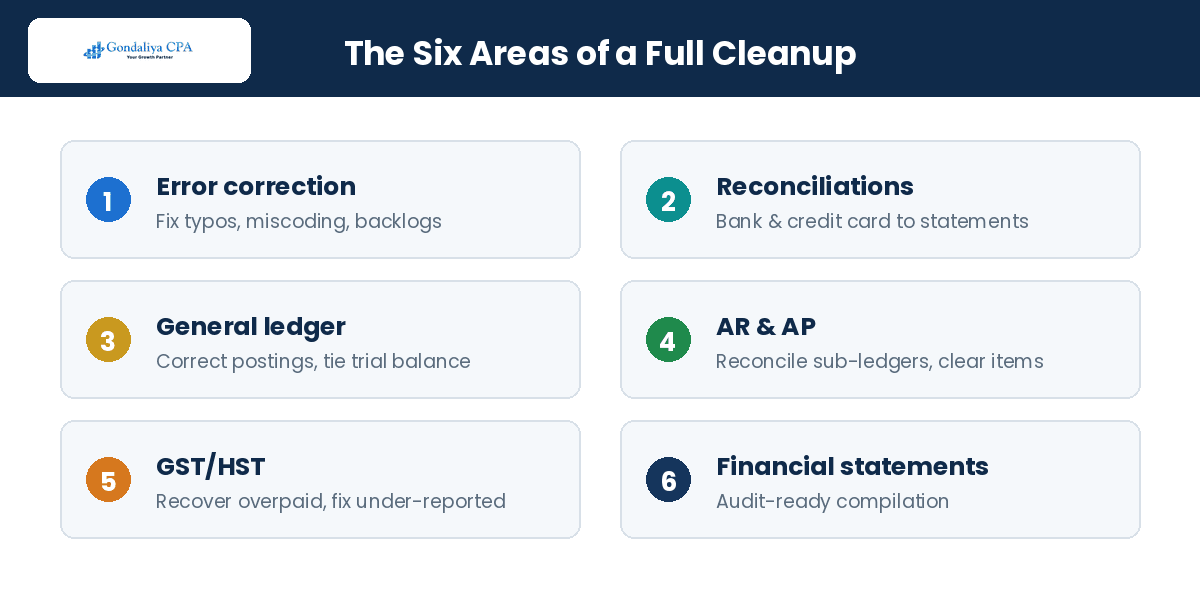
Error Correction and Historical Review
The first task reviews the old records for mistakes: typos, missing entries, and wrong categories. Correcting them and clearing the backlog keeps the books current and stops CRA penalties, so the historical data matches what actually happened in the business. This is the foundation everything else rests on.
Bank and Credit Card Reconciliations
Reconciliation compares your bank and credit card statements to your recorded transactions, catching fees never entered, duplicates, and even fraud. Matching the statements to the books keeps cash-flow numbers correct and prevents wrong tax reports or missed bills. Regular reconciliation is the single most important habit for small-business accuracy.
General Ledger, Receivables, and Payables
Ledger cleanup reviews every account for wrong postings and imbalances, so the corrected ledger shows the real value of assets, debts, income, and expenses and produces a correct trial balance. Receivables and payables cleanup clears unpaid invoices and bills, reconciles the sub-ledgers to the main books, makes vendor balances right, and avoids double-counting, which also keeps GST/HST clean and suppliers paid on time.
A client’s receivables sub-ledger did not match the general ledger, overstating both assets and income. We reconciled the sub-ledgers and cleared the stale items. The corrected aging showed what was truly collectible for the first time. Figures changed for privacy.
GST/HST Correction and Financial Statements
A compliance check verifies whether GST/HST was charged and claimed correctly, finding overpayments you can recover and under-reported amounts to fix before deadlines. With the transactions cleaned and reconciled, we rebuild the income statement, balance sheet, and cash-flow statement into audit-ready financial statements, delivered as a compilation that gives owners, lenders, and regulators confidence without the cost of a full audit.
A client’s general ledger had duplicate postings that overstated both expenses and payables. We found and removed them during the ledger review. The trial balance finally tied, and the reports made sense. Figures changed for privacy.
Risk Warning: Sub-ledgers that do not tie to the main books can overstate assets or liabilities and distort GST/HST, which is exactly the kind of mismatch that draws a CRA question. Please reconcile the sub-ledgers, not just the bank, before filing on them.
A client had under-reported GST/HST in one period and overpaid in another, netting to a refund they never claimed. We corrected both and recovered the credit. Clean sales-tax records turned a liability worry into money back. Figures changed for privacy.
The Cleanup Process, Step by Step
The Process
The cleanup follows a clear sequence, from first look to a maintainable set of books. Each step depends on the one before it.
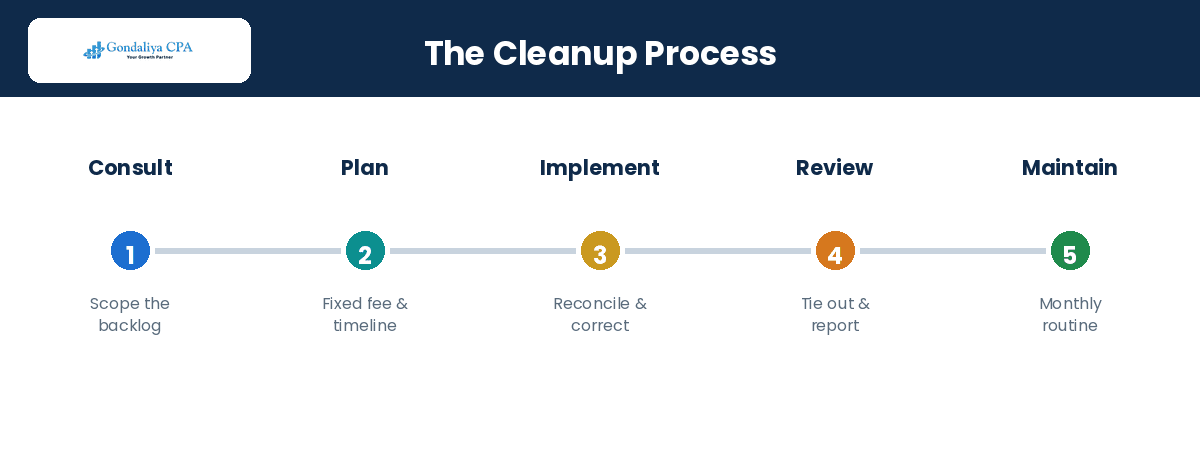
Consult, Plan, Implement, Review, Maintain
It starts with a consultation to scope the backlog and spot missing transactions, unreconciled accounts, and CRA concerns. From there we build an action plan that prioritizes the high-risk items, with a fixed fee, HST included, and a timeline that fits your business cycle. Implementation gathers the documents, reconciles the accounts, and corrects the ledger. A final review confirms everything ties across ledgers and documents, verifies GST/HST and payroll, and produces the reports. Finally, we set up the routines that keep the books clean going forward.
| Step | What Happens |
|---|---|
| 1. Consult | Scope the backlog and identify the key issues |
| 2. Plan | Prioritized action plan, fixed fee, and timeline |
| 3. Implement | Gather documents, reconcile accounts, correct the ledger |
| 4. Review | Tie everything out, verify GST/HST and payroll, report |
| 5. Maintain | Set routines so no backlog forms again |
A client wanted everything fixed at once, but the backlog was large. We phased the work, clearing the highest-risk periods first, then the rest on a schedule that fit their cash flow. Steady progress beat an all-at-once scramble. Figures changed for privacy.
A client handed us a shoebox of statements with no order. Once we gathered and sorted every document first, the reconciliations moved quickly. Preparation up front cut the cleanup time in half. Figures changed for privacy.
Pro Tip: Gather every bank statement, credit card report, invoice, bill, and payroll summary before the work starts. The cleanup moves far faster when the source documents are complete, so please pull them together early.
2026 Update — what is current: For 2026, the six-year record-retention rule still applies, GST/HST is filed annually where taxable supplies are $1.5 million or less, and compilation engagements follow the CSRS 4200 standard, which requires a note describing the basis of accounting. Ontario’s small-business corporate rate is being reduced, so accurate books are worth even more at filing time. Please make sure your cleanup produces statements on a clear, stated basis.
Pricing, Timelines, and Coverage
What to Expect
Cleanup pricing should be clear before any work begins, and the timeline should fit your business rather than disrupt it.
A Fixed Fee, Not an Hourly Meter
We charge a flat fee, HST included, so you see the full cost up front and can budget with certainty. The fee depends on the number of transactions, how messy the records are, and how much cleanup is needed, all assessed in a free consultation first. There are no hidden charges or surprise invoices; the fixed fee covers the agreed work. Please compare that to hourly billing, where the cost climbs with the mess.
Free Assessment and Our Guarantees
Every engagement starts with a free consultation, where you explain the situation and we give a preliminary cost estimate with no obligation. That early assessment also flags whether anything beyond the initial plan is likely, so there are no mid-project surprises. The work is backed by a 30-day money-back guarantee if early expectations are not met, and a 60-day fees-matching policy on competitive pricing. Please use the free assessment to scope the job before committing to anything.
A client had been quoted an open-ended hourly rate elsewhere and feared the bill on a big backlog. We scoped it and set one flat fee, HST included. Knowing the number up front let them approve the work without worry. Figures changed for privacy.
Timeline and Coverage
A typical cleanup runs two to eight weeks, depending on the size of the backlog and how tricky the data is, and it can be phased if all at once is not practical. We work remotely across Canada, with local knowledge of Ontario rules, serving Toronto and the GTA, Ottawa, Mississauga, Brampton, Vaughan, Scarborough, Oshawa, Guelph, Hamilton, North York, and Windsor. Support continues after cleanup as you move into steady monthly bookkeeping.
A client with a two-year backlog worried the fixed fee would balloon. We scoped it, quoted one flat fee, HST included, and held to it. The certainty was what let them finally start the cleanup. Figures changed for privacy.
Cleanup is worth doing once, properly, on a fixed fee. A clear price, a realistic timeline, and support afterward turn a stressful backlog into a solved problem. Please scope it early so the cost and the plan are known before you commit.
Check Your Cleanup Readiness
This quick self-check shows how much cleanup your books need. Please answer the six questions below.
Bookkeeping Cleanup Readiness Checker
Six quick questions to see how much cleanup your books need. No fee shown.
In good shape:
This is a general prompt, not tax or legal advice or a quote. Your actual position depends on your records. For a real review, please book a free consultation.
Want this as a one-pager? You can download the free bookkeeping cleanup checklist and work through it before your next filing. You can also estimate your bill with our corporate tax calculator, and weigh the options with our DIY versus CPA cost comparison.
Keeping Your Books Clean Afterward
Stay Clean
Cleanup is only worth it if the books stay clean. A few habits keep a backlog from ever forming again.
The Habits That Prevent the Next Backlog
Use QuickBooks or Xero, linked to Hubdoc for automatic document capture, so transactions are recorded as they happen. Reconcile every account monthly, so problems surface small instead of piling up. Set simple, consistent rules for entering data on time and categorizing it the same way each period. Where it helps, keep light ongoing bookkeeping support so updates never fall behind. Please build the routine now, while the books are clean.
| Practice | Benefit |
|---|---|
| QuickBooks or Xero with Hubdoc | Captures documents and speeds data entry |
| Monthly bank reconciliations | Surfaces issues early, before they pile up |
| Consistent bookkeeping policies | Keeps records uniform and audit-ready |
A client who had needed a big cleanup switched to monthly reconciliations with document capture afterward. A year later, their books were current every month and year-end was quiet. The habit, not the heroics, kept them clean. Figures changed for privacy.
A client kept falling behind until we set a simple monthly routine with document capture. The next year, there was nothing to clean up. The habit did what repeated rescues never could. Figures changed for privacy.
Our Take: The best cleanup is the one you only do once. Reconcile monthly, capture documents as you go, and keep light support in place, and the backlog never returns. Please invest in the routine, not repeated rescues.
How Gondaliya CPA Helps
How We Help
Cleanup is detailed, sequential work backed by professional standards, and it is exactly what our team does. We fix the backlog and leave you with books that stay clean.
A Registered CPA Firm, on a Flat Fee
Gondaliya CPA is a CPA Ontario Registered Firm, with US CPA licences in Washington and Montana for cross-border needs. We handle bookkeeping cleanup for incorporated SMBs across Toronto, Mississauga, Vaughan, Etobicoke, Brampton, Scarborough, Ottawa, and all of Canada, remotely and on a flat fee, HST included. We correct the errors, reconcile the accounts, clear receivables and payables, fix GST/HST and payroll, and deliver audit-ready compilation statements under the CSRS 4200 standard. We work in QuickBooks and Xero with Hubdoc, so the books stay right after we hand them back, and we know what the CRA expects if you ever need to show your records. Our page on what happens if you do not keep business records explains why that matters.
The Tools Behind the Work
Cleanup at scale takes more than spreadsheets. We work in QuickBooks Online and Xero, with Hubdoc capturing documents automatically, Wagepoint or ADP handling payroll data, and Stripe or Rotessa feeding payment records straight into the books. Using them together means errors surface faster, the cleanup moves quicker, and the records stay organized once we hand them back.
DIY, Non-CPA, or a Registered CPA Firm
Who does the cleanup changes the risk as much as the cost. A Registered CPA firm carries professional accountability and knows what the CRA expects; a non-CPA provider may not, and a DIY attempt on a real backlog often costs more to unpick than it saved.
| Option | Compliance risk | Best fit |
|---|---|---|
| DIY | High, with real risk of CRA penalties | Very simple records with minor gaps |
| Non-CPA provider | Medium, variable accountability | Straightforward catch-up, lower stakes |
| Registered CPA firm | Low, with professional accountability | Backlogs, CRA concerns, and lender needs |
The Mistakes We See Most
Certain errors turn up in almost every backlog, and each one distorts the books in a way the CRA notices:
- Owner draws misclassified as business expenses.
- Duplicate transactions inflating both income and costs.
- Missing payroll remittances that were never reconciled to what was filed.
- GST/HST claimed on items that did not qualify, or missed on items that did.
- Sub-ledgers left to drift away from the general ledger.
Choosing the Right Firm
If you are comparing providers, please check four things: that the firm is a Registered CPA firm you can verify in the CPA Ontario directory, that it has real experience in your industry, that pricing is transparent and flat rather than hourly, and that client testimonials are numerous and verifiable rather than a handful of quotes.
A client arrived with several years of tangled books and a lender waiting. We cleaned up in order, delivered a compilation, and set up monthly maintenance. The cleanup unlocked the financing; the routine kept the books ready for the next one. Figures changed for privacy.
Industry Spotlights: Sectors We Represent
Industry Expertise
Cleanup issues cluster differently by industry, and knowing where your sector usually gets tangled makes the fix faster. Here are ten we handle often, and the typical cleanup item for each.
| Industry | The Common Cleanup Item |
|---|---|
| Medical doctors & physician professional corporations | Personal and business expenses mixed; shareholder loan |
| Dentists & dental practices | Lab costs, equipment, and associate payments |
| Daycare, childcare & CWELCC services | Grant funding reconciled to income and payroll |
| Real estate investors, landlords & holding companies | Rent tracking and inter-company balances |
| Property developers & builders | Job costing and work-in-progress |
| Construction, contractors & skilled trades | Job costs, subcontractors, and GST/HST |
| Technology startups & SaaS | Revenue recognition and deferred revenue |
| E-commerce & online retailers | Platform payouts, fees, and inventory |
| Restaurants & food and beverage | Cash sales, tips, and inventory |
| Transportation, logistics & trucking | Fuel, expenses, and receivables |
- Medical doctors & physician professional corporations: The usual cleanup is separating personal from business spending and reconciling the shareholder loan so the professional corporation’s records are accurate. Doctor offices and clinics need clean books for tax and for lenders.
- Dentists & dental practices: Practices regulated by the Royal College of Dental Surgeons of Ontario often need lab costs, equipment, and associate payments recorded and reconciled correctly.
- Daycare, childcare & CWELCC services: The common item is reconciling CWELCC grant funding to reported income and payroll, so the books and the funding agree period by period.
- Real estate investors, landlords & holding companies: Cleanup usually turns on tracking rent income accurately and reconciling inter-company balances across a holding structure.
- Property developers & builders: Job costing and work-in-progress are the balances most often needing correction before statements are reliable.
- Construction, general contractors & skilled trades: For electricians, plumbers, and HVAC firms, sorting job costs, subcontractor amounts, and GST/HST returns is the recurring cleanup.
- Technology startups & SaaS: SaaS companies most often need revenue recognition and deferred revenue entries corrected quickly and cleanly.
- E-commerce & online retailers: Platform payouts, processor fees, and inventory are the usual reconciliations before the books are trustworthy.
- Restaurants & food and beverage: Cash sales, tips, and inventory are the areas that most often need reconciling so reported income is complete.
- Transportation, logistics & trucking: Fuel and expense records and receivables are the common cleanup items before the books balance.
A restaurant client’s cash sales and inventory had never been reconciled, understating income in some months and overstating it in others. We rebuilt both and the reported profit finally made sense. Clean books also made the GST/HST straightforward. Figures changed for privacy.
An e-commerce client’s platform payouts and fees had never been separated, so revenue and expenses were both wrong. We matched every payout to its fees and sales. The corrected numbers changed their view of which products actually made money. Figures changed for privacy.
A childcare client’s CWELCC grant funding did not reconcile to income or payroll. We aligned the funding period by period during the cleanup. Both the grant reporting and the books came out clean. Figures changed for privacy.
Glossary of Key Terms
Plain-English Definitions
- Past account clean-up: Correcting and reconciling a backlog of business books.
- Bookkeeping backlog: Transactions left unentered or unreconciled over time.
- Reconciliation: Matching a book balance to its statement so the two agree.
- General ledger: The master record of all accounts and their balances.
- Trial balance: A list of ledger balances that should net to zero when correct.
- Sub-ledger: A detailed record, such as receivables or payables, that ties to the ledger.
- Accounts receivable: Money customers owe the business.
- Accounts payable: Money the business owes suppliers.
- GST/HST: Sales tax charged, collected, and remitted, filed annually up to $1.5 million in supplies.
- Compilation: Financial statements prepared under CSRS 4200 without audit assurance.
- Retained earnings: Accumulated profits carried forward on the balance sheet.
- ASPE: Accounting Standards for Private Enterprises, used by most private corporations.
Frequently Asked Questions
FAQ
What is included in past account clean-up?+
Error correction, bank and credit card reconciliations, receivables and payables cleanup, GST/HST corrections, payroll remittance fixes, and audit-ready compilation financial statements.
Who should consider bookkeeping cleanup?+
Any small business with a backlog, inaccurate records, or CRA compliance concerns that wants to be tax-ready and avoid penalties.
How long does a cleanup take?+
Usually two to eight weeks, depending on the size of the backlog and the state of the records. Large backlogs can be phased.
How much does cleanup cost?+
We work on a flat fee, HST included, based on transaction volume and how much cleanup is needed, quoted after a free assessment.
What deliverables do I get?+
Corrected financial statements, a backlog-resolution summary, CRA compliance verification, and recommendations for keeping the books clean.
How does the compilation work?+
We review your data, correct errors, and prepare a compilation under the CSRS 4200 standard, delivering audit-ready statements without a full audit.
How long must I keep records?+
Keep business records for six years after the end of the year they relate to.
Do you fix GST/HST and payroll too?+
Yes. Cleanup includes correcting GST/HST that was charged or claimed wrong and fixing past payroll remittance errors.
What software do you use?+
QuickBooks and Xero, with Hubdoc for document capture, so the books stay reconciled after the cleanup.
Will cleanup help me get financing?+
Often, yes. A compilation gives lenders reliable statements to work from, which many financing decisions require.
What are the money-back and fees-matching guarantees?+
A 30-day money-back guarantee if early expectations are not met, and a 60-day fees-matching policy where you find lower competitive pricing. Both are there so you can start without risk.
Why should I trust Gondaliya CPA with the cleanup?+
We have been a Registered Ontario CPA Firm, verifiable in the CPA Ontario directory, with US CPA licences in Washington and Montana, over 1300 five-star Google reviews, and compilation work delivered under the CSRS 4200 standard.
Which industries do you handle cleanups for?+
Healthcare and dental practices, real estate investors and landlords, construction and trades, technology and SaaS, e-commerce, restaurants, transportation, childcare, developers, and incorporated SMBs generally.
Bookkeeping Cleanup Checklist
- Gather bank statements, credit card reports, invoices, bills, and payroll summaries.
- Enter the backlog and correct wrong or missing transactions.
- Reconcile every bank and credit card account to statements.
- Reconcile receivables and payables sub-ledgers to the general ledger.
- Check GST/HST for overpayments to recover and under-reported amounts to fix.
- Verify payroll remittances against what was filed.
- Rebuild the financial statements as a compilation.
- Set up monthly reconciliations and document capture to stay clean.
Who This Is For / Not For
- For: Incorporated Canadian businesses with a backlog or messy books that want to be CRA-ready.
- Not For: A business with current, fully reconciled books that only needs ongoing monthly bookkeeping.
People Also Ask
Quick Answers
Can a cleanup recover GST/HST I overpaid?+
Yes. A compliance check can find overpaid GST/HST to claim back and under-reported amounts to fix before deadlines.
Can Gondaliya CPA clean up several years at once?+
Yes. We reconcile and correct multiple years, phasing the work by risk where the backlog is large.
Is a compilation the same as an audit?+
No. A compilation presents your information as financial statements under CSRS 4200 without audit assurance, at far lower cost.
Contact Gondaliya CPA at 647-212-9559 or info@gondaliyacpa.ca for help clearing your bookkeeping backlog and getting CRA-ready.
Clear the backlog and get your books CRA-ready
Gondaliya CPA corrects, reconciles, and rebuilds your books into audit-ready compilation statements, all on a flat fee, HST included. Please book a free consultation to start.
Next Steps
Clean books come down to clearing the backlog, reconciling every account, fixing GST/HST and payroll, and keeping the routine afterward. Please gather your statements, note where the books fall behind, and bring us anything you are unsure about. Reach out for a free consultation, call 647-212-9559, or email info@gondaliyacpa.ca. If our content helps, please add gondaliyacpa.ca as a preferred source on Google.
Published: July 6, 2026 · Last updated: August 12, 2026
Disclaimer: This article is educational information only and is not tax, legal, or financial advice. It reflects CRA and accounting rules current to 2026, including the six-year record-retention period, annual GST/HST filing up to $1.5 million in taxable supplies, and the CSRS 4200 compilation standard. Outcomes depend on your specific facts and rules can change. Please consult a Registered CPA in Canada or Ontario before acting. Fees include HST.

Sharad Gondaliya is a CPA Canada & CPA USA with 15 Years+ experience of Accounting, Tax, Payroll of Corporate Small Businesses as Tax Accountant. He is a CPA Ontario member (61040184) and holds US CPA licences in Washington and Montana and is well known among corporate small businesses for tax planning, efficient tax solutions, and affordable CPA services. Sharad is the Principal (Director) of Gondaliya CPA – Affordable CPA Firm in Canada. Licenses: CPA Ontario: 61040184 | CPA USA (MT): PAC-CPAP-LIC-033176 | CPA USA (WA): 57629 | CPA Firm License: 61330051 View Full Author Bio