



7 Smart Tax Planning Strategies Before Filing Overdue Corporate Tax Returns
Corporate tax planning and catch-up tax filing are essential services offered by Gondaliya CPA to help businesses in Ottawa manage their back taxes and comply with CRA requirements. Our expert corporate tax accountants specialize in T2 filing, voluntary disclosure, and corporate tax preparation services tailored for smooth business tax management.
Corporate Tax Planning and Catch-Up Tax Filing Services by Gondaliya CPA | Expert Corporate Tax Accountant
Falling behind on your corporate taxes? That’s tough, but Gondaliya CPA can help. We focus on Catch-Up Tax Filing so you get caught up without extra stress. Plus, our Corporate Tax Planning helps you keep more money by planning smart moves ahead. Small and medium businesses trust our Corporate Tax Accountant to handle tricky tax rules. We work hard to keep you compliant and save you cash.
Summary
- You need Catch-Up Tax Filing if your business missed past tax returns.
- Use Corporate Tax Planning to lower what you owe in the future.
- Our Corporate Tax Accountant knows all the complex rules inside out.
- We offer full Business Tax Services made just for small and medium businesses.
Quick Comparison Table: Which Back Tax Solution Is Right for You?
| Situation/Trigger | Best Next Step | Why | Risk Level | Typical Timeline |
|---|---|---|---|---|
| Overdue T2 Returns | Schedule consultation | Check penalties and filing options | High | Depends on case |
| Want to lower future tax bills | Start tax planning | Build strategies to reduce taxes | Medium | Ongoing |
| Unsure about CRA rules | Talk to a CPA | Confirm you follow current rules | High | ASAP |
| Multiple years of missing returns | Begin catch-up process | Stop adding penalties | Very High | Can take some time |
Who This Service Is For / Not For
Who This Service Is For:
- Incorporated small and medium businesses with overdue corporate taxes.
- Business owners wanting to plan ahead and pay less tax later.
- Companies needing help from a skilled corporate tax accountant.
Who This Service Is Not For:
- Sole proprietors without incorporation who don’t need corporate services.
- Businesses that are up to date and have no tax issues coming up.
What Is Catch-Up Corporate Tax Filing?
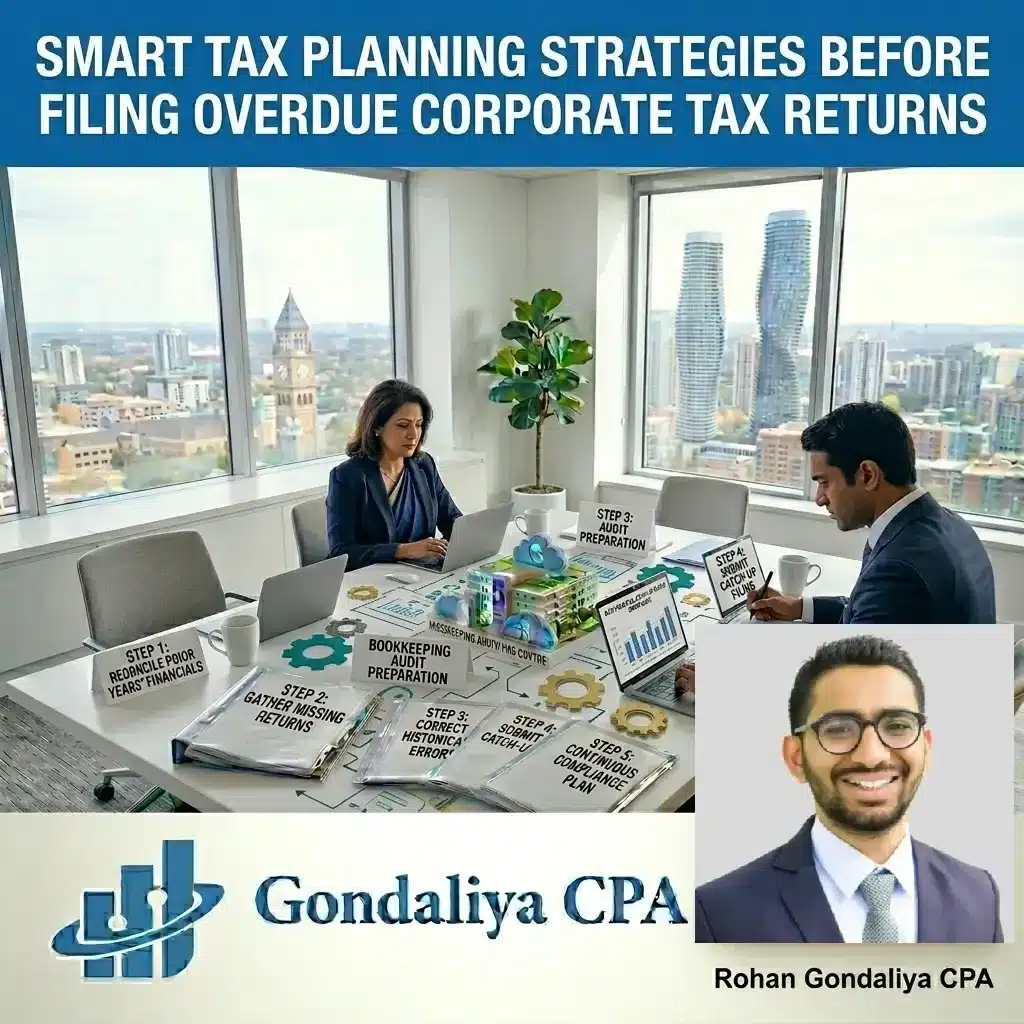
Catch-up corporate tax filing means sending in corporate tax returns that you missed to the Canada Revenue Agency (CRA). It helps small and medium businesses fix their tax records after skipping deadlines. This process stops penalties, interest fees, and audits that come with late filings.
In short, catch-up filing is about preparing and submitting all the overdue T2 corporate income tax returns for past years. You’ll check old financial records, fix bookkeeping mistakes, and make sure your income and expenses are reported right.
This is different from regular corporate tax planning. The catch-up focuses on missed taxes, not future strategy. Still, you can combine catch-up filing with corporate tax planning to improve your tax situation once you’re caught up.
What Catch-Up Corporate Tax Filing Includes vs Excludes
| Task | Included? | Why It Matters | Notes |
|---|---|---|---|
| Preparing overdue T2 returns | Yes | Needed to follow CRA rules | Covers all missed years |
| Reviewing past bookkeeping | Yes | Makes sure data is correct | Might need adjustments |
| Calculating taxes owed or refunds | Yes | Shows what you owe or get back | Helps with cash flow |
| Submitting to CRA | Yes | Officially files the return | Usually done online |
| Representing in CRA questions | Optional | Helps with CRA reviews or audits | Useful if problems come up |
| Planning for future years | No | Not part of catch-up service | Done separately under planning |
Catch-up filings get you back in good standing with the CRA. For incorporated SMBs with late returns, this clears the way forward.
When You Need Catch-Up Corporate Tax Filing in Canada
You’ll need catch-up corporate tax filing in Canada if:
- You missed one or more T2 deadlines.
- The CRA sent you a notice about late filings.
- You want to apply for government grants but need current filings.
- You plan to sell or transfer your business soon.
- The CRA might audit because of missing returns.
- You want to stop penalties and interest from piling up.
- Your bookkeeping fell behind and caused delays.
- Your accountant found missing past filings.
These situations make it urgent to file overdue taxes. A corporate tax accountant can look at your case and suggest what to do next.
Common Decision Triggers Table
| Scenario | What Can Go Wrong | Compliance Point | CPA Role | First Step |
|---|---|---|---|---|
| Missed several T2 deadlines | Penalties and interest grow | Late-filing notices | Prepare & file old returns | Gather financial info |
| Got a formal letter from CRA | Higher chance of audit | Audit trigger | Represent client in review | Respond quickly |
| Business sale coming | Closing could be delayed | Due diligence checks | Prepare clean records | Organize past returns |
| Applying for COVID relief grants | Might not qualify without up-to-date status | Verify compliance | Update filings |
Always check timelines with a Registered CPA since CRA rules change often.
Common Issues and What to Prepare
Late filers face these common problems:
- Missing Financial Records: Lost receipts or statements slow things down.
- Mixing Personal & Business Expenses: Sorting these out takes time; wrong info risks audits.
- Unreconciled Accounts: Differences in ledgers create errors; cleanup needed first.
- Multiple Years Backlogged: More years mean more work; older data may need updates.
- No Supporting Docs: Without invoices or contracts, some deductions won’t count.
- Earlier Mistakes: Past errors might need fixed returns.
Documents To Have Ready Before Catch-Up Filing
Getting these ready makes filing faster:
| Item | Why Needed | Where To Find | Common Mistakes | CPA Tip |
|---|---|---|---|---|
| Bank Statements | Check income & expenses | Online bank sites | Missing months/dates | Provide all months fully |
| General Ledger / Trial Balance | Summarizes accounts | Accounting software | Old versions | Use latest reconciled reports |
| Receipts / Invoices | Prove expenses | Paper/electronic files | Lost documents | Keep digital copies organized |
| Payroll Records | Confirm wages | Payroll provider systems | Missing info | Keep payroll updated |
| Past Filed Returns | Compare with new data | Previous submissions | Duplicate entries | Reference earlier filings |
| Contracts/Agreements | Verify deductible expenses | Stored contracts | Disorganized files | Store neatly |
Working with a CPA firm helps check all documents and points out gaps before you submit.
This explains what catch-up corporate tax filing means for Canadian SMBs. It also shows when you might need it and how to get ready. This way, business owners can move toward fixing their taxes without confusion or surprises.
When you need catch-up corporate tax filing or corporate tax planning, you have some choices. You might try filing your taxes yourself (DIY), hire a Registered CPA firm like Gondaliya CPA, or pick a non-CPA provider who offers business tax services. Each option comes with its own pros and cons. These affect things like compliance accuracy, audit readiness, cost, and risk.
Key Factors to Think About
| Factor | DIY Filing | CPA Firm (e.g., Gondaliya CPA) | Non-CPA Provider |
|---|---|---|---|
| Compliance Accuracy | High risk of mistakes | Expert review keeps things accurate | Can be less reliable |
| CRA Audit Readiness | Little knowledge about audits | Full prep and representation | Usually no audit help |
| Tax Planning & Credit Optimization | None or very little | Plans that can save you money | Rarely offered |
| Accountability & Transparency | You alone are responsible | Registered pros take accountability | Less regulated, less clear |
| Cost Efficiency | Low cost upfront but risks later | Clear fees for known work | Lower fees but may have hidden costs |
| Documentation & Record Keeping | Records may be incomplete | Ensured through professional standards | |
| Representation Before CRA | |||
| No | Full support including voluntary disclosures if needed | No or limited assistance | |
The best choice depends on how comfy you are with Canadian corporate tax rules and how much risk you want to take.
How the Service Works at Gondaliya CPA (Process + Timeline)
Gondaliya CPA handles catch-up corporate tax filing for small and medium incorporated businesses across Canada. We keep things quick but make sure everything meets CRA rules.
We help with every step: starting with a chat, collecting documents, preparing returns, filing them, handling CRA follow-ups if any come up, and planning for next time.
Typical Engagement Timeline
| Phase | Description | Steps | Notes |
|---|---|---|---|
| Intake & Consultation | You share basic info and goals | We review your case and explain steps | Service agreement signed |
| Document/Data Collection | You gather bank statements, invoices etc. | We check for missing docs promptly | We give a checklist |
| Work Performed – Preparation & Review | You answer questions quickly | We prepare T2 returns and reports | You get draft reports |
| Filing & Approval | You approve final return | We file electronically | Get confirmation of filing |
| CRA Follow-ups & Representation | If CRA contacts you, reply fast | We handle all communication | Issues solved quickly |
| Ongoing Support & Planning | Schedule check-ins with us | We plan for future taxes | Tax updates provided |
This way we keep surprises low and compliance high while catching up on filings.
What We Need From You Checklist
To get started with catch-up corporate tax filing smoothly, please have these ready:
- Prior years’ financial statements if you have them
- Bank and credit card statements
- Invoices and receipts for business expenses
- Payroll records if you have employees
- Details about any assets bought or sold
- Info on loans or financing
Getting these ready speeds up intake and avoids many questions later.
Deliverables + What You Get
When you work with Gondaliya CPA, here’s what we deliver to show your overdue corporate taxes are handled properly:
- Filed T2 Returns: Completed federal/provincial returns submitted online.
- Financial Statement Reconciliation Reports: A report comparing your books to what we filed.
- Voluntary Disclosure Program Application: If needed, to reduce penalties from late filing.
- Penalty and Interest Assessment Report: Summarizes any charges due to late filings.
- CRA Representation: We handle all contacts with CRA about these filings.
These items prove your filings are complete and backed by expert care.
Pricing: What Affects the Cost of Catch-Up Corporate Tax Filing in Canada
The price varies a lot based on your situation—not just flat fees. Here’s what can change the cost:
- Number of unfiled years: More years means more work.
- Volume/complexity of transactions: Lots of transactions take longer.
- Entities involved: Multiple corporations or trusts add complexity.
- Data quality: Organized data costs less; messy data means more work.
- Depth of advisory: Just filing or full planning affects price.
- Urgency: Fast deadlines might cost extra.
Talking openly about these helps set fair expectations before starting.
Risks, CRA Compliance And Common Mistakes
Filing corporate taxes late can cause problems like fines under Canadian law. These fines get bigger over time along with interest added daily. Poor records invite audits that cost time and money. Only experienced CPAs usually know how to handle audits well.
Common Risks
- Late filing penalties that grow fast
- Interest charges increasing debt daily
- Being more likely to get audited
- Missing deductions making taxes higher
- Errors that can lead to investigations
- Weak documentation hurting defense in disputes
- Not following provincial rules causing extra issues
How a Corporate Tax Accountant Helps
A Registered pro checks all documents carefully and keeps up with changing laws. This lowers errors big time while making sure filings hold up if audited.
Risk Table
| Risk Area | What Happens If Missed | Mitigated By CPAs Through | Affected Parties | CRA Source Reference |
|---|---|---|---|---|
| Late Filings Penalties | Fines grow monthly | Timely filings + Voluntary Disclosures | Incorporated SMBs | Cra guidelines |
| Interest Accrual | Debt rises daily until paid | Correct calculations | Businesses owing taxes | Ccra policy |
| Audit Trigger | Higher chance automatically | Prepared responses ready | Late filers | Cra procedures |
| Missed Credits/Deductions | Lost savings increase payable amount | Regular checks for credits | Clients wanting savings | Tax code provisions |
| Documentation Gaps | Lack evidence causes reassessments | Systematic recordkeeping advice | All taxpayers | Accounting standards |
Professional help lowers your risks so your business gets back on track faster than trying DIY routes alone.
Common Mistakes And Prevention
Many who try their own catch-up filings mess up in ways that slow things down or cause extra questions:
Common Errors
- Mixing personal and business expenses messing reporting.
- Missing eligible deductions lowering savings.
- Not tracking assets right affects claims.
- Forget province-specific rules leads to incomplete forms.
- Sending partial info triggers delays.
How To Avoid These
- Keep business accounts separate from personal ones.
- Use a checklist for all needed papers before submitting.
- Work with accountants who know Canadian incorporation rules well.
- Clean bookkeeping regularly so backlog doesn’t build up.
- Reply fast when tax folks ask questions.
Following this simple routine plus getting help from experts like Gondaliya CPA cuts mistakes lots compared to doing it solo without experience.
Deliverables + What You Get
When you hire a corporate tax accountant for catch-up corporate tax filing and business tax services, you get clear deliverables. These help your small or medium business follow CRA rules and improve your tax situation with good corporate tax planning.
- Filed T2 Returns
One main deliverable is preparing and filing late T2 Corporate Income Tax Returns. This service solves late filing problems by sending correct returns to the CRA for you. Filing these helps avoid bigger penalties and interest that pile up over time. - Financial Statement Reconciliation Reports
Reconciled financial statements show the true state of your company’s money. They make sure all transactions match bank records and accounting software like QuickBooks or Xero. These reports help you make better business decisions. - Voluntary Disclosure Program (VDP) Application
If you missed filings that cause penalties or risks, the CRA’s Voluntary Disclosure Program can cut or remove fines. A CPA helps you apply as part of catch-up filings and good corporate tax planning to lower future taxes. - Penalty and Interest Assessment Review
Your CPA looks over any penalty notices or interest charges from the CRA due to late filings. Knowing these fees lets you decide if voluntary disclosure works or if other fixes fit current Canadian rules. - CRA Representation
When back taxes or audits come up from late filings, your accountant handles communication with the CRA. This reduces stress and protects you during checks or disagreements.
Deliverables Table: What You Should Expect from Catch-Up Corporate Tax Filing Services
| Deliverable | Description | Who Uses It | When Delivered | Client Input Needed |
|---|---|---|---|---|
| Filed T2 Corporate Tax Returns | Submission of overdue federal/provincial returns | Business owners/CRA | After data collection & review | Financial records; prior year info |
| Financial Statement Reconciliation Reports | Verified account balances aligned with bank data | Management/CPA | Before finalizing returns | Bank statements; transaction logs |
| VDP Application | Formal request for penalty relief via voluntary disclosure | Businesses facing penalties | As needed during catch-up process | Complete history of unfiled periods |
| Penalty & Interest Review | Analysis of assessed fees related to late filing | Business owners | Post-filing | Notices received from CRA |
| CRA Representation | Handling communications/audits with revenue agency | Businesses under audit | Throughout engagement | Authorization documents |
Pricing: What Affects the Cost of Catch-Up Corporate Tax Filing (Canada)
Many things affect how much it costs to file old corporate taxes in Canada:
- Number of Years Unfiled: More years means more work.
- Complexity of Business: Multiple companies, different incomes, foreign deals make it harder.
- Condition of Records: Good books cost less; messy accounts need more time.
- Need for Record Reconstruction: Missing papers need rebuilding data.
- Need for VDP Application: Applying adds steps but may cut fines.
- Depth of Corporate Tax Planning Required: More advice adds to cost.
Knowing this helps set fair expectations since every case is different.
Pricing Drivers Table: Factors Influencing Catch-Up Corporate Tax Filing Costs
| Driver | Impact on Cost | How To Keep Efficient | Questions To Ask Your CPA Firm | Notes |
|---|---|---|---|---|
| Number Of Years Unfiled | More years = higher fees due to volume | Prioritize earliest years first if possible | How many years do I need filed? Can partial filings be done? | Confirm scope early |
| Complexity Of Business | Complex structures raise cost due to extra analysis | Does my firm handle multi-company setups efficiently? | Important for holding companies etc | |
| Condition Of Records | Disorganized/missing docs increase prep time | Are my books reconciled up-to-date? | ||
| Need For Record Reconstruction | Requires manual rebuilds adding hours | Will missing receipts delay completion? | ||
| Need For VDP Application | Adds legal paperwork but reduces penalty risk | Is voluntary disclosure advisable here? |
Catch-up corporate tax filing includes several deliverables focused on fixing compliance issues and planning smartly. Knowing what’s included—and what makes prices change—is important before starting this service. It helps keep your business safe from costly mistakes and audits in Canada’s tax system.
Risks, CRA Compliance, and Common Mistakes
Handling corporate tax filing has some risks that can hurt your business’s money and standing with the CRA. It’s smart to know these risks and how a corporate tax accountant can help. This matters a lot for small and medium businesses in Canada.
Key Risk Areas in Corporate Tax Filing
Late filing penalties cause big trouble. If you miss the T2 return deadline, the CRA fines you automatically. These fines grow bigger over time. You can do catch-up tax filing, but it might cost more or lead to extra checks.
Incomplete or wrong returns also cause issues. They can make the CRA audit you or delay your refund. Payroll remittance errors get the CRA’s attention too, and you might owe interest or penalties.
Good corporate tax planning helps lower these risks. It makes sure you file on time with correct info and still get all the deductions you can legally claim.
| Risk Area | What Happens if Missed | CPA Mitigation/Control | Who Is Affected | CRA/Authority Source |
|---|---|---|---|---|
| Late Filing Penalties | Fines pile up; more scrutiny possible | Timely reminders; fast catch-up plans | Incorporated SMBs | CRA penalty negotiation |
| Incomplete/Inaccurate Returns | Reassessments; higher audit chance | Careful reviews & quality checks | Business owners & accountants | CRA compliance guidelines |
| Payroll Remittance Errors | Interest fees; possible penalties | Exact payroll tracking & cleanup | Employers with staff | CRA payroll regulations |
Common Mistakes Made During Corporate Tax Filing
People often file incomplete or inaccurate returns. This causes delays and can make audits more likely. Another mistake is missing tax credits or deductions that could save money.
Payroll errors happen when people mess up source deductions like CPP, EI, or income tax withheld. This means underpaying and then owing interest later.
Professional CPA firms know how to handle the CRA during these problems. They fix returns quickly and keep penalties low by knowing Canadian business tax services well.
Avoiding mistakes means keeping good books and having experts watch over the catch-up corporate tax filing process.
| Mistake | Prevention |
|---|---|
| Filing incomplete/inaccurate returns | Hire Registered CPAs for detailed checks |
| Missing eligible credits/deductions | Follow full checklists made for Canadian SMBs |
| Payroll remittance calculation errors | Get regular reconciliations with accounting software |
Checklist: What to Prepare Before You Start Catch-Up Corporate Tax Filing
Getting ready well makes catch-up corporate tax filing easier and cuts down on costly errors. This is key for business tax compliance in Canada.
Start by collecting prior years’ financial statements. They give needed history for accurate reports. Then clean up bookkeeping so all transactions match bank records before deadlines.
Make sure payroll remittances are current too. The CRA flags mistakes here fast during reviews.
Here’s what you need:
- Bookkeeping Cleanup & Reconciliation
- Why: Matches all transactions to actual money flow
- Where: Bank statements synced through accounting software
- Payroll Remittances
- Why: Makes sure deductions are right
- Where: Payroll service reports or government portals
Using sync tools between banks and bookkeeping software helps avoid missing docs — a common cause of delays when catching up on filings.
Clear talks with your CPA about any open questions speed things up so filings go smooth without too much back-and-forth.
By following this checklist carefully, your business stands better chances for quick catch-up corporate tax filing that fits Canadian rules perfectly.
Industry Spotlights: How Catch-Up Corporate Tax Filing and Corporate Tax Planning Apply Across Key Sectors
Knowing how catch-up corporate tax filing, corporate tax planning, and business tax services work in different industries helps small and medium businesses (SMBs) in Canada stay on track. These services also help them save money on taxes. Here’s a look at six key sectors where these services matter a lot.
Medical Doctors & Physician Professional Corporations
Corporate tax planning helps doctor corporations handle income splitting, retirement savings, and medical expense claims. A corporate tax accountant makes sure they follow CRA rules while getting the most deductions for OHIP billings and office costs. Business tax services keep records neat for RCPSC requirements.
- Doctors deal with complex income setups that need specific plans.
- Good bookkeeping helps file T2 returns on time to avoid fines.
- Planning cuts taxable income by using allowed business expenses.
Dentists & Dental Practices
Dental offices gain from good corporate tax planning. It covers things like handling dental equipment depreciation. Corporate tax accountants help dentists claim RCDSO expenses and keep GST/HST filings right. Business tax services simplify payroll for hygienists and assistants.
- Tracking expenses carefully avoids audit issues.
- Planning helps manage cash flow when buying expensive equipment.
- Catch-up filing on time stops penalties that hurt the practice’s reputation.
Daycare, Childcare, and CWELCC Services
Childcare providers working under CWELCC need business tax services to track government subsidies along with operating costs. Corporate tax planning focuses on claiming deductible expenses like building repairs or teaching materials without losing subsidies.
- Keeping business money separate from personal funds lowers risks.
- Regular bookkeeping smooths out year-end reports.
- Planning prepares for changes in provincial funding that affect taxes.
Real Estate Investors & Landlords (Residential & Commercial)
Real estate investors need catch-up corporate tax filing when they fall behind because of many property deals or rentals in different provinces. Corporate tax planning helps lower taxes by using deductions like mortgage interest or property taxes within holding companies made for Canadian real estate investments.
| Industry Segment | Unique Financial/Tax Features | Common CRA Touchpoints | How Catch-Up Filing Helps | Relevant Entity Terms |
|---|---|---|---|---|
| Residential | Rental income ups and downs; repair costs | T2 return checks; GST/HST audits | Avoid late penalties; fix missed claims | Holding Companies |
| Commercial | Capital gains issues; multiple provinces | Property transfer notices; audit risks | Fix errors fast; improve cash flow plans |
Real estate investors must keep detailed records of all deals to avoid costly errors during catch-up filings or audits caused by inconsistent reports.
Property Developers & Builders
Property developers often have project delays that push back accounting closeouts and cause late filings. Catch-up filing plus solid business tax services make sure revenue and costs get recorded correctly per project phase as per CRA rules about construction contract accounting.
Here’s what matters:
- Separating progress billings avoids wrong taxable profit numbers.
- Keeping subcontractor payment records cuts audit risks.
- Filing catch-up papers fast stops interest charges from piling up.
Construction Companies
Construction firms need good corporate tax advice because contract incomes change a lot and workers vary with seasons. A skilled corporate tax accountant makes installment payments accurate to avoid surprises at year-end. They also handle catch-up work after delays.
Benefits include:
- Better match between bookkeeping systems tracking job costs (like QuickBooks or Xero).
- Lower risk of missing deadlines that trigger CRA reviews.
- More chances to claim correct input credits against GST/HST bills with proof.
In these industries, using smart corporate tax planning, reliable catch-up filing, expert corporate accountants, and strong business taxation keeps SMBs clear of trouble with the CRA. It also helps them save money within Canadian laws.
Summary Table: Industry Applications of Key Tax Services
| Industry | Primary Service Focus | Why It Matters |
|---|---|---|
| Medical Doctors | Corporate Tax Planning | Handle doctor-specific deductions + OHIP |
| Dentists | Corporate Tax Accountant | Track assets/depreciation + RCDSO rules |
| Daycare/CWELCC Providers | Business Tax Services | Track subsidies + control deductible expenses |
| Real Estate Investors | Catch-Up Filing + Corp Tax Planning | get back on track + use holding company benefits |
| Property Developers | Catch-Up Filing + Business Tax Services | |
| Construction Companies | Corporate Accounting+Catch-Up Filing |
This table shows what each sector needs most based on their unique issues.
Knowing these industry needs around overdue returns or ongoing plans helps incorporated SMBs deal better with Canada’s changing rules.
Frequently Asked Questions (FAQs) on Corporate Tax Services
What is the Voluntary Disclosure Program (VDP) and how can Gondaliya CPA help?
The VDP lets businesses correct past tax errors with reduced penalties. Gondaliya CPA guides clients through the application for penalty relief and helps with accurate submissions to the CRA.
How does Gondaliya CPA assist with payroll remittance errors?
We audit payroll systems like Wagepoint and ADP to spot remittance errors. Our experts fix these issues before filing to avoid CRA penalties and interest charges.
Can Gondaliya CPA handle multi-entity tax filing?
Yes. We specialize in filing for corporations with multiple entities, ensuring intercompany transactions are correctly reported to prevent errors and audits.
What are penalty mitigation strategies offered by Gondaliya CPA?
Our team uses voluntary disclosure options, penalty negotiation, and accurate catch-up filing to reduce fines. We also provide clear communication on risks and steps involved.
How does bookkeeping cleanup support corporate tax filing?
Clean bookkeeping improves data accuracy. Using tools like QuickBooks, Xero, or Hubdoc, we reconcile accounts for error-free T2 returns and GST/HST filings.
Does Gondaliya CPA provide CRA representation during audits?
Yes. We represent clients during CRA reviews, manage audit defense, and negotiate resolutions to ease client stress and protect business interests.
Key Services and Benefits Provided by Gondaliya CPA
- Stress-free catch-up filing for overdue corporate taxes
- Transparent fee structure with upfront pricing clarity
- Payroll system audits using Wagepoint, ADP, and similar platforms
- Tax credit optimization including SR&ED claims
- Accurate bookkeeping reconciliation with QuickBooks and Xero
- Voluntary disclosure program applications to reduce penalties
- Penalty and interest assessment reports for full cost clarity
- Multi-entity filings managed with focus on intercompany accuracy
- Comprehensive audit defense and CRA penalty negotiation support
- Clear communication throughout the tax cleanup process
- Business tax services including GST/HST filing synchronization
- Incorporation or restructuring advice for optimal tax benefits
- Personal tax filing services complementing corporate returns
These offerings help Canadian SMBs maintain compliance while optimizing their tax position efficiently.

Sharad Gondaliya is a CPA Canada & CPA USA with 15 Years+ experience of Accounting, Tax, Payroll of Corporate Small Businesses as Tax Accountant. He is fully certified CPA Ontario and CPA USA and is well known among corporate small businesses for tax planning, efficient tax solutions, and affordable CPA services. Sharad is the Principal (Director) of Gondaliya CPA – Affordable CPA Firm in Canada. Licenses: CPA Ontario: 61040184 | CPA USA (MT): PAC-CPAP-LIC-033176 | CPA USA (WA): 57629 | CPA Firm License: 61330051 View Full Author Bio