



Catch-Up Corporate Tax Filing in Canada: How to Reduce CRA Penalties & Maximize Tax Savings
Catch-up corporate tax filing is essential to avoid penalties when dealing with a late corporate tax return in Canada. Understanding deadlines, managing corporate income tax return submissions, and addressing late tax filing can help minimize CRA penalties and keep your business compliant.
Catch-Up Corporate Tax Filing and Avoiding Penalties for Late Corporate Tax Return in Canada – Gondaliya CPA
If your business missed filing its corporate tax return on time, catch-up corporate tax filing is what you need. This helps lower CRA penalties and can even boost your tax savings. Knowing about late corporate tax returns and the T2 returns filing deadlines can really help your business avoid trouble with the CRA. Act quickly to fix late filings and keep things on track.
Here’s what you should keep in mind:
- File your overdue return ASAP.
- You might save money by reducing penalties.
- The CRA charges interest on late returns, so faster action means less cost.
- A professional can help you handle complicated situations.
Summary
- Late Corporate Tax Return: Missing the deadline usually brings fines.
- Catch-Up Corporate Tax Filing in Canada: Helps you stay within rules and lowers risks.
- CRA Voluntary Disclosure Program: Offers a chance to cut or erase penalties if you come clean early.
- Registered CPA Firm Compliance: Makes sure filings meet all legal requirements.
- Penalty Relief Options: Several ways exist to reduce or remove penalties if you qualify.
Quick Comparison Table
| Situation | Best Next Step | Why | Risk Level | Typical Timeline |
|---|---|---|---|---|
| Missed 1 tax year filing | File right away | Cuts down interest and penalty buildup | Medium | Should act immediately |
| Multiple years overdue | Hire a CPA firm | Experts lower risks from complex issues | High | Depends on case complexity |
| Minimal taxes owed | Try voluntary disclosure | Might avoid heavy penalties | Low | Usually quick process |
Who This Service Is For / Not For
For:
- Small and medium incorporated businesses (SMBs) in Canada that owe corporate taxes.
- Companies dealing with CRA fines for late corporate tax returns.
Not For:
- Sole proprietors or unincorporated businesses who don’t file corporate taxes.
- Firms current on their filings with no compliance problems.
Fixing missed corporate tax returns fast keeps your business safer. Knowing how catch-up corporate tax filing works in Canada helps you avoid extra fees. If things are messy, getting advice from a Registered CPA firm is smart. They help clean up bookkeeping and manage late filings properly. Don’t wait—taking action now reduces penalty costs later.
What Is Catch-Up Corporate Tax Filing?
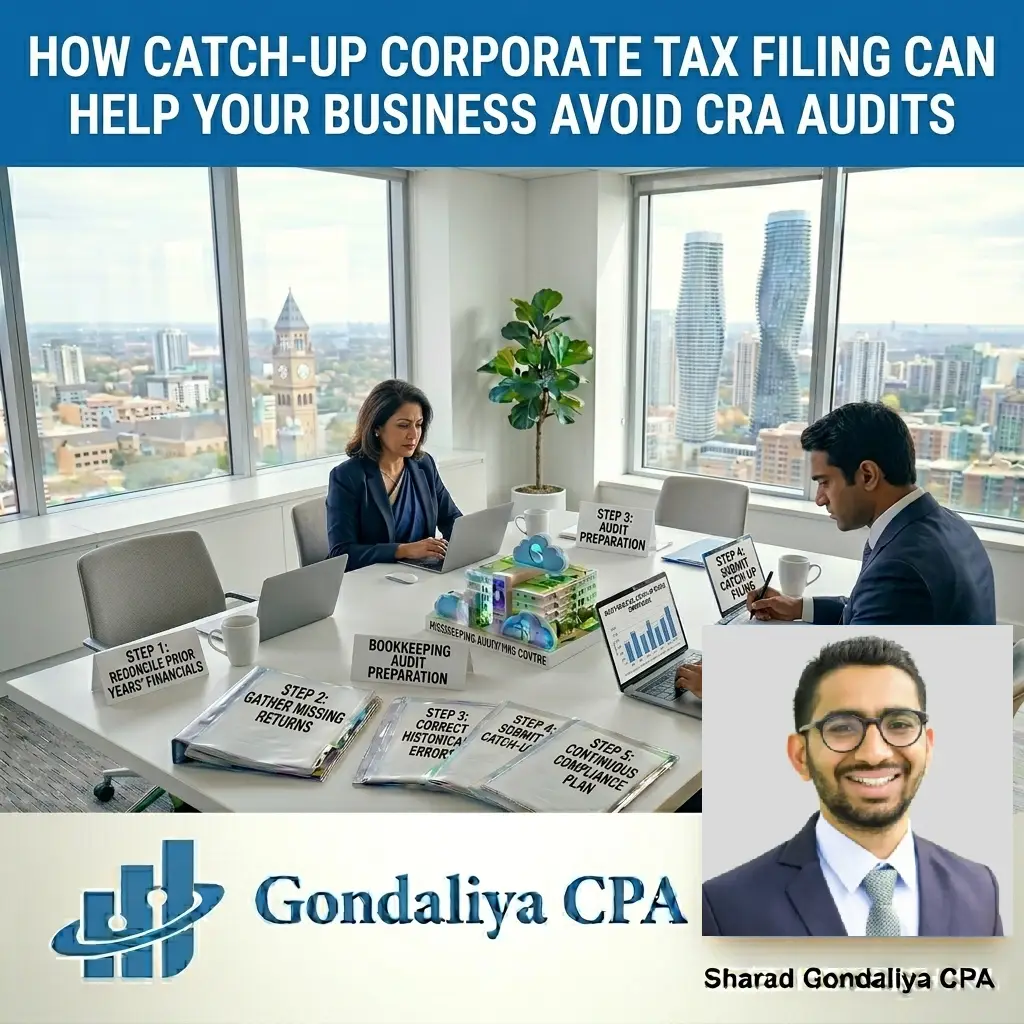
Catch-up corporate tax filing means sending in your late or overdue corporate income tax returns to the Canada Revenue Agency (CRA). If you run an incorporated small or medium-sized business (SMB) in Canada, this usually involves filing T2 Corporation Income Tax Returns that you missed. The main aim is to get your business back on track with CRA rules and avoid extra fees.
A late corporate tax return happens when a corporation doesn’t file its T2 return within six months after the fiscal year ends. This can happen for many reasons, like slow bookkeeping, management changes, or unexpected money problems. No matter why it happened, catching up on these filings is important because CRA corporate tax rules still apply even if you miss the deadline.
Corporate tax filing in Canada means reporting all the taxable income your corporation earned during its fiscal year. It also means figuring out taxes owed using federal and provincial rates, claiming any deductions or credits you qualify for, and paying what you owe. When you catch up on old filings, you fix your standing with CRA and avoid tough actions like garnishments or legal steps.
Knowing what catch-up corporate tax filing involves helps SMB owners see why filing on time matters—and how getting help can make this task easier.
| Term | Definition |
|---|---|
| Catch-Up Corporate Tax Filing | Sending in T2 returns that were not filed for past years |
| Late Corporate Tax Return | A T2 return sent after the six-month deadline following the end of a fiscal year |
| CRA Corporate Tax | Taxes charged by the Canada Revenue Agency on Canadian corporations’ taxable income |
| Corporate Tax Filing Canada | The process of preparing and submitting required federal and provincial corporate taxes |
When You Need Catch-Up Corporate Tax Filing in Canada (Decision Points)
You need catch-up corporate tax filing when you risk penalties or other problems from CRA. Here are some common times Canadian SMBs should think about filing late returns:
- Missed T2 Filing Deadlines: More than six months have passed since your corporation’s fiscal year ended without a T2 return.
- Getting CRA Notices: Letters asking for overdue returns or payments mean you must act fast.
- Owing Taxes With Interest: Your unpaid taxes keep growing because CRA charges daily interest.
- Penalties for Late Filings: Penalties add up the longer you wait; filing sooner cuts costs.
- Considering the Voluntary Disclosure Program: This program can lower penalties if you tell CRA before they start an audit.
- Preparing to Sell or Get Financing: Banks and buyers want proof you filed all recent returns.
- After Ownership or Management Changes: New leaders may find past filings are missing and need fixing right away.
- During Bookkeeping Checks: Missing returns found during accounting reviews need quick attention.
Here’s a quick table showing when catch-up filing makes sense:
| Scenario | Risk if Ignored | Compliance Touchpoint | CPA Role | First Step |
|---|---|---|---|---|
| Missed multiple annual deadlines | Penalties and interest grow | Overdue T2 returns | Prepare and submit correct returns | Gather financial records |
| Received formal CRA demand letter | Possible enforcement actions | Notice letters | Negotiate deadlines & represent | Review CRA letters |
| Unpaid taxes with big interest | Debt keeps increasing | Outstanding balances | Manage payment plans & advise | Check amounts owed |
| Growing monthly penalties | Fines hurt cash flow | Penalty notices | Apply penalty relief programs | Calculate possible savings |
| Voluntary Disclosure Program available | Penalties reduced if disclosed | Formal application needed | Guide eligibility | Collect documents |
| Business sale needs clean record | Audits may block sale | Due diligence checks | Confirm all filings complete | Ensure no issues remain |
| New ownership finds backlog | Legal risks for directors | Director duties | Fix non-compliance quickly | Alert new management |
| Bookkeeping review finds missing files | Accounting errors cause issues | Internal controls check | Reconcile accounts & file missing forms | Organize papers |
Spotting these signs early helps businesses act quickly instead of dealing with bigger problems later. It lowers stress and keeps things running smoothly with CRA.
Your Options: DIY vs CPA Firm vs Non-CPA Provider for Catch-Up Corporate Tax Filing
When your corporate tax filing is late, you have a few choices. You can do it yourself (DIY), hire a CPA firm like Gondaliya CPA, or use a non-CPA provider. Each option comes with its own pros and cons, especially when dealing with catch-up corporate tax filing in Canada or CRA corporate tax issues.
Here’s a quick look:
| Factor | DIY | CPA Firm (e.g., Gondaliya CPA) | Non-CPA Provider | Best For | Key Risk |
|---|---|---|---|---|---|
| Expertise | Limited | High; Registered professionals | Variable | Simple returns | Incorrect filing; penalties |
| Time Commitment | High | Low | Medium | Budget-conscious | Overlooked deductions |
| Compliance Risk | High | Low | Medium | Basic bookkeeping | Incorrect filing; penalties |
| Review Quality | Varies; often minimal | Thorough review & quality assurance | Inconsistent accuracy | Complex filings | |
| Accountability | None beyond self-responsibility | Full professional accountability & licensing | Limited accountability | ||
| CRA Representation | Not available | Included at firms like Gondaliya CPA | Rarely offered | ||
| Cost | Lowest upfront cost | Moderate to higher fees | Lower than CPAs but variable | ||
| Time and Convenience | Highest time investment | Streamlined process saves time | Moderate convenience |
If you want to try DIY, be ready for lots of work. It’s okay if your returns are simple and you know Canadian tax rules well. But mistakes happen easily. That could lead to fines from the CRA.
Hiring a CPA firm is the safest bet for most small to medium businesses. They know the rules inside out. Firms like Gondaliya CPA help reduce penalties and handle any CRA problems. They are fully Registered and accountable.
Non-CPA providers may cost less than CPAs but their skills vary a lot. They might help with basic bookkeeping but often miss complex tax details that the CRA cares about.
Think about your business size, how complex your taxes are, your budget, and how much risk you want to take when picking an option.
How the Service Works at Gondaliya CPA: Process + Timeline
Gondaliya CPA follows a clear process to help you catch up on corporate tax filings in Canada. They aim to cut down CRA penalties while keeping everything by the book.
Step 1: Initial Consultation
You start with a free talk about your situation. This helps figure out how late your T2 return is and what needs doing soonest.
Step 2: Document and Data Collection
You send over all financial records—bank statements, payroll info if needed, past returns, bookkeeping files from QuickBooks or Xero. Getting everything right here stops delays later.
Step 3: T2 Return Preparation
The team prepares detailed T2 Corporation Income Tax Returns for any missed years. They include all income and deductions based on current Canadian rules. Rushing incomplete forms is avoided to lower audit risks.
Step 4: Review and Quality Assurance
Senior accountants like Sharadkumar Gondaliya or Vandana Goel carefully check every number and rule before filing.
Step 5: Filing And Delivery
Once approved, documents go straight to the CRA electronically within set deadlines. This stops extra interest or fines piling up.
Step 6: CRA Follow ups And Representation
If the CRA asks questions or sends penalty notices later, Gondaliya CPA handles replies professionally so you don’t have to stress.
Step 7: Ongoing Support
After catching up, they keep helping with tax advice and planning for future years so problems don’t come back.
Typical Engagement Timeline Overview
| Phase | Typical Duration | Client Actions | CPA Actions | Outputs | Common Delays + Prevention |
|---|---|---|---|---|---|
| Initial Consultation | Few days | Give an overview of your case | Check scope & urgency | Engagement plan | Quick info sharing avoids delays |
| Document Collection | Up to two weeks | Submit financial docs & bookkeeping data | Request clarifications; organize files | Complete doc package | Missing docs cause delays |
| T2 Preparation | One week+ | Reply fast to queries | Prepare detailed T2 returns | Draft ready for review | Delays from slow responses |
| Review & QA | Several days | Review draft summaries | Conduct final checks | Final review completed | Overlooked errors |
| Filing & Delivery | Immediate post-QA | Confirm approval | File electronically | Filed with CRA | Late filings risk penalties |
| CRA Follow-Up | Weeks-months depending | Provide extra info when asked | Manage correspondence | Resolved issues | Delayed responses escalate issues |
| Ongoing Support | Continuous | Stay engaged periodically | Proactive advice | Future planning | Lack of follow-up causes recurring problems |
This step-by-step approach helps get your overdue returns done fast yet carefully. It also leans on strong experience dealing with tricky late corporate tax return rules across Canada.
This should give you a clearer idea of what options you have for catch-up corporate tax filing in Canada — plus how trusted firms like Gondaliya CPA handle this work while cutting down risks tied to late filings before they turn into bigger problems with the CRA.
Deliverables + What You Get
If you need catch-up corporate tax filing, a CPA firm like Gondaliya CPA will help you get back on track. They deliver everything your business needs to fix late filings and follow CRA rules.
These are the main things you’ll get:
| Deliverable | What it is | Who uses it | When delivered | What you provide | Source/Note |
|---|---|---|---|---|---|
| Penalty and Interest Calculation | Shows how much CRA penalties and interest you owe | Business owners with late filings | After initial review | Financial records, prior notices | Check CRA website for current penalty rules |
| Corporate Tax Return Preparation | Prepares your full T2 return with all schedules | Incorporated SMBs | Before filing deadline or ASAP | Accounting data, bookkeeping files | Follows Canadian corporate tax laws |
| CRA Communication and Representation | Handles letters and talks with the CRA | Businesses facing audits or disputes | During the whole process | Authorization to represent | Helps handle tough CRA issues professionally |
| Tax Planning and Optimization Strategies | Gives advice to lower future taxes and find deductions | Business owners wanting to plan ahead | After filing | Financial goals, past returns | Matches Canadian tax rules |
| Compliance Assurance | Checks that all filings meet CRA rules | Business owners wanting peace of mind | At final delivery | Documented filings & reconciliations | Follows Canada’s regulations |
Together, these services help avoid costly mistakes from late returns. Plus, they can set your business up for better tax results later.
Pricing: What Affects the Cost of Catch-Up Corporate Tax Filing (Canada)
Catching up on late corporate tax returns costs different amounts based on several things. Knowing what drives costs helps you plan better.
Key pricing drivers:
- Number of unfiled years: More years mean more work. Penalties add up too. To save money, focus on recent years first. Ask if some years can be handled together.
- Complexity of tax structure: If your company has many owners or parts, the work grows harder. Try cleaning up your records first. See if the firm knows how to handle multiple entities.
- Condition of records: Bad or messy books take longer to fix. Keep your records neat all year if possible. Check if bookkeeping help is available with filing.
- Communications with the CRA: Talking back and forth with CRA costs extra time. Reply fast and give permission for someone to talk for you early on. This keeps things moving.
Prices change a lot depending on each case. Being clear about what you need helps avoid surprise fees.
How each deliverable affects cost:
- Penalty calculations need careful checking; more overdue years mean more work.
- Handling CRA letters or audits adds time beyond just filing forms.
- Tax planning advice after filing gives benefits but takes extra effort.
- Quality checks ensure compliance but add some cost too.
Being aware of these parts helps keep catch-up work smooth without missing important details.
This info lets small and medium businesses across Canada—especially those late with T2 filings—set realistic budgets. It also helps them get the most out of expert help without extra stress.
Risks, CRA Compliance, and Common Mistakes
Filing corporate taxes in Canada can be tricky. You gotta watch deadlines and keep good records. Missing stuff can cost you with penalties or even legal trouble. Small and medium businesses (SMBs) especially need to know these risks if they’re filing late corporate tax returns. Staying on CRA’s good side helps you keep your tax benefits too.
Late Filing Penalties
File your T2 return late, and CRA hits you with penalties. These fees grow the longer you wait. The catch-up corporate tax filing costs more if you don’t act fast.
Usually, CRA charges a percentage of what you owe for each month late. This changes sometimes, so check CRA or ask a Registered CPA. Filing on time cuts your penalty risks big time.
Interest Charges
Besides penalties, CRA adds interest on unpaid taxes every day after the due date. So even if you pay later without extra taxes, expect interest piling up.
Interest rates change quarterly, so make sure you check the current rates when planning to pay or catch up.
Audit Risk
Late returns raise red flags at CRA. That ups your chance of getting audited.
Audits come when records look messy or wrong during catch-up filings. A CPA firm can help by checking your paperwork before sending it in. That way, you avoid surprises from audits later.
Loss of Tax Benefits
If you file late, you might miss some tax breaks. Quick catch-up filings often forget deductions meant for SMBs like investment credits or SR&ED claims.
Doing it right means claiming all deductions and keeping the most money in your pocket despite delays.
Legal Issues
Ignoring tax deadlines does more than cost money. You could face liens or garnishments if debts stay unpaid too long.
Hiring pros early can stop things from getting worse by setting up payment plans and keeping your business compliant.
Inaccurate Record Keeping
Messy bookkeeping is a big cause of mistakes in late filings. It’s hard to match bank statements, payroll info, and GST/HST details if records aren’t clear.
Cleanup services with software like QuickBooks help fix this mess before filing. That keeps numbers right and improves compliance quality.
| Risk area | What happens if missed | CPA mitigation/control | Who is affected | CRA/Authority source |
|---|---|---|---|---|
| Late filing penalties & interest charges | Penalties grow each month; interest adds on unpaid amounts | Reminders; payment plans | Incorporated SMBs | Check official CRA rules |
| Failure to claim eligible deductions | Lose money-saving chances | Expense reviews; claim max deductions | Business owners | Corporate Tax Act |
| Ignoring CRA notices | Enforcement can escalate to garnishments | Quick responses; professional representation | All taxpayers | Voluntary Disclosure Program |
| Inaccurate record keeping | Errors can trigger audits; wrong taxable income | Bookkeeping cleanup tools | Businesses handling own books | Accounting standards + T2 rules |
| Missing installment payments | Instalment penalties apply | Installment tracking systems | Corporations paying quarterly | Payment Remittance Guidelines |
Checklist: What to Prepare Before You Start Catch-Up Corporate Tax Filing
Getting ready before you start makes late filing less painful and lowers mistakes that CRA may spot. Here’s a quick checklist for Canadian incorporated SMBs:
- Financial Statements Preparation: Have your year-end balance sheet and income statement ready.
- Bank Statements Verification: Collect all bank statements for the needed periods.
- Payroll Remittance Records: Gather payroll summaries showing wages plus CPP/EI contributions paid.
- GST/HST Filings Status Check: Review previous GST/HST filings and any amounts still owing.
- Prior Filed Corporate Returns & Correspondence: Keep copies of past T2 returns and any letters from CRA about assessments or requests.
| Item | Why needed | Where to find | Common mistakes |
|---|---|---|---|
| Financial statements | get full picture of finances | Accounting system / Accountant files | Incomplete reconciliations slowing things down, Confirm everything is complete before submitting |
| Bank statements verification | required to match transactions | Online banking portals / Bank branch | Missing months cause errors, Get missing docs quickly |
| Payroll remittance records | required proof for wage expenses | Payroll provider reports / Government slips | Incomplete EI/CPP entries mess up calculations, Double-check totals carefully |
| GST/HST filings status check | required check against sales/purchases | GST portal / Past submissions | Filing gaps raise audit flags, Check latest submissions online |
| Prior filed corporate returns & correspondence | required baseline info + responses | Firm archives / Client emails | Lost docs hurt dispute chances, Keep organized digital records |
Having these ready helps business owners work smoothly with CPAs on catch-up corporate tax filing—cutting delays and boosting accuracy under Canadian rules.
<!–
Industry Spotlights — How Catch-Up Corporate Tax Filing Shows Up in Real Businesses
Catch-up corporate tax filing matters a lot for many Canadian small and medium businesses. Late corporate tax returns can cause penalties and interest charges. They can also make you miss chances to save on taxes. Every industry has its own problems with late filings and CRA rules. Knowing these issues helps business owners see why quick catch-up filing is needed.
Medical Doctors & Physician Professional Corporations
Doctors’ corporations must follow OHIP billing rules while handling pay for doctors. Filing taxes late can mess up benefits linked to income reporting. It can also cause issues during OHIP checks. Filing on time keeps government program access steady.
- OHIP billing needs correct financial reports.
- Late filings delay benefits affecting doctors’ taxes.
- Catch-up filing helps avoid OHIP audit problems.
Dentists & Dental Practices
Dental offices deal with money from patients and big expenses like tools or rent. Late tax filings can cause trouble with the Royal College of Dental Surgeons of Ontario (RCDSO). This might lead to audits or discipline.
- Tracking expenses well helps get max deductions.
- Late returns raise chances of RCDSO audits.
- Catch-up filing fixes standing with CRA and regulators.
Daycare, Childcare, and CWELCC Services
Childcare businesses have tough reporting rules for CWELCC funding. Filing late risks losing subsidies, hurting cash flow badly.
- CWELCC reports need careful checking before sending.
- Late files may stop subsidies until fixed.
- Quick catch-up keeps childcare funding flowing.
Real Estate Investors & Landlords + Holding Companies
Real estate firms handle rent income, property costs, capital gains, and holding company deals. Filing late can block smart tax plans like delaying gains or using deductions.
- Rental income changes need fresh bookkeeping.
- Missing deadlines cuts tax-saving choices.
- Fast catch-up protects chances to save on taxes in Canada.
Property Developers & Builders
Builders track project costs and money coming in while arranging loans. Late filings slow loan approvals because banks want full papers.
- Accurate project numbers show profits taxed each year.
- Late returns hold up financing talks with banks.
- Timely catch-ups keep lender trust intact.
Construction Companies & General Contractors + Skilled Trades
Construction companies watch sub-contractor payments and inventory closely. Late returns raise audit risk since records may not match what’s filed.
- Subcontractor payments must match payroll records exactly.
- Rushed year-end inventory can cause errors after deadline misses.
- Catching up lowers penalty risks from auditors checking costs.
Technology Startups & SaaS Companies
Tech startups spend on research that qualifies for SR&ED credits while dealing with tricky revenue recognition from subscriptions. Missing deadlines loses not just money but key refundable credits for growth.
- Revenue rules need expert review before filing T2 returns.
- Delays hurt timely SR&ED claims reducing refunds.
- Catch-up filing helps startups get all eligible incentives despite past slips.
E-commerce & Online Retailers (Shopify / Amazon FBA)
Online sellers collect GST/HST in several provinces and face sales surges needing sharp record keeping all year. Late corporate filings add to GST/HST penalty risks charged by provinces besides federal fines.
- Multi-province sales require updated bookkeeping monthly.
- Late filings bring bigger penalties plus interest charges.
- Quick catch-ups stop problems getting worse; smooth out future GST/HST filings.
Restaurants + Food & Beverage Businesses
Restaurants juggle fast inventory changes, complex payroll (like tips), and regular GST/HST collection at checkout points. Any delay leads to heavy penalties by CRA layered over payroll fines.
- Payroll mistakes cause extra employer fee assessments.
- Inventory errors bump up taxable income unexpectedly.
- Catching up fast cuts growing fines; keeps business running steady.
Transportation & Logistics Companies + Trucking Owner‑Operators
Fuel-tax credits are vital deductions along with vehicle costs tracked against driver payrolls. Late corporate filings threaten fuel rebates and driver compliance checked federally.
- Fuel-tax credit claims need matching expense papers yearly
- Payroll errors found after deadline hike audit chances
- Speedy catch-ups protect rebates keeping margins tight
| Industry | Unique Financial/Tax Features | Common CRA Touchpoints | How Catch-Up Filing Helps | Relevant Entity Terms |
|---|---|---|---|---|
| Medical Doctors | OHIP billing integration; physician compensation | Benefit calculations; RCPSC oversight | Restores benefit eligibility; avoids audits | OHIP; RCPSC |
| Dentists | Equipment depreciation; lease management | RCDSO compliance checks | Reduces audit risk; maintains regulatory standing | RCDSO |
| Daycare/CWELCC | Funding reports complexity | Subsidy eligibility verification | Prevents subsidy interruptions | – |
| Real Estate Investors | Rental income variability; capital gain timing | Income declarations | Enables strategic planning | – |
| Property Developers | Project cost tracking | Financing disclosures | Maintains lender confidence | – |
| Construction/Trades | Subcontractor payments alignment | Payroll remittances | “Reduces audit triggers” | – |
| Tech Startups/SaaS | Revenue recognition intricacies | SR&ED claim timing | Maximizes incentive capture | – |
| E-commerce/Retail | GST/HST multi-provincial handling | Penalty avoidance | Restores compliant status | – |
| Restaurants/Food Service | Inventories/payroll/GST-HST coordination | Penalty reduction | – | |
| Transportation/Logistics | Fuel-tax credit synchronization | Payroll/documentation integrity | Rebate preservation | – |
This look at industries shows how overdue corporate taxes hit each one differently but always show why acting fast matters. Specialized catch-up services help Canadian incorporated SMBs fix late T2 returns everywhere—including Toronto/Ontario clients served by pro CPA firms like Gondaliya CPA following CRA rules closely.
FAQs on Catch-Up Corporate Tax Filing for Canadian SMBs
What is penalty appeal assistance for late corporate tax filing?
Penalty appeal assistance helps reduce or cancel CRA fines using formal requests. A Registered CPA firm usually manages this to meet CRA rules.
Can multiple years of corporate tax returns be filed at once?
Yes, filing of multiple years at once can speed up catch-up and reduce overall penalties. It requires careful bookkeeping cleanup before submission.
How do payment arrangements work with the CRA for overdue taxes?
Payment arrangements allow businesses facing financial hardship to pay taxes in installments over time, easing immediate cash flow pressure.
What is the taxpayer relief program and who qualifies?
The taxpayer relief program offers penalty and interest waivers due to hardship or errors beyond taxpayer control. Registered CPA representation improves success chances.
Why is audit readiness important during catch-up filings?
Audit readiness ensures all documents are accurate and complete. This reduces reassessment risks and helps pass any CRA audit smoothly.
How does recordkeeping improvement affect corporate tax compliance?
Better recordkeeping cuts errors and speeds up filing. Using software integration like QuickBooks also helps track GST/HST or payroll remittance catch-up tasks.
What benefits does Registered CPA firm representation provide?
Registered CPA firms offer professional tax planner expertise, manage CRA correspondence, prepare voluntary disclosure packages, and provide ongoing support & advice.
Are personal tax filings included in corporate catch-up services?
No, personal tax filing exclusion means these services focus solely on corporate tax compliance Canada issues like T2 returns.
Additional Essential Points on Corporate Tax Compliance and Relief
- Professional Tax Planner Role: Experts help maximize deductions and create tax planning & deductions maximization strategies for SMBs.
- CRA Correspondence Management: Registered firms handle all CRA letters to prevent miscommunications or missed deadlines.
- Voluntary Disclosure Package Preparation: Early disclosure can reduce penalties by revealing past errors proactively.
- Accounting Cleanup Summary: Organizing past financial records reduces mistakes during catch-up corporate filings.
- Timeline Pressure Handling: Firms prioritize urgent cases to avoid further penalty accumulation.
- License CPA Oversight: Ensures accuracy, compliance, and reduces risk of reassessment by CRA audits.
- Missed Eligibility for Relief Programs Risks: Late or poor filings may lose access to key relief programs including penalty waivers.
- Form T1134/T1135 Foreign Affiliates Reporting: Corporations with foreign affiliates must report holdings; failure risks severe penalties.
- Documentation Retention Importance: Keeping thorough records supports audit defense and future tax planning needs.
- Ongoing Support & Advice Post-Filing: Continuous guidance helps avoid repeat late filings and improves future compliance.
Common Mistakes Table (Summary)
| Mistake | Result | Prevention |
|---|---|---|
| Incomplete bookkeeping | Errors in returns | Use software integration |
| Ignoring CRA notices | Increased penalties | Prompt professional response |
| Missing installment payments | Instalment penalties | Track payment deadlines |
| Overlooking foreign reports | Penalties on foreign holdings | Prepare Form T1134/T1135 |
| Failing documentation retention | Audit difficulties | Keep organized records |
This focused content helps incorporated small and medium businesses (SMBs) understand critical aspects of catch-up corporate tax filing in Canada while addressing remaining key topics efficiently.

Sharad Gondaliya is a CPA Canada & CPA USA with 15 Years+ experience of Accounting, Tax, Payroll of Corporate Small Businesses as Tax Accountant. He is fully certified CPA Ontario and CPA USA and is well known among corporate small businesses for tax planning, efficient tax solutions, and affordable CPA services. Sharad is the Principal (Director) of Gondaliya CPA – Affordable CPA Firm in Canada. Licenses: CPA Ontario: 61040184 | CPA USA (MT): PAC-CPAP-LIC-033176 | CPA USA (WA): 57629 | CPA Firm License: 61330051 View Full Author Bio