



How Much Does Bookkeeping Cost in Toronto?
Bookkeeping Rates and Services for Incorporated Canadian Businesses
Gondaliya CPA provides monthly bookkeeping services for incorporated small and medium businesses in Toronto and across Canada. Knowing what the work costs, and what moves the price, lets a small incorporated business plan the year instead of guessing at it.
Quick Summary
Monthly bookkeeping in Toronto generally sits between $100 and $500, while freelance bookkeepers charge roughly $25 to $75 an hour. Please note that packages sometimes cost less overall than paying by the hour, because the price stops moving with the workload. What changes the figure most is transaction count and the range of services included.
| Aspect | Details |
|---|---|
| Monthly cost | Around $100 to $500 a month for ongoing bookkeeping. |
| Freelance rates | About $25 to $75 per hour. |
| What moves it | Business size, transaction count, and the tasks included. |
| Packages | Package deals may cost less than hourly rates overall. |
Reading time: 16 minutes.
Table of Contents
- What Bookkeeping Costs in Toronto
- What Bookkeeping Covers, and What It Does Not
- When You Need Professional Bookkeeping
- DIY, a CPA Firm, or a Non-CPA Provider
- How the Work Runs at Gondaliya CPA
- What Drives the Price and What You Can Do About It
- Frequently Asked Questions
- Essential Points for Business Owners
- Industry Spotlights: Sectors We Represent
- Professional Guidance and Quick Reference
The Numbers That Matter
This article covers what bookkeeping costs for incorporated small and medium businesses in Toronto, Ontario and across Canada, current to 6 November 2026. It covers the monthly and hourly figures the market shows, what bookkeeping includes and excludes, the decision points that indicate professional help is needed, the comparison between doing it yourself, a CPA firm and a non-CPA provider, the process and timeline at Gondaliya CPA, the documents required, the deliverables produced, the drivers behind the price, the compliance risks and the mistakes that add cost, a worked example at $1 million of revenue, and how to choose a firm. It does not quote a figure for any particular business, advise on GST/HST or payroll filing deadlines beyond their effect on bookkeeping work, cover unincorporated sole proprietors and partnerships, or predict how CRA will treat any particular set of records. Gondaliya CPA performs compilation engagements under CSRS 4200, which provide no assurance; audit and review engagements are referred out. This is educational information only and not tax, legal or accounting advice.
What Bookkeeping Costs in Toronto
The Figures
The Monthly Range, the Hourly Rate, and What Sits Behind Them
Two figures describe the Toronto market. Monthly bookkeeping generally runs from $100 to $500. Freelance bookkeepers generally charge $25 to $75 an hour. Everything else is a question of which of those two shapes you are buying.
| What You Are Buying | Price | What Moves It |
|---|---|---|
| Ongoing monthly bookkeeping | Around $100 to $500 per month | Business size, transaction count, services needed |
| Freelance bookkeeper, by the hour | About $25 to $75 per hour | Hours worked, which vary with the month |
| Package from a larger firm | A fixed figure covering the basics | Scope agreed at the outset rather than hours |
| Cleanup on top of either | Charged separately by most providers | How far behind the records are |
Packages from larger firms may cost less overall than hourly rates. The reason is not a discount. An hourly arrangement prices the work after it is done, so a month with a backlog costs more than a month without one; a package prices the scope before the work starts, and the provider carries the variance.
Which Option Fits Which Situation
| Situation | Best Next Step | Why | Risk Level | Typical Timeline |
|---|---|---|---|---|
| Small business with few transactions | Hire a freelance bookkeeper | Cheaper where you do not need much help | Low | Start right away |
| Growing SMB with multiple accounts | Use a CPA firm | They keep everything correct | Medium | 1–2 weeks |
| Startup needing setup help | Try package services | A fixed price covers all the basics | Medium | Ongoing |
| Established business needing audit-ready records | Pick experienced CPAs | You get audit-ready papers | High | Depends on the audit |
The last row is the one owners underestimate. Audit-ready records are not a different kind of bookkeeping done at the end; they are ordinary bookkeeping done with the supporting documents kept as it goes. Reconstructing them after CRA asks costs several times what keeping them would have.
An owner of a two-location retail business had been paying a freelance bookkeeper by the hour for three years. In quiet months the invoice was close to $150; in the months after a stock take or a seasonal run it was closer to $700, and in one month that included catching up on a missed quarter it came to about $1,900. The hours were honest and the work was competent. What he could not do was budget. We scoped the same work on a fixed annual fee, and the only thing that changed on his side was that the number stopped surprising him. He told us afterwards the total over the year was broadly similar; the predictability was what he had actually been buying. Figures changed for privacy.
Those are the figures a Toronto business can expect. The rest of this article is about what sits behind them: what the work includes, when you need it, who should do it, and which of your own circumstances push the number toward the top of the range rather than the bottom. A corporate tax return is prepared from whatever the bookkeeping produced, which is why the two are usually priced and planned together.
What Bookkeeping Covers, and What It Does Not
Scope
What You Are Paying For, and What Is Charged Separately
Bookkeeping means recording and sorting every movement of money through the business: sales, bills, payments, payroll and bank records. For a small or medium business in Toronto it keeps the financial records clear enough to file taxes correctly and to meet CRA requirements.
Good bookkeeping prevents missed deductions and wrong filings. It also saves time, because the accounts stay ready rather than being assembled once a year. Most price disagreements between owners and providers are not about the rate; they are about which of the lines below were inside the scope.
| Task | Included? | Why It Matters | Notes |
|---|---|---|---|
| Recording daily sales and purchases | Yes | Keeps the financial information current | Needed for reports and tax returns |
| Checking bank records | Yes | Makes sure the books match the bank data | Finds errors and fraud |
| Payroll handling | Sometimes | Needed where you have workers | Some providers charge extra for this |
| Tax filing preparation | No | CPAs usually handle the final filing | Bookkeepers get the data ready |
| Financial advice | No | Outside normal bookkeeping duties | Accountants or CPAs usually do this |
Knowing where those lines fall is what makes two quotes comparable. A monthly figure that includes payroll is not the same product as one that does not, and the difference is often larger than the gap between the two prices.
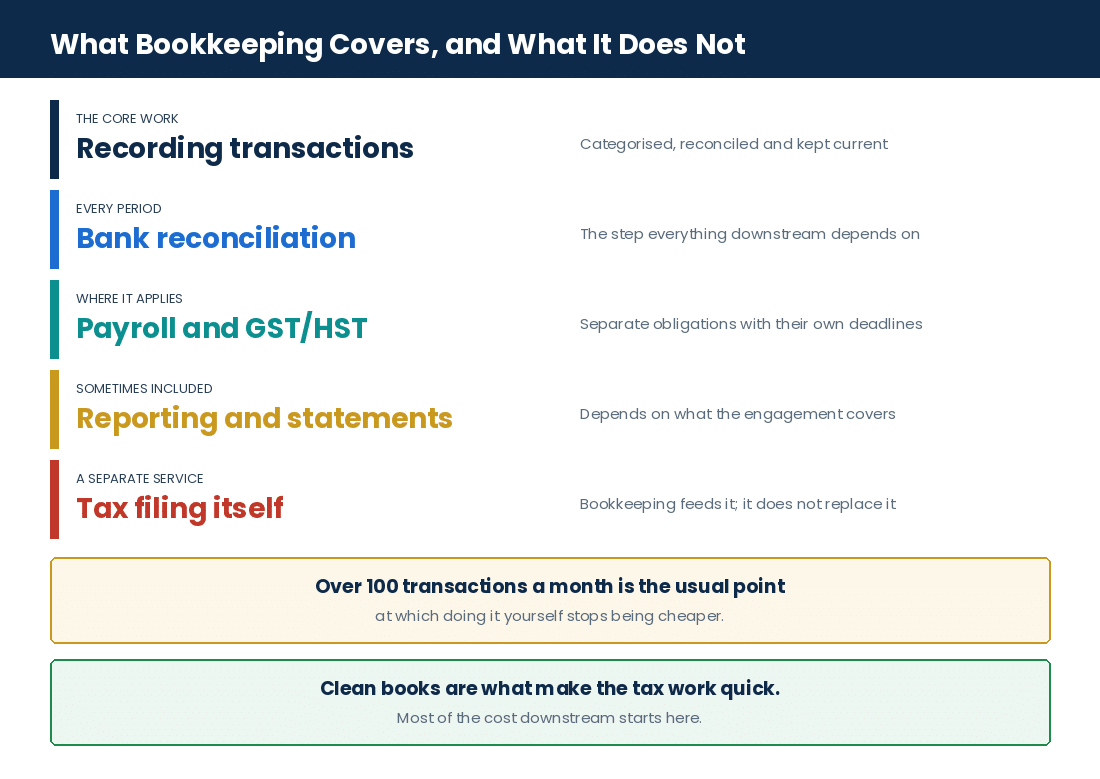
The Two Lines That Cause the Most Confusion
Payroll sits in the middle column for a reason. It is a separate system with its own remittance dates, and whether it falls inside the monthly fee varies by provider. Ask the question before signing rather than after the first payroll run.
Tax filing sits outside bookkeeping altogether. The bookkeeper produces the data; the final return is prepared and filed by a CPA. Where both come from the same firm the handover costs nothing, which is the practical argument for buying them together rather than separately. At Gondaliya CPA the year-end package produced by the bookkeeping feeds directly into tax preparation and filing, and the financial statements behind it are issued under a compilation engagement, which provides no assurance.
A dental practice came to us after two years with a provider whose quote had looked about $180 a month cheaper than ours. Payroll for six staff was not in that quote, and neither was GST/HST preparation. Both were billed on top, and across the year the additions came to roughly $3,400 more than the gap in the headline figures. Nobody had misled her. She had compared two numbers that described different work. We now put the excluded items on the engagement letter in the same list as the included ones, because the omissions are what cost people money. Figures changed for privacy.
When You Need Professional Bookkeeping
Decision Points
The Points at Which Doing It Yourself Stops Being Cheaper
Knowing when to hire a professional prevents costly mistakes and trouble with the rules. These are the points at which the decision usually arrives.
- You have a large number of monthly transactions.
- You want GST/HST returns done on time.
- Payroll has become complicated with several employees.
- Your year-end tax work needs tidy books.
- Bank checks regularly show mistakes.
- Your startup needs neat books for a loan application.
- Sales come in from several places.
- CRA asks for proof during an audit.
The last one is worth separating from the rest. The firm does help clients through CRA audits, and the work is far shorter where the records already exist in order. That is the clearest case where bookkeeping spend earlier is cheaper than the same money spent later.
Common Canadian Signs You Need Professional Bookkeeping
| Situation | What Could Go Wrong | CRA or Tax Link | How to Fix It |
|---|---|---|---|
| Over 100 transactions a month | Missing receipts; late GST filings | GST/HST payments; corporate taxes | Keep invoices and bank records updated |
| Many employees or contractors | Payroll errors; fines | Payroll tax reports | Get payroll information in on time |
| Year-end work piles up | Wrong profit numbers | Corporate income tax (T2) | Give all expenses and income early |
| Startup needs funding | Investors want clear finances | Loans; tax credits | Keep good records from day one |
| Multiple sales platforms | Missed deposits; wrong revenue | Sales reports; GST checks | Gather all sales data quickly |
The transaction count in the first row is the single most useful threshold in the table, because it maps directly onto hours. A business crossing 100 transactions a month is no longer a business whose books can be caught up in an evening, and the price of professional work stops being the comparison. The comparison becomes the price of professional work against the cost of the errors.
An online retailer selling on two platforms did his own books for four years and crossed about 400 transactions a month in the third. By the time he came to us, deposits from one platform had been recorded gross and the platform fees never separated, so revenue was overstated and expenses understated by roughly $46,000 across two years. None of it was dishonest; it was one spreadsheet column that nobody had time to reconcile. Correcting it cost more than two years of monthly bookkeeping would have. The transaction count had crossed the line long before the books did. Figures changed for privacy.
Bookkeeping Cost Check
Five quick questions on what will drive your bookkeeping fee. No fee shown.
Points to raise with us:
This is a general prompt, not tax or legal advice or a quote. Your position depends on your full facts. For a real review, please book a free consultation.
DIY, a CPA Firm, or a Non-CPA Provider
Your Options
Three Ways to Get It Done, and What Each One Costs You
You can do the bookkeeping yourself, use a CPA firm, or use a non-CPA service. The right choice depends on your budget, your skills, how much risk you can carry, and what you plan to grow into.
| Factor | DIY | CPA Firm | Non-CPA Provider |
|---|---|---|---|
| Cost | Low upfront cost | Higher but set prices | Medium fees, sometimes hourly |
| Skill level | Limited knowledge | Registered experts working to standards | Varies a great deal |
| CRA support | None | Full help including audits | Little or none |
| Quality checks | You check your own work | Internal review processes | Inconsistent checks |
| Technology use | Depends on the user | Uses industry software and tools | May use outdated systems |
| Accountability | Sole responsibility | Regulated firm, liable for its work | Less formal agreements |
DIY looks cheaper because no fee leaves the business. The hidden cost is non-compliance penalties, which can be far larger than the saving. A registered CPA firm offers safeguards through regulated practice built for incorporated SMBs operating inside Ontario’s legal framework, and that regulation is the thing being paid for as much as the data entry.
Non-CPA providers may offer competitive rates but lack full accountability under provincial regulation. That is not a criticism of their competence; it is a statement about who carries the consequence when something is wrong. Choosing well means balancing the price against accuracy and regulatory adherence, both of which matter in the current Canadian environment.
A construction client used a non-CPA provider at roughly half our monthly figure for two years, which saved him in the order of $4,200. CRA then queried subcontractor payments. The provider could not represent him, had no file notes explaining how payments had been classified, and was not insured for the consequence. The review took four months and the reconstruction of two years of subcontractor records cost about $9,000 on its own, before any adjustment. The monthly saving had been real. It was smaller than the single event it had not covered. Figures changed for privacy.
How to Choose a CPA Firm in Toronto or Ontario
Picking a firm takes some thought, and the cheapest option is not automatically the wrong one or the right one. Some firms do not know enough about incorporated SMBs and their more complex needs. These are the things worth checking:
- Experience with incorporated SMBs. Make sure they know corporate tax filings, GST/HST returns, payroll remittances and CRA audits.
- Clear pricing models. Flat fees or yearly fixed prices stop the surprise bills that often come with hourly rates.
- CRA compliance skills. They should help you meet deadlines and keep up with rule changes.
- Use of modern technology. Firms using QuickBooks or Xero work faster and more accurately.
- Good communication. Pick a firm that answers quickly during tax season or an audit.
| Your Situation | Complexity Score (1–5) | Recommended Option | Why | Next Step |
|---|---|---|---|---|
| Small incorporated business; simple transactions | 2 | Mid-tier CPA firm | Good cost with professional care | Request a consultation |
| Multiple entities; cross-border issues | 5 | Experienced CPA firm | Specialised skills reduce risks | Ask about cross-border services |
| Startup needing basic bookkeeping | 3 | Affordable CPA provider | Budget-friendly but meets the rules | Compare package pricing |
| Need full accounting plus tax planning | 4 | Full-service CPA firm | An all-in-one approach saves time | Schedule a meeting |
Ask about their experience with businesses like yours, and check that the fee is in the range the Toronto market shows. Before signing an engagement letter with any firm, read how it handles refunds and fee comparisons. Gondaliya CPA publishes both in full: the 30-day money-back guarantee and the 60-day fee matching policy.
How the Work Runs at Gondaliya CPA
Process
Eight Steps, Honest Timelines, and What You Get Each Month
Understanding how the work runs explains where the cost comes from. We keep it simple and clear, and we work with small and medium incorporated businesses, so you know what is coming next and there are no surprises in the price.
| Phase | Typical Duration | What You Do | What We Do | What You Get | What Delays It |
|---|---|---|---|---|---|
| Initial consultation | 1–2 days | Share business information | Check your needs | A plan of action | Slow sharing of information |
| Document collection | Monthly or quarterly | Send financial papers | Schedule the data entry | Organised files | Late documents; reminders help |
| Data entry and sorting | Monthly, ongoing | Check transactions | Enter and sort transactions | An updated ledger | Missing receipts |
| Reconciliation | Monthly | Provide bank statements | Match the accounts | Reconciled accounts | Missing bank information |
| Financial reporting | Monthly | Review the reports | Prepare the financial statements | Final reports | Slow replies to questions |
The Step-by-Step Workflow
- We talk about your business first. This tells us what you need and what the fee will be.
- You send papers regularly. Bank statements, receipts, invoices and payroll records.
- We enter and sort the transactions correctly, following CRA requirements.
- We check bank records every month, so mistakes are fixed before tax time rather than after.
- We produce reports such as Profit and Loss statements and Balance Sheets, to help you decide on money matters.
- You review them and ask questions, and we answer quickly.
- We help with tax filings, including GST/HST returns, lined up with the reporting cycle.
- We support you through the year, with no extra charge for changes or questions.
Two clients joined us in the same quarter, both incorporated consultancies of a similar size. One connected the bank feeds and set up a shared folder for receipts in the first week. The other emailed photographs of receipts in batches whenever he remembered, usually six weeks late. The first file closed each month in about two hours of our time; the second took closer to seven, most of it spent asking which deposit matched which invoice. Both paid a fixed annual fee, so the difference showed up in how fast they got their reports, not in the invoice: three business days against five weeks. The preparation is the part the client controls. Figures changed for privacy.
What We Need From You
Sending the right papers on time is the single largest thing that keeps the fee fair, because it is the one variable we cannot do anything about from our side. Please provide:
- Monthly bank statements for all accounts
- Sales invoices for each period
- Receipts for purchases, with digital copies preferred
- Payroll summaries if you use Wagepoint or ADP
- Business credit card statements
- Loan or financing details
- Access to QuickBooks Online or Xero if you use them
- Last year’s final financials or tax returns where available
What You Get
The deliverables below are what the monthly fee buys. They prevent costly mistakes and give a usable view of cash flow, and they are the reason bookkeeping is best read as part of the bookkeeping service rather than as data entry.
| Deliverable | What It Does | Who It Is For | Frequency | Input Needed | Benefit |
|---|---|---|---|---|---|
| Profit and Loss statement | Shows income against expenses over a chosen period | Business owners and accountants | Monthly or quarterly | Your sales and purchase data | Helps you make informed decisions |
| Bank reconciliation | Makes sure the ledger matches the bank records | Accountants and reviewers | Monthly | Timely bank statements | Keeps cash tracking accurate |
| GST/HST return preparation | Sums taxable sales and payments for filing | Businesses registered for GST/HST | Quarterly, around CRA deadlines | Sales and purchase input | Keeps filings on time |
| Year-end summary package | Collects the yearly numbers for the T2 corporate return | SMBs and the CPAs filing for them | Yearly, after the fiscal year end | Full year data | Makes the filing straightforward |
| Balance Sheet | Shows what the company owns and owes | Owners, lenders and investors | Monthly or quarterly | Complete ledger for the period | Supports loan and funding requests |
| Monthly ledger | Lists all income and expenses sorted to CRA categories | Owners and bookkeepers | Monthly | Receipts, invoices, statements | Keeps the record defensible |
The year-end summary package is the one that connects this work to everything else. It is what the corporate tax filing is prepared from, and the quality of it is what decides whether the tax work is quick or slow.
What Drives the Price and What You Can Do About It
Cost & Prep
Seven Drivers, the Mistakes That Add to Them, and a Worked Example
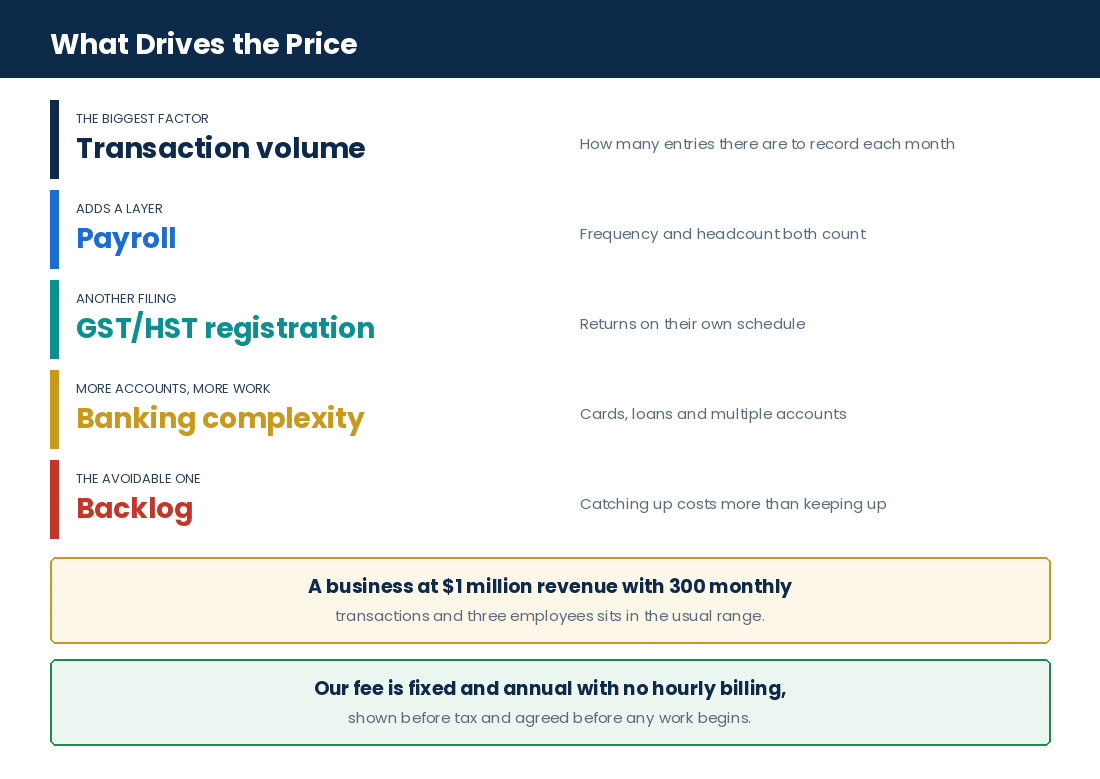
The price for bookkeeping changes a great deal, and it changes for reasons that can be listed. It depends on how much work there is and how complicated that work is. Rather than guess, see the number: the pricing calculator shows your full and final flat fee in about two minutes with HST included, and our pricing transparency promise explains exactly what that fee covers and the only thing that can change it.
| Driver | What Raises Cost | How to Keep It Low | Questions to Ask a Firm |
|---|---|---|---|
| Transaction volume | More sales, purchases and bank entries | Keep records updated; avoid big backlogs | How do you handle high transaction volumes? |
| Business complexity | Many business parts or income sources | Simplify the accounts where you can | Can you handle multi-entity bookkeeping? |
| Data cleanup needs | Missing receipts or unmatched accounts | Stay organised all year | Do you charge extra for cleanup? |
| Number of bank and credit accounts | Each account adds matching work | Run fewer accounts | How many accounts can you handle well? |
| Payroll frequency and size | Paying staff often, or many employees | Use automated payroll tools | Do you manage payroll too? |
| Software and integrations | Using several apps such as QuickBooks and Xero | Use fewer apps where possible | Are integrations included or extra? |
| Advisory depth and reporting | Custom reports and frequent meetings | Ask only for the reports you use | Is advice part of the price or extra? |
Fees at Gondaliya CPA are fixed and annual with no hourly billing, shown before tax with sales tax on its own line, and agreed before any work begins. Good firms explain the drivers above before starting rather than after.
Risks, CRA Compliance and the Mistakes That Add Cost
Part of what the fee covers is risk management. These are the risks bad bookkeeping creates:
- Forgotten GST/HST filings, which cause interest charges
- Wrong expense categories, which lead to incorrect tax returns
- Late payroll payments, which cause fines
- Mixing personal and business expenses, which flags audits
A CPA firm follows CRA requirements closely and catches these early. Separately, these are the mistakes that add directly to what you pay:
- Sending records late, which causes cleanup fees.
- Losing receipts, which means guesses that may trigger an audit.
- Skipping reconciliations, which hides errors instead of removing them.
- Not updating software, which slows the work down.
- Mixing personal and business money, which makes everything harder to separate later.
- Missing proof for credits, which wastes money you were entitled to.
CPAs deal with these using checklists, regular reviews, digital tools such as Hubdoc, and continuous contact with the client. That suits Canadian small businesses well, and it is why keeping the books right lowers future costs: some firms charge more precisely because the fixes they prevent cost more than the premium.
A restaurant client ran personal and business spending through one account for eighteen months because opening a second account kept getting postponed. Separating it meant going through roughly 5,400 transactions line by line and asking him about several hundred of them. The cleanup took eleven weeks and cost about $7,800, against a monthly bookkeeping fee that would have been a fraction of that over the same period. He opened the corporate account on the day we finished. The cheapest control in bookkeeping is a second bank account, and it costs almost nothing. Figures changed for privacy.
What to Prepare Before You Start
Getting the papers ready lets the work start quickly, and it keeps the fee stable by removing the surprise work that missing information creates.
| Item | Why Needed | Where To Find It | Common Mistakes |
|---|---|---|---|
| Business Number and GST/HST registration | To file taxes correctly | Certificates or emails from CRA | Missing information delays the start |
| Bank statements | For monthly reconciliation | Online banking | Missing months cause a backlog |
| Invoices and receipts | To prove expenses | Email and files | Losing originals causes errors |
| Payroll records | For paying staff properly | Payroll system or Wagepoint | Leaving out contractors triggers audits |
| Chart of accounts | Shows the categories | Xero or QuickBooks | Old charts confuse the entries |
| Previous year financials | Gives a starting point | Accountant or bookkeeper archives | Missing past data blocks trend spotting |
| Contracts and leases | Shows costs and obligations | File storage or email | Forgotten contracts lose deductions |
| Loan agreements | Tracks debts | Banking or legal files | Overlooked loans hide true debt |
| Credit card statements | Helps match credit charges | Online banking portals | Late statements delay closing |
One Realistic Numeric Example
Consider an incorporated technology startup in Toronto using QuickBooks Online with Wagepoint for payroll. The books are mostly up to date but carry some uncategorised transactions, because the company is growing fast with several online sales channels and occasional contractors whose agreements are not yet fully recorded.
| Metric | Value |
|---|---|
| Annual revenue | $1 million CAD |
| Monthly transactions | 300 |
| Employees | 3 |
| Payroll frequency | Monthly |
| Deliverable | Delivered To | Delivery Timing |
|---|---|---|
| Financial statements | Management team | Quarterly |
| Bank reconciliations | Accounting department | Monthly |
| Payroll reports | HR manager | Bi-monthly |
| CRA filing support | Gondaliya CPA | Annually |
The next steps on a file that looks like this are to fix the uncategorised transactions every month rather than at year end, keep contractor contracts updated, review the reports quarterly before the tax filing, use the software’s automation features to cut errors, and bring in a registered CPA early when scaling beyond the starting phase. The example shows what sits behind the price for a business of that shape: the transaction count and the software in use, rather than the revenue figure on its own. Tax planning work on the same file is priced separately.
A SaaS client at close to the revenue in that example came to us with 11 app integrations feeding QuickBooks, several of which duplicated each other. Three of them were writing the same Stripe payouts into the ledger twice, and the reconciliation difference had been carried as a suspense balance of about $18,000 for a year. We switched off eight integrations in an afternoon. Monthly bookkeeping time fell by roughly 40 per cent, and the suspense balance resolved itself once the duplicates stopped. More software had made the books worse and the fee higher at the same time. Figures changed for privacy.
Frequently Asked Questions
FAQs
Frequently Asked Questions on Bookkeeping Cost in Toronto
How much does bookkeeping cost in Toronto?+
Monthly bookkeeping generally runs from $100 to $500, and freelance bookkeepers charge about $25 to $75 an hour. Within that range the figure moves with transaction count, complexity, the number of accounts reconciled, the software needed and how often the books are updated. Monthly fees start low for startups and rise for larger businesses needing more detailed service under Canadian tax rules.
What affects the cost of bookkeeping services?+
Transaction volume each month, whether there is a backlog to clean up, how many bank accounts get reconciled, how many payroll runs there are, and any special reporting a sector requires — healthcare and dental practices being the common examples. Business complexity, the number of software integrations and the depth of advisory reporting also move it.
Are there affordable options for small businesses?+
Yes. Many firms offer tiered packages that balance the price against what CRA requires of Ontario-incorporated SMBs, so you are not paying for work you do not need while the records still stay audit-ready. The thing to check is which tasks sit inside the tier, because payroll and GST/HST preparation are frequently outside it.
Can I get flat-rate packages instead of hourly billing?+
Yes. Fixed-price plans let you budget while the quality of work stays to the agreed terms, and they remove the surprise invoices that arrive during busy periods such as a corporate filing deadline. At Gondaliya CPA fees are fixed and annual with no hourly billing, shown before tax with sales tax on its own line.
Do virtual bookkeepers charge less than local ones?+
Often, yes. Virtual bookkeepers frequently charge lower fees while working flexibly and professionally with tools such as QuickBooks or Xero. What varies is not the location but the accountability behind it, so compare the regulatory position and the CRA support alongside the rate rather than the rate alone.
Is it better to hire a freelance bookkeeper or an established firm?+
Freelancers work hourly and are often cheaper, but carry little or no CRA representation. A CPA firm provides full compliance support, internal review, professional liability behind the work and a regulator behind the firm. A small business with few transactions may be well served by a freelancer; a growing business with several accounts generally is not.
How often should I update my books professionally?+
Monthly. Transactions are entered and sorted as they arise, bank records are checked every month, and reports follow monthly or quarterly. The reason for monthly rather than annual is cost rather than tidiness: mistakes found in the month they happened are corrected in minutes, and the same mistakes found at year end are corrected from memory.
Does outsourcing affect my CRA compliance risks?+
It can reduce them, provided the provider is accountable for the work. A registered CPA firm follows CRA requirements closely, catches problems such as missed GST/HST filings and wrongly categorised expenses early, and can represent you through a CRA audit. A provider with no regulatory accountability can leave you carrying the risk you thought you had transferred.
What are the benefits of CPA-led bookkeeping for incorporated SMBs?+
Professional oversight and audit readiness. Registered CPAs review the work to maintain quality control, which catches errors early rather than at year end, and the records are kept to the standard CRA expects of an incorporated business. The practical result is accurate financial management and a year-end package the corporate filing can be prepared from directly.
What risks do businesses face without proper CRA compliance?+
Fines from late payroll remittances, missed GST/HST filings, incomplete reconciliations and audit penalties. Mixing personal and business expenses is the pattern most likely to draw attention, and wrong expense categories produce incorrect returns that have to be corrected later. Each of those is cheaper to prevent than to fix.
Essential Points for Business Owners
Key Takeaways
What Decides What Bookkeeping Costs
The market range is narrow. What varies within it is how much work your records create, which tasks are inside the scope, and who carries the consequence when something is wrong.
| Point | What It Means | Why It Changes the Price |
|---|---|---|
| Monthly range | Around $100 to $500 a month | Sets the band; your facts place you in it |
| Freelance hourly rate | About $25 to $75 per hour | Cheaper in quiet months, dearer in busy ones |
| Freelancers against CPA firms | Freelancers bill hourly with little CRA representation | CPA firms price full compliance support instead |
| Transaction volume | Over 100 a month is the usual signal | Hours scale with entries, not with revenue |
| Accounting software and tools | QuickBooks, Xero and Wagepoint raise accuracy | Affects the fee but lowers the error rate |
| Cleanup needed | Extra fees where data needs correcting | Staying organised removes the charge entirely |
| Payroll | Sometimes inside the scope, sometimes extra | Integration adds complexity and improves accuracy |
| GST/HST tracking and filing | Proper management keeps returns on time | Avoids fines and interest charges from CRA |
| Audit readiness | CPA-led work meets the standard CRA expects | Reduces audit risk and the penalties behind it |
| CRA representation | A firm that offers it resolves CRA issues for you | Priced into a CPA fee; usually absent elsewhere |
| Advisory depth | Strategic consultation and custom reports | Raises cost, and can improve the tax outcome |
| Customised solutions | Packages fitted to business size and sector | Keeps the figure predictable rather than variable |
| Clear scope and ongoing support | Defined scope with regular contact | Prevents the surprises that follow vague scopes |
| Hidden costs | Transparent contracts list the fees in full | Stops unexpected charges in high-volume periods |
The Six Things We Check First
- How many transactions a month? It is the number the hours actually follow, and owners usually underestimate it.
- How many bank and credit card accounts need reconciling? Each one is a separate monthly job.
- Is there a backlog? Cleanup is priced separately by almost everyone, so it is better known at the start than discovered.
- Is payroll in or out? Frequency and headcount decide whether it belongs in the monthly fee.
- Which software, and how many integrations? More apps is not more accurate; duplicated feeds are a common and expensive fault.
- Are personal and business transactions in the same account? It is the single largest driver of avoidable cleanup hours.
Our Approach
Gondaliya CPA scopes the work against your transaction count, your accounts and your software before quoting, so the figure reflects the real file rather than an average; lists the excluded items on the engagement letter alongside the included ones, because the omissions are what cost people money; enters and sorts transactions to CRA categories and reconciles every account monthly, so errors surface in the month they occur; prepares Profit and Loss statements, Balance Sheets and a year-end summary package the corporate filing can be built from directly; prepares GST/HST returns in step with the reporting cycle; and answers questions through the year without charging for them. Registered CPAs review the work before it goes out. Fees are fixed and annual with no hourly billing, shown before tax with sales tax on its own line, and agreed before any work begins.
Industry Spotlights: Sectors We Represent
Industry Expertise
Every sector generates its bookkeeping volume differently. Here are eleven, and what drives the work and the price in each.
| Industry | What Drives the Bookkeeping Volume and Cost |
|---|---|
| Technology startups & SaaS | Monthly subscription revenue and deferred revenue spread across subscription periods |
| E-commerce & online retailers | Inventory tracking and marketplace fees from Shopify or Amazon |
| Consulting firms | Few transactions, but personal and business spending in the same account |
| Construction, contractors & skilled trades | Many payroll runs, subcontractor payments and WSIB premiums |
| Property developers & builders | Job costing by project phase and progress billing tied to contract stages |
| Real estate investors & holding companies | Multiple entities, inter-company transactions and per-entity allocations |
| Transportation, logistics & trucking | Mileage logs, fuel invoices and mixed personal and business vehicle use |
| Restaurants & food and beverage | Daily cash reconciliations and high volumes of small card and cash sales |
| Daycare, childcare & CWELCC services | Subsidies tracked separately from parent fees, plus EI and CPP remittances |
| Dentists & dental practices | Equipment purchases, patient cost records and payroll for hygienists and staff |
| Medical doctors & physician corporations | OHIP billing cycles and keeping corporate money separate from personal |
- Technology startups & SaaS: Subscription revenue repeats monthly and automated systems link invoicing to bank deposits, but deferred revenue has to be calculated so earnings show across the subscription period rather than as upfront cash, and GST/HST varies by the customer’s location inside Canada.
- E-commerce & online retailers: Inventory turnover changes balance sheet value and cost of goods sold, marketplace fees from Shopify or Amazon have to be recorded separately from gross deposits, and GST/HST collection varies by the province shipped to.
- Consulting firms: Transaction counts are usually low, so the cost driver is not volume but how much personal spending has to be separated out of a single account before anything reconciles.
- Construction, contractors & skilled trades: Frequent payroll runs and subcontractor payments make remittance management the bulk of the work, and WSIB premiums sit alongside CPP and EI contributions that have to be tracked separately.
- Property developers & builders: Job costing has to be exact and progress billing is tied to contract stages, so project costs are tracked by phase and the timing of revenue follows the contract rather than the invoice date.
- Real estate investors & holding companies: Several entities need combined accounting across the properties and a separate return each, so inter-company transactions and the allocation of rental income, expenses and depreciation per entity are what the hours go on.
- Transportation, logistics & trucking: Fuel expenses need mileage logs and purchase invoices to support input tax credits, and owner-operated vehicles mix personal and business use, which means logbooks reviewed often rather than once a year.
- Restaurants & food and beverage: Cash handling needs daily reconciliations and tip reporting is watched by CRA, while cash and card payments across a high count of small sales make this the highest-volume sector we handle.
- Daycare, childcare & CWELCC services: CWELCC reporting needs subsidies received tracked against fees from parents, with payroll remittances for EI and CPP and GST/HST where it applies, so the reporting rather than the transaction count sets the workload.
- Dentists & dental practices: RCDSO licensing means tight records on equipment purchases and patient costs, and payroll for hygienists and staff plus HST filings timed to cash flow are what push these files above the simple monthly band.
- Medical doctors & physician corporations: OHIP billing runs on cycles that have to be counted into the right period, and keeping corporate money clearly separate from personal is the control that keeps the file cheap and the audit risk low.
Two clients of similar revenue arrived the same year, one a consultancy and one a restaurant. The consultancy had about 40 transactions a month; the restaurant had closer to 2,600 once daily card batches and supplier invoices were counted. The restaurant’s monthly fee was roughly five times the consultancy’s, and both were fair, because the hours were five times as many. The owner of the restaurant had been comparing his quote against what a friend in consulting paid and had assumed he was being overcharged by about $900 a month. Sector, not revenue, is what sets the band. Figures changed for privacy.
Professional Guidance and Quick Reference
Guidance
Essential Points for Toronto and Canadian Corporations
Bookkeeping quotes go wrong in a predictable set of ways: two figures compared when one includes payroll and the other does not; an hourly arrangement chosen for the low quiet-month invoice and then billed at four times that in a busy one; a backlog discovered after the engagement starts rather than priced into it; personal and business spending in one account, which is the largest avoidable cost in this work; software integrations added until they duplicate each other; and nobody asking whether the provider can represent the business if CRA writes. Gondaliya CPA scopes against transaction count and lists the exclusions with the inclusions.
Quick Answers
At a Glance
- Monthly bookkeeping in Toronto: around $100 to $500
- Freelance bookkeepers: about $25 to $75 per hour
- What moves the figure: business size, transaction count, tasks included
- Packages against hourly: package deals may cost less overall
- Always included: recording daily sales and purchases
- Always included: checking bank records against the ledger
- Sometimes included: payroll handling, often charged extra
- Not included: tax filing preparation, which a CPA handles
- Not included: financial advice, which sits with an accountant or CPA
- The usual volume signal: over 100 transactions a month
- Worked example: $1 million revenue, 300 transactions a month, 3 employees
- Reconciliation frequency: monthly, against every account
- Reporting frequency: monthly or quarterly
- Year-end deliverable: a summary package for the T2 corporate return
- GST/HST preparation: quarterly, around the CRA deadlines
- Software in common use: QuickBooks Online, Xero
- Payroll tools: Wagepoint, ADP
- Document capture: Hubdoc
- Cleanup: charged separately by most providers
- Biggest avoidable cost: personal and business money in one account
- DIY cost: low upfront, with non-compliance penalties as the risk
- Non-CPA provider: medium fees, little or no CRA support
- CPA firm: higher but set prices, full help including audits
- CRA audits: the firm does represent clients through them
- Our fee model: fixed and annual with no hourly billing
- How it is shown: before tax, with sales tax on its own line
- Across sectors: following the regulations cuts penalties
- Across sectors: knowing the industry raises accuracy
- Across sectors: using technology cuts repetitive work and lowers cost over time
- Quickest way to a figure: the pricing calculator, about two minutes
Who This Is For / Not For
Fit Check
- For: small and medium businesses with regular transactions that need accurate records.
- For: incorporated businesses wanting CRA-compliant books and reports they can act on.
- For: owners who would rather spend their time on growth than on the numbers, and companies needing help with taxes or rules.
- Not for: sole proprietors who handle simple books on their own.
- Not for: businesses with very few transactions that do not need the extra help.
- Not for: a quote on your own file, which depends on your transaction count, accounts and software.
People Also Ask
Related Questions
How do monthly bookkeeping packages help startups in Toronto?+
They offer fixed pricing and ongoing support, with timely deliverables and a scope fitted to the business. For a startup the predictability matters more than the rate, because the months when the workload spikes are the same months when cash is tightest. A package also puts the records in order early, which is what investors and lenders ask to see.
Can virtual bookkeeping services reduce the cost of bookkeeping in Toronto?+
Yes. Virtual bookkeepers often charge lower fees while providing flexible, professional service using tools such as QuickBooks or Xero. The saving comes from how the work is delivered rather than from doing less of it, so the thing to confirm is that the scope and the accountability are the same as a local arrangement would have carried.
Why is transparency in pricing important for bookkeeping services?+
Clear pricing avoids hidden costs. It lets a business budget properly and makes sure the scope of service is understood before the work starts rather than after the first invoice that does not look like the quote. Transparent contracts list the fees in full, which prevents unexpected charges during tax season or high-volume periods.
How does payroll integration affect bookkeeping cost?+
It adds complexity and improves accuracy at the same time. Payroll frequency and headcount both add work, and the remittances carry their own deadlines. Using tools such as Wagepoint streamlines the handling and reduces errors, which is why a payroll-inclusive fee is usually higher than a quote without payroll and is not comparable to it.
What role do advisory services play in bookkeeping pricing?+
Advisory work adds value through strategic consultation, and it may increase the cost while helping optimise tax planning and financial decisions. Custom reports and frequent meetings are the parts that move the figure, so the practical step is to ask only for the reports you actually use and to confirm whether advice sits inside the fee or outside it.
Glossary of Key Terms
Definitions
- Bookkeeping: recording and sorting every movement of money through the business.
- Bank reconciliation: matching the ledger against the bank records each month.
- Profit and Loss statement: income against expenses over a chosen period.
- Balance Sheet: what the company owns and what it owes.
- Monthly ledger: all income and expenses sorted to CRA categories.
- Chart of accounts: the list of categories transactions are sorted into.
- Year-end summary package: the yearly figures the T2 corporate return is prepared from.
- Data cleanup: correcting and reconciling records that were not kept properly.
- Transaction volume: the count of entries a month, which the hours follow.
- Flat fee: a fixed price agreed before the work begins.
- Compilation engagement: financial statements prepared under CSRS 4200, providing no assurance.
- GST/HST return: the sales tax return summing taxable sales and payments.
- Payroll remittance: the deductions sent to CRA after each payroll run.
- Audit readiness: records kept so the supporting documents exist when CRA asks.
Want a checklist to work from? You can download our free bookkeeping cost checklist before your consultation.
Four things decide what bookkeeping costs you. Where you sit in the range — the market runs from about $100 to $500 a month, freelancers charge roughly $25 to $75 an hour, and what places you inside those figures is business size, transaction count and which tasks are included rather than anything about your revenue. Which pricing model you buy — an hourly arrangement prices the work after it is done, so the quiet months are cheap and the busy ones are not, while a package or a fixed annual fee prices the scope first and leaves the variance with the provider. What is inside the scope — recording and bank checking are always in, payroll is sometimes in and often charged extra, and tax filing and financial advice are outside bookkeeping altogether, which is why two quotes can differ by less than the work they describe. And what your own records create — a backlog, lost receipts, skipped reconciliations and personal spending run through a business account are all priced as cleanup, and all of them are avoidable before the engagement rather than after it.
Three questions settle what you will actually pay, and none of them needs an accountant to answer. First, how many transactions does the business put through in a month? Count a busy month rather than a quiet one; above about 100 the work is no longer something an evening absorbs. Second, is payroll in the quote? Ask it of every provider in the same words, because it is the commonest reason two figures are not comparable. Third, are personal and business transactions running through the same account? If they are, separating them is the first invoice you will receive, and opening a second account costs almost nothing.
Bookkeeping in Toronto: How Gondaliya CPA Can Help
Know the figure before the work starts
Gondaliya CPA scopes monthly bookkeeping against your transaction count, your bank and credit card accounts, your payroll and the software you already use, so the fee reflects your file rather than an average. We enter and sort transactions to CRA categories, reconcile every account monthly so errors surface in the month they happen, prepare Profit and Loss statements and Balance Sheets you can act on, prepare GST/HST returns in step with the reporting cycle, and deliver a year-end summary package the corporate tax filing is built from directly. Financial statements are prepared under a compilation engagement, which provides no assurance. Registered CPAs review the work before it goes out, and we answer questions through the year without charging for them. Fees are fixed and annual with no hourly billing, shown before tax with sales tax on its own line, and agreed before any work begins. Please book a free consultation.
Next Steps
Please call 647-212-9559 or email info@gondaliyacpa.ca for a free consultation, and bring three things: a count of the transactions a busy month puts through, a list of every bank and credit card account the business uses, and whatever bookkeeping files already exist, in whatever state they are in. We will tell you where in the range your file sits and why, and the first conversation is usually shorter than owners expect. If payroll is in the picture, say how many people and how often; if the books are behind, say so at the outset, because cleanup is scoped separately and is far cheaper known than discovered. We perform compilation engagements under CSRS 4200, which provide no assurance, and we refer audit and review engagements out; we do represent clients through CRA audits, which is a different thing. You will get a fixed annual fee, shown before tax with sales tax on its own line, agreed before any work begins. We serve Toronto, Mississauga, Brampton, Vaughan, Etobicoke, Scarborough, Hamilton, Ottawa and the rest of Ontario, and work with corporations across Canada. If our content helps, please add gondaliyacpa.ca as a preferred source on Google.
Published: · Last updated:
Editorial policy: We research against current Canadian federal and provincial rules on bookkeeping, CRA guidance, CPA Canada Handbook standards and CPA Ontario sources, fact-check the figures, and Sharad Gondaliya, CPA, reviews the content, which we update as the rules change, without hype or unproven claims.
Disclaimer: This article is educational information only and is not tax, legal or accounting advice, and it cannot guarantee any result as to bookkeeping costs or services. It covers what bookkeeping costs for incorporated small and medium businesses in Toronto, Ontario and across Canada, including the monthly range of about $100 to $500 and freelance hourly rates of about $25 to $75, what bookkeeping includes and excludes, the decision points for hiring professional help, the comparison between DIY, a CPA firm and a non-CPA provider, the process, timeline, documents and deliverables at Gondaliya CPA, the drivers behind the price, the compliance risks and the mistakes that add cost, a worked example at $1 million of revenue and 300 monthly transactions, the industry patterns that shape volume, and how to choose a firm. It does not quote a figure for any particular business, cover GST/HST or payroll filing deadlines in detail, address unincorporated sole proprietors and partnerships, or predict how CRA will treat any particular set of records. Rates, thresholds and market figures change, and every figure should be confirmed for your own circumstances before you rely on it. Tax laws change quickly, so please speak to a registered professional who knows the Ontario and Canadian rules before making financial decisions. Gondaliya CPA performs compilation engagements under CSRS 4200, which provide no assurance, and does not perform audit or review engagements; the firm does represent clients through CRA audits, which is separate. Please consult a licensed CPA before acting.

Sharad Gondaliya is a CPA Canada & CPA USA with 15 Years+ experience of Accounting, Tax, Payroll of Corporate Small Businesses as Tax Accountant. He is a CPA Ontario member (61040184) and holds US CPA licences in Washington and Montana and is well known among corporate small businesses for tax planning, efficient tax solutions, and affordable CPA services. Sharad is the Principal (Director) of Gondaliya CPA – Affordable CPA Firm in Canada. Licenses: CPA Ontario: 61040184 | CPA USA (MT): PAC-CPAP-LIC-033176 | CPA USA (WA): 57629 | CPA Firm License: 61330051 View Full Author Bio