



How Outsourced Payroll Services Can Save Your Business Time and Money
Outsource Payroll with Gondaliya CPA: Efficient Payroll Services and Corporate Tax Planning
Outsourcing your payroll helps you save time and follow CRA rules. Gondaliya CPA offers payroll services made for small and medium businesses in Canada. We handle your payroll well and help with corporate tax planning too. This means you get the most out of your money and avoid mistakes.
Here’s what we do:
- Manage your payroll so it’s done right.
- Keep you on track with CRA payroll compliance.
- Plan your corporate taxes to reduce what you owe.
Summary
- Outsourced payroll services save you time.
- We are a Registered CPA firm that knows SMBs well.
- We keep you compliant with CRA payroll rules.
- Our corporate tax planning helps save money.
- We manage your monthly payroll smoothly.
Quick Summary
Payroll is a monthly deadline rather than a yearly one, so the cost of getting it wrong arrives twelve times a year instead of once. Please note that outsourcing the work does not move the employer obligation off the corporation; it puts a CPA firm in front of the calculations, the remittances and the filings that CRA holds the employer to. Gondaliya CPA runs the payroll and ties it to the corporate tax planning rather than treating the two as separate files.
| Aspect | Details |
|---|---|
| Payroll processing | We figure out salaries, bonuses, deductions like CPP/QPP and EI, and get ready remittances. |
| CRA payroll compliance | T4 slips, source deductions and remittances handled on schedule, with employer health tax tracked in provinces such as Ontario. |
| Corporate tax planning | Planning taxes connected to paying employees, so pay runs and the corporate tax planning line up. |
| What it costs with us | Our fees are fixed and annual with no hourly billing, shown before tax with sales tax on its own line. |
Reading time: 18 minutes.
Table of Contents
- What Corporate Payroll Services Cover
- When You Need Corporate Payroll Services
- DIY, Gondaliya CPA, or a Non-CPA Provider
- How the Service Works and What You Get
- Pricing: What Affects the Cost
- Risks, CRA Compliance and What to Prepare
- Frequently Asked Questions
- Essential Points for Business Owners
- Industry Spotlights: Sectors We Represent
- Professional Guidance and Quick Reference
The Numbers That Matter
This article covers outsourced corporate payroll services for incorporated small and medium businesses in Ontario and across Canada, current to 10 November 2026. It covers payroll processing, gross wage calculation, source deductions including income tax, CPP/QPP and EI, other authorized deductions such as union dues and benefits, pay stubs, the payroll register, T4 and RL-1 preparation, tax remittance to CRA, employer health tax in provinces such as Ontario, vacation and leave tracking, payroll software integration with QuickBooks or Xero, the intake and onboarding sequence, document and data collection, review and quality assurance, deliverables and filings, ongoing support and representation through CRA audits of employment matters, the pricing drivers behind a payroll engagement, the risk areas and common mistakes CRA penalises, and the documents to prepare before a payroll engagement starts. It does not set the payroll for any particular business without reviewing its facts, does not decide worker classification without the contracts behind it, and does not cover provincial employment standards province by province. Gondaliya CPA performs compilation engagements under CSRS 4200, which provide no assurance; audit and review engagements are referred out. We do represent clients through CRA audits, which is a separate service and not an assurance engagement. This is educational information only and not tax, legal or accounting advice. Talk to a Registered pro in Canada or Ontario about your case.
What Corporate Payroll Services Cover
The Service
What Is Corporate Payroll Services?

Corporate payroll services help companies pay their workers right and on time. For small and medium businesses in Canada, these services cover many tasks like figuring out wages and dealing with government forms. Outsourced payroll means a business hires experts outside, like CPA firms, to do this work.
Payroll management means tracking work hours, taking out taxes and benefits, giving paychecks or direct deposits, and making official reports like T4 slips. It also includes planning for corporate taxes since payroll affects the company’s tax bill.
Using pro payroll services cuts down mistakes that cause CRA penalties. It saves time by handling tricky calculations and keeps the business following Canadian laws.
Definitions Table
| Term | Definition |
|---|---|
| Payroll Services | Handling payments, deductions, tax sending, and reporting for workers |
| Outsourced Payroll | Hiring someone outside your company to run all or some payroll tasks |
| Payroll Management | Everyday work to keep employee payments correct |
| Corporate Tax Planning | Planning taxes connected to paying employees |
An incorporated design studio with six people on staff ran payroll in a spreadsheet for two years because the owner thought payroll was arithmetic. The arithmetic was fine. What was wrong was the classification: two long-standing contractors were, on the facts of their contracts and their hours, employees, and no source deductions had ever been withheld for either of them. CRA assessed the unremitted deductions on both sides along with interest, and the bill came to roughly $31,000 for work the studio had already paid for once. Nothing in the spreadsheet had been miscalculated. The question nobody had asked was who was an employee. Figures changed for privacy.
Gondaliya CPA’s Corporate Payroll Services Include
Gondaliya CPA gives full payroll help for small and medium incorporated businesses in Canada. We do:
- Payroll Processing: We figure out salaries, bonuses, deductions like CPP/QPP and EI, and get ready remittances.
- T4 Slips Preparation: We make sure T4 slips are done on time each year as CRA needs.
- Employer Health Tax Management: We track health tax duties for employers in provinces such as Ontario.
- Vacation & Leave Tracking: We keep tabs on vacation days and leaves like maternity or paternity leave under Canadian laws.
- Payroll Software Integration: We link your payroll to popular software like QuickBooks or Xero so data flows easily.
These services keep your business legal and free you from manual work. We use trusted tools like Wagepoint or ADP but choose what fits your setup best.
When You Need Corporate Payroll Services
Fit & Timing
Who This Service Is For
Our payroll services work best for:
- Incorporated Canadian SMBs that want to follow CRA payroll rules.
- Businesses that want to cut admin costs and make payroll easier.
This service is not good for:
- Sole proprietors who don’t have employees needing payroll.
If you pick Gondaliya CPA, you get help that keeps things legal while letting you focus on growing your business.
When You Need Corporate Payroll Services in Canada
Small and medium incorporated businesses get more complex as they grow staff or add new benefits. CRA rules must be met; missing deadlines or wrong filings lead to fines.
You want pro payroll help if you see:
- More workers making manual errors likely
- Trouble following changing tax rules from federal or provinces
- Risk of late payments causing extra charges
- Hard time tracking different leave types by law
- Need to link tax planning with payroll info easily
A good CPA lowers risk by keeping payroll right every month and helping plan taxes smartly.
A client grew from four employees to nineteen across Ontario and Alberta in a single year and kept running payroll the way she had when it was four. The Alberta hires were paid on the Ontario template, the employer health tax position in Ontario was never recalculated against the higher payroll, and two months of remittances went in at the old amount. The shortfall, the penalty on the late portion and the interest came to about $14,500, and the cleanup took us three weeks of reconstructing pay runs. Nothing had gone wrong at four employees. The system simply stopped fitting somewhere around twelve. Figures changed for privacy.
Scenario Decision Table
| Scenario | What Can Go Wrong | CRA/Compliance Touchpoint | What a CPA Changes |
|---|---|---|---|
| Growing workforce | More mistakes in calculations | Penalties from late or missed files | Automated checks cut errors |
| Complex benefit plans | Wrong deductions or remittances | Compliance audits | Expert advice matches benefits/taxes |
| Multiple provincial operations | Confused by different provincial rules | Employer health tax miscalculations | Correct handling across regions |
| Manual recordkeeping | Lost papers raise audit risks | Missing doc requests | Digital records improve proof |
DIY, Gondaliya CPA, or a Non-CPA Provider
Your Options
Quick Comparison: DIY vs. Gondaliya CPA vs. Non-CPA Provider
| Situation/Trigger | Best Next Step | Why | Risk Level | Typical Timeline | Source/Note |
|---|---|---|---|---|---|
| Small incorporated business (1–10 employees) | Choose Gondaliya CPA | Professional help avoids errors. | Low | Monthly | Reliable service |
| Growing business with complex payroll | Use outsourced service | Makes hard tasks easier | Medium | Monthly or bi-weekly | Cuts down mistakes |
| Startup doing payroll manually | Outsource soon | Saves time for other work | High | Setup right away | Boosts efficiency |
Your Options: DIY vs Gondaliya CPA vs Non‑CPA Provider
Picking how you handle payroll depends on money, skills, risk level, and how it fits with your taxes.
DIY Payroll Software
Many start with easy software made for non-experts. This saves cash at first but risks errors if setup is wrong or updates miss CRA rule changes. DIY usually has no personal help during audits or tough cases.
Gondaliya CPA Firm
Our CPAs know accounting rules well plus how tech works. We take full responsibility. We connect bookkeeping with taxes tied to pay runs — helping find legal deductions while keeping you compliant.
Non‑CPA Providers
Some companies just process basics without knowing bigger tax effects on pay. They might not represent you before CRA nor warn about new employer rules.
A client moved his payroll to a low-cost processor that quoted less than half what a CPA engagement would have cost, and for fourteen months it ran without complaint. Then CRA opened an employer review of his source deductions and asked for the working papers behind two years of taxable benefits. The processor’s answer was that it processed what it was given and did not represent clients before CRA. He arrived at our office with a deadline nine days away and no file. Assembling the support and answering the review cost him about $9,000 in fees he had never budgeted, which was most of what the cheaper processing had saved him. The processing had been fine. There was simply nobody to stand behind it. Figures changed for privacy.
Comparison Table: DIY vs Gondaliya CPA vs Non‑CPA Provider
| Factor | DIY | Gondaliya CPA | Non‑CPA Provider | Best For | Key Risk |
|---|---|---|---|---|---|
| Compliance Accuracy | Medium | High | Medium | Simple needs small startups | Mistakes causing fines or audits |
| Corporate Tax Planning Integration | Low | High | Low | Businesses wanting tax advice | – |
| Accountability & Support | Limited | Full professional duty | Varies | Firms needing dependable backup | – |
| Audit Readiness | Low | High | Medium | Companies facing regular audits | Poor prep raises penalty chances |
This table shows why many incorporated SMBs go with CPAs who get day-to-day payroll plus tax effects well tied together.
Payroll Setup Check
Five quick questions on what your payroll engagement will need. No fee shown.
Points to raise with us:
This is a general prompt, not tax or legal advice or a quote. Your position depends on your full facts. For a real review, please book a free consultation.
How the Service Works and What You Get
Process & Deliverables
How the Service Works at Gondaliya CPA
Knowing how payroll services work helps your business save time and avoid big mistakes. At Gondaliya CPA, we handle outsourced payroll management for Canadian small and medium businesses. We make sure your payroll follows CRA rules and fits your corporate tax planning.
Here’s how our payroll service works:
- We manage payroll tasks clearly and accurately.
- We keep things compliant with Canadian laws.
- We help you plan your taxes better.
The Gondaliya CPA Payroll Process
We use a step-by-step way to handle payroll. This keeps things simple, fast, and correct each month. Our process covers everything from start to finish.
Our steps include:
- Intake and onboarding
- Document and data collection
- Payroll processing
- Review and quality checks
- Deliverables and filings
- Ongoing support
Each part helps your business stay on track with rules and saves you work.
Intake and Onboarding
First, we collect info about your company, employees, and payroll needs. This helps us get things ready for smooth monthly payroll work.
What we do:
- Gather employee wages, hours, benefits, deductions.
- Learn about pay schedules like weekly or monthly.
- Set up records in our system for tracking.
This phase sets the base to serve your business right and follow all legal rules.
Document and Data Collection
You send us needed papers like timesheets or attendance reports. Tell us if employee details or wages change. We help connect payroll software too, like QuickBooks or Xero.
Why this matters:
- It helps with correct employee wage calculations.
- Keeps tax deductions right.
- Makes sure payments go on time to the government.
Good data now means fewer errors later.
Payroll Processing
Each pay period we:
- Calculate gross wages by hours or salary.
- Take out required taxes (income tax, CPP, EI).
- Deduct other authorized amounts (union dues, benefits).
Then we:
- Create clear pay stubs for employees showing pay details.
- Send deducted taxes to CRA on time to stay compliant.
This step ensures all payments are done right without late fees or fines.
Review and Quality Assurance
Before finishing payroll each cycle we:
- Double-check calculations against CRA rules.
- Make sure correct filing codes are used for different workers.
This review lowers audit risks by keeping documents ready if CRA asks. Being prepared means fewer surprises during any checks on your payroll records.
Deliverables and Filings
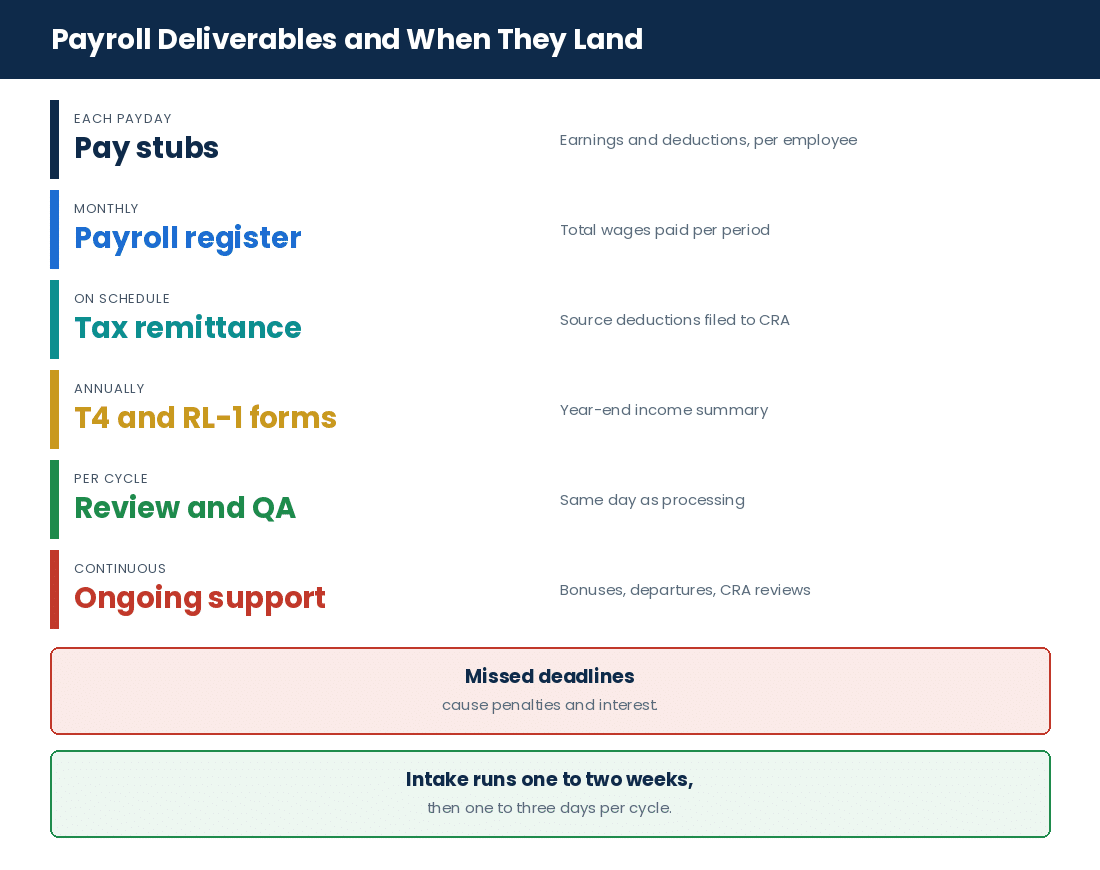
| Deliverable | What It Is | Who Uses It | When Delivered |
|---|---|---|---|
| Pay Stubs | Shows earnings & deductions | Employees | Each payday |
| Payroll Register | Summary of payments made | Business owners/HR | Monthly |
| T4 / RL‑1 Forms | Year-end income summary | Employees & CRA | Annually |
| Tax Remittance | Tax payments filed electronically | Government Agencies | On schedule |
These give clear info to employees and meet Canadian reporting laws.
Ongoing Support and CRA Representation
Payroll is not just about paying people. Rules change often, audits happen too. We provide ongoing help such as:
- Answering questions on bonuses or leaving employees
- Giving advice on tax planning tied to payroll
- Representing you if CRA audits employment matters
You get CPA-led support whenever you need it.
A client sent us her timesheets on the morning of payday for eleven months running, and every one of those pay runs went out late by a day or two. The employees noticed before CRA did. When one of them filed an employment standards complaint over the pattern of late pay, the file that answered it was the payroll register we had been producing monthly, which showed every amount and every date. The complaint closed without a finding. A second client the same quarter had no register, could not show when anything had been paid, and settled for roughly $7,000 rather than argue a case he could not document. The deliverable nobody reads is the one that answers the question. Figures changed for privacy.
Process Timeline Table: Typical Engagement Timeline (Intake → Delivery → Follow-Up)
| Phase | Typical Duration | Client Actions | CPA Actions | Outputs | Common Delays + Prevention |
|---|---|---|---|---|---|
| Intake & Onboarding | 1–2 weeks | Give company info & employee list | Setup client profile; confirm scope | Setup complete | Late docs slow setup |
| Document Collection | Weekly before payday | Submit timesheets/payroll data | Check inputs; prepare calculations | Ready data | Missing info delays process |
| Payroll Processing | 1–3 days per cycle | Approve preliminary numbers | Calculate wages/deductions/remit taxes | Pay stubs; tax files | Late error fixes add rework |
| Review & QA | Same day as processing | Answer clarifications quickly | Verify accuracy | Verified reports | Poor review raises risk |
| Deliverables Filing | By deadlines | Confirm receipt/distribute | File T4s/tax returns | Filed forms/reports | Missed deadlines cause penalties |
| Ongoing Support | Continuous | Ask questions/report issues | Give advice/audit help | Issue resolution | Slow replies delay fixes |
Our timeline works for startups or steady SMBs needing reliable monthly service.
Deliverables + What You Get
When you use our outsourced payroll service, here’s what comes regularly to keep things clear without surprises:
Key Payroll Deliverables:
| Deliverable | What It Is | Get Who Uses It | Get When Delivered |
|---|---|---|---|
| Pay Stub | A detailed view of gross/net pay plus deductions | Employees | Every payday |
| Payroll Register | A full report listing total wages paid per period | Business owners / HR staff | Monthly after close |
| T4 Slips | Annual report showing taxable income | Employees /CRA | Annually before deadline |
| Tax Remittance | Electronic filing/payment of withheld taxes | Government agencies | On schedule |
Each one helps employers stay informed inside the company while meeting CRA rules outside.
By following this simple flow—from intake through delivery—you get accurate monthly payroll that meets Canadian laws well. This frees up your team from extra admin work. Plus, expert checks help with smart corporate tax planning that fits incorporated SMBs across Canada.
Pricing: What Affects the Cost
Pricing
Pricing: What Affects the Cost of Corporate Payroll Services in Canada
Figuring out what makes payroll services cost more or less helps businesses plan better. In Canada, for small and medium incorporated companies, things like outsourced payroll, how many employees you have, and how often you run payroll matter a lot.
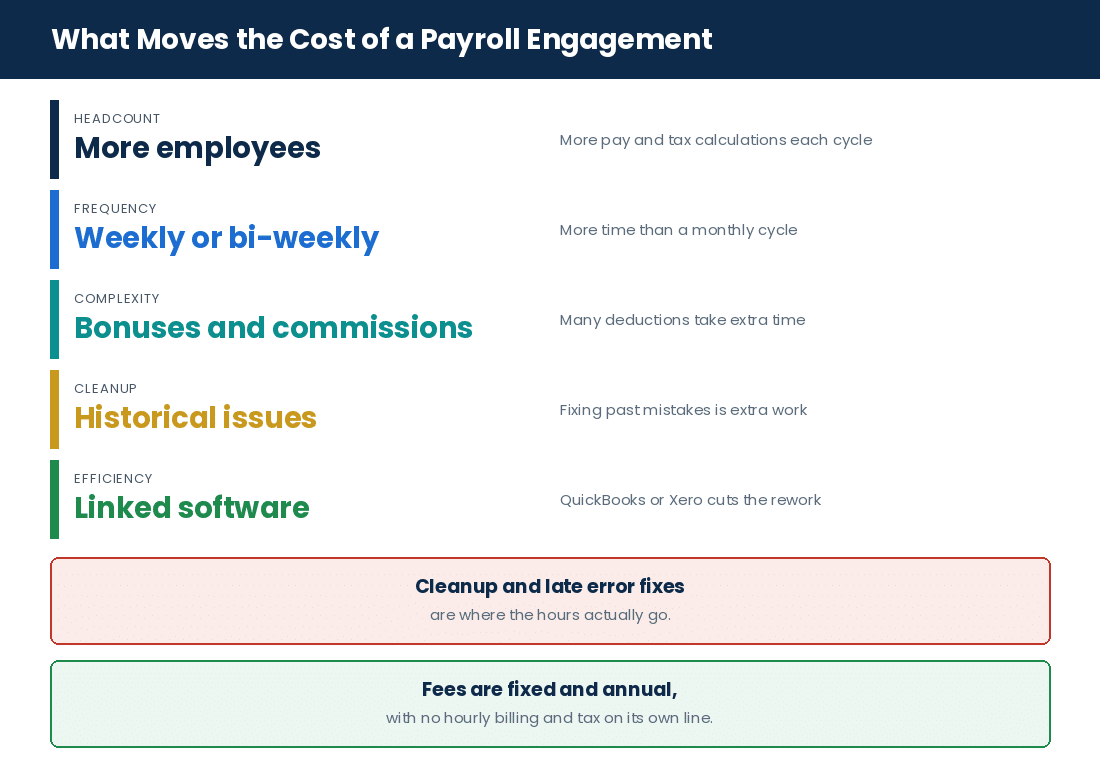
Key Drivers Affecting Payroll Service Costs
Here are some big factors that change the price of payroll management:
- Outsourced Payroll: Letting experts handle your payroll can cost more than doing it yourself.
- Number of Employees: More workers mean more work calculating pay and taxes.
- Payroll Frequency: Running payroll every week or two takes more time than monthly.
Other stuff that adds to cost includes tricky payroll details like bonuses and fixing old errors.
Our own fees are fixed and annual with no hourly billing, shown before tax with sales tax on its own line, and agreed before any work begins.
What Increases Cost?
| Driver | What Increases Cost |
|---|---|
| Complexity of Payroll Items | Bonuses, commissions, and many deductions take extra time. |
| Cleanup or Historical Issues | Fixing past mistakes needs extra work. |
Two clients came to us the same month, both with nine employees. The first paid monthly, had no bonuses and no commission, and sent one clean file each cycle. The second paid weekly, ran commissions for four sales staff, and arrived with eighteen months of mismatched remittances that had to be reconciled against the CRA account before anything current could be run. The second engagement cost roughly four times the first in its opening year, and about two thirds of that was the cleanup rather than the ongoing payroll. Headcount was identical. Frequency, complexity and history were the whole difference. Figures changed for privacy.
How to Keep It Efficient
You can cut costs while keeping things right by:
- Using payroll software that links with your accounting tools like QuickBooks or Xero.
- Planning taxes with a CPA to get the best deductions through payroll.
These steps help avoid mistakes and save time.
Questions To Ask When Considering a Firm
Before picking an outsourced payroll or CPA team, ask:
- Do you handle outsourced payroll for incorporated SMBs?
- How do you keep things CRA-compliant?
- Can your system work with our current accounting software?
- What help do you give if CRA audits our payroll?
These questions help you see value beyond price.
Risks, CRA Compliance and What to Prepare
Risk & Prep
Risks, CRA Compliance, and Common Mistakes
Handling corporate payroll right is super important. Mistakes can lead to fines from the Canada Revenue Agency (CRA). That hits your money and reputation hard. Knowing common risks helps stop big problems.
Key Risk Areas in Payroll Management
| Risk Area | Potential Consequences | Importance |
|---|---|---|
| Missed Payroll Deadlines | Penalties from late payments | Paying on time avoids fines |
| Incorrect Tax Calculations | Wrong payments cause trouble | Accurate filings keep audits away |
| Failure to Remit Source Deductions | Interest and penalties | The law requires this |
| Non-compliance with Employment Standards | Lawsuits and unhappy workers | Keeps employee rights safe |
| Data Breaches / Unauthorized Access | Sensitive info gets stolen | Secure portals protect privacy |
| Missed T4/RL1 Filings | Late filing leads to penalties | Annual docs must be on time |
| Incorrect Vacation/Leave Tracking | Worker disputes happen | Software helps track leave right |
| Failure to Remit Employer Health Tax (Ontario) | Extra penalties apply | Very important for Ontario employers |
Dodging these mistakes keeps your business safe from money loss and trouble.
A client used the payroll account as a cash buffer for one slow quarter and remitted the source deductions two months late, intending to catch up. The deductions were never his money to hold, which is the part that surprised him. CRA assessed the penalty on the late remittance plus interest from the original due date, and the directors were put on notice of personal liability for the unremitted amounts. Clearing it took about $18,000 he had spent on something else, and the account stayed under closer scrutiny for two years afterwards. Source deductions are held in trust. A cash flow gap is not a defence. Figures changed for privacy.
Common Mistakes & Prevention Controls
Small errors can cause big problems like:
- Paying late to the government
- Putting employees in wrong tax groups
- Forgetting records needed for audits
- Not following rules for workers outside Canada
CPAs check carefully and use software to stop mistakes fast.
Checklist: What To Prepare Before You Start Outsourced Payroll Services
Getting papers ready before starting speeds things up. It also keeps you okay with CRA rules. Here’s what firms usually ask for:
| Item | Why Needed | Where To Find | Common Mistakes | CPA Tip |
|---|---|---|---|---|
| Employee Details | Check identity & SIN | HR files | Missing SIN; wrong address | Confirm SIN yearly with workers |
| Previous Payroll Records | Use past info | Accounting/bookkeeping records | Old info slows setup | Give full history early |
| Bank Information | Set up direct deposit | Bank statements/accounts | Wrong account numbers | Double-check bank info |
| Timesheets / Work Hours | Calculate pay correctly | Time tracking logs/apps | Missing hours causes low pay | Automate time tracking if possible |
| Benefits & Deductions Info | Apply benefits right | HR/payroll policies | Missing deductions make errors | Review benefits often |
Having this ready stops delays when starting payroll.
Checklist: What to Prepare Before You Start Payroll Services
Before you start payroll services, get your documents and info ready. This helps keep things neat and makes sure you follow the rules. The list covers stuff you need for payroll management, outsourced payroll, and corporate tax planning in Canada.
| Item | Why Needed | Where to Find | Common Mistakes | CPA Tip |
|---|---|---|---|---|
| Employee Information | Calculates pay right and reports to CRA | Contracts from work; HR files | Forgetting SIN numbers or wrong addresses | Check all employee info before paying |
| Payroll Records | Follows CRA rules; ready for audits | Old pay slips; accounting software | Records missing or not matching | Keep digital copies updated for quick use |
| Tax Forms (TD1) | Gets tax deductions correct | New workers’ forms | Using old forms | Make sure TD1 forms are the newest ones |
| Benefit Deductions | Handles benefits right | Benefit plan papers | Missing voluntary deductions | Talk with your CPA about benefits often |
| Timesheets/Attendance Data | Pays wages correctly | Time tracking tools or paper logs | Turning in late causes payment problems | Try using automated time tracking if you can |
| Payroll Schedule | Pays on time, sends taxes on time | – | – | – |
| Bank Account Details | Sets up direct deposit & sends money right | Bank info for business | Wrong account info delays payments | Check bank details every few months |
| Payroll Software Access Credentials | Links payroll systems smoothly | Ask IT or provider | Old passwords cause delays | Use password managers; update often |
| Corporate Tax Documents (T2 filings) | Helps with tax planning tied to payroll | Last year’s T2 forms with CRA | Ignoring payroll in taxes leads to errors | Work with your CPA during tax time |
| Employment Standards Documentation | Follows province labour laws on pay | Look at government sites / company rules | Missing updates on minimum wage or overtime | Check these rules yearly to stay legal |
What You Need
- Employee info like SIN, address, and contracts.
- Past payroll records that show pay history.
- Tax forms such as TD1 for each worker.
- Records of benefits deducted from pay.
- Timesheets or attendance logs.
- A clear payroll schedule.
- Business bank details for direct deposit.
- Access info for your payroll software.
- Corporate tax docs like T2 filings.
- Papers about employment standards.
Having all this ready stops mistakes. You avoid wrong pays, missed taxes, and late filings. It also helps if you work with an outsourced payroll service or manage it yourself.
Why This Matters
Good employee info means paychecks come out right. Up-to-date tax forms stop the wrong amount of tax being taken. Benefits info keeps deductions clean and fair.
Timesheets make sure hours worked are counted right. Payroll schedules keep payments and taxes on track so no fees pop up.
Correct bank info means money goes straight to workers without delay. Software access helps run payroll fast without mixups.
Tax documents link your payroll costs to the bigger picture of corporate tax planning. This connection is key when filing returns with help from a CPA.
Watch out for common errors like missing SINs, old forms, late timesheets, wrong bank numbers, and ignoring labour law changes. These slip-ups cause trouble down the road.
Advice From a CPA
Your CPA can help connect payroll work with corporate tax planning. They remind you when forms change and catch problems before audits happen.
Make sure employee details are checked each month before processing pay. Review benefit plans regularly to avoid mistakes. Keep bank details current by checking with your financial institution often.
Getting these things ready before starting saves lots of back-and-forth emails or calls. Whether you pick an outsourced payroll provider made for Canadian businesses like Gondaliya CPA—or do it yourself—preparing well is a smart move.
Frequently Asked Questions
FAQs
Frequently Asked Questions (FAQs)
What are the benefits of monthly payroll management?+
Monthly payroll management keeps employee payments consistent and compliant. It reduces errors and helps with timely tax remittance.
How does payroll tax remittance work with Gondaliya CPA?+
We calculate and send your payroll taxes to CRA on time. This avoids penalties and keeps your business compliant.
What is audit readiness in payroll services?+
Audit readiness means keeping accurate records and reports. Gondaliya CPA ensures your payroll files are organized for CRA audits.
Why should a business consider payroll outsourcing benefits?+
Outsourcing saves time, lowers risk of mistakes, and ensures professional handling of complex payroll and tax rules.
Does Gondaliya CPA offer transparent invoicing and fixed pricing?+
Yes, we provide clear invoices with fixed pricing so you know exactly what you pay without hidden fees.
Can Gondaliya CPA help with payroll software setup and integration?+
We set up your payroll software and link it with accounting tools like QuickBooks or Xero for smooth data flow.
How does Gondaliya CPA handle payroll tax filings?+
We prepare and file all required tax forms accurately and on schedule to meet CRA requirements.
Are cross-border payroll considerations managed by Gondaliya CPA?+
Yes, we assist businesses paying employees across borders, ensuring compliance with relevant laws.
What is consolidated CPA payroll service?+
It means managing all your company’s payroll through one CPA firm for better control and accuracy.
What kind of CPA payroll consulting does Gondaliya CPA provide?+
We advise on tax planning, worker classification, benefits design, audit preparation, and compliance issues.
Essential Points for Business Owners
Key Takeaways
Essential Payroll Management Points by Gondaliya CPA
Payroll is a monthly obligation, so the points below are not a one-off setup list. They are what a payroll file is checked against every cycle, grouped by the part of the engagement they sit in.
| Area | Point | What It Means in Practice |
|---|---|---|
| Essential Payroll Management Points by Gondaliya CPA | Payroll reconciliation | We verify all payments match records to avoid discrepancies. |
| Essential Payroll Management Points by Gondaliya CPA | Payroll compliance report | Regular checks ensure you follow CRA rules precisely. |
| Essential Payroll Management Points by Gondaliya CPA | Tax planning advice | We suggest ways to lower your tax burden legally. |
| Essential Payroll Management Points by Gondaliya CPA | Payroll fraud prevention | Strong controls protect against unauthorized changes or payments. |
| Essential Payroll Management Points by Gondaliya CPA | Non-compliance with provincial laws | We monitor local regulations to keep you safe from penalties. |
| Important Payroll Processes & Documentation | CRA payroll accounts info | We manage your CRA account details for smooth communication. |
| Important Payroll Processes & Documentation | CRA payroll audits | We represent you during CRA audits to handle questions professionally. |
| Important Payroll Processes & Documentation | Payroll error reduction | Our reviews catch mistakes before they cause fines or delays. |
| Important Payroll Processes & Documentation | Payroll software failures | We troubleshoot software issues quickly to avoid pay delays. |
| Important Payroll Processes & Documentation | Payroll record-keeping errors | Accurate digital records reduce risks during audits or reviews. |
| Employee & HR Related Payroll Functions | Worker classification | Correctly classify employees vs contractors to meet CRA standards. |
| Employee & HR Related Payroll Functions | Employee HR functions | We coordinate leave tracking, benefits enrollment, and contract updates. |
| Employee & HR Related Payroll Functions | Benefits plan design beyond deductions | Advise on benefit structures that fit your company goals. |
| Critical Payroll Compliance & Support Services | CRA authorization letter | Helps us communicate officially with CRA on your behalf. |
| Critical Payroll Compliance & Support Services | Payroll audit preparation | We prepare detailed reports and documents before audits begin. |
| Critical Payroll Compliance & Support Services | Payroll policy documents | Draft clear policies on pay schedule, overtime, leave, and deductions. |
| Payroll Cleanup & Advisory Services | Payroll cleanup or historical issues | Fix old errors so current records are clean and accurate. |
| Payroll Cleanup & Advisory Services | Advisory & consulting depth | Ongoing advice supports your changing business needs confidently. |
| Payroll Frequency, Locations & Risk Management | Payroll frequency management | Choose weekly, bi-weekly or monthly cycles that suit your cash flow. |
| Payroll Frequency, Locations & Risk Management | Multi-location payroll setup | Handle different provincial rules for businesses operating in multiple places. |
| Payroll Frequency, Locations & Risk Management | Payroll risks identification | Proactively spot risks like missed remittances or classification errors early on. |
| Payroll Schedule & Employment Standards | Payroll schedule adherence | Follow a strict timetable for paying staff on time every cycle. |
| Payroll Schedule & Employment Standards | Employment standards documentation | Keep updated papers covering minimum wage, breaks, overtime rules per province. |
A client asked us to take over a payroll that had been running for five years and looked immaculate: every pay run on time, every stub issued, every remittance made. What was missing was the authorization letter, so when CRA queried a single T4 amount nobody at the firm could phone to ask what the query meant, and the client spent six weeks exchanging letters over something a call would have settled in ten minutes. The amount in dispute was about $900. The delay cost him more than that in his own time and most of a quarter of worrying. The small administrative pieces are the ones that decide how fast a problem closes. Figures changed for privacy.
The Six Things We Check First
- Is every worker on the payroll actually an employee? Worker classification is the first question, because getting it wrong is assessed on both sides with interest.
- Are the source deductions reaching CRA on the due date? They are held in trust, and a cash flow gap is not a defence.
- Do the TD1 forms on file match the current year? An old form is the commonest reason the wrong amount of tax comes off.
- Is the employer health tax position right for each province you pay in? Ontario employers in particular get caught when payroll grows.
- Can you show a payroll register for every period? It is what answers an employment standards complaint or a CRA employer review.
- Are vacation and leave balances tracked, not estimated? Worker disputes start where the tracking stops.
Our Approach
Gondaliya CPA takes the employee list and the contracts before touching a pay run, settles classification first, calculates gross wages, income tax, CPP/QPP and EI along with any other authorized deductions, issues the pay stubs and the monthly payroll register, remits to CRA on schedule, tracks the employer health tax where it applies, prepares the T4 and RL-1 slips at year end, keeps the payroll tied to the corporate tax planning rather than filed away from it, and represents clients through CRA audits of employment matters, which is a service we provide directly. Our fees are fixed and annual with no hourly billing, shown before tax with sales tax on its own line, and agreed before any work begins.
Gondaliya CPA provides comprehensive outsourced payroll solutions that cover all these critical points professionally to help Canadian SMBs stay compliant, efficient, and well-prepared for any challenges related to payroll management and corporate tax planning. Schedule a free consultation today to streamline your payroll, reduce compliance risks, and focus on growing your business with confidence.
Industry Spotlights: Sectors We Represent
Industry Expertise
Every sector runs payroll differently. Here are eleven, and what makes the payroll harder in each.
| Industry | What Makes the Payroll Harder |
|---|---|
| Technology startups & SaaS | Headcount that changes with every funding round, plus stock options and founder compensation |
| E-commerce & online retailers | Seasonal hiring spikes and commission-paid staff that have to reconcile to the sales platform |
| Consulting firms | Staff billed to clients in more than one province, with the employer obligations following them |
| Construction, contractors & skilled trades | Union agreements, variable hours and overtime rates, and classification audits |
| Property developers & builders | Wage costs allocated by project while subcontractors sit outside the payroll entirely |
| Real estate investors & holding companies | Property managers and maintenance crews paid out of holding structures |
| Transportation, logistics & trucking | Drivers working across provincial lines, so more than one set of provincial rules applies |
| Restaurants & food and beverage | High turnover, tip income that is taxable, and vacation pay under local law |
| Daycare, childcare & CWELCC services | Wage subsidies to reconcile and staffing levels that move week to week |
| Dentists & dental practices | Mixed teams of hygienists, assistants and office staff, with taxable benefits to report |
| Medical doctors & physician corporations | Income splitting rules and deferral planning sitting on top of ordinary staff payroll |
- Technology startups & SaaS: Team size changes fast during funding or launches, so the payroll has to scale in the same month the hiring does rather than the quarter after.
- E-commerce & online retailers: Busy seasons bring sudden hiring, from warehouse workers to customer service reps paid by commission, and the payroll data has to match what the sales platform shows.
- Consulting firms: Staff follow the engagement across provincial borders, and the employer obligations in each province follow the staff rather than the head office.
- Construction, contractors & skilled trades: Union contracts and variable hourly and overtime rates have to be right every cycle, and CRA checks classification where contractors mix with permanent workers on site.
- Property developers & builders: Full-time admin and site supervisors are on the payroll while the trades are not, and the wage calculations have to be allocated to the right project.
- Real estate investors & holding companies: Property managers and maintenance crews are paid through holding structures, and the pay records are what a lender or an auditor asks to see.
- Transportation, logistics & trucking: Drivers cross provincial lines in the course of a week, so more than one province’s rules can bear on the same pay run.
- Restaurants & food and beverage: Turnover is high, tips have to count as taxable income correctly, and vacation pay follows local law whether or not anyone is tracking it.
- Daycare, childcare & CWELCC services: Wage subsidies have to reconcile to what was actually paid, and staffing levels move enough that break and overtime rules get missed.
- Dentists & dental practices: Hygienists, assistants and office staff are paid on different terms, and taxable benefits are where the reporting usually goes wrong.
- Medical doctors & physician corporations: Physician corporations carry income-splitting rules and deferral planning on top of an ordinary staff payroll, and the two have to be handled together.
Industry Spotlights: How Corporate Payroll Services Apply Across 10 Key Sectors
Payroll services, outsourced payroll, payroll management, and corporate tax planning matter a lot in many industries. Each sector has its own needs. That’s why good payroll helps with rules, saves time, and keeps money matters healthy. Here’s how these services fit into ten important Canadian business sectors.
Medical Doctors & Physician Professional Corporations
Doctors usually work through physician professional corporations. Payroll services pay doctors and staff on time. They also help follow health rules like OHIP billing. Outsourced payroll takes some work off doctors’ plates so they can care for patients.
Corporate tax planning is big here. Physician corporations face special income-splitting rules and ways to defer taxes. Good payroll makes sure benefits and deductions report right with CRA rules.
Payroll services help with:
- Managing salaries for physicians and staff
- Keeping healthcare regulations in check
- Lowering admin work through outsourcing
- Planning corporate taxes to save money
Dentists & Dental Practices
Dentists have many workers like hygienists, assistants, and office staff. Payroll management handles paying them all right on time. Payroll services keep everything legal under Ontario’s employment laws.
Corporate tax planning helps dentists set pay in the best way inside the RCDSO rules. This means handling taxable benefits correctly so dentists keep more money after taxes.
Dentistry payroll tasks include:
- Paying multiple employees properly
- Following Ontario employment standards
- Reporting taxable benefits well
- Making tax plans to get better pay outcomes
Daycare, Childcare and CWELCC Services
Childcare workers often deal with wage subsidies or government help like CWELCC (Canada-Wide Early Learning Child Care). Outsourced payroll cuts mistakes around these payments.
Good payroll management keeps things running smoothly even when staff numbers change a lot. Outsourcing makes sure break times, overtime pay, and holidays follow the rules without extra HR hassle.
Here’s why outsourcing helps childcare:
- Avoiding errors with subsidies
- Handling changing staff numbers easily
- Following provincial labour laws about breaks and overtime
- Freeing up time from HR tasks
Real Estate Investors & Landlords (Residential & Commercial) + Holding Companies
Real estate investors use holding companies that need special corporate tax planning. Payroll management handles paying property managers or maintenance crews right.
Keeping track of worker pay helps during audits or loan checks. Payroll services make paying monthly wages easy while staying on top of CRA rules. This avoids fines or problems from late filings or worker mix-ups.
Key points for real estate payroll:
- Managing holding company tax planning
- Tracking employee pay correctly
- Simplifying salary processing each month
- Meeting CRA remittance deadlines
Property Developers & Builders
Developers often work with lots of subcontractors but still need good outsourced payroll for full-time workers like admin or site supervisors. Using pros cuts mistakes in wage calculations tied to projects.
Payroll services lower risks from manual errors during busy construction times when deadlines loom large. Developers get more time to focus on permits and client work without stressing about compliance slips.
Payroll support includes:
- Paying full-time admin or site staff accurately
- Cutting errors in wage calculations linked to projects
- Keeping up with tight deadlines without missing payments
Construction Companies & Skilled Trades
Construction companies deal with union contracts and tricky hourly pay for tradespeople like electricians or plumbers. Outsourced payroll handles overtime rates and union rules without fuss.
Experts make sure all deductions happen correctly every pay period. This protects companies from CRA audits that often check if workers are hired right—especially since contractors mix with permanent workers at sites.
Payroll matters for construction:
- Managing complex hourly and overtime pay rates
- Following union agreements closely
- Ensuring accurate deductions every pay cycle
- Avoiding worker classification mistakes
Technology Startups & SaaS Companies
Tech startups grow fast and change team size a lot during funding or launches. Payroll management must keep up without breaking down.
Corporate tax planning advises founders on salary vs dividends plus stock option plans—all handled by smart automated systems built for tech firms.
Smooth monthly payroll frees leaders to focus on their product instead of paperwork.
Tech payroll helps by:
- Scaling fast as teams change quickly
- Planning founder compensation smartly
- Running automated systems made for tech needs
- Saving leadership time from admin chores
E-commerce & Online Retailers
E-commerce stores have busy seasons needing flexible outsourced payroll to handle sudden hiring spikes—from warehouse workers to customer service reps paid by commission.
Payroll tools sync well with sales platforms so data matches real-time—cutting month-end cleanup work a lot.
This agility lowers risks around missed remittances that can mess up GST/HST returns tied to cash flow plans.
Why e-commerce loves outsourced payroll:
- Handling seasonal hiring easily
- Managing commissions smoothly
- Syncing data across platforms fast
- Reducing risk of missing payments
Restaurants + Food & Beverage Businesses
Restaurants see high worker turnover, which makes keeping pay right tough without help from pros who know food business rules.
Payroll services make sure tips count as taxable income right and vacation pay follows local laws—so owners avoid fights later over money owed.
Outsourcing also means owners don’t miss updates on wage minimums keeping them out of trouble year-round.
Restaurant payroll basics:
- Managing frequent employee changes
- Calculating tip income correctly
- Applying vacation pay as required
- Keeping up with wage law changes
Industry Spotlight Summary Table
| Industry | Unique Financial/Tax Needs | Common CRA Touchpoints | How Payroll Services Help | Relevant Entity Terms |
|---|---|---|---|---|
| Medical Doctors | Income splitting; OHIP billing | T4 slips; CPP/EI contributions | Compliance assurance; reduced admin workload | OHIP; RCPSC |
| Dentists | Taxable benefits; RCDSO regulations | Employee source deductions | Accurate benefit reporting; optimized taxation | RCDSO |
| Daycare/Childcare/CWELCC | Wage subsidies; fluctuating staffing | Employment standards adherence | Error reduction; subsidy reconciliation | – |
| Real Estate Investors/Landlords | Expense allocation via holding companies | Timely remittance filing | Streamlined payments supporting audit readiness | – |
| Property Developers/Builders | Project-based budgeting | Source deduction accuracy | Reduced manual error risk | – |
| Construction/Skilled Trades | Union contracts; variable hours | Classification audits | Statutory deduction accuracy | – |
| Tech Startups/SaaS | Stock options; founder compensation optimization | T4/T5 issuance | Scalable automation | – |
| E-commerce/Retailers | Seasonal hiring; commission structures | GST/HST integration | Flexible workforce scaling | – |
| Restaurants/Food&Beverage | Tip inclusion; vacation pay mandates | Regulatory update monitoring | – | – |
Across these different fields, solid corporate payroll services make things easier day-to-day and support smart corporate tax planning — helping small to medium businesses stay on top of money matters while following Canadian law closely.
A dental practice and a restaurant asked us the same question in the same week, and the payroll work behind the answer was nothing alike. The dental practice had eleven people on stable terms and the only real exposure was taxable benefits that had been reported inconsistently for three years; correcting the T4 slips and the deductions came to about $6,400 including the amended filings. The restaurant had forty-one people through the door in a year, tip income that had never been treated as taxable, and vacation pay that nobody had accrued. That cleanup ran closer to $21,000 and took two months. Same headcount order of magnitude, same province, same rules. The sector decided the work. Figures changed for privacy.
Professional Guidance and Quick Reference
Guidance
Essential Points for Canadian Employers Running Payroll
Payroll files go wrong in a predictable set of ways: a long-standing contractor who was an employee on the facts of the contract and had no source deductions withheld; remittances treated as working capital for one slow quarter; TD1 forms left on file from an earlier year so the wrong amount of tax comes off; employer health tax in Ontario never recalculated after the payroll grew; vacation and leave balances estimated rather than tracked, until somebody disputes one; and a pay run that cannot be evidenced because no payroll register was ever produced. Gondaliya CPA settles worker classification before the first pay run rather than after a CRA review asks about it.
Quick Answers
At a Glance
- What payroll services cover: payments, deductions, tax sending, and reporting for workers
- What outsourced payroll means: hiring someone outside your company to run all or some payroll tasks
- What payroll management means: everyday work to keep employee payments correct
- Corporate tax planning: planning taxes connected to paying employees
- Deductions we calculate: income tax, CPP/QPP and EI, plus union dues and benefits
- Year-end slips: T4 and RL-1 forms, annually
- Pay stubs: every payday
- Payroll register: monthly after close
- Tax remittance: filed electronically, on schedule
- Employer health tax: tracked for employers in provinces such as Ontario
- Software we link to: QuickBooks or Xero
- Tools we work in: Wagepoint or ADP, chosen to fit your setup
- Intake and onboarding: 1–2 weeks
- Document collection: weekly before payday
- Payroll processing: 1–3 days per cycle
- Review and QA: same day as processing
- Deliverables filing: by deadlines
- Ongoing support: continuous
- Payroll frequency: weekly, bi-weekly or monthly, to suit your cash flow
- Best fit: small incorporated business with 1–10 employees
- What drives the cost: number of employees, payroll frequency, complexity, and cleanup
- Our fees: fixed and annual with no hourly billing, shown before tax with sales tax on its own line
- CRA audits: we represent you if CRA audits employment matters
- Tax forms to have ready: TD1 for each worker, current year
- Corporate tax documents: T2 filings from last year
- What you send us: timesheets, attendance reports, and any changes to employee details or wages
- Worker classification: employees versus contractors, decided to meet CRA standards
- Source deductions: sent to CRA on time to stay compliant
- Multi-location payroll: different provincial rules handled for businesses operating in several places
- Not a fit: sole proprietors who don’t have employees needing payroll
Who This Is For / Not For
Fit Check
- Ideal candidates: incorporated Canadian SMBs that want to follow CRA payroll rules.
- Ideal candidates: businesses that want to cut admin costs and make payroll easier.
- Not suitable for: sole proprietors who have no employees needing payroll.
- Not for: a ruling on your own worker classification without the contracts and the hours behind it, which is what the consultation is for.
People Also Ask
Related Questions
Can I keep the source deductions for a month if cash is tight?+
No, and this is the single most expensive assumption on the page. The deductions withheld from an employee’s pay are held in trust rather than owned by the corporation, so a late remittance attracts a penalty and interest from the original due date, and the directors can be put on notice of personal liability for the unremitted amounts. A cash flow gap is a real problem, but it is not a defence. If the money is not there, the conversation to have is about the pay run, not about the remittance.
If someone invoices me as a contractor, is that settled?+
Not on its own. Worker classification turns on the facts of the arrangement rather than on what the paperwork calls it, which is why a long-standing contractor working set hours under your direction can be an employee on review. When CRA reclassifies, it assesses the unwithheld source deductions on both sides along with interest, and you have already paid for the work once. This is the first thing we settle on a new payroll file, before a single pay run goes out.
Do I still need a payroll register if everyone gets a pay stub?+
Yes, and the reason only becomes obvious when somebody asks a question. Pay stubs go to employees; the register is the monthly summary of total wages paid per period that answers an employment standards complaint or a CRA employer review. A business with pay stubs but no register can tell you what one person was paid and cannot show the pattern across the payroll, which is usually the thing in dispute.
Does outsourcing payroll mean the provider is responsible to CRA?+
The employer obligation stays with the corporation. What changes is who does the work and who stands behind it: a CPA firm takes full responsibility for the calculations and the filings and represents you if CRA audits employment matters, while many non-CPA providers process what they are given and will not appear before CRA at all. That difference is invisible for as long as nothing is reviewed, and it is the whole difference once something is.
How often should TD1 forms be refreshed?+
Make sure TD1 forms are the newest ones, which in practice means a current-year form for every worker and a new one whenever an employee’s circumstances change. Using old forms is one of the commonest reasons the wrong amount of tax comes off, and the employee feels it either as an unexpected balance owing or as a refund they lent to the government all year. We check the forms on file against the current year as part of onboarding and again each year after.
Glossary of Key Terms
Definitions
- Payroll services: handling payments, deductions, tax sending, and reporting for workers.
- Outsourced payroll: hiring someone outside your company to run all or some payroll tasks.
- Payroll management: the everyday work of keeping employee payments correct.
- Corporate tax planning: planning taxes connected to paying employees.
- Source deductions: the income tax, CPP and EI withheld from pay and remitted to CRA.
- Pay stub: a detailed view of gross and net pay plus deductions, issued every payday.
- Payroll register: a full report listing total wages paid per period, produced monthly.
- T4 slip: the annual report showing an employee’s taxable income.
- RL-1 form: the year-end income summary used alongside the T4 where it applies.
- Tax remittance: the electronic filing and payment of withheld taxes, on schedule.
- Employer health tax: the health tax duty employers carry in provinces such as Ontario.
- TD1 form: the tax form that sets how much tax comes off a worker’s pay.
- Worker classification: deciding employee versus contractor to meet CRA standards.
- Payroll cleanup: fixing old errors so current records are clean and accurate.
Want a checklist to work from? You can download our free payroll checklist before your consultation.
Four things decide whether outsourced payroll is worth it for your corporation. How many people you pay and how often — headcount and frequency are the two drivers that move the cost, and a weekly payroll is simply more work than a monthly one. Whether the classification is settled — employees versus contractors is decided on the facts of the arrangement, it is assessed on both sides with interest when it is wrong, and it is the one question to answer before a pay run rather than after. Whether the remittances go out on the due date — source deductions are held in trust, late remittance brings penalty and interest from the original due date, and directors can be put on notice personally. And whether anyone will stand behind the file — a CPA firm takes full responsibility and represents you through a CRA audit of employment matters, which is a service we provide directly, while a processor that only processes leaves you to answer the review alone.
Three things settle a payroll engagement before anyone talks about fees. First, how many people do you pay, on what cycle, and in which provinces? That answers the cost and the complexity in one go, because multi-location payroll means more than one set of provincial rules. Second, is every worker on the list an employee? Bring the contracts and the hours, not the invoices, because classification is decided on the facts and it is the most expensive thing on this page to get wrong. Third, is there any history to clean up? Mismatched remittances, missing registers or unreported taxable benefits are ordinary work, but they are work, and they belong in the opening conversation rather than in the third month.
Outsourced Payroll Services: How Gondaliya CPA Can Help
Settle the classification, then run the payroll on time every cycle
Gondaliya CPA takes your employee list and contracts, settles worker classification before the first pay run, calculates gross wages, income tax, CPP/QPP and EI plus other authorized deductions, issues pay stubs each payday and the payroll register monthly, remits source deductions to CRA on schedule, tracks employer health tax in provinces such as Ontario, keeps vacation and leave balances tracked rather than estimated, prepares the T4 and RL-1 slips at year end, links your payroll to QuickBooks or Xero so the data flows, ties the payroll to your corporate tax planning, and represents you if CRA audits employment matters. Our fees are fixed and annual with no hourly billing, shown before tax with sales tax on its own line, and agreed before any work begins. Please book a free consultation.
Next Steps
Have more questions or need personalized guidance? Schedule a free consultation with our expert CPAs today and ensure your business stays fully compliant. Bring four things when you do: the employee list with SIN, address and contracts, the last twelve months of payroll records, the current-year TD1 form for every worker, and your business bank details for direct deposit. Tell us at the outset how often you pay and in which provinces, because frequency and location decide both the cost and the compliance load faster than headcount does. If anyone on the list has been invoicing you as a contractor, say so first; worker classification is the one thing CRA assesses on both sides with interest, and it is far cheaper to settle before a pay run than after a review. We serve Toronto, Mississauga, Brampton, Vaughan, Etobicoke, Scarborough, Hamilton, Ottawa and the rest of Ontario, and run payroll for clients across Canada. If our content helps, please add gondaliyacpa.ca as a preferred source on Google.
Published: · Last updated:
Editorial policy: We research against the Income Tax Act, the Income Tax Regulations, CRA payroll deductions guidance and employer guides, the Employer Health Tax Act in Ontario, provincial employment standards legislation, CPA Canada Handbook standards and CPA Ontario sources, fact-check the figures, and Sharad Gondaliya, CPA, reviews the content, which we update as the rules change.
Disclaimer: This article is educational information only and is not tax, legal or accounting advice. It covers outsourced corporate payroll services for incorporated small and medium businesses in Ontario and across Canada, including payroll processing, gross wage calculation, source deductions for income tax, CPP/QPP and EI, other authorized deductions, pay stubs, the payroll register, T4 and RL-1 preparation, tax remittance to CRA, employer health tax in provinces such as Ontario, vacation and leave tracking, payroll software integration with QuickBooks or Xero, the intake and onboarding sequence, review and quality assurance, the pricing drivers behind a payroll engagement, the risk areas and common mistakes CRA penalises, and the documents to prepare before a payroll engagement starts. It does not set the payroll for any particular business without a review of its facts, does not decide worker classification without the contracts and hours behind it, and does not cover provincial employment standards province by province. Payroll rates, thresholds, forms and deadlines change without notice, and the current figures should be confirmed on the relevant government website at the time you file. Gondaliya CPA performs compilation engagements under CSRS 4200, which provide no assurance, and does not perform audit or review engagements; we do represent clients through CRA audits, which is a separate service. Please consult a licensed CPA before acting.

Sharad Gondaliya is a CPA Canada & CPA USA with 15 Years+ experience of Accounting, Tax, Payroll of Corporate Small Businesses as Tax Accountant. He is a CPA Ontario member (61040184) and holds US CPA licences in Washington and Montana and is well known among corporate small businesses for tax planning, efficient tax solutions, and affordable CPA services. Sharad is the Principal (Director) of Gondaliya CPA – Affordable CPA Firm in Canada. Licenses: CPA Ontario: 61040184 | CPA USA (MT): PAC-CPAP-LIC-033176 | CPA USA (WA): 57629 | CPA Firm License: 61330051 View Full Author Bio