



Federal Corporation vs Provincial Corporation for Start-up (Our charge only CAD 35)
Affordable Corporation Registration in Canada depends on whether you choose a federal corporation or provincial corporation start-up process, each affecting your business reach and registration fees. Gondaliya CPA provides practical insights on incorporating federally or provincially, helping your start-up comply with regulations in any province or territory.
Federal Corporation vs Provincial Corporation for Start-up in Canada
Starting a business means you need to decide how to incorporate it. In Canada, you can go federal or provincial. Both have upsides and downsides. These affect how your start-up grows and runs.
Summary
- A Federal Corporation Start-up gives you name protection across Canada. It also makes extra-provincial registrations easier.
- A Provincial Corporation Start-up usually costs less and goes faster. But its reach is only inside one province.
- You can get Affordable Corporation Registration starting at just CAD 35.
- Gondaliya CPA helps with both incorporation types so you pick what fits you best.
Quick Comparison Table: Federal vs Provincial Incorporation
| Feature | Federal Incorporation | Provincial Incorporation |
|---|---|---|
| Name Protection | Covers whole country | Only within the province |
| Registration Cost | Often higher | Usually cheaper |
| Extra-Provincial Registrations | Easier process | More complicated |
| Compliance Requirements | Stricter rules | Less strict |
| Duration of Process | Takes longer | Faster |
Who This Service Is For / Not For
Ideal Candidates:
- Entrepreneurs wanting to protect their name all over Canada.
- Businesses that plan to work in many provinces.
Not Suitable For:
- Small businesses that stay inside one province may save money with provincial registration.
Both options give limited liability benefits. This means your personal stuff stays safe if the business owes money.
Disclaimer: This info is just for learning, not tax or legal advice. Talk to a Registered pro in Canada or Ontario about your case.
What Is Affordable Corporation Registration in Canada?
Affordable corporation registration in Canada means setting up a business legally without paying too much. You have to follow rules either from the federal or provincial government. If you’re starting a new business, you’ll pick between a federal corporation start-up or a provincial corporation start-up. Each choice has its perks depending on where you want to work and how much you want to spend.
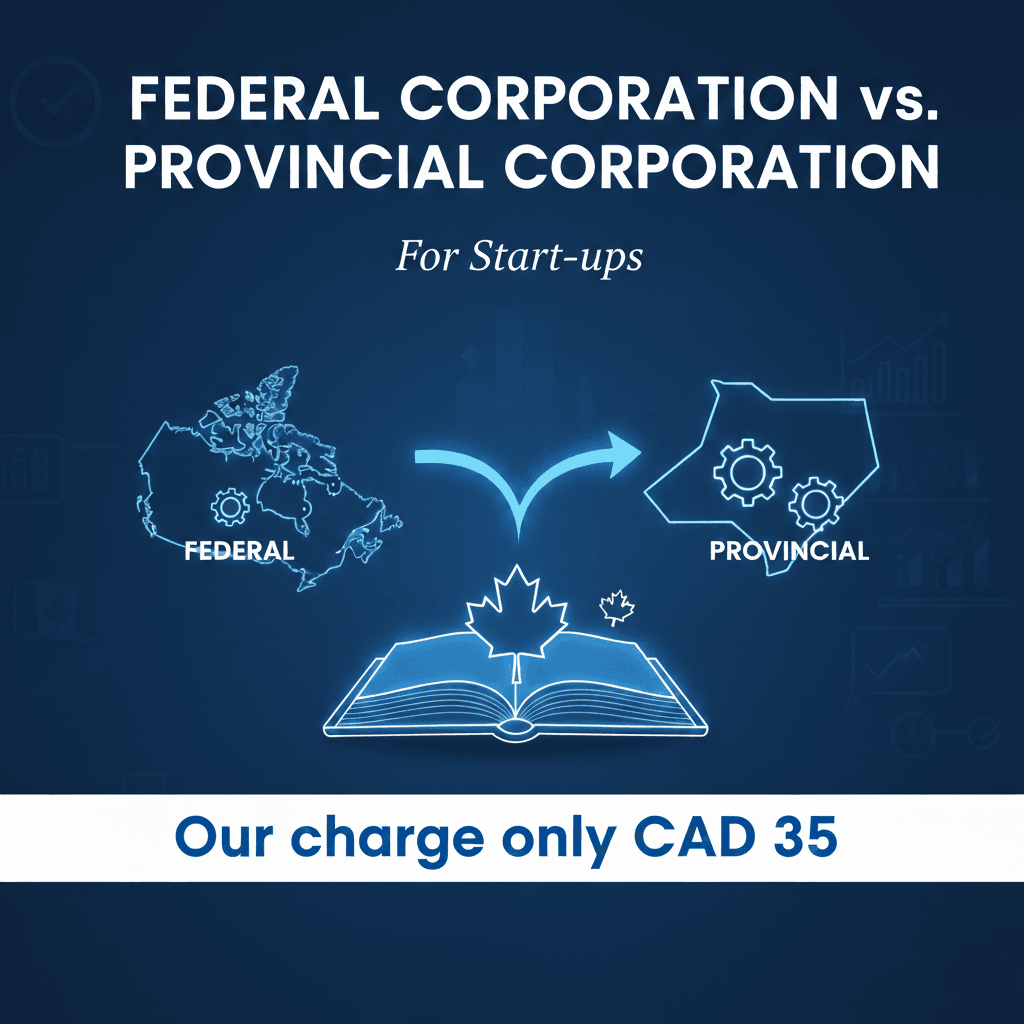
A federal corporation start-up protects your business name across all provinces and territories in Canada. That means no one else can use it anywhere in the country. This makes it easier if you plan to grow outside one province. Also, if your business works in other provinces, federal registration makes extra-provincial registrations simpler.
A provincial corporation start-up is usually faster and costs less at the start. But, it only works legally inside that province. If you want to do business somewhere else later, you have to register again there.
Affordable registration tries to keep costs clear and low — sometimes as little as CAD 35 for basic help. This often covers important steps like NUANS name searches and filing forms with the government.
Starting a corporation helps solve big problems like protecting your personal stuff from company debts (limited liability). It also makes your business official for tax reasons, so you can file proper returns with the CRA like T2 returns. Plus, banks or clients may ask for incorporated status before doing business.
Getting advice from a pro when registering cheaply lowers the chance of missing rules or deadlines. It also helps small businesses plan for taxes and keep up with what’s needed after they register.
Definitions Table
| Term | Definition |
|---|---|
| NUANS Name Search | A search system that checks your company name against others across Canada. It helps stop duplicate names. Most incorporations need this. |
| Extra-provincial Registration | When a business registered federally or in one province registers again to work legally in another province or territory. |
When You Need Affordable Corporation Registration in Canada
You should get affordable corporation registration when these things apply:
- Starting a new business and wanting to separate your personal money from the company.
- Needing limited liability so your personal stuff stays safe if business owes money.
- Planning to grow all over Canada—federal corporations make that easier.
- Wanting fast setup and cheaper costs by registering only in one province.
- Knowing that after incorporation, CRA rules require filing things like T2 income tax returns and GST/HST registrations.
- Looking for expert help to handle tricky legal rules better.
Federal corporations give broad protection — your name is protected nationwide plus easier paperwork if you expand out of province.
Provincial corporations usually cost less at first but can mean more work if you cross borders later.
Limited liability means owners don’t lose their own money if something goes wrong with the company’s debts or lawsuits.
After incorporation, filing corporate taxes correctly becomes necessary. That means getting financial reports right and sending forms on time to CRA.
Getting help from someone who knows this stuff ensures all papers are right at the start and can help with smart tax plans as your small biz grows.
Scenario Decision Table
| Scenario | What Can Go Wrong | CRA/Compliance Touchpoint | CPA Role Adds Value | What To Prepare First |
|---|---|---|---|---|
| Starting a national brand needing wide name protection | Duplicate names causing rejection | NUANS Name Search requirement | Does detailed searches & advises | Proposed company names |
| Launching locally within Ontario only | No room for growth without plan | Provincial Incorporation filings | Suggests best place to register | Business address & director info |
| Operating cross-border sales | Forgeting extra-provincial registration | Extra-provincial Registrations | Handles filings in many places | Existing corp documents |
| Protecting owner assets | Risk of losing personal assets | Corporate governance & liability rules | Explains limited liability setup | Shareholder agreements |
| Filing first-year taxes correctly | Penalties from late or wrong filing | Annual T2 return & GST/HST obligations | Prepares financial reports correctly | Financial records |
Your Options: DIY vs CPA Firm vs Non-CPA Provider for Incorporation
Starting a business in Canada means you have to choose how to incorporate. You can do it yourself (DIY), hire a CPA firm like Gondaliya CPA, or use a non-CPA provider. Each way has good and bad points about cost, risks, service quality, and support.
DIY Incorporation
Lots of people try to do incorporation themselves. It’s cheap and fast if you know what you’re doing. There are online platforms for affordable corporation registration where you can file federal or provincial paperwork.
Here’s why some pick DIY:
- Costs less at the start.
- Filing can be quick if done right.
- Works fine for simple startups.
But watch out:
- No expert checks your forms; mistakes can cause trouble with CRA.
- You might not pick the best corporate setup (federal vs provincial).
- No help with tax planning when you incorporate.
So, if your startup is simple and you want affordable options, DIY looks good. Just be careful about errors that could cost more later.
CPA Firm Incorporation Services
If you hire a Registered CPA firm, they’ll make sure your federal or provincial corporation is set up right. Gondaliya CPA works with Canadian small businesses and offers fixed fees for affordable corporation registration.
Here’s what they bring:
- Help choosing between federal and provincial based on your plans.
- Careful checks on all documents before filing.
- Setup help with bookkeeping, payroll, GST/HST registration.
- Support with CRA and tax planning after incorporation.
A CPA firm does more than just file papers. They make sure you follow laws and get the best benefits from starting a corporation.
Non‑CPA Providers
Non‑CPA providers offer low-cost packages mostly for startups who want quick, easy setups without advice. They focus on preparing documents but don’t give tax or financial help.
Good points:
- Low flat fees for budget buyers.
- Easy online steps to submit forms.
Downsides:
- No Registered professional looks over your paperwork—risking incomplete filings.
- Little to no help after incorporation with taxes or accounting.
If you go this way, weigh savings against possible mistakes that could slow your startup later.
Options Comparison Table
| Factor | DIY | CPA Firm (e.g., Gondaliya) | Non‑CPA Provider |
|---|---|---|---|
| Cost | Lowest upfront | Moderate; fixed fee CAD 35+ | Low–Moderate |
| Compliance Risk | High if inexperienced | Low due to expert review | Medium |
| Quality Assurance | None | Full document & process check | Basic document prep only |
| Tax Planning Advice | None | Included; specific strategies | Not included |
| Post-Incorporation Support | Limited | Full service including CRA help | None |
| Federal/Provincial Choice Guidance | Depends on user | Expert advice based on goals | General info only |
| Typical Timeline | Hours/days depending on accuracy | Days/weeks including consultation | Days |
| CRA Audit Readiness | Low | High | Medium |
| Best For | Simple incorporations on tight budgets | Businesses needing full compliance & advice | Budget-conscious startups wanting fast setup |
| Key Risk | Filing errors causing penalties | Missing best structure & credits | Incomplete filings causing delays |
How the Service Works at Gondaliya CPA (Process + Timeline)
If you pick Gondaliya CPA in Ontario to incorporate, here’s how things flow. We keep it clear and simple so nothing gets missed.
- Initial Consultation: We talk about your business type and goals—whether you want a federal or provincial corporation—and cover liability needs and area coverage in Canada/Ontario.
- Document Collection: You get a checklist preview listing what we need—company names (with NUANS search), directors’ info, shares details, office address—all ready for smooth filing.
- Preparation & Review: Our team drafts your papers carefully. We check rules for federal or provincial laws plus any accounting standards that apply to SMBs. This helps avoid rejection or delays by Corporations Canada or Ontario Ministry.
- Filing Submission: Senior CPAs Sharad Gondaliya, CPA Gondaliya and Vandana Goel review everything again. Then we send in your documents electronically using secure methods designed for each jurisdiction’s timeline (~a few days).
- Confirmation Delivery: Once approved, we send proof of registration plus certificates and explain next steps like annual returns. We also suggest bookkeeping tools like QuickBooks if needed to keep finances tidy later.
- Ongoing Support: After filing, we help with yearly tax returns (T2), GST/HST registrations/refunds, plus CRA matters like audits — taking pressure off new corporations.
Process Timeline Table
| Phase | Typical Duration* | Client Actions | CPA Actions | Outputs |
|---|---|---|---|---|
| Initial Consultation | 1–3 days | Schedule meeting; provide info | Evaluate needs; advise options | Service summary |
| Document Collection | 3–7 days | Gather/share info | Request clarifications; verify NUANS | Document checklist |
| Preparation & Review | 5–10 days | Provide feedback promptly | Draft/review/incorporate changes | Finalized docs ready-to-file |
| Filing Submission | 1–5 days | Confirm go-ahead | Submit electronically | Confirmation receipt |
| Confirmation Delivery | Variable* | Receive confirmation | Deliver certificates/package | Registered entity proof |
| Ongoing Support | Ongoing | Request help | Advise/report/file taxes | Continuous access |
*Times vary by government speed.
What We Need From You Checklist Preview
To keep things moving fast with our flat fee of CAD 35—for federal or provincial incorporation—you’ll need:
- Proposed company name(s) – preferably cleared through NUANS search
- Director(s) info – names, addresses, residency
- Share structure – types/classes/number of shares allowed
- Registered office address – must be inside jurisdiction
- Business activity description – short summary matching registry codes
Giving us full info upfront avoids delays asking for missing details later.
This guide breaks down choices for incorporating your Canadian startup. It shows how an Ontario-based Registered accountant helps from first chat through final registration smoothly and affordably. You’ll know exactly what info to gather and how federal versus provincial options work while staying within budget — all fitting today’s market needs across Toronto/Ontario serving clients nationwide too.
Deliverables from Affordable Corporation Registration Service
If you pick an affordable corporation registration service in Canada, you get several important documents and registrations. These papers set up your start-up’s legal status, whether it’s federal or provincial.
- Certificate of Incorporation: This proves your business is legally set up in Canada. It shows your company’s name, the date you incorporated, and where you are registered.
- Articles of Incorporation: These papers explain how your company will work. They include things like shares, director powers, and company goals.
- NUANS Name Search Report: This report checks if your business name is unique across Canada. It helps avoid conflicts with other companies.
- Business Number & CRA Accounts Setup: Your new company gets a Business Number (BN) from the CRA. This BN links all tax accounts like GST/HST, payroll deductions, and income tax.
These deliverables meet Canadian rules and give your start-up a clear legal identity. The service works for federal corporations start-ups or provincial ones but does not include bookkeeping or tax filing unless you pay extra.
| Topic/Task | Included? | Why it matters | Notes |
|---|---|---|---|
| Certificate of Incorporation | Yes | Proof the company legally exists | Required by law |
| Articles of Incorporation | Yes | Shows governance rules | Sets roles for shareholders/directors |
| NUANS Name Search Report | Yes | Prevents duplicate names | Needed federally; varies provincially |
| Business Number & CRA Accounts Setup | Yes | Needed to manage taxes | Important for CRA compliance |
| Ongoing Tax Filing | No | Separate service | – |
Pricing: Factors Affecting Cost of Incorporation Services in Canada
How much it costs to incorporate a start-up in Canada depends on several things beyond just government fees. Knowing these helps you find affordable corporation registration without surprises.
Main pricing factors:
- Incorporation Fees: Fees differ between federal ($200 online) and provincial incorporations (around $300+ depending on province).
- Extra-Provincial Registration: If you register federally but work in a province—or the other way around—you might need extra registrations which cost more.
- Turnaround Time Requirements: Faster processing usually costs extra from governments or service providers.
Other things that affect price are if you have many shareholders or complex share classes. Also, legal reviews to change articles or extra advice like startup tax help can add to the cost.
Choosing Federal Corporation Start-up or Provincial Corporation Start-up changes costs because each has different fees and rules.
Clear pricing helps avoid surprise bills—flat fees work better than hourly rates for many people.
Pricing Drivers Table
| Driver | What Increases Cost | How to Keep It Efficient |
|---|---|---|
| Incorporation Fees | Picking rush service; complex shares | Use normal timelines; simple shares setup |
| Extra-Provincial Registration | required if working outside first jurisdiction | Start operating in one province/federal zone only |
| Turnaround Time | required rush filings | Plan ahead; accept normal processing times |
Risks, CRA Compliance Requirements & Common Mistakes in Incorporation
Starting a corporation means following strict CRA rules plus other laws. Missing deadlines or filing wrong can cause penalties or loss of good standing.
Common risks:
- Late Annual Return Filing – You must file returns on time with your authority and update info yearly with the CRA.
- Incorrect Name Registration – Using wrong names can get your incorporation rejected or cause problems later.
- Failure To Update Director Information – You must report changes in directors quickly; not doing this causes issues.
- Ignoring Corporate Minute Book Maintenance – Keeping good records helps during audits but is often missed by new businesses.
A CPA firm helps avoid these by making sure filings follow laws and CSRS standards. They also guide clients on what to do after incorporation.
Risk & Compliance Table
| Risk Area | What Happens If Missed | CPA Mitigation / Control | Who Is Affected | Authority Source |
|---|---|---|---|---|
| Late Annual Return Filing | Fines; lose good standing | Reminders + timely filing | Directors + Shareholders | Provincial/Federal Regulator |
| Incorrect Name Registration | Rejection/delays | Careful NUANS checks before filing | All stakeholders | NUANS / Corporate Registry Rules |
| Failure To Update Director Info | Fines + compliance notices | Regular client updates | Directors + Officers | Corporate Law / CSA Guidelines |
Common Mistakes Prevention Table
Avoid mistakes by:
- Sending forms early with calendar reminders
- Using pros for name searches instead of just DIY tools
- Updating records after every director or shareholder change
- Keeping minutes book organized as required by law
Doing these cuts risks a lot compared to trying to do everything yourself without expert help.
Knowing what comes standard with affordable incorporation services, what affects pricing, and how to avoid common CRA mistakes puts you in a better spot when picking between Federal Corporation Start-up vs Provincial Corporation Start-up in Canada’s rules.
Risks, CRA Compliance, and Common Mistakes in Incorporation
Starting a business in Canada means you get some good perks. You get limited liability and tax breaks. But you also face risks and rules you must follow. Whether you pick a federal corporation start-up or a provincial one, you gotta stick to CRA rules. This keeps your business safe and your personal stuff protected.
Key Risks and CRA Compliance Considerations
Incorporating keeps your personal things safe from business debts. But it doesn’t wipe out all risks. If you ignore rules, you can face fines or lose good standing. Sometimes it even leads to legal problems. Knowing these risks helps you avoid big headaches.
| Risk Area | What Happens If Missed | CPA Mitigation/Control | Who Is Affected | CRA/Authority Source |
|---|---|---|---|---|
| Federal vs Provincial Registration | Operating without proper registration | Check where you should register; file extra-provincial papers if needed | Business owners | CRA / Provincial Registries |
| Corporate Tax Filing Compliance | Penalties for late or missing T2 returns | Send reminders on time; review books carefully | Corporation & Directors | CRA |
| Annual Return Filing | Losing corporate status; paying fines | Use automatic tracking; keep an annual calendar | Corporation | Corporations Canada / Province |
| Director Information Updates | Wrong public info causing compliance trouble | Update info when filing; keep clients informed | Directors & Shareholders | Corporations Canada / Province |
| Limited Liability Misunderstanding | Personal money at risk if mixing funds | Explain clear split between personal/business money | Business Owners | Legal standards |
Limited liability stops most business debts from hitting your personal stuff. But you have to follow corporate rules well. Like keeping separate bank accounts and filing papers on time.
Common Incorporation Mistakes and How to Prevent Them
New businesses often miss key steps. This causes delays or compliance problems later on. Avoiding these mistakes keeps things smooth.
| Common Mistake | Impact | Prevention Strategy |
|---|---|---|
| Extra-Provincial Registration Omission | Breaking the law outside the registered province | Check where you operate early; register extra-provincially if needed |
| Late Annual Return Filing | Fines and risk of losing corporate status | Set up automatic reminders for filing dates |
| Failure to Update Director Information | Public records are wrong; causes legal trouble | Update director details quickly after changes |
Other common errors include mixing business money with personal cash or forgetting to change your registered office address after moving.
Checklist: What You Need Before Starting Affordable Corporation Registration in Canada
Getting some important stuff ready before starting your affordable corporation registration helps things go faster. This checklist fits both federal and provincial incorporation across Canada.
| Item | Why Needed |
|---|---|
| Proposed Corporate Name | Make sure it’s unique & follows naming rules |
| Get a NUANS name search report | Don’t pick names too close to others |
| Directors’ Filings | Law requires this for honesty & control |
| Give full names & addresses | Keep info updated all year |
| Registered Office Address | Official spot for legal notices |
| Needs to be a real address inside the area | Change it fast if the office moves |
You might also want to write articles of incorporation based on whether you go federal or provincial.
Knowing the risks, dodging common mistakes, and preparing well will help your start-up incorporation go smoothly in Canada. It keeps both your business and yourself safe under Canadian law.
Industry Spotlights: Affordable Corporation Registration Across Ten Industries
Starting a corporation in Canada can be helpful, but the rules change depending on your business type. You might pick a federal or provincial corporation start-up. Knowing what fits your industry makes a big difference. Here’s a quick look at ten industries where affordable corporation registration matters.
Medical Doctors & Physician Professional Corporations (PCs)
Doctors get help from pros to lower risks and follow CRA rules better. Incorporation lets them grow their small businesses and keeps their personal stuff safe from business debts. Filing taxes for physician PCs means paying close attention to CRA regulations.
- Keeps personal and business money separate.
- Protects doctors’ own assets.
- Requires yearly corporate filings and special tax returns.
Dentists & Dental Practices
Dentists need help with affordable registration that covers getting a CRA Business Number and filing annual returns. This makes tax stuff easier while staying within dental rules.
- Business number sets up tax accounts.
- Annual returns keep the business legal.
- Dentist status might change some steps; advice helps smooth things out.
Daycare / CWELCC Services
Daycares often must incorporate to get grants or join programs. Federal incorporation can be trickier with more rules. Providers need to update registered office info and report regularly for subsidies like CWELCC.
- Must incorporate to get some funding.
- Federal vs provincial affects how many rules you follow.
- Keeping office details updated is super important.
Real Estate Investors & Holding Companies
Real estate folks who work in different provinces have extra steps. They need extra-provincial registrations for places outside their home province. This means more fees and paperwork but opens bigger markets.
| Key Considerations | Details |
|---|---|
| Extra-provincial registration | Needed if working in other provinces |
| Extra fees | Fees charged per province |
| More reports | More forms to fill out |
Planning ahead helps avoid surprises when dealing with many provinces.
Construction Companies & Skilled Trades
Builders and tradespeople need a business number fast for tax accounts like payroll and GST/HST after starting their corporation. They must also file directors’ reports and keep office info current.
- Business number sets up tax accounts fast.
- Directors’ reports keep things transparent.
- Updating office info avoids fines or missed letters.
Technology Startups / SaaS Companies
Tech startups benefit from federal corporations that protect names all over Canada. This also makes extra-provincial registrations easier than just going provincial. Gondaliya CPA charges CAD 35 flat fee to help choose the best option without surprise costs.
Federal incorporation helps by:
- Giving name protection across the country
- Letting you operate in any province easily
- Cutting down on paperwork when renewing
Great if your SaaS wants clients everywhere early on.
E-commerce / Retailers
Online sellers need strong name protection with NUANS searches whether they pick federal or provincial incorporation. It stops costly brand mix-ups later.
Key points:
- NUANS report needed before approval
- Name must be unique across places
- Register early to protect your brand
Many packages bundle this service saving time at start-up.
Restaurants / Food & Beverage Businesses
Incorporation shields restaurant owners’ personal stuff from debts or lawsuits linked to daily work.
Why incorporate?
- Protects owner’s private property
- Helps get financing easier
- Makes managing employees simpler
They also file regular financial statements as CRA expects.
Transportation / Logistics Companies
After incorporation, transport businesses must file taxes like T2 returns and set up GST/HST accounts for fuel and freight charges. Getting advice early is smart.
Things to watch:
- File T2 on time to avoid penalties
- Register GST/HST to claim credits
- Keep books tidy for audits
The structure limits owner risks from transport hazards.
Industry Spotlight Summary Table
| Industry | Unique Financial/Tax Features | Common CRA Touchpoints | How Affordable Corporation Registration Helps | Relevant Entity Terms |
|---|---|---|---|---|
| Medical Doctors & Physician PCs | Corporate tax filing; asset protection | Annual T2 Returns; Payroll Remittances | Risk reduction; Compliance support | OHIP; RCPSC |
| Dentists & Dental Practices | Business Number issuance; Return Filing | Annual Returns | Efficient setup at low cost | RCDSO |
| Daycare/CWELCC Services | Grant-linked mandates; Registered Office Updates | Government Reporting | Navigates complex federal/provincial rules | – |
| Real Estate Investors/Holding Cos | Extra-provincial Registrations | Multi-province Filings | Manages expanded jurisdictional needs | – |
| Construction/Skilled Trades | Business Number essential | Director Filings | Ensures timely statutory submissions | – |
| Technology Startups/SaaS | Nationwide Name Protection | NUANS Search | Simplifies cross-province operations | – |
| E-commerce/Retailers | Name Protection via NUANS | Prevents branding conflicts | – | |
| Restaurants/Food&Beverage | Limited Liability Benefits | Protects owners’ assets | – | |
| (Transportation/Logistics) | Mandatory Tax/GST Accounts | – |
Knowing these details helps people pick federal or provincial corporations wisely when starting up in Canada. Affordable CPA firms with clear fees, like CAD 35 flat services, make it simpler too.
FAQs on Corporation Registration and Compliance in Canada
What are annual returns and why are they important for corporations?
Annual returns report your corporation’s status to the government. Filing them on time keeps your business in good standing.
How do directors’ filings affect corporate compliance?
Directors’ filings update the government on who manages the corporation. Missing filings can cause penalties or legal trouble.
What is a registered office update and when is it required?
A registered office update informs authorities of your corporation’s official address. You must file changes promptly to avoid fines.
Why is corporate tax filing compliance critical after incorporation?
Corporate tax filing ensures you meet CRA rules. Late or wrong filings lead to penalties and audit risks.
What are T2 returns and who must file them?
T2 returns are corporate income tax returns. Every Canadian corporation must file annually with the CRA.
When should GST/HST registrations be completed for a new corporation?
Register for GST/HST if your revenues exceed the threshold or you expect taxable sales. This registration supports input tax credits.
How does professional guidance help in corporation start-up incorporation?
Experts help choose structures, prepare documents, and ensure compliance to reduce risks and avoid costly mistakes.
What role do share structures play in incorporation?
Share structures define ownership types, rights, and controls. Proper setup helps prevent shareholder disputes.
What are certificates of compliance and why do they matter?
Certificates prove your corporation meets all regulatory requirements. They help with contracts, financing, and licensing.
How should corporate records and governance be maintained post-incorporation?
Keep accurate records of meetings, shares, and decisions. Good governance ensures legal compliance and smooth audits.
Key Points on Corporate Compliance & Governance
- Automated reminders help avoid late annual return filing penalties.
- Updating directors’ details quickly maintains accurate public records.
- Registered office address changes must be filed without delay to stay compliant.
- Share issuances and amendments require proper documentation for legality.
- Rush filings are available but usually increase costs significantly.
- Integration needs like bookkeeping with QuickBooks or Xero improve financial accuracy.
- Penalties arise from missing deadlines or inaccurate corporate records.
- Maintaining good standing protects against legal penalties or loss of business licenses.
- Non-profit incorporations have special compliance rules tied to government grants.
- Contracts, leases, and licenses often require proof of corporate good standing.
- Shareholder disputes often relate to unclear ownership or poor governance documents.
- Audit risks reduce by maintaining audit-ready documentation including shareholder lists.
- Seeking legal advice ensures your corporate governance aligns with laws and best practices.
- Tax planning consultations optimize benefits like credits available under Canadian law.
- Professional accountability enhances trust with authorities during compliance audits.
This FAQ set covers crucial topics about federal vs provincial corporation start-up options, focusing on ongoing compliance duties after affordable registration in Canada by Gondaliya CPA.
Have more questions or need personalized guidance? Schedule a free consultation with our expert CPAs today and ensure your business stays fully compliant.

Sharad Gondaliya is a CPA Canada & CPA USA with 15 Years+ experience of Accounting, Tax, Payroll of Corporate Small Businesses as Tax Accountant. He is a CPA Ontario member (61040184) and holds US CPA licences in Washington and Montana and is well known among corporate small businesses for tax planning, efficient tax solutions, and affordable CPA services. Sharad is the Principal (Director) of Gondaliya CPA – Affordable CPA Firm in Canada. Licenses: CPA Ontario: 61040184 | CPA USA (MT): PAC-CPAP-LIC-033176 | CPA USA (WA): 57629 | CPA Firm License: 61330051 View Full Author Bio