



Affordable & Efficient GST/HST Filing Solutions for Growing Businesses
Affordable GST and HST Filing Services for Self-Employed Individuals by Gondaliya CPA
Affordable GST and HST filing services by Gondaliya CPA make it easy for self-employed individuals to manage their taxes with confidence. With expert guidance on return services and business tax compliance, Canadians receive reliable support tailored to meet the needs of self-employed professionals. Filing GST/HST can feel tricky if you are self-employed. Gondaliya CPA offer affordable GST/HST filing services that help you save money by claiming all input tax credits. Filing on time cuts down the chance of penalties. Plus, it helps you plan your taxes better as your business grows. Whether you do it yourself or hire a CPA or non-CPA depends on how complex your business is, how much risk you are willing to take, and if you want protection during audits.
Quick Summary
Knowing what affects GST/HST filing costs helps you plan your budget better. Please note that the pricing drivers are business complexity, filing frequency, cleanup required, advisory depth and turnaround time, and each of them is something a growing business can act on before the invoice is written. Affordable tax services fit your business tax compliance needs without cutting corners.
| Aspect | Details |
|---|---|
| What it is | Affordable, accurate and timely GST/HST filing for incorporated small and medium businesses across Canada. |
| What it costs | Fees are fixed and annual with no hourly billing, shown before tax with sales tax on its own line. |
| What moves the price | Business complexity, filing frequency, cleanup required, advisory depth and turnaround time. |
| What you get back | Every input tax credit you qualify for, filings before the deadline, and audit support if CRA asks. |
Reading time: 18 minutes.
Table of Contents
- Your Options: DIY, Non-CPA or Registered CPA
- The GST/HST Filing Process
- How the Service Works at Gondaliya CPA
- What You Can Expect for the Fee
- What Affects the Cost of GST/HST Filing
- Risks, and a Growing Business Worked Through
- Frequently Asked Questions
- Essential Points for Business Owners
- Industry Spotlights: Sectors We Represent
- Professional Guidance and Quick Reference
The Numbers That Matter
This article covers affordable and efficient GST/HST return filing for incorporated small and medium businesses in Ontario and across Canada, current to 6 November 2026. It covers the choice between filing yourself, using a non-CPA provider and engaging a Registered CPA firm; the GST/HST filing process from choosing reporting periods through to record retention; how the service runs at Gondaliya CPA and the timeline each phase takes; what the engagement delivers; the six drivers that set the cost; the risk areas CRA looks at, including registration, calculation, deadlines, input tax credit documentation and audit exposure; a worked example of a growing Toronto software company; and the sector-specific points that change how filing is handled. It does not set corporate income tax filing deadlines, advise on Provincial Sales Tax in the provinces outside the HST system, or quote a fee for any particular business. Gondaliya CPA performs compilation engagements under CSRS 4200, which provide no assurance; audit and review engagements are referred out. This is educational information only and not tax, legal or accounting advice.
Your Options: DIY, Non-CPA or Registered CPA
Three Routes
Your Options: DIY vs. Gondaliya CPA vs. Non-CPA Provider
When you need to file GST/HST, you basically have three choices: do it yourself (DIY), hire a Registered CPA like Gondaliya CPA, or use a non-CPA provider. Each has its own pros and cons for tax compliance, accuracy, and saving money.
Summary
- Affordable Tax Services: CPAs make sure your taxes are done right.
- Maximize Input Tax Credits: Claim every credit you qualify for.
- Timely Filing: Submit your returns before deadlines to avoid fees.
- Proactive Planning: Get advice that helps your business grow smoothly.
- Choosing Providers: Pick based on how tricky your taxes are and your audit concerns.
Quick Comparison: DIY vs. Gondaliya CPA GST/HST Filing
| Situation/Trigger | Best Next Step | Why | Risk Level | Typical Timeline | Source/Note |
|---|---|---|---|---|---|
| Simple transactions | DIY | Easy to handle alone | Low | 1 month | N/A |
| Complex filings | Hire a CPA | CPAs know the rules well | High | 2 months | N/A |
| Missing documentation | Non-CPA provider | Might miss important stuff | Medium | Varies | N/A |
| Audit concerns | Hire a Registered firm | Professional audit support | High | Depends | N/A |
What Each Route Actually Buys
DIY Filing is popular with small business owners who want to save money by doing their GST/HST returns on their own. You can use CRA’s online tools or accounting software. But if your transactions get complicated, mistakes happen more often without an expert checking your work. Those errors can cause fines or lost input tax credits.
Non-CPA Providers include bookkeepers or tax helpers without CPA licenses. They might cost less but don’t always know all the rules well. Also, they may not help you save as much on taxes or keep you fully compliant with CRA rules.
Hiring Gondaliya CPA means working with a Registered firm that knows Ontario rules well and focuses on incorporated SMBs business tax compliance. They offer:
- Expert knowledge of GST/HST laws.
- Accurate filings that lower your audit risks.
- Tips to claim more input tax credits and avoid penalties.
- Clear pricing with no hidden fees.
What works best depends on your business size, risk level, and how much help you want from an expert.
| Factor | DIY | Non-CPA Provider | Registered CPA Firm (Gondaliya CPA) | Best For | Key Risk |
|---|---|---|---|---|---|
| Compliance Accuracy | Medium | Medium-Low | High | Simple businesses, startups | Penalties from mistakes |
| Tax Efficiency | Low | Medium | High | Businesses wanting savings | Missed deductions/credits |
| Accountability | None | Limited | Full professional responsibility | Audit support needed | No recourse if issues |
| Cost | Lowest | Moderate | Fixed transparent fees | Budget-conscious | Unexpected expenses |
| Review & Quality Control | None | Limited | Thorough internal QA checks | Peace of mind businesses | Filing errors |
| CRA Audit Readiness | Low | Medium | High | – | Audit risk |
The row that most often decides it is accountability. DIY and a non-CPA helper both leave the business carrying the whole consequence of an error, while a Registered firm carries professional responsibility and can provide CRA audit readiness behind the filings it signs off.
Two e-commerce clients arrived within a month of each other, both filing quarterly, both around the same revenue. One had done her own returns for three years using the platform’s sales report as the only source, and had never claimed the HST on advertising, software or shipping supplies. The other had used a bookkeeper who claimed everything, including the personal portion of a vehicle. The first was owed roughly $14,000 of unclaimed input tax credits across the open periods; the second had about $6,000 of credits that would not have survived a review. Both engagements cost the same fixed annual fee. Cheap filing is only cheap if the numbers behind it hold. Figures changed for privacy.
The GST/HST Filing Process
The Return Itself
The GST/HST Filing Process, Step by Step
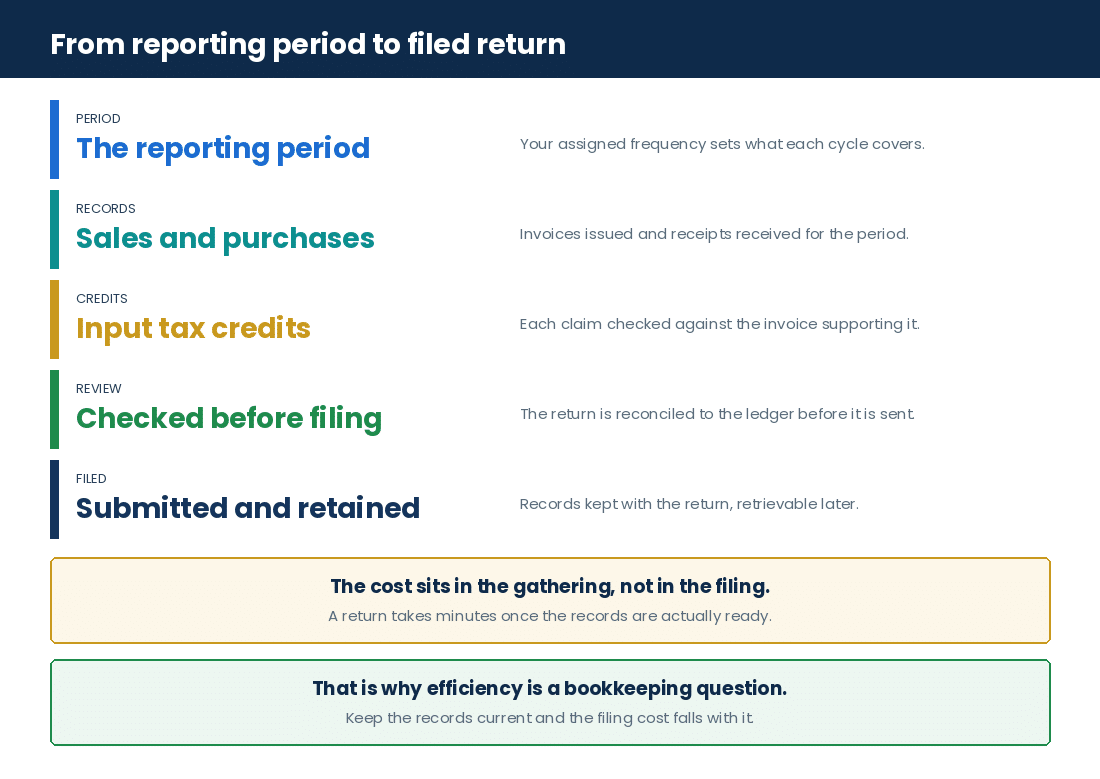
Filing GST/HST means reporting how much sales tax you collected minus what you paid on purchases for business use during set periods chosen by the CRA.
Here’s what it looks like:
- Pick Reporting Periods: Depending on your yearly taxable revenue, filing might be monthly, quarterly, or semiannually. Make sure deadlines match CRA’s schedules for incorporated SMBs in places like Ontario/Toronto where HST rates apply.
- Collect Sales Info: Add up total sales that are taxable separately from exempt sales so you apply the right tax rates according to federal and provincial rules current as of June 2024.
- Calculate Input Tax Credits (ITCs): Claim only ITCs allowed for expenses directly linked to your business using CRA criteria—this helps maximize credits without risk of rejection.
- Fill Out Forms Correctly: Complete required forms showing gross tax collected minus ITCs to get correct payable or refundable amounts with accurate numbers and categories.
- File Returns Electronically / Paper: Most incorporated SMBs prefer e-filing via certified platforms like ours because it cuts processing time and errors compared to paper methods which still exist but are less common.
- Pay Balances On Time: Any money owing must be sent by the deadline set each year to avoid interest or penalties; CPAs watch this closely so clients don’t slip up.
- Keep Records Well: Save all receipts, invoices, contracts for at least seven years per Canadian rules in case of audits later.
Common Mistakes Avoided by Professionals
Many businesses mix personal with business expenses badly, claim ITCs wrong, miss deadlines or misclassify transactions—all raising risk of reassessments and fines avoided by working with CPAs who manage compliance actively. The seven mistakes that cost growing businesses the most are set out in detail in our guide to the GST/HST filing mistakes we see most often.
How Multi-Jurisdictional Rules Affect Your Business Taxes
Businesses operating in multiple provinces must track varying HST rates carefully to avoid underreporting or overpaying taxes. Expert CPA guidance ensures compliance across regions. This is the point at which a growing business usually outgrows doing the return itself: one province is a single rate applied to a single sales figure, while five provinces is a mapping exercise that has to be right every period rather than once.
A Toronto wholesaler expanded from Ontario into four other provinces in a single year and kept filing the way it always had, applying one rate to total sales. The under-and-over reporting across the provinces netted out to roughly $9,000 owing once we rebuilt the periods by destination, and the correction cost more in our time than three years of ordinary filings would have. Nothing about the business had become complicated except where it shipped. Growth is the thing that changes the filing, not revenue. Figures changed for privacy.
How the Service Works at Gondaliya CPA
Process
How the Service Works at Gondaliya CPA
Gondaliya CPA makes GST/HST filing simple and clear. Their process fits your needs while keeping your business tax compliance on track:
- Intake & Onboarding: They start by learning about your business and past filings with a free consultation. This helps them plan exactly what you need.
- Document Collection: You send sales records, invoices, bank statements, payroll info (if needed), and previous GST/HST returns through secure channels. They work well with QuickBooks or Xero too.
- Data Review & Cleanup: The team checks all documents carefully to find mistakes like missed input taxes or wrong transaction types that could cause problems.
- GST/HST Calculation & Filing Prep: Following the latest CRA rules in Canada/Ontario (including Toronto where HST applies), they calculate your taxes owed or refunds due precisely while making sure you get all eligible credits.
- Quality Check: Before submitting, they run multiple reviews inside the firm to make sure numbers match source documents perfectly, reducing audit chances.
- Submission & Confirmation: After you approve final reports electronically, they file directly via authorized portals before deadlines to avoid late penalties.
- CRA Follow-Up Support: If CRA asks questions later or changes happen in rules, they handle communications for you so you don’t have to worry about penalties or confusion.
Process Timeline Overview
| Phase | Typical Duration | Client Actions | Gondaliya CPA Actions |
|---|---|---|---|
| Intake & Consultation | 1–3 days | Give company basics | Plan workflow; schedule call |
| Document Submission | 1–2 weeks | Send financial records securely | Check completeness; ask for more |
| Data Review + Cleanup | 3–5 days | Answer questions quickly | Spot errors; fix entries |
| Return Preparation | 4–7 days | Approve draft calculations | Calculate taxes; QA checks |
| Final Approval + Filing | 1 day | Confirm final numbers | File electronically on time |
| Post-Filing Support | Ongoing | Stay available | Handle CRA follow-up |
The only phase on that table with real variance is document submission, and it is the client’s to control. A business that books an intake consultation with records already assembled routinely runs the whole engagement in the shorter half of every band.
Typical Phases in Engagement Confirmation & Filing Process
- Client provides data summary report and engagement confirmation.
- Draft return prepared for client review and approval.
- Final return package submitted electronically before deadline.
- CRA acceptance confirmed with documentation sent to client.
Two clients of almost identical size started the same week. One uploaded every bank statement, sales report and receipt file on day two. The other sent documents in eleven separate batches over six weeks, each one prompting a fresh completeness check. The first return was filed nine days after intake; the second took seven weeks and arrived three days before the deadline. The preparation work was the same in both cases, and so was the fee, because the fee was fixed in advance. What the delay cost was the second client’s own peace of mind. Figures changed for privacy.
GST/HST Filing Cost Check
Five quick questions on what your filing will involve. No fee shown.
Points to raise with us:
This is a general prompt, not tax or legal advice or a quote. Your position depends on your full facts. For a real review, please book a free consultation.
What You Can Expect for the Fee
Deliverables
What You Can Expect from Gondaliya CPA
Hiring a Registered firm means more than just filing accurately—you get clear processes focused on growing incorporated SMBs aiming for smart taxation that follows Canadian law including Ontario rules:
Main Benefits
- Affordable flat fees with no surprise charges.
- Thorough reviews that find ways to increase legal input tax credits boosting cash flow.
- Reminders timed around deadlines helping stop late submissions and fines.
- Easy-to-understand updates about rule changes affecting your taxes throughout the year.
- Access to experts familiar with various industries—from healthcare providers dealing with OHIP issues to tech startups needing multi-region advice.
Fees are fixed and annual with no hourly billing, shown before tax with sales tax on its own line, and agreed before any work begins. That is what makes the benefits above countable rather than aspirational: a review that finds another $3,000 of input tax credits is worth the same whether it took us an hour or a day, because the hour or the day is not what you are paying for.
What Clients Receive
Besides filed returns, clients get detailed summary reports showing key numbers plus suggestions for planning ahead so improvements continue year after year. Where the filings sit alongside a corporate tax filing, the same records feed both and the summary report covers the pair.
Tools That Help
They work smoothly with bookkeeping systems like QuickBooks and Xero letting data move fast and cutting manual errors for quicker turnarounds.
Choosing expert help instead of going solo—or hiring less skilled providers—means trusting someone focused on protecting your business interests while legally getting every dollar back possible in Canadian tax law.
Check official sources regularly since rules change from time to time.
Why Ongoing Support Matters Post-Filing
Gondaliya CPA offers ongoing monitoring of rule changes, timely reminders about deadlines, and handles CRA follow-ups so you avoid surprises after filing.
A client who had been filing her own quarterly returns for four years engaged us mainly for the reminders, because she had been late twice. The first review found that software subscriptions, merchant processing fees and a share of her home office had never been claimed at all, which came to roughly $11,500 of input tax credits across the periods still open to adjustment. She had engaged us to avoid a few hundred dollars of penalties. The credits were twenty times that, and they had been sitting in her own accounting file the whole time. Figures changed for privacy.
What Affects the Cost of GST/HST Filing
Cost Drivers
Pricing: What Affects the Cost of GST/HST Filing with Gondaliya CPA
Knowing what affects GST/HST filing costs helps you plan your budget better. At Gondaliya CPA, we offer affordable tax services that fit your business tax compliance needs without cutting corners.
Here are some factors that change the pricing for GST/HST filing:
Pricing Drivers
| Driver | What Raises It | What You Can Do |
|---|---|---|
| Business Complexity | More entities, locations, or transactions mean more work. That can raise costs. | Keep your records neat and use good accounting tools to make things easier. |
| Filing Frequency | Monthly or quarterly filings take more time than annual ones. | If CRA lets you, choose less frequent filings to save money. |
| Cleanup Required | Messy accounts or missing receipts add extra work. | Stay on top of bookkeeping and keep records updated to avoid this. |
| Advisory Depth | More detailed planning, ITC checks, or audit help costs more. | Start by focusing on core filing needs, then add extras later if needed. |
| Turnaround Time | Rush jobs need special handling and cost more. | Give documents early to avoid rush fees and keep things smooth. |
By knowing these cost drivers, small and medium businesses can control their GST/HST filing spending without risking errors or CRA problems. Fees are fixed and annual with no hourly billing, shown before tax with sales tax on its own line, so the drivers above are settled at the quoting stage rather than discovered on an invoice.
Key Factors Influencing Affordable & Efficient GST/HST Filing Solutions
- Transaction volume impacts the time needed for accurate reporting.
- Complexity of records affects data cleanup and review requirements.
- Number of entities determines coordination effort for filings.
- Use of accounting tools like QuickBooks/Xero streamlines processing.
- Filing frequency (monthly/quarterly) changes workload and cost.
- Advisory needs vary based on audit risk and planning depth.
Advantages of Leveraging CPA Expertise vs DIY or Non-CPA Providers
- Improved accuracy reduces risk of penalties or audits.
- Higher tax efficiency by maximizing legitimate ITCs.
- Full accountability including professional audit defense.
- Better integration with corporate tax filing and payroll taxes.
Checklist for Smooth GST/HST Filing Preparation
- Gather business incorporation documents early.
- Collect all previous GST/HST returns for reference.
- Compile complete payroll records aligned with filings.
- Use Hubdoc or similar apps to digitize receipts.
- Separate personal from business expenses clearly.
A fuller version of that list, period by period, is set out in our GST/HST filing checklist for Canadian SMEs.
A client filing monthly asked us to look at nothing except the fee. Her taxable revenue had never required monthly reporting; she had elected it years earlier on advice nobody could remember. Moving to quarterly cut twelve filings a year to four, reduced the annual fee by roughly a third, and made no difference to anything she owed. We also moved her receipt capture into Hubdoc, which removed most of the cleanup work that had been the other half of the cost. The saving came from the two drivers she had assumed were fixed. Figures changed for privacy.
Risks, and a Growing Business Worked Through
Risk & Scale
Risks, CRA Compliance, and Common Mistakes in GST/HST Filing
GST/HST filing follows strict CRA rules. Mistakes can cause penalties or audits. Knowing common risks keeps you safe while still getting affordable tax services.
Here’s a quick look at main risks:
Risk Areas
| Risk Area | What It Costs | How It Is Managed |
|---|---|---|
| Missing GST/HST Registration | Late registration leads to penalties and interest charges. | CPAs watch revenue limits so you register on time. New businesses and growing SMBs must be alert. |
| Incorrect GST/HST Calculation | Paying too much hurts cash flow; paying too little causes penalties. | We carefully review returns and match input tax credits to avoid errors. |
| Missed Filing Deadlines | Late filings bring penalties fast and may affect your status with CRA. | Automated reminders plus follow-ups help clients meet deadlines no matter their schedule. |
| Inadequate ITC Documentation | Lack of proof means losing credits and higher audit risk. | We check paperwork thoroughly and teach clients how to keep good records. |
| CRA Audit Exposure | Audits mean extra checks, fines, or reassessments if not handled well. | Experienced CPAs provide audit defense and represent your business professionally. |
Avoiding these mistakes keeps your business running smoothly within Canadian tax rules. The penalties that follow a missed deadline are set out in our guide to late filing and how to avoid them.
Gondaliya CPA makes sure your calculations are correct, filings happen on time, registrations occur when needed, and ITC documents are complete. If the CRA comes knocking, we stand by you with solid audit support.
Contact us at info@gondaliyacpa.ca or call 647-212-9559 for a free talk about handling your incorporated SMB’s GST/HST filing in Ontario or anywhere in Canada without surprise costs or risks.
A growing trades business crossed the registration threshold in the second quarter of its first year and registered eleven months later, after an accountant finally asked. The tax on the sales made in between was owed regardless, about $21,000 of it, and none of it had been collected from the customers. We claimed the input tax credits on the same period, which brought the net figure down to roughly $13,000, and the registration date was backdated so the credits were available at all. The whole exposure came from one unanswered question about revenue. Figures changed for privacy.
One Realistic Numeric Example
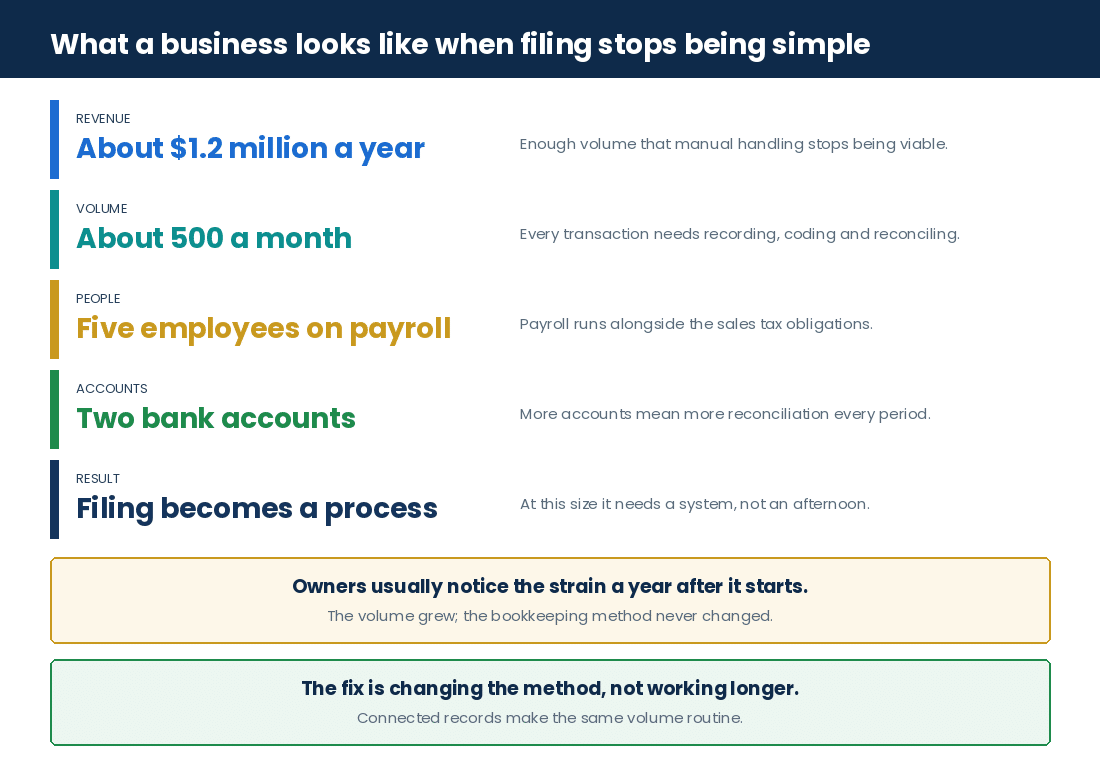
A Toronto software startup makes about $1.2 million a year. It handles close to 500 sales each month across Canada. The company has five employees and runs payroll monthly. They use QuickBooks and Xero for bookkeeping and payroll.
But there are some issues. Bank accounts aren’t fully reconciled. Business and personal expenses mix together. Receipts for software subscriptions go missing. Bookkeeping updates come late. These problems make GST/HST filing tricky and affect business tax compliance.
Assumptions (Illustrative)
| Metric | Detail | Nature |
|---|---|---|
| Annual revenue | $1,200,000 | Actual experience |
| Monthly transactions | ~500 | Actual experience |
| Employees | 5 | Actual experience |
| Payroll frequency | Monthly | Actual experience |
| Bank accounts | 2 (business checking + savings) | Actual experience |
| Software used | QuickBooks & Xero | Actual experience |
| Data issue | Behind reconciliations; missing receipts for subscriptions; mixed expenses; delayed updates |
Outputs/Deliverables
Affordable GST/HST filing focuses on better tax efficiency while meeting CRA rules:
- Prepare and file GST/HST returns accurately and on time.
- Spot and claim input tax credits to lower the tax owed.
- Help fix differences between bank statements and records.
- Organize documents by digitizing missing receipts with Hubdoc or similar tools.
- Advise on keeping personal and business expenses separate to avoid audits.
Next Steps for the Worked Example
- Digitize all missing receipts using Hubdoc or another capture tool.
- Update bookkeeping in QuickBooks and Xero every month.
- Set clear deadlines for monthly document submissions from teams.
- Book quarterly GST/HST check-ins with Gondaliya CPA experts.
- Keep personal finances separate from business accounts all year.
Doing this will smooth out the GST process. It lowers risks like penalties or missed credits. These steps fit well with affordable tax services made for growing Canadian businesses like this startup.
Proactive Tax Planning Tips for Growing SMBs
Plan quarterly check-ins to adjust filings as business grows or changes occur; keep bookkeeping updated monthly; separate transactions clearly; review advisory reports regularly. Where the aim is to turn the filing itself into a source of saving rather than a cost, our note on GST/HST filing strategies takes that further.
Common Mistakes Prevented by Working With Gondaliya CPA
Avoid late filing, incorrect ITC claims, underreported sales, non-registration issues, mishandling of multi-provincial rates, and poor documentation practices that raise audit risks.
The startup above is a composite of three files we have run. In every one, the single most expensive item was not the tax — it was the reconstruction. Separating mixed personal and business spending across two accounts and roughly 6,000 transactions a year took longer than preparing four returns, and the missing subscription receipts cost about $4,800 of input tax credits that could not be supported. Once receipt capture and monthly bookkeeping were in place, the next year’s filings cost less than half as much to produce. Figures changed for privacy.
Frequently Asked Questions
FAQs
FAQs on Affordable GST/HST Filing and Business Tax Compliance
What documents do I need for GST/HST filing?+
You need business incorporation papers, previous GST/HST returns, payroll records, and sales invoices. Using Hubdoc helps organize receipts easily.
How does transaction volume affect filing costs?+
Higher transaction volume means more work in reviewing and filing. This raises service fees because of extra time spent. It is the driver that moves most as a business grows, which is why volume is one of the things we scope at intake rather than after the work has started.
Can Gondaliya CPA help with multi-entity or consolidated filings?+
Yes, we handle GST/HST filings for multiple entities and offer consolidated return preparation to simplify compliance. The number of entities determines the coordination effort, so bringing all of them in together is cheaper than adding them one at a time.
Do you provide support for SR&ED claims alongside GST/HST filing?+
Yes, we integrate SR&ED claims with your regular tax filings to maximize credits and keep your business compliant.
What is the typical timeline for GST/HST filing services at Gondaliya CPA?+
From intake to final filing, it usually takes 2 to 4 weeks depending on document submission speed and complexity. Intake and consultation run 1 to 3 days, document submission 1 to 2 weeks, data review and cleanup 3 to 5 days, return preparation 4 to 7 days, and final approval and filing a single day.
Do QuickBooks and Xero actually bring the filing cost down?+
They automate transaction tracking and link with payroll, reducing errors and speeding up data review. Because cleanup is one of the five pricing drivers, a connected and current bookkeeping file removes work from the engagement rather than just making it tidier, and the saving shows up in the quote.
What risks do I face with late or incorrect GST/HST filings?+
Risks include penalties, lost input tax credits, audit exposure, and interest charges from CRA.
Does Gondaliya CPA offer audit support documentation if CRA contacts me?+
Yes, we prepare audit support documents and manage CRA correspondence to protect your business interests. Representing a client through a CRA audit is a service we provide directly, and it is separate from an assurance engagement.
Can you handle the registration when we cross the revenue limit?+
We guide you through registration thresholds and help register your business correctly with CRA on time. Late registration leads to penalties and interest charges, and because the tax on sales made before registering is still owed, watching the revenue limit is part of the engagement for any growing business.
Would filing less often reduce what I pay you?+
Often, yes. Monthly or quarterly filings take more time than annual ones, so if CRA lets you choose a less frequent period, that is a direct reduction in workload and cost. The reporting period available to you depends on your yearly taxable revenue, so it is worth checking rather than assuming the frequency you were set up on is the one you have to keep.
Essential Points for Business Owners
Key Takeaways
What Decides What GST/HST Filing Costs You
The return itself is a short piece of arithmetic. What varies is the condition of the records behind it, how often it has to be done, how many entities are involved, and whether anybody checked the credits before it was filed.
| Point | What It Means | Where It Shows Up |
|---|---|---|
| What the return reports | Sales tax collected minus what you paid on purchases for business use | Every reporting period |
| Reporting period | Monthly, quarterly or semiannually, depending on yearly taxable revenue | Filing frequency driver |
| Input tax credits | Claim only ITCs allowed for expenses directly linked to your business | Where most of the money is won or lost |
| Record retention | Receipts, invoices and contracts kept for at least seven years | ITC documentation risk |
| Registration | Late registration leads to penalties and interest charges | Growing SMBs crossing the limit |
| Deadlines | Late filings bring penalties fast and may affect your status with CRA | Missed deadline risk |
| Multi-province sales | Varying HST rates must be tracked to avoid underreporting or overpaying | Expansion |
| Business complexity | More entities, locations or transactions mean more work | Pricing driver |
| Cleanup required | Messy accounts or missing receipts add extra work | Pricing driver |
| Turnaround time | Rush jobs need special handling and cost more | Pricing driver |
| Accountability | DIY carries none; a Registered firm carries full professional responsibility | Choosing a provider |
| Fees | Fixed and annual with no hourly billing, shown before tax with sales tax on its own line | Agreed before work begins |
The Six Things We Check First
- Is the business registered, and was it registered on time? Revenue limits are crossed quietly, and the tax on sales made before registering is owed anyway.
- What reporting period are you on, and does your revenue require it? A frequency nobody has revisited is the commonest avoidable cost on the file.
- Do the bank accounts reconcile? Unreconciled accounts are the single largest item of cleanup work, and cleanup is a pricing driver.
- Is there a receipt behind every input tax credit? Lack of proof means losing credits and higher audit risk, and the credits are where the money is.
- Are personal and business expenses mixed? Separating them costs more than keeping them apart ever would, and it raises audit exposure in the meantime.
- Which provinces do you sell into? One province is one rate; five provinces is a mapping exercise that has to be right every period.
Our Approach
Gondaliya CPA starts with a free consultation to learn the business and its past filings, so the scope is known before anything is quoted; collects sales records, invoices, bank statements, payroll information and prior returns through secure channels, working directly with QuickBooks or Xero where they are in place; reviews and cleans the data to find missed input taxes and wrongly classified transactions; calculates the net tax under current CRA rules for Canada and Ontario, including Toronto where HST applies; runs multiple internal quality checks so the numbers match the source documents before anything is submitted; files electronically through authorised portals ahead of the deadline; and handles CRA follow-up afterwards, including audit support documentation and correspondence. Fees are fixed and annual with no hourly billing, shown before tax with sales tax on its own line, and agreed before any work begins.
Industry Spotlights: Sectors We Represent
Industry Expertise
GST/HST filing and business tax rules differ a lot by industry, and so does what the work costs. Here are eleven, and what makes the filing harder in each.
| Industry | What Makes the Filing Harder |
|---|---|
| Technology startups & SaaS | Cross-border GST issues on services sold globally, and foreign revenue that has to be reported correctly |
| E-commerce & online retailers | Cross-provincial sales needing multi-jurisdiction tracking, with digital payments adding challenges |
| Consulting firms | Service fees often exempt or zero-rated, needing clear classification on every invoice |
| Construction, contractors & skilled trades | Subcontractor payments causing billing cycles that affect return accuracy |
| Property developers & builders | Capital assets changing the timing of ITC claims because projects last long |
| Real estate investors & holding companies | Multiple rental properties making income reporting tricky, with ITCs on capital costs to reconcile |
| Transportation, logistics & trucking | Specialised fuel input tax credit claims, with payroll taxes separate but linked |
| Restaurants & food and beverage | Many daily sales requiring exact tax calculation, where late filings cause penalties |
| Daycare, childcare & CWELCC services | Government funds changing GST/HST credit claims and affecting net payables |
| Dentists & dental practices | Exemptions that have to be watched closely because the regulators set the rules |
| Medical doctors & physician corporations | Complex ITC eligibility, with many fees exempt or zero-rated and costs affecting claims |
- Technology startups & SaaS: Tax plans focus on startup perks and cross-border GST issues, and CPA advice helps prevent double taxation in these complicated setups.
- E-commerce & online retailers: Keeping track means using systems that follow goods shipped into different provinces, and automation reduces the manual errors that come with lots of small orders.
- Consulting firms: Billing must clearly show whether a service is taxable or not under federal and provincial laws, because wrong categorisation is what causes the mistake after filing.
- Construction, contractors & skilled trades: Making sure invoicing matches payroll remittances keeps returns accurate when filed electronically through CRA portals.
- Property developers & builders: Claims usually happen in phases matching construction milestones, and proper timing smooths financial reports and eases inspections about asset accounting policies.
- Real estate investors & holding companies: Input tax credits linked to big expenses like renovations or purchases need careful tracking, and good records let landlords balance operating revenues against capital spending.
- Transportation, logistics & trucking: Checking fuel invoices carefully ensures companies claim all they can without CRA flags during audits.
- Restaurants & food and beverage: Some food is zero-rated while other items are fully taxed, so good calculation methods plus disciplined record keeping avoid problems when reconciling annual taxes.
- Daycare, childcare & CWELCC services: Knowing how public funding mixes with private fees helps maximise input credits claimed without overpaying taxes.
- Dentists & dental practices: Exemptions have to be watched closely because the regulators set the rules, and mixing up taxable and exempt uses can cause costly audits or fines.
- Medical doctors & physician corporations: Most doctor services are exempt, but some supplies or extra services may be taxable, and input tax credits only apply if the expense relates to taxable services.
Where CRA Looks, and What Filing Well Delivers
| Industry | Common CRA Touchpoints | How GST/HST Filing Helps | Industry Entity Terms |
|---|---|---|---|
| Medical Professionals (Doctors, Dentists) | Professional audits; strict record keeping | Makes sure eligible ITCs get claimed right; helps with audit defense | OHIP, RCPSC (doctors); RCDSO (dentists) |
| Real Estate Investors & Landlords | Rental income checks; property buy/sell reports | Helps match ITCs across properties to avoid mistakes | — |
| E-commerce & Online Retailers | Sales channel audits on provincial rates | Uses bookkeeping tools to keep up with different provincial rules | — |
| Restaurants & Food & Beverage Businesses | Frequent CRA checks during busy times | Filing on time cuts penalty risks and keeps compliance | — |
| Transportation & Logistics Companies | Fuel purchase checks | Proper fuel ITC claims boost cash flow | — |
| Technology Startups & SaaS Companies | Cross-border reviews | Handles complex filings including foreign revenue | — |
| Daycare, Childcare, CWELCC Services | Regular government audits | Helps claim max input credits given funding | — |
| Construction Companies & General Contractors | Payroll remittance syncing needed | Prevents errors by aligning billing and filings | — |
| Property Developers & Builders | Capital cost allowance audits | Manages phased claiming with project timelines | — |
| Professional Services (Lawyers, Accountants, Consultants) | Client billing checks | Offers expert advice for affordable compliant filings | — |
Summary Across Industries
Businesses from doctors to tech startups all need accurate GST/HST filing. It helps them stay compliant and claim input tax credits. The issues vary—real estate owners juggle multiple properties, while restaurants handle lots of daily sales. Knowing each industry’s money flow lets CPAs set up easy systems that cut mistakes and support growth.
Medical Professionals: Doctors and Dentists
Doctors face tricky GST/HST rules. Most doctor services are exempt, but some supplies or extra services may be taxable. Dentists have to watch exemptions closely too as their regulators set the rules. Input Tax Credits only apply if expenses relate to taxable services. Mixing these up can cause costly audits or fines. Medical pros often face detailed CRA checks focused on fees and expenses. So having audit support helps a lot.
- Many professional fees are exempt or zero-rated
- Expenses must be split between taxable and exempt uses
- Detailed records help during professional audits
Real Estate Investors and Landlords
If you own several rental properties, filing GST/HST can get messy. Input Tax Credits linked to big expenses like renovations or purchases need careful tracking. Rental income reporting changes by province since HST rates differ. Mistakes may cost penalties or lost credits. Good records let landlords balance operating revenues with capital spending properly.
- Multiple properties complicate income reporting
- Input tax credit reconciliation is key
- Provincial HST rates vary for rental income
E-commerce and Online Retailers
Online sellers in Canada face many rules because provinces charge different sales taxes within the HST system. Keeping track means using systems that follow goods shipped into different provinces. Digital bookkeeping paired with payroll software helps automate this work. This cuts down errors from manual data entry, especially since online stores have lots of small orders.
- Cross-provincial sales require multi-jurisdictional compliance
- Digital tools link bookkeeping with payroll
- Automation reduces manual errors
Restaurants and Food & Beverage Businesses
Restaurants deal with tons of daily transactions subject to varying tax rules. Some food is zero-rated while other items are fully taxed. Filing GST/HST on time is vital. Late reports can bring penalties and interest charges during busy times like year-end. Using good calculation methods plus disciplined record keeping avoids problems when reconciling annual taxes.
- High transaction volume demands precise tax calculations
- Late filings lead to penalties
- Record keeping supports smooth reconciliations
Transportation and Logistics Companies
Fuel purchases make up a big part of these businesses’ costs where they claim special fuel-related Input Tax Credits apart from regular expenses. Payroll taxes aren’t filed here but deadlines overlap so managing both together matters. Checking fuel invoices carefully ensures companies claim all they can without CRA flags during audits.
- Fuel input tax credit claims are specialized
- Payroll remittances are related but separate
- Proper documentation avoids compliance risks
Technology Startups and SaaS Companies
Startups face tricky cross-border GST issues because they sell services globally. Reporting foreign revenue correctly matters a lot here. They also focus on tax plans that save money early on while following business tax rules for software-as-a-service models. CPA advice helps prevent double taxation in these complicated setups.
- Tax efficiency focuses on startup incentives
- Expert guidance reduces double taxation risks
Daycare, Childcare, And CWELCC Services
Government funding like CWELCC changes how childcare providers figure their net GST/HST payable after input credits. Knowing how public funding mixes with private fees helps maximize input credits claimed without overpaying taxes. These operators often face government audits checking their calculations against funding rules.
- Government funding affects GST/HST credit claims
- Maximizes input credits based on subsidies
- Regular program audits take place
Construction Companies And General Contractors
Payments to subcontractors create billing patterns that affect the timing of your GST/HST returns. Making sure invoicing matches payroll remittances keeps returns accurate when filed electronically through CRA portals. This coordination prevents mismatches between reported taxes collected versus what was actually paid out during contracts.
- Subcontractor payments influence invoicing cycles
- Payroll remittance sync important
- Aligns billing with filing schedules
Property Developers And Builders
Property developers buy capital assets over long projects which affects when Input Tax Credits can be claimed. Claims usually happen in phases matching construction milestones to fit CRA rules on capital cost allowances during audits. Proper timing smooths financial reports and eases government inspections about asset accounting policies.
- Capital assets affect timing of ITC claims
- Phased claiming fits project stages
- Helps during capital cost allowance audits
Professional Services: Lawyers, Accountants And Consultants
Lawyers, accountants, consultants mostly provide exempt advice so billing must clearly show if a service is taxable or not under federal/provincial laws. Registered CPA firms offer affordable GST/HST filing help so mistakes don’t happen after filing due to wrong categorization of services provided.
- Service fees may be exempt or zero-rated
- Client billing reviews check classifications
- Expert CPA help ensures affordable compliant filing
A childcare operator receiving CWELCC funding had been treating the whole of its income as exempt and claiming no input tax credits at all. Once the public funding and the private fees were separated, part of the activity supported credits, and the recoverable amount across the periods still open came to roughly $17,000. The filings themselves had never been late and had never been questioned. They had simply been prepared by somebody who had not met the funding rules before, which is the difference sector experience makes to an affordable filing. Figures changed for privacy.
Professional Guidance and Quick Reference
Guidance
Essential Points for Growing Canadian Businesses
Affordable GST/HST filing goes wrong in a predictable set of ways: a reporting frequency nobody has revisited since the business was a fraction of its present size; bank accounts left unreconciled until the week before the deadline, which turns preparation into reconstruction; receipts for software subscriptions and small recurring charges never captured, so the credits behind them cannot be supported; personal and business spending run through one account; registration left until long after the revenue limit was crossed; and expansion into new provinces filed on the old single rate. Gondaliya CPA scopes the work at a free consultation and quotes a fixed annual fee before anything starts.
Quick Answers
At a Glance
- What the return reports: sales tax collected minus what you paid on business purchases
- Reporting periods: monthly, quarterly or semiannually
- What sets the period: your yearly taxable revenue
- Input tax credits: only for expenses directly linked to the business
- Record retention: receipts, invoices and contracts for at least seven years
- Filing channel: electronic through authorised portals, or paper, which is less common
- Payment: any amount owing must be sent by the deadline to avoid interest or penalties
- Intake and consultation: 1 to 3 days
- Document submission: 1 to 2 weeks
- Data review and cleanup: 3 to 5 days
- Return preparation: 4 to 7 days
- Final approval and filing: 1 day
- Intake to filed return: usually 2 to 4 weeks
- Pricing driver one: business complexity
- Pricing driver two: filing frequency
- Pricing driver three: cleanup required
- Pricing driver four: advisory depth
- Pricing driver five: turnaround time
- Fee basis: fixed and annual with no hourly billing, shown before tax with sales tax on its own line
- Three ways to file: DIY, a non-CPA provider, or a Registered CPA firm
- DIY accountability: none
- Non-CPA accountability: limited
- Registered firm accountability: full professional responsibility
- Registration risk: late registration brings penalties and interest
- Documentation risk: no proof means lost credits and higher audit risk
- Multi-province sales: varying HST rates must be tracked per province
- Tools we work with: QuickBooks, Xero, Wagepoint, Stripe, Rotessa, Hubdoc and ADP
- Audit support: documents prepared and CRA correspondence managed
- Multi-entity work: consolidated return preparation available
- Contact: 647-212-9559 or info@gondaliyacpa.ca
Who This Is For / Not For
Fit Check
- For: incorporated small and medium businesses (SMBs) all over Canada, especially Ontario, that want affordable, accurate, and timely GST/HST filing.
- For: companies needing expert help with business tax compliance and saving money on taxes, including those growing fast enough that volume, entities or provinces are changing.
- Not for: sole proprietors with very few transactions, or people who prefer doing their own filing.
- Not for: a business that doesn’t care much about accuracy or timing, which might not get much benefit from professional help with tricky tax rules.
People Also Ask
Related Questions
What happens to my fee when the business doubles in size?+
Not as much as owners expect, as long as the records keep up. Transaction volume raises the review time, and more entities or locations raise the coordination effort, so both move the fee. What moves it far more is cleanup: a business that doubles its volume while keeping its bookkeeping current adds a modest amount of work, while one that doubles its volume and falls three months behind on reconciliations adds a reconstruction job on top of a filing job. The fee is fixed and annual, agreed before any work begins, so a change in scale is priced at the quoting stage rather than appearing afterwards.
Is doing it myself actually cheaper?+
On the invoice, always. On the outcome, often not. DIY filing carries no professional accountability and no recourse if something goes wrong, and the two commonest results we see are credits never claimed because nobody knew they were eligible, and credits claimed that cannot be supported. Either one can exceed a year’s fee on a single period. For simple transactions and low volume, DIY is a reasonable answer; once the transactions get complicated, the saving stops being a saving.
Why does a rush job cost more than a planned one?+
Because turnaround time is one of the five pricing drivers. A return that arrives with four working days before the deadline has to be prepared, reviewed and quality-checked in sequence with no slack, which means reordering other work and compressing the internal checks that normally catch problems. Giving documents early avoids rush fees and keeps things smooth, and it is the cheapest single thing a client can do to lower what they pay.
We run three corporations. Is that three times the work?+
No, but it is more than one. Each entity files its own return, so the number of entities determines the coordination effort, and intercompany items have to agree across them. Bringing all three in at the same time is materially cheaper than adding them one at a time, because the records are gathered once and the intercompany reconciliation is done once. We prepare consolidated return packages for exactly this reason.
Does tidy bookkeeping really lower the bill?+
It is the largest lever a client controls. Cleanup required is a pricing driver in its own right, and messy accounts or missing receipts add extra work that has nothing to do with the complexity of the tax. Keeping the books current in QuickBooks or Xero, capturing receipts as they arrive with Hubdoc or a similar tool, and keeping personal spending out of the business accounts removes most of that work before it ever reaches us.
Glossary of Key Terms
Definitions
- GST/HST filing: reporting the sales tax you collected less what you paid on business purchases.
- Input Tax Credit (ITC): the GST/HST paid on a business expense that you can claim back.
- Reporting period: the monthly, quarterly or semiannual cycle the return covers.
- Filing frequency: how often returns are due, which changes workload and cost.
- Registration threshold: the revenue limit at which registering for GST/HST becomes mandatory.
- Zero-rated supply: a taxable sale that carries no tax, such as certain foods.
- Exempt supply: a sale outside the tax, which does not support an input tax credit.
- Net tax: gross tax collected minus input tax credits, payable or refundable.
- Business tax compliance: meeting the CRA reporting and remittance rules on time.
- Cleanup: the bookkeeping repair work done before a return can be prepared.
- Advisory depth: how much planning, ITC review and audit help an engagement includes.
- Turnaround time: how fast the filing has to be produced, which affects the fee.
- Audit support documentation: the papers prepared so a CRA review can be answered.
- Compilation engagement: financial statements prepared under CSRS 4200, providing no assurance.
Want a checklist to work from? You can download our free GST/HST filing solutions checklist before your consultation.
Why Trust Gondaliya CPA
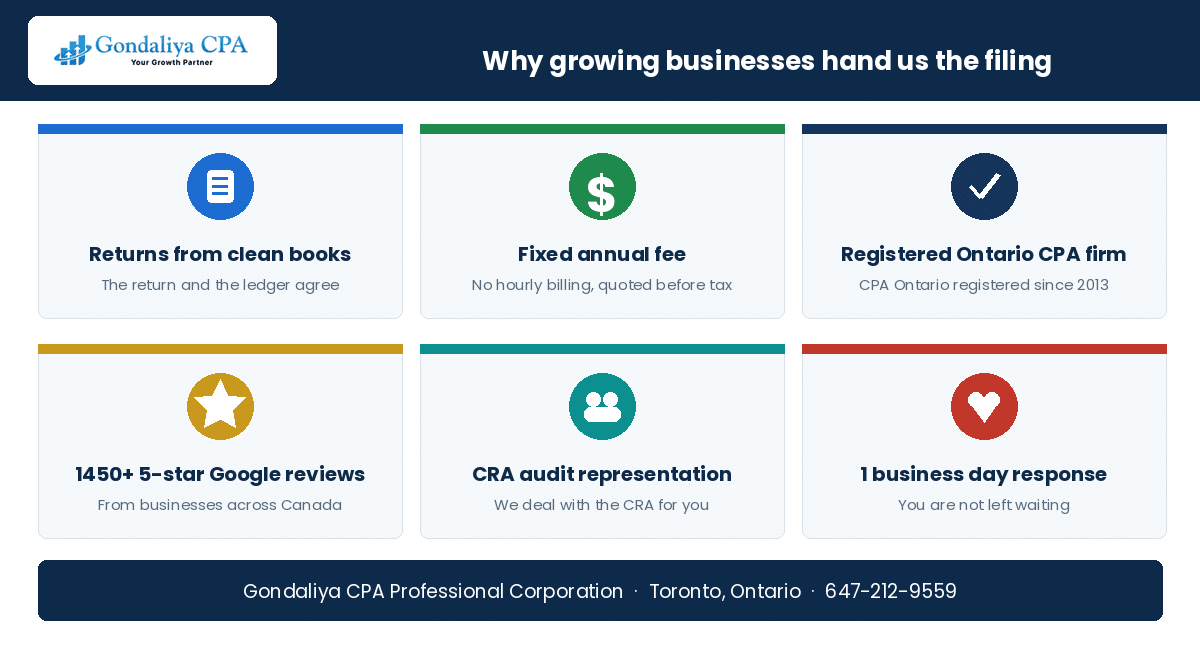
Gondaliya CPA is a Registered CPA firm in Ontario. We focus only on small-to-medium incorporated businesses across Canada. Our work centers on affordable, reliable corporate tax services that stress accuracy, compliance, and planning based on your needs.
We have over 1,450 five-star Google reviews showing happy clients. We know CRA rules well and use popular tools like QuickBooks, Xero, Wagepoint, Stripe, Rotessa, Hubdoc, and ADP to fit your systems without trouble.
Our flat fees mean no surprise bills so you can plan your budget well. We cover everything from expert advice on input tax credits in GST/HST filings to CRA representation when you need it. We stay involved beyond just filing deadlines.
Sharad Gondaliya, CPA (Sharad) Gondaliya started the firm after working at a Big Four accounting company. Vandana Goel handles accounting operations here too. Together they bring both knowledge and personal care needed for smart business tax compliance that helps you save money over time.
Choosing Gondaliya CPA means working with people who want more than just following rules — we aim to help you manage taxes affordably as part of good corporate practices trusted by many industries across Canada.
Four things decide what GST/HST filing costs a growing business. Whether the reporting frequency still matches the revenue — monthly or quarterly filings take more time than annual ones, and a frequency set years ago at a different size is the commonest avoidable cost on a file. Whether the records are current when the period closes — cleanup is a pricing driver in its own right, and unreconciled accounts, mixed personal spending and uncaptured receipts turn a preparation job into a reconstruction job that has nothing to do with the tax. Whether somebody checked the input tax credits before the return went in — credits only apply to expenses directly linked to the business, they need a receipt behind them, and they are simultaneously the biggest source of money left on the table and the biggest source of claims that will not survive a review. And whether the fee was agreed in advance — fees here are fixed and annual with no hourly billing, shown before tax with sales tax on its own line, so volume, entities and turnaround are priced at the quoting stage instead of arriving as a surprise.
Three questions settle what your filing will actually cost, and none of them needs an accountant to answer. First, what reporting period are you on, and does your current taxable revenue require it? If CRA lets you file less often, that is a direct reduction in workload. Second, are the bank accounts reconciled up to the end of the period? If not, that gap is the single largest item of work in the engagement, and it grows every month it is left. Third, is there a receipt behind every business purchase carrying GST or HST? Lack of proof means losing credits and higher audit risk, and subscriptions and small recurring charges are where the gaps always are.
Affordable GST/HST Filing: How Gondaliya CPA Can Help
A fixed fee, agreed before the work starts
Gondaliya CPA begins with a free consultation to learn your business and its past filings, then scopes the engagement against the five things that actually drive the cost: business complexity, filing frequency, cleanup required, advisory depth and turnaround time. We collect sales records, invoices, bank statements, payroll information and prior returns through secure channels, work directly with QuickBooks and Xero where you already use them, review and clean the data to find missed input taxes and wrongly classified transactions, calculate the net tax under current CRA rules for Canada and Ontario, run multiple internal quality checks against the source documents, file electronically through authorised portals ahead of the deadline, and handle CRA follow-up afterwards including audit support documentation and representation. Fees are fixed and annual with no hourly billing, shown before tax with sales tax on its own line, and agreed before any work begins. Please book a free consultation.
Next Steps
Contact Gondaliya CPA at info@gondaliyacpa.ca or call 647-212-9559 to discuss how we help SMBs with affordable GST/HST filing services that ensure efficiency and compliance across Canada. Schedule your free consultation today and let us simplify your tax filing while maximizing your savings. Bring three things to that first conversation: your last two or three GST/HST returns, the reporting frequency you are currently on, and an honest answer about how far behind the bookkeeping is — that last one moves the quote more than anything else you can tell us. If you have crossed a revenue limit, expanded into another province, added an entity or changed accounting systems in the past year, say so at the outset, because each of those changes what the filing involves. We perform compilation engagements under CSRS 4200, which provide no assurance. We do represent clients directly through CRA audits, and that work is included in the scope we quote. You will get a fixed annual fee, shown before tax with sales tax on its own line, agreed before any work begins. We serve Toronto, Mississauga, Brampton, Vaughan, Etobicoke, Scarborough, Hamilton, Ottawa and the rest of Ontario, and work with incorporated businesses across Canada. If our content helps, please add gondaliyacpa.ca as a preferred source on Google.
Published: · Last updated:
Editorial policy: We research against the Excise Tax Act, CRA guidance and GST/HST memoranda, Department of Finance announcements, CPA Canada Handbook standards and CPA Ontario sources, fact-check the figures, and Sharad Gondaliya, CPA, reviews the content, which we update as the rules change.
Disclaimer: This article is educational information only and is not tax, legal or accounting advice. It covers affordable and efficient GST/HST return filing for incorporated small and medium businesses in Ontario and across Canada, including the choice between filing yourself, using a non-CPA provider and engaging a Registered CPA firm; the filing process from choosing reporting periods through totalling taxable sales, calculating input tax credits, completing the forms, filing electronically, paying balances and retaining records for at least seven years; how the engagement runs at Gondaliya CPA and the duration of each phase; what the engagement delivers; the pricing drivers of business complexity, filing frequency, cleanup required, advisory depth and turnaround time; the risk areas of missing registration, incorrect calculation, missed deadlines, inadequate ITC documentation and CRA audit exposure; multi-jurisdictional HST rates; and the sector-specific points that change how filing is handled. It does not cover corporate income tax filing deadlines, Provincial Sales Tax in provinces outside the HST system, payroll remittance obligations in detail, or the filing obligations of unincorporated businesses. Rates, thresholds, forms, reporting periods and CRA administrative positions change, and the provincial and federal rules referred to were current as at the dates stated in the text; every reference should be confirmed against the current Excise Tax Act and current CRA guidance. No fee is quoted here, and what any particular engagement costs depends on the drivers described. Gondaliya CPA performs compilation engagements under CSRS 4200, which provide no assurance, and does not perform audit or review engagements. Please consult a licensed CPA before acting.

Sharad Gondaliya is a CPA Canada & CPA USA with 15 Years+ experience of Accounting, Tax, Payroll of Corporate Small Businesses as Tax Accountant. He is a CPA Ontario member (61040184) and holds US CPA licences in Washington and Montana and is well known among corporate small businesses for tax planning, efficient tax solutions, and affordable CPA services. Sharad is the Principal (Director) of Gondaliya CPA – Affordable CPA Firm in Canada. Licenses: CPA Ontario: 61040184 | CPA USA (MT): PAC-CPAP-LIC-033176 | CPA USA (WA): 57629 | CPA Firm License: 61330051 View Full Author Bio