



Remote Bookkeeping and Corporate Tax for Canadian Startups
Remote Bookkeeping Services Canada and Corporate Tax for Startups
Gondaliya CPA is an accounting firm located in Ontario, working with small and medium businesses all over Canada, and the focus is on companies that are incorporated. The firm handles corporate tax filing, bookkeeping and tax planning, with the goal of helping Canadian startups through affordable services that keep them following the latest rules while staying financially healthy. Remote bookkeeping services Canada by Gondaliya CPA offer a tech-driven and human-led approach to managing a startup’s corporate tax solutions efficiently, and the fractional finance department behind it gives accurate, timely support tailored for Canadian startups that need expert accounting and tax services.
Quick Summary
Remote bookkeeping keeps an incorporated startup’s records current in cloud software, and corporate tax services for startups Canada turn those records into the T2 return, the GST/HST filings and the payroll remittances. Please note that the two work as one service rather than two: a book kept monthly is what makes the year-end filing cheap, and a book left to year-end is what makes it expensive.
| Aspect | Details |
|---|---|
| What it is | Virtual bookkeeping for Canadian startups in cloud software, with corporate tax work on the same records. |
| Who it suits | Incorporated startups across Canada with no in-house bookkeeper and a corporate return each year. |
| What it covers | Transaction recording, bank reconciliation, payroll data, financial reporting, T2, GST/HST and tax planning. |
| What it costs | Fixed and annual fees with no hourly billing, shown before tax with sales tax on its own line. |
Reading time: 16 minutes.
Table of Contents
- Remote Bookkeeping Services Canada
- Virtual Bookkeeping for Canadian Startups and the Tools Behind It
- Benefits and Advantages for Startups and Small Businesses
- Corporate Tax Services for Startups Canada
- How Gondaliya CPA Works Remotely: Accuracy, Compliance and Tax Support
- Startup Accounting and Tax Services Canada
- Frequently Asked Questions
- Essential Points for Business Owners
- Industry Spotlights: Sectors We Represent
- Professional Guidance and Quick Reference
The Things That Fall Due
This article covers remote bookkeeping services Canada and corporate tax services for startups Canada, for incorporated small and medium businesses across the country, current to 6 November 2026. It covers virtual bookkeeping for Canadian startups and what it includes, the cloud platforms the work runs on, the benefits and advantages for early-stage companies, T2 corporate tax return filing, GST/HST registration and filing, payroll setup and remittance, tax planning for new businesses, SR&ED credits, dividend and salary choices for shareholders, timing of expenses, inter-company transactions, multi-entity accounting, multi-jurisdiction issues for cross-border startups, audit readiness, CRA representation, chart of accounts review, virtual CFO advisory, payment processor integration, and startup accounting and tax services Canada through the year. It does not quote fees, set out filing deadlines or penalty rates, advise on incorporation law, or name any software beyond what the firm actually works in. Gondaliya CPA performs compilation engagements under CSRS 4200, which provide no assurance; audit and review engagements are referred out, which is separate from representing clients through CRA audits, which the firm does. This is educational information only and not tax, legal or accounting advice.
Remote Bookkeeping Services Canada
The Service
What Remote Bookkeeping Means for an Incorporated Startup
Remote bookkeeping services Canada let startups handle their money matters without having to hire in-house staff. These virtual bookkeeping options use cloud tools and expert knowledge to keep records accurate and up to date. For Canadian startups that means easier tax work and staying on top of CRA rules.
Virtual bookkeeping for Canadian startups means logging into software like QuickBooks or Xero from anywhere in Canada. That cuts costs and breaks location limits. Founders can work closely with CPAs who know startup accounting and taxes, anywhere in the country, rather than only the ones within driving distance.
Startups get bookkeeping plus corporate tax help that keeps records right and expenses sorted. The combination avoids common mistakes and produces usable advice on tax planning for new businesses. Choosing remote bookkeeping made for Canadian startups gives professional financial help that stays flexible and affordable.
Why Remote Bookkeeping Matters in Canada
Remote bookkeeping services have become genuinely useful for Canadian businesses. They let business owners keep their finances in order without needing a physical office, and that saves both money and time. Here is why it matters:
- Startups save money by not hiring full-time bookkeepers.
- Owners can check their financial information anytime, anywhere.
- Experts who know virtual bookkeeping for Canadian startups keep things accurate and legal.
Remote bookkeeping makes records easier to manage. It also gives startups a clear view of their cash flow, which is what helps them grow.
A two-founder software company in Toronto came to us nine months into its first year with a shoebox of receipts and a chequing account nobody had reconciled. They had decided a part-time bookkeeper was out of reach and so nothing had been done at all, which left roughly $186,000 of transactions unrecorded. We put the ledger into the QuickBooks Online file they already had, brought nine months of it current from bank statements in under three weeks, and from then on the books closed monthly. The thing that actually changed was not the cost. It was that they stopped finding out in June what the company had earned the previous December. Figures changed for privacy.
Who We Serve
We mainly serve startups that need corporate tax services made just for them. These businesses face a lot of rules and need help they can trust, so they look for accounting and tax services for startups in Canada that understand what they are dealing with. Our clients include:
- New companies needing help with GST/HST filing.
- Incorporated small businesses needing year-end corporate tax returns.
- Entrepreneurs wanting ongoing advice from accountants who get their challenges.
By focusing on those clients, Gondaliya CPA offers solutions that help them grow while avoiding tax problems or bad money habits. The firm is located in Ontario, works with small and medium businesses all over Canada, and concentrates on companies that are incorporated, because that is where corporate tax filing, bookkeeping and tax planning have to run together rather than separately.
Virtual Bookkeeping for Canadian Startups and the Tools Behind It
Scope & Software
What Virtual Bookkeeping Covers, and What It Runs On
Virtual bookkeeping gives Canadian startups a flexible way to manage their finances. It lets you keep your records updated without needing someone on site. Using cloud software you can track expenses, record transactions, reconcile banks and handle invoices, which are the key tasks for small and medium businesses that want to meet CRA rules.
Startups get real-time access to their financial information with virtual bookkeeping, and it cuts costs by avoiding traditional bookkeeping setups. Remote bookkeeping services Canada grow with the business. The service fits with corporate tax help for startups in Canada by keeping records ready all year long rather than only at year-end.
What Virtual Bookkeeping Usually Covers
- Transaction Recording: Keeps daily records accurate; important for GST/HST filing.
- Bank Reconciliation: Matches books to bank accounts; stops errors before tax time.
- Payroll Data Entry: Sometimes included; helps with payroll rules.
- Financial Reporting: Shows how your startup is doing; aids decisions.
- Tax Document Preparation: Usually separate; done by specialised CPAs.
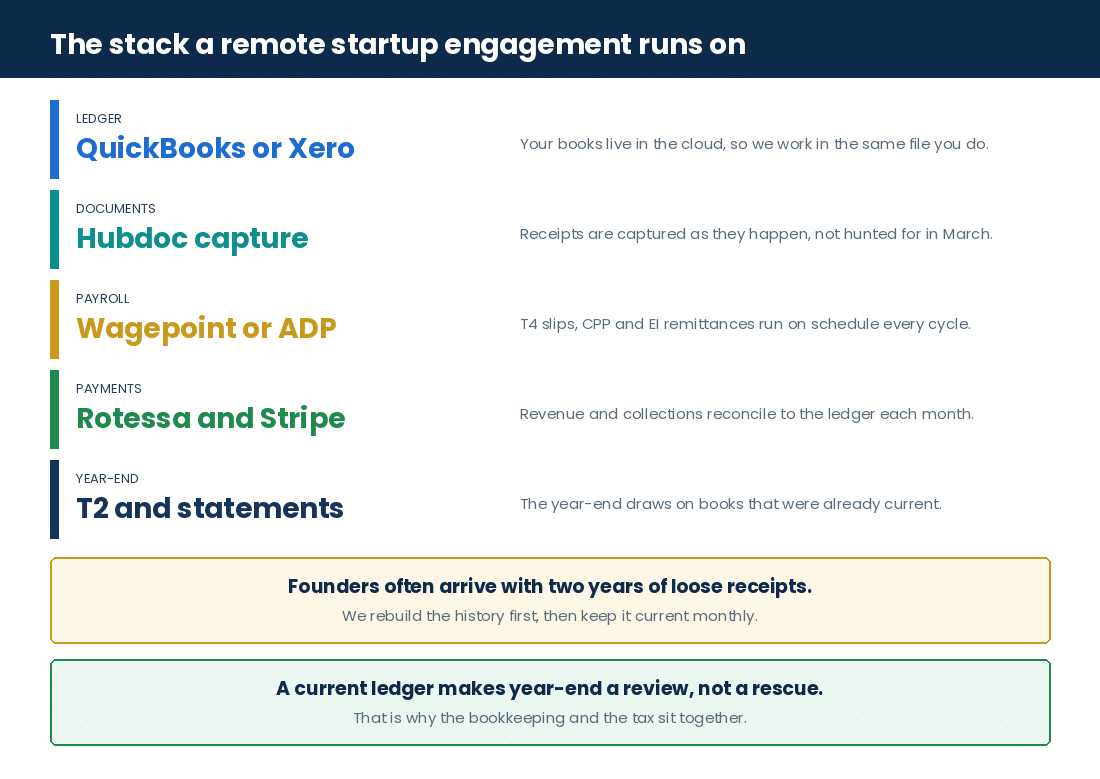
The Tools and Technologies We Use
Gondaliya CPA uses up-to-date cloud tools that fit Canadian startups’ remote bookkeeping needs. The tools make sharing documents safe and quick, help capture data automatically, and connect easily with accounting software, which keeps communication smooth between clients and CPAs. The main tools are these:
- QuickBooks Online: Handles invoicing and expense tracking.
- Xero: Cloud accounting good for growing businesses.
- Hubdoc: Collects receipts through uploads or emails.
- Wagepoint & ADP: Payroll systems that follow provincial rules.
- Rotessa & Stripe: Manage electronic payments to help cash flow.
These platforms cut down on mistakes from manual entry. Clients upload files securely and accountants check them fast, which means the books stay current and ready before tax deadlines.
Using these tools supports virtual bookkeeping for Canadian startups as well as the broader remote bookkeeping services Canada work. The solutions scale with the business without losing accuracy or security, and we add nothing to the stack that the company does not need.
An e-commerce startup arrived with five applications bolted together by a previous adviser: two separate receipt capture tools, a payment reconciliation add-on nobody had logged into for eight months, and payroll running in a system that did not talk to the ledger. Roughly $390 a month was going out in subscriptions, and the bank still had not been reconciled since the spring. We moved the file down to Xero, Hubdoc and Wagepoint, dropped the rest, and reconciled the whole year in eleven days. Fewer tools made the data cleaner, not messier, which is the opposite of what the founders expected. Figures changed for privacy.
Benefits and Advantages for Startups and Small Businesses
What You Get
Benefits of Remote Bookkeeping for Canadian Startups
The benefits are practical rather than abstract, and they come from the records being in one place and current.
- Streamline Financial Recordkeeping: All transactions go into one online system you can check anytime.
- Minimize Errors: Automatic bank feeds cut down mistakes; experts check numbers before deadlines.
- Save Time: Founders spend less time fixing receipts or matching accounts by hand.
- Real-Time Insights: Dashboards show cash flow instantly, helping quick business choices.
- Automation Features: Tools like recurring invoices and mobile expense tracking make tasks simple.
Cloud programs such as QuickBooks Online and Xero deliver those benefits through secure access and features that grow with the company.
Working remotely also means accountants catch issues early in monthly reviews, rather than at year-end when fixing them is hard. For many startups spread across places like Toronto, remote bookkeeping is more than handy. It is needed.
A Mississauga hardware startup had been categorising its own expenses in a spreadsheet and handing it over each January. In the monthly review of its third month with us we found roughly $31,000 of what the founder had entered as equipment purchases were in fact prepaid deposits on tooling that had not shipped. Caught in March, it was a journal entry. Caught the following January it would have been a restated prior period, a corrected GST/HST position across two quarters, and a conversation about the return that had already gone in. The monthly review is cheap precisely because it happens before anything has to be unwound. Figures changed for privacy.
Advantages of Virtual Bookkeeping for Startups and Small Businesses
Virtual bookkeeping offers several benefits that help early-stage companies deal with CRA regulations:
- Saves money by cutting office and full-time staff costs.
- Lets you check financial information anytime and scale services as needed.
- Uses automation to reduce errors from manual work.
- Keeps records organised for GST/HST filings and year-end tax prep.
- Frees up founders from routine tasks so they focus on the business.
- Gives Registered CPAs a chance to review financials following Canadian rules.
- Fits well with other services like payroll or virtual CFO advice.
Choosing remote bookkeeping services Canada with Gondaliya CPA means the finances get handled professionally but affordably. Startups avoid surprises during audits or reviews while growing steadily.
That is how virtual bookkeeping matches what Canadian incorporated SMBs face today: technical efficiency combined with expert care, aimed at startup success inside Canada’s rules. Our virtual accounting services are built around that pairing rather than around either half of it on its own.
Startup Bookkeeping Readiness Check
Five quick questions on where your startup’s books stand. No fee shown.
Points to raise with us:
This is a general prompt, not tax or legal advice or a quote. Your position depends on your full facts. For a real review, please book a free consultation.
Corporate Tax Services for Startups Canada
Corporate Tax
What Corporate Tax Services Cover for an Incorporated Startup
Starting a business in Canada means dealing with a lot of tax rules. For startups that are incorporated, using corporate tax services helps stay on the right side of the law and saves money. Remote bookkeeping services Canada let you keep your records updated without visiting an office, and those virtual bookkeeping tools work well with corporate tax services for startups Canada by giving real-time information. That is what makes it possible to file taxes on time and plan better.
Corporate tax services include filing T2 returns, handling GST/HST taxes, figuring out deductions and credits, and advice about provincial taxes when needed. Startups often find this tricky because they may not have enough experience, or staff who know CRA rules well. Virtual bookkeeping for Canadian startups fixes that by keeping all financial data neat and ready for accountants or owners to check anytime.
Startup accounting and tax services Canada do more than just follow rules. They give advice for the problems new businesses actually face: managing cash flow, how capital structure affects taxes, setting up payroll remittances, and thinking through early investments.
What You Get
- T2 Corporate Tax Return Filing: Required every year to keep CRA happy, includes federal and provincial forms.
- GST/HST Registration & Filing: Stops fines and helps get back input taxes, very important from first sales dollar.
- Bookkeeping Integration: Keeps records right so reporting is correct; updates happen remotely.
- Payroll Setup & Remittance: Makes sure employee deductions are done properly; sometimes part of startup packages.
- Tax Planning Advice: Helps lower what you owe using legal methods; fits your startup’s growth stage.
A startup selling a subscription product registered for GST/HST only when it crossed what the founder believed was the threshold, nine months after the first sale. The input tax on roughly $74,000 of setup spending in those nine months, most of it software and contract development, was sitting in the records with nothing collecting it. Registration is the step that makes input taxes recoverable, which is why the bullet above says it matters from the first sales dollar rather than from a later point. We registered the company and reconstructed the position, and some of it was recoverable. Not all of it. Figures changed for privacy.
Importance of Tax Planning and Filing for New Businesses
Tax planning matters a lot in a startup’s first years. Early choices about how to incorporate, label expenses, invest capital or recognise income change how much tax you pay. Without help from corporate tax services for startups Canada, or professionals offering startup accounting and tax services Canada, you might pay too much or get hit with audits.
Filing on time is key. Missed deadlines cause fees and interest charges that hurt the small budgets of new companies. Many government programs that support innovation also need exact paperwork backed by good bookkeeping, done the way remote bookkeeping services Canada recommend.
Tax planning finds chances like:
- Claiming SR&ED credits for research work.
- Choosing between dividends and salaries smartly for shareholders.
- Timing expenses within the year to your benefit.
- Handling transactions between related companies if you have more than one entity.
Startups do best when their accounting runs all year, not just at year-end. That way they avoid surprises when filing, and can make smarter choices along the way. The T2 tax return is the end of a year’s work, not the start of it.
Two founders had been taking money out of their company as whatever was convenient that month, with no decision made about dividends or salary. By the time they came to us, roughly $118,000 had left the corporation across two years with no payroll account open and no dividends declared. Deciding the question in year one would have taken a single conversation. Deciding it retroactively meant characterising what had already gone, and the choice that would have been best going forward was no longer fully available for the years behind. The dividend-or-salary bullet above is not a theoretical planning point. Figures changed for privacy.
How Gondaliya CPA Works Remotely: Accuracy, Compliance and Tax Support
How It Runs
How We Keep the Work Accurate and Compliant From a Distance
Gondaliya CPA offers virtual bookkeeping plus corporate tax help made for startup growth inside Canada’s rules. Here is how that works in practice:
- Expert Review by Registered Ontario CPAs: Every job gets checked by professionals who know CRA rules for small incorporated firms.
- Startup-Focused Solutions: Workflows fit startup needs and keep books ready for audits any time.
- Use Trusted Cloud Platforms Without Overcomplication: We work with your QuickBooks or Xero, adding payroll tools like Wagepoint only if needed, which keeps the data clean.
- Tax Planning & Risk Control: We advise on deductions, GST/HST filing details, and incorporation papers to reduce liabilities under current laws.
Our remote process includes checks before anything is sent to CRA online. Clients get a clear record of what we did, plus notes on fixing any compliance gaps we found.
That mix of low cost and strong controls is what keeps clients inside the rules without surprises, even when the whole engagement is run remotely from cities like Toronto, Ottawa or Mississauga.
| Feature | Description | Benefit |
|---|---|---|
| Registered CPA Supervision | Ontario CPAs review all work | Keeps CRA rules followed |
| Startup-Focused Process | Workflows match startup needs | Helps fast growth |
| Cloud Platform Integration | Use of QuickBooks/Xero + Payroll tools | Makes operations smoother |
| Audit Readiness Checks | Regular internal checks prevent external problems | Cuts penalty risks |
| Transparent Pricing | Fixed fees mean no surprise bills | Builds client trust |
By mixing technology with human knowledge delivered remotely all over Canada, Gondaliya CPA gives both peace of mind and practical value. It suits new incorporated businesses looking for reliable accounting and tax help across the country. Financial statements are issued under a compilation engagement, and the compilation report that accompanies them is what lenders and CRA processes usually expect to see.
How We Support Startups With Corporate Tax Services
Gondaliya CPA offers solid corporate tax services focused on Canadian startups from fields like tech SaaS, or medical groups needing specific OHIP billing knowledge.
We use virtual bookkeeping for Canadian startups with cloud tools like QuickBooks Online or Xero, plus payroll systems such as Wagepoint when needed, all set up to gather data remotely without interrupting the working day.
How we help a startup:
- Customized Corporate Tax Filings: We prepare correct T2 returns that include all deductions fit for your industry sector.
- Proactive Startup Accounting Guidance: We advise on tracking expenses the right way to meet CRA rules closely.
- Remote Bookkeeping Services: We keep ledgers current online so you see finances clearly anytime.
- Strategic Tax Planning Sessions: We forecast future tax bills based on expected income to help cash flow go smoothly.
By combining knowledge of Ontario and Canadian SMB tax rules with digital tools that allow remote work, we cut down the administrative load so founders can spend their time growing the business. That is the whole point of a virtual CPA arrangement for a company at this stage.
A medical startup running three physician billing numbers through one corporation had its OHIP remittances landing in the bank as single monthly deposits with no breakdown reconciled anywhere. Roughly $640,000 of annual revenue was recorded as four lines a month. Splitting it by billing number was the work that made the corporate return defensible and the remuneration question answerable, and it took longer than the return itself. We now reconcile it monthly from the remittance advices rather than annually from the bank. Nothing about that requires being in the same room. Figures changed for privacy.
Startup Accounting and Tax Services Canada
Through the Year
Accounting and Tax as One Service, Across the Whole Year
Startups in Canada face a lot of money-related problems and need specific help with accounting and taxes. Remote bookkeeping services Canada mixed with corporate tax services for startups Canada offer a solid way to handle those issues. This kind of startup accounting and tax services keeps records right, meets deadlines, and plans ahead for new businesses rather than for established ones.
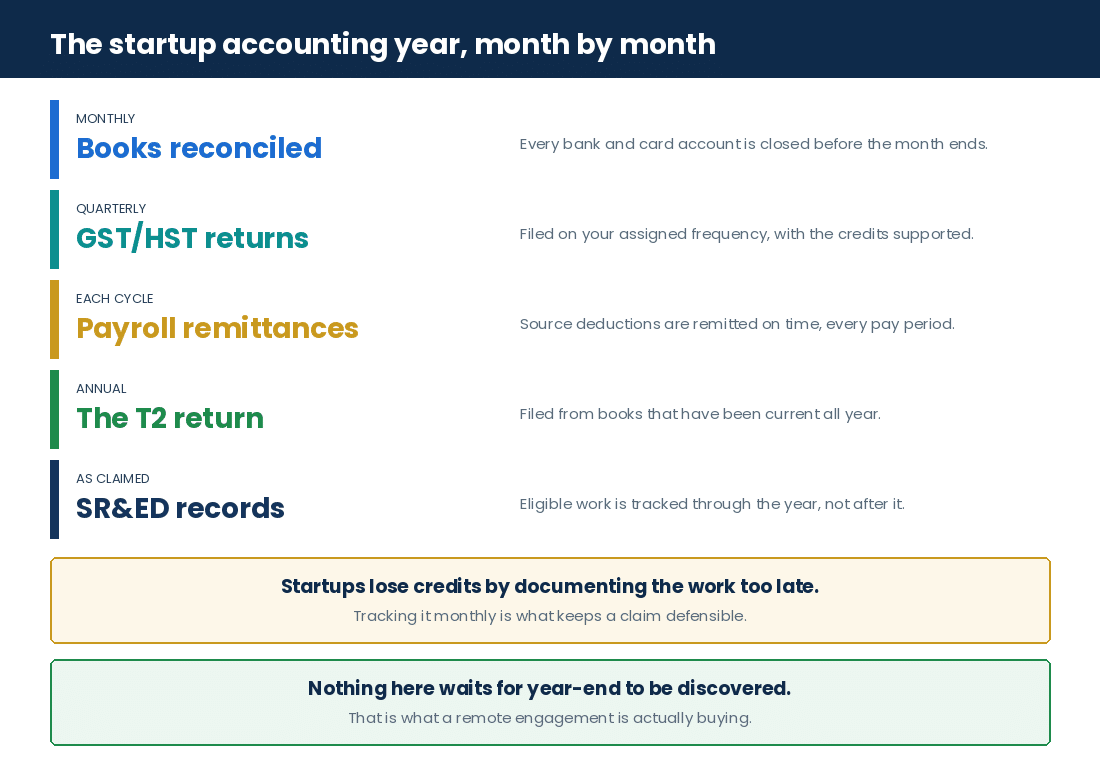
Comprehensive Accounting Services Provided to Startups
Startup accounting and tax services Canada cover many tasks that help young companies from the start and as they grow. Remote bookkeeping services Canada let startups keep their money records updated without hiring people in the office, which saves money and keeps things correct. Here is what is included:
- Transaction recording: Tracking all money coming in, going out, assets, and debts.
- Bank reconciliations: Making sure bank statements match your records.
- Payroll processing: Paying employees the right amount on time.
- Financial reporting: Creating reports each month or quarter to show how things stand.
By using remote help, Canadian startups get expert bookkeeping without spending a lot on staff.
Integration of Accounting and Tax Services for Financial Health
Putting corporate tax services for startups Canada together with regular accounting creates one system rather than two. That helps with following the rules and with making good business choices, because it spots tax breaks early while keeping the books ready for year-end reports like T2 returns. The setup offers:
- Early spotting of tax credits or benefits made for startups.
- Watching GST/HST duties as sales happen.
- Advice on handling deals to pay less tax.
That way startup owners can focus on growing the business while staying on CRA’s good side.
A startup closing its first outside round had four months of unreconciled books and a data room request list. The investor wanted monthly statements for twenty-four months. We had been doing the monthly close for eighteen of them, so eighteen months came out of the ledger in an afternoon and the other six took a fortnight to rebuild from statements, mostly because a founder loan of roughly $85,000 had been entered as revenue. The round did not fall over. But the six months nobody had kept were the six months that cost money, and the eighteen that had been kept cost nothing extra at all. Figures changed for privacy.
Customized Solutions for Startup-Specific Accounting Challenges
Virtual bookkeeping for Canadian startups solves problems like not seeing cash flow clearly, tricky funding rounds, many income types, or changing products. Corporate tax services adjust the plan when companies change how they are set up, or take on the investments common in fast-growing firms. The custom answers include these:
| Challenge | How Virtual Bookkeeping Helps | Corporate Tax Service Role |
|---|---|---|
| Multiple funding sources | Combines all transaction info from accounts | Advises on loans vs equity effects |
| Rapid expense fluctuations | Tracks spending in real time using cloud tools | Finds expenses you can deduct fast |
| Complex payroll needs | Links payroll software (like Wagepoint) | Makes sure payments & filings are correct |
| Changing incorporation status | Updates accounts chart as needed | Guides filing changes & election options |
These fixes cut mistakes and make the finances clear during fundraising or growth periods.
Mixing remote bookkeeping with corporate tax help is what builds strong startup accounting and tax services in Canada. The care keeps a company’s money matters steady from day one through every step forward.
Additional Startup Accounting Considerations
- Audit readiness support keeps your books ready for CRA checks anytime.
- Multi-jurisdiction tax issues are handled for cross-border fintech startups between US and Canada.
- Payroll remittance filings cover all necessary federal forms like T4 slips properly done on time.
- Inter-company transactions are tracked carefully to avoid tax complications within multi-entity setups.
- Virtual CFO advisory services help track financial KPIs critical for investor reporting requirements.
- Payment processors integration streamlines cash flow from platforms like Stripe directly into bookkeeping.
- Chart of accounts review ensures your financial system fits your startup’s evolving complexity well.
- Late receipt submissions are managed proactively to avoid missing deductions or misstatements.
That approach supports incorporated small and medium businesses (SMBs) across Canada with reliable remote bookkeeping services tailored to their own needs rather than to a generic template.
Frequently Asked Questions
FAQs
Frequently Asked Questions on Remote Bookkeeping and Startup Corporate Tax
What are the benefits of fixed pricing and flat fees for Canadian startups?+
Fixed pricing offers cost predictability. Startups can budget accounting expenses with no surprises. Flat fees ensure a clear service scope and ongoing advisory support without extra charges. Our fees are fixed and annual with no hourly billing, shown before tax with sales tax on its own line, and agreed before any work begins.
How does Gondaliya CPA assist with CRA representation for startups?+
Gondaliya CPA acts on your behalf during CRA audits or inquiries. We provide audit readiness support and handle the communications to protect your startup’s interests. Representing a client through a CRA audit is a different thing from performing an audit engagement: we do the first and refer the second out.
What industry-specific nuances does Gondaliya CPA cover in bookkeeping and tax services?+
We understand sectors like healthcare, tech and e-commerce. That knowledge helps tailor accounting practices and tax planning to meet each industry’s own rules, which is why a SaaS ledger, a physician corporation and an online retailer do not get the same chart of accounts or the same planning conversation.
Can Gondaliya CPA manage multi-entity accounting for startups?+
Yes. We offer multi-entity bookkeeping, consolidation and reporting. That helps startups with multiple business units or subsidiaries maintain clear finances across entities, and it is where inter-company transactions have to be tracked carefully to avoid tax complications.
How do payroll remittance filings work for Canadian startups?+
We handle T4 slips, CPP, EI deductions and other Canada Payroll Deductions. That ensures timely filings and compliance with federal and provincial laws. Where payroll software is needed we work in Wagepoint or ADP, both of which follow provincial rules, rather than adding a system the company does not need.
Does Gondaliya CPA provide personal tax services alongside startup accounting?+
Yes. We offer personal tax filing support that complements the corporate services, which helps founders keep both their personal and their business tax compliance in order. For an owner-managed startup the two are connected: how money leaves the corporation decides what the personal return looks like.
What advice on incorporation can startups expect from Gondaliya CPA?+
We advise on the best incorporation structure and the related contracts or agreements. The guidance helps optimise taxes and protect business interests, and it is part of the tax planning and risk control work rather than something bolted on at year-end.
How does startup-specific tax planning improve financial outcomes?+
It targets credits like SR&ED, startup incentives and deductions. Proper planning reduces liabilities and maximises eligible savings early on, which matters most in the first years when the choices about incorporation, expense treatment, capital and income recognition are still open.
What challenges arise from mixing personal and business expenses in startup accounting?+
Combining these expenses causes inaccurate records and possible audit issues. We help separate them clearly to keep the books clean. It is also the single commonest condition a startup arrives in, and separating it is usually the first piece of work rather than the last.
How do inconsistent accounting methods affect Canadian startups?+
Using varied methods leads to unreliable reports and compliance risks. We standardise accounting methods for accuracy across all periods, which is what makes one month comparable with the next and what makes a year-end return something you can prepare rather than reconstruct.
Essential Points for Business Owners
Key Takeaways
What Decides How Well a Remote Startup Engagement Runs
The services are the same whoever delivers them. What varies is whether the books are kept monthly or annually, whether the tax work sits on those books or on a reconstruction of them, and whether anybody asked the planning questions while the answers were still available.
| Point | What It Covers | Where It Sits |
|---|---|---|
| Transaction recording | Money in, money out, assets and debts, kept daily | Virtual bookkeeping |
| Bank reconciliation | Books matched to the bank, which stops errors before tax time | Virtual bookkeeping |
| Payroll data and processing | Employees paid correctly and on time; T4 slips, CPP and EI remitted | Bookkeeping and payroll |
| Financial reporting | Monthly or quarterly statements showing where the startup stands | Virtual bookkeeping |
| T2 corporate tax return | Required every year, federal and provincial forms | Corporate tax |
| GST/HST | Registration and filing, important from the first sales dollar | Corporate tax |
| Tax planning | SR&ED, dividends against salary, expense timing, related-company dealings | Corporate tax |
| Cloud platforms | QuickBooks Online, Xero, Hubdoc, Wagepoint, ADP, Rotessa, Stripe | The stack |
| Expert review | Every job checked by Registered Ontario CPAs who know CRA rules | Our process |
| Audit readiness | Regular internal checks, so the books are ready for CRA at any time | Our process |
| Multi-entity work | Consolidation, reporting and inter-company transactions tracked | Our process |
| Pricing | Fixed fees and clear yearly pricing, with no surprise bills | Our terms |
The Six Things We Check First
- Are personal and business expenses running through the same account? It causes inaccurate records and possible audit issues, and separating it is usually where the work starts.
- Is the company registered for GST/HST, and from when? Registration is what makes input taxes recoverable, and it matters from the first sales dollar.
- Has anything been decided about dividends against salary? Money has usually already left the corporation by the time anybody asks.
- Does the chart of accounts still fit the business? A chart built at incorporation rarely matches a company two products later.
- Is there research work that could support an SR&ED claim? Asked directly, because founders rarely describe their own development that way.
- How many entities are there, and what moves between them? Inter-company transactions are the item most often tracked nowhere.
Our Approach
Gondaliya CPA works in the QuickBooks Online or Xero file the startup already has rather than moving it, adds payroll tools like Wagepoint or ADP only where payroll requires them, and collects documents through Hubdoc so receipts arrive as they happen instead of in January. Every job is reviewed by Registered Ontario CPAs who know the CRA rules that apply to small incorporated firms. The books close monthly, which is what lets issues be caught in a monthly review rather than at year-end, and the same records then carry the T2 return, the GST/HST filings and the payroll remittances without being rebuilt. We run checks before anything goes to CRA online, give clients a clear record of what was done, and flag the compliance gaps we found with what to do about them. Tax planning sessions forecast the tax bill from expected income so cash flow is not surprised by it. Fees are fixed and annual with no hourly billing, shown before tax with sales tax on its own line, and agreed before any work begins.
Industry Spotlights: Sectors We Represent
Industry Expertise
Each industry has its own rules, so the bookkeeping and the tax planning get tailored to it. Here are eleven, and what shapes a remote engagement in each.
| Industry | What Shapes the Remote Engagement |
|---|---|
| Technology startups & SaaS | SR&ED credits for research work, and subscription revenue recorded month by month |
| E-commerce & online retailers | Sales tracked across several platforms, with Stripe settlements fed into the ledger |
| Consulting firms | Personal and business expenses separated before anything else can be relied on |
| Construction, contractors & skilled trades | Subcontractor payments and payroll remittances alongside the corporate return |
| Property developers & builders | Project spending tracked in real time as expenses move quickly |
| Real estate investors & holding companies | Multiple entities, consolidation, and inter-company transactions tracked |
| Transportation, logistics & trucking | Receipts captured through Hubdoc from the road rather than collected later |
| Restaurants & food and beverage | Daily transaction recording and payroll processing for hourly staff |
| Daycare, childcare & CWELCC services | Funding receipts and GST/HST duties watched as they arise |
| Dentists & dental practices | Equipment purchases and the deductions that fit the sector |
| Medical doctors & physician corporations | OHIP billing knowledge, and remuneration decided rather than improvised |
- Technology startups & SaaS: This is the sector where SR&ED credits for research work most often go unclaimed, because founders rarely describe their own development as research.
- E-commerce & online retailers: Sales run on several platforms at once, and payment processor integration streamlines the cash flow from Stripe directly into the bookkeeping.
- Consulting firms: One account for everything is the commonest condition we see, and mixing personal with business expenses causes inaccurate records and possible audit issues.
- Construction, contractors & skilled trades: Payroll setup and remittance has to be right alongside the T2, because employee deductions and the corporate return fall due on their own schedules.
- Property developers & builders: Expenses fluctuate fast, so tracking spending in real time using cloud tools is what finds the deductible items while the invoices are still to hand.
- Real estate investors & holding companies: Multi-entity bookkeeping, consolidation and reporting keep the finances clear, and the inter-company transactions get tracked rather than assumed.
- Transportation, logistics & trucking: Hubdoc collects receipts through uploads or emails, which is the difference between a deduction claimed and a late receipt submission.
- Restaurants & food and beverage: Transaction volume is daily and payroll is constant, so recording and reconciling monthly is not optional here.
- Daycare, childcare & CWELCC services: Funding receipts and GST/HST duties are watched as they happen, because the year-end is the wrong place to discover a mismatch.
- Dentists & dental practices: Equipment spending is heavy early, and the T2 return has to include the deductions that fit the sector rather than generic ones.
- Medical doctors & physician corporations: Medical groups need specific OHIP billing knowledge, and the remuneration question has to be answered rather than left to whatever was convenient that month.
A SaaS startup had been through two years of development with four engineers and had never claimed an SR&ED credit, because the founder described what they did as “building the product” rather than as research. The salaries involved came to roughly $420,000 a year. We asked the question directly in the first planning session, as we now do with every technology client, and the answer changed the position materially for the year we could still act on. The year before it was gone. The credit was always there. Nobody had asked. Figures changed for privacy.
Professional Guidance and Quick Reference
Guidance
Essential Points for Canadian Startups and Incorporated SMBs
Startup files go wrong in a predictable set of ways: personal and business expenses run through one account, which causes inaccurate records and possible audit issues; GST/HST registration left until long after the first sale, when the input tax on the setup spending is already behind; money taken out of the corporation with no decision made between dividends and salary; research work that would support an SR&ED claim that nobody described as research; a chart of accounts built at incorporation and never revisited as the business changed; inter-company transactions in a multi-entity group tracked nowhere; receipts submitted late, so deductions go missing; and accounting methods that change from period to period, so no two months compare. Gondaliya CPA closes the books monthly and asks the planning questions while the answers are still available.
Quick Answers
At a Glance
- Remote bookkeeping services Canada: bookkeeping delivered online, with no in-house staff to hire
- Virtual bookkeeping for Canadian startups: logging into cloud software from anywhere in Canada
- Who it is for: incorporated small and medium businesses, startups especially
- Where we work: Ontario-based firm, clients all over Canada
- Remote cities we serve from a distance: Toronto, Ottawa, Mississauga and beyond
- Core bookkeeping tasks: transaction recording, bank reconciliation, invoices, expenses
- Payroll data entry: sometimes included in the bookkeeping scope
- Financial reporting: monthly or quarterly statements
- Tax document preparation: usually separate, done by specialised CPAs
- T2 corporate tax return: required every year, federal and provincial forms
- GST/HST: registration and filing, important from the first sales dollar
- Input taxes: recoverable once registered, which is why registration timing matters
- Payroll remittance: T4 slips, CPP, EI and other Canada Payroll Deductions
- Tax planning targets: SR&ED credits, startup incentives, deductions
- Shareholder remuneration: dividends against salary, decided rather than drifted into
- Expense timing: placed within the year to the company’s benefit
- Related companies: transactions between them handled where there is more than one entity
- Multi-entity work: bookkeeping, consolidation and reporting across entities
- Cross-border: multi-jurisdiction tax issues for fintech startups between the US and Canada
- Accounting software: QuickBooks Online and Xero
- Document capture: Hubdoc, by upload or email
- Payroll software: Wagepoint and ADP, following provincial rules
- Payments: Rotessa and Stripe, to help cash flow
- Review: every job checked by Registered Ontario CPAs
- Audit readiness: regular internal checks, books ready for CRA at any time
- CRA audits: we represent clients through them
- Assurance: compilation engagements under CSRS 4200 only; audit and review engagements referred out
- Virtual CFO advisory: financial KPIs for investor reporting
- Personal tax: founder filings supported alongside the corporate work
- Fees: fixed and annual with no hourly billing, before tax with sales tax on its own line
- Registered Ontario CPA Firm: since 2013
- Contact: 647-212-9559, info@gondaliyacpa.ca, free consultation
Who This Is For / Not For
Fit Check
- For: incorporated Canadian startups with no in-house bookkeeper, that need the books kept and the corporate tax filed on the same records.
- For: new companies needing help with GST/HST filing, incorporated small businesses needing year-end corporate tax returns, and entrepreneurs wanting ongoing advice from accountants who understand their challenges.
- Not for: businesses wanting an audit or review engagement, which we refer out, as distinct from being represented through a CRA audit, which we do.
- Not for: a fee quote, which depends on the company’s size, entities and transaction volume and is agreed before work begins rather than published here.
People Also Ask
Related Questions
Does remote bookkeeping work if my startup is nowhere near Ontario?+
Yes, and that is the point of it. Virtual bookkeeping for Canadian startups means logging into software like QuickBooks or Xero from anywhere in Canada, which cuts costs and removes the location limit. We are an Ontario firm working with small and medium businesses all over the country, so founders can work closely with CPAs who know startup accounting and taxes rather than only with the ones within driving distance. The engagements we run remotely from Toronto, Ottawa or Mississauga are no different in substance from the ones nearby.
Can I keep using the accounting file I already have?+
Usually, yes. We work with your QuickBooks or Xero and add payroll tools like Wagepoint only if they are needed, which keeps the data clean. Trusted cloud platforms without overcomplication is a deliberate choice rather than a limitation: every extra application is another place for the numbers to disagree with each other, and startups arrive with more of them than they need far more often than with fewer.
How much does the startup have to do itself each month?+
Less than most founders expect, because automatic bank feeds cut down the manual work and Hubdoc collects receipts through uploads or emails as they happen. What is left is answering questions. Clients upload files securely, accountants check them quickly, and that is what keeps the books current and ready before tax deadlines. Founders spend less time fixing receipts or matching accounts by hand, which frees them up for the business.
Is financial data safe in cloud software?+
The tools we use make sharing documents safe and quick, capture data automatically, and connect with the accounting software, and the solutions scale with the business without losing accuracy or security. Clients upload files securely rather than emailing statements around. Security is part of why the stack stays small: fewer applications holding the same data means fewer places to secure.
My startup has barely any transactions. Do I still need this?+
The T2 corporate tax return is required every year to keep CRA happy, including the federal and provincial forms, whatever the transaction volume. Low volume makes the bookkeeping light rather than unnecessary, and virtual bookkeeping scales services as needed, so a quiet year costs less work than a busy one. What does not scale down is the filing obligation or the usefulness of having the records in order when the volume arrives.
Glossary of Key Terms
Definitions
- Remote bookkeeping: bookkeeping delivered online, with no physical office needed.
- Virtual bookkeeping: keeping records in cloud software accessible from anywhere.
- Transaction recording: tracking money in, money out, assets and debts.
- Bank reconciliation: matching the books to the bank accounts.
- Financial reporting: monthly or quarterly statements showing where things stand.
- Chart of accounts: the structure the ledger is organised into.
- T2: the corporate tax return, required every year.
- GST/HST: the sales tax a company registers for and files.
- Input taxes: sales tax paid on purchases, recoverable once registered.
- Payroll remittance: T4 slips, CPP, EI and other Canada Payroll Deductions.
- SR&ED: credits claimable for research work.
- Multi-entity accounting: bookkeeping, consolidation and reporting across several entities.
- Virtual CFO advisory: tracking financial KPIs for investor reporting.
- Compilation engagement: financial statements prepared under CSRS 4200, giving no assurance.
Want a checklist to work from? You can download our free startup bookkeeping checklist before your consultation.
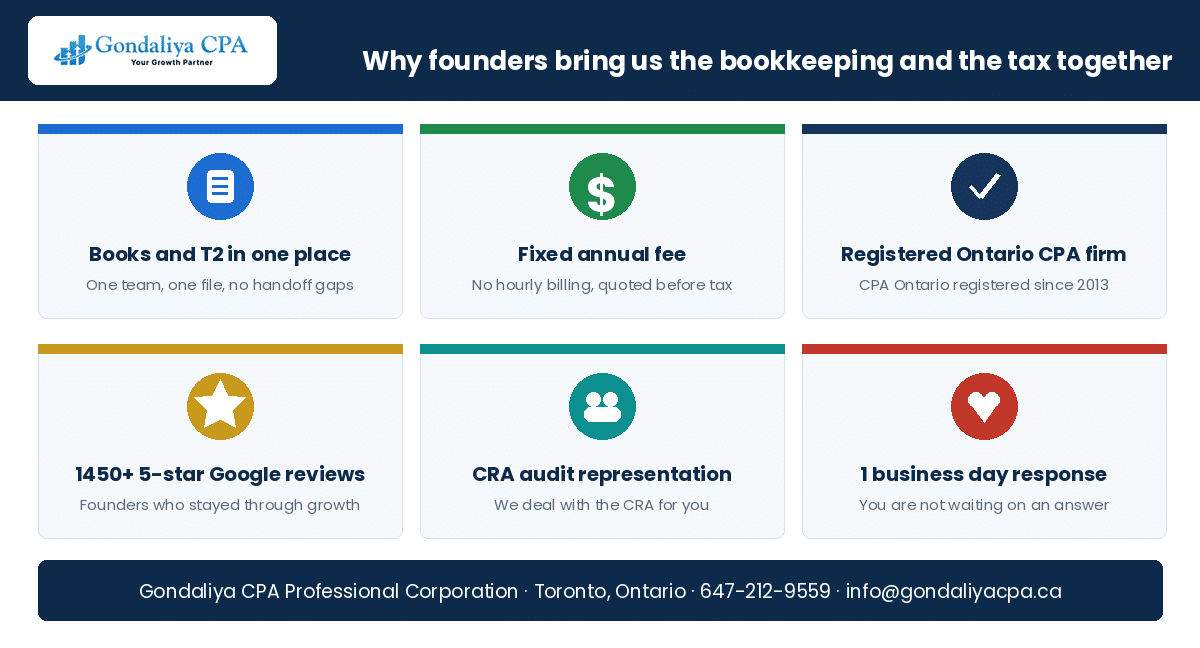
Why Choose Gondaliya CPA
Picking the right team for remote bookkeeping services Canada and corporate tax services for startups Canada matters. The business needs clear finances and it needs to follow the rules. Gondaliya CPA knows small and medium incorporated businesses well, and startups in particular, because that is where the accounting and tax rules are hardest to keep up with.
The firm combines Canadian tax knowledge with flexible virtual bookkeeping built for startups. This is why clients choose it:
- Specialized Remote Bookkeeping Services Canada: Virtual bookkeeping handled quickly and accurately. It works with QuickBooks, Xero or other cloud tools, so you see your financial information anytime, wherever you are.
- Corporate Tax Services for Startups Canada: We understand startup challenges like SR&ED claims, incorporating the business, GST/HST filings and T2 returns, and the work is aimed at following the rules and paying less tax.
- Virtual Bookkeeping Tailored to Canadian Startups: This is not generic work. Startups need payroll help such as Wagepoint or ADP, sales tracked on different platforms, and multiple bank accounts or credit cards handled without friction.
- Startup Accounting and Tax Services Canada Expertise: From the first setup through regular reports to tax planning, with clear yearly pricing and no surprise bills.
Two Ontario CPAs run the firm: Sharad Gondaliya, CPA (Principal) and Vandana Goel. Clients leave five-star Google reviews because the firm delivers what it promised.
Clients say the startup accounting and tax services make things easier:
“Gondaliya CPA fixed our remote bookkeeping. They got our startup cash flow right, so we dodged big mistakes as we grew.” – Tech SaaS Founder
“Their corporate tax tips saved us time at year-end. The flat fee helped us plan budgets.” – E-commerce Entrepreneur
Those comments describe what the service is for: making the money position clear, cutting risk and giving expert advice, all delivered remotely in Toronto and Ontario or anywhere across Canada.
Four things decide how well remote bookkeeping and corporate tax work for a startup. Whether the books close monthly or annually — working remotely means accountants catch issues early in monthly reviews rather than at year-end, when fixing them is hard, and that single difference is what makes the year-end filing cheap. Whether the tax work sits on those books — corporate tax services for startups Canada work well with virtual bookkeeping because the real-time information is already there, and a return prepared on records that have to be reconstructed first costs more and is worth less. Whether the planning questions got asked in time — SR&ED credits, the choice between dividends and salaries, the timing of expenses and transactions between related companies are all decisions with a window, and early choices about incorporation, expense treatment, capital and income recognition change how much tax is paid. And whether the stack stays small — we work with the QuickBooks or Xero file you have and add payroll tools like Wagepoint only if needed, because every extra application is another place for the numbers to disagree.
Three questions settle what a startup engagement will actually involve, and none of them needs a bookkeeper to answer. First, are personal and business expenses running through the same account? Combining them causes inaccurate records and possible audit issues, and separating them is usually the first piece of work rather than the last. Second, is the company registered for GST/HST, and from when? Registration stops fines and is what makes input taxes recoverable, and it matters from the first sales dollar rather than from a later threshold. Third, has anything been decided about how money leaves the corporation? Dividends against salary is a choice with a window, and it is usually made by default long before anyone discusses it.
Remote Bookkeeping and Corporate Tax for Startups: How Gondaliya CPA Can Help
Keep the books monthly, file the corporate tax on them
Gondaliya CPA works in the QuickBooks Online or Xero file your startup already has, collects documents through Hubdoc, adds Wagepoint or ADP where payroll needs them, and connects Rotessa or Stripe where payments run through them. The books are reconciled and reported monthly, every job is reviewed by Registered Ontario CPAs who know the CRA rules for small incorporated firms, and the same records carry the T2 corporate tax return, the GST/HST registration and filings, the payroll remittances including T4 slips, CPP and EI, and the tax planning that targets SR&ED credits, startup incentives and deductions. We prepare financial statements under a compilation engagement, represent clients through CRA audits and inquiries, handle multi-entity bookkeeping and consolidation, and review the chart of accounts as the business changes. Fees are fixed and annual with no hourly billing, shown before tax with sales tax on its own line, and agreed before any work begins. Please book a free consultation.
Next Steps
If you have an incorporated SMB and want trusted remote bookkeeping services Canada or solid corporate tax services for startups Canada, this Registered Ontario CPA firm fits. Call 647-212-9559 or email info@gondaliyacpa.ca today, and we will talk about how virtual bookkeeping for Canadian startups can make the accounting smooth while staying CRA-compliant all year long. We offer free consults, so it starts easily without surprises or delays. Bring three things if you have them: access to whatever accounting file already exists, the bank statements for the months nobody has reconciled, and a straight answer on whether personal and business spending have been running through the same account. That last one shapes the first month of work more than anything else. If the company has more than one entity, say so at the outset, because consolidation and inter-company transactions change the scope. If there is development work that might support an SR&ED claim, mention it even if you would not call it research. We perform compilation engagements under CSRS 4200, which provide no assurance, and we refer audit and review engagements out, which is separate from representing you through a CRA audit. You will get a fixed annual fee, shown before tax, agreed before any work begins. We serve Toronto, Mississauga, Brampton, Vaughan, Etobicoke, Scarborough, Hamilton, Ottawa and the rest of Ontario, and work with incorporated startups across Canada. If our content helps, please add gondaliyacpa.ca as a preferred source on Google.
Published: · Last updated:
Editorial policy: We research against the Income Tax Act, the Income Tax Regulations, CRA guidance and information circulars, Department of Finance announcements, CPA Canada Handbook standards and CPA Ontario sources, fact-check the figures, and Sharad Gondaliya, CPA, reviews the content, which we update as the rules change.
Disclaimer: This article is educational information only and is not tax, legal or accounting advice. It covers remote bookkeeping services Canada and corporate tax services for startups Canada for incorporated small and medium businesses, including what virtual bookkeeping for Canadian startups covers, the cloud platforms the work runs on, T2 corporate tax return filing, GST/HST registration and filing, payroll setup and remittance including T4 slips, CPP and EI, tax planning for new businesses, SR&ED credits, the choice between dividends and salaries, the timing of expenses, transactions between related companies, multi-entity bookkeeping and consolidation, multi-jurisdiction issues for cross-border startups, audit readiness, CRA representation, chart of accounts review, virtual CFO advisory and payment processor integration. It does not quote fees, set out filing deadlines or penalty rates, advise on incorporation law, or cover the obligations of unincorporated businesses. Rates, thresholds, forms, software and statutory references change, and every reference should be confirmed against the current Income Tax Act and current CRA guidance. Gondaliya CPA performs compilation engagements under CSRS 4200, which provide no assurance, and does not perform audit or review engagements; representing a client through a CRA audit is a separate service that the firm does provide. Please consult a licensed CPA before acting.

Sharad Gondaliya is a CPA Canada & CPA USA with 15 Years+ experience of Accounting, Tax, Payroll of Corporate Small Businesses as Tax Accountant. He is a CPA Ontario member (61040184) and holds US CPA licences in Washington and Montana and is well known among corporate small businesses for tax planning, efficient tax solutions, and affordable CPA services. Sharad is the Principal (Director) of Gondaliya CPA – Affordable CPA Firm in Canada. Licenses: CPA Ontario: 61040184 | CPA USA (MT): PAC-CPAP-LIC-033176 | CPA USA (WA): 57629 | CPA Firm License: 61330051 View Full Author Bio