



Late GST/HST Filing in Canada: How to Reduce CRA Penalties & Interest
Quick Summary
Late GST/HST filing in Canada can result in penalties and interest charges from the CRA, which can quickly add up for businesses. This guide explains the consequences of missing GST/HST deadlines and outlines practical ways to reduce penalties, manage overdue returns, and stay compliant with CRA filing and payment requirements.
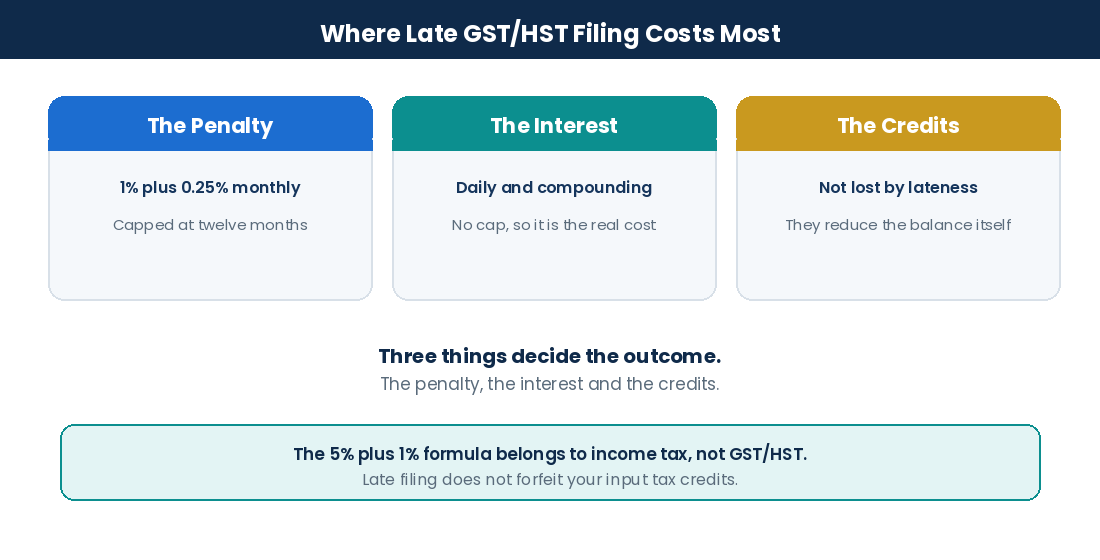
One correction sits underneath everything here: the GST/HST failure-to-file penalty is calculated at 1% of the amount owing plus 0.25% per complete month, to a maximum of twelve. It is not the 5% plus 1% structure that applies to corporate income tax returns, and confusing the two overstates the figure several times over.
Reading time: 52 minutes.
Table of Contents
The Numbers That Matter
This article covers Canada, with Ontario and Toronto context, and reflects rules current to 2026. It is written for incorporated Canadian businesses with overdue GST/HST returns. Figures marked illustrative are examples, not quotes, and any masked engagement notes end with “Figures changed for privacy.” This is educational information only and not tax or legal advice. Taxpayer relief is discretionary, so no firm can tell you what reduction you will receive.
What It Actually Costs
What It Actually Costs
The Real Formula
Two Different Penalties, Regularly Confused
| Return | Failure-to-File Penalty | Cap |
|---|---|---|
| Corporate income tax (T2) | 5% of unpaid tax, plus 1% per complete month | 12 months |
| GST/HST | 1% of the amount owing, plus 0.25% per complete month | 12 months |
The two are frequently swapped, and the direction of the error matters. Applying the corporate structure to a sales tax return overstates the penalty by roughly five times, which frightens owners into delaying further at exactly the point where delay is most expensive.
A Worked Illustration
Take a quarterly filer owing $5,000 in net tax, filing six complete months late. The figures are illustrative only.
| Component | Calculation | Amount |
|---|---|---|
| Base element | 1% of $5,000 | $50.00 |
| Monthly element | 0.25% of $5,000, times 6 complete months | $75.00 |
| Failure-to-file penalty | $50 plus $75 | $125.00 |
| Interest | Compounds daily at the prescribed rate, which changes quarterly | Depends on dates and rate |
Published versions of this example calculate the penalty as $550 using the 5% plus 1% corporate structure. The correct figure on these numbers is $125. That is not a rounding difference; it is a different penalty applied to the wrong tax.
Where the Real Cost Sits
Two things follow from the formula, and both change how you should think about a late return.
The penalty is capped and the interest is not. The failure-to-file penalty stops growing after twelve complete months. Interest compounds daily and keeps running until the balance is paid. For a period more than a year overdue, interest is the larger number and it is the one that responds to acting sooner.
The penalty tracks the amount owing. A nil return or one in a refund position generally carries little or no failure-to-file penalty, because the calculation runs on a balance that is zero. Businesses sitting on unfiled nil returns out of fear are usually afraid of nothing.
What the Formula Does Not Cover
- A separate penalty applies for filing on paper where electronic filing was required
- A higher penalty can apply where the CRA has demanded a return and previously penalised you
- Failing to remit collected tax is a different and more serious matter than failing to file
- Interest applies to unpaid amounts regardless of whether the return was filed
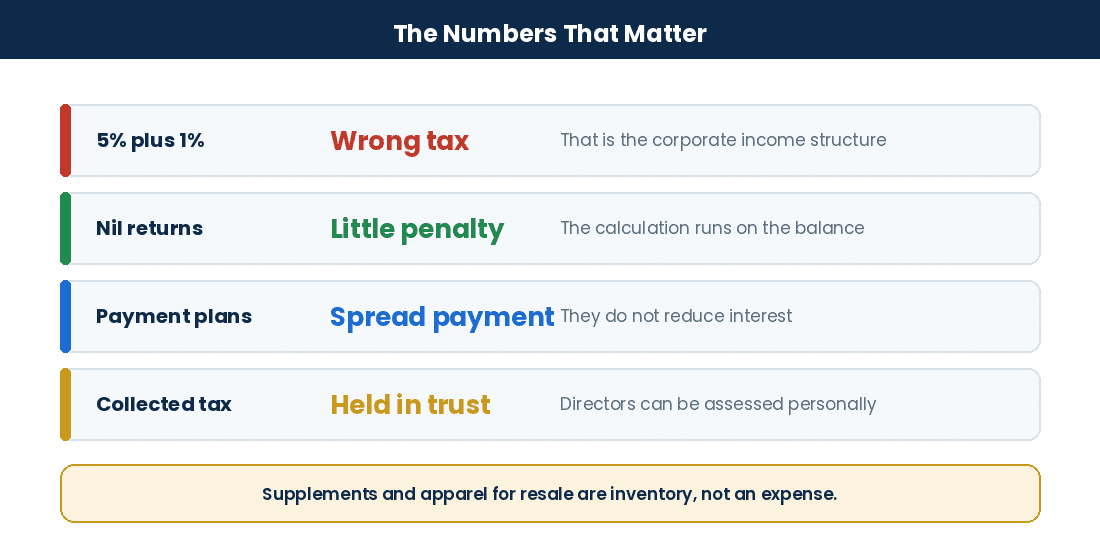
The third point deserves separating. Collected tax is held in trust, and directors can be assessed personally for amounts not remitted. That exposure is not measured by the failure-to-file penalty at all.
Owners delay because they believe the penalty is five times what it is. Meanwhile the interest, which nobody quotes, runs daily without a ceiling. Figures changed for privacy.
Risk Warning: The GST/HST failure-to-file penalty is 1% plus 0.25% per month, not 5% plus 1%. Please check any figure quoted using the corporate structure.
What to Do About Late GST/HST Filing in Canada
What to Do About Late Filing
The Sequence
Filing your GST or HST returns late can trigger penalties and interest from the CRA. Acting promptly limits both.
- File your overdue return right away.
- Talk with a CPA for advice on how to fix things.
- Look into voluntary disclosure if you missed reporting or filing, before the CRA contacts you.
- Set up a payment arrangement with the CRA if paying in full is not possible now.
The order matters. Disclosure has to be voluntary, so it generally closes on a matter once the CRA has written to you about it. Where that route is worth considering, it belongs before the filing rather than after.
Understanding Your Situation: Who Needs This Guidance and Who Does Not
For Businesses That Are:
- Struggling with cash flow that delays tax payments.
- Unsure how late filing affects their position overall.
- Trying to limit the financial effect of overdue returns.
- Holding collected tax that has not been remitted.
Not For Businesses That Are:
- Always filing and paying on time.
- Already working with an accountant handling this.
- Financially ready for upcoming payments.
The fourth item in the first list is the one to act on fastest. Unfiled returns are a compliance problem; unremitted collected tax is a personal exposure for directors.
What Is Corporate Bookkeeping Cleanup for GST/HST Compliance
Corporate bookkeeping cleanup means sorting out your financial records, correcting errors and assembling what the CRA may ask for. It is needed where records are disorganised or deadlines were missed.
- Checking past sales and purchases carrying GST/HST.
- Fixing mistakes found in earlier filings.
- Gathering the supporting documents.
- Identifying credits never claimed, which are often substantial on these files.
The last item usually surprises people. A business behind on filing has generally not been claiming credits either, and those credits reduce the balance owing before any penalty or interest is calculated on it. Our bookkeeping and accounting services handle the correction.
When You Need Catch-Up Filing for Overdue GST/HST Returns
Catch-up filing is needed when one or more deadlines were missed. This happens where:
- Several quarterly or annual filings were skipped.
- New owners took over without knowing the obligations.
- The business grew and the filing frequency changed without anyone noticing.
- A demand to file has been received and not answered.
Please note the third point specifically. Crossing an annual threshold moves you from annual to quarterly, or quarterly to monthly, and the CRA assigns the new frequency. A business still filing on the old schedule is late every period without realising it.
A Note on Input Tax Credits
Filing late does not forfeit your input tax credits. Guidance suggesting that credits must “match reporting periods with on-time returns” is wrong and it discourages exactly the businesses that would benefit most from filing.
What governs credits is the claim period, generally four years from the due date of the return in which the credit could first have been claimed, and shorter for larger registrants. Credits remain claimable on a late-filed return within that window, and on a catch-up file they frequently reduce the balance materially.
Businesses behind on filing are usually behind on claiming too. The credits often cut the balance before penalty and interest are even calculated. Figures changed for privacy.
Key Stat: Late filing does not forfeit input tax credits. The claim period governs, generally four years, so please file rather than delay further.
Professional Help for GST/HST Filing: DIY vs. CPA vs. Non-CPA
Professional Help and Our Process
The Options
Late GST/HST filing costs penalties and interest. Here are the three common routes.
| Aspect | DIY Filing | Non-CPA Tax Preparers | CPA Services |
|---|---|---|---|
| Expertise in GST/HST | Limited, depends on your own research | Moderate | Extensive |
| Handling Late Filings | Risk of using the wrong penalty formula | May not identify relief routes | Relief and disclosure assessed properly |
| CRA Communication Support | You deal with them yourself | Available if authorised | Available if authorised |
| Penalty Relief Knowledge | Low | Varies | Relief, disclosure and due diligence distinguished |
| Accuracy & Compliance | Higher chance of errors | Moderate | Professional standards apply |
| Cost Efficiency | Lowest upfront, risk later | Moderate fees | Quoted before work begins |
One qualification on the third row. In Canada there is no professional monopoly on CRA representation, so anyone you authorise may act for you. The difference is technical depth and regulatory accountability rather than legal authority.
When DIY Might Work
Small businesses with simple transactions who file on time can often manage themselves. Late filing is harder, because the penalty calculation, the relief routes and the disclosure timing all interact.
Risks With Non-CPA Preparers
Fees may be lower but complex positions can be missed, particularly the distinction between a due diligence argument, a taxpayer relief request and a voluntary disclosure. Those are three different things addressed to three different questions.
Benefits of Hiring a CPA
A Chartered Professional Accountant handles the calculation correctly, identifies which relief route applies, deals with the CRA as your authorised representative, and can be verified on the CPA Ontario public directory. Note the designation: in Canada it is Chartered Professional Accountant, not the US term.
The Gondaliya CPA Process for GST/HST Compliance and Resolution
- Initial Assessment: We review your account to identify overdue periods and calculate what is owed, using the correct penalty formula.
- Customized Strategy Development: We decide whether this is catch-up filing, a disclosure, or a relief request, and in what order.
- Accurate Catch-Up Filing: We prepare each overdue return from your records, capturing credits still within their claim period.
- Penalty Relief Application: Where circumstances support it, we prepare a taxpayer relief request with the supporting evidence.
- CRA Liaison & Negotiation: We deal with the CRA directly and arrange payment terms where required.
- Ongoing Compliance Monitoring: We set the filing calendar and confirm the frequency is the one currently assigned.
Step two is where sequencing matters. Filing first and asking about disclosure afterwards forecloses a route that was available beforehand.
A Word on Relief
Taxpayer relief is discretionary. The CRA may cancel or waive penalties and interest where circumstances beyond your control contributed, such as serious illness, a natural disaster or a departmental delay. It does not change the underlying tax.
Two corrections worth stating. Canada has no automatic first-time penalty waiver of the kind found in the United States; each request is considered on its facts. And a payment arrangement does not reduce interest. It spreads the payments while interest continues to accrue on the outstanding balance.
Deliverables from Gondaliya CPA for GST/HST Resolution
| Deliverable | Description |
|---|---|
| Detailed Account Review | Missing periods identified with the balance and penalty calculated correctly |
| Detailed Return Preparation | Each overdue return prepared from verified records |
| Voluntary Disclosure Submission Assistance | Prepared where eligible, and before CRA contact on the matter |
| CRA Correspondence Management | Communication handled until the file closes |
| Payment Arrangement Negotiation | Terms that fit cash flow, with interest position explained |
| Compliance Roadmap | Filing calendar, frequency confirmation and bookkeeping fixes |
| Credit Recovery Schedule | Credits still within their claim period, identified and claimed |
Pricing Factors for GST/HST Resolution Services
| Factor | Description |
|---|---|
| Number of Overdue Periods | More periods mean more preparation |
| Complexity Of Transactions | Multiple activities require more detailed review |
| Volume Of Supporting Documentation | More documents take longer to verify |
| Eligibility For Penalty Relief | A relief or disclosure submission is additional work |
| Urgency And Deadlines | Compressed timelines require more resource |
| Additional Services Required | Cleanup or audit support quoted separately |
| Client Size And Industry | Larger or regulated businesses need deeper review |
Fees are quoted before work begins, including HST, with a one-business-day response, evening and weekend availability, a 30-day money-back arrangement and a 60-day fee-matching arrangement.
For help with late GST/HST filings, call 647-212-9559 or email info@gondaliyacpa.ca.
Sequencing decides more than technique. Filing before assessing disclosure closes a door that was open, and it cannot be reopened afterwards. Figures changed for privacy.
Risk Warning: A payment arrangement spreads payments; it does not reduce interest. Please expect interest to continue accruing on the balance.
Risks of Non-Compliance and Ensuring CRA Compliance
Risks of Non-Compliance
The Exposure
| Risk Category | Description of Risk | Gondaliya CPA Mitigation Strategy |
|---|---|---|
| Financial Penalties & Interest | Penalties on the amount owing, plus interest compounding daily without a cap. | We file promptly, calculate correctly, and assess relief where circumstances support it. |
| Trust Money Exposure | Collected tax not remitted can be assessed against directors personally. | We identify the trust balance separately and prioritise it in any payment plan. |
| CRA Audits & Reviews | Repeated late filings can attract closer examination. | We correct the records and prepare documentation before anything is submitted. |
| Business Reputation Damage | Tax arrears can surface in lending and commercial due diligence. | We restore filing currency so the account reads correctly. |
| Disrupted Cash Flow | Arrears plus interest strain working capital. | We negotiate arrangements and set out the interest position honestly. |
| Delayed Input Tax Credits | Credits go unclaimed while returns sit unfiled, and eventually expire. | We recover credits still inside the claim period as part of the catch-up. |
| Administrative Burden | Reconstructing periods takes time away from the business. | Our team handles the reconstruction and the correspondence. |
| Increased Future Scrutiny | A filing history sits on the account. | We set the calendar and confirm the assigned frequency going forward. |
Financial Penalties & Interest
- Failure-to-file penalty: 1% of the amount owing, plus 0.25% per complete month, to a maximum of twelve.
- A higher penalty can apply where the CRA demanded a return and a penalty was previously assessed.
- A separate penalty applies for filing on paper where electronic filing was required.
- Interest compounds daily at the prescribed rate, which changes quarterly and has no cap.
How we help
We calculate the position correctly, which frequently reduces the figure a business was expecting, and we assess whether relief or disclosure applies. Please note that Canada has no automatic first-time waiver, so each request rests on its own facts.
CRA Audits & Reviews
- Extended examination that takes time from the business.
- Document requests with deadlines attached.
- Adjustments and further penalties where errors are found.
How we help
We correct the bookkeeping so the returns reconcile to the underlying records, which is what makes an examination straightforward rather than protracted.
Legal Action & Prosecution
Persistent non-compliance can lead to collection action, including liens and garnishment. Prosecution is a separate matter reserved for deliberate evasion rather than late filing.
Please note the distinction, because guidance blurs it. Filing late is a compliance failure attracting penalties and interest. Deliberately concealing tax is a different category entirely, and treating a late return as though it carried criminal exposure produces panic rather than action.
How we help
Where a past filing was wrong in a way carrying a penalty, the Voluntary Disclosures Program may reduce the consequences, provided you come forward before the CRA raises the issue. That timing condition is the whole programme.
Business Reputation Damage
- Arrears can surface during lending or commercial due diligence.
- Certificates of compliance may be required in some transactions.
How we help
Bringing filings current restores the account, which is what a third party actually looks at.
Disrupted Cash Flow
Arrears plus accrued interest strain working capital, particularly where the amount includes collected tax that was spent.
How we help
We arrange payment terms with the CRA. A correction on the authority sometimes cited for this: section 220(3) of the Income Tax Act concerns extending the time to file a return, not payment arrangements, and it is an income tax provision rather than a sales tax one. Payment arrangements are an administrative matter negotiated with collections.
Loss of Input Tax Credits (ITCs)
Credits go unclaimed while returns sit unfiled. They are not forfeited by lateness itself, but they do expire at the end of the claim period, generally four years and shorter for larger registrants.
How we help
We identify credits still within the claim period during the catch-up, which often reduces the balance before penalty and interest are calculated on it. Our guide to input tax credits in Canada covers the documentary requirements.
Administrative Burden
Reconstructing several periods, assembling documents and corresponding with the CRA takes sustained attention.
How we help
We take the reconstruction and the correspondence so the business keeps running.
Increased Future Scrutiny
A filing history sits on the account and informs how it is handled.
How we help
We set a filing calendar, confirm the currently assigned frequency, and put the bookkeeping on a routine that supports it.
The word prosecution appears in guidance about late filing far too often. Late filing is a penalty matter. Concealment is something else entirely. Figures changed for privacy.
Key Stat: Section 220(3) concerns extending the time to file, not payment arrangements, and it is an income tax provision. Please do not rely on it for a GST/HST payment plan.
GST/HST Compliance Strategies for Various Canadian Industries
Industry Strategies
By Sector
Every industry has its own reasons for falling behind. Knowing yours is the first step to not repeating it.
Doctors & Dentists
Most healthcare services are exempt, so no tax is charged and no credits are recoverable on related costs. Cosmetic work that is not medically necessary is generally taxable.
Things to watch for:
- Know the difference: Separate taxable from exempt supplies precisely.
- File on time: Even a period with little taxable activity has a filing obligation.
- Apportion credits: Where supplies are mixed, use a documented method.
Practices frequently fall behind because taxable activity is small and it feels unimportant. A return with a small balance carries a small penalty, which is exactly why filing it costs almost nothing.
Daycare Facilities
Childcare services for children 14 and under, for periods normally under 24 hours a day, are exempt. No tax is charged and no credits are recoverable on related costs.
Guidance describing childcare as partly taxable depending on the fee usually has this wrong. Where a centre makes genuinely taxable supplies alongside, only those support credits, but the core service is exempt regardless of programme funding.
Real Estate Professionals
Real estate agents deal with commissions, property types and rebates.
- Commission income is generally taxable.
- Residential resale is generally exempt; new housing and commercial are generally taxable.
- Keep documentation supporting any rebate position.
The second point decides recovery. An agent working across both needs an allocation, because costs relating to exempt transactions do not support credits.
Property Developers & Builders
| Issue | What to do |
|---|---|
| Complex ITC claims | Keep detailed purchase records with registration numbers |
| Different project timelines | File returns at times matching cash flow |
| Commercial vs residential work | Take advice on classification before the transaction |
| Self-supply on rental completion | Model the deemed supply before it arises |
The fourth row is added because it produces the largest unexpected balances in this sector. Where a builder constructs residential property and leases it rather than selling, a deemed supply can arise with no cash changing hands, and a business that has not planned for it falls behind immediately.
Construction Companies & Skilled Trades
Common problems:
- Returns delayed by administrative backlog
- Rebate and holdback rules affecting timing
- Tracking subcontractor invoices for credits
To reduce CRA penalties:
- Clean up bookkeeping on a regular cycle rather than annually.
- Consider voluntary disclosure before any CRA contact, not after.
- Act as soon as an overdue return or a demand notice appears.
Startups
- Set up accounting early, on the frequency assigned to you.
- Register when the threshold is crossed, on either test.
- Track founder purchases made personally, which carry recoverable credits.
Startups often cross the threshold in a single strong quarter and do not notice, then discover months later that tax should have been charged on sales already made. That amount is owed whether or not it was collected.
E-commerce Businesses
- Place of supply applied per sale
- Correct treatment of supplies to non-resident customers
- Order volume spikes delaying reconciliation and filing
The recurring cause of arrears here is assuming a sales platform remits on your behalf. Some marketplaces do; hosted store software does not. Check your settlement reports rather than assuming, because tax coming across to you is tax you are holding.
Transportation & Logistics Companies
- Keep records tied to the accounting system, with place of supply identified.
- Reconcile fuel purchases against distance to find unentered costs.
- Catch up after peak periods rather than letting them accumulate.
Note that certain freight transportation services, particularly international movements, are zero-rated. Credits on related costs remain fully recoverable, which can put a carrier in a refund position where filing sooner is worth money rather than costing it.
Every sector falls behind for its own reason, and in almost every case the balance is smaller than feared once the unclaimed credits are in. Figures changed for privacy.
Pro Tip: Please file periods with small or nil balances first. They cost almost nothing in penalty and they bring the account visibly current.
Next Steps for Late GST/HST Filing Resolution
Next Steps and Working With Us
The Resolution
Act promptly to limit interest and restore your filing position. Start by establishing your current status, the balance and any CRA correspondence.
Gather past returns, payment records and CRA notices. These show what is owed in tax, penalty and interest, which are three separate amounts with three different treatments.
Where a past filing was wrong in a way carrying a penalty, look at the Voluntary Disclosure Program before filing anything further. Not all cases qualify, and the timing condition means the route closes once the CRA raises the issue.
Where disclosure is not available, a payment arrangement lets you pay over time while remaining current on new periods. Interest continues on the balance, so the arrangement manages cash flow rather than reducing cost.
Finally, correct the bookkeeping once filings are current, since that is what stops the same position recurring.
Illustrative Example: What Relief Can and Cannot Do
Published comparisons of this kind show a penalty falling from one figure to another “with professional assistance”. That is not something any firm can promise, and presenting it as an expected outcome is misleading.
| Element | Can it be reduced | By what route |
|---|---|---|
| The underlying tax | Only if the return was wrong | Correct calculation, including unclaimed credits |
| Failure-to-file penalty | Possibly | Taxpayer relief, or disclosure where eligible |
| Interest | Possibly, in part | Taxpayer relief, on the same discretionary basis |
| Interest going forward | Yes, by paying | Nothing else stops it accruing |
The first row is where most real reductions come from and it is the one nobody advertises. A catch-up file that captures unclaimed credits reduces the tax itself, and because penalty and interest are calculated on the balance, both fall with it automatically.
The last row is the honest one. Relief is discretionary and uncertain. Paying stops interest with certainty.
Contact Gondaliya CPA for Expert Assistance
Gondaliya CPA handles overdue GST/HST returns for incorporated small and medium businesses. Our team handles relief requests, disclosures where eligible, payment arrangements and the bookkeeping cleanup behind them.
- We deal with the CRA as your authorised representative.
- You get clear advice on what is needed and in what order.
- Fees are quoted before work begins, including HST.
- We tell you plainly where relief is unlikely, rather than charging to apply anyway.
The last point matters. A relief request with weak grounds costs money and produces a refusal, and knowing that at the start is worth more than the application.
How to Prepare for Your Consultation with a CPA
Bring these:
- Copies of filed GST/HST returns with submission dates.
- Proof of payments made.
- Any CRA notices, assessments or demands to file.
- Records of taxable sales for the periods concerned.
- Purchase invoices for those periods, since credits reduce the balance.
- Details of anything that contributed to the delay, such as illness or a system failure.
The fifth and sixth items are the ones usually left behind. Purchase invoices reduce the tax, and the circumstances behind the delay are what a relief request rests on.
Ensuring Future Timely GST/HST Filings and Avoiding Penalties
- Keep a filing calendar marked well ahead of each due date.
- Set automated reminders in your accounting software.
- Confirm your assigned frequency annually, since growth changes it.
- Clean up bookkeeping quarterly rather than annually.
- Review monthly figures so errors surface early.
- Set collected tax aside as it is received, because it was never yours.
- Use electronic filing and payment, since paper filing carries its own penalty.
The third and sixth items prevent most repeat cases. Frequency changes catch growing businesses out, and spending collected tax is what turns a filing problem into a personal one.
Contact Gondaliya CPA at info@gondaliyacpa.ca, call 647-212-9559, or send us a message for guidance on GST/HST filing strategies.
The largest reductions come from correcting the tax, not from arguing the penalty. Unclaimed credits move the balance, and everything else follows it down. Figures changed for privacy.
Risk Warning: Taxpayer relief is discretionary. Please treat any quoted expected reduction as a sales figure rather than a forecast.
Frequently Asked Questions (FAQs) on Late GST/HST Filing and CRA Support
Frequently Asked Questions
FAQ
What is the GST/HST Voluntary Disclosure Program (VDP) and how can it help my business?+
It allows correction of past errors or late filings with reduced consequences. The condition is that the disclosure is voluntary, so it generally closes once the CRA has contacted you about the matter.
How does Gondaliya CPA negotiate payment arrangements with the CRA?+
We deal with collections directly to arrange terms that match your cash flow. Please note an arrangement spreads payments; interest continues to accrue on the balance.
Can small and medium-sized Canadian businesses benefit from Gondaliya CPA’s services?+
Yes. We work with incorporated small and medium businesses across Ontario and Canada on catch-up filing, relief requests and the bookkeeping behind them.
What professional credentials do Gondaliya CPA accountants hold?+
Sharad Gondaliya holds CPA designations in Canada and the USA. The firm is registered with CPA Ontario and can be verified on the public firm directory.
How does penalty appeal work for late GST/HST filings?+
A taxpayer relief request asks the CRA to cancel or waive penalties and interest where circumstances beyond your control contributed. It is discretionary and does not change the underlying tax.
Is electronic filing mandatory for GST/HST returns in Canada?+
For most registrants, yes, and a separate penalty applies for filing on paper where electronic filing was required.
How can audit defense strategies protect my business from CRA reviews?+
Correcting records before submission, keeping documentation to the requirements, and responding at the proposal stage before an assessment issues.
What is the GST/HST late filing penalty?+
1% of the amount owing, plus 0.25% of that amount per complete month the return is late, to a maximum of twelve months. It is not the 5% plus 1% structure applying to corporate income tax returns.
Does a nil return carry a late filing penalty?+
Generally little or none, because the penalty is calculated on the amount owing. Businesses holding unfiled nil returns are usually delaying over nothing.
Does interest stop once I file?+
No. Interest accrues on unpaid amounts and compounds daily at the prescribed rate, which changes quarterly. Only payment stops it.
Do I lose my input tax credits by filing late?+
No. Credits are governed by the claim period, generally four years and shorter for larger registrants. They remain claimable on a late-filed return within that window.
Is there a first-time penalty waiver in Canada?+
No automatic one. Canada has no equivalent of the United States first-time abatement. Each taxpayer relief request is considered on its own facts.
Can I be prosecuted for filing late?+
Late filing is a compliance failure attracting penalties and interest. Prosecution is reserved for deliberate evasion, which is a separate category entirely.
What happens if I collected tax and did not remit it?+
That is more serious than late filing. Collected tax is held in trust and directors can be assessed personally for amounts not remitted. Please take advice quickly.
Which section covers CRA payment arrangements?+
Not section 220(3), which concerns extending the time to file and is an income tax provision. Payment arrangements are an administrative matter negotiated with collections.
Should I file or wait until I can pay?+
File. Filing and paying are separate obligations, the failure-to-file penalty accrues while the return is outstanding, and filing lets you see the real balance including credits.
Sixteen questions and one underneath most of them: is this the penalty, the interest or the trust money. They behave differently. Figures changed for privacy.
Checklist for Addressing Late GST/HST Filing
The Late Filing Checklist
Quick Reference
Handling overdue returns takes a clear sequence. Work through these in order.
- Confirm Outstanding Returns: Check your CRA account to identify exactly which periods are missing.
- Calculate Amount Owed: Work out net tax using the correct 1% plus 0.25% penalty formula, not the corporate structure.
- Gather All CRA Correspondence: Collect notices, assessments and any demand to file.
- Organize Financial Records: Sales invoices, purchase invoices, receipts and bank statements for the missed periods.
- Determine Overdue Periods: Confirm the frequency currently assigned to you, since growth changes it.
- Assess Eligibility For Relief: Identify circumstances beyond your control and the evidence supporting them.
- Prepare Voluntary Disclosure If Applicable: Before filing, and before any CRA contact on the matter.
- Prepare Accurate Returns: Including every input tax credit still within its claim period.
- Negotiate Payment Arrangements: Realistic terms, understanding that interest continues.
- Review Bookkeeping Records: Reconcile and validate credits so nothing recoverable is missed.
- Maintain Documentation: Keep submissions, letters and confirmations organised.
- Establish Preventative Controls: Calendar, reminders, assigned responsibility.
- Monitor Compliance Going Forward: Confirm the frequency annually and file on it.
- Seek Professional Support: A registered CPA firm you can verify on the public directory.
Additional Key Points on GST/HST Compliance & Relief
- Transparent pricing with flat-fee options for penalty relief and bookkeeping cleanup.
- 30-day refund and 60-day fee match guarantee provide client confidence.
- Expertise in transitional adjustments and provincial new housing rebates.
- Handling recaptured ITCs alongside regular input tax credits, where the provincial regime applies.
- Managing instalment deficiencies and responding to demand to file notices.
- Providing bookkeeping practices that improve accuracy and future compliance.
- Supporting compliance consultations focused on reducing risk.
- Serving corporations needing professional liaison on complex GST/HST issues.
- Setting collected tax aside separately, since it is held in trust.
For expert guidance on GST/HST penalty relief, voluntary disclosure, or audit defense, schedule a free consultation with Gondaliya CPA.
Twenty-three points, and the seventh in the first list has to happen before the eighth. Filing first closes the disclosure route. Figures changed for privacy.
Businesses We Serve
Industry Expertise
Why businesses fall behind differs by sector. Here are ten.
| Business | Why They Usually Fall Behind |
|---|---|
| Medical and dental practices | Small taxable activity feels unimportant to file |
| Childcare operators | Exempt supplies, so filing seems irrelevant |
| Real estate agents | Commission timing against reporting periods |
| Property developers | Self-supply arising without cash to pay it |
| Construction and trades | Billing cycles and administrative backlog |
| Startups | Crossing the threshold in one strong quarter |
| Online sellers | Assuming a platform remits on their behalf |
| Transport operators | Peak periods that push paperwork aside |
| Growing businesses generally | Filing frequency changed and nobody noticed |
| Anyone with a cash squeeze | Spending collected tax, which is trust money |
- Medical and dental practices: Small balance, small penalty.
- Childcare operators: Exempt still means filing.
- Real estate agents: Match the period to the commission.
- Property developers: Model the deemed supply first.
- Construction and trades: Quarterly cleanup, not annual.
- Startups: One quarter can cross it.
- Online sellers: Check the settlement reports.
- Transport operators: Catch up after each peak.
- Growing businesses generally: Confirm frequency yearly.
- Anyone with a cash squeeze: That money was never yours.
The reason differs. The fix does not: file, capture the credits, then deal with the balance. In that order. Figures changed for privacy.
Professional Guidance and Quick Reference
Guidance
Professional Guidance: How Gondaliya CPA Handles Your Overdue Returns
Businesses handle overdue GST/HST badly in a predictable set of ways: delaying because they believe the penalty is the 5% plus 1% corporate structure when it is 1% plus 0.25% capped at twelve months, holding unfiled nil returns that carry almost no penalty at all, assuming late filing forfeits input tax credits when the claim period governs, filing before assessing whether disclosure was available and closing that route, expecting a payment arrangement to reduce interest when it only spreads payment, relying on quoted expected penalty reductions when taxpayer relief is discretionary, and spending collected tax that was held in trust. Gondaliya CPA handles overdue returns on a fee quoted before work begins.
We handle what decides the outcome: calculating the penalty on the correct formula, capturing every credit still within its claim period so the balance itself falls, sequencing disclosure before filing where it is available, preparing relief requests only where the grounds are real, arranging payment terms with the interest position stated honestly, and confirming the assigned filing frequency going forward.
Our team starts with your CRA notices, your last filed return and the purchase invoices for the missed periods. Those three establish the real balance. Whatever your sector, you get clear advice and a fixed price before we start.
Quick Answers
- The penalty: 1% plus 0.25% per month
- Not: The 5% plus 1% corporate structure
- Capped at: Twelve complete months
- Interest: Daily, compounding, no cap
- Nil returns: Little or no penalty
- Credits: Not forfeited by lateness
- Claim period: Generally four years
- Disclosure: Before CRA contact, and before filing
- Payment plans: Spread payment, not interest
- Collected tax: Trust money, and personal
Who This Is For
- For: Incorporated Canadian businesses with overdue GST/HST returns, or holding collected tax that has not been remitted.
- Not For: A forecast of what relief you will receive, since taxpayer relief is discretionary and decided on your own facts.
People Also Ask
What does a catch-up file usually find?+
Unclaimed input tax credits still within the claim period. Because penalty and interest are calculated on the balance, credits reduce all three amounts at once.
How far back do I need to go?+
Every unfiled period, since the obligation does not lapse. Credits, however, expire at the end of the claim period, so older periods may carry tax without recoverable credits.
Will a payment arrangement stop collection action?+
Generally it prevents further action while you keep to the terms. Missing a payment can restart it, so the terms need to be realistic rather than optimistic.
Glossary of Key Terms
- Failure-to-file penalty: 1% of the amount owing plus 0.25% per complete month.
- Demand to file: A formal CRA request that raises the penalty on repetition.
- Prescribed rate: The interest rate, which changes quarterly.
- Compounding: Interest calculated daily on the growing balance.
- Taxpayer relief: A discretionary request to cancel penalties and interest.
- Due diligence: An argument that a penalty should not apply despite an error.
- Voluntary Disclosures Program: Correcting filings before CRA contact.
- Payment arrangement: Terms to pay over time, with interest continuing.
- Catch-up filing: Submitting returns for periods never filed.
- Claim period: How long an input tax credit remains claimable.
- Trust amounts: Collected tax held for the government.
- Director liability: Personal exposure for unremitted trust amounts.
- Reporting frequency: Monthly, quarterly or annual, assigned by size.
- Electronic filing requirement: Mandatory for most registrants.
- Net tax: Tax collected less credits claimed for the period.
- Collections: The CRA function handling unpaid balances.
Late Filing Check
This quick self-check indicates where your operation most likely has room. Please answer the six questions below.
Late Filing Check
Six quick questions on your position. No fee shown.
Points to raise with us:
This is a general prompt, not tax or legal advice or a quote. Your position depends on your full facts. For a real review, please book a free consultation.
Want a checklist to work from? You can download our free late filing checklist before your consultation.
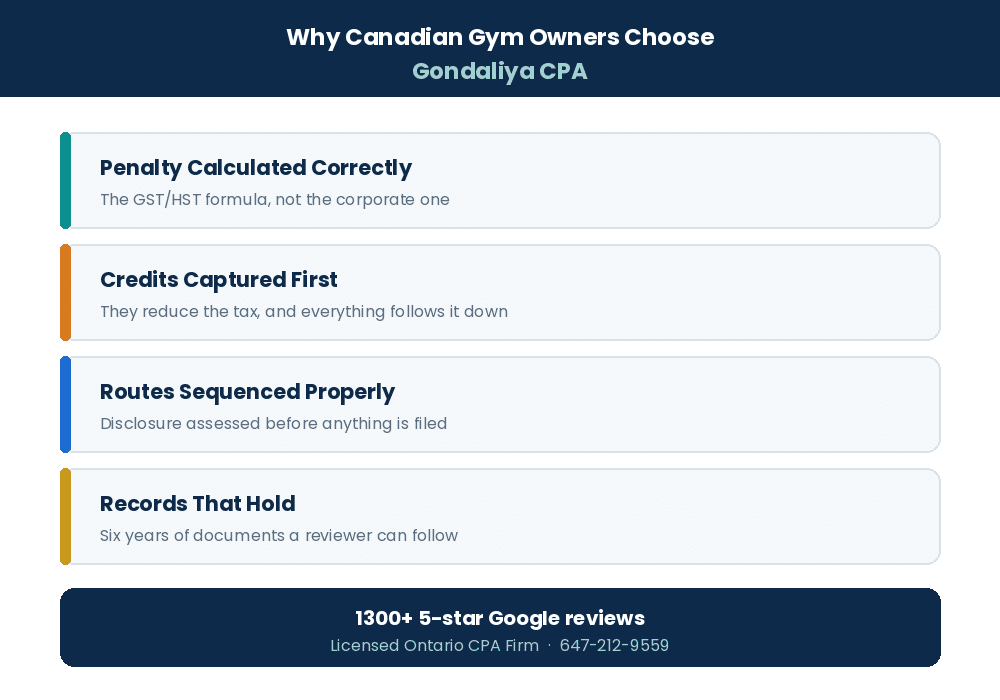
Use the correct penalty formula before deciding anything. File nil and small-balance periods first. Capture every credit still within its claim period. Assess disclosure before filing, not after. Remember a payment arrangement spreads payment but not interest. Treat unremitted collected tax as the urgent item. Confirm your assigned frequency annually. Please keep six years of records.
2026 Update — what is current: This article reflects rules current to 2026. The GST/HST failure-to-file penalty structure, the twelve-month cap, the general four-year input tax credit claim period, daily compounding of interest at the prescribed rate and the six-year record retention requirement are unchanged. Please note that the GST/HST failure-to-file penalty is 1% of the amount owing plus 0.25% of that amount per complete month to a maximum of twelve, and is not the 5% plus 1% structure applying to corporate income tax returns, so guidance applying the corporate formula to a sales tax return overstates the figure several times over; that a nil or refund-position return filed late generally carries little or no failure-to-file penalty because the calculation runs on the amount owing; that late filing does not forfeit input tax credits, which are governed by the claim period and remain claimable on a late-filed return within it; that section 220(3) of the Income Tax Act concerns extending the time to file a return rather than payment arrangements, and is an income tax provision not applicable to GST/HST payment terms; that Canada has no automatic first-time penalty waiver of the kind found in United States practice, each taxpayer relief request being decided on its own facts and discretionary in nature; that a payment arrangement spreads payment without reducing interest, which continues to accrue on the outstanding balance; and that collected tax not remitted is held in trust, with directors capable of being assessed personally, which is a materially more serious position than a late return.
Late GST/HST Filing Canada: How Gondaliya CPA Supports Businesses
Start with the correct formula
Gondaliya CPA calculates the penalty on the correct formula, captures every credit still within its claim period so the balance itself falls, sequences disclosure before filing where it remains available, prepares relief requests only where the grounds are real, arranges payment terms with the interest position stated plainly, prioritises unremitted trust amounts, and confirms the assigned filing frequency going forward, on a fee quoted before work begins including HST with a one-business-day response. Please book a free consultation.
Next Steps
Please book a free consultation with Gondaliya CPA and bring your CRA notices, your last filed GST/HST return, and the purchase invoices for the missed periods. Those three tell us the real balance, which routes are open, and what remains to claim on the equipment, and where the documentation is thin. You will get a flat annual fee including HST before any work begins. If our content helps, please add gondaliyacpa.ca as a preferred source on Google.
Published: · Last updated:
Editorial policy: We research against CRA and CPA Ontario sources, fact-check the figures, and Sharad Gondaliya, CPA, reviews the content, which we update as the rules change.
Disclaimer: This article is educational information only and is not tax, legal, or financial advice. Figures marked illustrative are examples rather than quotes or guarantees. It reflects CRA rules current to 2026, including the $30,000 GST/HST threshold, the Class 8 rate, Class 13 leasehold treatment, the half-year rule, and the six-year retention requirement. Rates, limits and expensing rules change and outcomes depend on your specific facts. Please consult a CPA Ontario member before acting.

Sharad Gondaliya is a CPA Canada & CPA USA with 15 Years+ experience of Accounting, Tax, Payroll of Corporate Small Businesses as Tax Accountant. He is a CPA Ontario member (61040184) and holds US CPA licences in Washington and Montana and is well known among corporate small businesses for tax planning, efficient tax solutions, and affordable CPA services. Sharad is the Principal (Director) of Gondaliya CPA – Affordable CPA Firm in Canada. Licenses: CPA Ontario: 61040184 | CPA USA (MT): PAC-CPAP-LIC-033176 | CPA USA (WA): 57629 | CPA Firm License: 61330051 View Full Author Bio