



How to Reduce CRA Interest & Penalties During Catch-Up Corporate Tax Filing
Quick Summary
Falling behind on corporate tax filings can lead to accumulating CRA interest and penalties, increasing the total amount owed over time. This guide explains how catch-up corporate tax filing works in Canada and outlines practical strategies to reduce CRA charges, manage overdue returns, and restore compliance efficiently while minimizing financial impact.
CRA Penalty Relief is essential for taxpayers facing penalties and interest charges, and Gondaliya CPA offers expert assistance with catch-up corporate tax filing and corporate tax services to ease the application process.
The framing worth carrying through: relief is discretionary and bounded, while correcting the tax itself is neither. Penalty and interest are both calculated on the balance, so a deduction that reduces the tax reduces all three at once.
Reading time: 52 minutes.
Table of Contents
- What Relief Can Actually Reach
- Catch-Up Filing and Its Triggers
- Understanding CRA Penalty Relief and Interest Reduction
- Our Process, Deliverables and Pricing
- Industry Support and the Numbers
- Choosing a Firm and Next Steps
- Frequently Asked Questions
- The Catch-Up Filing Checklist
- Businesses We Serve
- Professional Guidance and Quick Reference
The Numbers That Matter
This article covers Canada, with Ontario and Toronto context, and reflects rules current to 2026. It is written for incorporated Canadian businesses with overdue corporate tax returns. Figures marked illustrative are examples, not quotes, and any masked engagement notes end with “Figures changed for privacy.” This is educational information only and not tax or legal advice. Taxpayer relief is discretionary, so no firm can tell you what reduction you will receive.
What Relief Can Actually Reach
What Relief Can Actually Reach
The Limits
Three Boundaries Worth Knowing First
| Boundary | What It Means |
|---|---|
| The ten-year wall | A relief request generally reaches back only ten calendar years from the year the request is made |
| The grounds | Circumstances beyond your control, CRA error or delay, or genuine inability to pay |
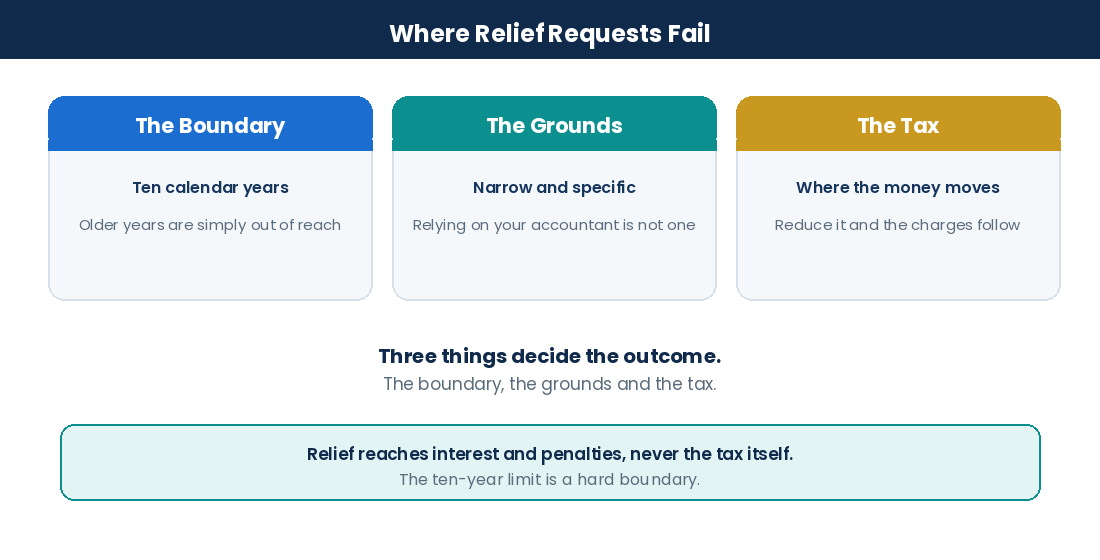
| The scope | Relief reaches penalties and interest. It never touches the underlying tax |
The first boundary is the one most guidance omits entirely, and it is a hard limit. A business ten years behind cannot reach the earliest years no matter how strong the grounds, which is another reason not to postpone.
The Ground That Usually Fails
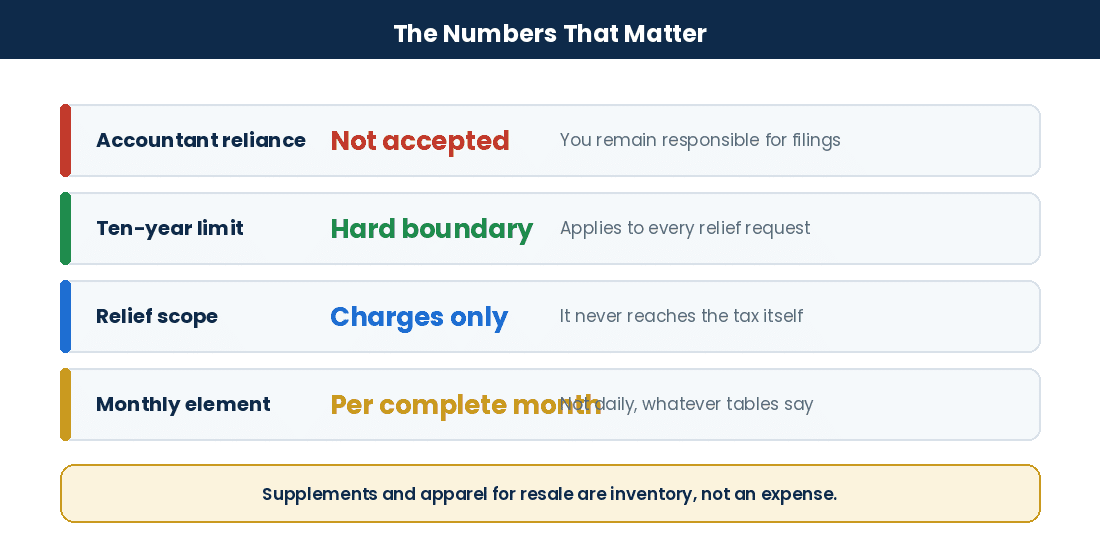
Guidance frequently lists “you followed wrong advice from a tax professional” as a basis for relief. In practice that is generally not accepted. The taxpayer remains responsible for their own filings, and reliance on a third party is treated as a matter between you and that party rather than a reason the CRA should waive charges.
This matters because businesses build applications on it. A request resting on that ground consumes fees and produces a refusal, and it can be harder to come back afterwards on a stronger basis.
| Ground | Position |
|---|---|
| Serious illness or accident affecting the person responsible | Generally accepted with evidence |
| Natural disaster, fire, flood or civil disturbance | Generally accepted with evidence |
| CRA error, processing delay or incorrect published information | Generally accepted |
| Genuine inability to pay or financial hardship | Considered, usually for interest |
| Relying on an accountant who filed late | Generally not accepted |
| Being busy, or the business being complicated | Not accepted |
Where the Real Reduction Comes From
Because penalty and interest are both calculated on the tax owing, anything that reduces the tax reduces all three amounts at once. That is not discretionary, it does not require an application, and it is usually the largest lever available.
- Deductions and credits never claimed on the unfiled years
- Capital cost allowance on assets never entered in the register
- Costs paid personally by the owner and never recorded
- Loss carrybacks against earlier profitable years
- Sales tax credits still within their claim period
A catch-up file that captures these produces a smaller balance, and the penalty and interest calculated on that smaller balance fall with it automatically. No relief officer has to agree to anything. Our corporate tax cleanup service handles that reconstruction.
Businesses ask about relief first. The larger number is almost always in the deductions nobody claimed on the years that were never filed. Figures changed for privacy.
Risk Warning: Reliance on an accountant is generally not accepted as a ground for relief. Please do not build an application on it.
Catch-Up Filing and Its Triggers
Catch-Up Filing and Its Triggers
The Basics
| Aspect | DIY Approach | CPA Services |
|---|---|---|
| Cost | Low, but time-consuming | Quoted before work begins |
| Expertise | Limited | Extensive |
| Time Required | Significant | Minimal for you |
| Risk of Errors | High | Low |
Who It’s For:
- Businesses with overdue corporate tax returns
- Companies seeking CRA penalty relief
- Organizations needing assistance with late T2 filings
Who It’s Not For:
- Businesses without any outstanding tax issues
- Companies comfortable managing their own bookkeeping and compliance
What Is Corporate Bookkeeping Cleanup?
Corporate bookkeeping cleanup means correcting and organising your company’s financial records so they match the money that actually moved. It usually includes:
- Checking what is already recorded.
- Fixing wrong entries.
- Putting documents in order.
- Identifying costs paid personally and never entered.
- Following the applicable accounting standards.
On the last point, Canadian private company statements are prepared under ASPE, and where a CPA compiles them the engagement is performed under CSRS 4200. Both “Canadian GAAP” and “Notice to Reader” are retired descriptions.
Doing this sets up catch-up corporate tax filing properly and, more importantly, finds the deductions that reduce the balance. Our catch-up bookkeeping services handle this stage.
When Catch-Up Corporate Tax Filing Becomes Necessary
You need catch-up filing if the corporation missed T2 deadlines. Typical reasons:
- Missed deadlines from lack of time or resources.
- New owners not knowing the obligations.
- Business changes disrupting record keeping.
- A dormant corporation assumed to have no filing obligation.
The last point catches people regularly. A corporation with no activity still has to file a return. Dormancy is not an exemption, and the returns are quick to prepare and generally carry little or no penalty because the calculation runs on tax owing.
Recognizing Common Triggers for CRA Penalties and Interest
- Inaccurate Filings: Figures that do not agree with information the CRA holds from other sources.
- Late Submissions: The late-filing penalty applies from the day after the deadline, and interest accrues separately.
- Failure To Report Income: Omitted income can attract adjustments, and repeated omissions attract more.
- Unremitted Trust Amounts: Source deductions and collected sales tax not remitted carry personal exposure for directors.
The fourth is added because it belongs in a different category from the others. Late filing is a corporate compliance matter. Unremitted trust money follows individuals.
The Imperative of Timely Corporate Tax Compliance Support
- Expert Guidance: Sector-specific handling for healthcare, real estate, construction and others.
- Streamlined Processes: A single calendar and a routine that survives staff changes.
- Peace Of Mind: The correspondence and the calculation handled by someone who does it regularly.
Please note one thing about deadlines that catches corporations out. Filing and payment are separate obligations with different dates. An eligible Canadian-controlled private corporation generally has three months after year end to pay, other corporations two, while the return itself is due six months after year end. Paying on time and filing late still attracts a late-filing penalty, though a much smaller one because it is calculated on unpaid tax.
Dormant corporations sit unfiled for years because nobody believes a nil return matters. They file in an afternoon and carry almost no penalty. Figures changed for privacy.
Key Stat: An eligible CCPC generally has three months after year end to pay and six to file. Please diarise them separately.
Understanding CRA Penalty Relief and Interest Reduction
Understanding CRA Penalty Relief and Interest Reduction
The Routes
CRA Penalty Relief Strategies for Overdue Corporate Tax Returns
Two routes exist and they are frequently conflated.
| Route | What It Is | Timing |
|---|---|---|
| Voluntary Disclosures Program | Coming forward about something the CRA does not know | Must be before CRA contact on the matter |
| Taxpayer relief | Asking for penalties and interest to be cancelled or waived | Within ten years, at any point |
The distinction is about what you are asking for. Disclosure asks the CRA to accept a correction with reduced consequences. Relief asks the CRA to exercise discretion on charges already applied. They are not alternatives to be chosen on preference; the facts determine which is available.
How to Reduce CRA Penalties Canada: Eligibility Criteria
| Eligibility Requirement | Description |
|---|---|
| Voluntary Disclosure | Complete disclosure made before any CRA contact or enforcement on the matter |
| Extraordinary Circumstances | Events beyond your control that prevented compliance, with evidence |
| CRA Actions | Departmental error, processing delay or incorrect information provided |
| Inability to Pay | Financial hardship, generally considered for interest |
| Prompt Compliance | Returns filed promptly once the problem was identified |
| Ten-Year Limit | The request reaches back ten calendar years, and no further |
The last row is added because it is the constraint that decides whether the exercise is worth starting on older years. Compliance history is a factor the CRA weighs, but a previous late filing is not a formal bar in the way some guidance suggests.
CRA Interest Relief Strategies: Specific Provisions and Applications
Interest accrues daily on unpaid amounts from the due date until payment, compounding at the prescribed rate which changes quarterly. It can be waived under the same taxpayer relief provisions, on the same grounds.
A relief request should:
- Identify the specific periods and amounts you are asking about
- Explain what prevented compliance, with dates
- Attach evidence such as medical documentation or an official report
- Show what you did once you were able to act
- Be made on Form RC4288
Partial relief is common, so be clear about which periods you are asking for rather than requesting everything without distinction.
Please note one thing no relief route changes: interest continues to accrue while the request is considered. Paying the balance is the only thing that reliably stops it, and a refund follows if relief is granted afterwards.
Situations That May Not Qualify for Taxpayer Relief
| Situation | Reason Denied |
|---|---|
| Intentional Non-compliance | Deliberate avoidance is not a ground for discretion |
| Chronic Late Filings | A sustained pattern weighs against the request |
| Insufficient Documentation | Assertions without supporting evidence |
| Ignoring Notices | No response despite correspondence |
| Reliance on a Professional | The taxpayer remains responsible for their own filings |
| Requests Beyond Ten Years | Outside the period the CRA can consider |
| Being Busy or Under-Resourced | Not a circumstance beyond your control |
The fifth row corrects guidance that lists professional reliance as a valid ground. It is among the more common reasons an application fails, not a reason it succeeds.
Voluntary Disclosure Program Canada: A Strategic Path to Rectification
- You must come forward before the CRA contacts you about the matter.
- The disclosure must be complete for the periods covered.
- It must involve a penalty that would otherwise apply.
- Accepted applications generally see penalty relief, and partial interest relief for older years.
- The tax itself remains payable.
The fourth point corrects a common understatement. Guidance saying interest “usually stays” under disclosure is not accurate; partial interest relief is available for years before the most recent ones under the general programme, though the terms differ by track.
Our Voluntary Disclosures Program filings service handles these submissions.
DIY Approach Versus CPA and Non-CPA Assistance for Overdue Corporate Tax Returns
| Aspect | DIY Approach | Non-CPA Assistance | CPA Services |
|---|---|---|---|
| Expertise in CRA Penalty Relief | May build on grounds that fail | Varies considerably | Grounds assessed before applying |
| Handling Complex Filings | Difficult without accounting skills | Simple filings manageable | Multi-year reconstruction |
| Reducing the Balance | Deductions often missed entirely | Some captured | Systematic review of open years |
| Accuracy & Compliance Risk | Higher | Moderate | Professional standards apply |
| Time Investment Required | High | Medium | Handled for you |
| Cost Considerations | Lowest upfront | Mid-range | Quoted before work begins |
Note that anyone you authorise can deal with the CRA in Canada. The difference is technical depth and accountability rather than legal authority.
The relief application is the visible part. The reconstruction that lowers the tax underneath it is where the money actually moves. Figures changed for privacy.
Risk Warning: Interest continues accruing while a relief request is considered. Please treat paying and applying as separate decisions.
The Gondaliya CPA Process for Catch-Up Corporate Tax Filing
Our Process, Deliverables and Pricing
The Engagement
- Initial Assessment
- Establish which filings are missing and how far back they go.
- Check the ten-year boundary against the oldest year.
- Identify which relief route, if any, is genuinely available.
- Review the financial position to see what payment terms are realistic.
- Corporate Bookkeeping Cleanup
- Reconcile accounts so the returns rest on real figures.
- Find deductions never claimed, which reduce the balance directly.
- Assemble the supporting documents.
- Preparation & Filing
- Prepare each overdue T2 return.
- Apply deductions and credits missed on those years.
- Model loss carrybacks against earlier profitable years.
- CRA Communication & Negotiation
- Submit relief requests on Form RC4288 where the grounds are real.
- Arrange payment terms, with the interest position stated plainly.
- Ongoing Support & Compliance Planning
- Set the filing calendar with payment and filing dates separated.
- Put the bookkeeping on a routine that supports it.
The order matters in one specific respect. Where disclosure may be available, it is assessed before anything is filed, because filing first can close that route.
Key Deliverables from Professional Corporate Tax Services
| Deliverable | Description |
|---|---|
| Corporate Bookkeeping Cleanup | Income and expense records corrected, documents organised |
| Catch-Up Corporate Tax Filing | All overdue T2 returns prepared and filed, with credits applied |
| CRA Penalty Relief | RC4288 submissions where the grounds support them, with evidence |
| CRA Payment Arrangement Help | Terms negotiated, with the continuing interest position explained |
| Balance Reduction Schedule | Deductions and carrybacks identified, showing the effect on the tax |
| Compliance Calendar | Filing and payment dates separated, with the frequency confirmed |
Pricing Factors for Corporate Tax Resolution Services
| Pricing Factor | Description |
|---|---|
| Number of Overdue Years | More years mean more reconstruction |
| Complexity Level | Transaction volume and business activities |
| Penalty Amounts Incurred | Larger balances warrant more detailed submissions |
| Financial Situation | Affects the payment arrangement work required |
| Urgency / Deadlines | Compressed timelines require more resource |
| Additional Advisory Needs | Planning work beyond the filings themselves |
| Condition of the Records | Reconstructing from statements costs more than correcting a ledger |
Fees are quoted before work begins, including HST, with a one-business-day response, evening and weekend availability, a 30-day money-back arrangement and a 60-day fee-matching arrangement.
For help sorting this out, contact Gondaliya CPA at 647-212-9559 or info@gondaliyacpa.ca.
Risks Associated with Overdue Corporate Tax Returns and CRA Compliance
| Risk Category | Description | Impact on Business | Mitigation Strategy |
|---|---|---|---|
| Late Filing Penalties | 5% of unpaid tax plus 1% per complete month, to twelve months, with a higher rate on repetition. | Raises the balance and reduces cash available. | File promptly and apply for relief where the grounds are real. |
| Interest Charges | Compounds daily on unpaid amounts from the due date, without a cap. | The balance grows continuously. | Reduce the tax through deductions, then pay to stop accrual. |
| Loss of Refunds or Credits | Loss carrybacks require the loss year to be filed, and refunds sit unclaimed. | Funds that were available stay unavailable. | File all overdue years so carrybacks and refunds can be claimed. |
| Compliance Risks & Audits | A pattern of late filing sits on the account. | Closer examination and more correspondence. | Correct the records before submitting anything. |
| Trust Money Exposure | Unremitted source deductions and collected sales tax follow directors personally. | Personal liability surviving the corporation. | Identify and prioritise the trust balance separately. |
| Impact on Business Reputation | Arrears surface in lending and commercial due diligence. | Harder to borrow or transact. | Bring filings current so the account reads correctly. |
The trust money row is added because it is the only one on this list that follows an individual rather than the company, and it should be prioritised accordingly in any payment plan.
We check the ten-year boundary before quoting. On a badly overdue file it decides which years are worth applying for at all. Figures changed for privacy.
Pro Tip: Please assess disclosure before filing anything. Filing first can close a route that was available beforehand.
Tailored Solutions and Practical Examples for CRA Penalty Relief and Catch-Up Corporate Tax Filing
Industry Support and the Numbers
By Sector
Corporate Tax Compliance Support for Diverse Industries
Every business faces the same rules and falls behind for different reasons. Knowing yours is what stops it recurring.
Doctors and Dentists: Specific Tax Considerations
- Keep clear records of patient fees against insurance payments.
- Track expenses such as supplies and premises costs.
- Manage shareholder loans and dividends properly.
The third point produces more catch-up findings than the other two combined. A shareholder loan balance that only grows is its own tax issue, and it is frequently the largest adjustment on a professional corporation file. Please also note that a corporation does not prorate home premises costs by space used; that is the sole proprietor method.
Daycare Businesses: Ensuring Regulatory Compliance
- Match government subsidies to reported revenue.
- Keep payroll accurate despite changing staff numbers.
- Maintain audit trails in case disclosure becomes relevant.
Payroll is where the exposure sits in this sector. Source deductions are trust money, and a centre behind on remittances has a director-level problem rather than a filing problem.
Real Estate Professionals and Property Developers: Capital Gains and T2 Filings
- Track purchase dates, proceeds, adjusted cost base and improvements.
- Distinguish inventory income from capital gains, which turns on intention at acquisition.
- Report development costs in the correct year.
The second point is the largest single adjustment area here. Whether a gain is on capital or income account is a factual question decided by intention when the property was acquired, not by how the gain is described afterwards.
Construction Companies and Skilled Trades: Project-Based Tax Management
- Separate costs by project phase using job costing.
- Track holdbacks owed and owing, since they affect timing.
- Align sales tax filings with income filings so neither drifts.
Two current points. Bill C-15 received Royal Assent on 26 March 2026, reinstating the accelerated investment incentive for most depreciable property acquired after 2024 and available for use before 2030, which matters on equipment-heavy catch-up files. And where the corporation owns a vehicle, it claims the costs in full and reports a taxable benefit rather than prorating by use.
Startups and E-commerce Ventures: Navigating New Business Taxes
- Set up bookkeeping that captures online sales automatically.
- Apply the correct treatment for digital goods and services.
- File before the balance and the interest build.
Please note there is no CRA relief programme aimed specifically at new businesses. Guidance suggesting startups qualify for tailored relief is describing something that does not exist; startups apply on the same grounds as everyone else. What does help startups is that costs paid on a founder’s personal card, which are almost never entered, carry real deductions once identified.
Restaurants: Managing Complex Expense Reporting
- Correct point-of-sale system errors.
- Separate food and drink purchases from other overheads.
- Confirm payroll payments match wage reports.
Equipment bought in a busy month and coded to supplies is the recurring catch-up finding, and it costs the depreciation claim in every subsequent year until corrected.
Transportation & Logistics Companies: Fuel Taxes and Cross-Border Considerations
- Reconcile fuel purchases against distance travelled to find unentered costs.
- Document interprovincial transactions with place of supply identified.
- Handle timing differences on cross-border shipments.
Note that fuel charge relief operates through specific programmes with their own eligibility rather than as a general rebate, so please confirm your position rather than assuming one applies.
Financial Impact: A Numeric Example for Late T2 Filing Penalties
The corporate late-filing penalty is 5% of the unpaid tax plus 1% of that amount per complete month the return is late, to a maximum of twelve months. The figures below are illustrative only.
| Unpaid Tax | Complete Months Late | Base at 5% | Monthly at 1% | Total Penalty |
|---|---|---|---|---|
| $50,000 | 2 | $2,500 | $1,000 | $3,500 |
| $200,000 | 4 | $10,000 | $8,000 | $18,000 |
| $200,000 | 12 or more | $10,000 | $24,000 | $34,000 |
Three points about this table, because published versions of it contain errors.
First, the monthly element accrues per complete month, not daily. A column headed “additional daily penalty (1% per month)” describes two different things at once.
Second, the arithmetic has to work. Sixty days is two complete months, giving $1,000 on $50,000, not $600. A hundred and twenty days is four complete months, giving $8,000 on $200,000, not $9,600. Neither published figure corresponds to any whole number of months.
Third, interest is separate and is not included above. It compounds daily at the prescribed rate, which changes quarterly, and it has no twelve-month cap. On a long-overdue balance it is the larger figure.
What Reduces These Numbers
| Action | Effect |
|---|---|
| Capture deductions never claimed | Reduces the tax, so penalty and interest both fall with it |
| Apply a loss carryback | Reduces tax in an earlier year, generating a refund |
| File promptly | Stops the monthly penalty element accruing |
| Pay the balance | The only thing that reliably stops interest |
| Apply for relief where grounds exist | Discretionary, uncertain, and worth doing where genuine |
The first row is the reliable one and the last row is not. Correcting the tax works without anyone’s agreement.
Recent CRA Penalty Relief Announcements And Their Implications
The CRA does adjust administrative practice from time to time, and specific relief measures have been announced in response to particular events such as natural disasters affecting defined regions.
Please treat general statements that “more taxpayers now qualify” or “payment plans got more flexible” with caution unless they cite a specific measure and date. The underlying taxpayer relief provisions and the ten-year limit have not changed, and an application still rests on your own facts and evidence.
Where a measure applies to your region or circumstances, it will be published with defined eligibility. Confirm against the CRA’s own announcements or through your CPA rather than relying on a general description.
Guidance about recent relief announcements almost never names one. If a measure applies to you it has a name, a date and defined eligibility. Figures changed for privacy.
Risk Warning: The monthly penalty element accrues per complete month, not daily. Please check any table that describes it as a daily charge.
Choosing a Firm and Next Steps
Choosing a Firm and Next Steps
Getting Started
How to Choose a CPA Firm for Your Corporate Tax Needs
- A firm that works regularly on Canadian corporate penalties and interest.
- Experience with multi-year catch-up files, not just current-year returns.
- Clear pricing quoted before work begins, so a long fix does not become open-ended.
- Honest assessment of whether relief grounds exist before charging to apply.
- A registration you can verify independently on the CPA Ontario public directory.
- Communication that keeps you informed through each stage.
The fourth point is worth weighting heavily. A firm that will tell you a relief application is unlikely to succeed saves you the fee and the refusal, and that is a better signal than any testimonial.
Why Trust Gondaliya CPA: Expertise in Corporate Tax Services
Gondaliya CPA works with incorporated small and medium businesses on catch-up corporate tax filing. We handle the reconstruction, the returns, the relief submissions where grounds exist, and the arrangements afterwards.
Sharad Gondaliya, CPA, leads the team with 15+ years of experience. Our fees are quoted before work begins, including HST, and our engagements carry a 30-day money-back arrangement and a 60-day fee-matching arrangement.
We say plainly where a position will not hold. Defending an indefensible relief ground costs money on the way to the same answer, and knowing that at the start produces a better result on everything else.
Proactive Tax Planning for Late Returns and Future Compliance
Tax planning matters most on a catch-up file, because the decisions are still open on years not yet filed.
- Review old records for missing or incorrect information.
- Decide the capital cost allowance claim rather than defaulting to the maximum.
- Model loss carrybacks and choose the year that produces the largest recovery.
- Set up payment terms where required.
- Assess relief grounds honestly before applying.
The second and third points are real choices, not formalities. Capital cost allowance is a maximum rather than an obligation, and claiming less in a loss year preserves the pool. A loss can be carried back three years and forward twenty, and the year you choose changes the recovery.
Getting Started with Business Tax Filing Help: Your Next Steps
- Establish which returns are outstanding and how far back they go.
- Check the ten-year boundary against the oldest year.
- Gather records showing income, expenses, credits and payments made.
- Assess whether disclosure is available, before filing anything.
- Prepare the returns with every deduction captured.
- File, then address the balance with a payment arrangement if needed.
Bring three things to a first meeting: your last filed corporate return, the CRA notices you have received, and the bank statements for the unfiled years including the owner’s personal card. That third item is where the unclaimed deductions usually are.
Contact Gondaliya CPA at info@gondaliyacpa.ca, call 647-212-9559, or send us a message. Our guide to catch-up filing and audit risk covers what follows.
Additional Services & Benefits from Gondaliya CPA
- Affordable CPA services tailored for small and medium-sized businesses
- Expert tax planning for late returns to prevent future penalties
- Clear communication regarding filing deadlines and responding to CRA notices
- Specialized knowledge for real estate professionals, property developers and builders
- Dedicated support for construction companies and skilled trades in tax matters
- Customized assistance for startups and e-commerce ventures facing unique compliance issues
- Accurate handling of restaurants’ complex expense reporting challenges
- Comprehensive solutions for transportation and logistics companies
- 30-day refund policy if service expectations are not met
- 60-day fee match guarantee ensures competitive pricing on services
We ask for the owner personal card statements at the first meeting. On a catch-up file that single document usually carries the largest unclaimed deductions. Figures changed for privacy.
Key Stat: A non-capital loss carries back three years and forward twenty. Please choose the carryback year by where the recovery is greatest.
FAQs on CRA Penalty Relief and Catch-Up Filing
Frequently Asked Questions
FAQ
What is the Voluntary Disclosure Program Canada, and how does Gondaliya CPA assist with it?+
It lets businesses correct past errors before the CRA raises them. We assess eligibility, prepare the submission and handle the correspondence. The condition is that the disclosure comes before CRA contact on the matter.
How do taxpayer relief provisions help small and medium-sized businesses?+
They allow the CRA to cancel or waive penalties and interest where circumstances beyond your control contributed. Relief is discretionary, reaches back ten years, and does not change the underlying tax.
Can Gondaliya CPA represent my business during CRA appeals?+
Yes, as your authorised representative. Note that anyone you authorise can act for you in Canada, so the difference is technical depth rather than legal authority.
What support does Gondaliya CPA offer for late T2 filings?+
We reconstruct the records, prepare and file every overdue return, capture deductions never claimed, and model loss carrybacks against earlier profitable years.
How does Gondaliya CPA help with payment arrangement requests at CRA?+
We negotiate terms that fit your cash flow. Please note an arrangement spreads payment; interest continues to accrue on the outstanding balance.
What is RC4288, and why is it important for penalty relief?+
It is the CRA form used to request cancellation or waiver of penalties and interest. We prepare it with the specific periods identified and the supporting evidence attached.
Does Gondaliya CPA provide any guarantees on refunds or fees?+
We offer a 30-day money-back arrangement and a 60-day fee-matching arrangement, with fees quoted before work begins including HST.
How far back can a taxpayer relief request go?+
Generally ten calendar years from the year the request is made. Years beyond that are outside what the CRA can consider, which is a reason not to postpone.
Is relying on my accountant a valid ground for relief?+
Generally no. The taxpayer remains responsible for their own filings, and reliance on a third party is treated as a matter between you and that party.
What grounds does the CRA actually accept?+
Circumstances beyond your control such as serious illness or a natural disaster, CRA error or processing delay, and in some cases genuine inability to pay. Evidence is required in each case.
Does relief reduce the tax I owe?+
No. Relief reaches penalties and interest only. The tax itself is reduced by correcting the return, which is usually the larger effect.
What is the corporate late-filing penalty?+
5% of the unpaid tax plus 1% of that amount per complete month the return is late, to a maximum of twelve months. A higher rate applies on repetition after a demand to file.
Does the penalty accrue daily?+
No. The base is applied once and the monthly element accrues per complete month. Interest accrues daily; the penalty does not.
Does an objection or relief request stop interest?+
No. Interest continues while a request is considered. Paying the balance is the only thing that reliably stops it, with a refund following if relief is granted.
Do I still file if my corporation was dormant?+
Yes. A corporation with no activity still has a filing obligation. Those returns are quick and generally carry little or no penalty, since the calculation runs on unpaid tax.
Is there special relief for startups?+
No. There is no CRA relief programme aimed at new businesses. Startups apply on the same grounds as everyone else, on their own facts.
Sixteen questions and one underneath most of them: is this reaching the tax or the charges on it. They move by different means. Figures changed for privacy.
Checklist for Successful Catch-Up Corporate Tax Filing and Penalty Relief
The Catch-Up Filing Checklist
Quick Reference
Work through these in order. The sequence matters more than the individual steps.
- 1. Identify Outstanding Returns: List every year needing catch-up filing, including dormant years.
- 2. Check the Ten-Year Boundary: Establish which years a relief request could still reach.
- 3. Assess Disclosure First: Before filing, since filing can close that route.
- 4. Gather Financial Records: Bookkeeping for each period, plus the owner’s personal card statements.
- 5. Calculate Taxes Owed & Penalties: Using 5% plus 1% per complete month, with interest separate.
- 6. Capture Every Deduction: This reduces the tax, and penalty and interest follow it down.
- 7. Model Loss Carrybacks: Three years back, choosing the year with the greatest recovery.
- 8. Prepare Accurate T2 Returns: Complete returns showing the true taxable income.
- 9. Submit Through Proper Channels: Electronically, since paper takes longer.
- 10. Request Penalty Relief If Eligible: On Form RC4288, with real grounds and evidence attached.
- 11. Separate Trust Amounts: Unremitted source deductions follow directors personally.
- 12. Arrange Payment If Needed: Realistic terms, understanding that interest continues.
- 13. Set the Compliance Calendar: Filing and payment dates diarised separately.
- 14. Fix the Bookkeeping Routine: Or the same position recurs.
Points Worth Remembering
- Relief reaches penalties and interest, never the underlying tax.
- A relief request generally reaches back ten calendar years, and no further.
- Reliance on a professional is generally not an accepted ground.
- Interest continues accruing while a relief request is considered.
- The corporate late-filing penalty is capped at twelve months; interest is not.
- The monthly penalty element accrues per complete month, not daily.
- Filing and payment are separate obligations with different deadlines.
- An eligible CCPC generally has three months to pay and six to file.
- Dormant corporations still have a filing obligation.
- There is no CRA relief programme specific to startups.
- Capital cost allowance is a maximum, not an obligation.
- A non-capital loss carries back three years and forward twenty.
For advice on CRA penalty relief options suited to your situation, schedule a free consultation with Gondaliya CPA.
Twenty-six points, and the third one has to come before the eighth. Everything else can be reordered; that pair cannot. Figures changed for privacy.
Businesses We Serve
Industry Expertise
Where the recovery sits differs by sector. Here are ten.
| Business | Where the Recovery Usually Sits |
|---|---|
| Medical and dental practices | Shareholder loan balances and premises treatment |
| Childcare operators | Payroll remittances, which are trust money |
| Real estate professionals | Capital against income classification on disposals |
| Property developers | Development costs recorded in the wrong year |
| Construction and trades | Equipment never entered in the asset register |
| Startups | Founder purchases on personal cards |
| Online sellers | Processor fees recorded net rather than gross |
| Restaurants | Kitchen equipment coded to supplies |
| Transport operators | Fuel purchases never reconciled to distance |
| Any corporation with a loss year | A carryback nobody applied |
- Medical and dental practices: Watch the loan account.
- Childcare operators: Trust money comes first.
- Real estate professionals: Intention at acquisition decides it.
- Property developers: Match the cost to the year.
- Construction and trades: Check supplies for equipment.
- Startups: Bring the personal statements.
- Online sellers: Gross, with fees as expense.
- Restaurants: Rebuild the register.
- Transport operators: Distance finds the gaps.
- Any corporation with a loss year: Look back three years.
The sector changes where the deductions hide. It does not change the principle, which is that reducing the tax reduces everything calculated on it. Figures changed for privacy.
Professional Guidance and Quick Reference
Guidance
Professional Guidance: How Gondaliya CPA Handles Your Catch-Up Filing
Corporations handle catch-up filing badly in a predictable set of ways: building a relief application on reliance on an accountant, which the CRA generally does not accept, not knowing that a relief request reaches back only ten calendar years so the oldest years quietly fall outside it, filing before assessing whether disclosure was available and closing that route, expecting relief to reduce the tax when it only reaches penalties and interest, planning around penalty tables whose arithmetic does not correspond to any whole number of months, assuming a dormant corporation has no filing obligation, and leaving unremitted trust amounts in the same queue as ordinary tax. Gondaliya CPA handles catch-up corporate tax filing on a fee quoted before work begins.
We handle what decides the outcome: checking the ten-year boundary before anything else, assessing disclosure before filing, reconstructing the records so every deduction is captured and the tax itself falls, modelling loss carrybacks against the best year, preparing relief requests only where the grounds are real, separating and prioritising trust amounts, and setting a calendar with filing and payment dates diarised apart.
Our team starts with your last filed corporate return, your CRA notices and the bank statements for the unfiled years including the owner’s personal card. Those three establish the real balance. Whatever your sector, you get clear advice and a fixed price before we start.
Quick Answers
- Relief reaches: Penalties and interest only
- Never: The underlying tax
- Ten-year limit: On any relief request
- The failing ground: Relying on your accountant
- Accepted grounds: Illness, disaster, CRA error, hardship
- The form: RC4288
- Penalty: 5% plus 1% per complete month, to twelve
- Interest: Daily, compounding, uncapped
- Best lever: Deductions that reduce the tax itself
- Trust money: Prioritise it, since it is personal
Who This Is For
- For: Incorporated Canadian businesses with overdue corporate tax returns and accumulated penalties or interest.
- Not For: A forecast of what relief you will receive, since taxpayer relief is discretionary and decided on your own facts and evidence.
People Also Ask
Which should I do first, disclosure or filing?+
Assess disclosure first. Filing can close that route, and it cannot be reopened afterwards on the same matter.
What does a catch-up file usually recover?+
Deductions never claimed on the unfiled years, capital cost allowance on assets never recorded, costs paid personally by the owner, and loss carrybacks nobody applied.
Do I need to pay before I file?+
No. Filing and payment are separate obligations. Filing stops the monthly penalty element accruing even where the balance cannot be paid yet.
Glossary of Key Terms
- Catch-up filing: Preparing and filing returns for years never filed.
- Late-filing penalty: 5% of unpaid tax plus 1% per complete month, to twelve.
- Repeated failure penalty: A higher rate after a demand and a prior penalty.
- Prescribed rate: The interest rate, which changes quarterly.
- Taxpayer relief: A discretionary request to cancel penalties and interest.
- RC4288: The form used to make a taxpayer relief request.
- Ten-year limit: How far back a relief request can reach.
- Voluntary Disclosures Program: Correcting filings before CRA contact.
- Payment arrangement: Terms to pay over time, with interest continuing.
- Non-capital loss: Carried back three years, forward twenty.
- Capital cost allowance: Tax depreciation, a maximum not an obligation.
- Shareholder loan: Amounts moving between owner and corporation.
- Trust amounts: Source deductions and collected sales tax.
- Director liability: Personal exposure for unremitted trust amounts.
- ASPE: The standards Canadian private company statements follow.
- CSRS 4200: The standard governing a CPA compilation engagement.
Relief Eligibility Check
This quick self-check indicates where your operation most likely has room. Please answer the six questions below.
Relief Eligibility Check
Six quick questions on your position. No fee shown.
Points to raise with us:
This is a general prompt, not tax or legal advice or a quote. Your position depends on your full facts. For a real review, please book a free consultation.
Want a checklist to work from? You can download our free catch-up and relief checklist before your consultation.
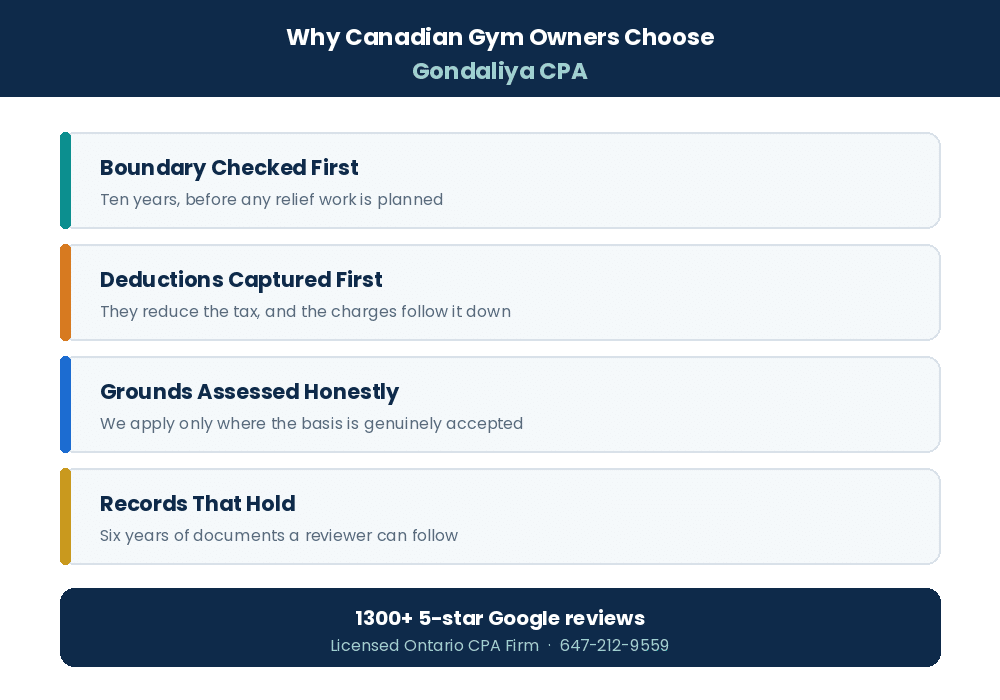
Check the ten-year boundary before planning any relief request. Assess disclosure before you file. Capture every deduction, since that reduces the tax itself. Model loss carrybacks against the best year. Do not build a relief application on reliance on an accountant. File dormant years too. Prioritise unremitted trust amounts. Please keep six years of records.
2026 Update — what is current: This article reflects rules current to 2026. The corporate late-filing penalty of 5% of unpaid tax plus 1% per complete month to a maximum of twelve, the higher repeated failure rate, the ten-year limit on taxpayer relief requests, daily compounding of interest at the prescribed rate and the six-year record retention requirement are unchanged. Bill C-15 received Royal Assent on 26 March 2026, reinstating the accelerated investment incentive for most depreciable property acquired after 2024 and available for use before 2030, which matters on equipment-heavy catch-up files. Please note that reliance on a tax professional is generally not an accepted ground for taxpayer relief, the taxpayer remaining responsible for their own filings, so guidance listing it as a valid basis will lead to a refused application; that a relief request generally reaches back only ten calendar years, which decides whether older years are worth applying for at all; that relief reaches penalties and interest and never the underlying tax, which is reduced instead by correcting the return; that the monthly penalty element accrues per complete month rather than daily, so tables describing a daily penalty at a monthly rate are describing two different things; that interest continues to accrue while a relief request is under consideration, with only payment reliably stopping it; that there is no CRA relief programme specific to startups; and that a dormant corporation retains its filing obligation even with no activity.
CRA Penalty Relief Canada: How Gondaliya CPA Supports Businesses
Start with the ten-year boundary
Gondaliya CPA checks the ten-year boundary before anything else, assesses disclosure before filing, reconstructs the records so every deduction is captured and the tax itself falls, models loss carrybacks against the year producing the greatest recovery, prepares relief requests only where the grounds are genuinely accepted ones, separates and prioritises trust amounts, and sets a calendar with filing and payment dates diarised apart, on a fee quoted before work begins including HST with a one-business-day response. Please book a free consultation.
Next Steps
Please book a free consultation with Gondaliya CPA and bring your last filed corporate return, your CRA notices, and the bank statements for the unfiled years. Those three tell us the real balance, which routes are open, and what remains to claim on the equipment, and where the documentation is thin. You will get a flat annual fee including HST before any work begins. If our content helps, please add gondaliyacpa.ca as a preferred source on Google.
Published: · Last updated:
Editorial policy: We research against CRA and CPA Ontario sources, fact-check the figures, and Sharad Gondaliya, CPA, reviews the content, which we update as the rules change.
Disclaimer: This article is educational information only and is not tax, legal, or financial advice. Figures marked illustrative are examples rather than quotes or guarantees. It reflects CRA rules current to 2026, including the $30,000 GST/HST threshold, the Class 8 rate, Class 13 leasehold treatment, the half-year rule, and the six-year retention requirement. Rates, limits and expensing rules change and outcomes depend on your specific facts. Please consult a CPA Ontario member before acting.

Sharad Gondaliya is a CPA Canada & CPA USA with 15 Years+ experience of Accounting, Tax, Payroll of Corporate Small Businesses as Tax Accountant. He is a CPA Ontario member (61040184) and holds US CPA licences in Washington and Montana and is well known among corporate small businesses for tax planning, efficient tax solutions, and affordable CPA services. Sharad is the Principal (Director) of Gondaliya CPA – Affordable CPA Firm in Canada. Licenses: CPA Ontario: 61040184 | CPA USA (MT): PAC-CPAP-LIC-033176 | CPA USA (WA): 57629 | CPA Firm License: 61330051 View Full Author Bio