



CPA Compilation Reports for Franchise Owners: What Canadian Franchises Need to Know
Quick Summary
A franchise compilation report is a set of year-end financial statements a Registered CPA assembles under CSRS 4200, built around the lines franchises live on: royalties, advertising-fund contributions, franchise-fee amortization, and unit-level performance. Single-unit owners usually need one report a year; multi-unit owners need one per entity, often consolidated for the bank and the franchisor.
| Aspect | Details |
|---|---|
| What it covers | Year-end statements reconciling royalties, ad-fund contributions, and unit-level results, with a compilation engagement report attached. |
| Why franchises need it | Franchisors, lenders, and landlords expect CPA-prepared statements, and franchise agreements often require annual financials. |
| Who it’s for | Incorporated single-unit and multi-unit franchise owners who need bank-ready and franchisor-ready statements. |
| Who it’s not for | Franchisees whose lender or franchisor specifically requires a review or audit, which carry assurance a compilation does not. |
Reading time: 22 minutes.
Table of Contents
- What Is a CPA Compilation Report?
- Why Do Franchise Owners Need One?
- Single-Unit vs Multi-Unit Franchise Reporting
- DIY vs CPA vs Non-CPA Provider
- How Does the Compilation Process Work?
- What Deliverables Do You Get?
- How Much Does It Cost in Canada?
- Risks, CRA Compliance & the 2026 Update
- What to Prepare Before You Start
- How It Applies Across 10 Franchise Sectors
- A Realistic Numeric Walkthrough
- How to Choose the Right CPA Firm
- Why Trust Gondaliya CPA
- People Also Ask
- Frequently Asked Questions
- Glossary of Key Terms
Franchise Reporting at a Glance
This article covers Canada, with Ontario context, and reflects CRA rules and CSRS 4200 in effect for the 2026 period. The proposed CSRS 4250 is noted as a 2026 development, not yet in force. Any figure marked “figures changed for privacy” is masked from a real engagement. This is educational information only and not tax, legal, or financial advice.
What Is a CPA Compilation Report?
Definition & Scope
A CPA compilation report is a set of financial statements a Registered CPA assembles from your records and presents under CSRS 4200 with no assurance attached. For a franchise owner, it organizes unit-level sales, royalties, and advertising-fund contributions into a balance sheet and income statement your franchisor, lender, and the CRA can read.
The standard took effect for periods ending on or after December 14, 2021, replacing the old Section 9200 Notice to Reader. The CPA does not audit or review the numbers; the engagement organizes them on a recognized basis of accounting and states plainly that no assurance is provided.
| Topic | Included? | Why it matters for franchises |
|---|---|---|
| Year-end financial statements | Yes | Often required by the franchisor and lenders |
| Royalty and ad-fund reconciliation | Yes | Confirms franchise fees tie to reported sales |
| Basis-of-accounting note | Yes | Required CSRS 4200 disclosure |
| Audit or review opinion | No | A compilation gives no assurance |
| Tax filing (T2) | No | Separate engagement; statements support it |
Key Stat: CSRS 4200 has governed every Canadian compilation engagement since December 14, 2021, and it requires a basis-of-accounting note that tells the franchisor and lender how your numbers were prepared.
We compiled year-end statements for a single-unit quick-service franchisee whose franchisor required a financial statement annually. The books were current, so we reconciled royalties and the ad-fund contribution to reported sales and issued the report under CSRS 4200. The franchisor accepted it without follow-up. Figures changed for privacy.
Why Do Franchise Owners Need One?
The Core Answer
Franchise owners need a compilation report because franchise agreements and lenders routinely ask for year-end financial statements, and royalties plus ad-fund contributions must reconcile to reported sales. A compilation produces statements both parties accept while keeping your franchise fees verifiable.
A franchise has reporting obligations a standalone business does not. The franchisor wants to see that royalties match sales. A lender financing a new unit wants statements it can rely on. The CRA expects your statements to support the T2. A compilation pulls all of this onto one consistent set of statements each year.
| Trigger | Who asks | What a compilation provides |
|---|---|---|
| Franchise agreement renewal | Franchisor | Year-end statements on a recognized basis |
| Financing a new unit | Lender | Statements the bank accepts |
| Royalty audit by franchisor | Franchisor | Royalties reconciled to sales |
| Resale of a unit | Buyer and lender | Clean financial history |
| Corporate tax filing | CRA | Statements supporting the T2 |
Pro Tip: Check your franchise agreement for the financial-reporting clause before year-end. Many agreements specify the statement format and the deadline, and a compilation prepared to that clause avoids a second round of requests.
A franchisee came to us mid-financing because the bank would not accept self-prepared spreadsheets for a second-unit loan. We compiled statements that reconciled royalties and the ad fund to sales, and the lender moved the file forward. Figures changed for privacy.
Single-Unit vs Multi-Unit Franchise Reporting
The Top Comparison
Single-unit franchisees usually need one compilation a year, while multi-unit owners often need one per legal entity plus a consolidated view for the lender and franchisor. Your corporate structure, not just your unit count, decides how many compilations you need.
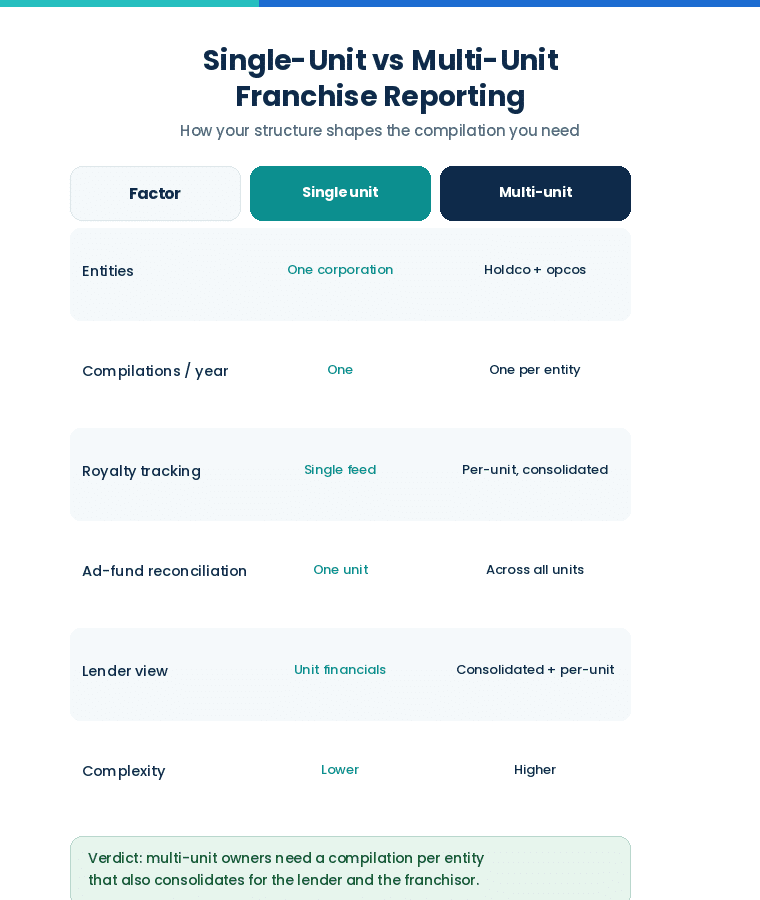
| Factor | Single-unit | Multi-unit |
|---|---|---|
| Entities | One corporation | Holdco plus opcos |
| Compilations per year | One | One per entity |
| Royalty tracking | Single feed | Per-unit, consolidated |
| Ad-fund reconciliation | One unit | Across all units |
| Lender view | Unit financials | Consolidated plus per-unit |
| Complexity | Lower | Higher |
Multi-unit owners usually need a compilation per entity that also consolidates for the lender and franchisor, while a single-unit owner typically needs one. Confirm your structure first, because it drives the count.
A three-unit owner held each location in a separate corporation under a holdco. We prepared a compilation for each opco and a consolidated view at the holdco level so the lender could see the whole group and the franchisor could see each unit. Figures changed for privacy.
DIY vs CPA vs Non-CPA Provider
Compare The Routes
Only a Registered CPA can issue a compilation engagement report, so for franchise statements that a franchisor or lender will rely on, a CPA firm is the route that produces an accepted document. DIY spreadsheets and non-CPA providers cannot issue the report.
| Factor | DIY | CPA firm | Non-CPA provider | Best for |
|---|---|---|---|---|
| Compilation report under CSRS 4200 | Not available | Yes | Not permitted to issue | CPA firm |
| Franchisor acceptance | Low | High | Varies | CPA firm |
| Lender acceptance | Low | High | Varies | CPA firm |
| Royalty and ad-fund reconciliation | Manual, error-prone | Structured | Inconsistent | CPA firm |
| Accountability | None | Registered and regulated | Limited | CPA firm |
For a franchise owner whose franchisor or lender requires year-end statements, a Registered CPA firm is the only route that issues a compilation report those parties will accept.
A franchisee had a non-CPA bookkeeper produce a statement the franchisor rejected because it carried no compilation report. We re-prepared the year-end as a CSRS 4200 compilation, reconciled the royalty line, and the franchisor accepted it. Figures changed for privacy.
How Does the Compilation Process Work?
Seven-Step Workflow
Our franchise compilation runs through seven defined steps, from intake to a finished report, with royalty and ad-fund reconciliation built into the assembly stage. Knowing the steps tells a franchise owner exactly what we need and when.
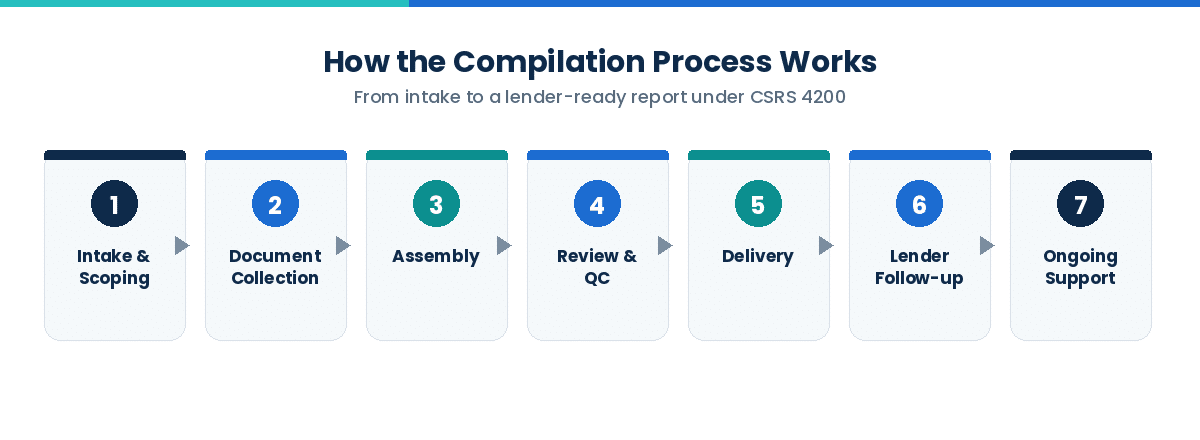
- Intake and scoping: confirm units, entities, and the franchisor’s reporting clause, then issue the engagement letter.
- Document and data collection: gather POS sales, bank statements, royalty and ad-fund records, and prior-year statements.
- Assembly: we compile each entity and reconcile royalties and ad-fund contributions to reported sales.
- Review and quality control: a second-level review checks each unit and the consolidation.
- Delivery: the compilation engagement report is issued and dated for each entity.
- Franchisor and lender follow-ups: we answer questions and supply consolidated views.
- Ongoing support: we keep records ready for the next cycle and the next unit.
| Phase | Duration (illustrative) | Client actions | CPA actions | Outputs |
|---|---|---|---|---|
| Intake and scoping | 1 business day | Share franchise agreement clause | Confirm entities and CSRS 4200 fit | Engagement letter |
| Document collection | 2 business days | Provide POS, bank, royalty records | Request missing items | Checklist complete |
| Assembly | 3 business days | Answer queries | Compile and reconcile royalties | Draft statements |
| Review and QC | 1 business day | None | Second-level review | Reviewed draft |
| Delivery and follow-up | 1 business day | Approve statements | Issue report and consolidate | Final report |
Pro Tip: Export a full year of POS sales by unit before intake. Royalty and ad-fund reconciliation runs on reported sales, and clean POS data is what keeps a multi-unit compilation on schedule.
For a two-unit food franchisee, we received POS exports and royalty statements at intake. Because the sales data was complete, assembly and reconciliation moved straight through, and both units were delivered together without a second document request. Figures changed for privacy.
What Deliverables Do You Get?
Tangible Outputs
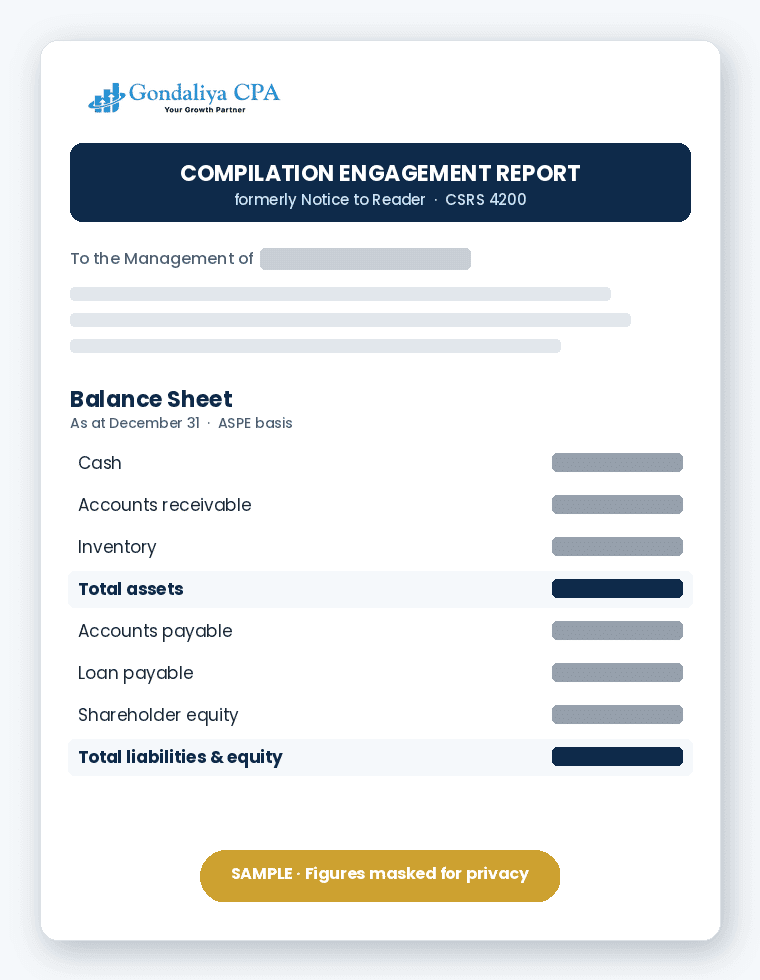
A franchise owner receives a complete financial statement package per entity, with the compilation engagement report, the basis-of-accounting note, and a royalty and ad-fund reconciliation. Multi-unit owners also receive a consolidated view for the lender and franchisor.
| Deliverable | What it is | Who uses it | When delivered |
|---|---|---|---|
| Balance sheet | Assets, liabilities, equity | Lender, franchisor | At delivery |
| Income statement | Revenue and expenses by unit | Owner, lender | At delivery |
| Royalty and ad-fund reconciliation | Fees tied to reported sales | Franchisor | At delivery |
| Basis-of-accounting note | Required CSRS 4200 disclosure | All readers | At delivery |
| Consolidated statements | Group view across units | Lender | At delivery (multi-unit) |
| Compilation engagement report | The CPA report replacing the old NTR | All readers | At delivery |
Our Take: For franchises, the royalty and ad-fund reconciliation is the deliverable that earns its keep. It is the line the franchisor checks first, and getting it right up front prevents a royalty query later.
A multi-unit owner needed both per-unit statements for the franchisor and a consolidated set for the bank. We delivered each opco compilation plus a holdco consolidation in one package, so each reader had exactly the view they required. Figures changed for privacy.
How Much Does a Franchise Compilation Report Cost in Canada?
Transparent Pricing
Gondaliya CPA prepares a compilation (Notice to Reader) financial statement starting at $282.50 per year including HST ($250 plus 13% HST), at a flat fee with no surprise invoices. For multi-unit franchises, each legal entity is its own compilation, so the count of corporations is the main driver. Cleanup, if your books are behind, is quoted separately.
| Driver | What increases cost | How to keep it efficient | Ask the firm |
|---|---|---|---|
| Number of entities | More corporations to compile | Plan structure with your CPA | Is each unit a separate entity? |
| Bookkeeping state | Months of unreconciled data | Close books monthly | Is cleanup quoted separately? |
| POS and sales feeds | Manual sales entry | Use connected POS exports | Do you accept POS data? |
| Consolidation | Group view across units | Keep intercompany clean | Is consolidation included? |
| Timeline | Rush turnaround | Book before franchisor deadlines | What is standard turnaround? |
You can estimate the corporate tax that flows from your compiled statements with our corporate tax calculator.
Franchise Compilation Scope Estimator
See how many year-end compilations your franchise structure points to. No fee shown.
Baseline year-end compilations:
This is a general scope estimate, not a quote or a fee. Your exact scope depends on your structure and franchise agreement. For a fixed quote, please book a free consultation.
A four-unit owner assumed one compilation covered everything. Because each unit sat in its own corporation, the structure pointed to four compilations plus a consolidation for the bank. We mapped the scope at the first call so the flat fee per entity was clear before any work began. Figures changed for privacy.
Risks, CRA Compliance & the 2026 Update
What’s Changing
The biggest franchise risks are royalties that do not reconcile to reported sales, treating one compilation as enough for a multi-entity group, and assuming a compilation can support new-unit financing on its own. The 2026 development below speaks directly to that last point.
2026 Update — proposed CSRS 4250: Canada’s Auditing and Assurance Standards Board has been developing CSRS 4250, a new standard for compilation engagements on future-oriented financial information and pro forma financial information. It completed its final approval read at the Board’s January 2026 meeting, with approval anticipated in spring 2026, and it is not yet in force (CPA Ontario assurance and accounting standards updates, cpaontario.ca). For franchise owners, this matters because projected statements for a new-unit loan or a resale are exactly the future-oriented information CSRS 4250 is designed to cover, and it sits separate from your CSRS 4200 year-end compilation.
Risk Warning: Using a year-end compilation as if it were a projection for a new-unit loan misreads what each engagement does. A compilation reports history with no assurance; projected statements are forward-looking and follow different standards.
| Risk area | What happens if missed | CPA mitigation |
|---|---|---|
| Royalty does not tie to sales | Franchisor query or audit | Reconcile royalties to reported sales |
| One compilation for many entities | Lender rejects the group view | Compile each entity and consolidate |
| Projection treated as a compilation | Financing stalls | Prepare future-oriented statements separately |
| Mixed personal and unit spending | Distorted results and CRA risk | Separate accounts per entity |
| Statements not tying to the T2 | Filing errors and queries | Tie each entity’s statements to its return |
For background only: each franchise corporation’s year-end statements support its T2, which the CRA requires to be filed within six months of the fiscal year-end (Canada Revenue Agency, canada.ca). A compilation has no separate CRA filing date.
A franchisee planning a second location asked us to use the year-end compilation as the basis for the bank’s projection request. We explained the difference, prepared forward-looking statements separately, and kept the year-end compilation for history. The lender received the right document for each purpose. Figures changed for privacy.
What to Prepare Before You Start
Six-Point Checklist
Gather six things before your franchise compilation starts and the engagement moves straight to assembly. The franchise agreement clause and a full year of POS sales matter most, because they drive the royalty and ad-fund reconciliation.
| Item | Why needed | Common mistake | CPA tip |
|---|---|---|---|
| Franchise agreement | Reporting clause and fee terms | Not shared | Send the financial-reporting section |
| POS sales by unit | Royalty and ad-fund base | Partial year | Export the full year per unit |
| 12 months bank statements | Reconcile cash per entity | Missing a month | Download all accounts |
| Royalty and ad-fund records | Tie fees to sales | Omitted | Provide franchisor statements |
| Prior-year statements | Comparatives | Not provided | Include each entity |
| Entity list and structure | Scopes the compilation count | Unclear holdco setup | Map units to corporations |
Want this as a one-pager? You can download the free franchise compilation prep checklist and bring it to your first call.
A franchisee sent the agreement clause, full-year POS exports, and the franchisor’s royalty statements before intake. Because the reconciliation base was ready, we tied royalties to sales on the first pass and delivered without a follow-up request. Figures changed for privacy.
How It Applies Across 10 Franchise Sectors
Industry Spotlights
Franchise reporting looks different by sector, so the compilation focus shifts with the business model. Below are ten sectors we serve, each with the financial detail a franchise compilation most often centres on.
| Sector | Franchise reporting focus | How the compilation helps |
|---|---|---|
| Restaurants and quick-service food | Royalty on high-volume sales | Ties POS sales to royalty and ad fund |
| Retail and e-commerce franchises | Inventory and multi-channel sales | Surfaces stock against reported sales |
| Home-services and trades franchises | Job-based receivables | Reconciles unit revenue to fees |
| Childcare and education franchises | Subsidy and tuition timing (CWELCC) | Shows cash flow against contributions |
| Transportation and courier franchises | Fuel and fleet costs per unit | Tracks cost against unit revenue |
| Real estate brokerage franchises | Commission splits and desk fees | Separates unit income and franchise fees |
| Home-improvement and build franchises | Project work-in-progress | Flags margin per unit and job |
| Service and SaaS-enabled franchises | Recurring revenue per unit | Shows deferred revenue and royalty base |
| Health and wellness clinic franchises | Practitioner mix and fees (OHIP, RCPSC) | Separates unit results from draws |
| Dental and orthodontic franchises | Equipment debt per unit (RCDSO) | Shows loan load against operations |
Related services, please: see our CPA compilation report service page for the full engagement, corporate tax filing for each entity’s T2, bookkeeping cleanup to get unit books ready first, GST/HST filing to stay compliant, and CRA audit resolution if the CRA contacts you.
A quick-service restaurant franchisee reported strong sales, but the compilation tied POS revenue to the royalty and ad-fund lines and showed a small under-remittance from a prior period. We flagged it, the owner corrected it with the franchisor, and the next year reconciled cleanly. Figures changed for privacy.
Pro Tip: Match each unit to its legal entity before year-end. The compilation count follows your corporate structure, so a clean unit-to-entity map is what lets us quote a flat fee per entity with no surprises.
A Realistic Numeric Walkthrough
Flagship Engagement
Here is one multi-unit engagement start to finish: a Toronto franchisee operating three units, each in its own corporation under a holdco, engaged us for year-end compilations and a consolidation. Figures are masked.
| Assumptions | Value |
|---|---|
| Structure | Holdco plus 3 opcos |
| Units | 3 |
| Combined annual sales | $2,100,000 |
| Royalty rate | 6% |
| Ad-fund rate | 2% |
| Monthly transactions per unit | 1,200 |
| Bank accounts across group | 7 |
| Outputs / Deliverables | Detail |
|---|---|
| Compilations issued | 3 opco reports plus 1 consolidation |
| Royalty reconciled | $126,000 across the group |
| Ad-fund reconciled | $42,000 across the group |
| Consolidated net income | $188,000 |
| Basis-of-accounting note | ASPE disclosed, prior-year comparatives shown |
| Turnaround | 8 business days per unit, books current |
Confirm the royalty of $126,000 and ad fund of $42,000 reconcile to each unit’s POS sales, deliver the consolidation to the lender for the group facility, file each opco T2 from its own statements, and keep intercompany balances clean for next year.
This walkthrough reflects a real Toronto multi-unit engagement we completed: three opcos, one holdco, royalties and ad-fund contributions reconciled to POS sales across the group, and a consolidation the bank accepted for a single group facility. Figures changed for privacy.
How to Choose the Right CPA Firm
Buyer’s Guide
Choose a CPA firm on four things: licensing, experience with franchise reporting, fixed pricing per entity, and whether they reconcile royalties and ad-fund contributions as part of the engagement. A firm that has never tied a royalty line to POS sales will slow a multi-unit compilation down.
| Your situation | Complexity (1–5) | Recommended option | Next step |
|---|---|---|---|
| Single unit, clean books | 2 | One compilation | Book intake |
| Franchisor requires statements | 2 | CSRS 4200 compilation | Share the agreement clause |
| Two to four units, separate entities | 4 | Compilation per entity plus consolidation | Map units to corporations |
| Financing a new unit | 4 | Compilation plus projected statements | Confirm lender requirements |
| Behind on unit bookkeeping | 3 | Cleanup then compilation | Request cleanup quote |
Questions to ask on a free consultation: Are you a Registered CPA firm in Ontario? Have you reconciled franchise royalties and ad-fund contributions before? Will each entity get a compilation under CSRS 4200? Do you provide a consolidated view for lenders? Can you prepare projected statements for new-unit financing? Is your fee a flat amount per entity with no surprise invoices? Is cleanup quoted separately? Do you accept POS exports? Will the statements tie to each T2? How do I verify your licence?
A multi-unit owner had used a generalist who treated all three corporations as one file, which the franchisor rejected. We scoped a compilation per entity with a consolidation, reconciled each royalty line, and the franchisor and lender both accepted the package. Figures changed for privacy.
Why Trust Gondaliya CPA
Verifiable Trust Signals
Gondaliya CPA is a fully Registered Ontario CPA firm that works only with incorporated SMBs, including single-unit and multi-unit franchise owners, on a flat fee per entity with no surprise invoices. We compile under CSRS 4200, reconcile royalties and ad-fund contributions, file corporate tax, and represent clients with the CRA.
| Trust signal | What it means for franchise owners |
|---|---|
| Registered Ontario CPA firm | Reports franchisors and lenders accept |
| Business-only focus | Deep incorporated-SMB and franchise experience |
| 1300+ 5-star Google reviews | Consistent client experience |
| 30-Day Money-Back Guarantee | Lowered engagement risk |
| 60-Day Fees-Matching Policy | Fair pricing assurance |
| Flat fee per entity | No surprise invoices across units |
| CRA representation | Support on reviews and queries |
Verify our firm registration on the CPA Ontario public firm directory. Editorial policy: this article was researched against primary Canadian sources, principally CRA, CPA Canada, and CPA Ontario, fact-checked for current standards including the proposed CSRS 4250, reviewed by a CPA, and updated when rules change.
A franchise owner chose us after confirming our registration on CPA Ontario and learning we reconcile royalties as standard. Combined with a flat fee per entity, that franchise-specific experience is why they moved their group of units to our firm. Figures changed for privacy.
People Also Ask
Adjacent Questions
Do franchise owners need a compilation report in Canada? Many do. Franchise agreements and lenders routinely require year-end financial statements, and a compilation report under CSRS 4200 produces statements both accept. It also reconciles royalties and ad-fund contributions to reported sales, which the franchisor checks.
How many compilation reports does a multi-unit franchise need? Usually one per legal entity. If each unit is its own corporation, each needs its own compilation, plus a consolidated view for the lender or franchisor. If all units sit in one company, one compilation covers the operation.
Does a compilation report verify my royalty payments? A compilation reconciles royalties and ad-fund contributions to reported sales, so the figures are organized and traceable. It does not audit them, since a compilation gives no assurance, but it makes the royalty base clear for the franchisor.
What is the difference between a compilation and an audit for a franchise? A compilation organizes your statements with no assurance, while an audit verifies them and provides an opinion. Most franchisors accept a compilation for year-end reporting; only some lenders or agreements require a review or audit.
Can a compilation report help me finance a new franchise unit? A year-end compilation supports a lender’s view of history, but new-unit financing often needs projected statements too. Those forward-looking statements fall under the proposed CSRS 4250 and are prepared separately from your year-end compilation.
What financial records does a franchise compilation require? The franchise agreement clause, a full year of POS sales by unit, bank statements, royalty and ad-fund records, prior-year statements, and your entity structure. These let the CPA reconcile fees to sales and scope the compilation count.
Is a compilation report enough for my franchisor? For most franchisors, a CSRS 4200 compilation that reconciles royalties and the ad fund to sales is enough. Always check the financial-reporting clause in your agreement, since a minority require a review or audit.
How is franchise accounting different from regular business accounting? Franchise accounting adds royalty and ad-fund tracking tied to reported sales, franchisor reporting clauses, and often multi-entity structures. A compilation organizes all of this into statements the franchisor, lender, and CRA can each use.
A franchisee asked whether one compilation could cover three corporations. We explained each entity needs its own, then delivered three compilations and a consolidation. The franchisor reviewed each unit and the lender reviewed the group, from the same package. Figures changed for privacy.
Frequently Asked Questions
Your Questions Answered
A franchise compilation report is structured financial statements a CPA assembles under CSRS 4200 with no assurance, with royalties and ad-fund contributions reconciled to reported sales. The questions below cover what franchise owners ask us most.
Why does my franchisor ask for a compilation report?+
Do I need a separate compilation for each franchise unit?+
Does the compilation reconcile my royalties and ad-fund?+
Will a compilation work for financing a new unit?+
Is a compilation the same as an audit for franchise reporting?+
How fast can you compile multi-unit franchise statements?+
What does a franchise compilation cost?+
Do you serve franchise owners outside Toronto?+
A franchisee asked whether we could handle units in two provinces from Toronto. We worked from their cloud bookkeeping and POS exports, compiled each entity, and consolidated for the lender, all remotely. Distance did not change the deliverable. Figures changed for privacy.
Get Your Franchise Compilation Scoped and Quoted
Book a free consultation and we will map your units to entities, scope the compilations, and quote a flat fee. Weekend and evening support available. Call 647-212-9559 or email info@gondaliyacpa.ca.
Glossary of Key Terms
Plain-English Definitions
- Compilation engagement: A CPA assembles financial statements without assurance under CSRS 4200.
- CSRS 4200: The Canadian standard governing compilation engagements since periods ending on or after December 14, 2021.
- CSRS 4250: A proposed 2026 standard for compilation engagements on future-oriented and pro forma financial information, not yet in force.
- Royalty: A fee a franchisee pays the franchisor, usually a percentage of reported sales.
- Ad fund: A franchise advertising-fund contribution, usually a percentage of reported sales.
- Pro forma statements: Adjusted or hypothetical statements showing a situation as if certain events had occurred.
- Future-oriented financial information: Projected statements about expected future results, used for financing.
- Holdco and opco: A holding company that owns operating companies, a common multi-unit franchise structure.
- Consolidation: Combining the statements of multiple entities into one group view.
- ASPE: Accounting Standards for Private Enterprises, a common basis for SMB statements.
- T2: The annual corporate income tax return every Canadian corporation must file.
Next Steps — How to Engage Gondaliya CPA
If you want your franchise statements scoped, compiled, and reconciled, share your franchise agreement clause, a full year of POS sales by unit, and your entity structure so we can map the compilation count. Getting started takes one short conversation, with no obligation. Call 647-212-9559 or email info@gondaliyacpa.ca.

Sharad Gondaliya is a CPA Canada & CPA USA with 15 Years+ experience of Accounting, Tax, Payroll of Corporate Small Businesses as Tax Accountant. He is a CPA Ontario member (61040184) and holds US CPA licences in Washington and Montana and is well known among corporate small businesses for tax planning, efficient tax solutions, and affordable CPA services. Sharad is the Principal (Director) of Gondaliya CPA – Affordable CPA Firm in Canada. Licenses: CPA Ontario: 61040184 | CPA USA (MT): PAC-CPAP-LIC-033176 | CPA USA (WA): 57629 | CPA Firm License: 61330051 View Full Author Bio