



How a CPA Compilation Report Can Speed Up Business Loan Approvals in Canada
Quick Summary
A compilation report speeds up loan approval because it hands the lender the document they ask for first: year-end financial statements prepared by a Registered CPA under CSRS 4200. The statements are structured, consistent, and recognizable to an underwriter, which cuts back-and-forth, supports the credit decision, and keeps your application moving.
| Aspect | Details |
|---|---|
| Why it speeds approval | Lenders receive CPA-prepared statements they recognize, reducing follow-up requests during underwriting. |
| What lenders accept | For most small-business loans, a compilation is enough; larger or covenant-heavy loans may need a review or audit. |
| Who it’s for | Incorporated businesses applying for a term loan, line of credit, equipment finance, or commercial mortgage. |
| Important caveat | A compilation expresses no assurance; it organizes your figures but does not verify them, which most SMB lenders accept. |
Reading time: 22 minutes.
Table of Contents
- What Is a CPA Compilation Report?
- How Does It Speed Up Loan Approval?
- Compilation vs Review vs Audit: What Lenders Accept
- DIY vs CPA vs Non-CPA Provider
- How Does the Compilation Process Work?
- What Deliverables Do You Get?
- How Much Does It Cost in Canada?
- Risks, CRA Compliance & the 2026 Update
- What to Prepare Before You Apply
- How It Applies Across 10 Industries
- A Realistic Numeric Walkthrough
- How to Choose the Right CPA Firm
- Why Trust Gondaliya CPA
- People Also Ask
- Frequently Asked Questions
- Glossary of Key Terms
Loan-Ready at a Glance
This article covers Canada, with Ontario context, and reflects CRA rules and CSRS 4200 in effect for the 2026 period. The proposed CSRS 4250 is noted as a 2026 development, not yet in force. Any figure marked “figures changed for privacy” is masked from a real engagement. This is educational information only and not tax, legal, or financial advice.
What Is a CPA Compilation Report?
Definition & Scope
A CPA compilation report is a set of financial statements a Registered CPA assembles from your records and presents under CSRS 4200 with no assurance attached. For a loan application, it converts your bookkeeping into a balance sheet and income statement a lender’s underwriter recognizes and can work from.
The standard took effect for periods ending on or after December 14, 2021, replacing the old Section 9200 Notice to Reader. The CPA does not audit or review the numbers, but a compilation report from a Registered firm carries credibility a self-made spreadsheet does not, which is what helps move a credit file.
| Topic | Included? | Why it matters for a loan |
|---|---|---|
| Balance sheet and income statement | Yes | The core documents a lender reviews |
| Prior-year comparatives | Yes | Lenders look for a trend, not one year |
| Basis-of-accounting note | Yes | Required CSRS 4200 disclosure |
| Audit or review opinion | No | A compilation gives no assurance |
| Verification of your numbers | No | The CPA organizes, does not test |
Key Stat: CSRS 4200 has governed every Canadian compilation engagement since December 14, 2021, and it introduced the compilation engagement report that lenders now see in place of the old Notice to Reader.
A client applying for an equipment loan had only spreadsheet statements the bank kept questioning. We compiled the year-end under CSRS 4200 with prior-year comparatives, and the lender accepted the package on the first submission. The credit file moved without another statement request. Figures changed for privacy.
How Does It Speed Up Loan Approval?
The Core Answer
A compilation report speeds up loan approval by giving the underwriter the exact document they ask for, in the format they expect, on the first submission. Recognizable CPA-prepared statements reduce clarification requests, which is where most loan files lose time.
Underwriting slows down when a lender has to chase missing or inconsistent figures. A compilation removes that friction: the statements are structured, the prior year is shown for trend, and the basis of accounting is disclosed. The file arrives complete, so the credit team can assess it rather than rebuild it.
| Loan stage | What slows it down | What a compilation changes |
|---|---|---|
| Document intake | Spreadsheets the bank questions | CPA statements the bank recognizes |
| Underwriting | Missing prior-year trend | Comparatives shown on the statements |
| Credit review | Unclear basis of accounting | Basis disclosed in the note |
| Conditions | Repeated statement requests | Complete package up front |
| Funding | Back-and-forth delays | Fewer follow-ups, faster decision |
Pro Tip: Ask your lender which engagement level they require before you apply. Many SMB loans accept a compilation; some covenant-heavy facilities ask for a review. Knowing this up front avoids preparing the wrong document.
A business applied for a line of credit and stalled twice on statement requests. We delivered a CSRS 4200 compilation with comparatives, and the underwriter cleared the financial condition in one pass. The time lost to back-and-forth on the prior attempts did not repeat. Figures changed for privacy.
Compilation vs Review vs Audit: What Lenders Accept
The Top Comparison
For most small-business loans in Canada, a CPA compilation is the statement lenders accept; reviews and audits are usually reserved for larger, covenant-heavy, or regulated financing. Your loan size and the lender’s policy decide which level you need.
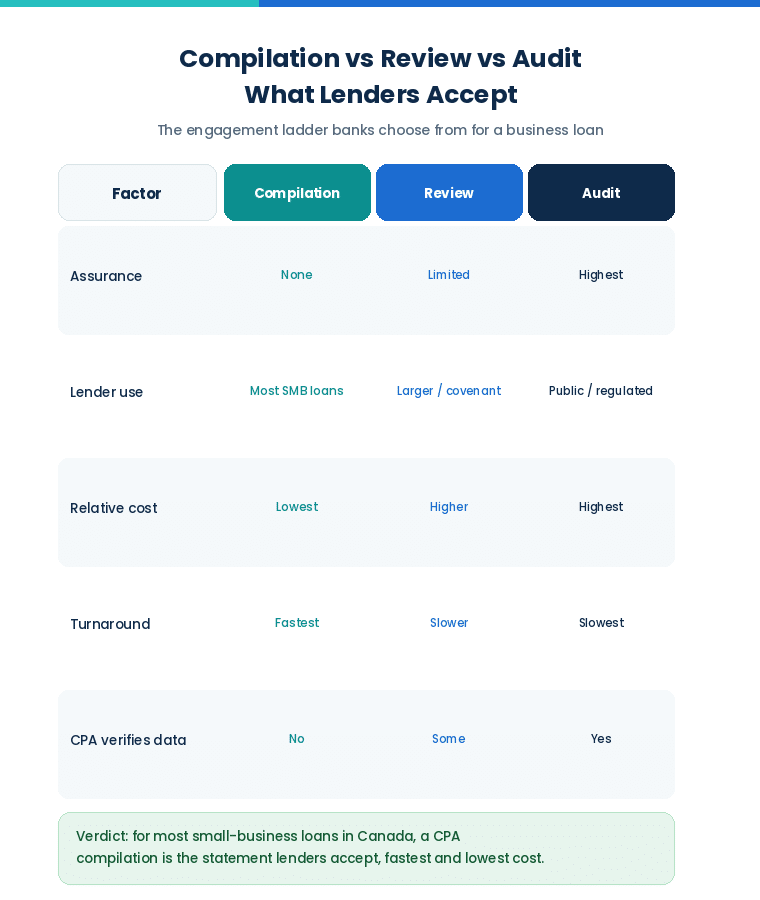
| Factor | Compilation | Review | Audit |
|---|---|---|---|
| Assurance | None | Limited | Highest |
| Typical lender use | Most SMB loans | Larger or covenant loans | Public or regulated |
| Relative cost | Lowest | Higher | Highest |
| Turnaround | Fastest | Slower | Slowest |
| CPA verifies data | No | Some procedures | Yes |
For a typical incorporated SMB seeking a term loan or line of credit, a compilation is the fastest, lowest-cost statement the lender will accept. Confirm with your lender, then step up to a review only if they require it.
Our Take: Most owners over-prepare or under-prepare because they never asked the lender which level is required. One question at the start saves the cost of an audit you did not need, or the delay of submitting a spreadsheet that gets rejected.
A client assumed the bank wanted an audit for a modest term loan and was bracing for the cost. We confirmed with the lender that a compilation met their policy, prepared it under CSRS 4200, and the loan proceeded. The owner avoided an engagement they did not need. Figures changed for privacy.
DIY vs CPA vs Non-CPA Provider
Compare The Routes
Only a Registered CPA can issue a compilation engagement report, so for statements a lender will rely on, a CPA firm is the route that produces an accepted document. DIY spreadsheets and non-CPA providers cannot issue the report a bank looks for.
| Factor | DIY | CPA firm | Non-CPA provider | Best for |
|---|---|---|---|---|
| Compilation report under CSRS 4200 | Not available | Yes | Not permitted to issue | CPA firm |
| Lender acceptance | Low | High | Varies | CPA firm |
| Speed through underwriting | Slow, many questions | Faster, recognized format | Inconsistent | CPA firm |
| CRA-readiness | Low | High | Medium | CPA firm |
| Accountability | None | Registered and regulated | Limited | CPA firm |
For any business that wants its loan application to move quickly, a Registered CPA firm is the route that issues a compilation report the lender accepts and underwrites without rebuilding.
An owner submitted self-prepared statements for a commercial mortgage and the file stalled on repeated questions. We re-prepared the year-end as a CSRS 4200 compilation, the lender recognized the format, and the application advanced. The DIY route had cost weeks. Figures changed for privacy.
How Does the Compilation Process Work?
Seven-Step Workflow
Our compilation runs through seven defined steps, from intake to a lender-ready report, and the goal at every step is a package the bank accepts without follow-up. Knowing the steps tells you exactly what to gather before you apply.
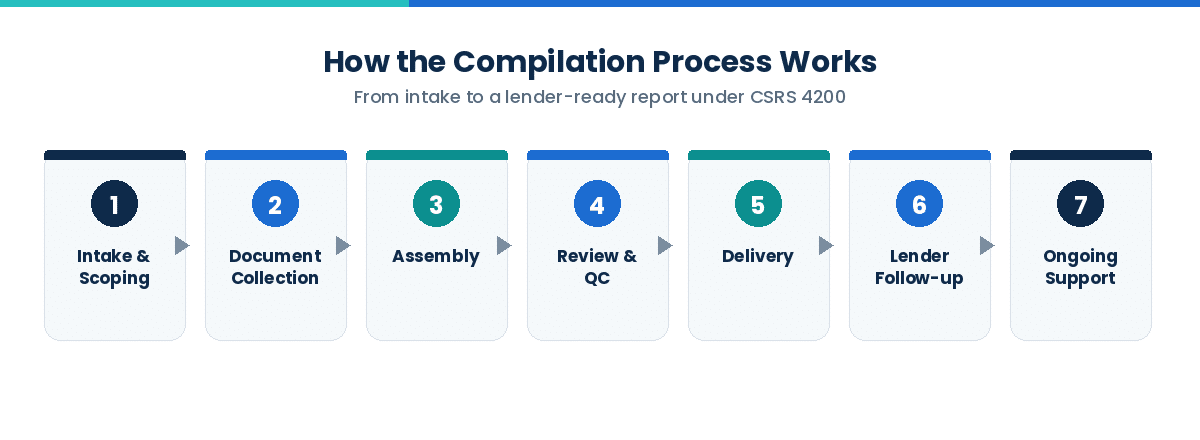
- Intake and scoping: confirm the lender’s required engagement level and deadline, then issue the engagement letter.
- Document and data collection: gather bank statements, ledgers, and prior-year statements.
- Assembly: we compile the statements with prior-year comparatives the lender expects.
- Review and quality control: a second-level review checks the draft before it goes out.
- Delivery: the compilation engagement report is issued and dated for your application.
- Lender follow-ups: we answer underwriter questions and supply supporting detail.
- Ongoing support: we keep records ready for the next facility or renewal.
| Phase | Duration (illustrative) | Client actions | CPA actions | Outputs |
|---|---|---|---|---|
| Intake and scoping | 1 business day | Confirm lender requirement | Confirm engagement level | Engagement letter |
| Document collection | 2 business days | Share statements and ledgers | Request missing items | Checklist complete |
| Assembly | 3 business days | Answer queries | Compile with comparatives | Draft statements |
| Review and QC | 1 business day | None | Second-level review | Reviewed draft |
| Delivery and follow-up | 1 business day | Submit to lender | Issue report and support file | Final report |
Pro Tip: Start the compilation before you submit the loan application, not after the lender asks. A finished report in hand at application is what shortens the timeline, because the bank never has to wait on it.
A client booked the compilation a week before applying for a term loan. Because the report was ready at submission, the lender opened underwriting with the financials already in hand and did not pause to request them. The early start removed the usual wait. Figures changed for privacy.
What Deliverables Do You Get?
Tangible Outputs
You receive a complete financial statement package built for a lender: a balance sheet, an income statement, prior-year comparatives, the basis-of-accounting note, and the compilation engagement report required under CSRS 4200. Together they form the financials a bank reviews.
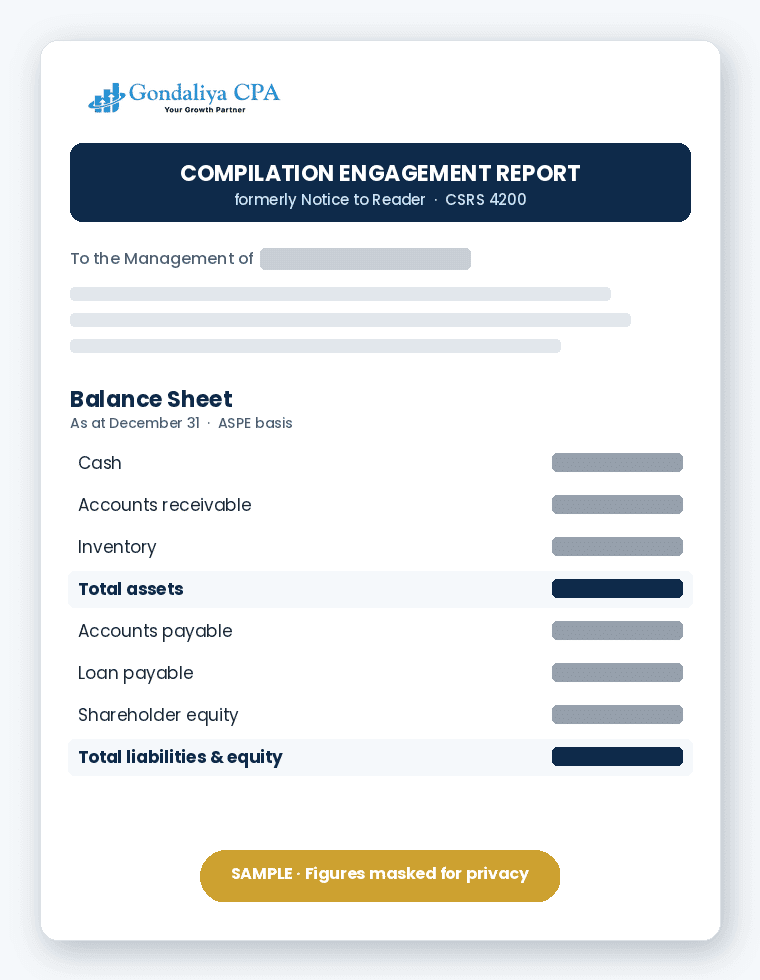
| Deliverable | What it is | Who uses it | When delivered |
|---|---|---|---|
| Balance sheet | Assets, liabilities, equity | Lender underwriter | At delivery |
| Income statement | Revenue and expenses | Lender, owner | At delivery |
| Prior-year comparatives | Last year beside this year | Lender, for trend | At delivery |
| Basis-of-accounting note | Required CSRS 4200 disclosure | All readers | At delivery |
| Compilation engagement report | The CPA report replacing the old NTR | Lender, CRA | At delivery |
Our Take: For a loan, prior-year comparatives are the deliverable that does the quiet work. A lender wants to see direction, not a single snapshot, and two years side by side is what answers that without a follow-up question.
A client’s lender asked for two years of financials mid-application. Because our compilation already presented prior-year comparatives, we forwarded the existing package and the request was satisfied the same day, with no rework. Figures changed for privacy.
How Much Does a CPA Compilation Report Cost in Canada?
Transparent Pricing
Gondaliya CPA prepares a compilation (Notice to Reader) financial statement starting at $282.50 per year including HST ($250 plus 13% HST), at a flat fee with no surprise invoices. For a loan application, that flat fee buys the document the lender accepts, often far less than the cost of a delayed or declined facility. Cleanup, if your books are behind, is quoted separately.
| Driver | What increases cost | How to keep it efficient | Ask the firm |
|---|---|---|---|
| Bookkeeping state | Months of unreconciled data | Close books before applying | Is cleanup quoted separately? |
| Transaction volume | High monthly transaction count | Use connected bank feeds | Is volume a fee factor? |
| Number of accounts | Many bank and credit accounts | Consolidate where possible | How many accounts are included? |
| Prior-year data | No comparatives available | Provide last year’s statements | Will you show year-over-year? |
| Timeline | Rush before a loan deadline | Start before you apply | What is standard turnaround? |
You can estimate the corporate tax that flows from your compiled statements with our corporate tax calculator.
Loan Document Readiness Checker
Answer six quick questions to see how loan-ready your financials are. No fee shown.
Documents ready:
This is a general readiness check, not a loan assessment or a quote. For lender-ready statements, please book a free consultation.
A client booked a compilation at our flat fee specifically to support a loan. The same statements satisfied the bank and supported the T2 filing, so one engagement covered both needs. The lender accepted the package without a separate request. Figures changed for privacy.
Risks, CRA Compliance & the 2026 Update
What’s Changing
The main loan risks are submitting self-made statements a lender rejects, treating a compilation as if it carried assurance, and assuming a year-end report covers the projection a lender asks for. The 2026 development below speaks to that last point.
2026 Update — proposed CSRS 4250: Canada’s Auditing and Assurance Standards Board has been developing CSRS 4250, a new standard for compilation engagements on future-oriented financial information and pro forma financial information. It completed its final approval read at the Board’s January 2026 meeting, with approval anticipated in spring 2026, and it is not yet in force (CPA Ontario assurance and accounting standards updates, cpaontario.ca). For a loan, this matters because the forecast or projection a lender requests is exactly the future-oriented information CSRS 4250 is designed to cover, and it sits separate from your CSRS 4200 year-end compilation.
Risk Warning: Presenting a compilation to a lender as if it verified your numbers misstates what it does. A compilation gives no assurance; claiming otherwise can undermine the credibility the report is meant to provide.
| Risk area | What happens if missed | CPA mitigation |
|---|---|---|
| Self-made statements submitted | Lender rejects or questions them | Issue a CSRS 4200 compilation |
| Compilation treated as assured | Misrepresents the report | State no assurance clearly |
| Projection treated as a compilation | Financing stalls | Prepare future-oriented statements separately |
| Stale or unfiled tax | Lender flags non-compliance | File the T2 and tie statements to it |
| Books behind at application | Delays the whole file | Reconcile before applying |
For background only: your year-end statements support the T2, which the CRA requires to be filed within six months of the fiscal year-end (Canada Revenue Agency, canada.ca). Lenders often ask to see that recent filings are current.
A client’s lender asked for a forward forecast alongside the year-end statements. We explained the year-end compilation reports history with no assurance, then prepared the projection separately. The lender received the right document for each purpose and the file moved forward. Figures changed for privacy.
What to Prepare Before You Apply
Six-Point Checklist
Gather six things before you apply and your loan file arrives complete. Current year-end statements and prior-year comparatives matter most, because the lender wants both the position and the trend on the first submission.
| Item | Why needed | Common mistake | CPA tip |
|---|---|---|---|
| Year-end compilation | The core lender document | Submitting spreadsheets | Have it ready at application |
| Two years of statements | Shows the trend | Only one year provided | Include prior-year comparatives |
| 12 months bank statements | Reconcile and support cash | Missing a month | Download all accounts |
| Recent T2 filed | Shows tax compliance | Stale or unfiled return | File before applying |
| Reconciled bookkeeping | Statements tie out | Books behind | Close the books first |
| Forecast if requested | Some lenders ask | Treating it as the compilation | Prepare it separately |
Want this as a one-pager? You can download the free loan document readiness checklist and bring it to your first call.
A client gathered the compilation, two years of comparatives, and bank statements before approaching the bank. Because the file was complete at application, the lender did not pause for documents, and the financial condition cleared in a single review. Figures changed for privacy.
How It Applies Across 10 Industries
Industry Spotlights
Loan applications look different by sector, so the financials a lender focuses on shift with the business model. Below are ten industries we serve and the financing detail a compilation most often supports for each.
| Industry | Financing focus | How the compilation helps |
|---|---|---|
| Physician professional corporations | Equipment and practice loans (OHIP, RCPSC) | Shows stable income for the lender |
| Dentists and dental practices | Operatory and fit-out financing (RCDSO) | Presents debt against operations |
| Daycare and CWELCC services | Expansion and facility loans | Shows subsidy-supported cash flow |
| Real estate investors and holdcos | Commercial mortgages | Presents holdings and carrying costs |
| Property developers and builders | Construction and project finance | Shows project margins to lenders |
| Construction and skilled trades | Equipment and working-capital loans | Presents receivables and backlog |
| Technology startups and SaaS | Growth and venture debt | Shows recurring revenue and runway |
| E-commerce and online retailers | Inventory and expansion financing | Presents inventory against sales |
| Restaurants and food and beverage | Build-out and equipment loans | Shows margins and cash flow |
| Transportation and logistics | Fleet and equipment finance | Presents asset base and costs |
Related services, please: see our CPA compilation report service page for the full engagement, corporate tax filing for your T2, bookkeeping cleanup to get your books ready before applying, GST/HST filing to stay compliant, and CRA audit resolution if the CRA contacts you.
Pro Tip: Match your compilation timing to your application timeline. Lenders want the most recent year-end on file, so a report finished close to application carries more weight than one that is a year stale.
A transportation client needed fleet financing and the lender wanted to see the asset base clearly. The compiled balance sheet presented the equipment and the related debt in a form the underwriter could assess directly, and the financing advanced. Figures changed for privacy.
A Realistic Numeric Walkthrough
Flagship Engagement
Here is one engagement start to finish: a Toronto incorporated wholesaler applying for a $250,000 term loan engaged us to prepare lender-ready statements. Figures are masked.
| Assumptions | Value |
|---|---|
| Entity type | Incorporated CCPC |
| Loan requested | $250,000 term loan |
| Annual revenue | $1,150,000 |
| Monthly transactions | 820 |
| Bank and credit accounts | 4 |
| Prior-year statements | Available |
| Books status | Reconciled to month-end |
| Outputs / Deliverables | Detail |
|---|---|
| Compilation issued | Year-end statements under CSRS 4200 |
| Comparatives | Two prior years shown for trend |
| Balance sheet | Assets $612,000; liabilities $268,000; equity $344,000 |
| Income statement | Revenue $1,150,000; net income $142,000 |
| Basis-of-accounting note | ASPE disclosed |
| Turnaround | 8 business days, books current |
Submit the compilation with two years of comparatives at application, confirm the lender does not require a review for this loan size, keep books reconciled so the figures hold up under questions, and prepare a short forecast only if the lender asks.
This walkthrough reflects a real Toronto engagement we completed: a wholesaler seeking a term loan, statements compiled with two years of comparatives, and a package the lender accepted at submission. The financial condition cleared without a repeat request. Figures changed for privacy.
How to Choose the Right CPA Firm
Buyer’s Guide
Choose a CPA firm on four things: licensing, experience with lender-ready statements, fixed pricing, and turnaround that fits your loan timeline. A firm that delivers late or in a format the bank questions defeats the purpose.
| Your situation | Complexity (1–5) | Recommended option | Next step |
|---|---|---|---|
| Small term loan, clean books | 2 | Compilation with comparatives | Book intake |
| Line of credit application | 2 | Compilation under CSRS 4200 | Confirm lender requirement |
| Larger or covenant loan | 4 | Confirm if a review is required | Ask the lender first |
| Books behind before applying | 3 | Cleanup then compilation | Request cleanup quote |
| Lender asks for a forecast | 4 | Compilation plus projection | Scope both separately |
Questions to ask on a free consultation: Are you a Registered CPA firm in Ontario? Will my statements be a compilation engagement report under CSRS 4200? Do you show prior-year comparatives lenders want? What is your turnaround to a finished report? Can you start before my loan deadline? Is your fee a flat amount with no surprise invoices? Is cleanup quoted separately? Can you prepare a forecast if my lender asks? Will the statements tie to my T2? How do I verify your licence?
A borrower came to us after a firm delivered statements too late for the loan window. We confirmed the deadline at intake, prioritized the file, and delivered a CSRS 4200 compilation in time for submission. Meeting the timeline was as important to the client as the document itself. Figures changed for privacy.
Why Trust Gondaliya CPA
Verifiable Trust Signals
Gondaliya CPA is a fully Registered Ontario CPA firm that works only with incorporated SMBs, on a flat annual fee with no surprise invoices. We compile under CSRS 4200, prepare statements lenders accept, file corporate tax, and represent clients with the CRA.
| Trust signal | What it means for borrowers |
|---|---|
| Registered Ontario CPA firm | Statements lenders rely on |
| Business-only focus | Deep incorporated-SMB expertise |
| 1300+ 5-star Google reviews | Consistent client experience |
| 30-Day Money-Back Guarantee | Lowered engagement risk |
| 60-Day Fees-Matching Policy | Fair pricing assurance |
| Flat, fixed annual pricing | No surprise invoices |
| CRA representation | Support on reviews and filings |
Verify our firm registration on the CPA Ontario public firm directory. Editorial policy: this article was researched against primary Canadian sources, principally CRA, CPA Canada, and CPA Ontario, fact-checked for current standards including the proposed CSRS 4250, reviewed by a CPA, and updated when rules change.
CPA Ontario | US CPA licences in Washington and Montana | Registered Ontario CPA Firm | 1300+ 5-star Google reviews | CPA Ontario Membership Number: 61040184 | CPA Firm Registration Number: 61330051
A borrower chose us after confirming our registration on CPA Ontario and learning we deliver lender-ready statements on a fixed fee and a firm timeline. That combination of a verifiable licence and reliable turnaround is why they engaged us for their financing. Figures changed for privacy.
People Also Ask
Adjacent Questions
Do banks require a compilation report for a business loan in Canada? Many do. For most small-business loans, a Canadian lender asks for year-end financial statements prepared by a CPA, which a compilation under CSRS 4200 provides. Larger or covenant-heavy loans may require a review or audit instead.
Will a compilation report help me get approved faster? A compilation can speed approval by giving the lender recognizable, CPA-prepared statements on the first submission, which reduces follow-up requests. It does not guarantee approval, since the lender still assesses the numbers, the business, and the credit risk.
What financial statements do lenders want for a loan? Lenders typically want a balance sheet, an income statement, and prior-year comparatives, prepared by a CPA. A compilation engagement report under CSRS 4200 packages these in the format underwriters recognize, alongside recent tax filings and bank statements.
Is a compilation report enough, or do I need an audit? For most small-business loans, a compilation is enough. Audits are usually reserved for public companies, regulated entities, or large covenant-heavy facilities. Ask your lender which engagement level their policy requires before you prepare anything.
How long does it take to get a compilation for a loan? With current, reconciled books, many compilations are ready within five to ten business days. The main delay is bookkeeping cleanup, which is quoted separately. Starting before you apply keeps the report from becoming the bottleneck.
Can a compilation report be used for a forecast the lender wants? No. A compilation reports historical results with no assurance. A forecast or projection is forward-looking and is prepared separately. The proposed CSRS 4250, a 2026 development, is the standard aimed at that future-oriented information.
Does my business loan need recent tax filings too? Usually yes. Lenders often want to see that your most recent T2 is filed and that statements tie to it. Current filings signal compliance, and a compilation that ties to the return supports a cleaner application.
What if my bookkeeping is behind when I apply? Behind books are the most common cause of loan-file delays. Reconcile and close the period first, then compile. Submitting incomplete or unreconciled figures usually triggers lender questions that stall the whole application.
A borrower asked whether a compilation alone would get them approved. We explained it supports the application by giving the lender the document they expect, but the credit decision is still theirs. We prepared the statements, and the file proceeded on its merits. Figures changed for privacy.
Frequently Asked Questions
Your Questions Answered
A compilation report is structured financial statements a CPA assembles under CSRS 4200 with no assurance, and for a loan it gives the lender the document they ask for in a recognizable form. The questions below cover what borrowers ask us most.
How exactly does a compilation speed up my loan approval?+
Does a compilation guarantee I get the loan?+
Will my bank accept a compilation, or do they want an audit?+
Should I get the compilation before or after I apply?+
What if the lender asks for a forecast as well?+
Do prior-year comparatives really matter to a lender?+
My books are behind. Can I still apply soon?+
Do you serve borrowers outside Toronto?+
A borrower asked whether to apply first and add statements later. We advised preparing the compilation up front, delivered it before the application, and the lender opened the file with the financials already in hand. The early start kept the financials off the critical path. Figures changed for privacy.
Get Lender-Ready Statements Before You Apply
Book a free consultation and we will prepare a compilation your lender accepts, in time for your application. Weekend and evening support available. Call 647-212-9559 or email info@gondaliyacpa.ca.
Glossary of Key Terms
Plain-English Definitions
- Compilation engagement: A CPA assembles financial statements without assurance under CSRS 4200.
- CSRS 4200: The Canadian standard governing compilation engagements since periods ending on or after December 14, 2021.
- CSRS 4250: A proposed 2026 standard for compilation engagements on future-oriented and pro forma financial information, not yet in force.
- Underwriting: The lender’s process of assessing a loan application and its credit risk.
- Covenant: A condition in a loan agreement the borrower must meet, sometimes requiring a review or audit.
- Prior-year comparatives: Last year’s figures shown beside this year’s so a lender can read the trend.
- Future-oriented financial information: Projected statements about expected future results, used for financing.
- Basis of accounting: The accounting framework used, disclosed in a required note.
- ASPE: Accounting Standards for Private Enterprises, a common basis for SMB statements.
- Assurance: An audit or review opinion; a compilation provides none.
- T2: The annual corporate income tax return every Canadian corporation must file.
Next Steps — How to Engage Gondaliya CPA
If you want lender-ready statements before you apply, gather twelve months of bank statements and your prior-year financials so we can compile a complete package. Getting started takes one short conversation, with no obligation. Call 647-212-9559 or email info@gondaliyacpa.ca.

Sharad Gondaliya is a CPA Canada & CPA USA with 15 Years+ experience of Accounting, Tax, Payroll of Corporate Small Businesses as Tax Accountant. He is a CPA Ontario member (61040184) and holds US CPA licences in Washington and Montana and is well known among corporate small businesses for tax planning, efficient tax solutions, and affordable CPA services. Sharad is the Principal (Director) of Gondaliya CPA – Affordable CPA Firm in Canada. Licenses: CPA Ontario: 61040184 | CPA USA (MT): PAC-CPAP-LIC-033176 | CPA USA (WA): 57629 | CPA Firm License: 61330051 View Full Author Bio