



How Corporate Tax Planning at Year-End Can Help Reduce Taxes for Canadian Businesses
Quick Summary
Year-end corporate tax planning is the work a CPA does before your fiscal year closes to lower the tax your corporation pays, legally and within CRA rules. It covers the salary and dividend mix, timing of deductions and purchases, protecting the small business deduction on the first $500,000 of active income, and managing passive investment income. Once the year closes, most of these levers are gone.
| Aspect | Details |
|---|---|
| What it does | Sets owner pay, times deductions, and protects the small business rate before year-end. |
| Why timing matters | Most planning levers only work before the fiscal year closes, not after the books are locked. |
| Who it’s for | Incorporated Canadian businesses (CCPCs) wanting to reduce corporate tax within CRA rules. |
| Important caveat | Planning reduces tax through legitimate strategy; it is not tax evasion and offers no guaranteed dollar saving. |
Reading time: 23 minutes.
Table of Contents
- What Is Year-End Corporate Tax Planning?
- How Does Year-End Planning Reduce Taxes?
- Salary vs Dividends: Which Saves More?
- DIY vs CPA vs Non-CPA Provider
- How Does the Year-End Planning Process Work?
- What Deliverables Do You Get?
- How Much Does It Cost in Canada?
- Risks, CRA Compliance & the 2026 Update
- What to Prepare Before Year-End
- How It Applies Across 10 Industries
- A Realistic Numeric Walkthrough
- How to Choose the Right CPA Firm
- Why Trust Gondaliya CPA
- People Also Ask
- Frequently Asked Questions
- Glossary of Key Terms
Year-End Tax Planning at a Glance
This article covers Canada, with Ontario context, and reflects CRA and Ontario rules in effect for the 2026 tax year, including the 2026 Ontario Budget small-business rate cut. Any figure marked “figures changed for privacy” is masked from a real engagement, and rates are cited to government sources. This is educational information only and not tax, legal, or financial advice.
What Is Year-End Corporate Tax Planning?
Definition & Scope
Year-end corporate tax planning is the work a CPA does before your fiscal year closes to lower the tax your corporation pays, using legitimate strategies within CRA rules. For an incorporated Canadian business, it means deciding how to pay the owner, what to deduct, and how to protect the small business rate, while there is still time to act.
Once the fiscal year closes, most levers are fixed. Planning before year-end is what lets you set a salary and dividend mix, accelerate a deduction, or time a capital purchase. After the books are locked, the corporation files what already happened.
| Topic | Part of year-end planning? | Why it matters |
|---|---|---|
| Salary and dividend mix | Yes | Sets owner tax and RRSP room |
| Timing of deductions and purchases | Yes | Shifts expense into the right year |
| Small business deduction planning | Yes | Protects the lower rate on active income |
| Passive investment income review | Yes | Avoids grinding the small business limit |
| Tax evasion or hiding income | No | Illegal and not part of planning |
Key Stat: A CCPC pays the combined small business rate on the first $500,000 of active business income, which in Ontario was 12.2% until June 30, 2026 and is 11.2% from July 1, 2026 (Ontario Ministry of Finance, ontario.ca). Year-end planning protects access to that rate.
We reviewed a Toronto corporation six weeks before its year-end. Active income was approaching the small business limit, so we planned a year-end bonus to the owner that kept active income under the threshold and used the owner’s RRSP room. The plan was set before the books closed, not after. Figures changed for privacy.
How Does Year-End Planning Reduce Taxes?
The Core Answer
Year-end planning reduces taxes by using legitimate levers before the fiscal year closes: setting the owner’s pay mix, timing deductions and capital purchases, protecting the small business deduction, and managing passive income so the lower corporate rate is not ground down. Each lever has to be pulled before year-end to count.
The table below lists the main levers a CPA reviews, what each one does, and the rule behind it. None of these guarantees a dollar saving; the right combination depends on your numbers and your goals.
| Lever | What it does | The rule behind it |
|---|---|---|
| Salary and dividend mix | Balances corporate and personal tax | Salary is deductible; dividends are after-tax |
| Owner bonus accrual | Lowers active income to the limit | Accrued bonus deductible if paid within 179 days |
| Timing capital purchases | Claims depreciation sooner | Capital cost allowance on assets in use |
| Protecting the SBD | Keeps income at the lower rate | Small business deduction up to $500,000 |
| Managing passive income | Avoids grinding the SBD limit | Limit reduced over $50,000 passive income |
| RRSP room from salary | Builds personal tax-deferred savings | Salary creates RRSP contribution room |
CRA Deadline: An accrued owner bonus is deductible in the year only if it is paid within 179 days of the corporation’s fiscal year-end (CRA, canada.ca). Declare it before year-end, then pay it inside that window.
Risk Warning: Passive investment income above $50,000 in a CCPC begins to grind the $500,000 small business limit, eliminating it at $150,000 of passive income (CRA, canada.ca). Ignoring this at year-end can quietly push active income to the 26.5% general rate.
A corporation had built up investment income inside the company without realizing it was grinding the small business limit. We flagged it before year-end, adjusted the holding approach for the following year, and protected the lower rate on the active business income. Figures changed for privacy.
Salary vs Dividends: Which Saves More?
The Top Comparison
Neither salary nor dividends is always cheaper; the right mix depends on your cash needs, RRSP goals, and whether you want to pay into CPP. Salary is deductible to the corporation and creates RRSP room; dividends are simpler and skip CPP but come from after-tax profit.
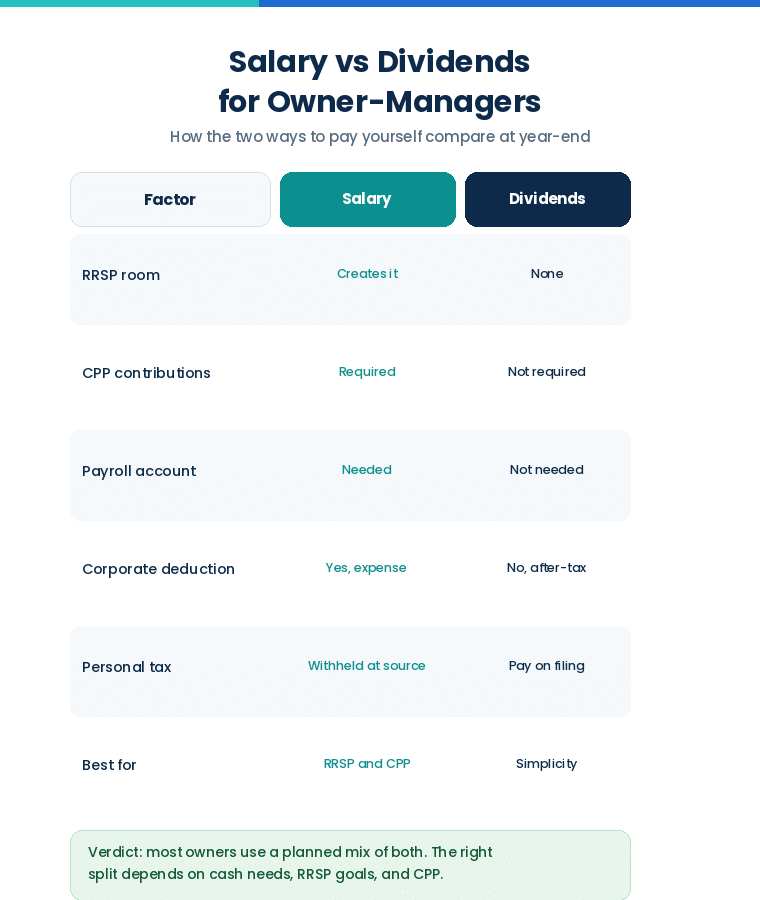
| Factor | Salary | Dividends |
|---|---|---|
| RRSP room | Creates it | None |
| CPP contributions | Required | Not required |
| Payroll account | Needed | Not needed |
| Corporate deduction | Yes, an expense | No, paid after tax |
| Personal tax | Withheld at source | Paid on filing |
| Best for | Building RRSP and CPP | Simplicity and flexibility |
Most owner-managers use a planned mix of salary and dividends rather than one or the other. The right split depends on how much cash you need personally, whether you want RRSP room and CPP, and your overall tax picture.
Our Take: The salary-versus-dividend question rarely has a single right answer. We model both for each owner against their cash needs and RRSP goals, because the best mix this year may not be the best mix next year.
An owner had taken only dividends for years and had no RRSP room. We modelled a salary and dividend mix at year-end that created RRSP room and kept the overall tax close to before, giving the owner a tax-deferred savings option they had been missing. Figures changed for privacy.
DIY vs CPA vs Non-CPA Provider
Compare The Routes
A Registered CPA is the route that combines year-end planning with the T2 filing and stands behind the advice. DIY risks missing levers that only work before year-end, and a non-CPA provider may file the return without doing the planning that reduces the tax.
| Factor | DIY | CPA firm | Non-CPA provider | Best for |
|---|---|---|---|---|
| Year-end planning before close | Often missed | Built in | Sometimes | CPA firm |
| Salary and dividend modelling | Guesswork | Modelled | Varies | CPA firm |
| SBD and passive-income planning | Easily missed | Reviewed | Inconsistent | CPA firm |
| T2 filing accountability | None | Registered and regulated | Limited | CPA firm |
| CRA representation | None | Yes | Rarely | CPA firm |
For an incorporated business that wants to reduce tax and file correctly, a Registered CPA firm is the route that plans before year-end, models the owner’s pay, and files the T2 with accountability.
A business self-filed for two years and never planned the owner’s pay or timed purchases. When we took over, we ran a pre-year-end review, set a salary and dividend mix, and timed an equipment purchase into the right year. The planning happened before close, where it counts. Figures changed for privacy.
How Does the Year-End Planning Process Work?
Seven-Step Workflow
Our year-end planning runs through seven defined steps, starting with a pre-year-end review while there is still time to act and ending with a plan for next year. Each step maps to a decision that affects the tax your corporation pays.
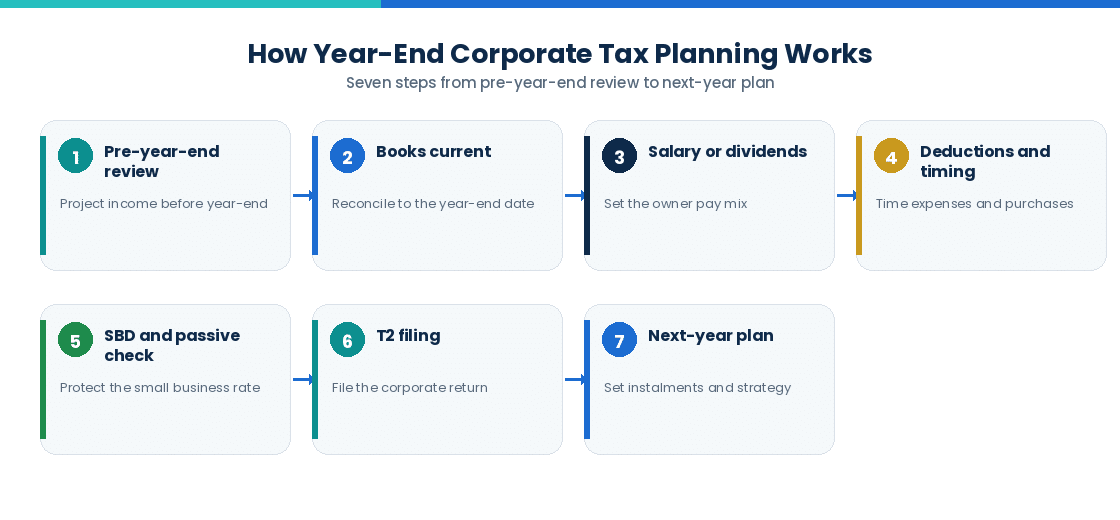
- Pre-year-end review: project income before the fiscal year closes, while levers are still available.
- Books current: reconcile the bookkeeping to the year-end date so projections are accurate.
- Salary or dividends: set the owner’s pay mix for the year.
- Deductions and timing: time eligible expenses and capital purchases into the right year.
- SBD and passive check: confirm the small business deduction is protected.
- T2 filing: prepare and file the corporate return from the planned position.
- Next-year plan: set instalments and a strategy for the coming year.
| Phase | Timing (illustrative) | Client actions | CPA actions | Outputs |
|---|---|---|---|---|
| Pre-year-end review | 6 weeks before year-end | Share projected numbers | Project income and tax | Planning options |
| Books current | 2 business days | Provide ledgers and statements | Reconcile to year-end | Updated books |
| Pay and timing decisions | 1 business day | Confirm cash needs | Model salary and dividends | Owner pay plan |
| T2 preparation | 3 business days | Approve the plan | Prepare the return | Draft T2 |
| Filing and next-year plan | 1 business day | Sign off | File and set instalments | Filed T2 and plan |
Pro Tip: Book the pre-year-end review about six weeks before your fiscal year closes. That window is long enough to set the owner’s pay, time a purchase, and adjust passive income while the levers still work.
A client engaged us two months before year-end. The pre-year-end review showed income tracking just over the small business limit, so we planned a bonus and a deductible purchase before close. By filing time, the position was already set and the return simply reported it. Figures changed for privacy.
What Deliverables Do You Get?
Tangible Outputs
You receive a clear year-end plan and the filed return that puts it into effect: a tax-plan summary with the owner pay mix and year-end actions, the prepared and filed T2, and an instalment plan for next year. The deliverables turn the planning into action.
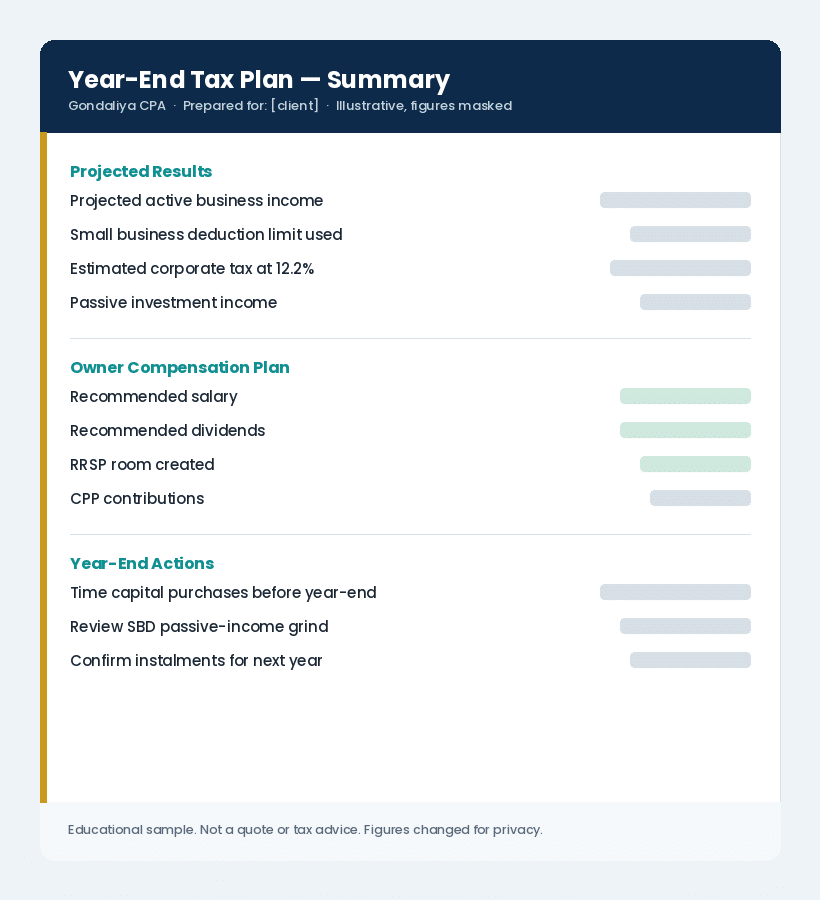
| Deliverable | What it is | Who uses it | When delivered |
|---|---|---|---|
| Year-end tax-plan summary | Owner pay mix and year-end actions | Owner | Before year-end |
| Salary and dividend recommendation | The planned pay split | Owner, payroll | Before year-end |
| Prepared T2 return | The corporate income tax filing | CRA | At filing |
| Instalment plan | Next year’s payment schedule | Owner | After filing |
| Supporting workpapers | The calculations behind the plan | Owner, CRA if asked | At filing |
Pro Tip: Ask for the plan summary before year-end, not just the filed return after. The summary is what lets you act on the salary mix and the timing while the decisions still change your tax.
A client received a one-page year-end plan summary setting the salary and dividend split and two timing actions. They acted on it before close, and the filed T2 simply reflected the plan. Having the summary early was what made the actions possible. Figures changed for privacy.
How Much Does Corporate Year-End Tax Planning Cost in Canada?
Transparent Pricing
Gondaliya CPA prices year-end work as a flat annual fee with no surprise invoices, and the compiled year-end financial statements start at $282.50 per year including HST ($250 plus 13% HST); the corporate tax planning and T2 filing are quoted to your corporation’s size. The fee buys planning that can reduce tax, often far more than the fee itself.
| Driver | What increases cost | How to keep it efficient | Ask the firm |
|---|---|---|---|
| Bookkeeping state | Months of unreconciled data | Keep books current | Is cleanup quoted separately? |
| Number of owners | Multiple shareholders to model | Confirm cash needs early | Is each owner’s pay modelled? |
| Passive investments | Investment income to review | Track passive income | Do you review the SBD grind? |
| Multiple entities | Associated corporations | Map the group structure | Is the group limit shared? |
| Timing | Last-minute, near year-end | Start six weeks ahead | What is your planning lead time? |
You can estimate the corporate tax on your active income with our corporate tax calculator.
Year-End Tax-Saving Opportunity Finder
Answer six quick questions to see which planning areas are worth reviewing before year-end. No fee shown.
Planning areas flagged:
This is a general prompt, not tax advice or a quote. Your actual opportunities depend on your full situation. For a real review, please book a free consultation.
A corporation engaged us for year-end planning at a flat fee. We modelled the owner’s pay, protected the small business rate, and timed a purchase before close. The planning identified more in tax reduction than the fee itself, set out clearly before the year ended. Figures changed for privacy.
Risks, CRA Compliance & the 2026 Update
What’s Changing
The main risks are planning too late to act, grinding the small business limit with passive income, and confusing legitimate planning with aggressive schemes the CRA challenges. The 2026 changes below directly affect year-end decisions, so they belong in this year’s plan.
2026 Update — Ontario small-business rate cut and capital gains confirmed: The 2026 Ontario Budget reduces the Ontario small business corporate tax rate from 3.2% to 2.2% on the first $500,000 of active business income, effective July 1, 2026, bringing the combined federal-Ontario small business rate from 12.2% to 11.2% (Ontario Ministry of Finance, ontario.ca). Corporations whose fiscal year straddles July 1, 2026 apply a blended rate, which is a year-end planning point. Separately, the proposed increase to the capital gains inclusion rate was cancelled, so the rate stays at 50% in 2026, while the Lifetime Capital Gains Exemption is $1,275,000 for 2026 now that indexation has resumed (Department of Finance Canada and Canada Revenue Agency, canada.ca).
Risk Warning: Leaving passive investment income unmanaged is the quiet risk. Once it passes $50,000 in a CCPC, it grinds the $500,000 small business limit, and at $150,000 the limit is gone, pushing active income to the 26.5% general rate (CRA, canada.ca).
| Risk area | What happens if missed | CPA mitigation |
|---|---|---|
| Planning after year-end | Levers no longer available | Pre-year-end review six weeks out |
| Passive income grind | Small business rate lost | Track and manage passive income |
| Wrong salary or dividend mix | Higher overall tax | Model both for each owner |
| Straddle year-end rate change | Blended rate miscalculated | Apply the July 1, 2026 blend correctly |
| Aggressive schemes | CRA challenge and penalties | Use only legitimate planning |
For background only: the planned year-end position is reported on the T2, which the CRA requires to be filed within six months of the fiscal year-end (Canada Revenue Agency, canada.ca). Planning happens before close; filing happens after.
A corporation with a fiscal year crossing July 1, 2026 was unsure how the Ontario rate cut applied. We calculated the blended small business rate for the straddle year so the right rate applied to each part of the period, and built it into the year-end plan. Figures changed for privacy.
What to Prepare Before Year-End
Six-Point Checklist
Gather six things before your fiscal year closes and the planning can actually change your tax. Projected income and your cash needs matter most, because they drive the salary and dividend mix and the timing decisions.
| Item | Why needed | Common mistake | CPA tip |
|---|---|---|---|
| Projected income to year-end | Drives every planning decision | Waiting until after close | Estimate six weeks out |
| Your personal cash needs | Sets the salary and dividend mix | Not knowing the number | Decide how much you need |
| Current bookkeeping | Accurate projections | Books behind | Reconcile to date |
| Passive investment income | Checks the SBD grind | Ignored until filing | Track it through the year |
| Planned purchases or bonuses | Timing into the right year | Decided too late | List them before close |
| Prior-year T2 and notices | Carryforwards and instalments | Not provided | Share last year’s return |
Want this as a one-pager? You can download the free year-end tax planning checklist and bring it to your first call.
A client came in six weeks before year-end with projected income, their cash needs, and a list of planned purchases. Because the inputs were ready, we set the salary mix and timed two purchases the same week, before the year closed. Figures changed for privacy.
How It Applies Across 10 Industries
Industry Spotlights
Year-end tax planning looks different by sector, so the levers that matter most shift with the business model. Below are ten industries we serve and the planning focus each one most often needs.
| Industry | Year-end planning focus | How planning helps |
|---|---|---|
| Physician professional corporations | Salary, dividends, and retained earnings (OHIP, RCPSC) | Sets owner pay and defers tax |
| Dentists and dental practices | Equipment timing and CCA (RCDSO) | Times purchases for depreciation |
| Daycare and CWELCC services | Grant timing and active income | Protects the small business rate |
| Real estate holdcos and investors | Passive income and the SBD grind | Manages investment income |
| Property developers and builders | Project income recognition | Times income across years |
| Construction and skilled trades | Equipment and vehicle purchases | Claims CCA in the right year |
| Technology startups and SaaS | Losses, SR&ED, and owner pay | Uses credits and sets pay |
| E-commerce and online retailers | Inventory and income timing | Times deductions and stock |
| Restaurants and food and beverage | Equipment and active income | Plans purchases and owner pay |
| Transportation and logistics | Fleet purchases and CCA | Times asset buys for depreciation |
Related services, please: see our corporate tax planning service page, corporate tax filing for your T2, bookkeeping cleanup to get your books ready first, GST/HST filing to stay compliant, and CRA audit resolution if the CRA contacts you.
Pro Tip: If you operate more than one corporation, remember the $500,000 small business limit is shared across the associated group. Year-end planning across the group avoids two companies both claiming a full limit they cannot both have.
A trades corporation planned to buy a vehicle just after year-end. We showed that purchasing and putting it in use before close let the company claim capital cost allowance a full year earlier, so the owner moved the purchase forward by two weeks. Figures changed for privacy.
A Realistic Numeric Walkthrough
Flagship Example
Here is how a year-end plan can come together for a Toronto CCPC: set the owner’s pay mix, keep active income under the small business limit, and time a purchase before close. The figures below are illustrative and masked; planning could reduce tax, but no saving is guaranteed.
| Assumptions (illustrative) | Figure |
|---|---|
| Active business income before pay | $540,000 |
| Owner’s personal cash need | $120,000 |
| Passive investment income | $0 |
| Small business limit | $500,000 |
| Combined small business rate (Ontario, 2026) | 11.2% |
The corporation’s active income is $540,000, which is $40,000 over the small business limit. Without planning, that $40,000 is taxed at the 26.5% general rate. We plan a $40,000 deductible bonus to the owner before year-end, bringing active income to exactly $500,000, all taxed at the 11.2% small business rate.
The bonus also forms part of the owner’s salary, creating RRSP room, and the rest of the owner’s $120,000 cash need is met with a planned dividend. The exact salary and dividend split is modelled to the owner’s situation.
| Outputs (illustrative) | Result |
|---|---|
| Active income after bonus | $500,000 |
| Income taxed at general 26.5% rate | $0 |
| Corporate tax at 11.2% on $500,000 | $56,000 |
| RRSP room created by salary | Yes |
| Owner cash need met | $120,000 |
Our Take: The lever here was timing. The same bonus paid one day after year-end does nothing for the closing year. Paid before close, it kept $40,000 at the lower rate and built the owner’s RRSP room.
Next steps for this situation:
- Confirm projected active income six weeks before year-end.
- Decide the owner’s personal cash need for the year.
- Model the salary and dividend split, please.
- Pay any planned bonus before the fiscal year closes.
- File the T2 reflecting the planned position.
We ran this kind of plan for a Toronto corporation sitting just over the small business limit. A year-end bonus brought active income back to the limit and built the owner’s RRSP room, while a planned dividend met the rest of their cash need. The plan was set before close. Figures changed for privacy.
How to Choose the Right CPA Firm
Buyer’s Guide
Choose a Registered CPA firm that plans before year-end, models the owner’s pay, files the T2, and quotes a flat fee with no surprises. The right firm starts the conversation weeks before your year closes, not at filing time.
| Your situation | What to look for | Why it matters |
|---|---|---|
| Income near the SBD limit | Pre-year-end planning | Protects the lower rate |
| Owner takes all dividends | Salary and dividend modelling | May be missing RRSP room |
| Investment income in the corp | Passive-income review | Avoids the SBD grind |
| Multiple corporations | Group planning | Shared $500,000 limit |
| Wants budget certainty | Flat annual fee | No surprise invoices |
Questions to ask on a free consultation:
- How far before year-end do you start planning?
- Do you model both salary and dividends for each owner?
- How do you protect the small business deduction?
- Do you review passive investment income?
- Is the T2 filing included in the fee?
- How do you handle multiple associated corporations?
- Is your fee a flat annual amount including HST?
- Will you set instalments for next year?
- Are you a Registered Ontario CPA firm I can verify?
- Who reviews the plan before it is finalized?
Pro Tip: Ask one question first: “How far before year-end do you start planning?” A firm that answers “at filing time” cannot do most of the planning that reduces your tax. The levers are gone by then.
An owner interviewed us alongside a firm that only filed returns. We walked through a pre-year-end review and showed the levers still available before close. They chose planning over filing-only, and we set the owner’s pay mix that year. Figures changed for privacy.
Why Trust Gondaliya CPA
E-E-A-T & Editorial Policy
Gondaliya CPA is a Registered Ontario CPA firm that works only with incorporated businesses, plans before year-end, files the T2, and charges a flat annual fee with no surprise invoices. Our work is verifiable on the CPA Ontario public firm directory.
| Trust signal | What it means for you | Where it matters |
|---|---|---|
| Registered Ontario CPA firm | Regulated, verifiable advice | Planning and T2 filing |
| Business-only focus | Deep corporate experience | CCPC tax planning |
| Flat annual fee | No surprise invoices | Budget certainty |
| CRA representation | We deal with the CRA for you | Reviews and questions |
| 1300+ 5-star Google reviews | Consistent client experience | Choosing a firm |
| 30-Day Money-Back Guarantee | Confidence in the service | Engaging us |
You can verify our firm on the CPA Ontario public firm directory. We are dual-credentialed in Canada and the USA (Washington and Montana), which supports cross-border business tax work where relevant.
Editorial policy: This article was researched against CRA and Ontario government sources, fact-checked, and reviewed by a Registered CPA. Rates and rules are cited to government pages and updated when they change.
CPA Ontario | US CPA licences in Washington and Montana | Registered Ontario CPA Firm | 1300+ 5-star Google reviews
A new client checked our licence on the CPA Ontario directory before their first call, then asked about our flat-fee model and the 30-day guarantee. We confirmed both, scoped the year-end plan, and started the pre-year-end review the same week. Figures changed for privacy.
People Also Ask
Quick Answers
These are common questions Canadian business owners search about year-end corporate tax planning, each answered on its own.
Is corporate tax planning legal in Canada? Yes. Tax planning uses legitimate strategies, such as setting the owner’s pay mix and timing deductions, to reduce tax within CRA rules. It is different from tax evasion, which is hiding income or falsifying records and is illegal.
When should year-end tax planning happen? Before your fiscal year closes, ideally about six weeks ahead. Most levers, such as a bonus, a salary mix, or a timed purchase, only work before close. After the year ends, the corporation files what already happened.
What is the small business deduction? The small business deduction lowers the corporate tax rate on the first $500,000 of active business income for a CCPC. In Ontario it gives a combined rate of 12.2% in 2026, falling to 11.2% on July 1, 2026.
Should I pay myself salary or dividends? Most owners use a mix. Salary is deductible and builds RRSP room and CPP; dividends are simpler and skip CPP but come from after-tax profit. The right split depends on your cash needs and goals.
What is passive investment income’s effect on my corporation? Passive investment income over $50,000 in a CCPC grinds the $500,000 small business limit, and at $150,000 the limit is gone, pushing active income to the 26.5% general rate.
Did the capital gains inclusion rate change for 2026? No. The proposed increase to two-thirds was cancelled, so the inclusion rate stays at 50% in 2026. The Lifetime Capital Gains Exemption is $1,275,000 for 2026 and is indexed to inflation each year.
How does the 2026 Ontario rate cut affect year-end? Ontario’s small business rate falls from 3.2% to 2.2% on July 1, 2026, taking the combined rate from 12.2% to 11.2%. Corporations with a year-end straddling that date apply a blended rate.
Can I do year-end tax planning myself? You can, but it is easy to miss levers that only work before close, such as the salary mix, passive-income planning, and the small business deduction. A Registered CPA models these and files the T2 with accountability.
An owner asked whether planning was even worth it for a small corporation. We ran a short pre-year-end review and found two levers worth using before close. They were glad they asked before the year ended rather than after. Figures changed for privacy.
Frequently Asked Questions
FAQ
Short answers to the questions we hear most about corporate year-end tax planning in Canada.
| Question | Short answer |
|---|---|
| Is planning the same as filing? | No. Planning happens before year-end; filing reports it after. |
| What rate applies to small business income? | 12.2% combined in Ontario in 2026, falling to 11.2% on July 1, 2026. |
| What is the small business limit? | $500,000 of active business income for a CCPC. |
| Do you file the T2 too? | Yes, the planning and the T2 filing go together. |
| Is the fee flat? | Yes, a flat annual fee with no surprise invoices. |
| Do you serve clients outside Toronto? | Yes, across Ontario and Canada, entirely virtually. |
A first-time caller asked most of these same questions before engaging us. We answered each one, scoped a flat annual fee, and booked the pre-year-end review on the call. Having the questions ready made the first conversation efficient. Figures changed for privacy.
When is the best time to start year-end tax planning?+
About six weeks before your fiscal year closes. That window lets us project income, set the owner’s salary and dividend mix, and time any purchases or bonuses while the levers still work. After the year closes, most planning options are gone and the corporation simply files what happened.
Will planning guarantee I pay less tax?+
No. Planning uses legitimate strategies that can reduce tax, but no specific saving is guaranteed. The result depends on your numbers, your cash needs, and the choices you make before year-end. We model the options and show you the position before you decide.
What is the difference between salary and dividends?+
Salary is deductible to the corporation and creates RRSP room and CPP, with tax withheld at source. Dividends come from after-tax profit, skip CPP, and need no payroll account, with tax paid on filing. Most owners use a planned mix of both.
How does passive income affect my small business rate?+
Passive investment income over $50,000 in a CCPC reduces the $500,000 small business limit, and at $150,000 the limit is eliminated, so active income is taxed at the 26.5% general rate instead of the lower small business rate. We review this before year-end.
Do I need to be in Toronto to work with you?+
No. We serve incorporated businesses across Ontario and Canada entirely virtually. Documents are shared through our secure portal, and planning calls happen by phone or video, including evenings and weekends. Your corporation does not need to be in the same city as your CPA.
What does the 2026 Ontario rate cut mean for me?+
Ontario’s small business corporate tax rate drops from 3.2% to 2.2% on July 1, 2026, taking the combined federal-Ontario small business rate from 12.2% to 11.2% on the first $500,000 of active income. If your fiscal year crosses July 1, 2026, a blended rate applies, which we calculate for you.
Can you help if my bookkeeping is behind?+
Yes. Accurate planning needs current books, so we can bring your bookkeeping up to date first, then run the year-end plan. Bookkeeping cleanup is quoted separately so you know the cost before we start. Getting the books current is often the first step.
How much does year-end tax planning cost?+
We charge a flat annual fee with no surprise invoices, quoted to your corporation’s size. The compiled year-end financial statements start at $282.50 per year including HST, and the planning and T2 filing are quoted on top. Please ask for a quote on a free consultation.
Plan your year-end before the books close
Gondaliya CPA helps incorporated Canadian businesses reduce corporate tax with year-end planning, T2 filing, and a flat annual fee. Please book a free consultation and bring your numbers.
Glossary of Key Terms
Plain-English Definitions
- Corporate tax planning: Using legitimate strategies before year-end to reduce the tax a corporation pays within CRA rules.
- Year-end: The date a corporation’s fiscal year closes, after which most planning levers are fixed.
- CCPC: A Canadian-Controlled Private Corporation, the status that unlocks the small business deduction.
- Small business deduction (SBD): A reduction that lowers the corporate tax rate on the first $500,000 of active business income.
- Active business income: Income from a corporation’s regular operations, eligible for the small business rate.
- Passive investment income: Income from investments inside a corporation, which can grind the small business limit.
- Salary: Deductible owner pay that creates RRSP room and CPP, with tax withheld at source.
- Dividends: Owner pay from after-tax corporate profit, with no CPP and no payroll account.
- Capital cost allowance (CCA): The tax depreciation a corporation claims on capital assets in use.
- Capital gains inclusion rate: The portion of a capital gain that is taxable, 50% in 2026.
- Lifetime Capital Gains Exemption (LCGE): An exemption of up to $1,275,000 on qualifying small business shares.
- T2 return: The federal corporate income tax return every incorporated business files with the CRA.
Next Steps
Year-end corporate tax planning works best before your fiscal year closes, while you can still set the owner’s pay, time deductions, and protect the small business rate. Gondaliya CPA plans before close, files your T2, and charges a flat annual fee with no surprise invoices. Please reach out for a free consultation, call 647-212-9559, or email info@gondaliyacpa.ca. If our content helps, please add gondaliyacpa.ca as a preferred source on Google.
Published: June 24, 2026 · Last updated: June 24, 2026
Disclaimer: This article is educational information only and is not tax, legal, or financial advice. It reflects CRA and Ontario rules for the 2026 tax year, including the 2026 Ontario Budget small-business rate cut effective July 1, 2026, and the capital gains inclusion rate of 50%. No outcome or saving is guaranteed; tax planning reduces tax through legitimate strategy, not evasion. Tax rules change and depend on your situation. Please consult a Registered CPA in Canada or Ontario before acting. Fees are subject to applicable taxes.

Sharad Gondaliya is a CPA Canada & CPA USA with 15 Years+ experience of Accounting, Tax, Payroll of Corporate Small Businesses as Tax Accountant. He is a CPA Ontario member (61040184) and holds US CPA licences in Washington and Montana and is well known among corporate small businesses for tax planning, efficient tax solutions, and affordable CPA services. Sharad is the Principal (Director) of Gondaliya CPA – Affordable CPA Firm in Canada. Licenses: CPA Ontario: 61040184 | CPA USA (MT): PAC-CPAP-LIC-033176 | CPA USA (WA): 57629 | CPA Firm License: 61330051 View Full Author Bio