



The Ultimate Guide to Corporate Year-End Accounting and T2 Filings in Canada
Corporate Year-End Accounting and T2 Filing Canada: A Complete Guide by Gondaliya CPA
Corporate year-end accounting and T2 filing Canada are critical for accurate corporate tax return Canada submissions. Gondaliya CPA offers clear guidance on corporation income tax return and small business taxes, including transparent flat fee options.
The starting point is knowing which deadline applies to what, because the payment date, the filing date and the remittance dates are all different. Corporate year-end accounting and filings begin with getting those straight.
Quick Summary
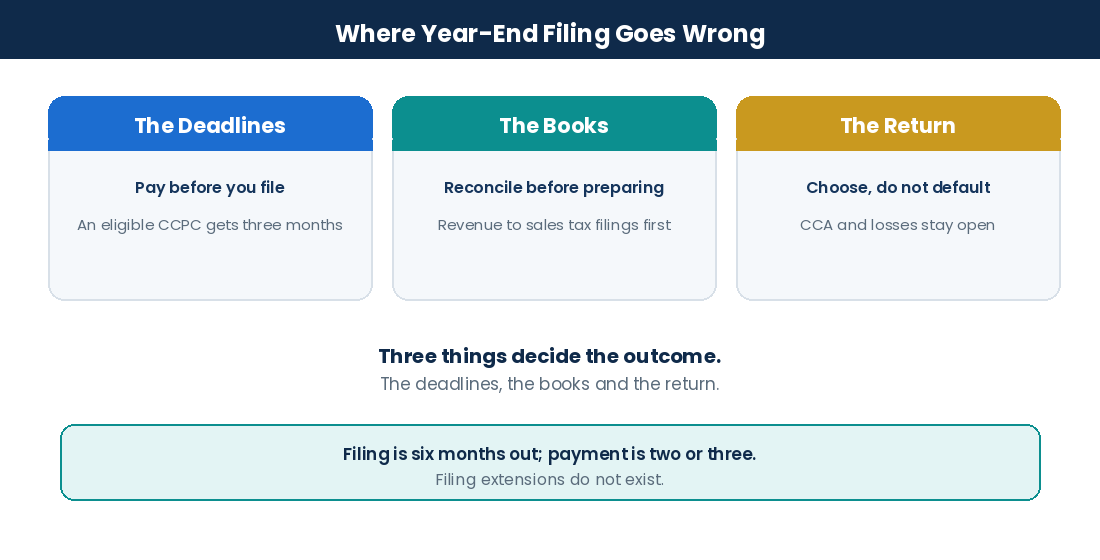
A corporate year-end has three clocks: the balance is due two or three months after year end, the return is due at six months, and payroll and sales tax run on their own schedules entirely. Most guidance collapses these into one date, and one common version has the two-and-three-month rule backwards.
Reading time: 52 minutes.
Table of Contents
The Numbers That Matter
This article covers Canada, with Ontario and Toronto context, and reflects rules current to 2026. It is written for incorporated Canadian businesses, principally Canadian-controlled private corporations. Figures marked illustrative are examples, not quotes, and any masked engagement notes end with “Figures changed for privacy.” This is educational information only and not tax or legal advice. Corporate registry filings, annual returns to the incorporating jurisdiction and licensing sit with those authorities rather than with the CRA.
Three Clocks, Not One
Three Clocks, Not One
The Deadlines
The Correction That Matters Most
The balance owing is due before the return is. That much most guidance gets right. What it frequently reverses is which corporations get the longer period.
| Corporation | Balance Due |
|---|---|
| An eligible CCPC claiming the small business deduction | Three months after year end |
| Other corporations | Two months after year end |
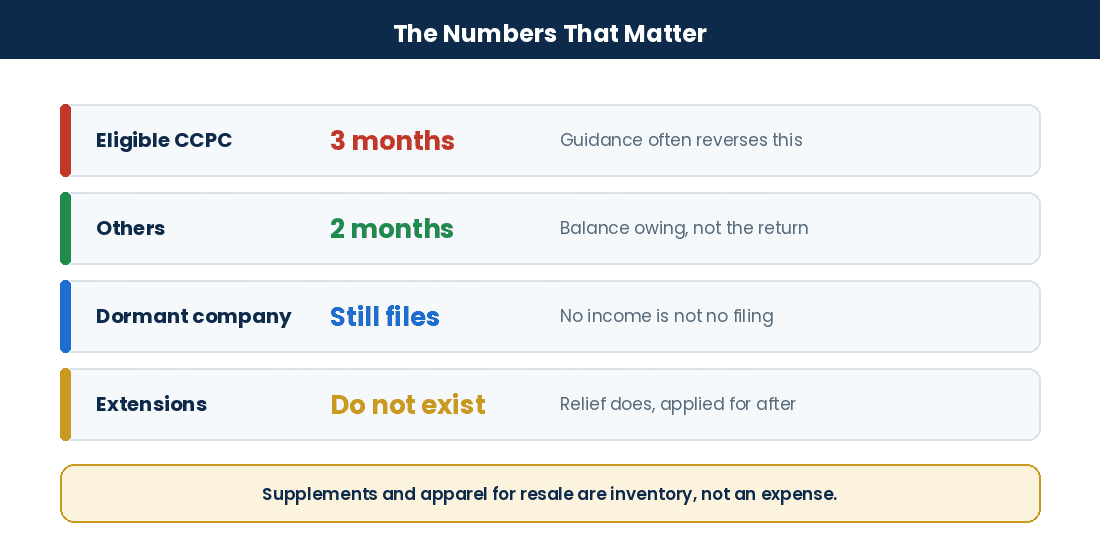
Guidance stating that CCPCs pay in two months while other corporations get three has it exactly backwards. The extended period is a concession to smaller corporations, not a restriction on them.
If you have been working from that version, please check your own position. Paying a month early costs nothing; paying a month late costs interest.
The Three Clocks
| Obligation | Runs From | Deadline |
|---|---|---|
| Corporate balance owing | Fiscal year end | Three months for an eligible CCPC, otherwise two |
| T2 return | Fiscal year end | Six months |
| Corporate instalments | Through the year | Monthly, or quarterly if eligible |
| Payroll remittances | Pay dates | Per your remitter type |
| T4 and T5 slips | Calendar year | Last day of February |
| GST/HST return | Your reporting period | Per the period assigned |
Note that payroll and slips run on the calendar year regardless of your fiscal year end. A corporation with a September year end still files T4s by the end of February.
The Late-Filing Penalty
The penalty is 5% of the unpaid tax plus 1% for each complete month the return is late, to a maximum of twelve months.
Two consequences follow that most descriptions miss. A nil return filed late generally attracts no penalty, because the calculation is a percentage of an amount that is zero. And a large balance filed late attracts a substantial one. There is no flat monthly minimum of a hundred dollars in this regime, despite that figure circulating widely.
A higher penalty can apply where the CRA has demanded a return and a late-filing penalty was assessed in one of the three preceding years, so repeated lateness escalates.
On Extensions
The CRA does not grant extensions to the T2 filing deadline. What exists is relief, where penalties and interest may be cancelled because of circumstances beyond your control. That is applied for after the fact and it does not move the deadline.
Guidance suggesting you can ask for an extension for special reasons is describing something that does not exist. Please file on time and request relief separately if the circumstances warrant it.
Businesses file on the last day of the sixth month, entirely on time, and discover interest has been running for three or four months. Two different clocks. Figures changed for privacy.
Risk Warning: An eligible CCPC gets three months to pay; other corporations get two. Please check which applies, since guidance often reverses it.
What Is Still Open After Year End
What Is Still Open After Year End
The Timing
Two Different Conversations
People often ask their accountant for tax savings in the month the return is due. By then most of the levers have closed, and the honest answer is that the return is a report on decisions already made.
| Decision | When It Closes |
|---|---|
| Buying and commissioning equipment | Before year end, and available for use |
| Declaring a bonus | Before year end, paid within the allowed period |
| Writing off a bad debt or obsolete stock | Before year end, with evidence |
| Realising a gain or loss on investments | Before year end |
| Repaying a shareholder loan | Within the period the Act allows |
| Choosing the capital cost allowance claim | On the return, so still open |
| Applying a loss back or forward | On the return, so still open |
| Designating dividends as eligible or not | When paid |
The two rows marked as open on the return are genuinely useful, and they are also the two most often defaulted rather than decided. Claiming maximum capital cost allowance in a year where income already sits below the small business limit wastes a deduction that would be worth more later.
The Review Worth Booking
A review roughly two to three months before your fiscal year end catches the decisions while they can still be acted on.
- Project the year’s taxable income against the business limit
- Check whether investment income has crossed the grind threshold
- Decide capital purchases while there is time to commission them
- Settle owner remuneration across both tax years
- Review the shareholder loan against its repayment deadline
- Identify bad debts and obsolete stock while the evidence is fresh
Shareholder Loans, Precisely
Money taken that is neither salary nor dividend builds a shareholder loan. If it is not repaid within the period the Act allows, generally by the end of the taxation year following the one in which it arose, it can be included in your personal income.
That is not a flat “one year after fiscal year end”, which is how it is usually described. Depending on when in the year the advance was made, the actual period can be closer to two years. It is still a hard, dated deadline, and knowing the real one is worth something.
A deemed interest benefit can also arise on an outstanding balance, and repaying then immediately re-borrowing can be challenged.
Your Year-End Date Itself
A corporation chooses its fiscal year end at the outset, and it does not have to be 31 December. A non-calendar year end can move the workload away from the busiest season and creates a gap between the corporate year and the personal calendar year, which gives flexibility in timing owner remuneration.
Changing an established year end requires CRA approval and needs a sound business reason. It is a decision better made at incorporation than revisited later.
The most common thing we cannot fix is timing. Equipment arrived in the wrong week, or the bonus was never declared. Both were decisions, and both had closed. Figures changed for privacy.
Key Stat: The capital cost allowance claim and loss application stay open on the return. Please decide them rather than defaulting to maximum.
Closing the Books Properly
Closing the Books Properly
The Cleanup
What Cleanup Actually Involves
Bookkeeping cleanup is not tidying. It is establishing that the numbers are right before anything is built on them.
- Reconcile every bank and credit card account to the statements
- Confirm revenue ties to your sales tax filings
- Confirm wage expense ties to slips filed and remittances made
- Identify every deposit that is not revenue and label it
- Clear suspense and unclassified accounts entirely
- Review the shareholder loan movement line by line
- Reconcile the asset register to the depreciation schedule
- Confirm accounts receivable and payable to supporting detail
The revenue-to-sales-tax comparison is the single most valuable check, because it is the comparison most likely to be run on your file externally. Running it first means nothing surfaces later that you have not already explained.
Year-End Adjustments
| Adjustment | Why It Belongs |
|---|---|
| Accruals for costs incurred but not invoiced | The liability existed at year end |
| Prepaid expenses split across periods | They belong to the periods they cover |
| Accrued vacation and payroll liabilities | Earned in the year |
| Depreciation for accounting purposes | Separate from the tax claim |
| Inventory count and valuation | Closing stock moves income directly |
| Bad debt write-offs | Income already reported that will not arrive |
| Deferred revenue on unearned amounts | Money received before the work is done |
Note the depreciation row. Accounting depreciation and capital cost allowance are different figures serving different purposes, and the return reconciles between them. A set of books showing tax depreciation as though it were accounting depreciation is not wrong for tax, but it produces statements that misstate the business.
What Engagement You Actually Need
Most owner-managed corporations receive a compilation engagement under CSRS 4200. It produces financial statements from information you provide and gives no assurance.
| Engagement | Assurance | Typical Use |
|---|---|---|
| Compilation, CSRS 4200 | None | The corporate return, owner-managed reporting |
| Review | Limited | Some lender and credit requirements |
| Audit | Reasonable | Larger financing, external shareholders |
Two points of terminology worth correcting. The compilation replaced the former “Notice to Reader”, so that term is retired. And private Canadian corporations report under ASPE, not “Canadian GAAP”, which is dated language for the current private company framework.
Where a lender specifies a review or an audit, confirm what is actually required before commissioning it, since the cost and the work involved differ considerably. Our page on the CPA compilation report explains what the engagement does and does not provide.
When Books Are Badly Behind
Catch-up work has an order, and following it saves rework.
- Assemble the records: statements, invoices, receipts, payroll and prior filings
- Reconcile the bank accounts for each year, oldest first
- Rebuild the ledger year by year rather than in aggregate
- Prepare statements for each year separately
- File the returns oldest first, so balances carry forward correctly
- Address any penalty exposure once the numbers are known
Filing quickly with unreconciled numbers produces returns that will not withstand review, and amending them afterwards costs more than doing it once properly. Our catch-up corporate tax filing service follows exactly this sequence.
An operator closing books once a year finds eleven months of errors at once, in the week the return is due. Monthly closing is the cheapest control there is. Figures changed for privacy.
Pro Tip: Please reconcile revenue to your sales tax filings first. It is the comparison most likely to be run on your file externally.
The Return Itself
The Return Itself
The Filing
Who Has to File
- Every resident corporation, including a CCPC, whether or not it had income
- A corporation with no activity at all still files
- A non-resident corporation carrying on business in Canada, or disposing of taxable Canadian property
- Holding companies and inactive corporations
- Certain tax-exempt entities, though the position varies by type
One clarification worth making. Registered charities do not file a T2. They file an annual information return specific to charities. Some non-profit organisations file a T2 and may also have a separate information return obligation. Guidance lumping all non-profits into the T2 requirement is oversimplifying a distinction that matters.
A corporation with no income and no activity still has to file, and this is the single most common cause of penalty exposure among dormant companies whose owners assumed nothing was required.
The Schedules
| Schedule | What It Is |
|---|---|
| Schedule 1 | Reconciliation of net income for tax purposes |
| Schedule 100 | Balance sheet information |
| Schedule 125 | Income statement information |
| Schedule 141 | Notes checklist, recording who prepared the statements |
| Schedule 8 | Capital cost allowance |
| Schedule 50 | Shareholder information |
| Schedule 4 | Continuity and application of losses |
| Schedule 3 | Dividends received and paid |
Schedule 141 is worth pausing on. It records the level of involvement the accountant had with the financial statements, and it should match the engagement actually performed. A compilation declared as something else is a misstatement on the return itself.
The trial balance maps to GIFI codes populating Schedules 100 and 125, which is why a clean trial balance makes the whole return straightforward and a messy one makes every step harder.
The T2 Short Return
A shorter version exists for corporations with simple affairs, broadly a CCPC with nil net income or a loss for the year meeting further conditions, or certain tax-exempt corporations.
It is not automatically available to any small business. Check the conditions rather than assuming, since using it where you do not qualify means filing the wrong return.
Filing Mechanics
Corporations file through the corporation internet filing service. NETFILE is the personal service and does not apply here, which is a distinction worth keeping straight when reading general guidance.
Electronic filing is mandatory for most corporations, with narrow exceptions. Where you genuinely have to file on paper, the correct tax centre depends on the corporation’s address, and that should be confirmed against current CRA guidance rather than an older reference.
Amending and Objecting
- Amend where something was missed, within the reassessment period
- Request a loss carryback on the loss year return, not by amending the earlier year
- Object within 90 days of an assessment you disagree with
- Request taxpayer relief where penalties arose from circumstances beyond your control
- Use voluntary disclosure where a past filing was wrong in a way carrying a penalty
Where returns went unfiled, the Voluntary Disclosures Program may reduce penalties, provided you come forward before the CRA raises the issue. Our CRA audit guide covers what a review involves.
Dormant corporations that never filed because there was no activity are the most common catch-up file we see. The obligation exists regardless of income. Figures changed for privacy.
Risk Warning: A corporation with no income and no activity still has to file. Please do not treat a dormant year as a year off.
Protecting the Rate
Protecting the Rate
The Biggest Number
The Small Business Deduction
A CCPC pays a reduced federal rate of 9% on active business income up to the federal business limit of $500,000, and the general rate above it. Ontario reduced its small business rate to 2.2% effective 1 July 2026.
The gap between the reduced rate and the general rate is the largest single number in corporate tax, which is why protecting the limit matters more than any individual deduction.
| Reduction | How It Works |
|---|---|
| Association | Associated corporations share one limit between them |
| Passive income grind | $5 of limit lost per $1 of investment income above $50,000 |
| Taxable capital grind | The limit reduces where taxable capital across the group is large |
The passive grind uses the prior year’s investment income to reduce the current year’s limit, so a strong investment year has its effect the following year. That gives a year of warning if anyone is watching for it.
Owners who incorporate a second company expecting a second $500,000 are usually mistaken. Association turns on control and share ownership, including through family members, not on whether the businesses are commercially separate.
All three reductions are worth checking before the year closes rather than at filing, since by then the limit is simply whatever it turned out to be. Our guide to corporate tax planning for small and medium businesses sets out how the limit is calculated and eroded.
The Personal Services Business Trap
This deserves more attention than it usually receives, because the consequences are severe and the exposure is common.
Where a corporation essentially provides the services of one individual to what is effectively a single client, and that individual would reasonably be regarded as an employee of the client but for the corporation, the CRA can treat it as a personal services business.
- The small business deduction is denied entirely
- Most ordinary business deductions are denied, beyond salary and a narrow list
- An additional rate applies on top of the general corporate rate
- The combined effect is substantially worse than either employment or a normal corporation
The exposure sits with consultants, contractors and some professional arrangements. What weighs against the finding is genuine independence: multiple clients, your own equipment, control over how the work is done, and real financial risk.
Please have this tested where your corporation serves one dominant client. It is the sort of issue that is manageable in advance and very expensive to discover on assessment.
Deductions Worth Getting Right
- Capital cost allowance, with the incentive reinstated by Bill C-15
- Accrued costs incurred but not invoiced at year end
- Bonuses declared before year end and paid within the allowed period
- Bad debts and obsolete inventory, with evidence
- Professional and financing fees
- Genuine home office arrangements, documented properly
Two corrections belong here. A corporation does not prorate vehicle costs by business use; that is the sole proprietor method. It claims them in full and reports a taxable benefit for personal use. And the individual home office deduction rules are not how a corporation handles an owner working from home; that is addressed through a documented arrangement rather than by claiming a share of household costs on the T2.
Owner Remuneration
Integration means the difference between salary and dividends is usually modest, and it depends on your personal income, province, family circumstances and the corporation’s tax accounts. Salary creates RRSP room and requires CPP contributions; dividends do neither.
Paying a family member a salary is legitimate where they genuinely work in the business at a reasonable amount, with the record kept. Dividends to family members raise split income rules that apply the top marginal rate unless an exclusion is met, so the older general approach to income splitting no longer holds.
The personal services business question is the one consultants never ask until it is raised for them. Tested early it is manageable; discovered on assessment it is not. Figures changed for privacy.
Risk Warning: A personal services business loses the small business deduction and most ordinary deductions. Please have it tested where one client dominates.
Sector Notes and Working With Gondaliya CPA
Sector Notes and Working With Us
The Variations
Where Sectors Differ
| Sector | The Year-End Question That Matters Most |
|---|---|
| Medical and dental practices | Personal services business exposure and remuneration mix |
| Childcare and care services | Exempt supplies, meaning no sales tax recovery on costs |
| Real estate operators | Capital gain against business income, and recapture on sale |
| Developers and builders | Work in progress, holdbacks and self-supply rules |
| Construction and trades | Job costing, contract payment reporting and equipment |
| Startups | Loss carryforwards and refundable research credits |
| E-commerce | Inventory valuation and place of supply across provinces |
| Restaurants | Stock counts, tips and the meals limitation |
| Transport and logistics | Vehicle classification and enhanced driver meal rates |
Three Worth Expanding
Childcare services are exempt, not zero-rated. The difference matters enormously: an exempt supplier recovers no sales tax on its costs, so tax on rent, supplies and equipment is a permanent cost rather than something recovered. Guidance describing daycare as zero-rated has the consequence backwards.
Real estate turns on intention. Whether a gain is a capital gain or fully taxable business income depends on the intention at acquisition and the pattern of activity, not on how it is described afterwards. Property held for resale is inventory. Please also note that the capital gains inclusion rate has been the subject of announced and subsequently reversed changes in recent years, so confirm the rate applying to your disposition year rather than relying on a figure quoted in an older article.
Restaurants have two different food costs. Food and beverage purchased as inventory for resale is cost of goods sold and fully deductible. The 50% limitation applies to meals and entertainment consumed by the business. They belong in different accounts and get conflated constantly.
What Pricing Depends On
- Transaction volume and the condition of the records
- How many periods are outstanding, if any
- Whether payroll and sales tax are also involved
- Sector complexity and the number of judgement areas
- Whether planning and advisory work is included
- Whether a review or audit is required rather than a compilation
Pricing is quoted before any work begins, including HST. Our engagements carry a 30-day money-back arrangement and a 60-day fee-matching arrangement, with a one-business-day response and evening and weekend availability around deadlines.
What We Do
We support incorporated businesses on a flat annual fee covering bookkeeping through the year, the pre-year-end planning review while decisions are still open, cleanup and reconciliation, compilation financial statements under CSRS 4200, capital cost allowance with the reinstated incentive, loss application and instalment review, owner remuneration modelling, association and business limit protection, the corporate return, and support if the CRA follows up.
Where returns are outstanding we do the catch-up work in order, oldest first, before filing anything.
Choosing an Accountant
Whoever prepares your return, two questions are worth asking. First, what engagement level are they performing, and does it match what will be declared on the notes checklist. Second, are they reviewing the position or simply reproducing last year’s treatment.
The second question finds more money than any other. A return that is internally consistent with last year can still be consistently wrong, and nothing about the filing process surfaces that on its own.
Please also confirm registration. Our firm can be verified on the CPA Ontario public directory, and any firm you engage should be equally straightforward to check.
Getting Started
Bring three things: your last filed corporate return, a current trial balance, and your instalment history. Those show us where the position stands, whether the books support it, and what needs fixing before anything is filed.
Contact Gondaliya CPA at info@gondaliyacpa.ca, call 647-212-9559, or send us a message.
The question that finds the most is whether a position is right, not whether it matches last year. Those are different tests and only one of them gets run. Figures changed for privacy.
Key Stat: Childcare services are exempt rather than zero-rated, so sales tax on costs is not recoverable. Please check which applies to your supplies.
FAQs on Corporate Year-End and T2 Filing
Frequently Asked Questions
FAQ
When is my corporate balance due?+
Three months after year end for an eligible CCPC, and two months for other corporations. Guidance stating the opposite has it reversed, and the extended period is a concession to smaller corporations.
When is the T2 return due?+
Six months after your fiscal year end. That is a different date from the balance due date, so a corporation filing perfectly on time can still owe interest.
Can I get an extension on the filing deadline?+
No. The CRA does not extend the T2 deadline. What exists is relief from penalties and interest where circumstances were beyond your control, applied for after the fact.
What is the late-filing penalty?+
5% of the unpaid tax plus 1% for each complete month late, to twelve months. A nil return filed late generally carries no penalty; there is no flat monthly minimum in this regime.
Do I have to file if the corporation had no activity?+
Yes. A corporation with no income and no activity still files. This is the most common cause of penalty exposure among dormant companies.
Do registered charities file a T2?+
No. Charities file an annual information return specific to charities. Some non-profit organisations file a T2 and may have a separate information return obligation, so confirm which applies.
What is the T2 Short Return?+
A shorter version for corporations with simple affairs, broadly a CCPC with nil net income or a loss meeting further conditions, or certain tax-exempt corporations. Check the conditions rather than assuming.
How long do I have to repay a shareholder loan?+
Generally until the end of the taxation year following the one in which it arose, which depending on timing can approach two years. It is not a flat one year after fiscal year end.
What decisions are still open after year end?+
Mainly the capital cost allowance claim and the application of losses. Most other levers, including equipment timing, bonus declaration and write-offs, close at your year-end date.
Do I have to claim maximum capital cost allowance?+
No. It is a maximum, not an obligation. Claiming less in a year where income already sits below the business limit preserves the pool for a year when the deduction is worth more.
Will a second corporation give me another $500,000?+
Generally not. Associated corporations share one business limit. Association turns on control and share ownership, including through family members, not on commercial separation.
What is a personal services business?+
Broadly, a corporation providing one individual’s services to what is effectively a single client where that person would otherwise look like an employee. It loses the small business deduction and most ordinary deductions.
What engagement do I need on my financial statements?+
Most owner-managed corporations need a compilation under CSRS 4200, which gives no assurance. Where a lender specifies a review or audit, confirm what is actually required before commissioning it.
Is it still called a Notice to Reader?+
No. That term was retired and replaced by the compilation engagement report under CSRS 4200. Private corporations also report under ASPE rather than the dated Canadian GAAP terminology.
Which schedule is the balance sheet?+
Schedule 100. Schedule 125 is the income statement and Schedule 141 is the notes checklist recording who prepared the statements and on what basis.
Does my corporation prorate vehicle costs?+
No. That is the sole proprietor method. A corporation claims the costs in full and reports a taxable benefit for personal use by a driver.
Sixteen questions and one underneath most of them: which deadline is this, and is that position actually right. Figures changed for privacy.
The Year-End Checklist
The Year-End Checklist
Quick Reference
Before the Year Closes
- Book the planning review two to three months ahead.
- Project income against the $500,000 business limit.
- Check investment income against the $50,000 grind threshold.
- Confirm whether any corporations are associated.
- Review taxable capital across the group.
- Buy and commission equipment, not just order it.
- Declare any bonus before year end.
- Review the shareholder loan against its real deadline.
- Write off bad debts and obsolete stock while evidence is fresh.
- Settle owner remuneration across both tax years.
Closing the Books
- Reconcile every bank and card account to the statements.
- Tie revenue to your sales tax filings.
- Tie wage expense to slips and remittances.
- Label every deposit that is not revenue.
- Clear suspense and unclassified accounts.
- Count inventory and support the valuation.
- Accrue costs incurred but not invoiced.
- Split prepaid expenses across the periods they cover.
- Reconcile the asset register to the depreciation schedule.
- Confirm the engagement level matches what will be declared.
Filing and After
- Diarise the balance date separately from the filing date.
- Remember an eligible CCPC has three months, others two.
- Choose the capital cost allowance claim rather than defaulting.
- Decide whether to carry losses back or forward.
- File even where the corporation had no activity.
- Check the T2 Short Return conditions before using it.
- File T4 and T5 slips by the last day of February.
- File the T2 within six months of year end.
- Amend within the reassessment period where something was missed.
- Object within 90 days if you disagree with an assessment.
- Keep six years of records supporting every position.
For a review of your year-end position, contact Gondaliya CPA at info@gondaliyacpa.ca, call 647-212-9559, or book a free consultation.
Thirty-one points and one date underneath them. Everything above the year-end line is a decision; everything below it is a report. Figures changed for privacy.
Businesses We Serve
Industry Expertise
Which issue dominates differs by the corporation. Here are ten and the usual one.
| Situation | Where the Attention Belongs |
|---|---|
| A dormant or inactive corporation | The obligation to file regardless of income |
| An eligible CCPC | Three months to pay, not two |
| A consultant serving one main client | Personal services business exposure |
| Books more than a year behind | Catch-up in order, oldest first |
| Investment income in the company | The grind on next year’s business limit |
| Two or more corporations | One shared limit, not one each |
| Equipment bought since 2024 | The reinstated investment incentive |
| A shareholder loan balance | The real repayment deadline |
| A lender asking for statements | Which engagement level is required |
| A year-end approaching | The review while decisions are open |
- A dormant or inactive corporation: No income is not no filing.
- An eligible CCPC: Guidance often reverses it.
- A consultant serving one main client: Test it early.
- Books more than a year behind: Reconcile before filing.
- Investment income in the company: A year of warning.
- Two or more corporations: Confirm before assuming.
- Equipment bought since 2024: The first-year claim changed.
- A shareholder loan balance: It is dated, and not one year.
- A lender asking for statements: Confirm before commissioning.
- A year-end approaching: Two to three months out.
The corporation changes which item matters. It does not change the order, which is plan before the year closes, reconcile before you file, and check the position rather than repeating it. Figures changed for privacy.
Professional Guidance and Quick Reference
Guidance
Professional Guidance: How Gondaliya CPA Handles Your Year-End
Corporations run into trouble at year end in a predictable set of ways: treating the six-month filing deadline as though the balance were due then as well, following guidance that reverses the two and three month payment rule so an eligible CCPC pays a month late, assuming a dormant corporation with no activity has nothing to file, meeting the accountant in the sixth month when every planning decision closed at the year-end date, claiming maximum capital cost allowance in a year where income already sat below the business limit, incorporating a second company expecting a second $500,000, and never testing personal services business exposure where one client dominates. Gondaliya CPA handles corporate year-ends on a fixed annual fee.
We handle what decides the outcome: the planning review while decisions are still open, reconciling revenue to sales tax filings and wages to slips before anything is prepared, compilation financial statements under CSRS 4200 matched to what the notes checklist declares, capital cost allowance chosen rather than defaulted with the reinstated incentive applied, association and both grinds checked before the limit is lost, shareholder loan deadlines diarised, and catch-up work done oldest first.
Our team starts with your last filed return, a current trial balance and your instalment history. Those three show where the position stands and what needs fixing. Whatever your sector, you get clear advice and a fixed price before we start.
Quick Answers
- Eligible CCPC: Three months to pay
- Other corporations: Two months to pay
- Filing: Six months after year end
- Late penalty: 5% plus 1% per month
- Extensions: Do not exist; relief does
- Dormant company: Still has to file
- Charities: File their own return, not a T2
- Still open: The CCA claim and losses
- Schedule 100: Balance sheet
- Compilation: Provides no assurance
Who This Is For
- For: Incorporated Canadian businesses, principally Canadian-controlled private corporations, preparing a year-end, catching up on outstanding returns, or planning ahead of a fiscal year end.
- Not For: Sole proprietors and unincorporated businesses, or corporate registry filings and annual returns to the incorporating jurisdiction, which sit with those authorities rather than the CRA.
People Also Ask
Can I change my fiscal year end?+
It requires CRA approval and a sound business reason. The choice is better made at incorporation, since a non-calendar year end can move the workload and give remuneration timing flexibility.
How do I fix a return already filed?+
Amend within the reassessment period where something was missed, and object within 90 days where you disagree with an assessment. A loss carryback goes on the loss year return instead.
How far back do I need to catch up?+
File every outstanding year, oldest first, so balances carry forward correctly. Reconcile before filing rather than rushing returns that will not withstand review.
Glossary of Key Terms
- T2: The corporation income tax return.
- CCPC: A Canadian-controlled private corporation.
- Fiscal year end: The date the corporation closes its books.
- Balance owing: Tax due two or three months after year end.
- Instalment: A payment made during the year against expected tax.
- Business limit: The income eligible for the small business rate.
- Association: Corporations sharing one business limit.
- Passive income grind: Reduction of the limit above 50,000 dollars of investment income.
- Taxable capital grind: Reduction of the limit where the balance sheet is large.
- Personal services business: An incorporated employee arrangement, heavily penalised.
- Shareholder loan: Company funds used personally, taxable if not repaid in time.
- Capital cost allowance: The tax depreciation claim, a maximum not an obligation.
- GIFI: The coding system mapping your accounts onto the return.
- ASPE: Accounting Standards for Private Enterprises.
- Compilation engagement: Statements prepared under CSRS 4200 with no assurance.
- T2 Short Return: A shorter return for corporations meeting set conditions.
Year-End Readiness Check
This quick self-check indicates where your operation most likely has room. Please answer the six questions below.
Year-End Readiness Check
Six quick questions on your corporation. No fee shown.
Points to raise with us:
This is a general prompt, not tax or legal advice or a quote. Your position depends on your full facts. For a real review, please book a free consultation.
Want a checklist to work from? You can download our free corporate year-end and T2 checklist before your consultation.
Diarise the balance date separately from the filing date. Remember an eligible CCPC has three months to pay, not two. File even where the corporation had no activity. Book the planning review before year end. Reconcile revenue to sales tax filings before preparing anything. Choose the capital cost allowance claim rather than defaulting. Please keep six years of records.
2026 Update — what is current: This article reflects rules current to 2026. The federal small business limit of $500,000 at a 9% federal rate, the $50,000 passive income threshold with the limit reduced by $5 per $1 above it, the six-month T2 filing deadline, the 5% plus 1% per month late-filing penalty, the 90-day objection period, the end-of-February slip deadline and the six-year retention requirement are unchanged. Ontario reduced its small business rate to 2.2% effective 1 July 2026. Bill C-15 received Royal Assent on 26 March 2026, reinstating the accelerated investment incentive for most depreciable property acquired after 2024 and available for use before 2030. Please note that the corporate balance owing is due three months after year end for an eligible CCPC and two months for other corporations, so guidance reversing those periods is incorrect; that the CRA does not grant extensions to the filing deadline, only relief from penalties and interest after the fact; that the late-filing penalty is a percentage of unpaid tax rather than a flat monthly minimum; that a corporation with no income and no activity still has to file; that registered charities file their own annual information return rather than a T2; that a shareholder loan must generally be repaid by the end of the taxation year following the one in which it arose rather than within a flat year of fiscal year end; that private corporations report under ASPE rather than the dated Canadian GAAP terminology, with a CSRS 4200 compilation replacing the former Notice to Reader and providing no assurance; that Schedule 100 is the balance sheet, Schedule 125 the income statement and Schedule 141 the notes checklist; and that childcare services are exempt rather than zero-rated, meaning no recovery of sales tax on costs.
Corporate Year-End Accounting Canada: How Gondaliya CPA Supports Incorporated Businesses
Start before the year closes
Gondaliya CPA runs the planning review while decisions are still open, reconciles revenue to sales tax filings and wages to slips before anything is prepared, produces compilation financial statements under CSRS 4200 matched to what the notes checklist declares, chooses the capital cost allowance claim rather than defaulting and applies the reinstated incentive, checks association and both grinds before the business limit is lost, diarises shareholder loan deadlines and completes catch-up work oldest first, on a flat annual fee including HST with a one-business-day response. Please book a free consultation.
Next Steps
Please book a free consultation with Gondaliya CPA and bring your last filed corporate return, a current trial balance, and your instalment history. Those three tell us where the position stands, whether the books support it, and what remains to claim on the equipment, and where the documentation is thin. You will get a flat annual fee including HST before any work begins. If our content helps, please add gondaliyacpa.ca as a preferred source on Google.
Published: · Last updated:
Editorial policy: We research against CRA and CPA Ontario sources, fact-check the figures, and Sharad Gondaliya, CPA, reviews the content, which we update as the rules change.
Disclaimer: This article is educational information only and is not tax, legal, or financial advice. Figures marked illustrative are examples rather than quotes or guarantees. It reflects CRA rules current to 2026, including the $30,000 GST/HST threshold, the Class 8 rate, Class 13 leasehold treatment, the half-year rule, and the six-year retention requirement. Rates, limits and expensing rules change and outcomes depend on your specific facts. Please consult a CPA Ontario member before acting.

Sharad Gondaliya is a CPA Canada & CPA USA with 15 Years+ experience of Accounting, Tax, Payroll of Corporate Small Businesses as Tax Accountant. He is a CPA Ontario member (61040184) and holds US CPA licences in Washington and Montana and is well known among corporate small businesses for tax planning, efficient tax solutions, and affordable CPA services. Sharad is the Principal (Director) of Gondaliya CPA – Affordable CPA Firm in Canada. Licenses: CPA Ontario: 61040184 | CPA USA (MT): PAC-CPAP-LIC-033176 | CPA USA (WA): 57629 | CPA Firm License: 61330051 View Full Author Bio