



Top Bookkeeping Mistakes That Increase Your Risk of a CRA Audit in Canada
Bookkeeping Mistakes and CRA Audit Risk in Canada: How Accounting Errors Affect Small Businesses
Bookkeeping mistakes can increase CRA audit risk in Canada and lead to common tax filing errors for small businesses. Proper, CRA-compliant bookkeeping helps reduce audit triggers, improve accuracy, and save time during tax filing. Gondaliya CPA provides expert guidance to help businesses stay compliant and avoid costly mistakes.
The useful move is sorting the errors by what they actually do to you, because the fix for a mismatch is nothing like the fix for a trust money failure. Our bookkeeping and accounting services are organised around exactly that split.
Quick Summary
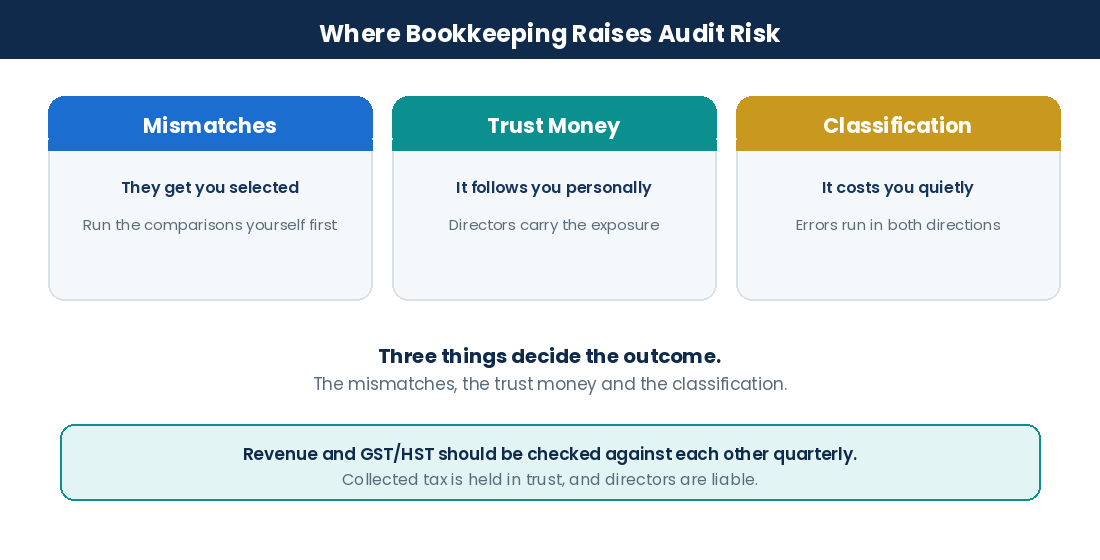
Bookkeeping errors fall into three groups: mismatches against data the CRA already holds, which get you selected; failures involving money held in trust, which carry personal liability for directors; and classification errors, which cost money quietly in both directions.
Reading time: 52 minutes.
Table of Contents
- Three Kinds of Error
- Mismatches: What Gets You Selected
- Trust Money: What Follows You Personally
- Classification: What Costs You Quietly
- What the Penalties Actually Are
- Fixing It and Working With Us
- Frequently Asked Questions
- The Bookkeeping Risk Checklist
- Businesses We Serve
- Professional Guidance and Quick Reference
The Numbers That Matter
This article covers Canada, with Ontario and Toronto context, and reflects rules current to 2026. It is written for incorporated Canadian small businesses and the people keeping their books. Figures marked illustrative are examples, not quotes, and any masked engagement notes end with “Figures changed for privacy.” This is educational information only and not tax or legal advice. Penalty amounts depend entirely on the amounts and periods involved, so no article can tell you what a particular failure will cost.
Three Kinds of Error
Three Kinds of Error
The Framing
Why the Usual List Does Not Help
Most articles on this subject give you a flat list: missing receipts, payroll mistakes, misclassified expenses, income reporting. All real, but presenting them as equivalent hides the thing that actually matters, which is what each one does to you.
| Type | What It Does | Who Bears It |
|---|---|---|
| Mismatches against data the CRA holds | Gets your file selected for review | The corporation |
| Trust money failures | Penalties, and personal exposure | Directors, personally |
| Classification errors | Wrong tax, in either direction | The corporation, often silently |
The middle row is the one to take seriously. Source deductions and sales tax collected are money held for someone else, and failing to remit them does not stay inside the corporation.
A Word on Risk Scores
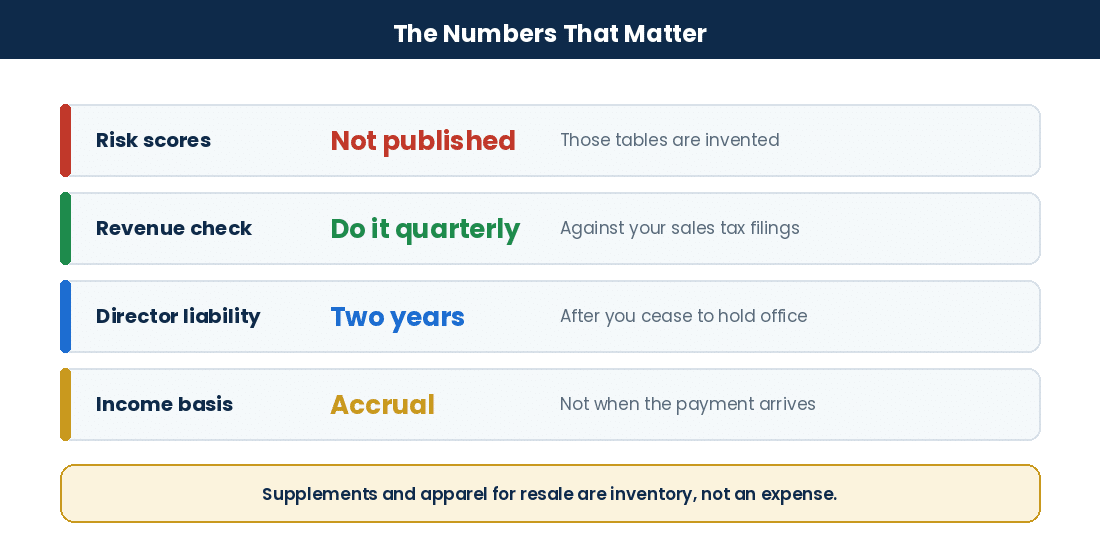
You will see tables rating each error “high”, “moderate” or “very high” risk. Those ratings are invented. The CRA does not publish a scoring model that assigns audit probability to bookkeeping errors, and any table presenting one is guessing with a confident face.
What is real and documented is that the CRA holds information from third parties and compares it to what you filed. That is not a risk score; it is arithmetic, and you can run the same comparisons yourself before they do.
The Conservative Error Nobody Catches
Classification errors run both ways. Capitalising something that should have been expensed defers a deduction you were entitled to take now. Missing a deduction entirely means paying tax that was never owed.
Nothing flags that. No notice arrives, because nothing was claimed improperly. On most cleanup files we find errors in both directions, and the under-claims frequently outweigh the over-claims, which surprises owners who expected only bad news.
Owners brace for what they over-claimed. The larger number is usually what they never claimed at all, because nothing in the system ever points at it. Figures changed for privacy.
Risk Warning: Trust money failures follow directors personally. Please treat source deductions and collected sales tax differently from every other payable.
Mismatches: What Gets You Selected
Mismatches: What Gets You Selected
The Comparisons
What the CRA Already Holds
Your file is not assessed in isolation. Information arrives from other parties independently of anything you file, and the comparison between the two is the most productive check the CRA runs.
| Comparison | What It Tests |
|---|---|
| Revenue on the corporate return against sales tax filings | Whether you reported the same sales twice over |
| Wage expense against T4 slips filed | Whether payroll deducted matches payroll reported |
| Contractor payments against slips issued | Whether service payments were reported |
| Slips issued to you by others | Whether you reported income someone else declared paying you |
| Bank deposits against reported revenue | Whether money arriving exceeds income declared |
| Sector expense ratios | Whether your pattern looks unlike comparable businesses |
Each of these can be run by you, on your own books, before anyone else runs it. That is the entire practical point of this section.
Run the First One Quarterly
Revenue against sales tax filings is the single most valuable reconciliation. Run it quarterly rather than at year end.
- Total the revenue in your ledger for the period
- Total the sales reported on your sales tax returns for the same period
- Explain every difference: exempt or zero-rated supplies, timing, adjustments
- Write the explanation down in the working papers as you go
- Investigate anything you cannot explain immediately
Legitimate differences exist and are entirely fine. What matters is that the explanation is on file rather than reconstructed under time pressure two years later, when the people involved may have moved on.
Deposits That Are Not Revenue
Money arrives in a business account for many reasons that are not sales: shareholder contributions, loan advances, transfers between accounts, insurance settlements, refunds, capital injections.
Every one of those needs labelling when it arrives. An unexplained deposit sitting in the records is treated as unreported income until you demonstrate otherwise, and the burden of that demonstration is yours.
A business receives an owner contribution and a loan advance in the same quarter, both deposited without description. At review, both appear as revenue the corporation did not report. The documents establishing what they actually were existed but took weeks to assemble, and in the meantime the assessment stood. Figures changed for privacy.
Income That Arrives Without an Invoice
Underreporting is often accidental rather than deliberate. The common causes are structural.
- Cash sales recorded loosely or not at all
- Platform and marketplace revenue reported net of fees rather than gross
- Payment processor settlements recorded as a single net figure
- Barter and exchange arrangements never entered
- Amounts collected by a related company on your behalf
The processor point catches a lot of businesses. Where fees are deducted before settlement, recording only the net amount understates both revenue and expense, and the processor reports the gross. That is a mismatch created purely by how the entry was made.
Where several of these have accumulated across unfiled or under-prepared years, the work belongs in a structured cleanup rather than a single correction. Our catch-up corporate tax filing service handles the return side once the books are rebuilt.
Timing Differences
Business income is generally reported on the accrual basis, meaning when earned rather than when collected. The cash method is available for farming and fishing businesses, and certain professionals have their own arrangements.
Guidance suggesting you should choose cash or accrual based on business size is describing a choice that mostly does not exist for corporate business income. Recording revenue only when payment arrives creates timing mismatches against sales tax filings and against what customers reported paying.
Revenue against sales tax filings is the comparison most likely to be run on your file. Running it yourself first means nothing surfaces that you have not already explained. Figures changed for privacy.
Key Stat: Business income is generally reported on the accrual basis. Please do not record revenue only when payment arrives.
Trust Money: What Follows You Personally
Trust Money: What Follows You Personally
The Personal Exposure
Why This Category Is Different
Two amounts in your books are not yours. Source deductions withheld from employees, and sales tax collected from customers, are held in trust for the government.
Failing to remit them is not an ordinary unpaid payable. Directors can be held personally liable for the amounts, plus interest and penalties, and that liability survives the corporation. It can be assessed for up to two years after a person ceases to be a director.
The practical implication is direct: using collected tax to cover a slow month is not a corporate risk decision. It is a personal one, and it is the single most consequential bookkeeping issue in this article.
Where Source Deduction Failures Come From
- Remitting on the wrong schedule after payroll grows
- Calculating deductions on the wrong pensionable or insurable earnings
- Paying bonuses, commissions or per-load amounts outside the payroll system
- Missing taxable benefits such as vehicles or allowances
- Treating an employee as a contractor and withholding nothing at all
- Cash flow pressure leading to a deliberate short remittance
Remittance deadlines follow your remitter type, set by average monthly withholding. A regular remitter pays by the 15th of the following month; accelerated remitters pay more frequently, in the largest category within a few working days of the pay date.
Growing businesses cross into an accelerated category and keep remitting on the old schedule, producing a late remittance every period until somebody notices. Please confirm your type whenever payroll grows materially.
The Sales Tax Side
Sales tax collected is the same category. You charged it to a customer, you are holding it, and it is due on your reporting schedule.
| Error | Consequence |
|---|---|
| Collected but not remitted | Trust money exposure, including director liability |
| Not charged where it should have been | Assessed against you whether or not you collected it |
| Credits claimed without proper documentation | Denied on review, with interest |
| Credits claimed on purchases from unregistered suppliers | No tax was charged, so nothing to recover |
| Personal purchases claimed through the business | Denied, and it colours the whole review |
The second row deserves emphasis. Failing to charge tax does not remove the obligation. The assessment lands on you, and recovering it from a customer months later rarely works.
Credit Documentation
A credit needs an invoice showing the supplier’s name, their registration number, the date, the amount of tax or a statement that it is included, and a description. Above certain thresholds the requirements increase.
The registration number is the item most often missing on small receipts, and its absence is enough to defeat an otherwise valid claim. Check for it at the counter rather than during a review two years later. Our overview of input tax credits in Canada sets out the full documentary requirements.
What to Do If You Are Already Behind
- Bring current remittances up to date first, before addressing arrears
- Establish the actual balance rather than estimating it
- Contact the CRA about a payment arrangement early rather than late
- Separate the trust amounts from other creditors in your own planning
- Get advice before a director resigns, since the liability window keeps running
The last point is worth stating plainly. Resigning does not end the exposure; it starts a two-year clock during which an assessment can still be made.
Collected tax used as working capital during a slow month is the decision owners most regret. It is trust money, and the exposure is personal. Figures changed for privacy.
Risk Warning: Director liability for unremitted trust amounts can be assessed up to two years after leaving office. Please get advice before resigning.
Classification: What Costs You Quietly
Classification: What Costs You Quietly
The Silent Cost
Capital Against Current
The largest classification decision is whether something is a current expense or a capital asset. Getting it wrong costs money in both directions and neither direction announces itself.
| Item | Usual Treatment |
|---|---|
| Routine maintenance restoring an asset | Current expense |
| Work materially extending an asset’s life | Capital |
| Replacing a component in the ordinary course | Generally current |
| An upgrade adding new capability | Generally capital |
| Fit-out in leased premises | Capital, over the lease term |
| Software licensed annually | Generally current |
Expensing something capital risks a denied deduction on review. Capitalising something current defers a deduction you were entitled to take immediately, and nobody ever queries that. Where the amount is significant, decide deliberately and record the reasoning with the invoice.
Capital Cost Allowance Errors
- Assets placed in the wrong class, so the rate is wrong for the life of the asset
- Claims dated from purchase rather than from availability for use
- The half-year rule applied where the reinstated incentive gives more
- Maximum claimed by default in a year when less would have been worth more
- Disposals not recorded, leaving assets in the pool that no longer exist
- Recapture ignored, so a gain surfaces unexpectedly on assessment
Two current points. Bill C-15 received Royal Assent on 26 March 2026, reinstating the accelerated investment incentive for most depreciable property acquired after 2024 and available for use before 2030, so returns prepared on the plain half-year rule for recent purchases are worth revisiting. And the claim is a maximum, not an obligation; claiming less in a low-income year preserves the pool.
Worker Classification
Calling someone a contractor does not make them one. The test looks at control over how the work is done, who supplies the tools and equipment, whether the worker carries a chance of profit and risk of loss, and how integrated they are in the business.
A written agreement describing someone as a contractor carries very little weight against facts pointing the other way. Where the finding goes against you, the CRA can assess the source deductions that should have been withheld, plus penalties and interest, and this lands back in the trust money category with its personal exposure.
Test long-term arrangements before the next pay run rather than after a review. It is manageable in advance and expensive afterwards.
Personal and Business
Mixing personal expenditure into business accounts causes more damage than the amounts involved. Individually the items are small; collectively they undermine the credibility of everything else on the file.
- Run separate bank accounts and cards from the outset
- Where a personal item goes through, code it to the shareholder loan immediately
- Never bury it in an expense account and hope
- Watch the shareholder loan balance, since it is also its own tax issue
- Remember a corporation reports a benefit for personal use rather than prorating costs
That last point corrects a persistent error. A corporation does not apply a business-use percentage to a company vehicle; it claims the cost in full and reports a taxable benefit. Applying the sole proprietor method understates the deduction and leaves an unreported benefit at the same time.
Receipts
Missing receipts do not simply weaken a claim; they can defeat it. A bank statement shows money left the account, not what it bought or whether it was for the business.
Electronic copies are acceptable provided they remain readable and retrievable for the retention period. The trap is an accounting system migration that leaves years of attachments unreadable, which is a retention failure even though the data technically exists.
Capitalising routine maintenance is the error nobody reports. The deduction was available immediately and got deferred for years instead. Figures changed for privacy.
Key Stat: Capital cost allowance is a maximum, not an obligation. Please claim less in a low-income year rather than defaulting to the full amount.
What the Penalties Actually Are
What the Penalties Actually Are
The Real Figures
Why This Section Exists
A great deal of guidance quotes penalty figures that do not correspond to anything. Tables showing a percentage escalating with days late, or flat dollar fines running to five figures, are inventions.
The actual structures are formula-based and depend on the amounts and periods involved. That means nobody can tell you what a particular failure will cost without knowing your numbers, but the shape of each is worth understanding.
The Structures
| Failure | How the Penalty Works |
|---|---|
| Late corporate return | 5% of unpaid tax plus 1% per complete month, to twelve |
| Repeated late corporate return | A higher rate where demanded and previously penalised within three years |
| Late source deduction remittance | A percentage of the amount, rising in tiers with how late it is |
| Late sales tax return | A formula on the amount owing, with a monthly element |
| Late information slips | Based on the number of slips and how late they are |
| Gross negligence | A substantial percentage of the understated amount |
| Interest | Compounds daily, separately from any penalty |
Two observations follow from the structure. A nil or refund return filed late generally carries little or no penalty, because the calculation runs on an amount owing that is zero. And a large balance filed late carries a serious one. The penalty tracks the money, not the paperwork.
The Remittance Tiers
Late source deduction remittances are penalised at a rate that rises with lateness, reaching 10% at the top tier. A further penalty can apply where the failure is repeated and made knowingly or through gross negligence.
This is why a pattern matters more than a single lapse. One late remittance is a penalty. A consistent pattern of them attracts a materially worse outcome and invites attention to everything else.
How Long Things Stay Open
- The normal reassessment period for a CCPC is generally three years from the notice of assessment
- Certain corporations and situations carry a longer period
- There is no time limit where there was misrepresentation attributable to neglect, carelessness or wilful default
- Records must be kept six years from the end of the year they relate to
- Capital property records are kept until six years after the year of disposition
- You have 90 days to object to an assessment
The third point is the one that surprises people. The three-year window is not absolute, and it does not close where the return contained a misrepresentation of that kind.
Relief
Where penalties and interest arose from circumstances beyond your control, a taxpayer relief request may be available. It asks for those amounts to be cancelled or waived; it does not change the underlying tax.
Where a past filing was wrong in a way that carries a penalty, the Voluntary Disclosures Program may reduce the consequences, provided you come forward before the CRA raises the issue. That condition is the whole programme. Once contact is made, the route generally closes.
Penalty figures quoted in articles are almost always invented. The real structures track the amount owing, which is why a nil return late is very different from a large one. Figures changed for privacy.
Risk Warning: There is no time limit on reassessment where there was misrepresentation through neglect or carelessness. Please do not assume three years closes everything.
Fixing It and Working With Gondaliya CPA
Fixing It and Working With Us
The Remedy
The Monthly Discipline
Almost everything in this article is prevented by a monthly close rather than an annual one. The cost difference is not close.
| Frequency | What Gets Done |
|---|---|
| Monthly | Bank and card reconciliation, receipt capture, deposits labelled |
| Quarterly | Revenue against sales tax filings, shareholder loan review |
| Mid-year | Draft statements, so errors surface while the year can absorb them |
| Year end | Asset register, accruals, inventory, wage-to-slip reconciliation |
An operator closing books once a year discovers eleven months of misclassification at the same moment, usually while trying to meet a deadline. The errors are identical; only the timing of discovery differs, and that timing decides whether they are cheap or expensive to fix.
Warning Signs
- Bank reconciliations not done for months
- Revenue that does not tie to sales tax filings
- A suspense or unclassified account with a real balance in it
- A shareholder loan balance that only grows
- Source deductions remitted late more than occasionally
- Receipts missing for material expenses
- Correspondence from the CRA that has not been answered
Answering CRA correspondence promptly matters more than the content of most replies. A request answered on time usually ends there. Ignored, it becomes an assessment based on whatever the CRA has, which you then have to displace. Where a review has already opened, our CRA audit resolution services handle the correspondence and the representation.
Cleaning Up Properly
- Establish the correct position before touching the entries
- Reconcile the bank and card accounts, oldest period first
- Rebuild the ledger period by period rather than in aggregate
- Quantify the effect year by year, in both directions
- Decide what to amend, correct going forward, or disclose
- Fix the process so the same error does not repeat
The last step is the one usually skipped. Correcting three years of misclassification without changing how the books are kept simply means doing it again later. Our catch-up bookkeeping services follow this sequence.
Sector Notes
| Sector | The Bookkeeping Issue That Recurs |
|---|---|
| Medical and dental practices | Mixed taxable and exempt supplies, and credit apportionment |
| Childcare | Exempt supplies, so no recovery on costs, plus subsidy separation |
| Construction and trades | Contract payment reporting and subcontractor classification |
| Real estate | Capital against income, and expenses tied to the right property |
| E-commerce | Processor settlements recorded net rather than gross |
| Restaurants | Cash controls, stock counts and tip treatment |
| Transport | Vehicle classification and fuel reconciled to distance |
| Professional services | Work in progress and the personal services business question |
Note the childcare row specifically. Childcare services are exempt, not zero-rated, so tax paid on costs is not recoverable. Guidance describing them as zero-rated has the consequence backwards.
What We Do
We support incorporated small businesses on a flat annual fee covering monthly bookkeeping with reconciliation built in, quarterly revenue-to-sales-tax comparison, deposit identification and labelling, shareholder loan monitoring, capital against current decisions recorded, asset register maintenance, payroll and remitter type review, worker classification testing, sales tax filing, financial statements and the corporate return.
Where the books need correcting first we do that before filing anything, and we tell you what we find in both directions. Pricing is quoted before any work begins, including HST, with a one-business-day response and evening and weekend availability. Our engagements carry a 30-day money-back arrangement and a 60-day fee-matching arrangement. Our CRA audit guide covers what a review involves if one arrives.
Getting Started
Bring three things: three months of bank statements, your last filed corporate return, and your most recent sales tax return. Those let us run the main comparisons and tell you what your file looks like from the outside.
Contact Gondaliya CPA at info@gondaliyacpa.ca, call 647-212-9559, or send us a message.
Three months of statements and two returns tell us how the file reads externally in about an hour. Most owners have never seen that view of their own books. Figures changed for privacy.
Pro Tip: Please fix the process alongside the numbers. Correcting three years without changing the routine means repeating the work later.
FAQs on Bookkeeping and CRA Audit Risk
Frequently Asked Questions
FAQ
Which bookkeeping errors actually get me selected?+
Mismatches against data the CRA already holds. Revenue that does not tie to your sales tax filings, wage expense that does not match slips filed, and deposits exceeding reported income.
Does the CRA score my errors by risk level?+
No. Tables rating bookkeeping errors high, moderate or very high risk are invented. What is real is that third-party information is compared to what you filed.
What is the single most useful check I can run?+
Revenue in your ledger against sales reported on your sales tax returns, quarterly. Explain every difference in writing as you go rather than reconstructing it later.
Why do deposits matter so much?+
An unexplained deposit is treated as unreported income until you show otherwise. Label loans, transfers, owner contributions and refunds when they arrive, not at year end.
Can I use the cash method for my corporation?+
Generally no. Business income is reported on the accrual basis. The cash method is available for farming and fishing, and certain professionals have their own arrangements.
What makes source deductions different from other payables?+
They are held in trust. Directors can be held personally liable for unremitted amounts plus interest and penalties, and that liability survives the corporation.
How long does director liability last after I resign?+
It can generally be assessed for up to two years after you cease to be a director. Resigning starts a clock rather than ending the exposure.
When are payroll remittances due?+
It depends on your remitter type, set by average monthly withholding. A regular remitter pays by the 15th of the following month; accelerated remitters pay more frequently.
What if I charged no sales tax but should have?+
The assessment lands on you whether or not you collected it. Recovering the amount from a customer months later rarely works, so the exposure is real.
What documentation supports a sales tax credit?+
The supplier’s name and registration number, the date, the tax amount or a statement it is included, and a description. The registration number is most often the missing piece.
Is capitalising something safer than expensing it?+
Not really. Expensing something capital risks a denied deduction; capitalising something current defers a deduction you could have taken now. Nobody ever queries the second one.
Do I have to claim maximum capital cost allowance?+
No. It is a maximum, not an obligation. Claiming less in a low-income year preserves the pool for a year when the deduction is worth more.
Does a written contract make someone a contractor?+
No. The test looks at control, who supplies the tools, chance of profit and risk of loss, and integration. A contract carries little weight against facts pointing the other way.
Does my corporation prorate vehicle costs by business use?+
No. That is the sole proprietor method. A corporation claims the costs in full and reports a taxable benefit for personal use.
What is the late-filing penalty on a corporate return?+
5% of the unpaid tax plus 1% per complete month, to twelve months. A higher rate can apply where a return was demanded and a penalty was assessed within the previous three years.
How far back can the CRA reassess?+
Generally three years from the notice of assessment for a CCPC, but there is no time limit where there was misrepresentation attributable to neglect, carelessness or wilful default.
Sixteen questions and one underneath most of them: which of the three kinds of error is this. The answer decides who bears it. Figures changed for privacy.
The Bookkeeping Risk Checklist
The Bookkeeping Risk Checklist
Quick Reference
Preventing Mismatches
- Reconcile revenue to your sales tax filings quarterly.
- Write the explanation for every difference down as you go.
- Tie wage expense to slips filed and remittances made.
- Label every deposit that is not revenue when it arrives.
- Record processor settlements gross, with fees as an expense.
- Capture cash sales through the same system as everything else.
- Report business income on the accrual basis.
- Clear suspense and unclassified accounts to zero.
Protecting Yourself Personally
- Treat source deductions and collected sales tax as trust money.
- Confirm your remitter type whenever payroll grows materially.
- Run bonuses, commissions and spiffs through payroll.
- Report taxable benefits including vehicles and allowances.
- Test long-term contractors against the classification factors.
- Never use collected tax as working capital.
- Get advice before a director resigns, since the window keeps running.
- Bring current remittances up to date before addressing arrears.
Not Losing Money Quietly
- Decide capital against current deliberately on large amounts.
- Record the reasoning with the invoice at the time.
- Check assets are in the right capital cost allowance class.
- Date claims from availability for use, not purchase.
- Review whether the reinstated incentive applies to recent purchases.
- Treat the capital cost allowance claim as a maximum, not a default.
- Record disposals so the pool reflects assets you still own.
- Claim company vehicle costs in full and report a benefit.
- Keep personal spending out of business accounts entirely.
- Check receipts carry the supplier’s registration number.
- Close the books monthly rather than once a year.
- Answer CRA correspondence promptly, through your CPA.
- Keep six years of records, readable through any system change.
For a review of how your books read from the outside, contact Gondaliya CPA at info@gondaliyacpa.ca, call 647-212-9559, or book a free consultation.
Twenty-nine points across three groups, and the groups matter. One prevents selection, one protects you personally, and one just stops you losing money. Figures changed for privacy.
Businesses We Serve
Industry Expertise
Which error group dominates differs by the business. Here are ten and the usual one.
| Business | The Recurring Bookkeeping Issue |
|---|---|
| Cash-handling retail and hospitality | Deposits exceeding reported revenue |
| Online sellers and platforms | Processor settlements recorded net |
| Businesses with growing payroll | Remitter type changed and nobody noticed |
| Operators using long-term contractors | Classification, and the personal exposure behind it |
| Equipment-heavy trades | Capital against current, decided by default |
| Medical and dental practices | Mixed taxable and exempt supplies |
| Childcare operators | Exempt supplies, so no recovery on costs |
| Owner-managed corporations | Personal spending and the shareholder loan |
| Businesses behind on the books | Eleven months of errors found at once |
| Anyone with a CRA letter unanswered | An assessment built on what they already have |
- Cash-handling retail and hospitality: Label deposits on arrival.
- Online sellers and platforms: Gross, with fees as expense.
- Businesses with growing payroll: Confirm the type.
- Operators using long-term contractors: Test before the pay run.
- Equipment-heavy trades: Decide it, then write down why.
- Medical and dental practices: Apportion on a real basis.
- Childcare operators: Exempt is not zero-rated.
- Owner-managed corporations: Separate accounts from day one.
- Businesses behind on the books: Monthly is cheaper.
- Anyone with a CRA letter unanswered: Answer it this week.
The business changes which error shows up first. It does not change the sorting, which is whether it gets you selected, follows you personally, or just quietly costs money. Figures changed for privacy.
Professional Guidance and Quick Reference
Guidance
Professional Guidance: How Gondaliya CPA Handles Your Books
Small businesses raise their audit exposure in a predictable set of ways: revenue that does not tie to sales tax filings, deposits arriving without any description so they read as unreported income, processor settlements recorded net of fees when the processor reports gross, source deductions remitted on an old schedule after payroll grew, long-term contractors who would not survive the classification test, capital work expensed and routine maintenance capitalised in the same set of books, personal spending buried in expense accounts, and books closed once a year so eleven months of errors surface together. Gondaliya CPA handles small business bookkeeping on a fixed annual fee.
We handle what decides the outcome: reconciling revenue to sales tax filings and wages to slips quarterly, labelling every deposit that is not revenue as it arrives, recording capital against current decisions with the reasoning attached, maintaining the asset register so pools reflect assets you still own, confirming remitter type as payroll grows, testing worker classification before the next pay run, and closing the books monthly rather than annually.
Our team starts with three months of bank statements, your last filed return and your most recent sales tax return. Those three show how your file reads from the outside. Whatever your sector, you get clear advice and a fixed price before we start.
Quick Answers
- Selection: Driven by mismatches, not untidiness
- Best check: Revenue against sales tax filings
- Deposits: Label them when they arrive
- Income basis: Accrual, not cash
- Trust money: Follows directors personally
- Director window: Two years after leaving office
- Remitter type: Changes as payroll grows
- CCA claim: A maximum, not an obligation
- Reassessment: Three years, unless misrepresentation
- Records: Six years retention
Who This Is For
- For: Incorporated Canadian small businesses and the people keeping their books, whether in-house or outsourced, across every sector.
- Not For: A prediction of what any particular failure will cost, since penalty structures depend entirely on the amounts and periods involved.
People Also Ask
How long do I keep records?+
Six years from the end of the year they relate to, and for capital property until six years after the year of disposition. Electronic records must stay readable throughout.
What if I am behind on remittances already?+
Bring current remittances up to date first, establish the actual balance, and contact the CRA about an arrangement early rather than late.
Can penalties be cancelled?+
A taxpayer relief request may cancel penalties and interest where circumstances were beyond your control. It does not change the underlying tax.
Glossary of Key Terms
- Reconciliation: Matching your records to an independent source.
- Information matching: Comparing your filings to third-party data.
- Trust money: Amounts withheld or collected for the government.
- Source deductions: Income tax, CPP and EI withheld from pay.
- Remitter type: The schedule your payroll remittances follow.
- Director liability: Personal exposure for unremitted trust amounts.
- Accrual basis: Reporting income when earned, not when received.
- Capital expenditure: Cost of an asset, deducted over time.
- Current expense: Cost deducted in the year incurred.
- Capital cost allowance: The tax depreciation claim, a maximum not an obligation.
- Available for use: When an asset becomes eligible for depreciation.
- Recapture: Income arising where proceeds exceed the pool balance.
- Input tax credit: Recovery of sales tax paid on business costs.
- Shareholder loan: Company funds used personally, taxable if not repaid in time.
- Reassessment period: How long the CRA has to revisit a return.
- Voluntary Disclosures Program: Correcting filings before CRA contact.
Bookkeeping Risk Check
This quick self-check indicates where your operation most likely has room. Please answer the six questions below.
Bookkeeping Risk Check
Six quick questions on your books. No fee shown.
Points to raise with us:
This is a general prompt, not tax or legal advice or a quote. Your position depends on your full facts. For a real review, please book a free consultation.
Want a checklist to work from? You can download our free bookkeeping risk checklist before your consultation.
Reconcile revenue to sales tax filings quarterly. Label every deposit that is not revenue when it arrives. Treat source deductions and collected tax as trust money. Confirm your remitter type as payroll grows. Test long-term contractors before the next pay run. Decide capital against current deliberately. Close the books monthly, not annually. Please keep six years of records.
2026 Update — what is current: This article reflects rules current to 2026. The six-year record retention requirement, the generally three-year normal reassessment period for a CCPC, the 90-day objection period, the 5% plus 1% per month corporate late-filing penalty and the tiered structure of the failure-to-remit penalty reaching 10% are unchanged. Bill C-15 received Royal Assent on 26 March 2026, reinstating the accelerated investment incentive for most depreciable property acquired after 2024 and available for use before 2030. Please note that the CRA publishes no scoring model assigning audit probability to individual bookkeeping errors, so tables rating errors as high, moderate or very high risk are invented, as are escalating percentage penalty schedules based on days late and flat five-figure fines for payroll errors; that penalty structures are formula-based and depend on the amounts and periods involved, meaning a nil return filed late generally carries little penalty while a large balance carries a serious one; that source deductions and collected sales tax are held in trust and directors can be assessed personally for up to two years after ceasing to hold office; that business income is generally reported on the accrual basis, with the cash method available for farming and fishing; that a corporation claims vehicle costs in full and reports a taxable benefit rather than prorating by business use; and that there is no time limit on reassessment where there was misrepresentation attributable to neglect, carelessness or wilful default.
Bookkeeping and CRA Audit Risk Canada: How Gondaliya CPA Supports Small Businesses
Start with three months of statements
Gondaliya CPA reconciles revenue to sales tax filings and wages to slips quarterly, labels every deposit that is not revenue as it arrives, records capital against current decisions with the reasoning attached, maintains the asset register so pools reflect assets you still own, confirms remitter type as payroll grows, tests worker classification before the next pay run and closes the books monthly rather than annually, on a flat annual fee including HST with a one-business-day response. Please book a free consultation.
Next Steps
Please book a free consultation with Gondaliya CPA and bring three months of bank statements, your last filed corporate return, and your most recent sales tax return. Those three tell us how your file reads from the outside, where the gaps are, and what remains to claim on the equipment, and where the documentation is thin. You will get a flat annual fee including HST before any work begins. If our content helps, please add gondaliyacpa.ca as a preferred source on Google.
Published: · Last updated:
Editorial policy: We research against CRA and CPA Ontario sources, fact-check the figures, and Sharad Gondaliya, CPA, reviews the content, which we update as the rules change.
Disclaimer: This article is educational information only and is not tax, legal, or financial advice. Figures marked illustrative are examples rather than quotes or guarantees. It reflects CRA rules current to 2026, including the $30,000 GST/HST threshold, the Class 8 rate, Class 13 leasehold treatment, the half-year rule, and the six-year retention requirement. Rates, limits and expensing rules change and outcomes depend on your specific facts. Please consult a CPA Ontario member before acting.

Sharad Gondaliya is a CPA Canada & CPA USA with 15 Years+ experience of Accounting, Tax, Payroll of Corporate Small Businesses as Tax Accountant. He is a CPA Ontario member (61040184) and holds US CPA licences in Washington and Montana and is well known among corporate small businesses for tax planning, efficient tax solutions, and affordable CPA services. Sharad is the Principal (Director) of Gondaliya CPA – Affordable CPA Firm in Canada. Licenses: CPA Ontario: 61040184 | CPA USA (MT): PAC-CPAP-LIC-033176 | CPA USA (WA): 57629 | CPA Firm License: 61330051 View Full Author Bio