



The Ultimate Guide to the CRA Audit Process for Businesses in Canada
The CRA Audit Process in Canada: Every Stage, and Where You Can Actually Influence It
The CRA audit process for businesses in Canada follows a defined sequence from first contact through examination, proposal, assessment and appeal. Gondaliya CPA explains each stage, what happens, and where a business genuinely has room to change the outcome.
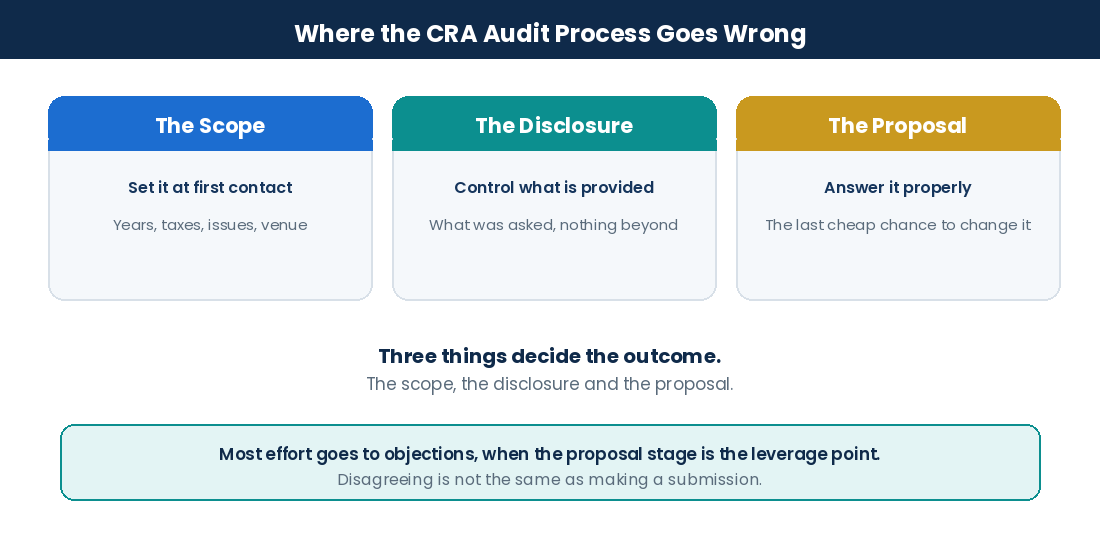
The useful way to read an audit is as a sequence with three points of leverage. Everything else is administration. Our CRA audit resolution services concentrate effort where it still counts.
Quick Summary
Influence concentrates at three points: setting the scope at the start, controlling what is provided during the examination, and responding properly to the proposal letter before an assessment issues. After assessment, changing the outcome is slower and costs more.
Reading time: 52 minutes.
Table of Contents
The Numbers That Matter
This article covers Canada, with Ontario and Toronto context, and reflects rules current to 2026. It is written for incorporated Canadian businesses under CRA examination. Figures marked illustrative are examples, not quotes, and any masked engagement notes end with “Figures changed for privacy.” This is educational information only and not tax or legal advice. Criminal investigations follow a different process with different rights, and anyone who suspects one should obtain legal advice immediately rather than relying on general guidance.
The Shape of an Audit
The Shape of an Audit
The Sequence
The Stages
| Stage | What Happens | Your Influence |
|---|---|---|
| Selection | Your file is identified for examination | None, at this point |
| First contact | A letter naming the auditor, period and subject | High: scope, venue and schedule |
| Examination | Records reviewed, questions asked | High: what is provided and how |
| Proposal letter | Intended adjustments set out | Highest: written response before assessment |
| Reassessment | Adjustments formalised with interest and penalty | Low: the position is now fixed |
| Objection | An independent officer reconsiders | Moderate, but slower and costlier |
| Tax Court | Litigation where the objection does not resolve | Moderate, at significant cost |
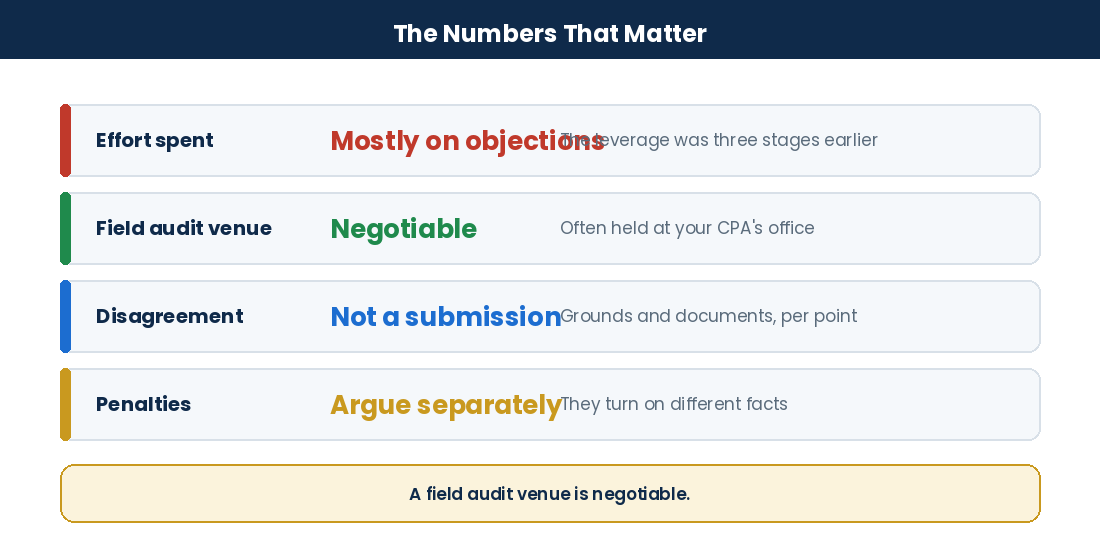
Notice where the effort usually goes. Most businesses do very little at first contact, provide whatever is asked during the examination without much thought, treat the proposal letter as a formality, then spend heavily objecting after assessment.
That is precisely backwards. The three high-influence stages all come before the assessment, and they are cheaper than everything after it.
The pattern makes emotional sense. An assessment is the first thing that feels real, arrives with a number attached, and demands a decision. Everything earlier feels procedural. But by the time the number exists, the reasoning behind it has been written, reviewed and filed, and the effort required to unpick it is a multiple of what the same argument would have cost three months earlier.
Why the Order Matters
Each stage narrows what is available at the next one. Scope agreed at first contact shapes what the examination covers. What is provided during the examination becomes the record the proposal is built on. The proposal response is the last chance to change anything before a formal position exists.
After the assessment issues, you are no longer explaining your position to someone forming one. You are asking a different part of the organisation to overturn a conclusion already reached, with reasons already written down.
How Long It Takes
Audits run for months, sometimes considerably longer. A desk audit on a narrow issue can conclude in weeks. A field audit covering several years can occupy the better part of a year, particularly where records need reconstructing or where the auditor’s workload is heavy.
- Plan for it as an ongoing commitment rather than an event
- Expect quiet periods followed by requests with short deadlines
- Keep the file organised throughout, because personnel can change
- Do not assume silence means the matter has gone away
- Budget the professional time realistically at the outset
A Note on What This Is Not
An audit is a civil examination of whether returns are correct. It is a different thing from a criminal investigation, which follows a separate process, involves different powers, and carries different rights including the right to remain silent.
If there is any indication that a matter has moved in that direction, stop and obtain legal advice immediately. General guidance about audits does not apply, and continuing to cooperate as though it does can be seriously harmful.
Businesses spend their money objecting and almost nothing at the proposal stage. The influence runs the other way, and by a wide margin. Figures changed for privacy.
Risk Warning: If a matter shows signs of becoming a criminal investigation, please stop and obtain legal advice. Different rules and rights apply.
First Contact and Scope
First Contact and Scope
Leverage Point One
What Arrives
The opening letter names the auditor, identifies the taxation years and the subject matter, and usually proposes a meeting or a records request. It is the most informative document you will receive and it repays close reading.
- Which years are covered, and whether that changes anything already settled
- Which taxes: corporate income tax, sales tax, payroll, or several
- Whether an on-site visit is proposed
- What records are requested initially
- The auditor’s name, office and contact details
- Any deadline attached to the first response
The First Three Things to Do
- Authorise your representative before any substantive contact happens
- Ask for the scope in writing, covering years, taxes and issues
- Negotiate venue and schedule rather than accepting the first proposal
All three are administrative and none of them is contentious. Auditors deal with represented taxpayers constantly and generally prefer it, because questions go to someone who understands them and answers arrive in a usable form.
Venue
| Venue | What It Means in Practice |
|---|---|
| Your premises | Staff interrupted, informal questions, less control |
| Your representative’s office | Questions routed, records controlled, operations undisturbed |
| CRA office | Records travel, less convenient, sometimes appropriate |
| Remote | Suitable for narrower examinations |
Requesting the second option is granted more often than businesses expect, and it changes the character of the audit substantially. There is a real difference between an auditor working through a defined set of records in a boardroom and one walking through an operation asking questions of whoever is nearest.
Scope
Getting the scope in writing does two things. It tells you what to prepare, and it gives you a reference point if the examination later drifts into areas that were not part of it.
Scope can legitimately expand where findings warrant it. What should not happen is drift without acknowledgement, and having the original scope on paper means that expansion becomes a conversation rather than something that just occurs.
Preparing Before It Starts
- Assemble the records for the scope, and only for the scope
- Reconcile everything you can before the auditor sees it
- Identify the weak points yourself, before someone else does
- Decide who will answer questions and route everything through them
- Brief your staff to refer questions rather than answering
- Set up the request and response log on day one
The third item is the one that separates a managed audit from a reactive one. Knowing where your own problems are means you can prepare a position rather than improvising when the question arrives.
It also tells you something you need before deciding anything else: whether the books actually support what was filed. Where they do not, the sequence changes entirely, because the underlying bookkeeping has to be sound before records are handed over. Providing weak records and then correcting them mid-audit is a far worse position than taking time at the start.
Authorising a representative, asking for scope in writing, and requesting the venue are three administrative steps that shape everything after them. Most businesses take none. Figures changed for privacy.
Key Stat: Three administrative steps at first contact shape the whole audit. Please take all three before substantive contact begins.
The Examination
The Examination
Leverage Point Two
What the Auditor Is Doing
An auditor is testing whether what you filed is supported by your records. That means tracing figures from the return back through the ledger to source documents, and testing whether the treatment applied was correct.
| Test | What It Establishes |
|---|---|
| Revenue against deposits and sales tax filings | Whether all income was reported |
| Expense samples against source documents | Whether claims are supported and deductible |
| Wage expense against slips and remittances | Whether payroll was handled correctly |
| Capital additions against the class claimed | Whether depreciation was correct |
| Shareholder account movement | Whether personal amounts were treated properly |
| Sales tax credits against invoices | Whether documentary requirements were met |
| Related party transactions | Whether terms were reasonable |
None of that is adversarial by nature. It becomes difficult where the records do not support the filing, and the question then is how that is handled rather than whether it is discovered.
Auditors are generally reasonable people doing a defined job. Treating the examination as a fight tends to produce a worse result than treating it as a technical exercise where you happen to disagree on some points. Professional courtesy costs nothing and the person on the other side has discretion in more places than the process suggests.
Providing Information
The principle from the outset applies throughout: provide what is requested, completely, and nothing beyond it.
- Deliver documents through the single point of contact
- Log every request and every response with dates
- Provide copies rather than originals wherever possible
- Where a request is unclear, ask what specifically is needed
- Where a request is large, ask for a realistic timeline
- Where something does not exist, say so rather than delaying
The fourth point saves considerable time. A broad request often has a narrow question behind it, and asking what the auditor is actually trying to establish frequently produces a much smaller task.
Interviews and Questions
Auditors ask questions, and during a field audit they ask them conversationally. That informality is where problems enter the record.
An answer given from memory in a corridor carries the same weight as one given carefully in writing. “I will confirm that and come back to you” is complete, proper and always available. No auditor objects to receiving a considered written answer a day later, and nobody is being tested on recall.
Where staff are likely to be asked things, brief them to refer questions rather than answer. That is not obstruction; it is ensuring answers come from someone with the full picture.
When You Find Your Own Problem
Sometimes preparation reveals something genuinely wrong that the auditor has not yet reached. The instinct is to say nothing and hope.
That is usually the wrong call. Where an error is real and within the scope, raising it with a proposed correction is materially better than having it found. It affects how the rest of the file is viewed, and it bears directly on whether a gross negligence penalty is considered.
Where the error sits outside the scope, the calculation is different and worth taking advice on before saying anything.
Keeping It Moving
Audits stall, and a stalled audit is not a resolved one. Interest continues to accrue on any amount eventually assessed, so delay is rarely in your favour.
- Respond to requests promptly, or ask for time before the date
- Follow up where a response has produced no reply for weeks
- Ask periodically where the auditor has reached and what remains
- Confirm agreed points in writing as they are settled
- Ask when a proposal letter is likely, so you can prepare
Asking what the auditor is actually trying to establish turns broad requests into narrow ones more often than not. It is the single most useful question in an audit. Figures changed for privacy.
Pro Tip: Please ask what a broad request is trying to establish. The underlying question is usually much narrower than the request.
The Proposal Letter
The Proposal Letter
Leverage Point Three
What It Is
Before finalising, the CRA generally sets out the adjustments it intends to make, explains the basis for each, and gives you a period to respond. This is the single most valuable point in the audit and the one most consistently wasted.
The reason it matters is structural. The auditor still holds the file, the reasoning is fresh, nothing has been formalised, and no separate part of the organisation has to be persuaded to overturn anything. Changing a position here is a conversation. Changing it after assessment is a process.
How to Read It
- Identify every adjustment proposed and the amount attached to each
- Establish the stated basis for each one, not just the outcome
- Separate points you accept from points you dispute
- For disputed points, identify what evidence would actually answer the objection
- Check the arithmetic, which is not always right
- Check whether penalties are proposed and on what basis
The fourth step is where most responses fail. Disagreeing is not a submission. Identifying the specific factual or legal reason the adjustment is wrong, and supplying the document that establishes it, is.
Building the Response
| Element | Why It Matters |
|---|---|
| Clear acceptance of what is correct | Establishes credibility on the rest |
| Specific grounds for each disputed point | Gives the auditor something to act on |
| Documents referenced and attached | Turns assertion into evidence |
| Correct arithmetic on your alternative | Makes acceptance administratively easy |
| Separate submission on penalties | Penalties turn on different facts from the tax |
| A professional tone throughout | The reader is a person with discretion |
The penalty point is worth separating out. Whether an adjustment is correct and whether a gross negligence penalty is warranted are different questions on different evidence, and a submission that addresses only the tax leaves the penalty unaddressed.
Conceding Well
Where a proposed adjustment is right, say so plainly and early in the response. This is not weakness and it is not tactically naive.
A submission that disputes everything invites the reader to treat all of it as noise. A submission that concedes two points cleanly and argues three with evidence tells the reader the arguments are considered. In practice the second gets a better outcome on the three than the first gets on any of them.
Timelines
The letter states a response period. Where the response genuinely needs longer, ask before the date rather than after. Extensions are commonly granted for a reasonable request made in time and rarely for one made late.
Where the period is simply too short to assemble what you need, say what you are doing and when it will arrive. Silence produces an assessment; a communicated timeline usually does not.
If It Does Not Work
Not every submission succeeds, and a proposal letter that survives a proper response is useful information: it tells you the strength of the position before you commit to objecting.
A point the auditor would not move on may still succeed at Appeals, where a different officer applies fresh judgement. But you go into that decision knowing what the argument is and how it was answered, which is a much better place than assessing it cold.
Conceding two points cleanly and arguing three with evidence outperforms disputing all five. The reader can tell which submissions were considered. Figures changed for privacy.
Risk Warning: Disagreement is not a submission. Please identify the specific reason an adjustment is wrong and supply the document that establishes it.
Assessment, Objection and Appeal
Assessment, Objection and Appeal
After the Audit
The Reassessment
The notice sets out the revised tax, the interest and any penalty. Read it against the proposal letter, because they do not always match and adjustments are sometimes dropped or modified after your submission.
- Confirm which proposed adjustments survived and which did not
- Check the arithmetic independently
- Identify what is tax, what is interest and what is penalty
- Note the date, because the objection clock runs from it
- Decide whether to pay the disputed amount pending objection
That last decision is a cash calculation. Interest generally continues to accrue on a disputed amount, so paying it and recovering later where you succeed can be cheaper than carrying it, depending on rates and on your own cost of funds.
The Objection
| Feature | Detail |
|---|---|
| Deadline | 90 days from the notice of reassessment |
| Who considers it | An Appeals officer independent of the audit |
| What it should contain | The facts, the issues, the reasons and the relief sought |
| What it should not be | A letter expressing disagreement |
| Late filing | An extension may be applied for, within limits |
| Outcome | Confirmed, varied, or vacated |
The independence of Appeals is the reason objections succeed more often than businesses expect. The officer did not conduct the audit, has no investment in its conclusions, and is applying fresh judgement to the file.
That only helps if the objection gives them something to work with. A properly constructed objection sets out the facts, identifies the issues precisely, states the legal or factual basis for each position, and says what relief is sought.
Tax Court
Where an objection does not resolve the matter, an appeal to the Tax Court of Canada is available. There is an informal procedure for smaller amounts and a general procedure for larger ones.
This is a legal proceeding and it needs legal representation. The cost is real and it should be weighed against the amount in dispute. Many matters that could go to Court sensibly settle before they do, and knowing the strength of your position from the objection stage informs that decision.
Penalties and Relief
Penalty structures are formula-based on the amounts and periods involved. What matters at this stage is that a penalty can be disputed separately from the tax, because it turns on different facts.
A gross negligence penalty requires more than an error; it requires a degree of culpability. Where an adjustment is correct but the penalty is not warranted, that is a separate argument worth making on its own terms.
Taxpayer relief is a distinct route again. It asks for penalties and interest to be cancelled because of circumstances beyond your control, and it does not touch the underlying tax.
How Long Things Stay Open
The normal reassessment period for a CCPC is generally three years from the notice of assessment. There is no time limit where there was misrepresentation attributable to neglect, carelessness or wilful default, so older years are not automatically safe.
Records must be kept six years from the end of the year they relate to, and longer for capital property. During an active dispute, keep everything regardless of the retention period.
Appeals officers did not conduct the audit and have no investment in its conclusions. That independence is real, and it is why properly argued objections work. Figures changed for privacy.
Key Stat: A penalty can be disputed separately from the tax, because it turns on different facts. Please argue it on its own terms.
Afterwards, and Working With Gondaliya CPA
Afterwards, and Working With Us
The Aftermath
Fixing What the Audit Found
An audit that identifies a problem has told you something useful about how your books work. Correcting the years examined without changing the practice means the same finding arrives again on the next examination.
- Identify the process failure behind each adjustment, not just the number
- Correct the treatment going forward from the current period
- Consider whether the same issue affects unexamined years
- Tighten the reconciliation that would have caught it
- Document the corrected treatment so it survives staff changes
The third point needs judgement. Correcting one year while identical treatment sits in others is visible, and taking advice on how to handle that is better than deciding it alone.
Paying What Is Owed
Where an amount is genuinely owed, addressing it promptly limits the interest. Payment arrangements are available where the amount cannot be paid at once, and asking early produces better arrangements than waiting for collections activity.
Where trust amounts are involved, the position is more serious because directors can carry personal liability for unremitted source deductions and collected sales tax. That should be understood before any decision about payment priority is made.
What Reduces the Next One
| Practice | What It Prevents |
|---|---|
| Quarterly revenue to sales tax reconciliation | The most commonly run external comparison |
| Wage expense tied to slips and remittances | Payroll mismatches |
| Every deposit labelled as it arrives | Deposits read as unreported income |
| Capital against current recorded with reasoning | Classification disputes with no contemporaneous basis |
| Shareholder account reviewed quarterly | Balances that only grow and then get assessed |
| Monthly close rather than annual | Eleven months of errors found at once |
Our guide to the bookkeeping mistakes that raise audit risk covers these in detail, and the difference between a CRA audit and a review matters for how you respond to whatever arrives next.
How We Handle Audits
We represent incorporated businesses through CRA examinations on a fee quoted before work begins, covering assessment of the letter and the scope, authorisation, venue and schedule negotiation, records preparation limited to the scope, controlled provision of documents with a full request log, attendance at meetings and interviews, written responses to technical questions, proposal letter analysis and submissions, objections, and Appeals representation.
Where the records need correcting before anything is provided, we do that first through corporate tax cleanup. Where returns are outstanding, catch-up corporate tax filing comes before the position can be settled at all.
Pricing depends on the periods and issues, the volume of records and their condition. It is quoted before work begins, including HST, with a one-business-day response and evening and weekend availability. Our engagements carry a 30-day money-back arrangement and a 60-day fee-matching arrangement.
What We Will Tell You
We will say plainly where we think a position will not hold. Defending something indefensible costs money on the way to the same outcome, and the better use of that time is conceding cleanly and defending what is actually arguable.
Owners generally prefer hearing that at the start rather than discovering it at the proposal stage, and it produces better results because the arguments that remain are the ones worth making.
Getting Started
Bring three things: the CRA letter, the returns for the years covered, and your records for the scope. Those let us tell you where the exposure sits and what the response should be. Our CRA audit guide covers what to prepare.
Contact Gondaliya CPA at info@gondaliyacpa.ca, call 647-212-9559, or send us a message.
An audit that finds a problem has told you how your books work. Correcting the years without changing the practice means the same finding next time. Figures changed for privacy.
Risk Warning: Where trust amounts are involved, directors can carry personal liability. Please understand that before setting any payment priority.
FAQs on the CRA Audit Process
Frequently Asked Questions
FAQ
Where in an audit can I actually influence the outcome?+
Three points, all before assessment: setting the scope at first contact, controlling what is provided during the examination, and responding properly to the proposal letter.
What should I do the day the audit letter arrives?+
Authorise your representative, ask for the scope in writing covering years, taxes and issues, and negotiate the venue and schedule rather than accepting the first proposal.
Can I choose where a field audit takes place?+
Often yes. Holding it at your representative’s office keeps records controlled, routes questions properly and leaves your operation undisturbed. It is granted more often than businesses expect.
How long does a CRA audit take?+
Months, sometimes considerably longer. A narrow desk audit can conclude in weeks; a field audit across several years can occupy much of a year. Plan for it as an ongoing commitment.
Can the audit expand beyond what it started on?+
Yes, where findings warrant it. Having the original scope in writing means expansion becomes a conversation rather than something that simply occurs unremarked.
How should I answer questions during a field audit?+
Through one point of contact, and in writing where the question is technical. Saying you will confirm and come back is complete and proper; guessing creates a record that has to be corrected.
Should I tell the auditor about a problem I found myself?+
Where it is real and within the scope, usually yes, with a proposed correction. It affects how the file is viewed and bears on whether a gross negligence penalty is considered.
What is the proposal letter?+
The CRA setting out the adjustments it intends to make and the basis for each, with a period to respond. It is the most valuable point in the audit and the most commonly wasted.
How do I respond to a proposal letter?+
Accept what is correct, then for each disputed point identify the specific factual or legal reason it is wrong and attach the document that establishes it. Disagreement alone is not a submission.
Should I concede anything?+
Yes, where a point is genuinely right. Conceding two cleanly and arguing three with evidence produces better outcomes than disputing everything, because the reader can tell which submissions were considered.
What if I need more time to respond?+
Ask before the date. Extensions are commonly granted for reasonable requests made in time, and rarely for ones made late. Silence produces an assessment.
How long do I have to object to a reassessment?+
90 days from the notice. The objection goes to an Appeals officer independent of the audit, which is why properly argued objections succeed more often than expected.
Does interest stop while I object?+
Generally not. Interest continues to accrue on the disputed amount, so paying it pending the objection can be cheaper than carrying it depending on your cost of funds.
Can I dispute a penalty separately from the tax?+
Yes, and you should. Whether an adjustment is correct and whether a penalty is warranted are different questions on different evidence. A gross negligence penalty requires culpability, not just an error.
How far back can the CRA reassess?+
Generally three years from the notice of assessment for a CCPC. There is no time limit where there was misrepresentation attributable to neglect, carelessness or wilful default.
What if this becomes a criminal matter?+
Stop and obtain legal advice immediately. A criminal investigation follows a different process with different powers and rights, and general audit guidance does not apply.
Sixteen questions and one underneath most of them: is this a stage where I can still change the outcome. Three times the answer is yes. Figures changed for privacy.
The Audit Management Checklist
The Audit Management Checklist
Quick Reference
At First Contact
- Read the letter for years, taxes, issues and venue.
- Authorise your representative before substantive contact.
- Ask for the scope in writing.
- Negotiate the venue rather than accepting the first proposal.
- Request a realistic schedule.
- Assemble records for the scope, and only the scope.
- Identify your own weak points before the auditor does.
- Brief staff to refer questions rather than answer them.
- Set up the request and response log on day one.
During the Examination
- Provide what was requested, completely, and nothing beyond.
- Route everything through the single point of contact.
- Ask what a broad request is actually trying to establish.
- Provide copies rather than originals wherever possible.
- Answer technical questions in writing.
- Say you will confirm rather than guessing.
- Log every request and response with dates.
- Confirm agreed points in writing as they settle.
- Follow up where weeks pass without a reply.
- Take advice before volunteering anything outside the scope.
Proposal and After
- Identify every adjustment and its stated basis.
- Check the arithmetic independently.
- Accept plainly what is genuinely correct.
- Give specific grounds and documents for each disputed point.
- Address any proposed penalty separately from the tax.
- Ask for more time before the deadline, not after.
- Compare the reassessment against the proposal letter.
- Decide whether to pay the disputed amount pending objection.
- Object within 90 days, properly argued.
- Fix the process behind each adjustment, not just the numbers.
- Keep all records while a dispute remains open.
For representation on an audit already under way, contact Gondaliya CPA at info@gondaliyacpa.ca, call 647-212-9559, or book a free consultation.
Thirty points across three stages, and all three stages come before the assessment. That is where the influence is. Figures changed for privacy.
Businesses We Serve
Industry Expertise
Where an audit lands differs by business. Here are ten and the usual focus.
| Situation | Where the Effort Belongs |
|---|---|
| An audit letter just received | Authorisation, scope and venue, this week |
| A field visit proposed at your premises | Requesting your accountant’s office instead |
| An examination already under way | Controlling what is provided from here |
| Broad information requests arriving | Asking what they are trying to establish |
| Staff being asked questions directly | Routing everything through one person |
| A problem you found yourself | Advice on whether and how to raise it |
| A proposal letter on the desk | A documented written response, properly built |
| A reassessment you dispute | An objection within 90 days |
| A penalty proposed alongside tax | A separate argument on different facts |
| An audit that has just concluded | Fixing the process, not only the numbers |
- An audit letter just received: Three steps, straight away.
- A field visit proposed at your premises: Ask for the alternative.
- An examination already under way: Control starts now.
- Broad information requests arriving: Narrow the question.
- Staff being asked questions directly: One voice only.
- A problem you found yourself: Timing changes everything.
- A proposal letter on the desk: The cheapest leverage there is.
- A reassessment you dispute: Ninety days, properly argued.
- A penalty proposed alongside tax: Argue it separately.
- An audit that has just concluded: Or it repeats.
The situation changes the detail. It does not change where the leverage sits, which is the scope, the disclosure and the proposal, all before assessment. Figures changed for privacy.
Professional Guidance and Quick Reference
Guidance
Professional Guidance: How Gondaliya CPA Handles Your Audit
Businesses lose ground in an audit in a predictable set of ways: doing nothing administrative at first contact so the scope, venue and schedule are set by default, letting a field audit run at their own premises where staff answer questions informally, providing whatever is requested without asking what it is for, answering technical questions from memory in a corridor, treating the proposal letter as a formality rather than the last cheap chance to change the outcome, disputing every adjustment so none of the arguments stand out, and spending heavily on an objection after the assessment when the same effort earlier would have cost a fraction. Gondaliya CPA represents businesses through audits on a fee quoted before work begins.
We handle what decides the outcome: authorisation before substantive contact, scope, venue and schedule agreed in writing, records prepared for the scope rather than generally, controlled provision with a full request log, technical answers in writing, proposal letter analysis separating what to concede from what to argue, and objections properly constructed for an independent Appeals officer.
Our team starts with the CRA letter, the returns for the years covered and your records for the scope. Those three tell us where the exposure sits. Whatever your sector, you get clear advice and a fixed price before we start.
Quick Answers
- Leverage: Scope, disclosure and the proposal
- All three: Come before the assessment
- First contact: Authorise, scope, venue
- Venue: Often can sit at your CPA’s office
- Disclosure: What was asked, nothing beyond
- Broad requests: Ask what they establish
- Proposal letter: Concede some, argue the rest
- Penalties: A separate argument entirely
- Objection: 90 days, to an independent officer
- Afterwards: Fix the process, not just the year
Who This Is For
- For: Incorporated Canadian businesses facing or undergoing a CRA audit, and those wanting to understand the process before one begins.
- Not For: Criminal investigations, which follow a separate process with different powers and rights and require legal advice rather than general guidance.
People Also Ask
What happens after the audit concludes?+
Fix the process behind each adjustment, not just the numbers. Correcting the examined years without changing the practice means the same finding arrives next time.
Can I arrange to pay over time?+
Payment arrangements are available, and asking early produces better ones than waiting for collections activity. Where trust amounts are involved the position is more serious.
What reduces the chance of the next one?+
Quarterly reconciliation of revenue to sales tax filings, wages tied to slips, every deposit labelled on arrival, and a monthly close rather than an annual one.
Glossary of Key Terms
- Audit: A scoped examination of records by an assigned auditor.
- Scope: The years, taxes and issues the examination covers.
- Desk audit: An audit conducted remotely on records you send.
- Field audit: An audit conducted at premises, over a broader scope.
- Representative: A person you authorise to deal with the CRA for you.
- Request log: Your record of what was asked and what was provided.
- Proposal letter: Intended adjustments set out before assessment.
- Submission: A documented written response to a proposal.
- Reassessment: A formal revision of a previously assessed return.
- Notice of objection: A formal dispute filed within 90 days.
- Appeals: The function that reconsiders, independent of the audit.
- Tax Court: Where an unresolved objection can be appealed.
- Gross negligence penalty: Requires culpability, not merely an error.
- Taxpayer relief: A request to cancel penalties and interest.
- Normal reassessment period: Generally three years for a CCPC.
- Misrepresentation: Where no reassessment time limit applies.
Audit Readiness Check
This quick self-check indicates where your operation most likely has room. Please answer the six questions below.
Audit Readiness Check
Six quick questions on your audit. No fee shown.
Points to raise with us:
This is a general prompt, not tax or legal advice or a quote. Your position depends on your full facts. For a real review, please book a free consultation.
Want a checklist to work from? You can download our free audit management checklist before your consultation.
Authorise a representative before substantive contact. Get the scope in writing. Negotiate the venue and the schedule. Provide what was asked and nothing beyond it. Ask what broad requests are trying to establish. Answer technical questions in writing. Build a real submission at the proposal stage. Object within 90 days where the assessment is wrong. Please keep six years of records.
2026 Update — what is current: This article reflects rules current to 2026. The 90-day period to file a notice of objection, the generally three-year normal reassessment period for a CCPC, the six-year record retention requirement and the formula-based structure of the late-filing, failure-to-remit and gross negligence penalties are unchanged. Please note that influence over an audit outcome concentrates at three stages, all of which precede the assessment: scope setting at first contact, control of what is provided during the examination, and the written response to the proposal letter; that a field audit can often be held at your representative\u2019s office rather than your premises, which materially changes how the examination runs; that disagreement alone is not a submission, and each disputed adjustment needs a specific factual or legal ground with supporting documents; that a penalty can and should be disputed separately from the tax because a gross negligence penalty requires culpability rather than merely an error; that objections are considered by an Appeals officer independent of the audit; that interest generally continues to accrue on a disputed amount while an objection is outstanding; that there is no reassessment time limit where there was misrepresentation attributable to neglect, carelessness or wilful default; and that a criminal investigation follows a separate process with different powers and rights, requiring legal advice rather than general audit guidance.
The CRA Audit Process Canada: How Gondaliya CPA Represents Businesses
Start with the letter and the scope
Gondaliya CPA authorises representation before substantive contact, agrees scope, venue and schedule in writing, prepares records for the scope rather than generally, provides documents through a single controlled channel with a full request log, answers technical questions in writing, builds a real submission at the proposal stage separating what to concede from what to argue, and constructs objections properly for an independent Appeals officer, on a fee quoted before work begins including HST with a one-business-day response. Please book a free consultation.
Next Steps
Please book a free consultation with Gondaliya CPA and bring the CRA letter, the returns for the years covered, and your records for the scope. Those three tell us where the exposure sits, what the response should be, and what remains to claim on the equipment, and where the documentation is thin. You will get a flat annual fee including HST before any work begins. If our content helps, please add gondaliyacpa.ca as a preferred source on Google.
Published: · Last updated:
Editorial policy: We research against CRA and CPA Ontario sources, fact-check the figures, and Sharad Gondaliya, CPA, reviews the content, which we update as the rules change.
Disclaimer: This article is educational information only and is not tax, legal, or financial advice. Figures marked illustrative are examples rather than quotes or guarantees. It reflects CRA rules current to 2026, including the $30,000 GST/HST threshold, the Class 8 rate, Class 13 leasehold treatment, the half-year rule, and the six-year retention requirement. Rates, limits and expensing rules change and outcomes depend on your specific facts. Please consult a CPA Ontario member before acting.

Sharad Gondaliya is a CPA Canada & CPA USA with 15 Years+ experience of Accounting, Tax, Payroll of Corporate Small Businesses as Tax Accountant. He is a CPA Ontario member (61040184) and holds US CPA licences in Washington and Montana and is well known among corporate small businesses for tax planning, efficient tax solutions, and affordable CPA services. Sharad is the Principal (Director) of Gondaliya CPA – Affordable CPA Firm in Canada. Licenses: CPA Ontario: 61040184 | CPA USA (MT): PAC-CPAP-LIC-033176 | CPA USA (WA): 57629 | CPA Firm License: 61330051 View Full Author Bio