



Corporate Financial Year-End Accounting Checklist for Accurate T2 Filing in Canada
Using a detailed financial year end accounting checklist helps businesses stay organized during year end reporting and tax filing in Canada. Gondaliya CPA offers practical insights on the corporate accounting checklist and year end financial checklist for business owners, to simplify the T2 preparation checklist.
Quick Summary
Year-end close is a sequence, not a scramble. You confirm your fiscal year-end and deadlines, reconcile bank and credit accounts, verify income and expenses, clean up receivables and payables, count inventory, update fixed assets, reconcile payroll and GST/HST, post adjusting entries, and finalize statements. Please start a few weeks before your close, because the T2 is only as accurate as the books behind it.
| Aspect | Details |
|---|---|
| Purpose | Close the books cleanly so the T2 reflects accurate numbers. |
| Core steps | Reconcile, verify, adjust, and finalize before filing. |
| Who it’s for | Incorporated Canadian SMBs preparing a T2 return. |
| Filing deadline | The T2 is due six months after the fiscal year-end. |
Reading time: 25 minutes.
Table of Contents
- Confirm Your Fiscal Year-End and Key Deadlines
- Prepare Your Books and Reconcile Accounts
- Receivables, Payables, and Bad Debts
- Inventory, Fixed Assets, and Adjusting Entries
- Payroll Compliance and Documentation
- GST/HST Year-End Considerations
- Tax Planning, Close, and Finalizing Statements
- Glossary of Key Terms
- Frequently Asked Questions
- People Also Ask
Year-End Close at a Glance
This article covers Canada, with Toronto and Ontario context, and reflects CRA rules current to 2026. It addresses incorporated businesses filing a T2 return, with financial statements prepared under ASPE, the standard most private corporations use. Items marked “illustrative” are examples, not quotes, and any masked engagement notes end with “Figures changed for privacy.” This is educational information only and not tax, legal, or financial advice. Fees include HST. Please confirm your own situation with a Registered CPA before acting.
Confirm Your Fiscal Year-End and Key Deadlines
Deadlines First
Your fiscal year-end sets the whole calendar. It fixes when your reports are due and when your taxes must be filed, so please confirm it early and work backward from there.
Understanding Your Fiscal Year-End Date
Many corporations choose December 31, while others pick a different month-end that suits their business cycle. Whatever the date, the T2 is due six months after it, and any balance owing is due sooner. Checking this early is the difference between a calm close and a last-minute rush.
A client thought their filing date was tied to the calendar year, but their fiscal year-end was in September. We mapped the real due dates the moment they came on board, which gave them months of runway instead of weeks. Figures changed for privacy.
Key Canadian Deadlines at Year-End
A few dates drive the whole process. T4 and T4A slips must be issued by the last day of February for the prior calendar year. GST/HST filing frequency depends on your taxable supplies: at or below $1,500,000, you can generally file annually; above that, filing moves to quarterly or monthly. Missing any of these invites penalties and interest, so please put them on the calendar before anything else.
| Obligation | Deadline |
|---|---|
| T2 corporate return | Six months after fiscal year-end |
| Balance owing | Two months after year-end; three months for many CCPCs |
| T4 and T4A slips | Last day of February for the prior calendar year |
| GST/HST annual filers | Based on your assigned filing frequency |
| Record retention | Six years after the tax year they relate to |
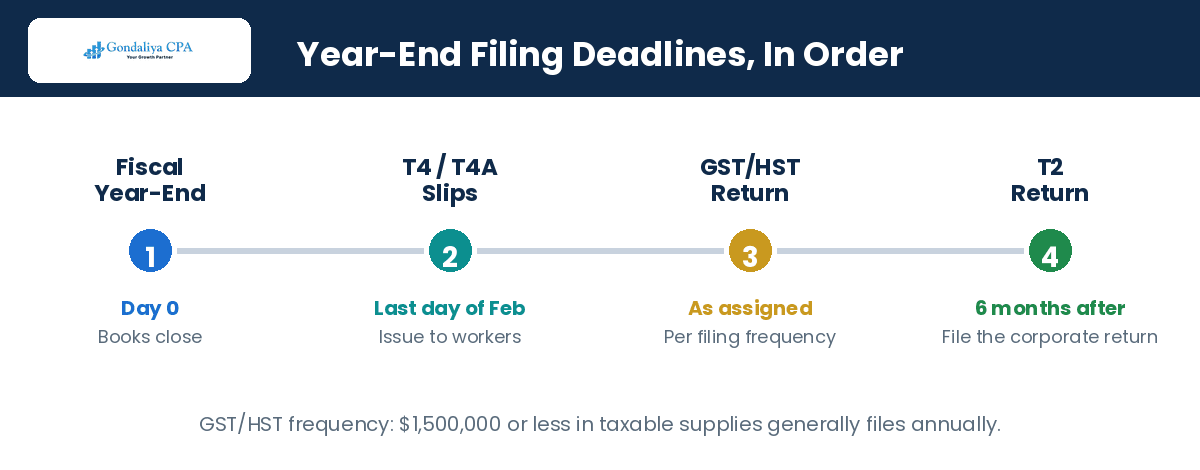
A client nearly missed the last-day-of-February slip deadline because payroll was handled off to the side. We flagged it in January and issued the T4 and T4A slips on time. A date on the calendar avoided a late-slip penalty. Figures changed for privacy.
Key Stat: Businesses with $1,500,000 or less in annual taxable supplies can generally file GST/HST once a year, while those above that threshold file quarterly or monthly. Confirming your frequency early keeps remittances on time and avoids interest.
Prepare Your Books and Reconcile Accounts
Reconcile
Clean books are the foundation of an accurate T2. Before you reconcile, gather last year’s invoices, receipts, bank statements, and records so nothing is missing when you start.
Organize Records and Clean the Chart of Accounts
Sort your documents by type and date, then review your chart of accounts. Confirm each account still matches how the business actually runs, and retire accounts you no longer use. A tidy chart makes your statements clearer and reduces the chance the CRA finds classification errors on review.
A client’s chart of accounts had grown to dozens of overlapping categories over the years. We consolidated it before the close, and the financial statements suddenly read clearly. A simple cleanup made the whole year-end faster. Figures changed for privacy.
Reconcile Bank and Credit Card Accounts
Reconciliation means matching every bank and credit card statement to your books. Check each transaction for missing entries, duplicates, or charges you do not recognize. Doing this monthly through the year means there is little left to fix at close. QuickBooks and Xero match transactions and keep an audit trail, which speeds the work and supports your records if the CRA ever asks.
| Step | Purpose | Common Issue | Prevention |
|---|---|---|---|
| Match statement entries | Confirm completeness and accuracy | Missing transactions | Reconcile monthly |
| Investigate discrepancies | Catch errors or fraud | Duplicate payments | Use automated matching |
| Adjust ledger balances | Show true cash available | Unrecorded fees | Keep records current |
A client had not reconciled in months, and a duplicated vendor payment was sitting in the books unnoticed. The reconciliation caught it, and we recovered the amount from the supplier. Monthly checks would have flagged it the same week. Figures changed for privacy.
Verify Income and Expense Records
Match your recorded income to sales invoices, receipts, contracts, and deposit slips, and confirm revenue is recognized in the correct fiscal period. On the expense side, tie vendor bills, purchase orders, payroll reports, and petty cash to your ledger, and make sure each expense is categorized the way the CRA expects. This is where understated income or misclassified expenses get caught before they become a reassessment.
Pro Tip: Check revenue timing carefully. Income belongs in the period it was earned, not when the cash arrived. A single sale recorded in the wrong fiscal year can shift your tax and draw questions, so please confirm the cut-off at close.
Receivables, Payables, and Bad Debts
AR, AP & Bad Debts
Getting receivables and payables right keeps your working capital honest and your reports ready for the CRA. Handle both before you close.
Manage Accounts Receivable and Payable
For receivables, list which customer invoices are still unpaid, follow up on late accounts, and identify amounts that may never be collected. For payables, confirm every vendor bill that arrived is recorded, and plan payments to fit your fiscal deadlines. Missing a vendor bill understates expenses and can trigger late fees, so please reconcile both sides carefully.
A client had several vendor bills still in an inbox at year-end, unrecorded. We captured them before close, which corrected the expense total and avoided a late charge from one supplier. A short review protected both the numbers and the relationships. Figures changed for privacy.
Identify and Write Off Bad Debts
Sometimes a customer will not pay even after real collection effort. Before you remove a receivable, keep proof you tried to collect, then write it off with the correct journal entry so the loss shows properly on the statements filed with your T2. Writing off genuine bad debts keeps taxable income honest by showing only what you actually expect to receive, and good records protect the claim if the CRA reviews it.
A client wanted to write off a large receivable but had no record of chasing it. We documented the collection attempts first, then booked the write-off. The paper trail turned a shaky claim into a defensible one. Figures changed for privacy.
Risk Warning: Do not write off a debt just because it is old. The amount must have been included in income, and you need evidence of reasonable collection effort. Please keep the support on file before you remove anything at year-end.
Inventory, Fixed Assets, and Adjusting Entries
Assets & Adjustments
Inventory drives cost of goods sold, and fixed assets drive depreciation, so both change your taxable profit. Adjusting entries then line everything up for accurate statements.
Conduct a Physical Inventory Count
Count your physical inventory and compare it to the book figures. This catches overstatements from theft, damage, or lost stock that a spreadsheet will not show on its own. Where you find a difference, investigate the reason and post a correcting journal entry so inventory values are right before you build the trial balance.
A retail client’s system showed more stock than the shelves held. The count exposed the gap, we adjusted it, and the cost of goods sold finally matched reality. Without the count, the profit on the T2 would have been overstated. Figures changed for privacy.
Update Fixed Assets and Depreciation
Update your fixed asset register for anything bought or sold during the year, then recalculate depreciation using the correct Capital Cost Allowance class rates. Accurate asset records make the trial balance cleaner and protect your deductions from CRA questions. If an asset was sold for more than its remaining value, please watch for recapture, which adds prior deductions back to income.
| Asset | CCA Class | Rate |
|---|---|---|
| Equipment, machinery, and tools | Class 8 | 20% |
| Vehicles (general use) | Class 10 | 30% |
| Computers and systems software | Class 50 | 55% |
| Goodwill and intangibles | Class 14.1 | 5% |
A client kept buying equipment but never removed the assets they had scrapped. We cleaned the register, wrote off the disposals, and the depreciation finally reflected what they actually owned. Accurate records, not a new purchase, fixed the numbers. Figures changed for privacy.
Review Prepaid Expenses and Post Adjusting Entries
Prepaid costs are paid ahead but belong to more than one period. At close, adjusting entries move only the portion that applies to this fiscal year into expense, under accrual accounting as used in ASPE. The same discipline applies to accruals and deferrals. These entries make expenses line up with the revenue they support, which is what makes the final statements trustworthy.
Our Take: Adjusting entries are where a rough set of books becomes a real financial statement. We document each one plainly so anyone reviewing the file, including the CRA, can see exactly why it was posted. Please have them approved before the books close.
Payroll Compliance and Documentation
Payroll
Payroll is a common source of year-end penalties, so please treat it as its own workstream. Verify records, confirm year-to-date figures, and reconcile every deduction.
Verify Employee and Contractor Records
Confirm each worker’s Social Insurance Number, address, employment dates, pay, and tax details, and get T4 and T4A slips ready by the last day of February. Employees and contractors are treated differently, so check whether contractor payments need a T4A. Neat records make issuing slips simple and keep you clear of CRA problems.
A client had paid a regular contractor all year without confirming whether a T4A was needed. We reviewed the arrangement and issued the right slip on time. Sorting it before the deadline avoided a late-slip penalty. Figures changed for privacy.
Confirm Year-to-Date Payroll Figures
Compare the wages you paid to what your bookkeeping shows. Match gross pay to the ledger, confirm both employer and employee CPP contributions add up, check EI premiums against the current rates, and make sure income tax withheld ties to the T4 slips. Catching a gap here before the deadline is far cheaper than fixing it after.
A client’s remittances did not tie to the year-to-date totals, off by a small amount each month. We traced it to a rate that had not been updated and corrected the slips before filing. A quick reconciliation kept the CRA out of it. Figures changed for privacy.
Reconcile CPP, EI, and Other Deductions
Confirm CPP contributions do not exceed the yearly maximum, EI premiums follow the current rates, and income tax withheld matches the federal and provincial tables used each pay period. Review any other deductions, such as pension or union amounts, if they apply. Getting these right is what keeps payroll penalties off your file.
GST/HST Year-End Considerations
GST/HST
GST/HST needs its own review at year-end. Recording taxable sales, input tax credits, and exempt sales correctly keeps you compliant and protects your cash flow.
Review GST/HST Transactions
Confirm every taxable sale is recorded so the tax collected is right, match input tax credits to valid purchase documents so you do not overclaim, and separate exempt or non-taxable sales so nothing is misclassified. Then check that your remittances were made on time. A short reconciliation here heads off the errors that lead to CRA penalties or an audit.
| Task | Description | Why It Matters |
|---|---|---|
| Verify taxable sales | Confirm all taxable goods and services are recorded | Correct tax calculation |
| Reconcile input tax credits | Match ITCs to valid purchase records | Prevents overclaiming |
| Review exempt sales | Identify non-taxable revenue accurately | Avoids misclassification |
| Check remittances | Confirm payments were made on time | Keeps you in good standing |
A client had claimed input tax credits on purchases without keeping all the supporting invoices. We rebuilt the support where we could and removed what we could not defend. Clean documentation is what makes an ITC claim hold up. Figures changed for privacy.
Prepare for GST/HST Return Filing
Gather your sales reports, expense ledgers showing ITCs, payroll summaries, and prior filings, then finalize the trial balance for the HST accounts. Confirm expenses eligible for ITCs are classified correctly and complete form GST34 from reconciled numbers. QuickBooks or Xero, paired with your payroll system, keeps the data accurate and the filing on time.
A client filed GST/HST from unreconciled numbers one year and had to amend later. We built the return from a finalized trial balance instead, and it matched the books exactly. Filing from reconciled figures the first time saved the rework. Figures changed for privacy.
Time Capital Purchases and Recover ITCs
Timing larger capital purchases near year-end can help, since the Capital Cost Allowance treatment and the input tax credit both affect your position. Capture every operating expense eligible for HST recovery, and plan payroll timing around your remittance schedule to keep cash flow steady. These small moves add up without stepping outside the rules.
Year-end GST/HST is mostly about matching: sales to tax collected, ITCs to invoices, and remittances to the calendar. Get the reconciliation right and the filing is straightforward. Please do it from a finalized trial balance, not a draft.
Check Your Readiness
Before you book your year-end, this quick self-check shows where the gaps are. Please answer the six questions below.
T2 Year-End Readiness Checker
Six quick questions to see how close your books are to a clean T2. No fee shown.
Complete:
This is a general prompt, not tax or legal advice or a quote. Your actual close depends on your books and year-end. For a real review, please book a free consultation.
Want this as a one-pager? You can download the free year-end and T2 preparation checklist and bring it to your first call. You can also estimate your bill with our corporate tax calculator.
Tax Planning, Close, and Finalizing Statements
Close & Finalize
With the books reconciled, the last stage is planning, closing, and producing statements that stand up to a lender or a CRA review.
Maximize Deductions and Time Recognition
Confirm every allowable deduction is claimed within the fiscal year, from office supplies and professional fees to vehicle costs and employee benefits, each backed by records. Recognize income when it is earned and match expenses to the same period under accrual accounting. Watch for deferred income, accrued liabilities, and unbilled services, which are easy to miss and can shift your result.
Before a client’s close, we found unbilled services that belonged in the year and a prepaid amount that did not. Adjusting both put the profit in the right period. The T2 reflected the real year, not a timing accident. Figures changed for privacy.
Finalize Statements and Adjusting Entries
Prepare the balance sheet and income statement from the reconciled trial balance, checking asset values, receivable aging, and payable balances. Post any final adjusting journal entries for accruals and deferrals, and make sure each one is approved and clearly explained before the books close, in line with CPA Ontario expectations. A short internal review at this stage prevents surprises later.
2026 Update — what is current: For 2026, the capital gains inclusion rate remains 50% and the Lifetime Capital Gains Exemption sits at $1,275,000 for qualified small business corporation shares. Ontario’s small-business corporate income tax rate was cut from 3.2% to 2.2% effective July 1, 2026, which brings the combined federal and Ontario small-business rate to 11.2% on income earned from that date. Please factor the July 1 change into any year-end that straddles that date.
Plan the New Fiscal Year
Use this year’s results to build next year’s budget from real forecasts, and reset your goals toward the areas that returned the most. Then improve the close itself: automate reconciliations in QuickBooks or Xero and fold the fixes you found this year into next year’s procedures. A better process each year is the quiet win most owners overlook.
After a rough first close with a new client, we automated their bank feeds and set a monthly reconciliation routine. The next year-end took a fraction of the time. The improvement came from the process, not extra effort. Figures changed for privacy.
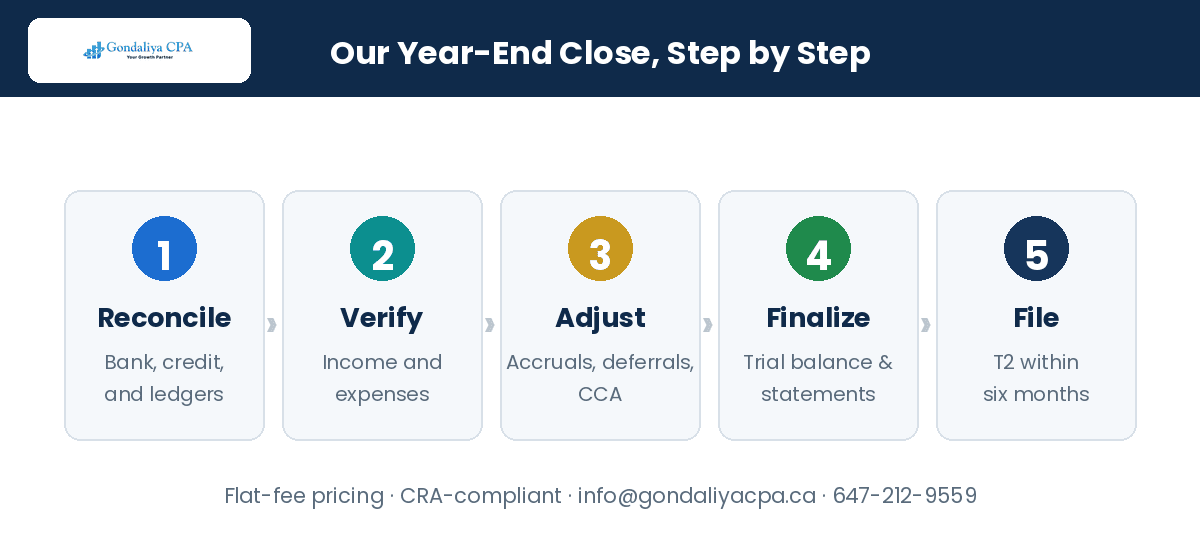
A client came to us with a draft T2 built from unfinished books. We reset it, finalized the trial balance, posted the adjusting entries, and produced statements that matched the ledger exactly. Building from a clean close, not a draft, is what kept it off the CRA’s radar. Figures changed for privacy.
How Gondaliya CPA Helps
Gondaliya CPA works with incorporated SMBs across Toronto, Mississauga, Vaughan, Etobicoke, Brampton, Scarborough, Ottawa, and all of Canada, remotely and on flat-fee pricing so the cost is clear. We organize your records, run the reconciliations, post the adjusting entries, prepare your GST/HST and payroll, and build a clean T2 package that keeps you audit-ready. A free consultation is enough to see whether a light touch or full support fits your business.
Where a Compilation Report Fits
Once the close is done, many owners need presentable statements for a lender, an investor, or their own records. A compilation engagement, prepared under CSRS 4200, presents financial statements from the information you provide, without assurance. It is the cost-effective option for a small corporation that does not need an audit, and it supports a smooth T2 filing. Our process is straightforward: we collect your records, run the reconciliations, post the adjusting entries, and prepare the statements with clear notes.
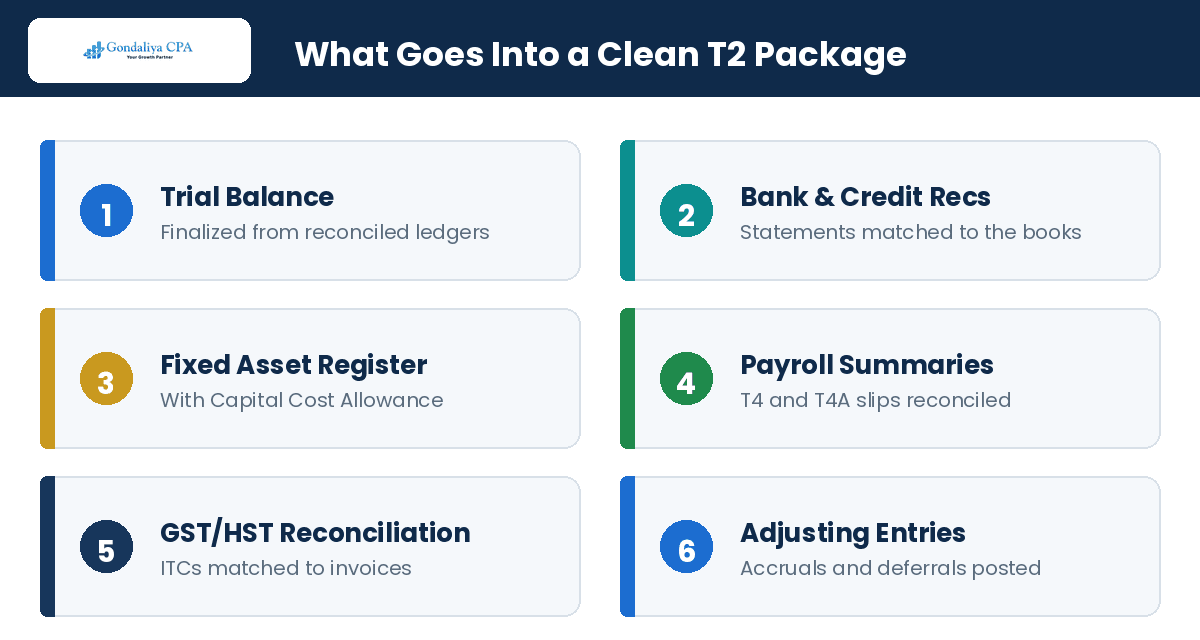
What Goes Into the Final Package
- A working trial balance, finalized and agreed.
- Bank and credit card reconciliations.
- A fixed asset register with Capital Cost Allowance.
- Payroll summaries with T4 and T4A slips.
- GST/HST reconciliation reports.
- Accounts payable and receivable aging reports.
- Loan documents and tax instalment records, where they apply.
- All year-end adjusting journal entries, documented.
How Much Time Year-End Takes
Most incorporated SMBs spend roughly 20 to 40 hours closing their books each year. Working from a checklist cuts that down considerably, because the organization is already done and there is less to chase. Please treat the hours you save as the real return on keeping monthly books current.
Why Businesses Choose Us
Gondaliya CPA is a CPA Ontario Registered Firm, handling multi-provincial corporate tax filings and serving clients across Etobicoke, Brampton, Scarborough, Ottawa, Toronto, and Ontario-wide. We handle industry-specific requirements, including medical offices, real estate investors, and technology startups, and we work on transparent flat annual pricing with no hidden fees, so the cost is predictable. The scope and assumptions are set out in your engagement letter before we begin, so there are no surprises later.
CRA Deadline: File the T2 within six months of your fiscal year-end, issue T4 and T4A slips by the last day of February, and keep your records for six years. Interest runs on late balances even when the return itself is not yet due, so please pay on time.
Glossary of Key Terms
Plain-English Definitions
- Fiscal year-end: The date a corporation closes its books each year, which sets the T2 filing deadline.
- T2 return: The Corporation Income Tax Return every incorporated business files each year.
- Reconciliation: Matching your books to bank and credit card statements to confirm accuracy.
- Chart of accounts: The list of accounts used to record and organize a company’s transactions.
- Trial balance: A listing of all ledger balances used to build the financial statements.
- Adjusting journal entry: An entry posted at close to record accruals, deferrals, or corrections.
- Accounts receivable: Amounts customers owe the business for goods or services delivered.
- Accounts payable: Amounts the business owes its vendors and suppliers.
- Bad debt: A receivable written off after reasonable collection effort fails.
- Capital Cost Allowance (CCA): The yearly tax deduction that writes off part of a capital asset’s cost by class.
- Input tax credit: A credit that recovers GST/HST paid on eligible business purchases.
- ASPE: Accounting Standards for Private Enterprises, the framework most private Canadian corporations use.
- Compilation engagement: Financial statements prepared under CSRS 4200 without assurance, often required by lenders.
Frequently Asked Questions
FAQ
When is the T2 corporate return due in Canada?+
The T2 is due six months after your fiscal year-end. Any balance owing is due two months after year-end, or three months for many CCPCs.
When must T4 and T4A slips be issued?+
By the last day of February for the prior calendar year. Late slips can trigger CRA penalties, so please prepare them early.
How often must I file GST/HST?+
Businesses with $1,500,000 or less in annual taxable supplies can generally file annually. Above that threshold, filing is quarterly or monthly.
How long must a corporation keep its records?+
Keep books, records, and supporting documents for six years from the end of the last tax year they relate to.
What documents make up a clean T2 package?+
A finalized trial balance, bank and credit card reconciliations, a fixed asset register with CCA, payroll summaries with T4 and T4A slips, and a GST/HST reconciliation.
What year-end errors most often trigger CRA attention?+
Late T2 filing, unreconciled bank accounts, missing payroll deductions, incorrect GST/HST filings, depreciation errors, and incomplete documentation.
How much does year-end and T2 preparation cost?+
We work on flat annual pricing set to the size and complexity of your business, with clear scope and assumptions confirmed before we start, HST included.
How long does year-end close take?+
It depends on your transaction volume and how current your bookkeeping is. Clean, reconciled monthly books make the close much faster than a year-end catch-up.
Do I need to file a T2 in a year with no activity?+
Yes. An incorporated business files a T2 each year, including a nil return, unless the CRA has advised otherwise.
How do I choose a CPA firm in Toronto or Ontario?+
Verify licensing on the CPA Ontario directory, look for experience with incorporated SMBs, and confirm clear flat-fee pricing and a strong review record.
What is a CPA compilation report, and when do I need one?+
A compilation engagement, prepared under CSRS 4200, presents your financial statements without audit assurance. You need one when a lender, investor, or other third party wants reliable statements, and it supports a smooth T2 filing.
How many hours does year-end bookkeeping usually take?+
Most incorporated SMBs spend roughly 20 to 40 hours closing their books. Working from a checklist reduces that, because the records are already organized.
Do you handle multi-provincial corporate filings?+
Yes. We manage filings across provinces and confirm compliance with the applicable CRA and provincial rules, including industry-specific requirements for medical offices, real estate investors, and technology startups.
Year-End Checklist at a Glance
- Confirm your fiscal year-end and all filing deadlines.
- Reconcile bank and credit card accounts to year-end.
- Verify income and expenses against source documents.
- Review receivables and payables and write off genuine bad debts.
- Count inventory and update the fixed asset register and CCA.
- Reconcile payroll and prepare T4 and T4A slips.
- Reconcile GST/HST and confirm your filing frequency.
- Post adjusting entries and finalize the statements.
Who This Is For / Not For
- For: Incorporated Canadian SMBs preparing an accurate T2 and wanting a clean close.
- Not For: Unincorporated sole proprietors filing only a personal return.
People Also Ask
Quick Answers
Can I file my T2 before finishing reconciliations?+
You can, but it is risky. A T2 built on unreconciled books often needs amending, so please finalize the trial balance first.
What is the difference between year-end close and tax filing?+
Close is the accounting work that produces accurate statements. Filing is submitting the T2 based on those statements to the CRA.
Does clean monthly bookkeeping really speed up year-end?+
Yes. Monthly reconciliations leave little to fix at close, which shortens the year-end and lowers the chance of errors.
Contact Gondaliya CPA at 647-212-9559 or info@gondaliyacpa.ca for help with your year-end close and T2 preparation.
Close the year clean, file the T2 with confidence
Gondaliya CPA handles year-end close, GST/HST, payroll, and T2 preparation at flat, fixed fees, so your books are accurate and your filing is on time. Please book a free consultation to start.
Next Steps
An accurate T2 starts with a clean close: confirm your dates, reconcile every account, verify income and expenses, handle receivables, payables, inventory, and assets, reconcile payroll and GST/HST, then post your adjusting entries and finalize the statements. Please start a few weeks before your fiscal close and bring us the gaps. Reach out for a free consultation, call 647-212-9559, or email info@gondaliyacpa.ca. If our content helps, please add gondaliyacpa.ca as a preferred source on Google.
Published: July 2, 2026 · Last updated: August 12, 2026
Disclaimer: This article is educational information only and is not tax, legal, or financial advice. It reflects CRA rules current to 2026, including the 50% capital gains inclusion rate, the $1,275,000 Lifetime Capital Gains Exemption, and Ontario’s small-business rate reduction to 2.2% effective July 1, 2026. Outcomes depend on your specific facts and rules can change. Please consult a Registered CPA in Canada or Ontario before acting. Fees include HST.

Sharad Gondaliya is a CPA Canada & CPA USA with 15 Years+ experience of Accounting, Tax, Payroll of Corporate Small Businesses as Tax Accountant. He is a CPA Ontario member (61040184) and holds US CPA licences in Washington and Montana and is well known among corporate small businesses for tax planning, efficient tax solutions, and affordable CPA services. Sharad is the Principal (Director) of Gondaliya CPA – Affordable CPA Firm in Canada. Licenses: CPA Ontario: 61040184 | CPA USA (MT): PAC-CPAP-LIC-033176 | CPA USA (WA): 57629 | CPA Firm License: 61330051 View Full Author Bio