



The Ultimate Guide to Payroll Services for Small Businesses in Canada
Payroll services play a vital role in managing small business payroll efficiently, and Gondaliya CPA offers reliable payroll management solutions tailored for Canadian businesses. As a trusted payroll service provider, we simplify payroll processing, tax compliance, and employee compensation to support your growth.
Payroll services play a vital role in managing small business payroll efficiently, and Gondaliya CPA offers reliable payroll management solutions tailored for Canadian businesses. As a trusted payroll service provider, we simplify payroll processing, tax compliance, and employee compensation to support your business growth.
Quick Summary
Running payroll in Canada means deducting CPP, EI, and income tax correctly, remitting them to the CRA on time, and filing T4 slips and Records of Employment when due. The rates change every year, the deadlines are firm, and the penalties for slipping are real. Please get the deductions and the remittance dates right first; everything else follows from those two.
| Aspect | Details |
|---|---|
| Core deductions | CPP, EI, and income tax withheld from every pay. |
| Employer cost | You also pay a matching CPP share and 1.4 times the EI premium. |
| Remittance | Regular remitters pay the CRA by the 15th of the following month. |
| Year-end | T4 and T4A slips are due by the last day of February. |
Reading time: 28 minutes.
Table of Contents
- What Payroll Involves in Canada
- 2026 Payroll Rates You Need to Know
- Remittances, Deadlines, and Year-End
- Setting Up and Running Payroll
- Provincial Payroll Obligations
- In-House vs Outsourced Payroll
- How Gondaliya CPA Helps
- Industry Spotlights: Sectors We Represent
- Glossary of Key Terms
- Frequently Asked Questions
- People Also Ask
Payroll at a Glance
This article covers Canada, with Toronto and Ontario context, and reflects CRA and payroll rules current to 2026. Rates shown are for employees outside Quebec, which runs its own pension and parental plans. Items marked “illustrative” are examples, not quotes, and any masked engagement notes end with “Figures changed for privacy.” This is educational information only and not tax, legal, or financial advice. Fees include HST. Please confirm your own situation with a Registered CPA before acting.
What Payroll Involves in Canada
The Basics
Payroll is more than paying wages. Every pay, you withhold the right deductions, add the employer’s own contributions, remit the total to the CRA, and keep records that can stand up to a review. Get those four things right and payroll runs quietly; get any one wrong and the penalties follow.
The Three Deductions
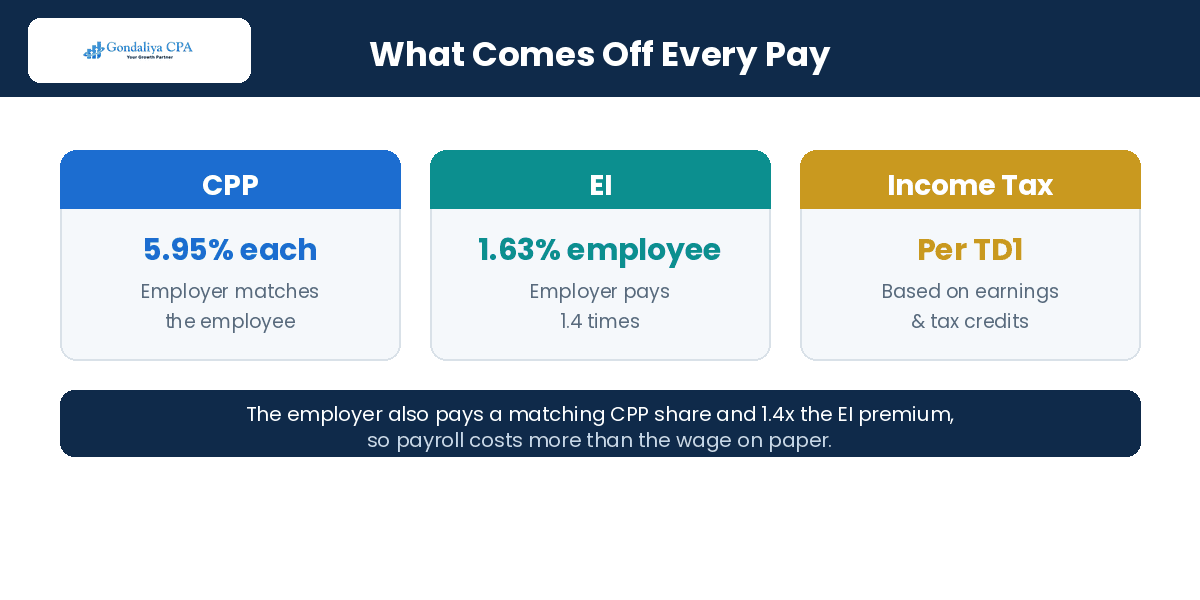
From each employee’s pay you withhold three things: Canada Pension Plan contributions, Employment Insurance premiums, and income tax. CPP and EI have set rates and annual maximums, while income tax is calculated on the employee’s earnings and their TD1 claim amounts. You send all three to the CRA as source deductions.
The Employer Pays More Than the Wage
Payroll costs the business more than the salary on paper. On top of the wage, you pay a matching CPP contribution and an EI premium of 1.4 times the employee’s, plus any provincial payroll tax and workplace insurance. Please budget for the full loaded cost of an employee, not just the gross pay, because the employer share is real money leaving the account every period.
Key Stat: The employer share is not small. You match the employee’s CPP contribution dollar for dollar and pay 1.4 times their EI premium, so two employees at the maximum can add several thousand dollars a year in employer contributions alone, before any provincial payroll tax. Please plan for it.
A client budgeted a new hire at the salary figure and was surprised by the added employer CPP and EI each month. We built the full loaded cost into their forecast so the next hire held no surprises. The employer share is part of the wage bill, not an extra. Figures changed for privacy.
2026 Payroll Rates You Need to Know
2026 Rates
Payroll rates change every year, and using last year’s figures is a common, costly mistake. Here are the numbers that drive your 2026 deductions, for employees outside Quebec.
CPP, CPP2, and EI for 2026
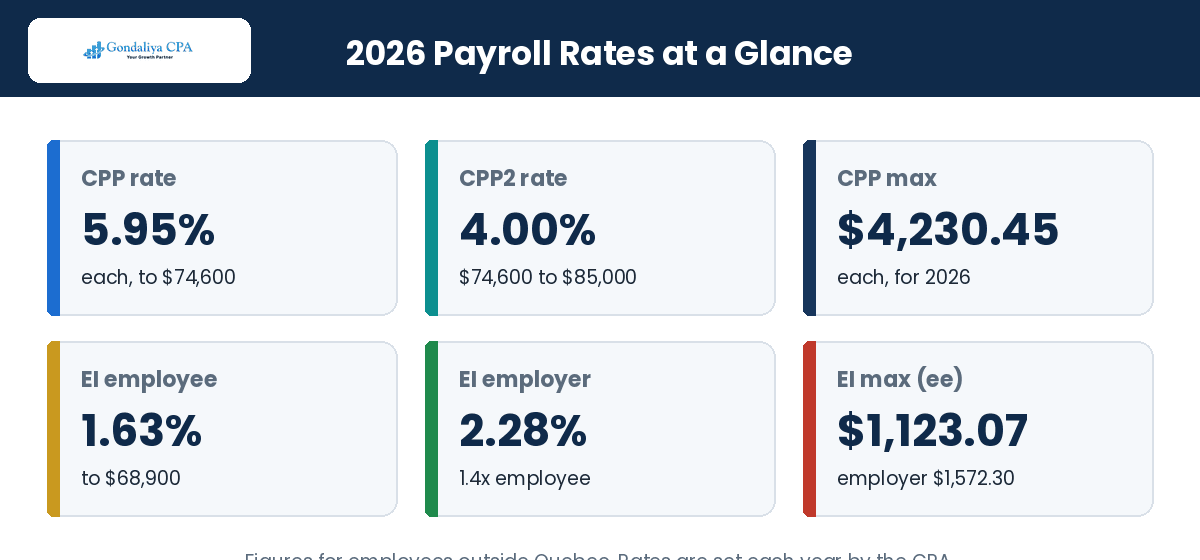
The CPP rate holds at 5.95% for both employee and employer, on earnings between the $3,500 basic exemption and the maximum pensionable earnings. A second tier, CPP2, applies above that ceiling. EI is a flat percentage of insurable earnings up to its own maximum, with the employer paying 1.4 times the employee rate. The table below sets out the exact figures.
| 2026 Payroll Figure | Amount |
|---|---|
| CPP contribution rate (employee and employer, each) | 5.95% |
| CPP basic exemption | $3,500 |
| CPP maximum pensionable earnings (YMPE) | $74,600 |
| CPP maximum contribution (each) | $4,230.45 |
| CPP2 rate (each) | 4.00% |
| CPP2 earnings band | $74,600 to $85,000 |
| CPP2 maximum contribution (each) | $416 |
| EI premium rate (employee) | 1.63% |
| EI premium rate (employer, 1.4 times) | 2.28% |
| EI maximum insurable earnings | $68,900 |
| EI maximum premium (employee) | $1,123.07 |
| EI maximum premium (employer) | $1,572.30 |
A new client’s payroll was still running the prior year’s CPP maximum, so contributions stopped too early. We updated the figures for the current year and corrected the shortfall before it became a remittance problem. Old rates in the software are an easy, expensive miss. Figures changed for privacy.
Pro Tip: Once an employee reaches the annual CPP or EI maximum, please stop deducting that item for the rest of the year. Over-deducting means the employee claims a refund on their return, while the employer’s overpayment is harder to recover.
Remittances, Deadlines, and Year-End
Deadlines
Deducting correctly is half the job; sending the money and the slips on time is the other half. The CRA treats source deductions seriously because they are trust funds you hold on its behalf.
Remittance Frequency
How often you remit depends on your size. Regular remitters send source deductions by the 15th day of the month after the deductions were made. New small employers and small remitters may qualify to remit quarterly, while larger employers become accelerated remitters and pay more often. Please confirm your remitter type, because sending late, even by a day, triggers a penalty.
CRA Deadline: Regular remitters send source deductions by the 15th of the month after they were withheld, T4 and T4A slips are due by the last day of February, and payroll records are kept six years. Please diarize the remittance date for every pay period, because a single day late still triggers a penalty.
A client remitted a few days late during a tight month and was surprised by the penalty on a trust amount. We set a calendar reminder tied to each pay run, and it never happened again. With remittances, the date is not flexible. Figures changed for privacy.
Risk Warning: Source deductions are trust amounts, and the CRA pursues them harder than almost any other balance, including holding directors personally liable in some cases. Please never borrow from remittances to cover cash flow; it is the fastest route to serious trouble.
T4, T4A, and Records of Employment
At year-end, prepare a T4 or T4A slip for each person showing their pay and deductions, and file them with the CRA and give them to employees by the last day of February. Issue a Record of Employment promptly whenever an employee’s earnings are interrupted, such as a departure or leave. Late T4 filing brings penalties that start at $100 and rise with the number of slips and how late they are.
| Year-End Item | Deadline |
|---|---|
| T4 and T4A slips to the CRA and employees | Last day of February |
| Record of Employment | Promptly after an interruption of earnings |
| Payroll record retention | Six years |
A client left a departing employee’s Record of Employment until year-end, which delayed the person’s EI claim and drew complaints. We set a process to issue every ROE at the moment of departure. Timely slips keep both the CRA and the former employee satisfied. Figures changed for privacy.
2026 Update — what is current: The 2026 CPP rate holds at 5.95% with the maximum pensionable earnings at $74,600, and the EI rate eases to 1.63% for employees with maximum insurable earnings of $68,900. Employers must now complete the Canadian Dental Care Plan box on every T4 and T4A, stating whether the employee had access to dental coverage, even when none was offered; leaving it blank can cause the CRA to reject the filing. Please apply the current-year figures and the dental reporting to your next run.
Setting Up and Running Payroll
Setup
Good payroll starts with clean setup. Get the account, the forms, and the worker classifications right at the outset and the pay runs mostly take care of themselves.
The Setup Essentials
Open a payroll (RP) account with the CRA, collect a federal and provincial TD1 form from each employee to set their tax credits, and gather banking details for direct deposit. Set a pay schedule, choose software that matches your accounting system, and confirm the current-year rates are loaded. Clean setup is what prevents the recurring errors that draw a payroll audit.
A client had employees without current TD1 forms, so tax was being withheld on default assumptions. We collected the forms and corrected the withholdings, which fixed several people’s take-home pay. The right forms at setup prevent months of small errors. Figures changed for privacy.
Employee or Contractor: Classify Carefully
One of the costliest payroll mistakes is treating an employee as a contractor. The CRA looks at control over the work, who provides the tools, the chance of profit and risk of loss, and how integrated the person is into the business. Get it wrong and the CRA can reassess for unremitted CPP, EI, and tax, with penalties and interest. Please assess each relationship on the facts, not on the label in the contract.
A client paid a long-term worker as a contractor, though the CRA’s factors pointed to employment. We restructured the arrangement correctly before an audit, avoiding a reassessment for years of unremitted deductions. Classification is judged on substance, not the wording. Figures changed for privacy.
Running the Pay Run
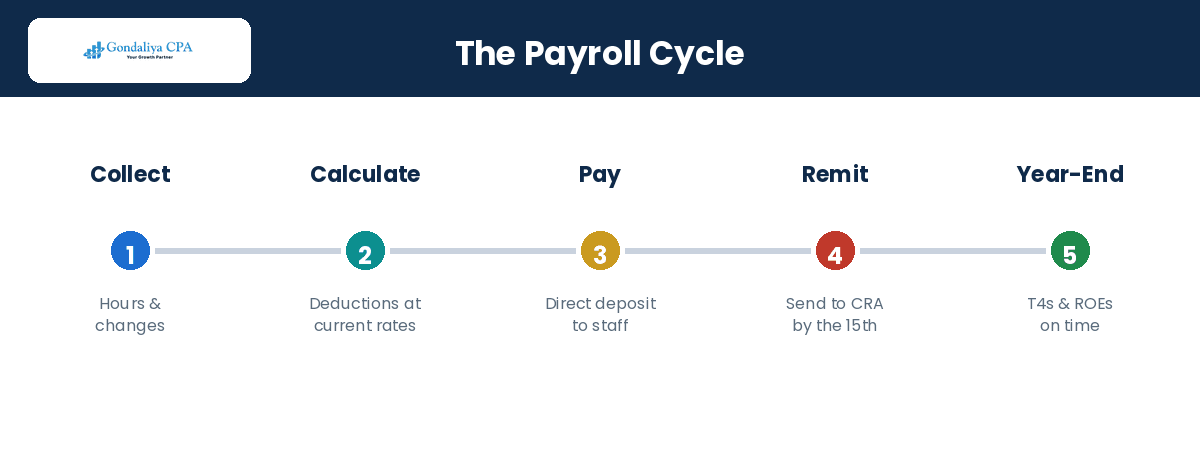
Each cycle, collect hours and any changes, calculate gross pay and the three deductions at current rates, pay employees by direct deposit, and record everything. Modern software handles the arithmetic, but a quick human review catches the outliers before money moves. Keep the pay records, remittance confirmations, and slips organized so a review is a non-event.
Our Take: Automate the calculations, but never skip the review. Software applies the rules you gave it; a person catches the wrong rate, the missing TD1, or the misclassified worker. Please pair good software with a set of trained eyes each run.
Check Your Payroll Compliance
Before your next run, this quick self-check shows where the gaps are. Please answer the six questions below.
Payroll Compliance Checker
Six quick questions to see how compliant your payroll is. No fee shown.
In place:
This is a general prompt, not tax or legal advice or a quote. Your actual compliance depends on your payroll records. For a real review, please book a free consultation.
Want this as a one-pager? You can download the free small business payroll compliance checklist and keep it by your pay run. You can also estimate deductions with our payroll tax calculator.
Provincial Payroll Obligations
Provincial
Federal deductions are only part of the picture. Each province adds its own payroll rules, and in Ontario there are a few you cannot miss.
Ontario Employer Health Tax and WSIB
Ontario’s Employer Health Tax applies to payroll above an exemption, which is $1,000,000 of Ontario remuneration for eligible employers, at rates from 0.98% to 1.95% depending on total payroll. Most Ontario employers must also register with the WSIB and pay workplace insurance premiums based on payroll and industry class. Please check both when you cross the relevant thresholds, because they are easy to overlook until a bill arrives.
A growing client crossed the Employer Health Tax threshold without realizing it and had not registered. We got them registered and current before penalties mounted. Provincial payroll taxes creep up quietly as you hire. Figures changed for privacy.
Vacation Pay and Employment Standards
Ontario’s Employment Standards Act sets minimums that payroll has to honour, including vacation pay of 4% of wages for employees with less than five years of service, rising to 6% at five years, plus statutory holiday pay and overtime rules. Payroll is where these obligations are calculated and paid, so the standards and the pay run have to line up. Please build the entitlements into the system rather than tracking them by hand.
A client had not increased vacation pay for staff who passed five years of service, creating a quiet liability. We corrected the rate and the accrual going forward. Employment standards feed straight into payroll, and the two must match. Figures changed for privacy.
In-House vs Outsourced Payroll
Build or Outsource
Every small business eventually asks whether to run payroll in-house or hand it to a professional. Both can work; the right answer depends on your size, complexity, and appetite for the compliance risk.
Weighing the Options
In-house payroll on good software is workable for a few salaried employees with simple pay. It costs less in fees but puts the compliance burden and the penalty risk on you. Outsourcing to a CPA-led service costs a fee but moves the rate updates, remittance deadlines, year-end filings, and audit exposure onto someone accountable. As headcount, provinces, or complexity grow, the case for outsourcing strengthens.
| Approach | Best When |
|---|---|
| In-house on software | A few salaried employees with simple, stable pay |
| CPA-led outsourced payroll | Growing headcount, multiple provinces, or complex pay |
A client ran payroll in-house until they hit several employees across two provinces, and the deadlines started slipping. Moving it to us removed the misses entirely and freed the owner’s time. Outsourcing paid for itself in avoided penalties alone. Figures changed for privacy.
A client kept payroll in-house on good software for two simple salaries and ran it cleanly for years. When they added hourly staff and benefits, we took it over. The right choice changed as their complexity grew, not before. Figures changed for privacy.
For one or two simple salaries, in-house software is fine. Once you add employees, provinces, benefits, or hourly complexity, a CPA-led service usually costs less than the penalties and hours it prevents. Please match the choice to your complexity, not your headcount alone.
How Gondaliya CPA Helps
How We Help
Payroll is exactly the kind of recurring, deadline-driven work a CPA firm is built to carry. We take it off your plate and stand behind the compliance.
Full-Service Payroll on a Flat Fee
Gondaliya CPA runs payroll for incorporated SMBs across Toronto, Mississauga, Vaughan, Etobicoke, Brampton, Scarborough, Ottawa, and all of Canada, remotely and on a flat fee, HST included, so the cost is clear. We calculate and remit deductions at current rates, file T4 and T4A slips and Records of Employment, handle provincial obligations, and stand with you during any CRA payroll review. We work in QuickBooks, Xero, and Wagepoint so payroll flows straight into your books.
Setup and Employee Onboarding
Payroll setup usually takes one to two weeks, covering data collection, software integration, and employee onboarding. New hires enter their own details through a secure online portal, so the information arrives accurate from the start and you spend less time chasing forms. That also lets us verify benefit eligibility and have the tax forms ready to CRA requirements before the first run.
Your Employees’ Data Stays Secure
Payroll holds sensitive information: SINs, bank details, salaries, and tax records. Our handling meets Canadian privacy requirements under PIPEDA, with encrypted storage, access limited by role, and regular security reviews. Please send anything sensitive through the secure portal rather than email.
What Your Employees See
Staff get digital pay statements they can open any time, showing hours, overtime, vacation and holiday pay, and every deduction clearly. Mobile access means remote workers and people across multiple sites can check a payslip on a phone rather than asking you on payday.
The Reports You Receive
| Report | Purpose | Frequency |
|---|---|---|
| Payroll summary | Total wages and deductions overview | Each pay period |
| Deduction report | Detail of CPP, EI, and income tax amounts | Each remittance |
| T4 and T4A slips | Annual earnings and deduction summary | Yearly |
Seeing wage costs as they happen makes cash flow far easier to manage than waiting for year-end.
Integrations That Cut Manual Entry
Beyond QuickBooks, Xero, and Wagepoint, we connect ADP for payroll and HR, Hubdoc for document capture, and Stripe or Rotessa for payment data. Employee information is entered once and flows through to calculations, remittances, and your books, so the same figure is never typed twice. Government rate changes update in the software rather than relying on someone to remember them.
Switching Providers Without a Gap
Changing payroll provider mid-year is common and manageable with planning. Give your current provider notice, and make sure recent pay runs, year-to-date figures, benefit plans, and deduction details are ready to transfer. Confirm the new system connects to your accounting software, and agree exactly which pay period is the last under the old provider and the first under the new one, so nothing falls between them. Please tell your employees before the change rather than after.
What Drives the Fee
| Cost driver | Effect on the fee |
|---|---|
| Number of employees | More employees means more processing each period |
| Pay frequency | Weekly runs carry more workload than monthly |
| Complexity of deductions | Multiple benefit plans raise the administration |
The fee is quoted in writing after a free consultation, HST included, and covers support during a CRA review rather than billing it separately. Gondaliya CPA is a CPA Ontario Registered Firm.
Working With Bookkeepers and Accountants
We also support bookkeepers and accountants who manage payroll for their own clients. Because we work across QuickBooks, Xero, Wagepoint, ADP, Stripe, Rotessa, and Hubdoc, bookkeeping data flows cleanly into payroll processing, which cuts reconciliation work and keeps T4 and GST/HST reporting consistent. Please get in touch if you would like to discuss a referral or partner arrangement.
Setup Takes One to Two Weeks
Getting started is quick. Setup usually runs one to two weeks, covering data collection, software integration, and employee onboarding. New hires enter their own details through a secure online portal, which cuts the admin work for you and gets accurate information from the start, including the TD1 forms and benefit eligibility the CRA expects.
Your Employee Data Stays Secure
Payroll involves the most sensitive data a business holds: SINs, bank details, salaries, and tax records. Our handling meets Canadian privacy requirements under PIPEDA, with encrypted storage, access limited by role, and regular security reviews. Please send documents through the secure portal rather than email.
What Employees See
Staff get digital pay statements they can open any time, showing hours, overtime, vacation and holiday pay, and every deduction broken out. Access works on a phone or tablet, which matters for remote workers and anyone who would otherwise be asking you for a copy each payday.
The Systems We Connect
Beyond QuickBooks, Xero, and Wagepoint, we integrate with ADP for payroll and HR, Hubdoc for document capture, and Stripe and Rotessa for payments. Connected systems mean employee information is entered once and flows everywhere it is needed, which removes the duplicate entry that causes most payroll errors.
What Drives the Fee
| Cost driver | Effect on price |
|---|---|
| Number of employees | More employees mean more processing each period |
| Frequency of pay periods | Weekly runs carry more work than monthly |
| Complexity of deductions | Multiple benefit plans raise the administration |
The fee is a fixed annual amount, HST included, quoted in writing after a free consultation, and it covers support during a CRA review rather than treating that as an extra.
Our Commitments to You
The engagement is backed by a 30-day money-back guarantee if early expectations are not met, and a 60-day fees-matching policy on competitive pricing. We respond within one business day, which matters when a remittance date is close. Gondaliya CPA is a CPA Ontario Registered Firm, and we also serve Hamilton, North York, and Windsor alongside the cities listed above.
Switching Providers Without Disruption
Changing payroll providers mid-year is routine when it is planned. Please give your current provider notice, and make sure recent pay runs, year-to-date totals, benefit plans, and deduction details are ready to transfer. We confirm where the old system stops and the new one starts so no pay period falls between them, and we help you tell employees what to expect. Done properly, nobody misses a payment.
Working With Your Bookkeeper
We also support bookkeepers and accountants who manage payroll for their own clients. Because we work across QuickBooks, Xero, Wagepoint, ADP, Hubdoc, Stripe, and Rotessa, bookkeeping data flows into payroll cleanly, which cuts reconciliation work and keeps T4 and GST/HST reporting consistent. Please get in touch if you are a practitioner looking for payroll support behind the scenes.
A client came to us after payroll errors surfaced in a CRA review, with slips and remittances out of order. We corrected the filings, arranged the shortfall, and put clean monthly processing in place. The cleanup fixed the past; the process protected the future. Figures changed for privacy.
A client dreaded every year-end because T4s and ROEs piled up. Once we ran the payroll monthly, year-end became a routine filing with nothing to scramble for. Steady processing all year is what makes February quiet. Figures changed for privacy.
Industry Spotlights: Sectors We Represent
Industry Expertise
Payroll challenges differ by industry, and knowing the pressure point for your sector keeps the pay run clean. Here are ten we handle often, and where payroll usually gets tricky.
| Industry | Where Payroll Gets Tricky |
|---|---|
| Medical doctors & physician professional corporations | Salary-and-dividend mix, family payroll, TOSI |
| Dentists & dental practices | Associate vs employee status, hygienist payroll |
| Daycare, childcare & CWELCC services | Wage-enhancement grants reconciled to payroll |
| Real estate investors, landlords & holding companies | Owner remuneration and management payroll |
| Property developers & builders | Project-based crews and subcontractor lines |
| Construction, contractors & skilled trades | Union wages, T5018, worker classification |
| Technology startups & SaaS | Stock options, bonuses, and remote-worker provinces |
| E-commerce & online retailers | Seasonal and part-time staff, multi-province payroll |
| Restaurants & food and beverage | Tips, gratuities, and high-turnover ROEs |
| Transportation, logistics & trucking | Owner-operator vs employee, per-diem treatment |
- Medical doctors & physician professional corporations: Payroll for a physician professional corporation usually means balancing salary and dividends, paying family members reasonably under the tax-on-split-income rules, and reconciling remuneration to the corporation’s cash. Specialists certified through the Royal College of Physicians and Surgeons of Canada face the same source-deduction rules as any employer.
- Dentists & dental practices: Practices regulated by the Royal College of Dental Surgeons of Ontario often need associate-versus-employee status settled and hygienist and assistant payroll run correctly with proper deductions.
- Daycare, childcare & CWELCC services: Childcare payroll ties into CWELCC wage-enhancement grants, so wages and the grant funding must reconcile cleanly each period alongside standard source deductions.
- Real estate investors, landlords & holding companies: The payroll question is usually owner remuneration and any management or property-staff wages, run through the operating company with correct deductions.
- Property developers & builders: Project-based crews and the line between employees and subcontractors drive the payroll and the T5018 reporting that goes with it.
- Construction, general contractors & skilled trades: For electricians, plumbers, and HVAC firms, union wage rules, T5018 subcontractor reporting, and correct worker classification are the recurring payroll issues.
- Technology startups & SaaS: Tech payroll adds stock-option benefits, bonuses, and remote employees working in different provinces, each with its own tax and reporting.
- E-commerce & online retailers: Seasonal and part-time hiring and staff spread across provinces make accurate, multi-jurisdiction payroll the main challenge.
- Restaurants & food and beverage: Tips and gratuities, high turnover, and the steady stream of Records of Employment make restaurant payroll among the most demanding to run cleanly.
- Transportation, logistics & trucking owner-operators: The core payroll issues are owner-operator versus employee classification and the correct treatment of allowances and per-diems for drivers.
A restaurant client with high turnover was falling behind on Records of Employment, drawing complaints and delays. We built a process that issued each ROE at departure and ran the tip payroll correctly. Steady processing tamed the busiest payroll we handle. Figures changed for privacy.
A construction client paid several crew members as subcontractors who were really employees. We corrected the classification and the T5018 reporting before a CRA review, avoiding a reassessment for unremitted deductions. Getting the status right protected the business. Figures changed for privacy.
A childcare client’s CWELCC wage-enhancement grant did not reconcile to the payroll records. We aligned the wages and the grant funding period by period, and the reporting matched. Clean payroll made the grant reporting straightforward. Figures changed for privacy.
Glossary of Key Terms
Plain-English Definitions
- Source deductions: The CPP, EI, and income tax withheld from pay and remitted to the CRA.
- CPP: Canada Pension Plan contributions, at 5.95% for 2026, matched by the employer.
- CPP2: The second CPP tier at 4% on earnings between the YMPE and $85,000.
- EI: Employment Insurance premiums, at 1.63% for employees in 2026, with the employer paying 1.4 times.
- YMPE: The Year’s Maximum Pensionable Earnings, $74,600 for 2026.
- TD1: The federal and provincial forms that set an employee’s tax credit amounts.
- Remitter type: How often you send deductions to the CRA, from quarterly to accelerated.
- T4 / T4A: Year-end slips reporting an employee’s pay and deductions.
- Record of Employment: The form issued when an employee’s earnings are interrupted.
- Employer Health Tax: Ontario’s payroll tax above a $1,000,000 remuneration exemption.
- WSIB: Ontario’s workplace safety insurance, funded by employer premiums.
- Worker classification: Whether a person is an employee or a contractor for payroll purposes.
Frequently Asked Questions
FAQ
What are the 2026 CPP and EI rates?+
For 2026, CPP is 5.95% for employee and employer each up to $74,600, with CPP2 at 4% to $85,000. EI is 1.63% for employees, and the employer pays 1.4 times that, up to insurable earnings of $68,900.
When do I have to remit source deductions?+
Regular remitters pay by the 15th of the month after the deductions were made. Small and new employers may qualify for quarterly remitting; larger employers remit more often.
When are T4 slips due?+
T4 and T4A slips are due to the CRA and to employees by the last day of February.
How long must I keep payroll records?+
Keep payroll records for six years after the end of the year they relate to.
What happens if I remit late?+
The CRA charges a penalty on late remittances, and since deductions are trust amounts, it pursues them aggressively. Please never remit late to ease cash flow.
Can I treat a worker as a contractor to save on payroll?+
Only if the facts support it. The CRA judges classification on control, tools, risk, and integration, and can reassess for unremitted CPP, EI, and tax if it disagrees.
Do I need to report dental coverage on T4 slips?+
Yes. Employers must complete the Canadian Dental Care Plan box on every T4 and T4A, stating whether the employee had access to dental coverage, even if none was offered.
What provincial payroll costs apply in Ontario?+
The Employer Health Tax above the exemption, WSIB premiums, and Employment Standards entitlements such as vacation and holiday pay.
How much does payroll service cost?+
We work on a flat fee, HST included, set to the number of employees and the complexity, with the scope confirmed up front before we start.
Should I run payroll in-house or outsource it?+
In-house software suits a few simple salaries. Once headcount, provinces, or complexity grow, a CPA-led service usually saves more than it costs.
How long does payroll setup take?+
Usually one to two weeks, covering data collection, software integration, and employee onboarding through a secure portal.
How is my employees’ payroll data protected?+
Data is encrypted, access is limited by role, and handling meets Canadian privacy requirements under PIPEDA, with regular security reviews.
Can I switch payroll providers mid-year?+
Yes. With notice to your current provider and a clean transfer of year-to-date figures, benefit plans, and deduction details, the change happens without a missed pay run.
Do employees get their own access to pay statements?+
Yes. Staff view digital pay statements on any device, showing hours, overtime, vacation and holiday pay, and every deduction.
Small Business Payroll Compliance Checklist
- Collect federal and provincial TD1 forms and employee details.
- Classify each worker correctly as employee or contractor.
- Deduct CPP, EI, and income tax at current 2026 rates.
- Remit source deductions by the CRA due date every period.
- File T4 and T4A slips by the last day of February.
- Issue Records of Employment promptly at any interruption of earnings.
- Track Ontario obligations: Employer Health Tax, WSIB, and vacation pay.
- Keep all payroll records for six years.
Who This Is For / Not For
- For: Incorporated Canadian businesses with employees who want clean, compliant payroll.
- Not For: A single owner with no employees and no plans to hire, who has no payroll obligations yet.
People Also Ask
Quick Answers
Does the employer really pay more than the employee’s wage?+
Yes. On top of the wage, the employer pays a matching CPP contribution and 1.4 times the employee’s EI premium, plus provincial payroll costs.
Can Gondaliya CPA run payroll across multiple provinces?+
Yes. We handle multi-province payroll, accounting for each province’s rates, surtaxes, and reporting.
What software do you work with?+
We work in QuickBooks, Xero, and Wagepoint so payroll integrates directly with your books.
Contact Gondaliya CPA at 647-212-9559 or info@gondaliyacpa.ca for help setting up or running your small business payroll.
Hand your payroll to a CPA and stop worrying about it
Gondaliya CPA calculates and remits deductions, files T4s and ROEs, and handles provincial obligations, all on a flat fee, HST included. Please book a free consultation to start.
Next Steps
Clean payroll comes down to the right deductions at current rates, remittances on time, slips filed when due, and workers classified correctly. Please confirm your 2026 rates are loaded, check your remittance dates, and bring us anything you are unsure about. Reach out for a free consultation, call 647-212-9559, or email info@gondaliyacpa.ca. If our content helps, please add gondaliyacpa.ca as a preferred source on Google.
Published: July 6, 2026 · Last updated: August 12, 2026
Disclaimer: This article is educational information only and is not tax, legal, or financial advice. It reflects CRA and payroll rules current to 2026, including the 5.95% CPP rate with a $74,600 maximum, CPP2 at 4% to $85,000, and the 1.63% employee EI rate with $68,900 maximum insurable earnings, for employees outside Quebec. Outcomes depend on your specific facts and rates change annually. Please consult a Registered CPA in Canada or Ontario before acting. Fees include HST.

Sharad Gondaliya is a CPA Canada & CPA USA with 15 Years+ experience of Accounting, Tax, Payroll of Corporate Small Businesses as Tax Accountant. He is a CPA Ontario member (61040184) and holds US CPA licences in Washington and Montana and is well known among corporate small businesses for tax planning, efficient tax solutions, and affordable CPA services. Sharad is the Principal (Director) of Gondaliya CPA – Affordable CPA Firm in Canada. Licenses: CPA Ontario: 61040184 | CPA USA (MT): PAC-CPAP-LIC-033176 | CPA USA (WA): 57629 | CPA Firm License: 61330051 View Full Author Bio