



How to Resolve CRA Audit Issues and Restore Tax Compliance for Your Business
Gondaliya CPA offers expert CRA audit resolution services and tax compliance solutions to help incorporated SMBs in Ontario and Toronto address corporate tax compliance and business tax correction needs. Our CPA tax resolution work focuses on restoring corporate tax compliance, managing CRA documentation, and improving overall CRA tax help for seamless tax filing corrections.
Quick Summary
Resolving a CRA issue follows a path: understand exactly what the CRA is saying, respond or object on time, correct any real errors, arrange the payment, and ask for relief from penalties and interest where the facts support it. Then rebuild your books so the problem does not repeat. Please act early, because most of the tools here have hard deadlines.
| Aspect | Details |
|---|---|
| First step | Get the full picture of what the CRA has assessed and why. |
| Dispute | A corporation objects to a reassessment within 90 days. |
| Relief | Penalty and interest relief can reach back up to 10 years. |
| Goal | Settle the issue and restore clean, current compliance. |
Reading time: 27 minutes.
Table of Contents
- Understanding CRA Audit Issues and Reassessments
- Common Issues That Need Resolving
- Your Options to Resolve the Issue
- Reducing Penalties and Interest
- Managing and Paying the Balance
- Restoring and Maintaining Compliance
- How Gondaliya CPA Helps
- Industry Spotlights: Sectors We Represent
- Glossary of Key Terms
- Frequently Asked Questions
- People Also Ask
Resolving CRA Issues at a Glance
This article covers Canada, with Toronto and Ontario context, and reflects CRA and Income Tax Act rules current to 2026. It addresses incorporated businesses resolving an audit finding, reassessment, or compliance gap. Items marked “illustrative” are examples, not quotes, and any masked engagement notes end with “Figures changed for privacy.” This is educational information only and not tax, legal, or financial advice. Fees include HST. Please confirm your own situation with a Registered CPA before acting.
Understanding CRA Audit Issues and Reassessments
The Basics
When an audit or review finds a problem, the CRA issues a Notice of Reassessment showing revised tax, interest, and any penalties. The first job is not to react but to understand: what exactly was changed, on what basis, and for which years. You cannot resolve what you have not pinned down.
Read the Reassessment Carefully
A reassessment sets out the adjustments and the reasons behind them. Compare it line by line to your filed return and your records so you know whether the CRA is right, partly right, or mistaken. Some findings are simple corrections you should accept, while others rest on a misunderstanding you can reverse with documents. Please separate the two before you decide how to respond.
A client wanted to fight an entire reassessment on principle. When we read it against their records, part of it was correct and part was an error. We accepted the right portion and disputed the rest, which resolved it faster and cheaper. Figures changed for privacy.
Know Your Deadlines From Day One
Every resolution tool runs on a clock. A corporation has 90 days from the date on the Notice of Reassessment to file an objection, and interest keeps compounding daily on any balance in the meantime. Missing the objection window does not end all options, but it removes the cleanest one, so please diarize the date the reassessment arrives.
CRA Deadline: A corporation has 90 days from the date on a reassessment to file a Notice of Objection, and a Tax Court appeal runs 90 days after the CRA confirms it. Taxpayer relief reaches back 10 years, and a valid voluntary disclosure must come before the CRA contacts you. Please treat each of these as a hard date.
Key Stat: The CRA’s taxpayer relief provisions can cancel or waive penalties and interest for circumstances beyond your control, but a request can only reach back to a tax year that ended within the previous 10 years. Older periods fall outside the window, so please act while relief is still available.
Common Issues That Need Resolving
The Issues
Most audit findings fall into a short list. Recognizing which one you face points straight to the right fix.
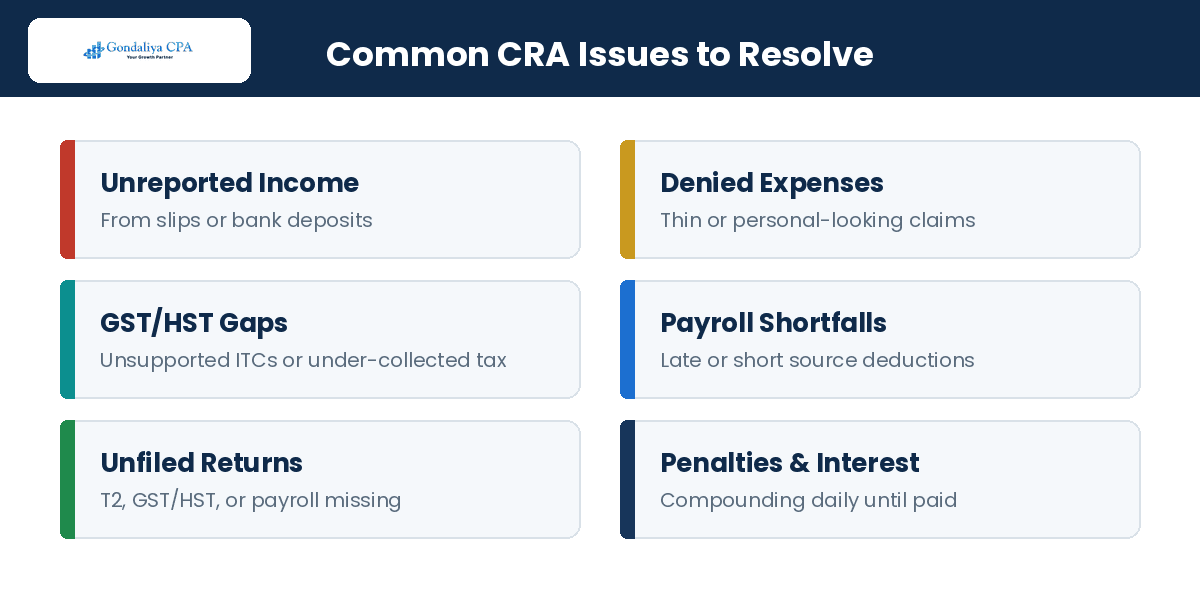
The Findings You Are Most Likely to See
Unreported income is the most serious, often surfacing from third-party slips or bank deposits. Denied expenses come next, usually where documentation is thin or a cost looks personal. GST/HST discrepancies arise when input tax credits are not supported or sales tax was under-collected. Payroll remittance gaps appear when source deductions were late or short. And unfiled returns, whether T2, GST/HST, or payroll, are their own issue that must be closed before anything else settles.
| Issue | How It Usually Gets Resolved |
|---|---|
| Unreported income | Correct the return, disclose where voluntary, and document the source |
| Denied expenses | Provide invoices and proof of business purpose, or accept the adjustment |
| GST/HST discrepancies | Reconcile input tax credits and sales tax to the records |
| Payroll remittance gaps | File and remit the shortfall; request relief on penalties where warranted |
| Unfiled returns | Bring all outstanding returns current before resolving the balance |
A client’s reassessment denied a block of expenses as unsupported. Most were legitimate; the receipts were simply disorganized. We assembled the invoices and tied each to a payment, and the bulk of the adjustment was reversed. Figures changed for privacy.
A client had unfiled GST/HST returns sitting behind an income tax problem. We closed the GST/HST filings first, which cleared part of the balance and simplified the rest. Fixing the returns in the right order untangled the whole file. Figures changed for privacy.
Risk Warning: Ignoring a reassessment does not make it go away; interest compounds daily and collection can begin. Unfiled returns only deepen the problem. Please deal with the issue promptly, even if you cannot pay it all at once.
Your Options to Resolve the Issue
Your Options
There is rarely just one path. The right choice depends on whether the CRA is correct, whether you are still in time, and whether you already knew about the problem.
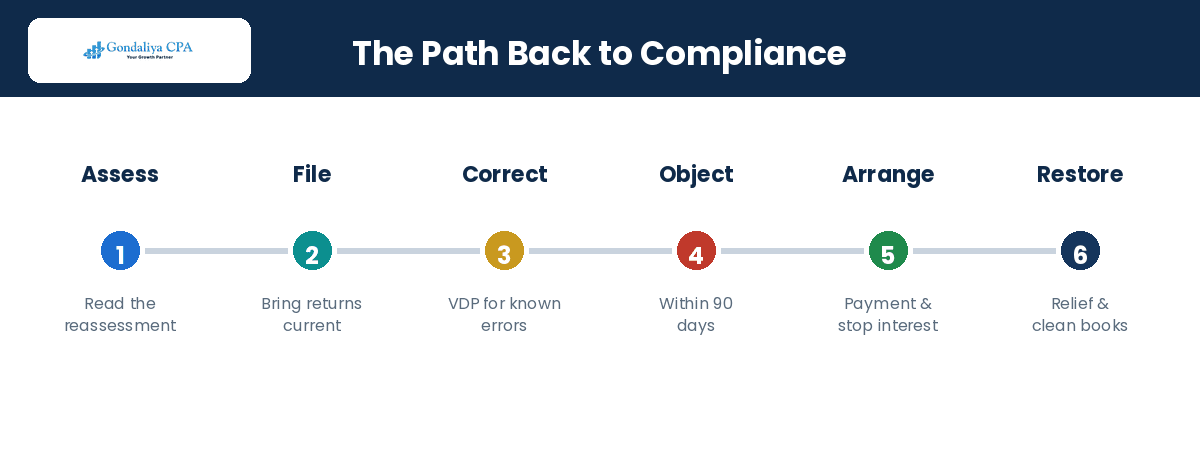
Respond, Object, or Accept
If the reassessment is wrong, you respond with documents, and if the file is already reassessed, you file a Notice of Objection within 90 days. The objection goes to the CRA Appeals Division, which reviews it fresh, and many disputes settle there. Our guide on how to file a CRA objection sets out the steps, and for the later stages see CRA objections and appeals. Where the CRA is correct, the faster resolution is to accept the adjustment and move to settling the balance.
A client came to us on day 78 after a reassessment, nearly out of time. We filed the objection inside the 90-day window with support attached, and the Appeals Division reversed most of it. Acting in the window saved the claim. Figures changed for privacy.
Correct Errors Through Voluntary Disclosure
If you already know a past return has an error the CRA has not yet raised, coming forward first through the Voluntary Disclosures Program is usually the better route. A valid disclosure must be voluntary, made before the CRA contacts you, complete, and generally at least one year overdue, and it can reduce or remove penalties and limit interest. Our page on Voluntary Disclosures Program filings explains how it works. Timing is everything, so please raise any known issue before a letter arrives.
A client realized a prior year had understated income and came to us before any CRA contact. We corrected it through the disclosure program, which removed the penalties and softened the outcome considerably. Coming forward first was far cheaper than being found. Figures changed for privacy.
Bring Unfiled Returns Current
Nothing settles while returns are missing. Filing all outstanding T2, GST/HST, and payroll returns is the foundation of any resolution, because it fixes the balance and, in many cases, replaces an arbitrary CRA estimate with your real numbers. Please gather the records and file the outstanding years first; everything else gets easier once the account is complete.
Pro Tip: If the CRA has issued an arbitrary or notional assessment because you did not file, filing the real return usually lowers the amount. An estimate is not the final word; your accurate return is. Please file it rather than accept the guess.
Reducing Penalties and Interest
Relief
Often the tax itself is manageable and the penalties and interest are what hurt. There are real, legitimate ways to reduce them.
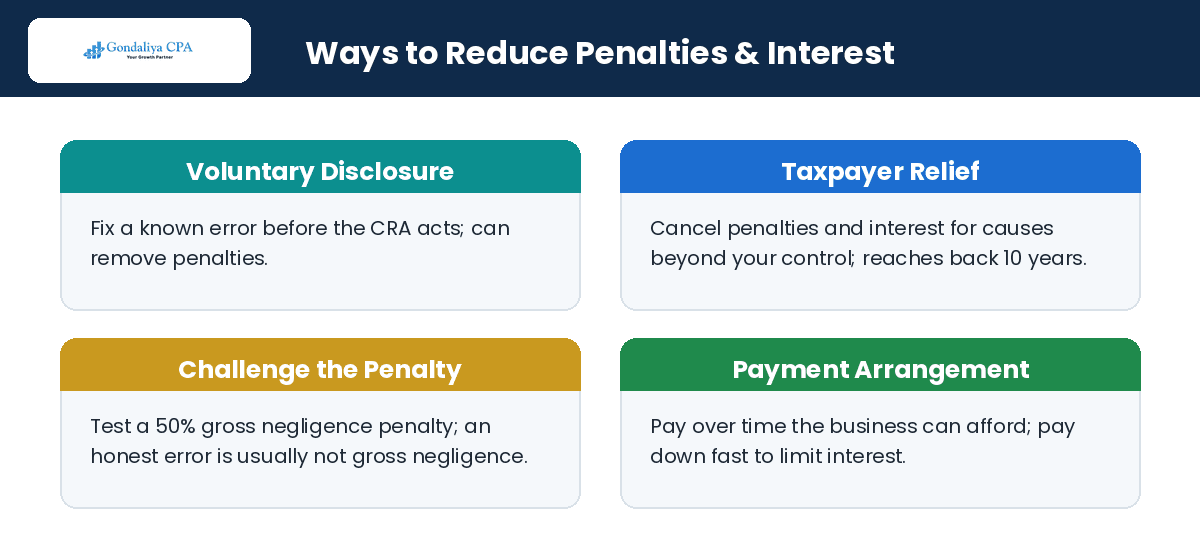
Taxpayer Relief for Penalties and Interest
The CRA can cancel or waive penalties and interest under its taxpayer relief provisions where the cause was beyond your control, such as illness, a natural disaster, or a CRA processing delay, or in cases of genuine financial hardship. A request can reach back to any tax year that ended within the previous 10 years. It is a written application supported by facts and documents, not a phone call, so a well-built request matters.
A client fell behind during a serious illness, and the interest and penalties had grown large. We filed a taxpayer relief request documenting the circumstances and timeline, and much of the interest and penalty was cancelled. The tax remained, but the burden shrank. Figures changed for privacy.
Challenging a Gross Negligence Penalty
Where the CRA has applied a gross negligence penalty, which is 50% of the tax on the disputed amount, we test whether the facts actually support it. An honest error, even a costly one, is usually not gross negligence, and the penalty is frequently overreached. Challenging it separately from the underlying tax can remove a large part of the bill even when the adjustment itself stands.
The CRA proposed a gross negligence penalty on a client’s genuine reporting mistake. We showed the error was neither knowing nor grossly negligent, and the penalty was dropped while the underlying adjustment remained. Separating the penalty from the tax mattered. Figures changed for privacy.
Voluntary Disclosure as Penalty Protection
The cleanest way to avoid penalties is to fix a known error before the CRA finds it, through the Voluntary Disclosures Program. Done properly and early, it can eliminate the penalties that would otherwise apply and limit the interest. Please treat it as a first option for any error you already know about, not a fallback after a letter arrives.
Penalties and interest are the most reducible part of a CRA bill. Taxpayer relief, a challenged gross negligence penalty, and voluntary disclosure each target them directly. Please look here first, because this is where the largest savings usually sit.
Managing and Paying the Balance
The Balance
Once the number is settled, the question is how to pay it without straining the business. The CRA would rather arrange payment than force collection.
Payment Arrangements and Stopping Interest
If you cannot pay in full, the CRA can set up a payment arrangement over time, based on what the business can afford. Interest continues to run on the outstanding balance during a plan, so paying as much as possible up front reduces the total. Where you are disputing a reassessment, many businesses pay the balance to stop interest and still object, receiving a refund if they win. Please weigh that cash decision with your CPA.
| Situation | Practical Approach |
|---|---|
| Can pay in full | Pay to stop interest immediately, then pursue any relief separately |
| Cannot pay in full | Arrange a payment plan and pay down as fast as cash allows |
| Disputing the amount | Consider paying to stop interest while the objection proceeds |
A client could not clear a reassessment at once, and interest was building. We negotiated a payment arrangement the business could sustain and paid down the principal quickly. The plan kept the doors open while the balance came down. Figures changed for privacy.
Order Your Payments Sensibly
Not all balances are equal. Payroll source deductions and GST/HST are trust amounts the CRA pursues most aggressively, so they usually come first. Corporate income tax follows. Sorting the balance by priority, and by which parts carry the fastest interest, keeps the business stable while you clear the debt. Please plan the order with your CPA rather than paying whatever letter arrives last.
A client was paying down corporate tax while a payroll remittance balance, a trust amount, kept escalating. We reordered the payments to clear the trust debt first, which reduced the CRA’s pressure. Paying in the right order changed the risk. Figures changed for privacy.
Restoring and Maintaining Compliance
Restore Compliance
Settling the issue is only half the work. The other half is making sure it does not happen again, which is what restores your standing with the CRA and your lenders.
Get Back to Good Standing
Good standing means every return is filed, the balance is paid or under an arrangement, and the account is current. Once you are there, you regain access to refunds, clearance certificates, and the confidence of banks that check your filings. Confirm the account is clean through My Business Account, and keep it that way with timely filing going forward.
A client needed a clean CRA account to close financing, but had lingering unfiled years. We brought every return current and confirmed good standing, and the loan proceeded. Restored compliance was worth real money to them. Figures changed for privacy.
Build Systems That Prevent a Repeat
Most CRA problems trace back to weak bookkeeping. Reconcile bank and credit accounts monthly, keep receipts organized by category, file every return on time, and remit source deductions and GST/HST on schedule. Records built this way answer questions before they are asked and keep you off the CRA’s radar. The businesses that never see a second problem are simply the ones that keep current books.
After resolving a client’s audit, we moved them to monthly reconciliations and automated filing reminders. The next few years passed without a single CRA issue. The cleanup fixed the past; the system protected the future. Figures changed for privacy.
Check Your Compliance Restoration
Before you decide your next move, this quick self-check shows where you stand. Please answer the six questions below.
Tax Compliance Restoration Checker
Six quick questions to see how close your business is to clean CRA standing. No fee shown.
In place:
This is a general prompt, not tax or legal advice or a quote. Your actual standing depends on your CRA account and filings. For a real review, please book a free consultation.
Want this as a one-pager? You can download the free CRA compliance restoration checklist and keep it on hand. You can also estimate your bill with our corporate tax calculator.
2026 Update — what is current: For 2026, the resolution tools are unchanged: 90 days to object to a reassessment, the 10-year reach for taxpayer relief on penalties and interest, and the Voluntary Disclosures Program for correcting known errors. The normal reassessment periods remain three years for a CCPC and four for other corporations, and the gross negligence penalty stays at 50%. Interest continues to compound daily at a rate the CRA sets each quarter, so please resolve balances sooner rather than later.
How Gondaliya CPA Helps
How We Help
Resolving a CRA issue takes both technical work and steady judgment about which tool to use and when. That is where we come in.
From First Letter to Clean Standing
Gondaliya CPA provides CRA audit support and representation for incorporated SMBs across Toronto, Mississauga, Vaughan, Etobicoke, Brampton, Scarborough, Ottawa, and all of Canada, remotely and on a flat fee so the cost is clear. We read the reassessment, decide whether to object or accept, prepare voluntary disclosures, bring unfiled returns current, negotiate payment arrangements, and build taxpayer relief requests, then rebuild your bookkeeping so the problem does not return. A free consultation is enough to review your account and map the next step.
What the CRA Usually Asks For
Knowing what will be requested lets you gather it before the deadline rather than after:
- Financial statements for the years under review.
- T2 corporate income tax returns as filed.
- Payroll records and remittance confirmations.
- GST/HST filings and the working papers behind them.
- Bank statements, invoices, and receipts supporting the amounts claimed.
Response windows are tight. An initial notice typically expects a reply within about 30 days, and follow-up document requests often allow 15 to 30 days. Please confirm the exact date on each letter, because the stated deadline governs.
What to Prepare Before We Start
Please have your bookkeeping records including payroll summaries, bank statements reconciled in QuickBooks or Xero, previous GST/HST returns and remittances, copies of the T2 returns already filed, and any penalty or audit letters you have received. The faster these arrive, the more options remain open on the file.
DIY, Non-CPA, or a Registered CPA Firm
Handling a reassessment yourself is cost-effective until it is not; the risk is missing a deadline or conceding a point that could have been won. A non-CPA provider may prepare filings without the depth to argue a gross negligence penalty or build a relief request. A Registered CPA firm carries professional accountability, can represent you directly with the CRA, and knows which tool applies at which stage.
How We Protect Your Information
Audit files contain sensitive material, so please know how it is handled. Documents are stored encrypted, access is limited by role to the people working your file, our site uses clear cookie consent so you control what is tracked, and we review security regularly. Handling follows Canadian privacy requirements under PIPEDA.
How We Work With You
Every engagement starts with a written engagement letter setting out scope, fees, and responsibilities, so there is no ambiguity about who does what. We follow the CPA Ontario Code of Professional Conduct, which means objectivity, confidentiality, due care, and no promises about outcomes we cannot control. The work is backed by a 30-day money-back guarantee and a 60-day fees-matching policy, and we respond to client messages within one business day. Gondaliya CPA is a CPA Ontario Registered Firm, and we also serve North York, Hamilton, and Windsor alongside the cities listed above.
Who Works on Your File
Sharad Gondaliya, CPA (Canada and USA), leads the firm and the audit resolution work, with 15+ years in business tax and corporate tax recovery. Vandana Goel, CPA, supports the team as an Accounting Specialist. We work in QuickBooks, Xero, Hubdoc, and Wagepoint to clean up the records behind a resolution, so the filings and the books agree before anything goes back to the CRA.
A client arrived with several years unfiled, a reassessment, and mounting interest, unsure where to start. We sequenced it: filed the returns, objected where warranted, arranged payment, and requested relief. Within months the account was current. A plan, applied in order, resolved it. Figures changed for privacy.
Our Take: Almost every CRA problem is resolvable with the right sequence and the deadlines met. The businesses that recover fastest are the ones that stop avoiding the mail and start working the file. Please send us the account and let us build the plan.
Industry Spotlights: Sectors We Represent
Industry Expertise
Compliance problems cluster differently by industry, and knowing the common issues for your sector speeds the resolution. Here are ten we help restore to good standing, and where the trouble usually starts.
| Industry | Where Compliance Issues Usually Arise |
|---|---|
| Medical doctors & physician professional corporations | OHIP billing reconciled to income, TOSI, shareholder loans |
| Dentists & dental practices | Exempt vs taxable services, associate status, equipment CCA |
| Daycare, childcare & CWELCC services | CWELCC funding and wage grants reconciled to parent fees |
| Real estate investors, landlords & holding companies | Capital vs income on sales, commercial vs residential HST |
| Property developers & builders | HST self-supply, new housing rebates, inventory vs capital |
| Construction, contractors & skilled trades | Unreported cash, T5018 reporting, payroll remittances |
| Technology startups & SaaS | SR&ED claims, deferred revenue, cross-border HST |
| E-commerce & online retailers | Multi-province and US sales-tax nexus, marketplace reporting |
| Restaurants & food and beverage | Unreported cash sales, tip payroll, HST on food |
| Transportation, logistics & trucking | Owner-operator status, long-haul meals, fuel and IFTA |
- Medical doctors & physician professional corporations: Resolving issues for a physician professional corporation often means reconciling OHIP billing to reported income, sorting the tax-on-split-income rules on dividends, and cleaning up shareholder loans. Specialists certified through the Royal College of Physicians and Surgeons of Canada face the same corporate compliance as any CCPC.
- Dentists & dental practices: Practices regulated by the Royal College of Dental Surgeons of Ontario usually need the GST/HST-exempt basic care separated from taxable cosmetic work, associate arrangements documented, and equipment CCA corrected.
- Daycare, childcare & CWELCC services: The common fix is reconciling CWELCC funding and wage-enhancement grants against parent-fee revenue. Childcare services are GST/HST-exempt, so accurate grant tracking restores the compliance.
- Real estate investors, landlords & holding companies: Issues centre on the capital-versus-income treatment of property sales, HST on commercial versus exempt residential rent, and documenting flows between an operating company and a holding company.
- Property developers & builders: Resolution usually turns on the HST self-supply rules for new residential, new housing rebates, and correcting the inventory-versus-capital treatment.
- Construction, general contractors & skilled trades: For electricians, plumbers, and HVAC firms, the fixes are typically unreported cash income, T5018 subcontractor reporting, and payroll remittance gaps.
- Technology startups & SaaS: Common issues include supporting SR&ED claims, correcting deferred revenue recognition, and sorting GST/HST on cross-border SaaS sales.
- E-commerce & online retailers: Sellers on Shopify and Amazon FBA usually need multi-province and US sales-tax nexus resolved, marketplace reporting reconciled, and inventory and foreign exchange corrected.
- Restaurants & food and beverage: Cash-heavy and tip-driven, restaurants often need unreported sales corrected, tip payroll cleaned up, and HST on food sales reconciled.
- Transportation, logistics & trucking owner-operators: Resolution focuses on owner-operator versus employee status, the long-haul meal deduction where eligible drivers claim 80% rather than the usual 50%, and fuel and IFTA records.
A childcare client faced a funding review with CWELCC funding, wage grants, and parent fees mixed in one account. We separated and reconciled the grant income, corrected the records, and restored their standing with both the funder and the CRA. Figures changed for privacy.
A landlord was reassessed when a property sale was treated as income rather than a capital gain. We documented the long-term rental intent and holding period, filed the objection, and the capital treatment was restored. The records resolved it. Figures changed for privacy.
An Amazon FBA seller had GST/HST gaps across several provinces after rapid growth. We rebuilt the registrations and reconciled the sales tax by jurisdiction, which cleared the balance and restored compliance. For online sellers, the jurisdiction detail is the fix. Figures changed for privacy.
Glossary of Key Terms
Plain-English Definitions
- Reassessment: The CRA’s revised assessment showing new tax, interest, and any penalties.
- Notice of Objection: The formal dispute a corporation files within 90 days of a reassessment.
- Appeals Division: The CRA area, separate from the auditor, that reviews objections.
- Taxpayer relief: The CRA’s ability to cancel or waive penalties and interest, reaching back up to 10 years.
- Voluntary Disclosures Program: A CRA program to correct errors before the CRA acts, reducing penalties.
- Gross negligence penalty: A penalty of 50% of the tax on a false statement or omission.
- Arbitrary assessment: A CRA estimate issued when a return is not filed, usually higher than the real amount.
- Trust amounts: Payroll source deductions and GST/HST the business holds for the CRA, pursued most aggressively.
- Payment arrangement: An agreement to pay a balance over time based on ability to pay.
- Good standing: A CRA account with all returns filed and the balance paid or arranged.
- My Business Account: The CRA online portal showing a corporation’s balances and filings.
- Interest: Charged on unpaid amounts, compounded daily at a prescribed rate set each quarter.
- Engagement letter: The written agreement setting out scope, fees, and responsibilities between you and the firm.
Frequently Asked Questions
FAQ
What should I do first after a CRA reassessment?+
Read it against your records to see what changed and why, note the 90-day objection deadline, and decide with your CPA whether to object or accept.
How long do I have to object to a reassessment?+
A corporation files a Notice of Objection within 90 days of the date on the Notice of Reassessment.
Can the CRA cancel my penalties and interest?+
Yes, through taxpayer relief, where the cause was beyond your control or there is financial hardship. A request can reach back up to 10 years.
What is the Voluntary Disclosures Program?+
A CRA program to correct a known error before the CRA acts. A valid disclosure is voluntary, complete, and generally at least one year overdue, and it can remove penalties.
What if I have several unfiled years?+
File them. Bringing outstanding returns current is the foundation of any resolution and often replaces a higher arbitrary assessment with your real numbers.
Can I set up a payment plan with the CRA?+
Yes. The CRA can arrange payment over time based on what the business can afford, though interest continues to run on the balance.
Should I pay a reassessment I plan to dispute?+
Interest runs during a dispute, so many businesses pay to stop the interest and still object, receiving a refund if they win. Please weigh this with your CPA.
Which CRA debts should I pay first?+
Trust amounts, meaning payroll source deductions and GST/HST, are pursued most aggressively and usually come first, then corporate income tax.
How much does audit resolution cost?+
We work on a flat fee, HST included, set to the scope of the file, with the scope and assumptions confirmed up front before we start.
How do I get back to good standing?+
File every outstanding return, pay or arrange the balance, and keep the account current, then confirm it through My Business Account.
What documents will the CRA ask me for?+
Financial statements, T2 returns as filed, payroll records and remittances, GST/HST filings, and the bank statements, invoices, and receipts supporting the amounts claimed.
How long do I have to respond to a CRA request?+
An initial notice typically expects a reply within about 30 days, and follow-up document requests often allow 15 to 30 days. The date stated on your letter governs, so please check it.
How is my information kept confidential?+
Documents are stored encrypted, access is limited by role, and handling follows Canadian privacy requirements under PIPEDA, with regular security reviews.
What guarantees do you offer?+
A 30-day money-back guarantee and a 60-day fees-matching policy, with a one-business-day response. Every engagement is set out in a written engagement letter covering scope, fees, and responsibilities.
Compliance Restoration Checklist
- Get the full picture of your CRA account and balances.
- File all outstanding corporate, GST/HST, and payroll returns.
- Correct known errors, through voluntary disclosure where it applies.
- Object to any wrong reassessment within 90 days.
- Arrange payment to stop interest building.
- Request taxpayer relief for penalties and interest where warranted.
- Rebuild monthly bookkeeping to stay compliant.
Who This Is For / Not For
- For: Incorporated Canadian businesses resolving an audit finding, reassessment, or filing backlog.
- Not For: Anyone seeking to hide income or avoid filing, which this article does not support.
People Also Ask
Quick Answers
Can a CRA problem really be fully resolved?+
Almost always, with the right sequence and the deadlines met. Filing, objecting where warranted, arranging payment, and requesting relief resolve most files.
Will resolving old issues trigger a new audit?+
Coming forward properly, especially through voluntary disclosure, is designed to bring you into compliance, not to invite further audit. Doing nothing carries more risk.
Do I need a CPA or a lawyer to resolve a CRA issue?+
A CPA handles filing, objections, disclosures, and relief. A tax lawyer is added if a matter reaches the Tax Court, and we coordinate that when needed.
Contact Gondaliya CPA at 647-212-9559 or info@gondaliyacpa.ca for help resolving a CRA audit issue and restoring your tax compliance.
Resolve the CRA issue and get back to clean standing
Gondaliya CPA reads the reassessment, files what is missing, disputes what is wrong, arranges payment, and requests relief, all on a flat fee, HST included. Please send us your account and book a free consultation to start.
Next Steps
Resolving a CRA issue comes down to understanding the assessment, using the right tool in the right order, meeting every deadline, and rebuilding your books so it does not repeat. Please pull your CRA account, file what is outstanding, and bring us anything you are unsure about. Reach out for a free consultation, call 647-212-9559, or email info@gondaliyacpa.ca. If our content helps, please add gondaliyacpa.ca as a preferred source on Google.
Published: July 6, 2026 · Last updated: August 12, 2026
Disclaimer: This article is educational information only and is not tax, legal, or financial advice. It reflects CRA and Income Tax Act rules current to 2026, including the 90-day objection window, the 10-year taxpayer relief limitation, and the 50% gross negligence penalty. Outcomes depend on your specific facts and rules can change. Please consult a Registered CPA in Canada or Ontario before acting. Fees include HST.

Sharad Gondaliya is a CPA Canada & CPA USA with 15 Years+ experience of Accounting, Tax, Payroll of Corporate Small Businesses as Tax Accountant. He is a CPA Ontario member (61040184) and holds US CPA licences in Washington and Montana and is well known among corporate small businesses for tax planning, efficient tax solutions, and affordable CPA services. Sharad is the Principal (Director) of Gondaliya CPA – Affordable CPA Firm in Canada. Licenses: CPA Ontario: 61040184 | CPA USA (MT): PAC-CPAP-LIC-033176 | CPA USA (WA): 57629 | CPA Firm License: 61330051 View Full Author Bio