



CRA Audit Representation: How a CPA Can Help Your Business Navigate a Tax Audit
With Gondaliya CPA, you get reliable CPA CRA representation and dedicated CRA audit accountant services tailored to simplify Canadian tax audits. Our team focuses on providing effective tax audit help in Canada to protect your interests and resolve audit issues efficiently.
Quick Summary
When the CRA audits your corporation, the outcome turns on how you respond: answer the exact request, keep to the scope, meet every deadline, and back each figure with a document. A CPA becomes your single point of contact, manages the exchange, replies to the proposal letter, and files an objection if needed. Please do not ignore the letter, because the clock starts the day it arrives.
| Aspect | Details |
|---|---|
| What it is | The CRA reviewing your records to verify income, deductions, and credits. |
| Best response | Answer the exact request, on time, with documents, through one contact. |
| Proposal letter | You generally have 30 days to respond before a reassessment is issued. |
| Objection | A corporation files a Notice of Objection within 90 days of the reassessment. |
Reading time: 26 minutes.
Table of Contents
CRA Audits at a Glance
This article covers Canada, with Toronto and Ontario context, and reflects CRA and Income Tax Act rules current to 2026. It addresses incorporated businesses dealing with a corporate audit or review. Items marked “illustrative” are examples, not quotes, and any masked engagement notes end with “Figures changed for privacy.” This is educational information only and not tax, legal, or financial advice. Fees include HST. Please confirm your own situation with a Registered CPA before acting.
What a CRA Audit Actually Is
The Basics
A CRA audit is the Canada Revenue Agency examining your books and records to confirm that the income, deductions, and credits on your returns follow the law. It is a verification, not an accusation, and most audits end with either no change or a manageable adjustment when the response is handled well.
Reviews vs Full Audits
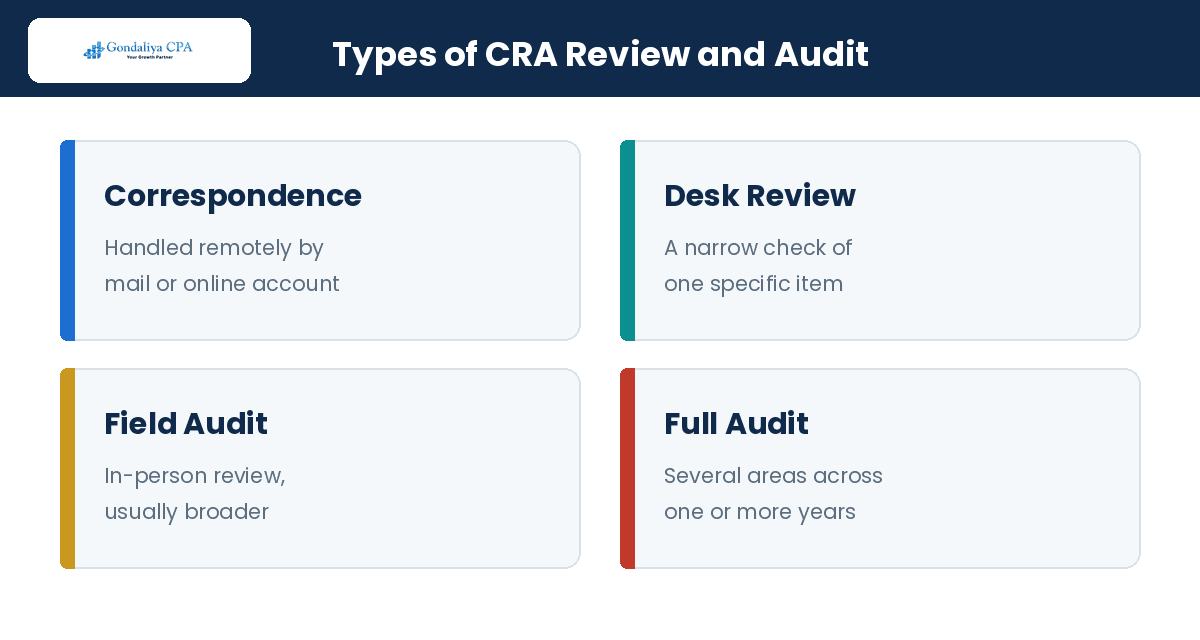
Not every CRA contact is a full audit. A review is a narrow check of one item, often handled by letter, where the CRA asks you to support a specific claim. A full audit is broader, examining several areas of one or more tax years. Both require the same discipline: answer only what is asked, support it with documents, and meet the deadline in the letter.
Desk, Field, and Correspondence Audits
Audits come in a few forms. A correspondence or desk audit is handled remotely, with the CRA requesting documents by mail or through your online account. A field audit means an auditor examines records in person, at your place of business or your representative’s office, and usually covers more ground. Knowing which one you face shapes how you prepare and how much support you gather.
A client panicked at a letter that was only a limited review of one expense, not a full audit. We supplied the single supporting document, and the file closed within weeks. Reading the letter carefully turned a scare into a quick reply. Figures changed for privacy.
What the CRA Is Checking
Across audit types, the CRA looks at whether all income was reported, whether deductions match allowed business costs, whether Capital Cost Allowance was claimed correctly, and whether related-party transactions reflect fair value. It compares your return to third-party information, such as T4, T5, and T5018 slips, and to industry norms. Clean records that answer these questions in advance are your best defence.
Key Stat: A corporation that disagrees with a reassessment has 90 days from the date on the Notice of Reassessment to file a Notice of Objection. Missing that window makes the reassessment much harder to challenge, so please diarize the date the moment it arrives.
What Triggers a CRA Audit
Triggers
Audits are rarely random alone. The CRA runs risk scoring on every return and flags patterns that look off, so understanding the triggers helps you file cleanly and lower your odds.
Mismatches and Risk Patterns
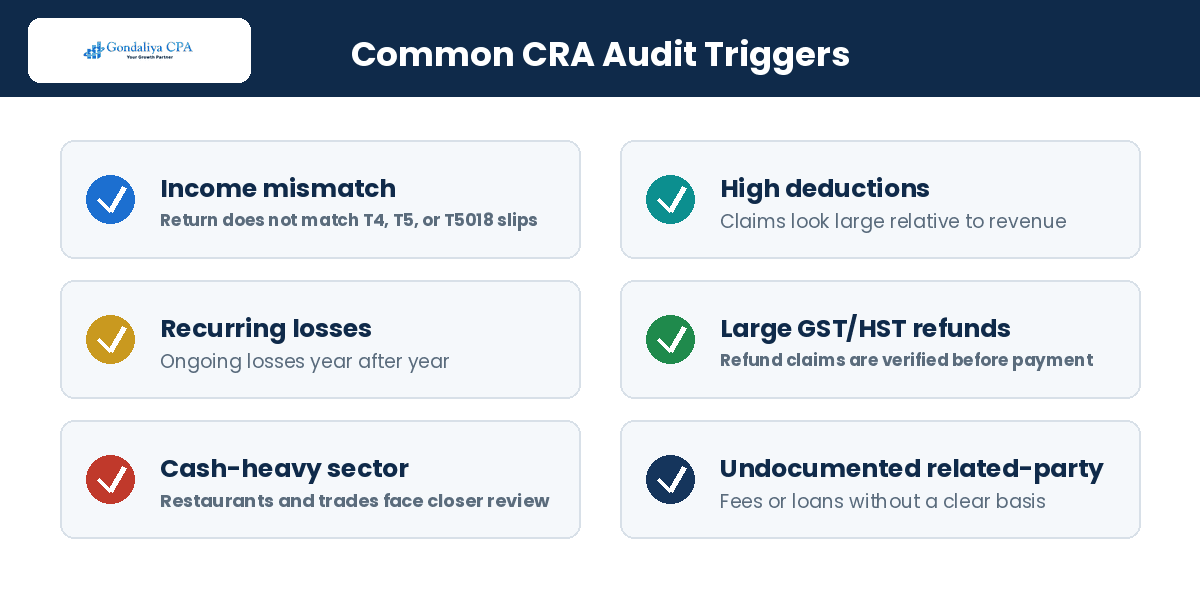
The most common trigger is a mismatch between your return and what third parties report, since the CRA matches slips automatically. Other patterns draw attention too: deductions that are large relative to income, recurring losses year after year, round-number expenses that look estimated, and unusually high vehicle, meal, or home-office claims. None of these is wrong on its own, but each invites a closer look when it is not supported.
| Trigger | Why It Draws Attention |
|---|---|
| Income mismatch with slips | Reported income does not match T4, T5, or T5018 data |
| High deductions vs income | Claims look disproportionate to revenue |
| Recurring losses | Ongoing losses can suggest a hobby or misreporting |
| Large GST/HST refunds | Refund claims are verified before payment |
| Cash-intensive business | Sectors with heavy cash face closer review |
A client’s reported income was short of the T5 slips a bank had filed, purely a timing error in their books. We reconciled it and explained the difference before it escalated. The mismatch, not any wrongdoing, is what had flagged the return. Figures changed for privacy.
Industry Benchmarks and Refund Claims
The CRA compares your numbers to others in your industry, so margins or expense ratios far outside the norm can prompt a review. Large GST/HST refund claims are checked before the refund is released, and cash-heavy sectors such as restaurants and trades face extra scrutiny. Related-party transactions and management fees also draw attention when the pricing is not documented.
A restaurant client claimed a sizeable GST/HST refund and the CRA held it for verification. Because the input tax credits were fully supported, we cleared the review and the refund was released. Documentation is what turns a held refund into a paid one. Figures changed for privacy.
Risk Warning: Round numbers, missing receipts, and personal costs run through the business are the fastest ways to turn a review into a full audit. Please keep personal and business spending separate and support every claim.
The CRA Audit Process, Step by Step
The Process
Knowing the sequence removes much of the fear. An audit follows a predictable path, and each stage has its own deadline and its own right response.
Notification and Information Requests
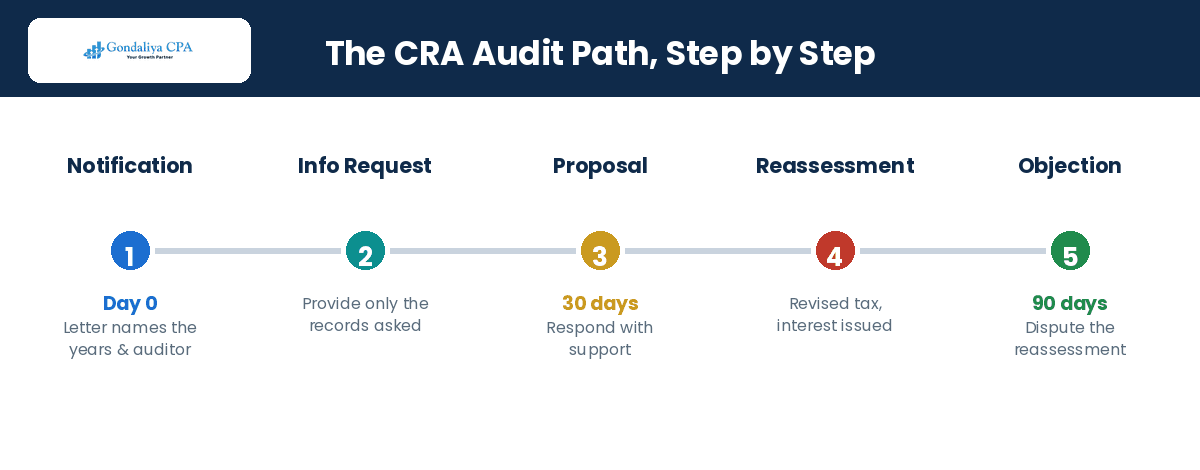
The audit begins with a letter or call identifying the auditor, the years under review, and the records requested. The CRA then asks for specific documents, such as invoices, bank statements, contracts, or ledgers. Provide exactly what is asked, no more, and organize it clearly. Volunteering extra material can widen the scope, so please answer the request as written.
A client wanted to send the auditor everything to seem cooperative, which would have opened new questions. We supplied only the records requested, indexed and labelled. Staying on scope kept the audit narrow and short. Figures changed for privacy.
Fieldwork and the Proposal Letter
The auditor reviews the records, may ask follow-up questions, and then issues a proposal letter setting out any adjustments they intend to make. You generally have 30 days to respond with additional support or an explanation before the changes are finalized. This stage is the best chance to correct an auditor’s misunderstanding, so a careful, documented reply matters most here.
CRA Deadline: A proposal letter generally allows 30 days to respond, and a Notice of Objection must be filed within 90 days of a reassessment. Please treat both as hard dates, because extensions are limited and missing them narrows your options.
Reassessment and What Follows
If the CRA proceeds, it issues a Notice of Reassessment showing the revised tax, interest, and any penalties. You can pay, or you can dispute it by filing an objection within 90 days. Interest continues to run on an unpaid balance during a dispute, so many businesses pay the amount to stop interest while still objecting, then receive a refund if they win. Please weigh that cash decision with your CPA.
After a reassessment, a client faced growing interest while deciding whether to object. We paid the balance to stop the interest and filed the objection, and the amount came back with the objection’s success. Managing the cash and the dispute together protected them. Figures changed for privacy.
Your Rights During an Audit
Your Rights
An audit is not a one-way process. The Taxpayer Bill of Rights sets out protections you can rely on, and knowing them keeps the exchange fair and professional.
The Right to Representation and Fair Treatment
You have the right to be represented by a professional, to be treated professionally and courteously, to clear information about why the CRA wants something, and to a reasonable timeline to respond. You also have the right to lodge a service complaint and to expect your information to be handled confidentially. Please use these rights; they exist to keep the process balanced.
An auditor asked a client for documents on a very short turnaround during their busy season. We requested a reasonable extension, which the CRA granted, and the client answered properly rather than in a rush. Knowing the right to reasonable time changed the outcome. Figures changed for privacy.
Records, Timelines, and Reasonable Requests
The CRA can ask for records you are required to keep, which is six years of books and supporting documents, but requests must be reasonable and tied to the years under review. You are not obliged to guess or to create documents that do not exist; you provide what you have. If a request feels out of scope, your representative can push back respectfully and ask the CRA to explain its relevance.
An auditor asked a client for records reaching well beyond the years under review. We asked the CRA to explain the relevance and confined the request to the audit period. A respectful push-back kept the scope where it belonged. Figures changed for privacy.
Pro Tip: Keep every audit exchange in writing where you can, and note the date of each call. A clear record of what was asked and what was provided protects you if the file is escalated or reviewed later. Please route it all through one contact.
How a CPA Represents You
Representation
This is where a CPA earns the engagement. Representation means we stand between you and the CRA, manage the exchange, and protect your position at every step.
Authorization and a Single Point of Contact
Representation starts with authorizing your CPA, either online through Represent a Client or with Form AUT-01, so the CRA can deal with us directly. From there, we become the single point of contact. You stop fielding calls and letters, we handle the auditor, and the tone stays calm and professional. That alone removes much of the stress and prevents the off-hand comments that can widen an audit.
A client had been answering the auditor’s calls directly and volunteering opinions that raised new questions. Once we were authorized and took over contact, the scope stopped expanding. A single, measured point of contact settled the file. Figures changed for privacy.
Managing Scope and Building the Response
We read the request precisely, gather only the records that answer it, and present them indexed and reconciled so the auditor’s questions are answered before they are asked. Where an adjustment is proposed, we prepare a documented reply within the 30-day window, correcting misunderstandings with evidence rather than argument. Framing the facts clearly is often the difference between a proposal that stands and one that is withdrawn.
An auditor proposed to deny a block of expenses as unsupported. We assembled the invoices and tied each to a bank payment, and most of the proposed adjustment was reversed. The documents did the arguing for us. Figures changed for privacy.
Penalties, Interest, and Negotiation
When an adjustment holds, we work to keep penalties and interest to what the law requires and no more. Where a gross negligence penalty is proposed, which is 50% of the tax on the disputed amount, we test whether the facts actually support it, because it is often overreached. We can also request relief from penalties and interest in the right circumstances through the CRA’s taxpayer relief provisions.
The CRA proposed a gross negligence penalty on a client’s honest reporting error. We showed the mistake was neither knowing nor grossly negligent, and the penalty was dropped while the underlying adjustment remained. Challenging the penalty separately mattered. Figures changed for privacy.
Check Your Audit Readiness
Before a letter ever arrives, this quick self-check shows where your exposure sits. Please answer the six questions below.
CRA Audit Readiness Checker
Six quick questions to gauge how ready your business is for a CRA review. No fee shown.
In place:
This is a general prompt, not tax or legal advice or a quote. Your actual exposure depends on your books and filings. For a real review, please book a free consultation.
Want this as a one-pager? You can download the free CRA audit response checklist and keep it on hand. You can also estimate your bill with our corporate tax calculator.
Objections and Appeals
Disputes
If the CRA reassesses and you disagree, the fight is not over. There is a formal, structured route to challenge the decision, and it works when the facts and documents are on your side.
Filing a Notice of Objection
A corporation files a Notice of Objection within 90 days of the date on the Notice of Reassessment, either through My Business Account or on Form T400A. The objection sets out the facts, the law, and the reasons the reassessment is wrong, supported by documents. It goes to the CRA Appeals Division, an area separate from the auditor, which reviews the file fresh. A clear, well-supported objection is often resolved without going further. Please see our guide on how to file a CRA objection for the steps.
| Dispute Stage | Deadline |
|---|---|
| Respond to a proposal letter | Generally 30 days |
| File a Notice of Objection | 90 days from the reassessment date |
| Appeal to the Tax Court of Canada | 90 days after the CRA confirms the reassessment |
| Retain supporting records | Six years after the tax year |
A client came to us on day 80 after a reassessment, nearly out of time to object. We filed the Notice of Objection before the 90-day deadline with the support attached, and the Appeals Division reversed most of it. Acting in the window saved the claim. Figures changed for privacy.
Appeals to the Tax Court
If the objection is not resolved in your favour, the next step is an appeal to the Tax Court of Canada, generally within 90 days of the CRA confirming the reassessment. Many disputes settle before a hearing, and a CPA works alongside a tax lawyer where a court appeal is needed. For corporations, the process is set out in our page on CRA objections and appeals. Please act early, because each stage carries its own strict deadline.
An objection did not fully resolve, so we prepared the file for the next stage, and the matter settled before a hearing once the CRA saw the documented position. Being ready to escalate brought a fair result without the cost of court. Figures changed for privacy.
The Voluntary Disclosures Program as an Alternative
If you already know a past return has an error, coming forward first through the Voluntary Disclosures Program is usually far better than waiting for an audit to find it. A valid, voluntary disclosure made before the CRA contacts you can reduce or remove penalties and limit the interest. Timing is everything, so please raise any known issue with your CPA before a letter arrives.
Objections work when the facts are documented and the deadline is met. The businesses that win disputes are not the loudest; they are the ones with organized records and a filed objection inside 90 days. Please diarize the date and build the file early.
2026 Update — what is current: For 2026, the objection and appeal deadlines are unchanged: 90 days to object to a reassessment and 90 days to appeal a confirmation to the Tax Court. The normal reassessment periods remain three years for a CCPC and four for other corporations, and the gross negligence penalty stays at 50%. The Voluntary Disclosures Program and taxpayer relief provisions remain available, so please raise any known issue early rather than waiting for a letter.
Preparing for and Avoiding Audits
Prevention
The best audit is the one that never opens, or the one you are ready for before the letter arrives. Prevention is mostly habit.
Build Audit-Ready Records All Year
Reconcile bank and credit accounts monthly, keep receipts and invoices organized by category, note the business purpose on larger claims, and file returns that tie to your slips. Keep personal spending out of the business, and retain everything for six years. Records built this way answer an auditor’s questions before they are asked, which is what turns a potential audit into a quick review.
A client kept every receipt filed by month and category all year. When a review came, we answered it in one package and closed it fast. The tidy records, kept as a habit, did the heavy lifting. Figures changed for privacy.
Fix Problems Before the CRA Finds Them
If you spot an error in a past return, correct it early, through the Voluntary Disclosures Program where it applies, rather than hoping it goes unnoticed. Address recurring losses, unusual ratios, and unsupported claims proactively with your CPA. Getting ahead of a problem almost always costs less than defending it under audit.
A client realized a prior year had understated income and came to us before any CRA contact. We corrected it through the disclosure program, which softened the outcome considerably. Coming forward first was far cheaper than being found. Figures changed for privacy.
A client came to us mid-audit after handling it alone for weeks, and the file had stalled with the scope creeping wider. We took over contact, reorganized the records, and brought it to a clean close. Stepping in, even late, steadied the file. Figures changed for privacy.
How Gondaliya CPA Helps
Gondaliya CPA provides CRA audit support and representation for incorporated SMBs across Toronto, Mississauga, Vaughan, Etobicoke, Brampton, Scarborough, Ottawa, and all of Canada, remotely and on a flat fee so the cost is clear. We take over contact with the auditor, manage the scope, prepare the documented response, handle the proposal letter and any objection, and work to keep penalties and interest to what the law requires. A free consultation is enough to review a letter and map the next step.
The Audits We Represent You On
- GST/HST audits: supporting input tax credit claims and responding to indirect tax requests before they become reassessments.
- Payroll tax audits: defending remittance and CPP/EI positions, including PIER findings.
- Corporate income tax audits: representation through T2 return reviews.
- Small business audits: proportionate support for smaller operations facing their first review.
Each includes direct contact with the auditor on your behalf, from the first notice to the final outcome, and help closing any compliance gaps afterwards.
What to Gather, and Where to Find It
| Item | Purpose | Where it lives |
|---|---|---|
| Financial statements | Confirm income and expenses | Accounting system or bookkeeper files |
| Bank statements | Check cash-flow consistency | Bank portal or monthly reports |
| Invoices and receipts | Support the deductions claimed | Accounting software exports or paper copies |
| Previous CRA correspondence | Track what has already been asked | Email archives and physical letters |
| Tax returns filed | Check the figures reported | Prior-year filings, digital or paper |
| Objection deadlines | Protect your appeal rights | Dates printed on the CRA letters |
Please gather these early. Watch for incomplete or superseded versions, missing months, and unreconciled entries, because those are exactly what an auditor notices.
What You Receive
Alongside the representation itself, you get a written engagement letter setting out scope, fees, and responsibilities, supporting schedules behind any figures we submit, a tax filing summary showing how the filings tie to the compiled data, and a management letter noting internal control weaknesses we found and how to close them. Where formal statements are needed, we prepare a compilation report under CSRS 4200.
What Drives the Fee
| Cost driver | Effect | How to manage it |
|---|---|---|
| Complexity of the issues | More complex means more time | Provide clear, organized records |
| Number of entities | More corporations increase the work | Handle related entities together |
| Volume and quality of records | Messy books need extra work | Keep clean books in QuickBooks or Xero |
| Timelines and urgency | Rush work costs more | Engage as soon as the letter arrives |
| Additional advisory | Extra advice adds scope | Agree the scope up front at a fixed fee |
Worth asking any firm: which audit types do you cover, are multiple entities charged separately, do you help clean up the bookkeeping, what is your usual turnaround, and do you offer ongoing advisory?
DIY, Non-CPA, or a Registered CPA Firm
Handling an audit yourself risks widening the scope through an off-hand answer or missing a deadline that cannot be recovered. A non-CPA provider can assemble documents but may not be able to challenge a gross negligence penalty or argue a position on the law. A Registered CPA firm can be formally authorized to deal with the CRA, carries professional accountability, and knows which tool applies at which stage.
Our Commitments to You
We respond to client messages within one business day, which matters when a 30-day proposal window is running. The work is backed by a 30-day money-back guarantee and a 60-day fees-matching policy, on a flat fee, HST included, quoted after a free consultation. Gondaliya CPA is a CPA Ontario Registered Firm, serving Toronto and Ontario including Oshawa, Guelph, Hamilton, North York, and Windsor, with secure remote support across Canada.
Our Take: An audit is won on preparation and calm, not on argument. Clean records, one measured point of contact, and every deadline met settle most files quietly. Please send us the letter before you reply, and let the documents speak.
Industry Spotlights: Sectors We Represent
Industry Expertise
The CRA audits different sectors differently, and knowing where an auditor tends to look for your industry is half the preparation. Here are ten we represent often, and where the scrutiny usually falls.
| Industry | Where the CRA Tends to Look |
|---|---|
| Medical doctors & physician professional corporations | OHIP billing reconciled to income, TOSI on dividends, shareholder loans |
| Dentists & dental practices | Exempt vs taxable services, associate status, equipment CCA |
| Daycare, childcare & CWELCC services | CWELCC funding and wage grants reconciled to parent fees |
| Real estate investors, landlords & holding companies | Capital vs income on sales, commercial vs residential HST |
| Property developers & builders | HST self-supply, new housing rebates, inventory vs capital |
| Construction, contractors & skilled trades | Unreported cash, T5018 reporting, holdback timing |
| Technology startups & SaaS | SR&ED claim review, deferred revenue, cross-border HST |
| E-commerce & online retailers | Multi-province and US sales-tax nexus, marketplace reporting |
| Restaurants & food and beverage | Sales suppression checks, tip payroll, HST on food |
| Transportation, logistics & trucking | Owner-operator status, long-haul meals, fuel and IFTA |
- Medical doctors & physician professional corporations: Audits of a physician professional corporation often turn on OHIP billing reconciled to reported income, the tax-on-split-income rules on dividends, and shareholder loans. Specialists certified through the Royal College of Physicians and Surgeons of Canada face the same corporate checks as any CCPC.
- Dentists & dental practices: Dental practices, regulated by the Royal College of Dental Surgeons of Ontario, draw review of the split between GST/HST-exempt basic care and taxable cosmetic work, associate-versus-employee status, and equipment CCA.
- Daycare, childcare & CWELCC services: Reviews focus on reconciling CWELCC funding and wage-enhancement grants against parent-fee revenue. Childcare services are GST/HST-exempt, so the grant tracking is where the file is won.
- Real estate investors, landlords & holding companies: Audits target whether a property sale is capital or income, HST on commercial versus exempt residential rent, and undocumented flows between an operating company and a holding company.
- Property developers & builders: The HST self-supply rules on new residential, new housing rebates, and the inventory-versus-capital line are the most common reassessment points.
- Construction, general contractors & skilled trades: Cash-intensive trades such as electricians, plumbers, and HVAC firms face closer review of unreported income, T5018 subcontractor reporting, and holdback timing.
- Technology startups & SaaS: SR&ED claims are frequently reviewed, and audits look at deferred revenue recognition and GST/HST on cross-border SaaS sales.
- E-commerce & online retailers: Sellers on Shopify and Amazon FBA see review of multi-province and US sales-tax nexus, marketplace reporting, and inventory and foreign exchange.
- Restaurants & food and beverage: Cash-heavy and tip-driven, restaurants draw scrutiny on sales suppression, tip payroll, and HST on food sales.
- Transportation, logistics & trucking owner-operators: Audits focus on owner-operator versus employee status, the long-haul meal deduction where eligible drivers claim 80% rather than the usual 50%, and fuel and IFTA records.
A childcare client in a funding review had CWELCC funding, wage grants, and parent fees mixed in one account. We separated and reconciled the grant income to the funding statements, and the review closed cleanly. With childcare, the grant tracking is the whole defence. Figures changed for privacy.
A landlord was reassessed on a property sale the CRA treated as income rather than a capital gain. We documented the long-term rental intent and holding period, and the capital characterization held. The paper trail decided it. Figures changed for privacy.
An Amazon FBA seller faced a GST/HST review across several provinces. Because we had tracked sales and tax by jurisdiction, we cleared it with no adjustment. For online sellers, the jurisdiction detail is the audit. Figures changed for privacy.
Glossary of Key Terms
Plain-English Definitions
- CRA audit: An examination of your records to verify the income, deductions, and credits on your returns.
- Review: A narrow check of a single item, often handled by letter.
- Field audit: An in-person examination of records, usually broader than a review.
- Proposal letter: The CRA’s notice of intended adjustments, with a window to respond before reassessment.
- Notice of Reassessment: The CRA’s revised assessment showing new tax, interest, and any penalties.
- Notice of Objection: The formal dispute a corporation files within 90 days of a reassessment.
- Appeals Division: The CRA area, separate from the auditor, that reviews objections.
- Tax Court of Canada: The court that hears tax appeals after the objection stage.
- Represent a Client / AUT-01: The ways to authorize a CPA to deal with the CRA on your behalf.
- Gross negligence penalty: A penalty of 50% of the tax on a false statement or omission.
- Taxpayer Bill of Rights: The set of rights that govern how the CRA must treat you.
- Voluntary Disclosures Program: A CRA program to correct errors before the CRA acts.
- Engagement letter: The written agreement setting out scope, fees, and responsibilities.
- Management letter: A report noting internal control weaknesses and recommendations.
Frequently Asked Questions
FAQ
What should I do first when I receive a CRA audit letter?+
Note the deadline, do not ignore it, and send the letter to your CPA before replying. The response should be accurate, on scope, and on time.
How long does a CRA audit take?+
It depends on the scope and how organized the records are. A narrow review can close in weeks, while a field audit covering several years takes longer.
How long do I have to respond to a proposal letter?+
Generally 30 days to provide additional support or an explanation before the CRA finalizes the adjustment.
How long do I have to object to a reassessment?+
A corporation files a Notice of Objection within 90 days of the date on the Notice of Reassessment.
Can a CPA deal with the CRA on my behalf?+
Yes. Once you authorize us through Represent a Client or Form AUT-01, we become your single point of contact with the auditor.
Should I pay a reassessment I plan to dispute?+
Interest runs on unpaid balances during a dispute, so many businesses pay to stop the interest and still object, receiving a refund if they win. Please weigh this with your CPA.
What is a gross negligence penalty?+
It is 50% of the tax on a false statement or omission made knowingly or in circumstances amounting to gross negligence, and it is often challengeable.
How long must I keep records for an audit?+
Keep books, records, and supporting documents for six years from the end of the last tax year they relate to.
How much does audit representation cost?+
We work on a flat fee, HST included, set to the scope of the audit, with the scope and assumptions confirmed up front before we start.
Can I avoid an audit entirely?+
You cannot rule one out, but clean records, full reporting, and returns that match your slips lower the odds and make any review quick.
Which types of CRA audit do you represent on?+
GST/HST audits, payroll tax audits including PIER findings, corporate income tax audits on T2 returns, and smaller small-business reviews, from the first notice through to the outcome.
What documents should I prepare before we start?+
Financial statements, bank statements, invoices and receipts, previous CRA correspondence, the returns already filed, and any letters showing objection deadlines.
What deliverables do I receive?+
An engagement letter setting out scope and fees, supporting schedules behind the figures submitted, a tax filing summary, and a management letter noting internal control weaknesses and how to close them.
What guarantees do you offer?+
A 30-day money-back guarantee and a 60-day fees-matching policy, with a one-business-day response to client messages.
CRA Audit Response Checklist
- Note the deadline in the letter and do not ignore it.
- Authorize your CPA through Represent a Client or Form AUT-01.
- Gather only the specific records the CRA requested.
- Route all communication through your representative.
- Review the proposal letter and respond within 30 days.
- File a Notice of Objection within 90 days if you disagree.
- Keep records for six years and close any gaps for next time.
Who This Is For / Not For
- For: Incorporated Canadian businesses facing a CRA audit, review, or reassessment.
- Not For: Anyone seeking to hide income or avoid filing, which this article does not support.
People Also Ask
Quick Answers
Does responding to an audit admit I did something wrong?+
No. An audit is a verification. Responding accurately and on scope is exactly what the CRA expects and what protects you.
Can the CRA audit a year I already filed?+
Yes, within the normal reassessment period of three years for a CCPC or four for other corporations, and longer where there is misrepresentation.
Do I need a lawyer or a CPA for an audit?+
A CPA handles the audit and objection stages. A tax lawyer is added when a matter proceeds to the Tax Court, and we coordinate that when needed.
Contact Gondaliya CPA at 647-212-9559 or info@gondaliyacpa.ca for help responding to a CRA audit or reassessment.
Facing a CRA audit? You do not have to handle it alone
Gondaliya CPA takes over contact with the auditor, manages the response, and handles any objection, all on a flat fee, HST included. Please send us the letter and book a free consultation to start.
Next Steps
Navigating a CRA audit comes down to a calm, documented, on-time response, with one representative between you and the auditor. Please note your deadline, gather the records requested, authorize your CPA, and let us manage the exchange and any objection. Reach out for a free consultation, call 647-212-9559, or email info@gondaliyacpa.ca. If our content helps, please add gondaliyacpa.ca as a preferred source on Google.
Published: July 6, 2026 · Last updated: August 12, 2026
Disclaimer: This article is educational information only and is not tax, legal, or financial advice. It reflects CRA and Income Tax Act rules current to 2026, including the 90-day objection window, the normal reassessment periods, and the 50% gross negligence penalty. Outcomes depend on your specific facts and rules can change. Please consult a Registered CPA in Canada or Ontario before acting. Fees include HST.

Sharad Gondaliya is a CPA Canada & CPA USA with 15 Years+ experience of Accounting, Tax, Payroll of Corporate Small Businesses as Tax Accountant. He is a CPA Ontario member (61040184) and holds US CPA licences in Washington and Montana and is well known among corporate small businesses for tax planning, efficient tax solutions, and affordable CPA services. Sharad is the Principal (Director) of Gondaliya CPA – Affordable CPA Firm in Canada. Licenses: CPA Ontario: 61040184 | CPA USA (MT): PAC-CPAP-LIC-033176 | CPA USA (WA): 57629 | CPA Firm License: 61330051 View Full Author Bio