



How Multi-Corporation Businesses Should Handle Year-End Accounting and T2 Filings in Canada
For multiple corporations in Canada, effective corporate group tax planning combined with careful holding company accounting helps optimize tax benefits and streamline T2 filing. Gondaliya CPA provides practical guidance to help businesses meet regulatory requirements while minimizing tax liabilities.
For multiple corporations in Canada, effective corporate group tax planning combined with careful holding company accounting helps optimize tax benefits and streamline T2 filing. Gondaliya CPA provides practical guidance to help businesses meet regulatory requirements while minimizing tax liabilities.
Quick Summary
Canada has no consolidated corporate return, so each company in your group files its own T2 within six months of its fiscal year-end. The work that keeps a group clean is separate books per entity, reconciled intercompany balances, documented shareholder loans and management fees, a sensible split of the $500,000 small business deduction, and the right schedules on every return. Please align your year-ends where you can, because it makes all of this simpler.
| Aspect | Details |
|---|---|
| Filing model | No consolidation; each corporation files its own T2 return. |
| Shared limit | Associated corporations split the $500,000 small business deduction. |
| Intercompany | Loans, fees, and dividends must be documented and reconciled. |
| Deadline | Each T2 is due six months after that entity’s fiscal year-end. |
Reading time: 27 minutes.
Table of Contents
- The T2 Return and Who Must File It
- Filing and Payment Deadlines for Multiple Corporations
- Holding Company Accounting for Corporate Groups
- Corporate Group Tax Planning Strategies
- Preparing and Filing T2 Returns for a Group
- How Gondaliya CPA Helps Multi-Corporation Businesses
- Industry Spotlights: Corporate Groups We Serve
- Glossary of Key Terms
- Frequently Asked Questions
- People Also Ask
Corporate Groups at a Glance
This article covers Canada, with Toronto and Ontario context, and reflects CRA and Income Tax Act rules current to 2026. It addresses incorporated businesses and corporate groups filing T2 returns, with financial statements prepared under ASPE, the standard most private corporations use. Items marked “illustrative” are examples, not quotes, and any masked engagement notes end with “Figures changed for privacy.” This is educational information only and not tax, legal, or financial advice. Fees include HST. Please confirm your own situation with a Registered CPA before acting.
The T2 Return and Who Must File It
The Basics
A T2 Corporate Income Tax Return is what every resident corporation in Canada must file. It shows the company’s income, deductions, and taxes owed to the Canada Revenue Agency. Each corporation files its own T2 return, even if it did not make money during the year.
T2 Requirements for All Resident Corporations
Resident corporations submit a T2 within six months after their fiscal year ends. They report income from sales, investments, and other business activities, expenses they can deduct such as salaries, rent, and cost of goods sold, and the tax owed on taxable income after those deductions. Filing correctly keeps the company in good standing and supports corporate group tax planning across the whole structure.
Non-Resident and Inactive Corporations
A non-resident corporation that carries on business in Canada or earns certain Canadian income must file a T2 if it has a permanent establishment here or earns certain passive income. An inactive corporation may still need to file each year if it was incorporated under Canadian law, unless the CRA says otherwise. Not filing risks penalties and the loss of good standing.
A client assumed a dormant subsidiary in their group did not need a return because it had no income. It still had to file. We brought it current before the CRA acted, and the group’s good standing stayed intact. An inactive company is not an exempt one. Figures changed for privacy.
T2 Corporate vs Personal Tax Returns
Corporate and personal returns differ in who files, what income they report, what deductions apply, and when they are due. Knowing the differences helps with holding company accounting and planning taxes across multiple corporations.
| Aspect | T2 Corporate Return | Personal Return |
|---|---|---|
| Who files | Incorporated businesses | Individuals |
| Income sources | Business revenue and investment earnings | Employment wages and personal investments |
| Deductions | Business expenses | Personal credits and exemptions |
| Filing deadline | Six months after fiscal year-end | April 30 following the calendar year |
Key Stat: Canada does not permit consolidated corporate returns. Every corporation in a group files its own T2, so a group of four companies files four separate returns, each with its own deadline and its own schedules. Please plan for that, not for one combined filing.
Filing and Payment Deadlines for Multiple Corporations
Deadlines
Each corporation picks a tax year that sets its reporting period, and that choice drives when its T2 is due. When you run several corporations, especially with a holding company, knowing each entity’s tax year is what keeps you on time.
Your Tax Year and Its Impact on Filing
A corporation’s tax year usually matches its fiscal year-end. Many small and medium businesses pick December 31, while some choose another date to line up with a parent or holding company. Holding company accounting often means syncing fiscal periods across subsidiaries, which helps group tax planning. The T2 is due six months after the fiscal period ends, so a company with a March 31 year-end files by September 30. Matching year-ends across a group smooths intercompany transactions and consolidation work; mismatched years slow both down.
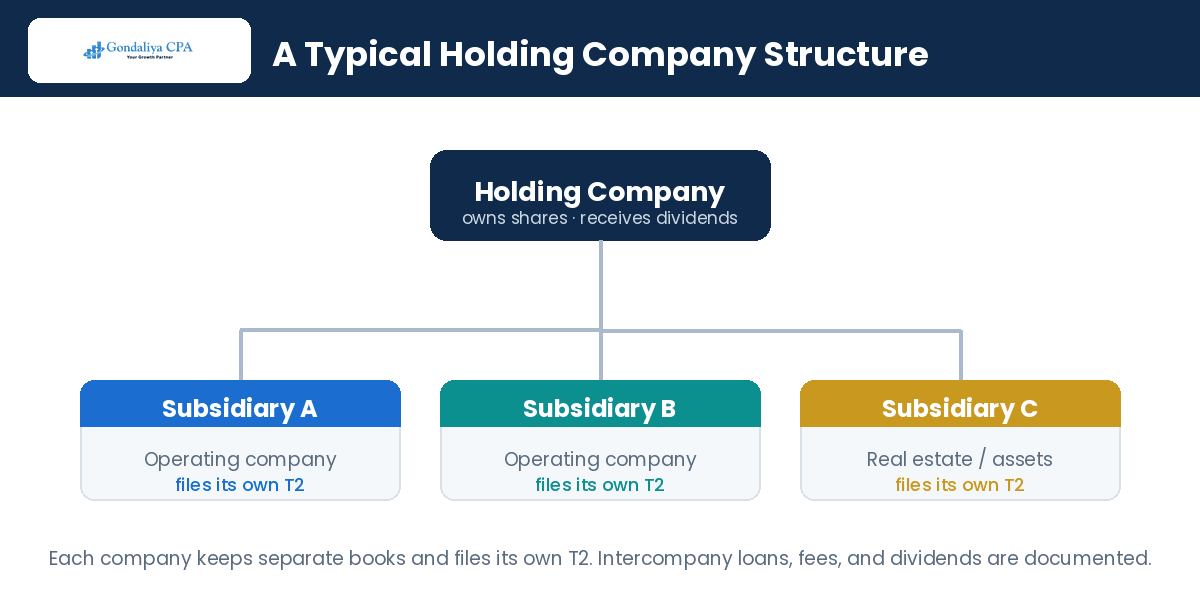
We helped a Toronto real estate investor with three subsidiaries and one holding company. Moving every fiscal year to December 31 made annual consolidation simpler and lined up the T2 deadlines for all four entities. One date replaced four calendars. Figures changed for privacy.
Filing vs Payment Deadlines
Filing and paying are two different deadlines. The complete T2 is due six months after year-end, even if no tax is owed. The balance owing is due two months after year-end, though an eligible Canadian-controlled private corporation gets three months without penalty. Across a group, those staggered dates demand close attention to cash flow, because filing on time but paying late on several entities adds up quickly through daily compound interest.
| Deadline | Due After Year-End | Applies To | Notes |
|---|---|---|---|
| T2 return filing | Within 6 months | All Canadian corporations | No penalty if filed late with no balance owing |
| Tax balance payment | Within 2 months | Most corporations | Eligible CCPCs get 3 months; interest runs daily |
A fast-growing tech client with two subsidiaries confused filing dates with payment dates and picked up late-payment interest. We built a cash-flow schedule during their restructuring so each entity paid on time. The mix-up was avoidable with one clear calendar. Figures changed for privacy.
Penalties for Late Filing and Payment
Missing a deadline costs real money, and in a group it costs it per entity. Filing late while owing tax brings a penalty of 5% of the unpaid balance plus 1% for each full month the return is late, up to 12 months. Interest is charged daily, compounded, on overdue balances and penalties until paid. Because each corporation faces these separately, weak coordination multiplies the total. Repeated late filing after a formal demand raises the penalty to 10% plus 2% per month, up to 20 months.
| Non-Compliance | Rate | Description |
|---|---|---|
| Late-filing penalty | 5% + 1% per month, up to 12 months | On the unpaid balance past the deadline |
| Repeated late filing | 10% + 2% per month, up to 20 months | After a formal demand to file |
| Interest | Daily, compounded | On overdue amounts and penalties |
We worked with an Ottawa construction group running four divisions and a holding company. By moving them to automated filing reminders instead of manual tracking, they avoided roughly $12,000 in penalties across the group in one year. Reminders were cheaper than fines. Figures changed for privacy.
CRA Deadline: Each corporation files its T2 within six months of its fiscal year-end and pays any balance within two months, or three for an eligible CCPC. In a group, please track these per entity, because a shared calendar with one date does not fit companies with different year-ends.
Risk Warning: In a group, a single missed date does not stay contained. Each late entity draws its own penalty and interest, and lenders watching your filings notice. Please treat every entity’s deadline as its own hard date.
Holding Company Accounting for Corporate Groups
Holding Company Accounting
Holding company accounting in Canada carries its own challenges. Managing several corporations under one group gets complicated fast, and good practice keeps you compliant while improving your tax position and keeping reports clear.
Accounting Practices for Holding Companies
A holding company keeps its own books, separate from its subsidiaries, even when the group prepares consolidated statements. Keeping each entity’s records distinct is what lets you track intercompany balances, dividends, and capital moves cleanly. A few practices matter most: a separate chart of accounts built for the holding company’s activities such as investment income, dividends received, and shareholder loans; accrual accounting so revenues and expenses match by year-end; consolidation adjustments that remove intercompany transactions so nothing is double counted; and the right framework, ASPE for most private corporations or IFRS for publicly accountable ones. Together these keep audit trails clean and make T2 filing easier across the group.
A client ran the holding company and its subsidiaries through one blended set of books, and the intercompany balances were impossible to trace. We separated the records entity by entity, and the group’s numbers finally reconciled. Separate books are the foundation, not a nicety. Figures changed for privacy.
Intercompany Transactions and Shareholder Loans
Deals between a holding company and its subsidiaries need solid paperwork so the CRA cannot challenge the pricing or the classification of a loan. Put every loan or service arrangement in a formal agreement with clear terms, including interest rates that match market levels. Record transactions promptly in software built for multi-company bookkeeping, reconcile the accounts monthly to catch errors early, and plan dividend flows through the structure so cash moves without unnecessary tax. Handled well, this keeps you clear of the shareholder-loan rules in Section 15(2) of the Income Tax Act, which can create an unwanted taxable benefit if a loan is not repaid on time.
| Intercompany Transaction | Key Compliance Point | Reference |
|---|---|---|
| Management fees | Arm’s length pricing with a documented basis | ITA Section 247 |
| Shareholder loans | Formal terms and repayment schedules | ITA Section 15(2) |
| Dividend payments | Proper declaration; timing matters | ITA Part I |
An owner drew from a subsidiary through a shareholder loan and left it outstanding past the deadline. We flagged it before it became a taxable benefit under Section 15(2) and arranged repayment in time. A repayment schedule on paper prevented a tax hit. Figures changed for privacy.
Capital Asset Planning Within a Holding Structure
How you handle capital assets inside a group affects tax now and later, when you sell assets or move them between entities. Use the rollover rules under Sections 85 and 86 of the Income Tax Act carefully when transferring assets between related companies, so you do not trigger an immediate tax bill. Assign Capital Cost Allowance claims to the entity that uses the asset, within the CRA’s class rules. And watch how amalgamations or wind-ups change asset values, so a restructuring does not create a surprise taxable gain or loss. Smart capital planning protects value inside the holding company while keeping every T2 in line.
Pro Tip: Before moving any asset between related corporations, please confirm whether a Section 85 rollover applies. Done right, it defers the tax; done without the election, the same transfer can create a gain you did not expect.
Corporate Group Tax Planning Strategies
Group Tax Planning
Managing tax across several corporations takes a clear plan. When companies work under one holding company, allocating deductions correctly and following the CRA’s rules saves money and avoids trouble. The goal is low tax cost with full compliance.
Sharing the Small Business Deduction
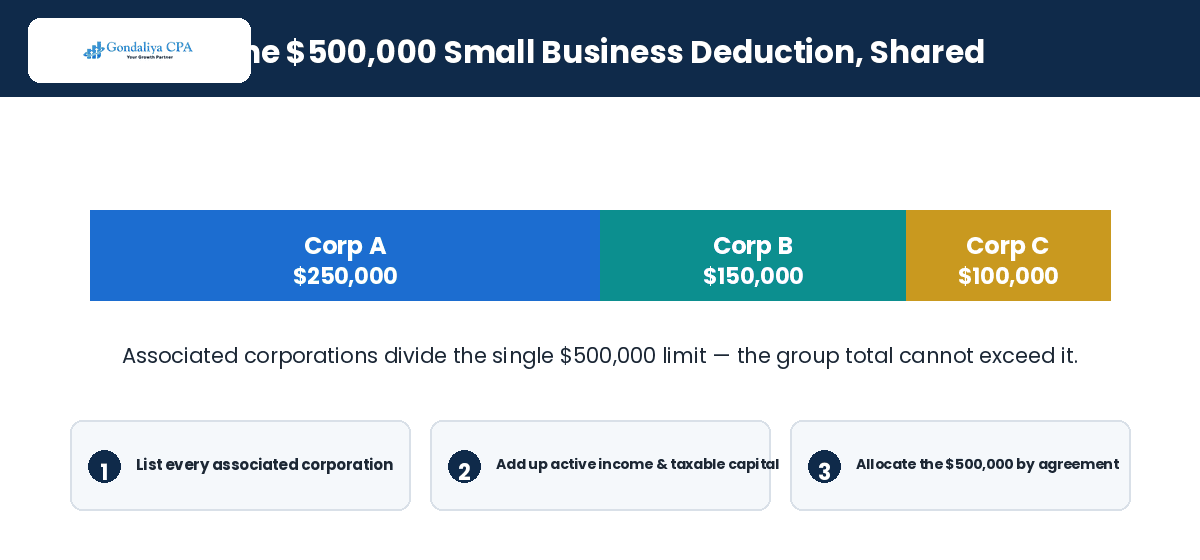
The small business deduction limit is shared among associated corporations. If businesses are linked by control or ownership, they split the $500,000 limit on active business income that qualifies, so each corporation must plan its share and keep the group total within the limit on the T2. The CRA combines taxable capital employed in Canada across the group to check eligibility, and getting the split wrong means deductions can be denied or reassessed. The method is straightforward: list every associated corporation, add up active business income and taxable capital, then divide the $500,000 limit by income shares or an agreed allocation.
| Aspect | Details |
|---|---|
| Small business deduction limit | $500,000, shared among associated corporations |
| Associated corporation rules | Apply where one corporation controls another, directly or indirectly (ITA Section 256) |
A group had two associated corporations each claiming the full small business deduction, which the CRA would have reassessed. We filed the allocation agreement and split the $500,000 limit properly. Fixing the split before filing protected the low rate for both. Figures changed for privacy.
Salary vs Dividends for Shareholders
Choosing salary or dividends changes the tax result. Salaries paid to shareholders from a subsidiary are deductible for the corporation but taxed personally, and payroll costs such as CPP apply. Dividends come from after-tax profits but carry a tax credit that reduces double taxation. Salary builds RRSP room while adding payroll cost; dividends avoid payroll tax and simplify cash flow between companies, which suits passive income moving through a holding company. Whichever mix you choose, please keep intercompany management fees and loans fair and well documented, because the CRA looks closely at these on audit.
An owner defaulted to all dividends across the group every year. After reviewing the personal and corporate sides together, a salary-and-dividend mix built RRSP room and fit their goals better. The right split showed up only when we looked at the whole picture. Figures changed for privacy.
Schedule 9 and Schedule 23 for Associated Corporations
Several schedules matter when you have related companies. Schedule 9 lists the related and associated corporations in your group, which is what ties the entities together on the return. Schedule 23 is the agreement among associated Canadian-controlled private corporations that allocates the business limit, so it drives the small business deduction split and other thresholds. If you run a group, please prepare these every year alongside the financial statements.
| Schedule | Purpose | Applies To |
|---|---|---|
| Schedule 9 | Lists related and associated corporations | Groups with related or associated entities |
| Schedule 23 | Agreement to allocate the business limit | Associated CCPCs sharing the $500,000 limit |
A new client’s prior returns had never included Schedule 9, so the association between their companies was not disclosed. We added it and the allocation agreement, and the filings finally matched the structure. Disclosing the group properly kept the returns clean. Figures changed for privacy.
Foreign Affiliates, Non-Resident Shareholders, and Offshore Assets
Many groups have foreign affiliates or non-resident shareholders, which brings cross-border rules into play. A non-resident corporation must file if it earns Canadian-source income or holds assets that affect the group’s results. Good planning can reduce withholding tax and makes sure required foreign-affiliate reports, such as Form T1134, are filed on time. Dividend flows between a resident holding company and non-residents follow the attribution rules, and transfer pricing applies to cross-border intercompany transactions, so please document them. Careful planning here avoids the penalties tied to foreign operations inside a domestic group.
A group with a foreign affiliate had not filed Form T1134 because no one realized it applied. We caught it and filed before it became a costly problem. Foreign reporting is easy to miss and expensive to ignore. Figures changed for privacy.
Common Mistakes in Multi-Corporation Structures
More corporations mean more chances to slip on deadlines or disclosures. The usual mistakes are not splitting the small business deduction correctly across associates, mixing up intercompany balances so accounts will not reconcile, forgetting schedules like Schedule 9 and Schedule 23, and skipping foreign-affiliate filings. Filing a T2 late while owing tax brings the 5% plus 1% per month penalty, and each entity carries it separately. Working with a CPA who knows multi-company bookkeeping keeps the controls strong and the filings current.
2026 Update — what is current: For 2026, the small business deduction limit remains $500,000, the capital gains inclusion rate stays 50%, and the Lifetime Capital Gains Exemption sits at $1,275,000 for qualified small business corporation shares. Ontario’s small-business corporate income tax rate was cut from 3.2% to 2.2% effective July 1, 2026. The mandatory disclosure rules for certain reportable and notifiable transactions remain in force, so please confirm current-year disclosure requirements for any group restructuring with your CPA before you file.
Preparing and Filing T2 Returns for a Group
Step by Step
Filing for a group is a sequence. Do it in order and each entity’s return stays clean and consistent with the others.
Gather Statements and Map GIFI Codes
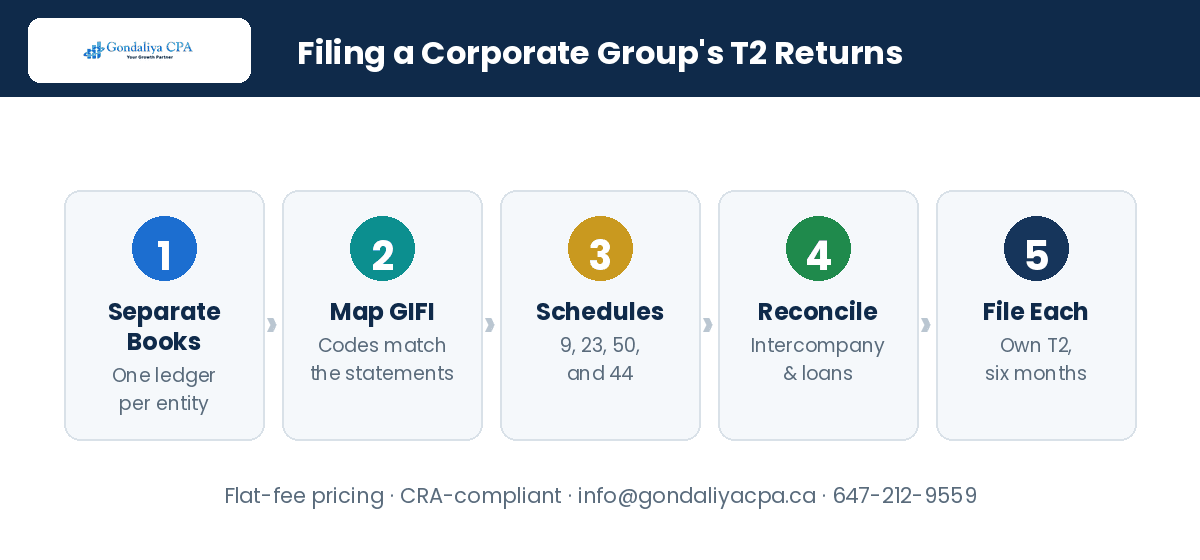
Start by gathering financial statements, with clear separate records for each company in the group. The General Index of Financial Information, or GIFI, standardizes reporting on the T2 by assigning numbers to financial items the CRA recognizes, so mapping each ledger account to the right GIFI code is what avoids errors and eases electronic filing. Line up each subsidiary’s information under the correct codes to keep consolidation accurate while respecting every company’s separate identity. In short: collect detailed statements for every corporation, map accounts to GIFI codes, check intercompany transactions carefully, and prepare consolidated information without mixing entities.
Complete the Required Schedules
A T2 needs more than the main form. Schedule 50 lists shareholders, which matters in a group with dividend planning. Non-arm’s-length and related-party transactions such as loans or fees between companies are reported on Schedule 44, and getting them right avoids errors that draw CRA attention. These disclosures clarify ownership links and related transactions, which affect taxable income, so accuracy keeps your filings aligned and your structure efficient.
| Schedule | Purpose | When Needed |
|---|---|---|
| Schedule 50 | Shareholder details | Corporations with shareholders |
| Schedule 44 | Non-arm’s-length transactions | Companies with intercompany dealings |
A group’s prior returns reported intercompany loans inconsistently across entities, so the balances did not agree. We rebuilt the disclosures on Schedule 44 so each side matched. Consistent related-party reporting is what keeps a group audit-ready. Figures changed for privacy.
Electronic Filing and Current Requirements
Most corporations, including those in multi-company groups, must file the T2 electronically. The CRA’s system demands precise formatting, especially GIFI codes that match exactly. The deadline stays six months after the fiscal year-end, but faulty files, such as a missing Schedule 50 or wrong GIFI data, can raise penalties. Reporting rules continue to evolve, so please confirm the current-year disclosure requirements for any group restructuring before filing. Software such as QuickBooks or Xero, paired with certified T2 software, keeps the e-filing workflow smooth for multi-company needs.
A client’s GIFI mapping did not match between the statements and the return, and an early filing bounced back. We aligned the codes across the group and the returns filed cleanly the first time after that. Precise GIFI mapping saves the rework. Figures changed for privacy.
The Role of CPA Expertise
CPA help matters most with holding company accounting and complex groups. A professional double-checks every form, including the tricky schedules, and confirms intercompany transactions follow the law and sound group practice. It also opens the door to legitimate savings through sensible dividend planning, fair expense allocation across companies, and early spotting of the audit risks the CRA’s systems flag on larger filers. In short, a CPA confirms compliance across all forms and schedules, verifies intercompany dealings, helps optimize planning within the group, and catches issues early.
For a single company, a careful owner can often manage. For a group, the schedules, the associations, and the intercompany reconciliations compound quickly, and one missed disclosure can unsettle several returns. Please bring in a CPA once you pass one corporation.
Check Your Group’s Readiness
Before you file, this quick self-check shows where the gaps are. Please answer the six questions below.
Multi-Corporation Year-End Readiness Checker
Six quick questions to see how ready your group is before filing. No fee shown.
In place:
This is a general prompt, not tax or legal advice or a quote. Your actual filing depends on your books and structure. For a real review, please book a free consultation.
Want this as a one-pager? You can download the free multi-corporation year-end and T2 checklist and bring it to your first call. You can also estimate your bill with our corporate tax calculator.
How Gondaliya CPA Helps Multi-Corporation Businesses
How We Help
Handling multiple corporations gets complicated fast, and without a clear plan you can miss chances to save. Corporate group tax planning keeps things organized and legal while lowering tax across all your businesses, and it pairs with holding company accounting that follows the CRA’s rules closely.
Integrated Filing and Group Planning
With a group, you cannot file each T2 in isolation. We prepare the returns together for every corporation, track and explain intercompany balances to avoid audits, plan dividend flows so cash keeps moving, and use the benefits of a holding structure such as asset protection and tax deferral. That way filing mistakes drop and problems get fixed before year-end deadlines arrive.
A client’s entities had been filed by different preparers in different years, and nothing tied together. We brought the whole group under one coordinated year-end, and the intercompany accounts finally agreed across every return. One coordinated process replaced the guesswork. Figures changed for privacy.
Professional Year-End Financial Statements
Year-end accounting done properly improves accuracy through bookkeeping built for multiple entities. A compilation engagement gives incorporated SMBs reliable financial statements without the cost of an audit or review, which still works for banks or lenders. The benefits are clear reports for financing, errors caught during year-end checks, and consistent bookkeeping in QuickBooks or Xero, all producing solid numbers for the T2. A compilation provides no assurance, and we say so plainly, but well-prepared statements make the return smoother.
A group needed financial statements for a lender across three of its companies. We prepared consistent compilation statements for each, and the financing moved ahead without follow-up questions. Clean, comparable statements did the talking. Figures changed for privacy.
Local Knowledge and Practical Tips
Knowing the CRA’s electronic filing steps speeds submissions and avoids the common errors tied to associated-corporation rules, and staying current with Ontario’s rules keeps a group on track. A few tips carry most groups a long way: document management fees at arm’s length to justify them, match payroll remittances to the salaries paid across related corporations, coordinate GST/HST when entities operate in different provinces, reconcile trial balances monthly to catch errors early, and put shareholder loan agreements in writing with repayment terms that fit the Income Tax Act.
Our Take: The groups that stay out of trouble are not the ones with clever structures; they are the ones with separate books, reconciled intercompany accounts, and every schedule filed. Please build the discipline first, and the planning works from there.
A client with five entities relied on a memory and a spreadsheet for filing dates, and one slipped. We set automated reminders keyed to each entity’s year-end, and nothing has been late since. The reminders cost far less than one penalty. Figures changed for privacy.
Why Choose Gondaliya CPA
We manage complex intercompany transactions in QuickBooks and Xero, keep your books audit-ready with thorough documentation, e-file through certified software with every required schedule attached, and set automated reminders tuned to each entity’s fiscal cycle so no deadline slips. We also prepare the disclosures a group reorganization requires. It is all delivered on a flat annual fee, HST included, with the scope confirmed up front, so the cost stays predictable across every entity.
What You Receive
- Financial statements for each corporation in the group.
- Intercompany reconciliations showing each balance agreeing on both sides.
- A completed T2 return package per entity, with every required schedule attached.
- The allocation agreement supporting the small business deduction split.
- Written notes on anything we corrected or that needs attention next year.
What to Prepare Before We Start
Please gather these for every corporation in the group before the first meeting:
- Financial statements or bookkeeping files for each entity.
- Intercompany transaction records, including loans, management fees, and dividends.
- Shareholder agreements and any allocation agreements already in place.
- Prior-year T2 returns for each corporation.
- A simple list of the entities, their fiscal year-ends, and who owns what.
That last item sounds obvious, but a clear ownership map is often the fastest way to spot an association nobody had disclosed.
Our Commitments to You
We respond to client messages within one business day, which matters when several entities have deadlines in the same month. The work is backed by a 30-day money-back guarantee and a 60-day fees-matching policy on competitive pricing. Gondaliya CPA is a CPA Ontario Registered Firm, serving corporate groups across Toronto, Mississauga, Vaughan, Etobicoke, Brampton, Scarborough, Ottawa, Oshawa, Guelph, Hamilton, North York, Windsor, and all of Canada remotely.
What to Prepare Before We Start
Gathering these first makes the group year-end considerably faster:
- Financial statements for every corporation in the group.
- Intercompany transaction records, including loans, management fees, and dividends.
- Shareholder agreements and any loan agreements in place.
- Prior-year T2 returns for each entity, to confirm opening balances carry forward.
- A list of every corporation, its fiscal year-end, and its ownership links.
What You Receive
Each engagement produces the same defined set for every entity: financial statements prepared as a compilation, intercompany reconciliations showing both sides agreeing, and a completed T2 return package with all required schedules attached and filed. You also get written notes on anything we corrected, so the group’s position is documented if the CRA ever asks.
Our Commitments to You
The engagement is backed by a 30-day money-back guarantee if early expectations are not met, and a 60-day fees-matching policy on competitive pricing. We respond to client messages within one business day, which matters when several entities have deadlines close together. Gondaliya CPA is a CPA Ontario Registered Firm, serving corporate groups across Toronto, Mississauga, Vaughan, Etobicoke, Brampton, Scarborough, Ottawa, Oshawa, Guelph, Hamilton, North York, Windsor, and all of Canada, remotely.
Industry Spotlights: Corporate Groups We Serve
Industry Expertise
Corporate groups look different in every industry, and the year-end work follows the sector. Here are ten we handle often, and where the attention goes for each.
| Industry | Where We Focus for Your Group |
|---|---|
| Medical doctors & physician professional corporations | Incorporation timing, TOSI limits, and a holding company for retained earnings |
| Dentists & dental practices | Practice-and-holdco structure; most dental services are HST-exempt |
| Daycare, childcare & CWELCC services | CWELCC funding and wage-grant reconciliation; childcare is HST-exempt |
| Real estate investors, landlords & holding companies | Opco-holdco structures, CCA on buildings, commercial vs residential HST |
| Property developers & builders | Inventory vs capital, HST self-supply, and new housing rebates |
| Construction, contractors & skilled trades | Holdbacks, work-in-progress, and T5018 subcontractor reporting |
| Technology startups & SaaS | SR&ED credits, deferred revenue, and IP-holdco planning |
| E-commerce & online retailers | Multi-province and cross-border sales tax on Shopify and Amazon FBA |
| Restaurants & food and beverage | Tip payroll, multi-location entities, and inventory controls |
| Transportation, logistics & trucking | Owner-operator structuring; long-haul meals are 80% deductible |
- Medical doctors & physician professional corporations: A Medicine Professional Corporation lets a physician defer tax on retained earnings, though the tax-on-split-income rules limit who can receive dividends. We time the incorporation, set a salary-and-dividend mix, and often pair the practice with a holding company for investments.
- Dentists & dental practices: A Dentistry Professional Corporation usually sits under a holding company that holds the equipment or premises. Because most dental services are GST/HST-exempt, input tax credit recovery is limited, so we track the taxable and exempt supplies carefully.
- Daycare, childcare & CWELCC services: Childcare operators blend CWELCC funding, wage-enhancement grants, and parent fees, and childcare services are GST/HST-exempt. We separate and reconcile the grant income so the year-end matches the funding reporting.
- Real estate investors, landlords & holding companies: Rental groups run on an operating-company-and-holding-company structure. We handle CCA on buildings, the difference between HST-exempt residential rent and taxable commercial rent, and the intercompany flows between entities.
- Property developers & builders: Development turns on whether a property is inventory or capital, and on the HST self-supply and new housing rebate rules. We keep project entities and joint ventures reported cleanly across the group.
- Construction, general contractors & skilled trades: For contractors, electricians, plumbers, and HVAC firms, we manage holdbacks, work-in-progress, equipment CCA, and the T5018 subcontractor reporting the CRA expects.
- Technology startups & SaaS: Tech groups often split an operating company from an intellectual-property holding company. We prepare SR&ED credit claims, handle deferred revenue and loss carryforwards, and sort GST/HST on cross-border SaaS sales.
- E-commerce & online retailers: Sellers on Shopify and Amazon FBA face multi-province and cross-border sales tax. We set the right GST/HST registrations, track sales by jurisdiction, and handle inventory and foreign exchange.
- Restaurants & food and beverage: Multi-location operators often run each site as its own corporation. We manage tip and payroll reporting, HST on food sales, and inventory controls across the group.
- Transportation, logistics & trucking owner-operators: We structure owner-operator versus employee arrangements, handle fuel and truck CCA, and apply the long-haul meal rule, where eligible long-haul drivers deduct 80% of meal costs rather than the usual 50%.
A childcare client running two centres in a small group had CWELCC funding, wage-enhancement grants, and parent fees flowing through one account. We separated the grant income and reconciled it to the funding statements, so the year-end matched the ministry reporting exactly. Clean grant tracking satisfied both the funder and the CRA. Figures changed for privacy.
A landlord held several rental properties directly and personally. We moved them into an operating company under a holding company, aligned the year-ends, and set intercompany agreements, which cleaned up the reporting and protected the structure. The holdco gave both control and clarity. Figures changed for privacy.
An online retailer selling into the United States through Amazon FBA had not sorted its GST/HST registration by province or its cross-border position. We set the registrations right and tracked sales by jurisdiction, which removed a growing reassessment risk before it landed. For cross-border sellers, the detail is the whole game. Figures changed for privacy.
Glossary of Key Terms
Plain-English Definitions
- T2 return: The Corporation Income Tax Return every incorporated business files each year.
- Corporate group: Two or more corporations connected by common ownership or control.
- Holding company: A corporation that owns shares in other corporations rather than operating directly.
- Associated corporations: Corporations linked by control that must share the small business deduction.
- Small business deduction: The measure lowering the corporate rate to 9% federally on the first $500,000 of active business income.
- Intercompany transaction: A loan, fee, sale, or dividend between companies in the same group.
- Shareholder loan: Funds a shareholder draws from a corporation, governed by Section 15(2) of the Income Tax Act.
- Section 85 rollover: An election to transfer property to a corporation on a tax-deferred basis.
- GIFI: The General Index of Financial Information, the CRA’s standard codes for financial statement items.
- Schedule 9: The T2 schedule that lists related and associated corporations.
- Schedule 23: The agreement among associated CCPCs to allocate the business limit.
- Compilation engagement: Financial statements prepared with no assurance provided.
Frequently Asked Questions
FAQ
What is the T2 filing deadline for multiple corporations?+
Each corporation files its T2 within six months after its own fiscal year-end. Holding companies and subsidiaries have individual deadlines based on their fiscal years.
What penalty applies for late T2 filing?+
5% of the unpaid tax plus 1% for each full month the return is late, up to 12 months. Interest accrues daily on overdue balances until paid.
How is the small business deduction shared among associated corporations?+
The $500,000 limit is allocated among all associated corporations based on income and taxable capital, so the group total does not exceed the limit.
What is the corporate tax payment deadline?+
Most corporations pay within two months after the fiscal year-end. An eligible CCPC gets three months without interest.
How many schedules does a complete T2 need?+
It varies by structure, but common ones include Schedule 50 for shareholders, Schedule 9 for related and associated corporations, and Schedule 23 for allocating the business limit.
Can multiple corporations file a consolidated T2 in Canada?+
No. Canada does not allow consolidated filings. Each corporation files separately, though group planning coordinates the reporting.
How much does multi-corporation year-end accounting cost?+
We work on a flat annual fee, HST included, set to the number of entities and the complexity, with the scope confirmed up front before we start.
How do I contact the CRA for corporate tax questions?+
You can reach CRA business inquiries at 1-800-959-5525 or use the CRA online services portal for account and filing support.
Do the same fiscal year-ends help across a group?+
Yes. Aligned year-ends simplify consolidation, intercompany tracking, and deadlines, though each entity still files its own T2.
How do I choose a CPA firm for a corporate group?+
Verify licensing on the CPA Ontario directory, look for multi-entity experience, and confirm clear flat-fee pricing and a strong review record.
What should I prepare before the group year-end starts?+
Financial statements for every corporation, intercompany transaction records, shareholder and loan agreements, prior-year T2 returns, and a list of each entity with its fiscal year-end and ownership links.
What deliverables do I receive for each entity?+
Compilation financial statements, intercompany reconciliations showing both sides agreeing, and a completed T2 return package with every required schedule attached and filed, plus written notes on any corrections.
What guarantees do you offer?+
A 30-day money-back guarantee if early expectations are not met, and a 60-day fees-matching policy, with a one-business-day response to client messages.
Multi-Corporation Year-End Checklist
- Align fiscal year-ends across the group where possible.
- Keep separate books for each entity.
- Reconcile intercompany balances and shareholder loans monthly.
- Document management fees at arm’s length.
- Allocate the $500,000 small business deduction across associates.
- Prepare Schedules 9, 23, 50, and 44 for each return.
- File every T2 within six months and pay on time.
Who This Is For / Not For
- For: Incorporated businesses managing more than one corporation and seeking clean group compliance.
- Not For: A single-company owner with no associated corporations or intercompany dealings.
People Also Ask
Quick Answers
Does a holding company file its own T2?+
Yes. A holding company files its own T2 each year, separate from its subsidiaries, even if its only income is dividends.
Can I move assets between my corporations without triggering tax?+
Often yes, using a Section 85 rollover, which defers the tax. Without the election, the same transfer can create a taxable gain, so please plan it first.
Does Gondaliya CPA handle multi-provincial corporate filings?+
Yes. We manage filings across provinces and confirm compliance with the applicable CRA and provincial rules.
Contact Gondaliya CPA at 647-212-9559 or info@gondaliyacpa.ca for help with your corporate group’s year-end accounting and T2 filings.
File your whole group clean and on time
Gondaliya CPA coordinates year-end accounting, intercompany reconciliations, and T2 filing across every corporation in your group, on a flat annual fee, HST included. Please book a free consultation to start.
Next Steps
Handling a group well comes down to separate books, reconciled intercompany accounts, a proper small business deduction split, the right schedules, and every T2 filed on time. Please align your year-ends where you can, list your entities and their deadlines, tidy the intercompany balances, and bring us anything you are unsure about. Reach out for a free consultation, call 647-212-9559, or email info@gondaliyacpa.ca. If our content helps, please add gondaliyacpa.ca as a preferred source on Google.
Published: July 6, 2026 · Last updated: August 12, 2026
Disclaimer: This article is educational information only and is not tax, legal, or financial advice. It reflects CRA and Income Tax Act rules current to 2026, including the $500,000 small business deduction, the 50% capital gains inclusion rate, the $1,275,000 Lifetime Capital Gains Exemption, and Ontario’s small-business rate reduction to 2.2% effective July 1, 2026. Outcomes depend on your specific facts and rules can change. Please consult a Registered CPA in Canada or Ontario before acting. Fees include HST.

Sharad Gondaliya is a CPA Canada & CPA USA with 15 Years+ experience of Accounting, Tax, Payroll of Corporate Small Businesses as Tax Accountant. He is a CPA Ontario member (61040184) and holds US CPA licences in Washington and Montana and is well known among corporate small businesses for tax planning, efficient tax solutions, and affordable CPA services. Sharad is the Principal (Director) of Gondaliya CPA – Affordable CPA Firm in Canada. Licenses: CPA Ontario: 61040184 | CPA USA (MT): PAC-CPAP-LIC-033176 | CPA USA (WA): 57629 | CPA Firm License: 61330051 View Full Author Bio