



Documents Required for a Compilation Engagement
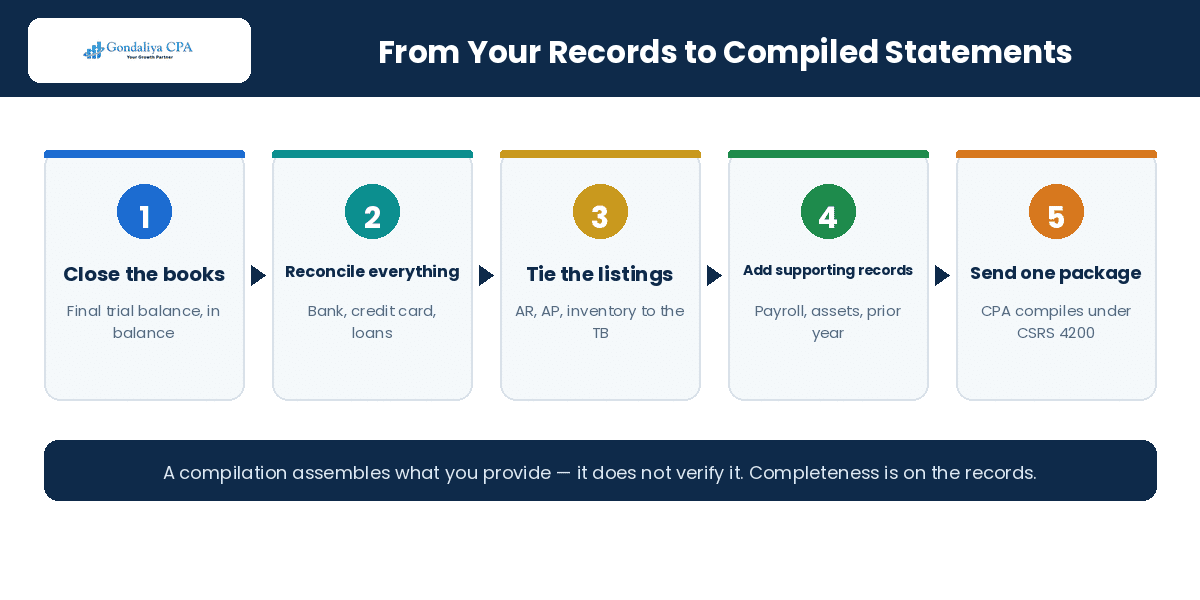
The compilation engagement documents required by any Canadian CPA firm come down to one essential item and six supporting groups. The essential item is a closed, reconciled trial balance. Everything else — bank records, receivable and payable listings, payroll filings, loan agreements, capital asset invoices, and last year’s statements — exists to support the numbers on it.
Send a complete package the first time and the engagement moves. Send it in pieces and it stalls, because a compilation cannot be assembled from information that is still changing. Here is exactly what to gather, and why each item is on the list.
Why the Document List Matters
A compilation engagement assembles financial information that management provides. Your CPA does not test balances or confirm them with your bank — under CSRS 4200 the work is assembly, not verification, and no assurance is expressed. That places the burden of completeness squarely on the records you hand over.
CSRS 4200 also requires your CPA to have knowledge of your business and to document the work properly. That is why the list runs past a trial balance: the supporting records are what make the compiled statements defensible and the basis of accounting note accurate.
The Foundation: Trial Balance and General Ledger
Start here, because nothing else can be used until this is settled.
Your CPA needs a closed trial balance for the fiscal year, in balance, with the opening balances agreeing to last year’s compiled statements. Alongside it, provide the general ledger detail so any unusual balance can be traced to the transactions behind it.
If you work in QuickBooks Online or Xero, direct access is usually simpler than exporting, because it lets your CPA see the detail behind a number without a round of emails. Please confirm the year is actually closed before sending — a trial balance that shifts after it arrives restarts the work.
Pro Tip: Check that retained earnings on your opening trial balance ties to the prior year’s closing figure. When it does not, something was posted to a closed period, and that single discrepancy will hold up the whole engagement. Please resolve it before you send anything.
Bank, Credit Card, and Loan Records
Every balance on the balance sheet that came from an outside institution needs its year-end statement attached.
Provide year-end bank statements with completed reconciliations for every account, including any account you rarely use. Do the same for credit cards. For every loan or line of credit, send the agreement and the year-end balance or amortization schedule, so the split between current and long-term portions is right and the interest expense can be checked against the statements.
Unreconciled accounts are the single most common reason a compilation slows down. If the book balance does not agree to the statement, every figure built on it is uncertain.
Receivables, Payables, and Inventory
These three are where the year-end cut-off is either right or wrong.
Send an accounts receivable aged listing at year-end that totals to the balance in your books, and flag anything you consider uncollectible. Send an accounts payable aged listing on the same basis. If you carry stock, provide your year-end inventory count and valuation, along with the method you used.
Please make sure each listing agrees to the trial balance before sending. A subledger that does not tie to the control account is a question your CPA has to ask, and every question costs days.
Payroll and Government Accounts
Payroll touches both the income statement and the liabilities, so the filings need to agree with the books.
Provide your payroll register or year-end summary, the T4 slips and T4 Summary filed for the year, and your PD7A remittance statements. Include any T4A or T5018 slips issued to contractors or subcontractors. On the sales tax side, send the GST/HST returns filed for the year and the year-end balance owing or refundable.
Where a remittance was filed but not paid, or paid but not posted, the liability on your balance sheet will not match the government’s record — and that gap has to be resolved before the statements can be finalized.
Capital Assets, Leases, and Shareholder Records
These are the items most often forgotten, and the ones most likely to trigger follow-up questions.
For anything bought or sold during the year, send the purchase and disposal invoices so additions are capitalized correctly and depreciation can be calculated. Provide lease agreements for vehicles, equipment, and premises. And provide the detail behind the shareholder loan account — the draws, the repayments, and the dates.
The shareholder loan is the balance a lender and the CRA both look at on an owner-managed corporation. When personal costs have run through the business accounts, each one has to be identified and reclassified before the balance sheet can be compiled.
Risk Warning: Capital purchases expensed as repairs, and personal costs sitting in business accounts, both change the compiled statements once corrected. Please flag anything unusual when you send the package rather than waiting to be asked — it is far cheaper than a restatement later.
Prior-Year Statements and Tax Filings
A compilation is rarely a standalone year. It has to connect to what came before.
Send last year’s compiled financial statements, so the comparative figures and opening balances agree. Send the prior-year T2 return and the Notice of Assessment, which confirm what the CRA has on record and carry forward the tax accounts. If your corporation was incorporated, amalgamated, or changed its share structure during the year, include the corporate records covering the change.
Please also tell your CPA who will read the statements. Under CSRS 4200, knowing the intended user shapes the engagement and the disclosure, so it is a question best answered at the start rather than the end.
Compilation Engagement Documents Required: The Complete Checklist
| Group | What to send |
|---|---|
| Trial balance | Closed year-end trial balance, in balance, plus general ledger detail |
| Banking | Year-end bank and credit card statements with reconciliations, every account |
| Debt | Loan and credit line agreements, year-end balances, amortization schedules |
| Receivables and payables | Aged listings at year-end that tie to the trial balance |
| Inventory | Year-end count, valuation, and the method used |
| Payroll | Payroll register, T4 slips and Summary, PD7A statements, T4A and T5018 slips |
| Sales tax | GST/HST returns filed and the year-end balance |
| Capital assets | Purchase and disposal invoices, lease agreements |
| Shareholder | Loan account detail: draws, repayments, and dates |
| Prior year | Last year’s financial statements, T2 return, Notice of Assessment |
What Happens When Documents Are Missing
An incomplete package does not simply delay the work — it changes the work.
When the trial balance is not closed, the engagement has not started, whatever the calendar says. When reconciliations are missing, the job becomes a bookkeeping clean-up before it can become a compilation, which is a longer and more expensive exercise. When supporting records arrive in batches, your CPA rebuilds context each time, and the questions multiply.
There is a records obligation behind all of this too: the CRA requires business records to be kept for six years after the end of the tax year they relate to. The documents on this list are not just for your CPA — they are the file you would need if the CRA ever asked.
Gather the package once, check that every listing ties to the trial balance, and send it complete. That single discipline does more for the cost and the timeline of a compilation engagement than anything else available to you.
Frequently Asked Questions
What documents are required for a compilation engagement?+
A closed and reconciled trial balance with general ledger detail, year-end bank and credit card statements with reconciliations, loan agreements, aged receivable and payable listings, inventory count and valuation, payroll records including T4 slips and PD7A statements, GST/HST returns, capital asset invoices, lease agreements, shareholder loan detail, and last year’s financial statements, T2 return, and Notice of Assessment.
Do I need to close my books before the engagement starts?+
Yes. A compilation assembles information management provides, so the information has to be final. If the trial balance is still moving, there is nothing stable to assemble and the engagement cannot begin.
Can I give my CPA access to QuickBooks or Xero instead?+
Access helps, and it usually reduces the back-and-forth, because your CPA can trace a balance to its detail without asking. It does not replace the external documents though — bank statements, loan agreements, invoices, and prior-year filings still need to be provided.
What if some documents are missing?+
The engagement slows, and if the gaps are large enough the work becomes a bookkeeping clean-up first. Please tell your CPA what is missing at the outset rather than sending an incomplete package, so the scope and the fee reflect reality from the start.
How long must I keep these records?+
The CRA requires business records to be kept for six years after the end of the tax year they relate to. Please store them so they can be produced quickly if asked.
Conclusion
The compilation engagement documents required are not arbitrary. Each group on the list supports a figure on the statements, and the trial balance sits under all of it. Close the year, reconcile every account, confirm each listing ties, gather the supporting records, and send one complete package.
Do that and a compilation is a straightforward engagement. Skip it and you are paying a CPA to do bookkeeping.
If you would like the checklist applied to your own year-end, please book a free consultation with Gondaliya CPA. We will tell you what is missing, what it will take, and quote a flat fee, HST included, in writing before any work starts — call 647-212-9559 or email info@gondaliyacpa.ca. Our CPA compilation report service covers the whole engagement.

Sharad Gondaliya is a CPA Canada & CPA USA with 15 Years+ experience of Accounting, Tax, Payroll of Corporate Small Businesses as Tax Accountant. He is a CPA Ontario member (61040184) and holds US CPA licences in Washington and Montana and is well known among corporate small businesses for tax planning, efficient tax solutions, and affordable CPA services. Sharad is the Principal (Director) of Gondaliya CPA – Affordable CPA Firm in Canada. Licenses: CPA Ontario: 61040184 | CPA USA (MT): PAC-CPAP-LIC-033176 | CPA USA (WA): 57629 | CPA Firm License: 61330051 View Full Author Bio