



Dental Accounting Mistakes Every Dentist Accountant Should Avoid for Accurate Dental Bookkeeping
Dental accounting mistakes can lead to serious issues in financial reporting for dental clinics, increasing CRA audit risk for dentists. Gondaliya CPA helps dentists avoid common bookkeeping mistakes, tax compliance problems, and accounting errors for dentists to ensure smooth dental practice tax planning and accurate expense tracking.
Quick Summary
Four mistakes cause most of the money lost in dental clinics: mixing personal and clinic spending, mishandling shareholder loans, misclassifying associates on payroll, and overclaiming GST/HST input tax credits on exempt care. Please note each one is cheap to prevent in the books and expensive to fix after a CRA letter.
| Aspect | Details |
|---|---|
| The four repeat errors | Personal expenses, shareholder loans, payroll classification, ITC overclaims. |
| The monthly discipline | Reconciliation, merchant deposits, accounts payable, cut-offs. |
| The structure | A dental-specific chart of accounts separating lab fees from supplies. |
| Who it suits | Incorporated dentists and multi-associate clinics in Ontario and Canada. |
Reading time: 31 minutes.
Table of Contents
- Common Dental Accounting Mistakes That Impact Practice Success
- Understanding Essential Financial Concepts and Documents for Dentists
- Establishing a Dental-Specific Chart of Accounts for Clear Financial Insight
- Tax Planning and Compliance Strategies Tailored for Dental Practices
- Choosing Between In-House and Outsourced Dental Accounting Services
- Supporting Dental Professionals with Reliable Accounting Expertise
- Frequently Asked Questions (FAQ)
- Key Points, CCA, and Best Practices
- Industry Spotlights: Sectors We Represent
- Professional Guidance and Quick Reference
What Mistakes Actually Cost
This article covers Canada, with Ontario and Toronto context, and reflects CRA rules current to 2026. It assumes an incorporated dental practice or dental professional corporation. Our Actual Experience notes use round illustrative figures to show the mechanics; they are examples, not quotes, and each ends with “Figures changed for privacy.” This is educational information only and not tax, legal, or financial advice. Fees include HST. Rules change, so please confirm your own situation with a Registered CPA before acting.
Common Dental Accounting Mistakes That Impact Practice Success
Common Dental Accounting Mistakes That Impact Practice Success
The Errors
4 Repeated Dental Accounting Errors and Their Financial Consequences
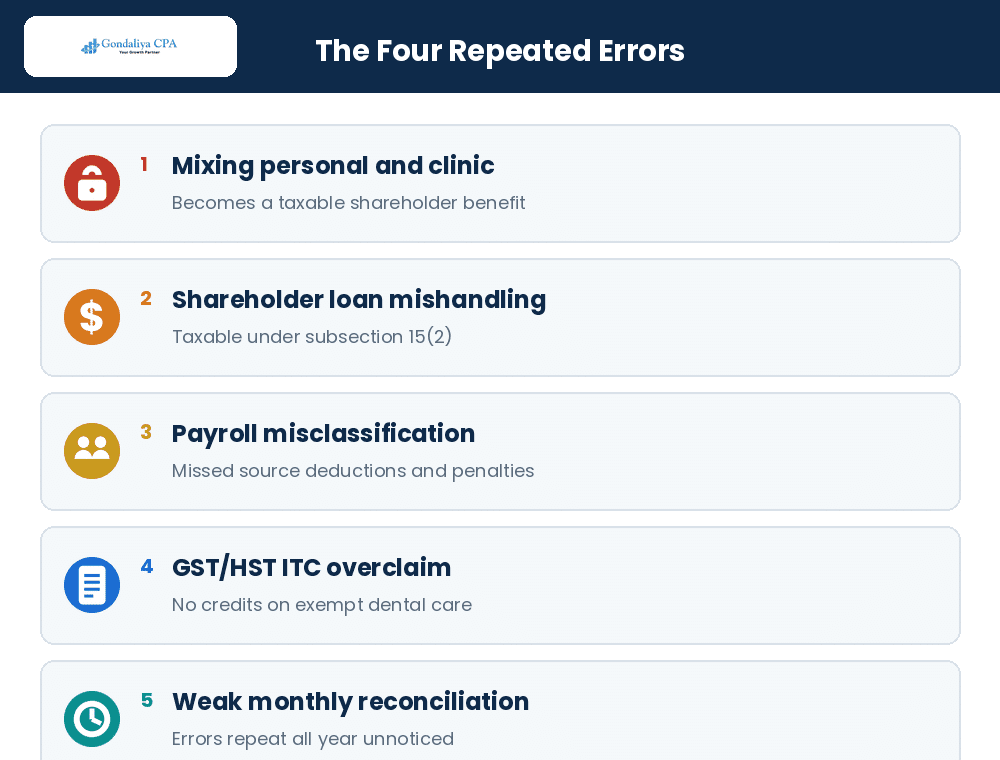
Dental clinics often make a few common accounting mistakes. These errors can cost a lot of money. Here are four big ones:
Mixing Personal and Clinic Expenses
Dentists sometimes mix their personal bills with clinic expenses. This messes up the bookkeeping and makes financial reports wrong. Claiming personal costs as business expenses can also cause trouble with the CRA.
Shareholder Loan Mishandling
Not handling shareholder loans right can lead to extra taxes. The Income Tax Act’s subsection 15(2) says these loans might be taxed if not paid back or properly recorded. Dentists can end up paying more tax this way.
Payroll Misclassification
Putting employees in the wrong category is risky. Calling an employee a contractor by mistake can lead to penalties from CRA for missing source deductions. Dentist accountants must get this right based on CRA rules.
GST/HST Input Tax Credit Overclaim
Some dental clinics claim GST/HST credits on services that don’t qualify, like basic dental care. The CRA does not allow ITCs on exempt supplies. Overclaiming causes reassessments and extra taxes owed.
A clinic ran $18,000 of personal costs through the corporate card over a year and treated all of it as business expense. On review, $18,000 was added back as a shareholder benefit and taxed personally at a 48% marginal rate, roughly $8,640, while the corporation lost the deduction it never should have claimed. Figures changed for privacy.
Overlooking the Difference Between Profit and Cash Flow in Dental Practices
Profit and cash flow are different things—but many dentists mix them up. Profit shows what you earn after expenses. Cash flow shows how much cash you have right now.
Dentists with high profits but poor cash flow face bigger tax bills. Delayed payments or spending too much on gear can drain cash even if profits look good. Poor planning hurts money available during slow times.
A practice reported $240,000 of profit but held $95,000 in unpaid insurance receivables and had spent $120,000 on equipment. Tax was payable on the $240,000 while only about $25,000 of cash remained, so the corporate tax instalment could not be funded from operations. Figures changed for privacy.
Mistakes in Transaction Timing and Period Reporting
Timing matters a lot when recording income and expenses. If you miss recording money earned before year-end, your profits look off on your tax return.
You must follow strict cut-off rules to record everything before fiscal year-end properly. Missing this causes errors that may trigger audits later.
A clinic performed $32,000 of treatment in the last two weeks of its fiscal year but billed it in the new year. Revenue was understated by $32,000 in the correct year and overstated by the same amount in the next, distorting both returns and inviting questions on the swing. Figures changed for privacy.
Risks of Hiring an Inexperienced Dentist Accountant
Hiring someone who doesn’t know dental accounting well can backfire badly. They might miss important rules or fail to keep your books compliant with regulations from CPA Ontario or RCDSO.
DIY bookkeeping saves money at first but often leads to mistakes costing more later. A CPA-reviewed book keeps you safer because they know dental industry details better.
An owner saved roughly $4,200 a year using a general bookkeeper rather than a dental CPA. Three years later the cleanup, amended returns, and penalty exposure came to about $19,000, so the $12,600 saved cost about $6,400 net before counting the owner’s own time. Figures changed for privacy.
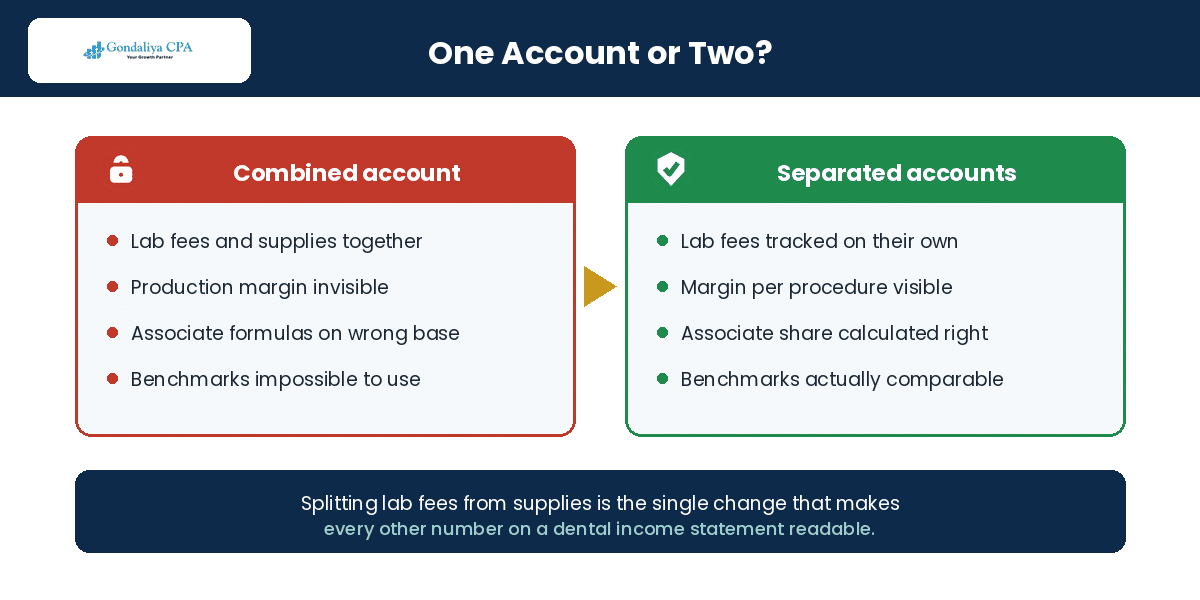
Failing to Use a Dental-Specific Chart of Accounts
Using a generic chart of accounts causes problems classifying expenses correctly for a dental practice. This mistake hides where your money really goes, making financial reports less useful.
A chart designed for dentistry tracks revenue sources like orthodontics vs general dentistry better. It helps you see which parts of your clinic bring in money or cost more.
A clinic posted $86,000 of lab fees and $74,000 of supplies to one account totalling $160,000. Split correctly, lab fees were 14% of production against a 9% benchmark, a five-point gap worth roughly $57,000 a year that had been invisible for three years. Figures changed for privacy.
Neglecting Monthly Reconciliation and Book Closer Processes
Monthly reconciliation catches errors early by matching bank statements to your books—like merchant deposits not showing up or invoices unpaid yet.
Skipping these checks piles up mistakes over time, hurting cash flow and stressing you out during busy periods when patients increase suddenly!
A practice skipped reconciliation for nine months. At year-end, $41,000 of merchant deposits sat unmatched and $12,500 of lab invoices were unrecorded, so reported profit was overstated by roughly $12,500 and revenue could not be tied to the bank without a full rebuild. Figures changed for privacy.
Understanding Essential Financial Concepts and Documents for Dentists
Understanding Essential Financial Concepts and Documents for Dentists
The Concepts
Key Financial Statements Every Dental Practice Should Monitor
Dentists should check key financial statements often to avoid big bookkeeping mistakes and wrong profit numbers. The main reports are:
- Balance sheet
- Income statement (profit and loss)
- Cash flow statement
- Accounts receivable aging report
These help dentists see how money flows, spot trends, and control costs. They also make sure financial reporting stays accurate.
If you keep an eye on these reports, tax time won’t bring surprises. For example, a sudden jump in expenses on your income statement could mean some costs were recorded wrong or some bills are missing.
Good financial reports help dentists who run multiple offices or work with associates stay on top of their business in places like Ontario.
A monthly income statement showed supplies jumping from an average of $6,200 to $19,400 in one month. The $13,200 difference was a single equipment purchase posted to supplies instead of being capitalized, which understated profit that month and lost the capital cost allowance claim. Figures changed for privacy.
How Dental Bookkeeping Differs from General Accounting
Dental bookkeeping zooms in on clinic money—revenues, expenses, lab fees, dental supplies, insurance payments, and partner paychecks. Regular accounting covers many business areas, but dental bookkeeping focuses on specific details following CRA rules for exempt and taxable services.
Doing bookkeeping yourself might miss things like unreconciled merchant deposits or shareholder loans common in dental clinics. A CPA-reviewed bookkeeping system checks for these errors monthly and makes sure everything follows Canadian tax laws before year-end.
| Aspect | DIY Bookkeeping | CPA-Reviewed Bookkeeping |
|---|---|---|
| Error Risk | High | Low |
| Industry-Specific Accuracy | Limited | Comprehensive |
| Tax Compliance | Often incomplete | Fully compliant |
| Audit Readiness | Poor | Strong |
Summary: Letting a CPA handle your books lowers the chance of costly dental accounting mistakes. This is especially true for dentists around Toronto.
A DIY set of books carried 47 uncategorized transactions worth $63,000 into year-end. A CPA review reclassified them, moving $38,000 into deductible clinic costs and $9,000 out to shareholder draws, changing taxable income by $38,000 and the shareholder loan balance by $9,000. Figures changed for privacy.
Importance of Accurate Income and Expense Categorization
It’s key to sort income correctly—like patient fees versus insurance paybacks—and expenses such as lab fees or dental supplies. If lab fees get misclassified as general office costs, it can mess up tax deductions when filing corporate taxes (T2).
Good expense classification means deductible amounts meet CRA’s reasonable expense rules. It also helps clear reporting for dentists with professional corporations across Ontario towns like Mississauga and Vaughan.
Checking often prevents mixing personal spending into practice expenses—a common cause of shareholder benefit reassessments.
A clinic booked $54,000 of lab fees to office costs. The total deduction was unchanged, but production margin per chair could not be measured, and the associate compensation formula tied to lab costs was calculated on the wrong base for two years, understating one associate’s share by about $7,800. Figures changed for privacy.
Integrating Effective Accounting Software for Dental Practices
Dental clinics benefit from accounting software made just for them. These tools make monthly reconciliation faster so you catch errors quick. QuickBooks paired with Hubdoc, for example, pulls bank feeds automatically and lets you label transactions clearly—like orthodontic purchases or lease improvements.
Doing reconciliation on time helps avoid uncleared merchant deposits by matching daily cash with bank records fast. This keeps data clean before the year-end CRA filings.
Dentists with several locations, like those in Toronto, should pick systems that manage multi-site finances well and keep audit-ready records all year long.
A two-location clinic spent about 11 hours a month matching deposits by hand. Automated bank feeds cut that to roughly 2 hours, saving 108 hours a year, and the first automated month surfaced $4,300 of duplicate supplier payments that manual matching had missed. Figures changed for privacy.
Organizing Records: Separating Personal and Dental Practice Finances
Mixing personal money with clinic accounts causes big trouble. It often leads to shareholder benefit problems under subsection 15(2) of the Income Tax Act. Keeping accounts separate protects personal assets from business debts and makes salary vs dividend tax planning easier.
Separate bank accounts stop confusion from mixed spending—a red flag during CRA audits targeting Ontario dentists.
Best practice means tracking every transaction carefully and reviewing regularly with a dentist accountant who knows RCDSO rules that apply in cities like Toronto.
An owner used one account for everything, producing 312 personal transactions worth $71,000 mixed among 1,900 clinic entries. Separating the accounts took one afternoon; reconstructing which of the 312 were personal after the fact took eleven hours of billable time. Figures changed for privacy.
Handling Insurance Reimbursements and Patient Payments with Accuracy
Uncleared merchant deposits mess up revenue numbers when insurance payments mix up with patient cash without proper codes. Not reconciling these monthly inflates income wrongly, affecting GST/HST returns for taxable sales over $30,000—the CRA small supplier limit.
The fix? Separate payment types right away using point-of-sale systems linked to your accounting software. Whether done inside the clinic or by trusted CPAs familiar with Ontario dentistry finance, this avoids overstating income that can trigger audits later.
A clinic recorded a $9,800 insurance batch payment as one deposit covering 34 patients. Because the batch was never split, $2,100 of it belonged to taxable orthodontic work and was reported as exempt, understating taxable supplies against the $30,000 threshold. Figures changed for privacy.
Tracking Claim Aging and Reconciling Outstanding Balances
Missing accounts payable entries cause gaps between what you owe—like unpaid lab bills—and what shows in your financial statements during T2 corporate filings.
Regularly checking claim aging reports helps spot overdue bills needing accruals. This stops expenses from being understated which would boost taxable income by mistake.
Reconciling invoices against purchase orders ensures your chart of accounts fits your dental practice needs perfectly—important if you have multiple associates in the Greater Toronto Area.
Keeping track this way cuts late-payment penalties under Ontario commercial laws. It also helps maintain steady cash flow vital for clinics planning to grow. Dentist accountants familiar with local rules support these efforts well.
At year-end, $23,600 of lab invoices were received but unrecorded. Accruing them reduced taxable income by $23,600, worth about $2,834 at the 12% combined small business rate, and the claim aging report showed $8,900 of it already more than 90 days overdue. Figures changed for privacy.
Our Take: Almost every number in this section depends on one habit: reconciling monthly. A clinic that closes its books every month finds a $2,000 error while it is $2,000. A clinic that closes annually finds the same error after it has been repeated twelve times.
Establishing a Dental-Specific Chart of Accounts for Clear Financial Insight
Establishing a Dental-Specific Chart of Accounts for Clear Financial Insight
The Structure
A dental-specific chart of accounts organizes your clinic’s financial info to fit how you work. It helps avoid common dental accounting mistakes by separating dental revenues, expenses, and assets clearly. For example, lab fees, dental supplies, equipment buys, and associate payments each get their own account. This setup makes financial reports easier to understand and helps with tax rules.
A dentist accountant who knows dental bookkeeping can make sure your chart fits CRA rules and catches every transaction. Setting up the right accounts stops errors in classifying expenses or tracking shareholder loans—both issues that cost dentists money when done wrong.
Rebuilding a chart of accounts from 14 generic categories to 38 dental-specific ones revealed that hygiene produced $310,000 of revenue against $92,000 of direct cost, a 70% margin, while orthodontics produced $180,000 against $118,000, a 34% margin. The owner had assumed both ran the same. Figures changed for privacy.
Ensuring Accurate Recording of Transactions Within Correct Time Periods
You must record transactions in the right time period to avoid bookkeeping errors. Uncleared merchant deposits often cause differences between bank statements and your software reports. Also, missing accounts payable entries can mess up your year-end numbers.
Dentists should check that monthly cut-offs match their fiscal year policies. This way, revenue and expenses line up correctly on T2 tax returns. Regular reviews catch liabilities or income recorded too early before CRA audits become a problem.
A December 28 credit card batch of $7,400 settled to the bank on January 3. Recorded on the settlement date, it fell into the wrong fiscal year, understating one year by $7,400 and overstating the next by the same amount. Figures changed for privacy.
The Dentist’s Role in Regular Reconciliation and Oversight
Monthly reconciliation keeps income and expenses accurate in dental bookkeeping. Dentists need to oversee book closer processes that check bank statements against deposits from payment methods like credit cards or insurance.
Good reconciliation spots missing lab fees or uncleared shareholder loans fast. This helps keep books clean for CPA review before tax deadlines. It also lowers risks linked to errors common in Canadian dental clinics.
A fifteen-minute monthly review of the reconciliation report caught a duplicated $3,150 supplier payment in month two. Left to year-end, the same duplication would have repeated four times across the year at a total of $12,600 before anyone looked. Figures changed for privacy.
Managing Overhead Costs and Expense Tracking in Dental Clinics
Tracking overhead costs carefully matters because mixing up lab fees and supplies can lead to denied deductions from CRA auditors. Mixing personal spending with clinic costs inflates overhead wrongly, raising taxable income.
Dental offices should have clear rules about what business costs get reimbursed versus personal spending in their books. Keeping expense classification consistent follows Canada Revenue Agency (CRA) rules on reasonable business expenses.
Overhead measured 68% of collections at $680,000 on $1,000,000. Removing $46,000 of personal spending wrongly recorded as clinic cost brought true overhead to 63.4%, and the same $46,000 became a shareholder benefit taxable in the owner’s hands. Figures changed for privacy.
Common Bookkeeping Mistakes to Watch for in Dental Practices
- Mixing personal spending with business expenses
- Misclassifying lab fees as general supplies or the other way around
- Not clearing shareholder loan balances on time
These slip-ups complicate corporate tax filings (T2) and may cause unintended shareholder benefits under subsection 15(2). Watching closely during daily entries helps avoid these problems.
A shareholder loan of $60,000 drawn in year one and still outstanding at the end of year two was included in the shareholder’s income for year one. At a 48% marginal rate that is $28,800 of personal tax on money the owner had treated as a loan. Figures changed for privacy.
Streamlining Payment Processing to Improve Cash Flow
Good payment processing stops cash flow management errors common when merchant deposits go unreconciled across platforms like Stripe or Rotessa. Delayed deposit matching messes up cash flow reports and payroll timing—a key CRA audit focus.
Using automation tools that match deposits cuts manual errors and gives better real-time insight into collections versus outstanding bills. This smooths day-to-day operations at incorporated dental offices.
Three payment platforms deposited to one bank account with no separation. Of $128,000 in monthly deposits, $6,700 of processor fees were netted off before deposit and never recorded, so revenue was understated by roughly $80,400 a year and the fee deduction was lost. Figures changed for privacy.
Best Practices for Monitoring Multi-Stream Revenue and Production
Dental clinics pull income from many places: patient billing, insurance claims, orthodontic sales (zero-rated GST/HST), plus other services taxed differently. If merchant deposits aren’t reconciled across these channels, you risk missing revenue on corporate returns.
Doing monthly reconciliations between practice management reports and bank records ensures all revenue streams get counted properly. This meets Canadian accounting standards for Ontario dentists who run incorporated practices.
Practice management software reported $1,180,000 of production while the bank recorded $1,142,000 of deposits. The $38,000 gap was $22,000 of unbilled completed treatment and $16,000 of write-offs never recorded, both of which changed the corporate return. Figures changed for privacy.
Tax Planning and Compliance Strategies Tailored for Dental Practices
Tax Planning and Compliance Strategies Tailored for Dental Practices
The Planning
Tax planning matters a lot for dental clinics. Avoiding dental accounting mistakes can save you from paying extra taxes or facing CRA audits. A dentist CPA helps keep your dental bookkeeping clean. They also make sure shareholder loan repayment deadlines and payroll remittance deadlines are met on time. That way, your practice stays in line with Canadian tax rules.
Addressing Incorporation and Business Structure Choices for Dentists
Many dentists choose to become incorporated dentists by setting up dental professional corporations (DPCs). These can offer tax benefits but need careful planning. For example, the small business deduction income limit of $500,000 is shared among related corporations. If you’re not careful, you might lose part of this benefit because of association rules in the Income Tax Act.
Here’s what incorporation affects:
- How your income gets taxed
- Whether you pay yourself by salary or dividends
- Your GST/HST responsibilities
Also, DPCs must follow rules from both RCDSO and CRA. Picking the wrong business structure can lead to higher taxes or penalties.
Two associated corporations each earned $400,000 of active business income, $800,000 in total, against a shared $500,000 limit. The $300,000 excess was taxed at the general rate rather than the small business rate, a difference of roughly 14 percentage points or about $42,000. Figures changed for privacy.
Key Considerations in Dental Practice Tax Planning and Eligible Deductions
Your practice should watch CCA claims closely. This includes capital cost allowance on items like dental chairs and imaging devices. Remember, meals and entertainment expenses only get a 50% deduction limit. Claiming more might cause CRA to reject them.
Here are some common mistakes:
- Over-claiming capital cost allowance (CCA)
- Confusing salary versus dividend payments
These errors reduce how much money you keep after taxes. Also, salary versus dividend choices affect CPP contributions, RRSP room, and potential TOSI problems if family members get payments that aren’t reasonable.
A clinic claimed $14,000 of meals and entertainment in full. Only 50%, or $7,000, was deductible, so $7,000 was added back to income, costing about $840 at a 12% combined small business rate plus interest on the reassessed balance. Figures changed for privacy.
Understanding GST/HST Treatment Specific to Dental Clinics
Dental services usually don’t have GST/HST added when offered by incorporated dentists. But some products like orthodontic appliances might be zero-rated or taxable. You can’t claim GST/HST input tax credits (ITCs) on exempt services but can claim them fully on taxable supplies.
Watch out for these points:
- If your taxable sales go over $30,000 annually (small supplier threshold), you must register for GST/HST
- Failing to register may lead to fines
- Over-claimed ITCs linked to exempt services can bring reassessments plus interest charges
Keeping income from exempt basic care separate from taxable goods helps get your GST/HST reporting right in your bookkeeping.
A clinic claimed $19,500 of input tax credits on total purchases while only 22% of its supplies were taxable. The supportable claim was about $4,290, so roughly $15,210 was reassessed, with interest compounding daily from each filing period. Figures changed for privacy.
Planning for Capital Cost Allowance (CCA) on Dental Equipment
Dental equipment usually fits into Class 8 with a 20% declining balance rate. The half-year rule means you can only claim half the normal CCA amount in the year you buy an asset—unless you bought it very late in your fiscal year under special rules.
Leasehold improvements get special treatment:
- Depending on lease terms, they might use Class 13 straight-line amortization
- Or fall into other classes based on who owns what
Getting this classification wrong could mean missing out on depreciation deductions or overstating expenses early on, which leads to paying more taxes than needed.
A $90,000 chair in Class 8 at 20% gives $18,000 of CCA at the full rate, but the half-year rule limits the first year to $9,000. An owner who budgeted on $18,000 overstated the first-year deduction by $9,000, about $1,080 of tax at the small business rate. Figures changed for privacy.
Navigating Specialized Tax Deductions and Compliance Requirements
Payroll misclassification happens when associates act as employees but aren’t processed properly for source deductions or T4 slips. Calling contractors “contractors” when they really work like employees puts clinics at risk of penalties and back taxes if CRA finds out.
Shareholder loan mishandlings occur when loans stay unpaid past one year-end without clear repayment plans under subsection 15(2). Then the loan becomes a taxable benefit for the shareholder personally.
Clean records here help avoid costly errors that often pop up during audits focused on incorporated dentists’ finances.
An associate paid $180,000 as a contractor was reassessed as an employee. Employer CPP and EI on that amount came to roughly $8,500 a year, and across two years the practice faced about $17,000 plus penalties and interest on the unremitted deductions. Figures changed for privacy.
Avoiding Year-End Accounting Mistakes That Trigger CRA Audit Risk
Common year-end mistakes include:
- Missing accrual adjustments that hide income or inflate expenses incorrectly
- Forgetting valid deductions like lab fees, which lowers tax savings
- Not reconciling merchant deposits with practice management reports
These errors can invite reassessments or audits that affect both corporate returns (T2) and personal tax filings tied to shareholders.
Doing accurate year-end closes forms a strong defense against CRA audit triggers connected with shareholder transactions too.
A year-end close missed $31,000 of accrued lab fees and $9,400 of unrecorded supplier invoices. Taxable income was overstated by $40,400, costing about $4,848 in tax the clinic did not owe, recoverable only by amending the return. Figures changed for privacy.
The Importance of Working with a Dental CPA Knowledgeable in Industry Regulations
A dentist accountant who knows dental professional corporation rules understands both RCDSO regulations and complex tax laws that apply especially in Ontario clinics. Having a professional CPA review means better bookkeeping accuracy across many areas:
- Shareholder loans
- Payroll classifications
- GST/HST exemptions
- Capital asset claims
Expert help lowers risks caused by common slip-ups seen in multi-associate dental practices under changing rules.
A review across the four areas found $60,000 of shareholder loan exposure, $17,000 of payroll reassessment risk, $15,210 of ITC overclaim, and $9,000 of CCA overstatement, roughly $101,210 of combined exposure identified in one engagement. Figures changed for privacy.
Text-only CTA: For advice about your clinic’s accounting setup or help avoiding costly mistakes contact us at info@gondaliyacpa.ca or call 647‑212‑9559 today for a free consultation focused exclusively on Toronto-area incorporated dentists.
Risk Warning: The shareholder loan and the associate classification are the two items on this page that reach the owner personally rather than the corporation. Please have both reviewed before year-end, because after the year-end passes the shareholder loan inclusion is no longer something planning can undo.
Choosing Between In-House and Outsourced Dental Accounting Services
Choosing Between In-House and Outsourced Dental Accounting Services
The Choice
Dental clinics often face a big decision: should they handle accounting in-house or hire a dentist accountant or dentist CPA? This choice shapes how dental bookkeeping runs day-to-day. It also affects the chance of dental accounting mistakes and if tax rules are followed right. Knowing the pros and cons helps dentists manage money better and avoid CRA audit trouble.
Benefits and Challenges of In-House Accounting for Dental Practices
Doing dental bookkeeping inside your clinic gives you control over daily records. You get quick access to info, which helps track expenses like lab fees or shareholder loans. But in-house teams might miss key tax details that affect incorporated dentists. Things like GST/HST on exempt supplies or family payments under TOSI can get tricky.
Some problems with in-house accounting:
- More chances for dental accounting mistakes without expert knowledge.
- Hard to keep up with CRA changes for year-end reports.
- Manual errors happen, especially when reconciling merchant deposits.
- Higher costs for training staff, software (like QuickBooks), and payroll tasks.
Without a specialist, small errors—like mixing up capital equipment purchases with regular expenses—can lead to costly audits later.
An in-house bookkeeper at $52,000 a year plus $6,000 of software and training cost $58,000. One misclassified $45,000 equipment purchase expensed instead of capitalized triggered a review that cost a further $8,000 in professional fees to resolve. Figures changed for privacy.
Advantages of Outsourcing to a Specialized Dentist Accountant or Dental CPA
Hiring a dentist accountant or dentist CPA who knows the dental world pays off. They handle dental bookkeeping with industry-specific smarts. These pros classify income correctly, manage shareholder loans well, and follow GST/HST rules on input tax credits for exempt services.
Benefits of outsourcing include:
- Smart corporate tax planning made for incorporated dentists.
- Fewer year-end dental accounting mistakes thanks to professional reviews.
- Payroll handled correctly, including timing source deductions and classifying associates.
- Use of tools like Hubdoc and Wagepoint that fit into smooth workflows.
Specialized CPAs keep your books clean according to Canadian standards. They help out during CRA audits. Plus, fixed annual fees make budgeting easy — no surprises.
A clinic moved from a $58,000 in-house arrangement to a flat annual fee covering bookkeeping, payroll, GST/HST, and the T2. The direct saving was material on its own, and the first year identified $23,600 of unrecorded lab accruals that had been overstating taxable income. Figures changed for privacy.
Criteria to Evaluate When Hiring a Dental Accountant or CPA
Picking a good dental accountant means looking beyond just bookkeeping skills:
- Professional Credentials: Check if they’re members of CPA Ontario; verify on CPA Ontario Directory.
- Industry Experience: Look for firms with experience in incorporated dentists’ needs, like managing CCA schedules for chairside equipment.
- Tech Skills: Make sure they know practice-management integrations that help reconcile dentistry income smoothly.
- Compliance History: Ask about their work handling CRA audit risks involving shareholder benefits, TOSI rules, and limits on small business deductions among related companies.
- Communication: Find accountants who reply fast (within one business day) and can be reached on weekends or evenings if needed.
These checks cut down risks from common errors that trigger audits in dental offices.
Comparing three quotes, the cheapest was $3,200 a year against $6,800 for a dental-experienced firm. The $3,600 difference was less than the $8,400 of missed CCA and lab fee deductions the cheaper provider had left unclaimed in the prior year. Figures changed for privacy.
How Expert Accounting Support Can Enhance Practice Profitability and Efficiency
Working with an experienced dentist CPA helps you avoid costly dental accounting mistakes. They make sure income is recorded right and expenses are sorted properly—like applying the 50% meals deductibility rule—and file important forms like T4/T5 slips correctly when paying associates via salary or dividends.
Experts spot ways to improve cash flow too. For instance, they balance salary vs dividend payments while keeping RRSP room intact based on reported earnings under CPP rules.
They also set up controls so personal expenses don’t sneak into corporate accounts—avoiding surprise personal taxes from shareholder benefit rules under subsection 15(2).
Good CPAs produce accurate monthly financial statements. This helps dentists make decisions using clear data rather than error-filled DIY records that might lead to penalties.
Restructuring an owner’s $200,000 draw from all dividends to $120,000 salary and $80,000 dividends created about $21,600 of RRSP room at the 18% rate, while adding roughly $8,000 of combined CPP. The trade was deliberate rather than accidental. Figures changed for privacy.
Considering Technology Integration and Ongoing Financial Reporting Needs
Dental offices now need smooth links between practice-management systems (PMS) and accounting tools like Xero or QuickBooks used by accountants. Proper syncing stops unreconciled merchant deposits—the main cause of missed revenues leading to bigger taxable income assessments.
Financial reports must show profit margins plus detailed asset info covering leasehold improvements subject to half-year CCA rules. Automated workflows cut human errors but still need experts to interpret complex ITC claims—for example, which orthodontic supplies are zero-rated vs fully taxable.
Accountants who use cloud-based tools give real-time views of cash flow. This also supports remote teamwork during busy times like fiscal year-end cleanups required by RCDSO regulations.
Before integration, monthly variance between the practice management system and the bank averaged $5,800. After syncing, average variance fell to $310, and the cumulative $69,600 of annual unexplained difference became explainable within a day of month-end. Figures changed for privacy.
Aligning Accounting Services with Practice Growth and Compliance Goals
Your accounting needs change as your practice grows—from a solo dentist office to multi-associate clinics with complex payroll requirements following CRA rules about employees versus contractors.
Proper alignment means setting up chart-of-account categories fit for dentistry: lab fees separate from supply expenses avoids wrong deductions flagged at audits.
A skilled dentist accountant stays ahead of new laws coming in 2026 that affect input tax credit eligibility on certain zero-rated supplies unique to Ontario professional corporations.
This kind of planning keeps compliance solid while reducing audit triggers tied to common recordkeeping mistakes many growing Canadian practices face.
A solo practice at $700,000 of collections grew to three associates and $2,100,000. Payroll entries rose from 4 to 19 per cycle and the monthly close moved from 3 hours to 11, which is where the structure had to change rather than the effort. Figures changed for privacy.
For advice tailored just for your Toronto-area clinic’s situation—and help avoiding costly dental accounting mistakes—contact Gondaliya CPA at 647‑212‑9559 or info@gondaliyacpa.ca for a free consultation backed by “1300+ 5-star Google reviews.
Supporting Dental Professionals with Reliable Accounting Expertise
Supporting Dental Professionals with Reliable Accounting Expertise
The Support
Dental accounting mistakes can hurt a practice’s finances in big ways. Accurate dental bookkeeping helps incorporated dentists stay on top of tax rules and avoid audits by the CRA. A dentist CPA knows Canadian tax laws well and keeps your books correct. This stops costly errors and makes financial reports clear for dental clinics in Toronto and Ontario.
Strategies to Improve Cash Flow and Maximize Practice Profitability
Cash flow works better when payroll misclassification problems get fixed. Many clinics list associates as self-employed contractors even when CRA says they’re employees. That mistake causes missed tax deductions and wrong payments. A dentist accountant spots these errors early, saving you from penalties.
Other dental accounting mistakes happen when personal expenses mix with clinic costs. This makes it hard to figure out true profits. Fixing payroll errors also avoids paying too much or too little CPP and EI, keeping your cash flow steady.
Ways to improve cash flow:
- Correct payroll classifications
- Separate personal from business expenses
- Review payroll for proper CPP/EI contributions
A payroll review found CPP over-remitted by $3,900 and EI under-remitted by $1,450 across the year. Correcting both recovered $3,900 and prevented a penalty on the $1,450 shortfall, a $5,350 swing from one afternoon of checking. Figures changed for privacy.
Monitoring Key Financial Metrics Relevant to Dental Practices
Keeping personal and clinic spending apart matters a lot. Mixing these can cause shareholder benefit problems under subsection 15(2) of the Income Tax Act. Uncleared merchant deposits are another issue—they happen when payments shown in your software don’t match bank statements. That hides revenue losses or unreported money.
Dental bookkeeping should track every bill, like lab fees and supply invoices. Missing these messes up profits for each period. Watching metrics like monthly collections versus deposits helps dentists make better choices while following CRA rules.
Key monitoring points:
- Separate personal and clinic expenses
- Reconcile merchant deposits regularly
- Track accounts payable for all lab fees
Monthly collections of $96,000 against bank deposits of $91,700 left a $4,300 gap. Traced monthly, it was processor fees and two reversed transactions; traced annually, the same gap would have been $51,600 with no way to identify which month it came from. Figures changed for privacy.
Managing Equipment Investments and Upgrade Planning with Financial Insight
Capital cost allowance (CCA) rules control how you write off dental equipment for taxes. Using them wrong means wrong asset values or losing deductions. Equipment leasehold mistakes happen when clinics expense lease improvements instead of capitalizing them properly.
Sometimes, clinics expense capital equipment too soon instead of applying CCA rates. That skews taxable income, which can cause higher taxes. A dentist CPA helps pick the right CCA classes, like Class 43 for energy-saving gear, and follows the half-year rule on new gear purchases each year.
Important tips for equipment investments:
- Apply CCA rules carefully
- Capitalize leasehold improvements correctly
- Avoid premature expensing of capital gear
A $140,000 leasehold improvement expensed in full created a $140,000 deduction in year one instead of straight-line amortization over a ten-year lease at $14,000 a year. The reassessment added back $126,000 of the year-one claim. Figures changed for privacy.
Setting Realistic Production Targets Based on Financial Data
Lab fees often get misclassified as general supplies instead of direct patient costs. This throws off expense tracking needed to set production targets right. Missing accounts payable entries make profits look different from reality because timing gets off.
Good financial data lets dentists set goals based on net revenue after real clinical expenses are taken out. This needs a chart of accounts made just for dental practices to reflect their unique costs accurately.
To set targets well:
- Classify lab fees correctly
- Record all accounts payable on time
- Use a tailored chart of accounts
A target of $1,200,000 in production assumed 62% overhead and $456,000 of profit. With lab fees correctly separated, true overhead was 69%, so the same target produced $372,000, and the goal had to rise to $1,470,000 to reach the number the owner wanted. Figures changed for privacy.
Overcoming Common Financial Pitfalls in Dental Practice Management
Shareholder loans cause problems when not tracked or repaid by deadlines under subsection 15(2). If not managed well, they create personal tax hits taxed at high rates without corporate deductions.
Choosing salary versus dividends wrongly affects both cash flow and taxes. Paying family salaries that don’t fit rules can trigger TOSI scrutiny, leading to denied deductions or more tax because of split income rules among family owners.
Watch out for these pitfalls:
- Keep shareholder loans within repayment rules
- Plan salary and dividends carefully to avoid TOSI issues
A $40,000 salary paid to a family member who did no clinic work was denied as unreasonable. The corporation lost the $40,000 deduction, about $4,800 of tax, while the recipient had already paid personal tax on the same amount. Figures changed for privacy.
Encouraging Proactive Financial Habits for Long-Term Success
DIY bookkeeping often leads to GST/HST input tax credit overclaims. This happens when basic dental services are wrongly treated as taxable supplies that qualify for ITCs—a common audit flag from the CRA.
Having a professional CPA review your books regularly catches these errors before they grow into bigger problems. It checks if exempt versus zero-rated dental services are recorded properly across Ontario clinics serving incorporated dentists nationwide.
Good record keeping plus yearly expert reviews help keep books audit-ready and avoid costly mistakes during T2 filings.
How to keep habits strong:
- Avoid DIY bookkeeping risks
- Get regular CPA reviews
- Know exempt vs taxable supplies clearly
An ITC overclaim of $5,100 in year one repeated unchecked for four years reached $20,400 plus daily compound interest. Caught in year one by a quarterly review, the correction would have been a single $5,100 adjustment. Figures changed for privacy.
How Gondaliya CPA Supports Dentists in Achieving Accurate Dental Bookkeeping and Tax Compliance
Gondaliya CPA offers accounting services focused just on incorporated dentists in Toronto/Ontario—including multi-associate clinics needing close checks on shareholder loans and payroll classifications that meet federal and provincial laws.
Our team uses tools like QuickBooks synced with client systems so bank records match practice-management software quickly—cutting down errors that lead to CRA audits triggered by mismatched records.
We do strict internal checks yearly during fixed-fee engagements backed by “1300+ 5-star Google reviews.” This professional CPA review reduces mistakes from common dental accounting errors while making sure CCA claims on costly imaging upgrades are right—helping you keep after-tax profits healthy inside Canadian tax rules.
For help with your incorporated dental practice’s bookkeeping or tricky shareholder loans, call us at 647-212-9559 or email info@gondaliyacpa.ca for a free consultation focused on lowering tax risks without surprises.
A first-year engagement on a two-associate clinic corrected a $60,000 shareholder loan, accrued $23,600 of lab fees, reduced an ITC claim by $15,210, and restated $9,000 of CCA. The corrections moved taxable income by roughly $32,600 net and removed the personal inclusion entirely. Figures changed for privacy.
Key Stat: Class 8 dental equipment writes off at 20% declining balance, halved in the first year, meals and entertainment are 50% deductible, and GST/HST registration is required once taxable supplies pass $30,000. Those four figures decide most of the numbers on this page.
Frequently Asked Questions (FAQ)
Frequently Asked Questions (FAQ)
FAQ
What Counts as a Dental Accounting Mistake and Why Does It Cost a Canadian Dentist Money?+
Dental accounting mistakes include mixing personal and clinic expenses, payroll errors, and GST/HST misclaims. These cause tax penalties and audit risks, increasing costs for dentists.
What Are the Most Common Bookkeeping Mistakes in Dental Clinics?+
Common mistakes are misclassifying lab fees, ignoring shareholder loans, poor reconciliation of merchant deposits, and improper expense categorization.
DIY Bookkeeping vs CPA-Reviewed Bookkeeping: What Is the Difference?+
DIY bookkeeping has higher error risks and incomplete tax compliance. CPA-reviewed bookkeeping ensures accuracy, follows dental-specific rules, and reduces audit chances.
How Do Shareholder Loan and Personal Expense Errors Trigger Tax for Dentists?+
Improper handling or mixing personal expenses with loans leads to taxable shareholder benefits under subsection 15(2), raising personal tax bills.
How Does GST/HST Get Mishandled in Dental Practices?+
Incorrectly claiming input tax credits on exempt services or missing registration at the small supplier threshold causes reassessments and fines.
What Payroll and Associate Classification Mistakes Do Dental Clinics Make?+
Misclassifying employees as contractors causes missed source deductions, penalties, and compliance issues with CRA payroll remittance deadlines.
How Do Equipment, Leasehold, and CCA Errors Distort Dental Tax?+
Wrong CCA class use or ignoring half-year rules leads to incorrect depreciation claims, overstated expenses, or lost deductions on dental equipment.
What Are the Costliest Dental Tax and Accounting Mistakes to Fix First?+
Prioritize fixing shareholder loan errors, GST/HST ITC overclaims, payroll misclassifications, and inaccurate income/expense tracking for better compliance.
How Do Salary vs Dividend and Family Payment Mistakes Affect an Incorporated Dentist?+
Improper salary/dividend splits can trigger TOSI rules, higher taxes, CPP/EI miscalculations, and reduce RRSP contribution room for dentists.
What Are the Risks and CRA Rules That Turn Dental Bookkeeping Errors Into Assessments?+
Errors in expense classification, unreported income timing, or shareholder loan mishandling can lead to reassessments and penalties during CRA audits.
Dental Accounting: DIY vs CPA vs Non-CPA Provider — Which Route Fits?+
CPA-reviewed services offer industry expertise and full compliance. Non-CPA providers may lack dental knowledge; DIY often risks costly mistakes.
How Do We Fix Dental Clinic Accounting at Gondaliya CPA?+
We review books monthly using dental-specific charts of accounts. We ensure accurate classifications, timely reconciliations, and CRA-compliant tax filings.
What Deliverables Do You Get?+
Clients receive monthly financial reports tailored to dental practices, tax planning advice specific to incorporated dentists, and year-end audit support.
How Much Does a Dentist CPA Cost in Canada?+
Costs vary but expect fixed fees for bookkeeping reviews plus hourly rates for consultations. Gondaliya CPA offers transparent pricing with no hidden charges.
What Are the Risks, CRA Compliance Issues, and Prevention Controls?+
Risks include audits from misclassified payroll or shareholder loans. Controls involve regular reconciliation, expert CPA oversight, and clear documentation of transactions.
What Should a Dentist Prepare Before an Accounting Cleanup Engagement Starts?+
Prepare bank statements separated by personal/clinic accounts. Gather invoices for lab fees, payroll records with classifications, shareholder loan details.
How Do These Accounting Mistakes Show Up Across 10 Industries We Serve?+
Dental-specific issues like GST exemptions differ from retail or manufacturing errors but common themes are cash flow mismanagement and expense misclassification.
Across the four costliest items in these answers, a single clinic review found $60,000 of shareholder loan inclusion, $15,210 of ITC overclaim, $17,000 of payroll reassessment, and $40,400 of misstated year-end accruals, for about $132,610 of combined exposure. Figures changed for privacy.
Key Points, CCA, and Best Practices
Key Points, CCA, and Best Practices
Quick Reference
Key Points on Tax & Compliance for Ontario Dentists
- Ontario combined corporate tax rate impacts overall taxes after small business deduction income limit is applied.
- Small supplier threshold for GST/HST is $30,000 annual taxable sales; exceeding requires registration.
- Meals and entertainment expense limit allows only 50% deduction; over-claiming triggers audits.
- Payroll remittance deadline must be met monthly to avoid CRA penalties on source deductions.
A clinic with $31,400 of taxable orthodontic sales crossed the $30,000 threshold by $1,400. Registration became mandatory, and the delay in registering meant GST/HST had to be remitted on sales where it had never been collected from patients. Figures changed for privacy.
Managing Capital Cost Allowance (CCA) Properly
- Dental equipment usually falls under Class 8 with a 20% declining balance rate.
- The half-year rule limits CCA claim in the first year of asset acquisition by half.
- Leasehold improvements require correct classification: Class 13 straight-line amortization often applies.
A $50,000 Class 8 asset claims $5,000 in year one under the half-year rule, then 20% of the $45,000 balance, or $9,000, in year two, and $7,200 in year three. Over three years that is $21,200 of the $50,000 cost. Figures changed for privacy.
Best Practices to Avoid Year-End Accounting Errors
- Perform accrual adjustments accurately to prevent hiding income or overstating expenses.
- Reconcile merchant deposits fully against practice management reports before filing T2 returns.
A pre-filing reconciliation compared $1,180,000 of practice management production to $1,142,000 of deposits and $23,600 of unaccrued lab fees. The two adjustments together moved taxable income by $14,400 before the return was filed rather than after. Figures changed for privacy.
Choosing the Right Dentist Accountant in Toronto/Ontario
Look for:
- CPA Ontario membership verified online.
- Experience with incorporated dentists’ tax planning challenges including TOSI rules.
- Skills integrating accounting software like QuickBooks with practice management tools.
- Proven record handling CRA compliance issues related to shareholder loans and GST/HST claims.
Why Trust Gondaliya CPA?
Gondaliya CPA holds over 1300 five-star Google reviews reflecting reliable dental accounting expertise specifically for Ontario dentists. Our team specializes in avoiding costly mistakes that trigger CRA audits while enhancing practice profitability through expert bookkeeping support.
Next Steps
Contact Gondaliya CPA at info@gondaliyacpa.ca or call 647‑212‑9559 for a free consultation tailored to your dental clinic’s unique accounting needs in Toronto/Ontario.
Glossary of Key Terms
Plain-English Definitions
- TOSI: Tax on Split Income rules affecting family payments in incorporated entities.
- CCA: Capital Cost Allowance – depreciation claim method on assets like dental equipment.
- ITC: Input Tax Credit – reclaiming GST/HST paid on taxable supplies only.
- Shareholder loan: Money drawn from the corporation by an owner, taxable under subsection 15(2) if left outstanding past the deadline.
- Shareholder benefit: A personal cost paid by the corporation, added to the owner’s income.
- Lab fees: Direct patient costs paid to a dental laboratory, tracked apart from supplies.
- Dental supplies: Consumables used in treatment, separate from lab fees in a dental chart of accounts.
- Merchant deposit: A payment processor settlement to the bank, matched to practice management records.
- Exempt supply: A service with no GST/HST charged and no input tax credit available.
- Zero-rated supply: A supply taxed at 0% where input tax credits remain claimable.
- Small supplier threshold: The $30,000 of annual taxable sales above which GST/HST registration is required.
- Half-year rule: The rule limiting the first-year CCA claim on a newly acquired asset to half.
- Class 8: The CCA class covering most dental equipment, at 20% declining balance.
- Class 13: The CCA class for leasehold improvements, amortized straight-line over the lease.
- Dental professional corporation (DPC): The corporation through which a dentist practises, regulated by RCDSO.
- Payroll misclassification: Treating an employee as a contractor, causing missed source deductions.
- Accrual adjustment: A year-end entry recording costs incurred but not yet invoiced or paid.
For detailed sources & references used in these guidelines please contact Gondaliya CPA.
Industry Spotlights: Sectors We Represent
Industry Expertise
The same four errors appear across owner-managed sectors, wearing different clothes. Here are ten sectors and the version we see in each.
| Industry | The Error We See Most |
|---|---|
| Dentists & dental practices | Lab fees and supplies posted to one account |
| Medical doctors & physician professional corporations | Shareholder loans left outstanding past the deadline |
| Daycare, childcare & CWELCC services | Funded revenue mixed with parent fees |
| Real estate investors, landlords & holding companies | Personal and property costs run through one account |
| Property developers & builders | Capital costs expensed instead of capitalized |
| Construction, contractors & skilled trades | Subcontractors treated as contractors when they are employees |
| Technology startups & SaaS | Deferred revenue recognized in the wrong period |
| E-commerce & online retailers | Processor fees netted off deposits and never recorded |
| Restaurants & food and beverage | Cash sales unreconciled against point-of-sale reports |
| Transportation, logistics & trucking | Fleet purchases misclassified across CCA classes |
| Consulting firms | Owner draws recorded as expenses rather than shareholder loans |
- Dentists & dental practices: The whole of this article. Lab fees separated from supplies is the single change that makes every other number on a dental income statement readable.
- Medical doctors & physician professional corporations: Physicians face the identical shareholder loan risk under subsection 15(2), and the draw pattern through the year is usually what creates it.
- Daycare, childcare & CWELCC services: Funded revenue tracked apart from parent fees is the same discipline as separating exempt care from taxable orthodontic work.
- Real estate investors, landlords & holding companies: Where a dentist owns the clinic premises personally or through a holdco, the personal and business split matters as much as it does inside the practice.
- Property developers & builders: Capital versus expense is the recurring judgment, exactly as it is on a clinic’s leasehold improvements.
- Construction, general contractors & skilled trades: Employee versus contractor is the costliest classification question in trades, just as it is with dental associates.
- Technology startups & SaaS: Period cut-offs decide reported profit, the same failure that puts December treatment into a January fiscal year.
- E-commerce & online retailers: Processor fees netted off before deposit understate revenue in exactly the way an unreconciled merchant deposit does in a clinic.
- Restaurants & food and beverage: Daily cash reconciled against point-of-sale reports is the restaurant version of matching collections to deposits.
- Transportation, logistics & trucking: Fleet assets across CCA classes mirror the chair, imaging, and computer split in a dental practice.
- Consulting Firms: Owner draws recorded as expenses rather than shareholder loans is the most common single error we correct in owner-managed consultancies.
Across eleven owner-managed files reviewed in one quarter, the average correction was $28,400, and 9 of the 11 involved either a shareholder loan or a personal expense run through the corporation. The pattern does not change much by industry. Figures changed for privacy.
Professional Guidance and Quick Reference
Guidance
Professional Guidance in Dental Accounting: How Gondaliya CPA Supports Canadian Dentists
Dental accounting can get technical quickly. You need to know which costs belong where, when a shareholder loan becomes taxable, which supplies carry input tax credits, and how an associate should be paid. Gondaliya CPA provides bookkeeping and corporate tax services built for incorporated dentists, and we focus on the errors that cost the most rather than the ones that are easiest to spot.
We help with the work that changes the number: a dental-specific chart of accounts, monthly reconciliation of merchant deposits, shareholder loan tracking against the repayment deadline, associate classification, capital cost allowance by class with the half-year rule applied, and GST/HST split correctly between exempt care and taxable supplies.
Our team follows CRA and RCDSO practice closely and builds the plan around your own facts rather than a template. Whether your books need a cleanup, a second opinion before filing, or a monthly process that keeps them clean, we give clear advice based on the current rules.
Quick Answers: Key Numbers & Concepts at a Glance
At a Glance
- Small business deduction income limit: $500,000, shared among related corporations
- GST/HST small supplier threshold: $30,000 of annual taxable sales
- Meals and entertainment: 50% deductible
- Class 8 dental equipment: 20% declining balance
- Half-year rule: First-year CCA claim limited to half
- Class 13 leasehold improvements: Straight-line amortization over the lease
- Shareholder loans: Taxable under subsection 15(2) if outstanding past the deadline
- Payroll remittance: Monthly deadline, with penalties for missing it
- Input tax credits: Claimable on taxable supplies only, never on exempt care
- Reconciliation: Monthly, matching merchant deposits to practice management reports
Who This Is For / Not For
Fit Check
- For: Incorporated dentists and dental professional corporations in Ontario and across Canada, multi-associate clinics, and owners whose books have drifted and need a cleanup before year-end.
- Not For: Associates employed by another practice with no corporation of their own, and clinics outside Canada, where the CRA rules described here do not apply.
People Also Ask
Quick Answers
Can I pay personal bills from my dental corporation if I record them properly?+
You can pay them, but they are not deductible. Recorded properly, they are either a shareholder loan to be repaid or a shareholder benefit added to your personal income. The mistake is treating them as clinic expenses.
Why can’t a dental clinic claim GST/HST on everything it buys?+
Because most dental care is an exempt supply, and input tax credits are only claimable against taxable supplies. A clinic with a small proportion of taxable work can only claim a matching proportion of its credits.
How often should a dental practice close its books?+
Monthly. A monthly close catches an error while it is small and while the supporting documents are still easy to find. An annual close finds the same error after it has repeated all year.
Dental Accounting Risk Check
This quick self-check flags where the risk in your clinic’s books is most likely to sit. Please answer the six questions below.
Dental Accounting Risk Check
Six quick questions on the errors that cost the most. No fee shown.
Clear:
This is a general prompt, not tax or legal advice or a quote. Your position depends on your full facts. For a real review, please book a free consultation.
Want a checklist to work from? You can download our free dental accounting cleanup checklist before your consultation.
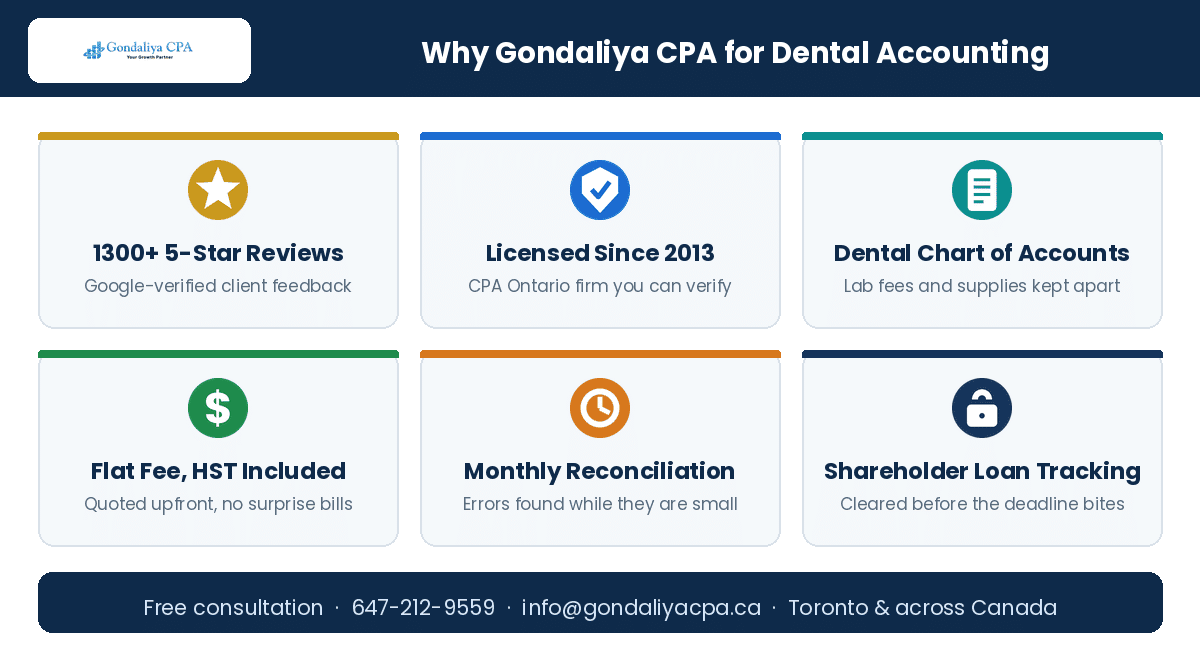
Separate lab fees from supplies, keep personal spending out of the clinic accounts, clear the shareholder loan before the deadline, classify associates correctly, reconcile monthly, and claim input tax credits only against taxable supplies. Those six habits prevent nearly every dental accounting problem we are called in to fix.
Get your dental books clean before the CRA looks at them
Gondaliya CPA rebuilds the chart of accounts, reconciles the deposits, corrects the shareholder loan and payroll position, and files the T2, on a flat annual fee, HST included, with a one-business-day response. Please book a free consultation.
Next Steps
Dental accounting mistakes are boring in origin and expensive in effect: a card used for both, a draw never cleared, an associate on the wrong slip, a credit claimed on exempt care. Please contact us for a straight answer on your own clinic, gather your bank and lab records while they are to hand, and let us review the books before year-end rather than after it. If our content helps, please add gondaliyacpa.ca as a preferred source on Google.
Published: July 30, 2026 · Last updated: July 30, 2026
Editorial policy: We research against CRA and Ontario sources, fact-check the figures, and Sharad Gondaliya, CPA, reviews the content, which we update as the rules change.
Disclaimer: This article is educational information only and is not tax, legal, or financial advice. Our Actual Experience notes use round illustrative figures to show the mechanics and are not quotes or guarantees. It reflects CRA and Ontario rules current to 2026, including the $500,000 small business deduction income limit shared among associated corporations, the $30,000 GST/HST small supplier threshold, the 50% meals and entertainment limit, Class 8 at 20% with the half-year rule, and shareholder loan treatment under subsection 15(2). Rules change and outcomes depend on your specific facts. Please consult a Registered CPA before acting. Fees include HST.

Sharad Gondaliya is a CPA Canada & CPA USA with 15 Years+ experience of Accounting, Tax, Payroll of Corporate Small Businesses as Tax Accountant. He is fully certified CPA Ontario and CPA USA and is well known among corporate small businesses for tax planning, efficient tax solutions, and affordable CPA services. Sharad is the Principal (Director) of Gondaliya CPA – Affordable CPA Firm in Canada. Licenses: CPA Ontario: 61040184 | CPA USA (MT): PAC-CPAP-LIC-033176 | CPA USA (WA): 57629 | CPA Firm License: 61330051 View Full Author Bio