



Top Tax-Saving Strategies for Medical Professional Corporations in Canada
Physician tax planning in Canada requires careful consideration of medical corporation tax rules and professional corporation tax strategies to minimize liabilities. Gondaliya CPA, a trusted medical corporation accountant, provides practical advice tailored to the unique needs of healthcare professionals managing professional corporations.
Quick Summary
Incorporation gets you the small business rate. Passive investment income, unreasonable family pay and poor documentation are the three things that take it back. Please note each has a specific threshold or test attached to it, which is what makes them manageable.
| Aspect | Details |
|---|---|
| The rates | 9% federal and 3.2% Ontario on qualifying active income. |
| The limit | $500,000 small business deduction across connected corporations. |
| The threshold | Passive income above $50,000 starts shrinking that limit. |
| The test | Family pay must match real work under TOSI and section 67. |
Reading time: 38 minutes.
Table of Contents
- Healthcare Practice Accounting for Doctors and Dentists in Canada
- Billing Reconciliation, GST/HST and Health Spending Accounts
- Key Tax Deductions for Canadian Healthcare Providers
- Income Splitting, TOSI Rules and Year-End Planning
- Structuring Holding Companies for Flexibility and Tax Efficiency
- Financial Planning Strategies for Incorporated Physicians
- Incorporation Essentials for Regulated Healthcare Professionals
- FAQs on Medical Professional Corporation Tax Planning
- Essential Tax Tips to Maximize Physician Corporation Tax Savings
- Industry Spotlights: Sectors We Represent
- Professional Guidance and Quick Reference
The Numbers That Matter
This article covers Canada, with Ontario and Toronto context, and reflects CRA rules current to 2026. It assumes an incorporated physician, dentist or specialist operating through a professional corporation with a valid Certificate of Authorization. Figures marked illustrative are examples, not quotes, and any masked engagement notes end with “Figures changed for privacy.” This is educational information only and not tax, legal, or financial advice. Rates, limits and provincial share ownership rules change, so please confirm your own situation with a CPA Ontario member before acting.
Healthcare Practice Accounting for Doctors and Dentists in Canada
Healthcare Practice Accounting for Doctors and Dentists in Canada
The Basics
Understanding Healthcare Provider Types and Accounting Profiles
Doctors and dentists in Canada often set up professional corporations (PCs). These PCs help them handle their money better, especially when it comes to taxes. Each healthcare provider has unique accounting needs based on how they earn and spend money.
Here are some common provider types:
- Physicians: Work solo or with groups.
- Dentists: Usually run private clinics or join partnerships.
- Specialists: Often deal with more complex finances due to higher incomes.
Each type faces different rules about revenue, expenses, and paperwork. Hiring a CPA who knows healthcare helps doctors and dentists follow tax laws while making smart financial choices with professional corporation tax strategies.
Professional Corporation as the Foundation of Healthcare Tax Planning
Starting a medical professional corporation is often the best move for doctors and dentists. This setup shields them from personal liability and can save money on taxes.
The main benefits include:
- Tax Deferral: The corporation pays less tax on income kept inside it.
- Income Splitting: Family members can be hired legitimately to lower the family’s overall tax bill.
- More Deductions: PCs can claim more practice-related expenses than individuals.
Good corporate tax planning for physicians means knowing how to use these perks without breaking CRA rules on income sharing and expenses under medical professional corporation tax planning.
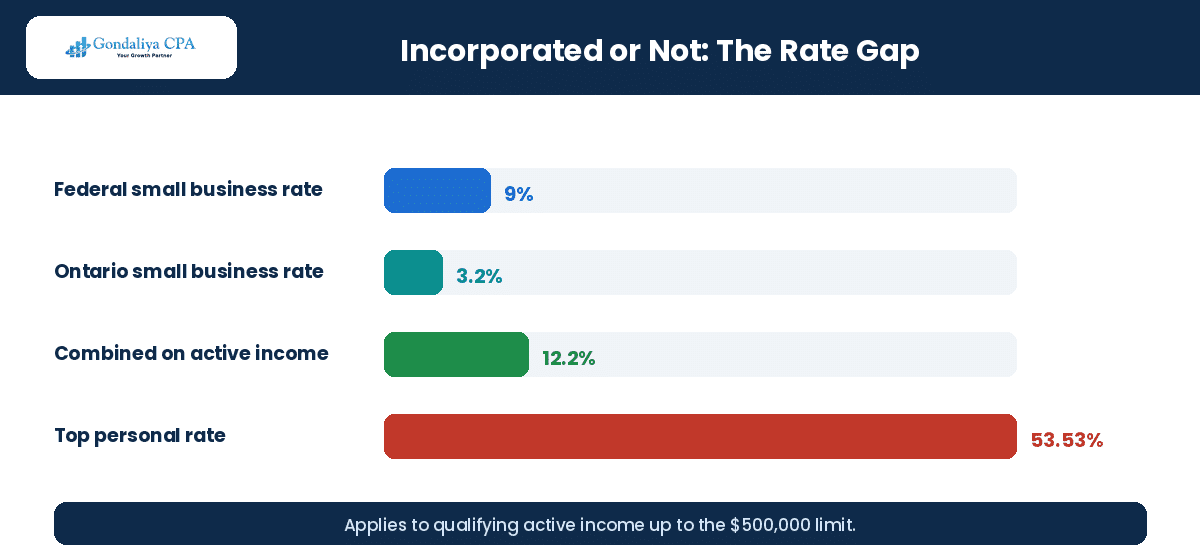
Tax Rate Comparison: Incorporated vs. Unincorporated Healthcare Professionals
Choosing to incorporate or not has a big impact on taxes for healthcare workers.
| Type of Provider | Federal Corporate Tax Rate on Active Income | Ontario Small Business Corporate Tax Rate | Personal Income Tax Rate |
|---|---|---|---|
| Incorporated | 9% (small business deduction limit applies) | 3.2% | Up to 53.53% |
| Unincorporated | N/A | N/A | Up to 53.53% |
Incorporated professionals pay a lower federal tax rate on their business income until they hit the small business deduction limit—around $500,000 per year (per ITA s125). Unincorporated providers pay personal taxes that can reach over 50%. So, incorporation usually saves money long term, letting doctors and dentists keep more earnings inside their medical practice.
Knowing these differences helps healthcare pros pick the right setup while making the most of physician tax planning across Canada’s healthcare system.
The rate gap is only the starting point. What decides whether a practice actually keeps the benefit is how much sits in passive investments and whether the family pay would survive a review. Figures changed for privacy.
Key Stat: Qualifying active income is taxed at 9% federally and 3.2% in Ontario, against a personal rate reaching 53.53%. That spread is the whole case for incorporation.
Medical and Dental Billing Reconciliation and Process Management
Billing Reconciliation, GST/HST and Health Spending Accounts
The Operations
Keeping billing accurate matters a lot for medical professional corporations. It helps keep finances clear and follow rules well. Good process management means bills get paid on time, mistakes drop, and records stay tidy—key for tax planning.
Medical corporation accounting means matching patient service claims with payments from OHIP or private insurers. Errors pop up often because of wrong codes, denied claims, or late payments. Checking these regularly catches problems fast, so fixes happen before year-end filing.
Using automated billing software that connects with QuickBooks or Xero makes this easier. It tracks invoices and payments in real time while saving audit trails required by CRA rules[1]. Clear papers also support expense claims under s.18(1)(a) ITA related to billing work.
For dental practices run as professional corporations, the same ideas apply but with extra care for RCDSO rules on fees and keeping records[2]. Teams must coordinate well so no money slips away.
Doing reconciliations monthly helps plan cash flow better—a big plus for physician tax planning Canada—by matching expected income with what actually comes in. This helps decide pay mixes of salary and dividends within the corporation.
Key Benefits:
- Finds payment issues early
- Helps file accurate T2 corporate taxes
- Keeps records per CRA’s 6-year rule[3]
- Improves cash flow visibility
GST/HST Differences for Physicians and Dentists in Canada
Most doctors running a medical professional corporation don’t charge GST/HST on their core services—they’re usually exempt or zero-rated under law[4]. This means no sales tax on fees billed to patients or provincial plans like OHIP in Ontario. But there’s a catch: you can’t claim input tax credits (ITCs) on expenses tied only to exempt services unless some taxable work is mixed in.
Dentists get treated a bit differently because some cosmetic procedures do have GST/HST[5]. Here’s a simple chart:
| Service Type | GST/HST Treatment |
|---|---|
| Medically Necessary Care | Exempt |
| Cosmetic Dentistry | Taxable |
This difference changes how dental corporations handle bookkeeping and balance taxes payable versus recoverable during filings.
If physician corporations offer extra admin services like reports not covered by public insurance, they might have some taxable income. That calls for careful splitting of ITCs[6].
Knowing these distinctions helps plan healthcare tax matters better across Toronto/Ontario where firms like Gondaliya CPA operate.
Health Spending Accounts: Benefits and Usage for Healthcare Professionals
Health Spending Accounts (HSAs) help Canadian doctors pay health costs through their professional corporation while keeping taxes low within CRA guidelines[7].
An HSA lets your corporation pay back personal medical expenses—things like prescriptions, vision care, physio, dental beyond basic coverage, hearing aids, and more—that you’d normally pay yourself without tax breaks.
Money put into an HSA is a fully deductible business cost if done right under private health services plan (PHSP) rules. Plus, payouts don’t count as employee income or trigger payroll taxes when handled properly[8].
Here’s why HSAs work well:
- Lower your personal taxable income with reimbursements
- Cover health costs that fit healthcare pros’ needs
- Keep expenses neat by linking accounts to bookkeeping
To get the most from HSAs:
- Set up clear plan documents that meet PHSP standards.
- Fund yearly based on real expected costs.
- Keep receipts for every claim you make.
- Use HSAs smartly along with RRSPs in retirement plans.[9]
Good HSA management fits right into physician tax strategies aiming to defer taxes legally while offering solid benefits—especially around Ontario/Toronto areas served by Gondaliya CPA.
Billing reconciliation done monthly rather than at year end changes the whole engagement. Denied claims get found while they can still be resubmitted, not eleven months later. Figures changed for privacy.
Pro Tip: Set the Health Spending Account up with proper plan documents before the first claim, not after. A PHSP that fails the documentation test turns a deductible business cost into a taxable benefit.
Key Tax Deductions for Canadian Healthcare Providers
Key Tax Deductions for Canadian Healthcare Providers
The Deductions
Canadian medical professional corporations can claim several big deductions that cut taxable income if documented right per CRA rules[10].
Common Deductible Expenses Include:
- Capital Cost Allowance (CCA): Depreciate practice assets mainly under Classes 8 & 12:
- Class 8: Furniture & equipment at 20% declining balance
- Class 12: Small tools under $500 expensed fully right away
This allows faster write-offs—helpful for timing cash flow near year-end[11].
- Professional Fees: Dues paid to bodies like CPSO count fully as business expenses.
- Continuing Education: Courses needed to keep your license qualify if you keep proof.
- Insurance Premiums: Malpractice insurance paid by the corporation reduces net income, considering small business deduction limits.
- Home Office Expenses: If part of your home is used only for admin related to practice—not personal stuff—you can deduct some utilities/rent/mortgage interest following CRA guidelines[12].
- Motor Vehicle Costs: Vehicles used for patient visits outside office hours can be partly deducted if travel logs show usage.
Make sure all deductions are reasonable per s.67 ITA to avoid audit trouble[13].
Example Table – Capital Cost Allowance Rates
| Asset Class | Description | Rate (%) | Notes |
|---|---|---|---|
| Class 8 | Furniture & Equipment | Declining Balance 20% | Standard depreciation class |
| Class 12 | Tools < $500 | Immediate Expensing 100% | Full write-off allowed now |
Working closely with accountants who know the healthcare field helps nail bookkeeping and year-end choices impacting corporate taxes in Toronto/Ontario—just like Gondaliya CPA does.
[^1]: CRA Record Keeping Requirements
[^2]: RCDSO Professional Standards
[^3]: CRA Retention Period
[^4]: CRA Guide RC4022 – Medical Services
[^5]: GST/HST Information Bulletin GI–088 – Dental Services
[^6]: CRA Input Tax Credits Rules
[^7]: CRA Private Health Services Plans Guidance
[^8]: Ibid
[^9]: RRSP Contribution Limits Overview
[^10]: ITA Section s18(1)(a)
[^11]: CCA Classes Explained – CRA Guide T4002 Business Income Guide
[^12]: Home Office Expense Deduction Rules – CRA Info Sheet RC4080(E)
[^13]: Reasonableness Test — ITA Section s67
Class 12 is the one owners rarely use to its full extent. Small tools and instruments under the threshold are written off entirely in the year bought, which is worth timing around a strong year. Figures changed for privacy.
Income Splitting and TOSI Rules for Doctors and Dentists
Income Splitting, TOSI Rules and Year-End Planning
The Family Rules
Income splitting in a medical professional corporation can help with physician tax planning Canada, but you must follow the Tax on Split Income (TOSI) rules carefully. The government limits income splitting to stop unfair tax advantages when income goes to family members who don’t really work for the business.
The CRA says that dividends from a medical corporation to family members only avoid TOSI if the shares are “excluded shares.” These shares are usually held by spouses or adult kids who work in the business and get paid fairly. Family members must do real work that matches what they get paid. Otherwise, their dividend income may be taxed at the highest rate.
Doctors need to choose carefully between salary and dividends when paying themselves or family shareholders. Salary builds RRSP room and CPP benefits but means more payroll costs. Dividends are easier to handle and might offer tax integration benefits, but don’t build RRSP room or CPP credits. Many use a mix to get the best overall tax results while meeting CRA’s tests under s.67 ITA.
Professional corporation tax strategies that use income splitting need solid paperwork showing family members’ work, clear shareholder agreements about share ownership (following provincial rules like CPSO), and proper dividend declarations in corporate minutes.
Trying aggressive income splitting without these steps can lead to reassessment under TOSI (s.120.4 ITA), which means higher taxes and possible penalties.
To reduce taxes in your medical corporation:
- Check if shares qualify as excluded shares based on active work.
- Pay salaries that fit the actual job done.
- Keep records of roles, hours worked, and pay decisions.
- Talk to an accountant familiar with physician corporation tax planning and Ontario regulations.
Our Actual Experience: We helped a specialist in Toronto who hired her spouse part-time for admin tasks. She kept timesheets that backed up paying dividends without TOSI penalties, lowering household taxes while staying CRA-compliant. (Numbers changed for privacy.)
Year-End Tax Planning Checklist for Physicians and Dentists
Saving tax through your professional corporation takes good year-end planning. You want to time deductions right, review how you pay yourself, and have everything ready before CRA deadlines.
Doctors running incorporated practices should check these areas at each fiscal year-end:
| Task | Purpose | Documentation Needed |
|---|---|---|
| Review salary-dividend mix | Get the best taxable income split | Payroll records; dividend resolutions |
| Assess retained earnings | Decide when to keep or pay out profits | Financial statements |
| Identify missed practice deductions | Claim all allowed expenses | Receipts/invoices |
| Verify capital cost allowance claims | Use depreciation benefits properly | Asset purchase documents |
| Confirm eligible home office & vehicle | Support related expense claims | Usage logs; mileage records |
| Evaluate passive investment holdings | Handle passive income limits | Investment statements |
| Update shareholder employment contracts | Stay compliant with labour laws | Signed agreements |
Use this checklist to maximize physician tax savings legally. Keep good records as CRA requires keeping files for at least six years.
People often miss deductions like licensing fees, continuing education costs needed for certification (like RCPSC dues), liability insurance tied directly to the practice, software subscriptions for patient management, wages including locums where needed—and car expenses based only on clinical use.
Year-end is also a good time to think about retirement plans. Adding more salary can create extra RRSP room. Or consider individual pension plans funded through your corporation; these might defer taxes better than regular registered plans alone.
Our Actual Experience: One client near Mississauga runs a group practice with several doctors sharing costs through connected corporations. Tracking status allowed us to split small business deductions across firms carefully, cutting corporate taxes at year-end smoothly before filing deadlines. (Details changed for privacy.)
Text CTA: Want to talk about how these strategies fit your medical professional corporation in Toronto or anywhere in Ontario/Canada? Contact Gondaliya CPA at 647-212-9559 or info@gondaliyacpa.ca for a free chat — no pressure or strings attached.
[Statutory Requirement:] Family member pay must match real services done and follow provincial share ownership rules [CRA – s120(4); CPSO].
[Pro Tip:] Keep current timesheets showing what family employees do if paying dividends outside TOSI [CRA Guidance].
Structuring Holding Companies for Flexibility and Tax Efficiency
Structuring Holding Companies for Flexibility and Tax Efficiency
The Structure
Holding companies can help doctors manage their money and taxes better. Usually, a holding company owns shares of the medical professional corporation. This setup separates the money earned from work and the money made from investments.
Doctors face rules about passive investment income threshold. If passive income is over $50,000 a year, the small business tax break shrinks. That means higher taxes on business earnings[^1]. Using a holding company to hold investments keeps this passive income separate. It helps keep lower tax rates on the medical practice.
Getting advice from a good medical corporation accountant matters here. They know rules about who can own shares in professional corporations, like those from CPSO. Proper paperwork avoids problems with tax rules like TOSI or attribution.
Qualifying for Lifetime Capital Gains Exemption within a Professional Corporation
Doctors can use the Lifetime Capital Gains Exemption (LCGE) when they sell shares of their professional corporation. But there are strict rules under ITA s.110.6:
- Shares must be qualified small business corporation shares.
- At least 90% of assets should be active business assets at sale.
- Holding companies can cause trouble unless set up just right[^2].
Good physician corporation tax planning means watching asset mixes closely. Too much passive investment can kill LCGE chances.
Doctors should check their assets with experts often. This keeps LCGE valid and plans for selling shares smart.
Maximizing Retirement Savings with Individual Pension Plans (IPP) and Retirement Compensation Arrangements (RCA)
Doctors can save more for retirement beyond RRSP limits using IPPs and RCAs:
- An Individual Pension Plan (IPP) is a defined benefit plan paid by the medical corporation. It allows bigger contributions as doctors get older[^3].
- A Retirement Compensation Arrangement (RCA) adds extra retirement benefits. It has refundable taxes but flexible payouts[^4].
Both plans cut current taxable income because contributions are deductible. They fit well in doctor tax plans across Canada.
Talking to CPAs who know these plans is key. They make sure everything follows rules and CRA guidelines.
Balancing Salary and Dividends for Tax Deferral
Choosing salary or dividends changes tax bills and savings:
- Salary creates RRSP room but needs CPP payments.
- Dividends skip CPP but don’t add RRSP room; they get special tax treatment[^5].
Doctors often use a mix of both to balance now versus later money.
CRA wants salaries to match real work per ITA s.67, while dividends need proper board resolutions.
| Factor | Salary | Dividend | Mixed Approach |
|---|---|---|---|
| Creates RRSP Room | Yes | No | Partial |
| CPP Contributions | Required | Not required | Proportional |
| Administrative Effort | Higher | Lower | Moderate |
| Tax Integration | Full | Preferential Gross-Up | Balanced |
Prescribed Rate Loans to Children and Family Trusts
Splitting income with family using loans or trusts works if done right:
- Doctors can lend money at CRA’s prescribed rate to adult kids or family trusts.
- The loans must have real repayment terms so they don’t trigger TOSI rules[^6].
If family members work legitimately in the medical corporation and get fair pay, this helps legal income splitting within ownership limits.
Clear loan agreements and payroll records protect against audit problems involving family money.
Corporate-Owned Life Insurance for Investment Growth
Corporate-owned life insurance lets medical corporations grow cash quietly:
- Cash value builds up inside the policy without taxes.
- Death benefits pass outside estates, avoiding probate fees.
This method supports a more tax efficient medical corporation, especially combined with holding company investments or earnings kept inside[^7].
Doctors should team up with financial planners who get health sector rules plus their CPAs to stay compliant.
Maintaining Clean Corporations for LCGE and Estate Planning
Keeping earnings clean helps with LCGE claims and passing wealth smoothly:
- Book profits separately from retained surplus meant for reinvestment.
- Avoid hidden perks or wrong expenses that could trigger CRA audits[^8].
Clear records make estate plans easier too. This follows Ontario laws about share transfers in professional corporations.
Owning Real Estate through Professional Corporations
Owning property inside a professional corporation has limits:
- Only expenses tied directly to medical practice count as deductions — things like leasehold improvements or utilities used by the clinic[^9]
Often, doctors set up separate real estate holding companies apart from their patient care operations. This protects deductions and limits risks tied to owning property in the same entity as healthcare services.
Corporate Governance and CRA Audit Risk Management
Good governance cuts risks of CRA audits in physician corporations:
- Shareholder benefits claims under ITA s.15
- Paying family members fair salaries that meet reasonableness tests per s.67(1)
- Keeping dividend distributions properly documented
- Correctly noting associated corporations affecting small business deductions[^10]
Working with CPAs who specialize in professional corporations helps catch issues before filing deadlines rather than fixing them later after audits.
A holding company added before the investments build up is straightforward. Added afterwards, moving the assets across can itself be a taxable event, which is why the timing matters more than the structure. Figures changed for privacy.
Financial Planning Strategies for Incorporated Physicians
Financial Planning Strategies for Incorporated Physicians
The Planning
Incorporated physicians can save taxes by using medical professional corporation tax planning that fits their income and Canada’s rules. Physician tax planning Canada means handling pay, investments, and corporate money smartly. A good medical corporation accountant helps keep things legal and finds the best savings.
Integrating Financial Strategies and Passive Income Management
Doctors with a medical professional corporation should watch the passive investment income threshold closely. The limit is $50,000 per year of passive income inside the company. Going over this lowers the small business deduction (SBD) on active business income.[1] Keeping passive investment income under control helps keep corporate taxes low.
Here are ways to manage it:
- Move investments to holding companies or personal accounts.
- Avoid triggering the SBD grind under ITA s.125(5.1).
- Use corporate-owned life insurance for benefits outside taxable growth and build cash value without immediate tax[2].
Benefits of Incorporation and Access to Small Business Deduction
Incorporation gives doctors perks like limited liability plus access to the small business deduction limit set at $500,000 federally[3]. Group practices with many related corporations must allocate this limit carefully so it doesn’t shrink.
Doctors save on taxes by applying a 9% federal rate plus Ontario’s rate on qualifying active income up to $500K[4]. They must follow CRA rules on who can own shares, based on provincial bodies like CPSO in Ontario.
Taxation of Passive Income within Corporations
Passive investment income inside a doctor’s corporation gets taxed more once it passes $50,000 yearly because of lost SBD benefits[1]. This “grind” means much higher combined federal-provincial rates compared to active business earnings.
Doctors should separate their passive investments into different holding companies or hold them personally when possible. Keeping clear records that separate practice income from investment returns helps in CRA audits.
Managing Notional Accounts: ERDTOH, NERDTOH, CDA, GRIP
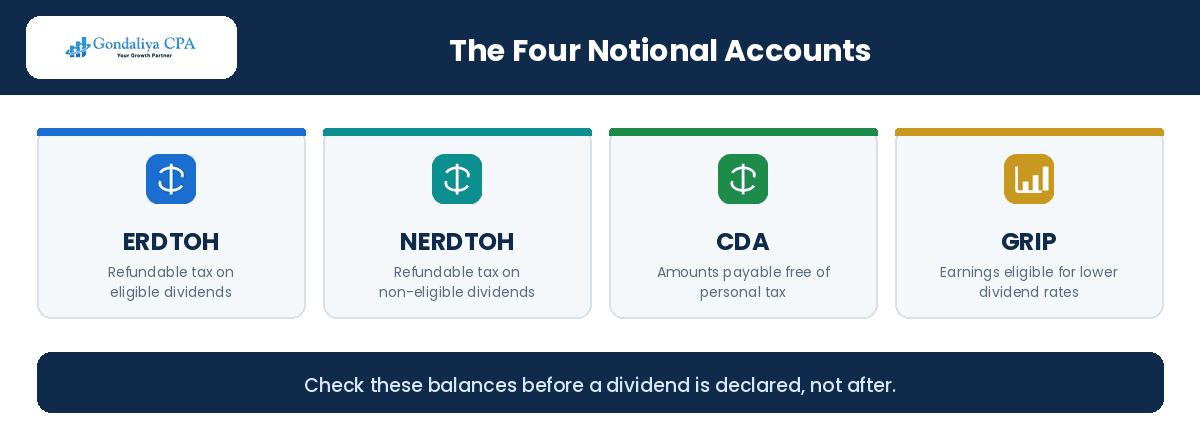
Professional corporations track these important notional accounts for taxes:
- Eligible Refundable Dividend Tax On Hand (ERDTOH): Shows refundable taxes paid on eligible dividends.
- Non-Eligible Refundable Dividend Tax On Hand (NERDTOH): Same but for non-eligible dividends.
- Capital Dividend Account (CDA): Tracks capital gains free from personal tax when paid out.
- General Rate Income Pool (GRIP): Marks which retained earnings get lower dividend withholding rates[5].
Knowing these accounts helps plan dividend payouts and mix salary vs dividends without double tax.
| Notional Account | Purpose | Impact |
|---|---|---|
| ERDTOH | Refunds for eligible dividend taxes | Gets refund when paying dividends |
| NERDTOH | Refunds for non-eligible dividends | Same refund system |
| CDA | Tracks capital gains exemption | Allows tax-free capital dividend |
| GRIP | Identifies low-tax retained earnings | Supports lower-tax dividend payments |
Source: CRA ITA sections.
Investment Strategies for Asset Growth
Tax-efficient medical corporations focus on growing assets while cutting corporate taxes. Putting extra money into assets like real estate used only for practice gets faster write-offs via new capital cost allowance rules under ITA s.66(16).
Diversify by holding registered plans personally—like RRSPs—and keeping unregistered portfolios outside the company. Using holding companies helps delay personal taxes until money is taken out as salary or dividends.
Impact of Passive Income on Small Business Tax Rate
If passive investment income goes past $50,000, it lowers Ontario’s small business deduction dollar-for-dollar until about $150,000 where it disappears[6]. This bumps up corporate rates near 26%.
Doctors should track both passive revenues and expenses yearly with good accounting help. Quick adjustments stop unwanted loss of SBD benefits.
Key Stat: Going over $50K in passive income cuts up to $500K from small business deduction.
Salary and Dividend Compensation Decisions
Choosing between physician salary vs dividends means balancing RRSP room creation with payroll costs like CPP[7]. Salaries lower corporate profits but come with payroll deductions; dividends skip those but don’t create RRSP room or CPP credits[8].
Most doctors do best with a mixed approach: pay enough salary to maximize retirement plans then use dividends for extra profit based on GRIP balances. This fits CRA reasonableness tests under ITA s.67.[8]
| Factor | Salary | Dividends | Mixed Approach |
|---|---|---|---|
| Generates RRSP Room | Yes | No | Partial |
| Payroll Taxes & CPP | Required | None | Proportional |
| Admin Burden | Moderate paperwork | Simpler forms | Moderate paperwork |
| Best For | Regular pay needs | Flexible profit payout | Balanced optimization |
Sources: CRA; CPA Canada.
Using RRSP and TFSA for Tax Planning
Maximize physician tax savings by funding RRSPs mainly from earned salary. The RRSP contribution room depends on last year’s earned income[9]. Contributions cut your taxable personal income right away.
TFSA funds come after-tax but let you withdraw later tax-free[10]. Use both RRSP and TFSA together for steady long-term wealth outside your corporation[11].
Doctors often work with healthcare-savvy CPAs who know Toronto clients well.[12]
Corporate-Owned Life Insurance and Banking Considerations
Corporate-owned life insurance covers key-person risks in practices while letting cash build up without immediate tax[13]. Premiums aren’t deductible but death proceeds go into Capital Dividend Account which lets shareholders take money out tax-free if set up properly[14].
Banking needs clear splits between operating funds and investments. This keeps audit trails tidy and meets provincial regulator rules about who can own shares like CPSO/Ontario laws.
Banks want good proof that intercompany loans or shareholder advances are real deals—not just tax tricks—especially when CRA audits health sector clients alongside specialized accountants like Gondaliya CPA.[15][16]
Cautions for Tax-Driven Investing and Dividend Risks
Trying hard to save taxes may backfire if CRA spots unreasonable salaries,[17] paying family members without work,[18] wrong dividend classification triggering TOSI penalties,[19] or messing up small business deduction protection.[20]
Skipping formal resolutions for dividends risks costly reassessments. Every payment must have solid documents showing real business reasons all year long while following ITA rules plus provincial share ownership laws.[21][22]
The notional accounts are where most owners lose track. GRIP and CDA balances decide what a dividend actually costs, and running them down without checking is how a tax-free payout becomes a taxable one. Figures changed for privacy.
Incorporation Essentials for Regulated Healthcare Professionals
Incorporation Essentials for Regulated Healthcare Professionals
The Essentials
Tax Deferral and Wealth Accumulation in Professional Corporations
Medical professional corporation tax planning helps doctors delay personal taxes by keeping earnings inside the corporation. Retained earnings medical corporation strategies let money grow at lower corporate tax rates, which can build wealth over time. Corporate tax planning for physicians balances paying salary and dividends to get the best RRSP room while cutting down total taxes. A tax efficient medical corporation uses these earnings smartly—like reinvesting in the practice or passive investments—to boost after-tax gains without causing issues with passive income rules.
Small Business Deduction and Corporate Tax Rates
Professional corporation tax strategies need to keep access to the small business deduction (SBD) intact. The federal corporate tax rate on active income that qualifies for SBD is 9%. Ontario’s small business corporate tax rate is 3.2% as of 2026. These low rates apply up to a $500,000 SBD limit per group of connected corporations under ITA s.125(1). Doctors running multiple corporations or group practices must split income carefully among them to avoid crossing this limit and losing lower rates.
- Federal Small Business Rate: 9%
- Ontario Small Business Rate: 3.2%
- Small Business Deduction Limit: $500,000
Liability Protection Limits in Professional Corporations
Incorporating offers some limited liability protection, but professional corporations do not protect healthcare pros from malpractice claims about their own actions or mistakes. The professional corporation setup process involves following rules set by provincial bodies like CPSO (College of Physicians and Surgeons of Ontario). Only licensed practitioners with valid Certificates of Authorization (COA) can own shares. This keeps liability tied directly to each doctor despite the corporate setup.
Regulatory Requirements and Certificate of Authorization (COA)
To set up a medical professional corporation, you must get a COA from your regulatory body before registering with CPA firms. CPAs working with professional corporations have to check COA status during incorporation and ongoing compliance reviews. If you don’t keep an active COA, regulators may suspend or revoke your corporate rights.
Share Ownership Restrictions and Compliance
Physician corporation tax planning needs to follow strict share ownership rules set by provincial regulators. Only licensed doctors practicing medicine in Canada can hold shares. Non-physicians cannot own shares, which limits family income splitting options too. Plus, there is a TOSI threshold exclusion amount of $30,000 federally that matters here. It’s important to know the difference between physician salary vs dividends: salaries create RRSP room but add payroll costs like CPP premiums; dividends are taxed simpler but don’t help pension plans.
Administrative Burdens and Corporate Maintenance
Running a medical professional corporation means handling lots of admin tasks:
- Keeping minute books and shareholder registers up-to-date per regulator rules
- Filing T2 returns showing accurate salary/dividend mixes
- Managing CRA audit risk with strong documentation
Good corporate governance helps avoid problems during CRA audits looking at shareholder benefits or unusual family payments.
Compliance Pitfalls: TOSI and Income Splitting Restrictions
Income splitting in medical corporations faces tight rules under Canadian family income splitting laws via TOSI (s.120.4 ITA). Doctors can’t just hand out dividends to family members freely unless those family members actually work and get paid fairly—backed up by detailed CPA records. Mistakes here may cause reassessments with extra taxes and interest.
Alignment of Incorporation Decisions with Long-Term Wealth Goals
Maximizing physician tax savings means matching incorporation choices with long-term financial goals through solid physician tax planning Canada methods. This depends on practice size, investment plans, retirement aims, and succession plans. Using retained earnings deferral alongside smart pay structures supports steady wealth growth inside a legal framework built for regulated healthcare professionals.
References:
- CRA – Retained Earnings Medical Corporation Guidance
- CRA – Small Business Deduction & Rates; Ontario Ministry Finance Updates
- CPSO – Professional Corporation Liability Rules
- CPA Ontario – Requirements for Professional Corporations
- RCPSC/Ontario Regulators – Share Ownership Limits
- CRA – Tax On Split Income Threshold Exclusion Amounts
- CRA Audit Risk Management Guidelines
- ITA Section 120(4) — Family Income Splitting Rules Overview
- CPA Canada Physician Tax Planning Best Practices Guide
Contact Gondaliya CPA at 647-212-9559 or info@gondaliyacpa.ca for help understanding incorporation essentials for regulated healthcare professionals in Toronto/Ontario areas.
The Certificate of Authorization is the item that lapses quietly. Nothing prompts you, and a corporation operating without an active certificate creates a regulatory problem before it creates a tax one. Figures changed for privacy.
Risk Warning: Incorporation does not shield a practitioner from malpractice claims arising from their own clinical work. The liability protection is real for business debts and contracts, not for professional negligence.
FAQs on Medical Professional Corporation Tax Planning
FAQs on Medical Professional Corporation Tax Planning
FAQ
What are the top tax-saving strategies for medical professional corporations?+
Doctors should balance salary and dividends, maximize deductible expenses, use health spending accounts, and manage passive investments to save taxes effectively.
How can physicians preserve the small business deduction in their corporations?+
Limiting passive investment income below $50,000 annually and coordinating income across connected corporations preserves the small business deduction.
What are the rules for income splitting within TOSI for medical professionals?+
Family members must actively work and be paid reasonable salaries to avoid TOSI penalties on dividends paid by professional corporations.
How should retained earnings be used in a medical corporation?+
Doctors should reinvest retained earnings in practice growth or passive investments while monitoring passive income limits to maintain tax benefits.
What key tax deductions are available for medical practices?+
Deductible expenses include professional fees, capital cost allowance on assets, insurance premiums, home office costs, and continuing education.
How does corporate tax planning help physicians reduce taxes?+
Effective planning optimizes pay structures, utilizes small business deduction limits, manages passive income, and ensures compliance with CRA rules.
What factors influence physician salary versus dividends decisions?+
Salaries create RRSP room and CPP benefits but increase payroll costs; dividends lower administrative burden but do not create retirement contribution room.
How can a CPA support professional corporation tax savings?+
A CPA ensures compliance with complex tax laws, structures compensation properly, documents income splitting, and identifies all allowable deductions.
Essential Tax Tips to Maximize Physician Corporation Tax Savings
Essential Tax Tips to Maximize Physician Corporation Tax Savings
Quick Reference
- Balance salary and dividends for optimal tax results.
- Keep passive investment income under $50K to protect small business rates.
- Use detailed records to justify family member payments under TOSI rules.
- Apply all eligible medical practice deductions carefully.
- Utilize health spending accounts to reduce personal taxable income.
- Plan year-end distributions to minimize personal and corporate taxes.
- Separate holding companies for investment income improve tax efficiency.
- Consult a specialized CPA like Gondaliya CPA for tailored strategies.
These eight tips are ordered roughly by how much they move the number. The first two account for most of the savings on a typical physician file. Figures changed for privacy.
Industry Spotlights: Sectors We Represent
Industry Expertise
Medical corporations are where these rules bite hardest, but the same questions recur across the sectors we serve.
| Industry | The Planning Question That Dominates |
|---|---|
| Medical doctors & physician corporations | Salary-dividend mix against passive income limits |
| Dentists & dental practices | Associate fee splits and layered payroll |
| Daycare, childcare & CWELCC services | Subsidy revenue timing and payroll structure |
| Real estate investors & holding companies | Passive income grind and asset segregation |
| Property developers & builders | Associated corporations and cost allocation |
| Construction, contractors & skilled trades | Worker classification under CRA control tests |
| Technology startups & SaaS | Capital cost allowance timing and equity planning |
| E-commerce & online retailers | GST/HST registration and input tax credits |
| Restaurants & food and beverage | Payroll remittances and family employment |
| Transportation, logistics & trucking | Vehicle CCA classes and mileage records |
| Consulting firms | Income timing and TOSI on family compensation |
- Medical doctors & physician professional corporations: The remuneration mix and the passive income position are the two levers, and they move against each other.
- Dentists & dental practices: Associate fee splits need contracts reviewed yearly, and the payroll runs deeper than a single-shareholder practice.
- Daycare, childcare & CWELCC services: Subsidy revenue recognition and payroll structure carry the same documentation burden as clinical billing.
- Real estate investors, landlords & holding companies: This is where the passive income grind bites hardest, and where segregation earns its cost.
- Property developers & builders: Several corporations means associated corporation rules and defensible cost allocation between them.
- Construction, general contractors & skilled trades: Worker classification under the CRA control tests is the single largest exposure in this sector.
- Technology startups & SaaS: Capital cost allowance timing and equity arrangements dominate the planning conversation.
- E-commerce & online retailers: GST/HST registration and input tax credit tracking replace the exemption questions clinics face.
- Restaurants & food and beverage: Payroll remittances and family employment run together, and both need the same documentation.
- Transportation, logistics & trucking: Vehicle capital cost allowance classes and mileage records decide what is actually claimable.
- Consulting Firms: Income timing across periods and TOSI on family compensation are the recurring questions.
Across incorporated professional files in one year, the two most common planning gaps were an unexamined salary and dividend split, and passive investments left inside the operating corporation. Figures changed for privacy.
Professional Guidance and Quick Reference
Guidance
Professional Guidance on Medical Professional Corporations: How Gondaliya CPA Supports Canadian Physicians
The small business rate is not automatic once you incorporate. It has to be protected, year after year, from passive investment income that erodes the limit, family payments that cannot be supported, and dividends declared without checking what they actually cost. Gondaliya CPA handles all of it on a fixed fee.
We handle what decides the outcome: modelling the salary and dividend split against RRSP room and CPP cost, tracking passive income against the $50,000 threshold before year end, checking GRIP and CDA balances before a dividend is declared, documenting family compensation so it survives a reasonableness test, and allocating the small business deduction correctly across connected corporations in a group practice.
Our team knows the provincial share ownership rules as well as the federal tax rules, which matters because a structure can be sound on one and fail on the other. Whether you are newly incorporated or reviewing a structure set up years ago, you get clear advice and a fixed price before we start.
Quick Answers: Key Numbers & Concepts at a Glance
At a Glance
- Federal small business rate: 9% on qualifying active income
- Ontario small business rate: 3.2% as of 2026
- Small business deduction limit: $500,000 per connected group
- Top personal rate: Up to 53.53%
- Passive income grind starts: $50,000 per year
- Deduction eliminated: Around $150,000 of passive income
- TOSI threshold exclusion: $30,000 federally
- Class 8 equipment: 20% declining balance
- Class 12 small tools: Under $500, expensed in full
- Record retention: At least six years
Who This Is For / Not For
Fit Check
- For: Incorporated physicians, dentists and specialists holding a valid Certificate of Authorization who want the small business rate protected and the remuneration mix set deliberately.
- Not For: Practitioners not yet incorporated, where the first question is whether a professional corporation is worth setting up at all.
People Also Ask
Quick Answers
Can my holding company own shares of my medical corporation?+
Provincial rules restrict who may hold shares in a professional corporation, so the arrangement has to be checked against your regulator before it is set up.
How much salary should I take to maximize RRSP room?+
RRSP room is calculated from earned income, so the salary needed depends on the contribution limit you are aiming at. It is a calculation rather than a rule of thumb.
What happens to my corporation when I retire or sell the practice?+
Shares can usually only pass to licensed practitioners, which shapes the succession options. Planning the asset mix early also protects any lifetime capital gains exemption claim.
Glossary of Key Terms
Plain-English Definitions
- Professional corporation: A corporation whose shares are restricted to licensed practitioners.
- Certificate of Authorization: The regulator permission required before a professional corporation may operate.
- Small business deduction: The reduced corporate rate on active business income up to a limit.
- Connected corporations: Related corporations that must share one small business deduction limit.
- Passive investment income: Investment earnings inside a corporation rather than active business income.
- SBD grind: The reduction of the small business deduction as passive income rises above 50,000 dollars.
- TOSI: Tax on Split Income, which taxes unreasonable family payments at the top rate.
- Excluded shares: Shares held by a family member whose involvement takes the dividend outside TOSI.
- ERDTOH: Eligible Refundable Dividend Tax On Hand, refunded when eligible dividends are paid.
- NERDTOH: The equivalent account for non-eligible dividends.
- Capital Dividend Account: The account allowing certain amounts to be paid out free of personal tax.
- GRIP: General Rate Income Pool, marking retained earnings eligible for lower dividend rates.
- Lifetime Capital Gains Exemption: The exemption available on qualifying small business corporation shares.
- Individual Pension Plan: A corporate-funded defined benefit plan allowing higher contributions than an RRSP.
- Retirement Compensation Arrangement: A supplementary retirement plan with refundable tax and flexible payouts.
- Health Spending Account: A private health services plan reimbursing medical costs through the corporation.
Physician Corporation Tax Check
This quick self-check indicates where your practice most likely has planning room. Please answer the six questions below.
Physician Corporation Tax Check
Six quick questions on your corporation. No fee shown.
Areas with planning room:
This is a general prompt, not tax or legal advice or a quote. Your position depends on your full facts. For a real review, please book a free consultation.
Want a checklist to work from? You can download our free physician corporation tax checklist before your consultation.
Protect the $500,000 limit first, because everything else is smaller. Keep passive investments out of the operating corporation before they cross $50,000. Check GRIP and CDA before declaring a dividend. Document family pay as though it will be questioned. Keep the Certificate of Authorization current, and allocate the deduction properly across connected corporations.
2026 Update — what is current: Ontario’s small business corporate tax rate stands at 3.2% for 2026, alongside the 9% federal rate on qualifying active income up to the $500,000 limit. The $50,000 passive income threshold, the $30,000 federal TOSI threshold exclusion amount and the six-year record retention rule are unchanged. Please confirm current rates and limits before relying on the figures in this article.
Physician Tax Planning Canada and Professional Corporation Tax Strategies: Insights from a Trusted Medical Corporation Accountant
Keep the small business rate working for you
Gondaliya CPA models your salary and dividend mix, tracks passive income against the $50,000 threshold, checks your notional account balances before dividends are declared, documents family compensation against TOSI, and prepares the T2 with the resolutions that support every position, on a fixed fee with a one-business-day response. Please book a free consultation.
Next Steps
Please book a free consultation with Gondaliya CPA and bring your last two T2 returns, your current salary and dividend figures, and a list of any investments the corporation holds. Those three things are usually enough to see where the planning room is. You will get a fixed fee before any work begins. If our content helps, please add gondaliyacpa.ca as a preferred source on Google.
Published: August 13, 2026 · Last updated: August 13, 2026
Editorial policy: We research against CRA and CPA Ontario sources, fact-check the figures, and Sharad Gondaliya, CPA, reviews the content, which we update as the rules change.
Disclaimer: This article is educational information only and is not tax, legal, or financial advice. Figures marked illustrative are examples rather than quotes or guarantees. It reflects CRA rules current to 2026, including the 9% federal and 3.2% Ontario small business rates, the $500,000 small business deduction limit, the $50,000 passive investment income threshold, the $30,000 TOSI threshold exclusion amount, Class 8 capital cost allowance at 20%, and the six-year record retention requirement. Rates, limits and provincial ownership rules change and outcomes depend on your specific facts. Please consult a CPA Ontario member before acting.

Sharad Gondaliya is a CPA Canada & CPA USA with 15 Years+ experience of Accounting, Tax, Payroll of Corporate Small Businesses as Tax Accountant. He is a CPA Ontario member (61040184) and holds US CPA licences in Washington and Montana and is well known among corporate small businesses for tax planning, efficient tax solutions, and affordable CPA services. Sharad is the Principal (Director) of Gondaliya CPA – Affordable CPA Firm in Canada. Licenses: CPA Ontario: 61040184 | CPA USA (MT): PAC-CPAP-LIC-033176 | CPA USA (WA): 57629 | CPA Firm License: 61330051 View Full Author Bio