



How Mortgage Brokers Can Reduce Corporate Taxes and Maximize After-Tax Income in Canada
Mortgage broker tax planning Canada is key to reducing corporate taxes and maximizing after-tax income through smart mortgage broker tax strategies and expense planning. Gondaliya CPA offers expert advice on incorporated mortgage broker tax planning, mortgage broker business expenses, and CRA tax planning mortgage brokers to help you save on taxes efficiently.
Quick Summary
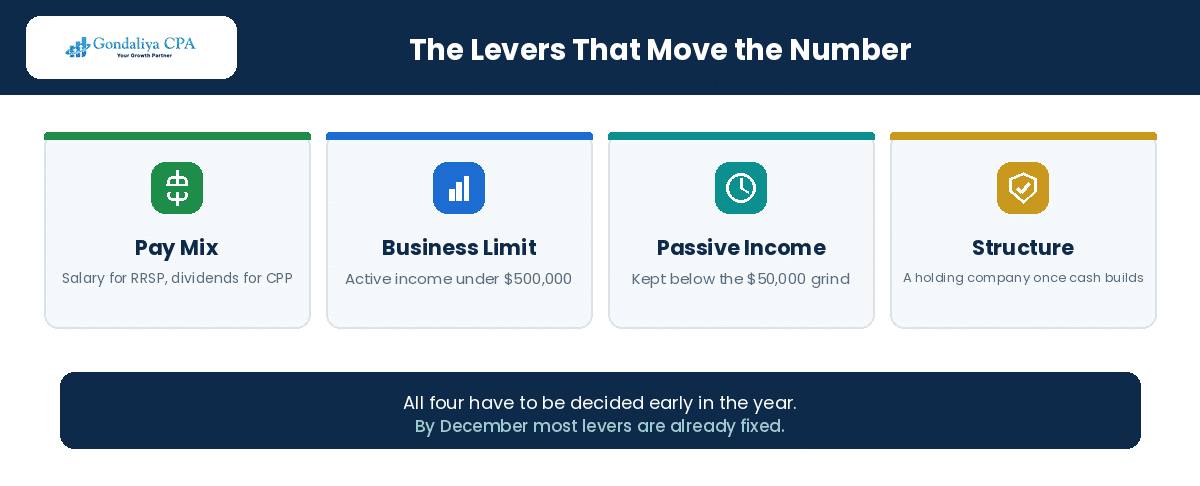
Most of the tax saving available to an incorporated broker sits in the salary and dividend mix, the small business deduction limit, and keeping passive investment income below the grind threshold. Please note that commission income is generally an exempt financial service, so input tax credits on that revenue are not available.
| Aspect | Details |
|---|---|
| The pay mix | Salary builds RRSP room, dividends avoid CPP. |
| The limit | $500,000 of active income at the small business rate. |
| The grind | Passive income above $50,000 reduces the deduction. |
| The structure | A holding company separates investments from operations. |
Reading time: 39 minutes.
Table of Contents
- Accounting and Tax Services for Mortgage Brokers in Canada
- Addressing Tax and Accounting Challenges Unique to Mortgage Brokers
- Strategic Tax Frameworks for High-Earning Mortgage Brokers
- Transparent Pricing and Service Packages
- Additional Accounting and Advisory Services
- Contact Gondaliya CPA for Tax Planning Expertise
- Frequently Asked Questions (FAQs)
- Planning Levers, Deliverables and Next Steps
- Broker Segments We Serve
- Professional Guidance and Quick Reference
The Numbers That Matter
This article covers Canada, with Ontario and Toronto context, and reflects rules current to 2026. It assumes an incorporated mortgage broker or one considering incorporation. Figures marked illustrative are examples, not quotes, and any masked engagement notes end with “Figures changed for privacy.” This is educational information only and not tax or legal advice. Licensing rules on billing commissions through a corporation differ by province, so please confirm your own position with FSRA or the equivalent regulator before acting.
Accounting and Tax Services for Mortgage Brokers in Canada
Accounting and Tax Services for Mortgage Brokers in Canada
The Basics
Mortgage brokers in Canada face some tricky tax situations. Good mortgage broker tax planning helps you keep more money and follow CRA rules. At Gondaliya CPA, we focus on corporate tax planning for mortgage brokers. We create plans that fit your business needs.
We review your finances to spot chances to save money with smart mortgage broker tax strategies. Working with a skilled mortgage broker tax accountant keeps your business on track and financially healthy.
Comprehensive Tax Services for Mortgage Brokers
Taxes can get complicated, especially for mortgage brokers. Our firm offers services just for you, focusing on smart corporate tax planning. We know what works best in your field and help you use deductions and credits right.
We help you decide how to pay yourself—through salary or dividends—to lower your taxable income. This helps improve cash flow and supports growth at your brokerage.
Bookkeeping and Accounting Solutions Tailored to Mortgage Brokers
Keeping good records is key to success in mortgage brokering. Gondaliya CPA provides accounting solutions made for mortgage pros. A good mortgage broker tax accountant keeps your books tidy and tracks expenses that you can deduct.
Organized records make year-end easier and help file papers with CRA on time. This way, you lower audit risks and can focus more on helping your clients well.
The brokers who save most are not the ones with the cleverest structure. They are the ones who decided the pay mix in January rather than the following June. Figures changed for privacy.
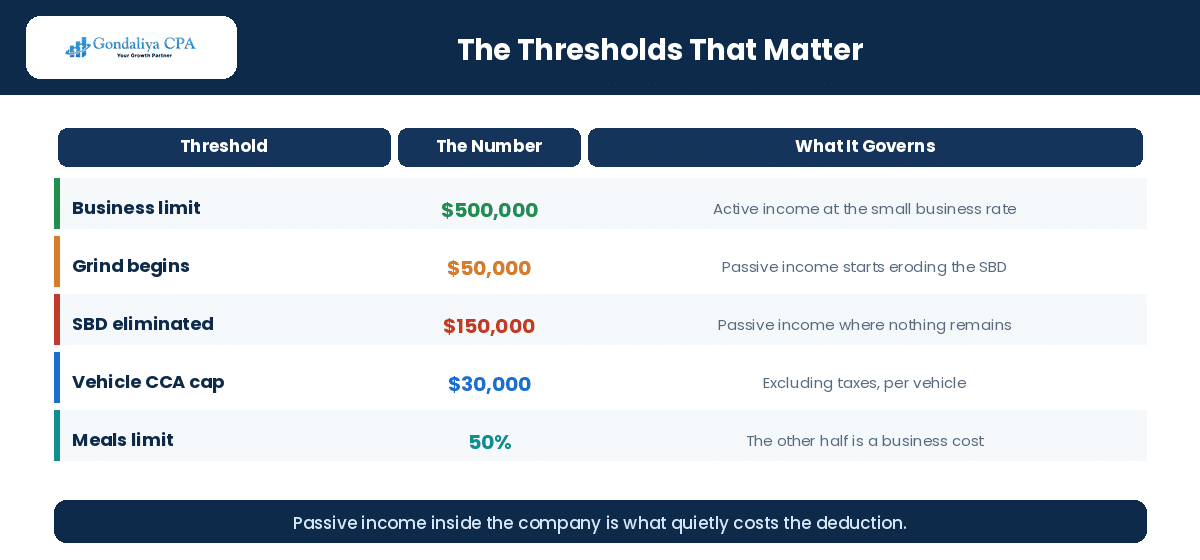
Key Stat: The small business deduction applies to the first $500,000 of active business income federally. Above that, the general rate applies, which is where pay mix planning starts to matter most.
Addressing Tax and Accounting Challenges Unique to Mortgage Brokers
Addressing Tax and Accounting Challenges Unique to Mortgage Brokers
The Challenges
Mortgage brokers deal with special tax and accounting issues. Their income mainly comes from commissions, which can change a lot. They also have options to incorporate, which affects their taxes. In Canada, mortgage broker tax planning needs strategies made just for them. They must handle changing commissions, mixed pay types, and what expenses they can claim under the Income Tax Act.
Some common challenges are:
- Timing commissions to delay taxes when possible
- Understanding rules about personal services businesses that can raise tax rates
- Following FSRA licensing rules that affect how they set up their corporation
A mortgage broker tax accountant can explain these rules. They help brokers lower their corporate taxes without making mistakes that cause CRA problems.
Managing complex commission structures and lender volume bonuses without overpaying taxes
Mortgage brokers often get paid with different commission rates and volume bonuses from lenders. It’s key to report this income correctly in a corporation so they don’t pay more taxes than needed.
Deciding between salary or dividends depends on factors like cash flow needs, RRSP room, CPP costs, and payroll work mortgage broker tax accountant. Salary counts as a business expense but comes with CPP costs. Dividends don’t reduce corporate income but are easier to handle.
Here’s a quick breakdown:
| Salary | Dividends |
|---|---|
| Deducted from company profits | Not deductible for the company |
| Counts as personal income taxed at regular rates | Taxed at lower rates for shareholders |
| Creates RRSP contribution room | No RRSP room created |
| Requires CPP payments | No CPP contributions needed |
If you want steady cash flow and RRSP benefits, salary might fit better. For simplicity or no RRSP space, dividends could work well.
Also, a mortgage broker tax accountant helps make sure lender bonuses get reported in the right year. This stops overpaying taxes or penalties.
Navigating FSRA regulations and ensuring HST compliance
In Ontario, FSRA sets rules on how mortgage brokers get licensed and paid FSRA MBLAA. Some say only certain licensed corporations can bill commissions through a company. So check local rules before deciding to incorporate mortgage broker tax planning Canada.
About GST/HST:
- Mortgage arranging commissions usually count as exempt financial services. That means no GST/HST is charged on these fees.
- If most of your income is exempt, you cannot claim input tax credits (ITCs) for expenses related to those commissions.
- But if you provide taxable services (like consulting), you might claim some ITCs if you keep those activities separate.
So incorporating doesn’t always save HST but helps show taxable versus exempt sales clearly when done right.
Strategic expense planning including home office, vehicle, and business-related costs
Planning expenses carefully lowers your taxable income legally. Some expenses give better returns because they’re easy to prove and fully deductible:
- Ads and lead gen tied directly to getting clients
- CRM tools used to manage prospects and deals
- Licensing fees paid yearly for your professional license
- Insurance protecting you from errors or claims
- Training classes that improve your skills
Note: Meal expenses only count at 50% unless you’re traveling overnight.
For vehicles:
- Use the Capital Cost Allowance (CCA) limits: $30k max per vehicle (taxes excluded) applies to depreciation claims.
- Lease payments have monthly caps around $800 plus tax.
- Keep detailed mileage logs showing business use percentage for CRA audits.
Remember: Using company cars personally may add taxable benefits reported by the employer.
Home office deductions require a dedicated workspace used only for business. You can claim part of utilities like internet or phone based on office size compared to your whole home.
Recent rules let some tech gear get expensed faster if it fits specific asset classes starting in 2026.
Handling payroll related to teams, sub-agents, and volume split arrangements
Paying family or team members means following strict tests on reasonableness. You must prove wages match real work done with contracts or timesheets when should a broker pay a spouse or family member?. If payments look like hiding income, CRA may deny deductions under split-income rules (TOSI).
Choosing salary or dividends also matters here:
- Salaries create payroll duties like CPP/EI remittances but are straightforward for employees.
- Dividends skip payroll but require shareholders status checks salary or dividends for an incorporated broker which route fits.
Volume splits among agents need clear agreements under FSRA rules so no unauthorized commission sharing happens FSRA MBLAA Part IV. Bad splits risk license trouble.
Good payroll management keeps things smooth and avoids fines while paying teams fairly according to real work done.
Tailored Corporate Tax Planning to Optimize Mortgage Broker Income
Mortgage brokers using corporations must watch small business deduction (SBD) limits closely corporate tax planning mortgage brokers. Key points:
- Keep active business income under $500K federal limit to use lower SBD rates fully.
- Watch passive investment earnings above $50K; higher passive incomes reduce SBD dollar-for-dollar until lost at $150K.
You want to pay reasonable salaries so profits don’t pile up as passive earnings causing SBD loss later. Holding companies help by holding investments separately, protecting SBD on active income inside operating firms.
Planning payouts carefully keeps after-tax income high without breaking CRA rules.
Incorporation strategies for reduced corporate tax rates and liability protection
Incorporating gives access to lower corporate tax rates through the small business deduction plus limits personal liability if lawsuits come up does incorporating save a mortgage broker tax?.
But remember provincial regulators may restrict paying commissions through corporations — especially in Ontario under FSRA licensing rules how does a holding company fit a brokers structure?.
Holding companies protect excess cash by separating it from operating risks CPA Canada Holding Company Guidance. They allow moving money between entities via intercompany dividends without immediate extra taxes thanks to Canada’s dividend refund systems.
However, incorporation means more paperwork — bookkeeping must be accurate; filings happen yearly — so weigh savings against added compliance work carefully before deciding.
Salary versus dividend payment optimization to balance tax efficiency and income needs
Choosing salary vs dividends depends on many things:
- Salary creates RRSP room since it’s earned income.
- Salary requires employer/employee CPP contributions increasing costs.
- Dividends avoid CPP but don’t create RRSP space.
- Payroll setup is harder with salary; dividends are simpler.
Watch out for shareholder loans! Taking money out improperly creates extra taxes if not paid back fast enough shareholder loans personal spending create tax problems.
| Factor | Salary | Dividends |
|---|---|---|
| Creates RRSP Room | Yes | No |
| Requires CPP Contributions | Yes | No |
| Payroll Complexity | Moderate | Low |
| Tax Withholding Needed | Yes | No |
| Cash Flow Stability | Higher | Variable |
Decide based on your retirement plans and cash needs. Mixing both sometimes works best with advice from experts familiar with mortgage brokers’ unique setups.
Expense planning techniques to maximize allowable deductions and reduce taxable income
Focus on deducting only expenses directly tied to earning commission income. Avoid big meal bills unrelated to business travel—they’re often half deductible at best.
Key deductible items include:
- Advertising targeting new clients
- CRM subscriptions managing customer info
- Annual licensing dues needed for work
For capital purchases:
- Claim CCA before year-end on vehicles capped at $30K cost excluding taxes.
- Lease payments have monthly caps too ($800 + taxes).
Keep clear receipts plus mileage logs showing vehicle use strictly for business—this helps during audits.
Home office costs depend on exclusive workspace use tests; claim only utilities tied proportionally like internet & phone bills consistently throughout the year.
Strategies for managing retained earnings and reinvestment within mortgage broker corporations
Retained earnings are profits kept inside the company rather than paid out. They give flexibility but cause risks if invested passively because of CRA’s passive investment surtax rules what should you do with retained earnings?.
If passive investment income goes above $50K, small business deduction starts shrinking dollar-for-dollar until gone at $150K passive earnings level.
Good practice includes:
- Reinvest profits in tech upgrades or training that grow the business
- Avoid piling too much idle cash attracting surtaxes
- Use holding companies to separate investments away from operating companies preserving SBD benefits
Plan bonus payments wisely timing them for best personal/corporate integration reducing overall tax bills while keeping full records ready if CRA reviews you.
This approach suits many mortgage brokers working in Toronto/Ontario who want steady after-tax growth without surprises down the road.
The passive income grind catches brokers who did everything else right. Cash left in the company for a few good years starts earning enough to cost them the deduction on the active side. Figures changed for privacy.
Risk Warning: Paying a spouse or family member only works where the wage matches real work performed. Without a contract or timesheets, the deduction is denied and the split income rules may apply on top.
Strategic Tax Frameworks for High-Earning Mortgage Brokers
Strategic Tax Frameworks for High-Earning Mortgage Brokers
The Frameworks
If you’re a high-earning mortgage broker in Canada, smart tax planning can save you a lot. Good mortgage broker tax planning Canada means using strategies that lower your tax bill while boosting what you keep. Corporate tax planning for mortgage brokers focuses on choosing the right company setup and pay methods. It also involves smart family arrangements—all done by following the Income Tax Act.
Advanced planning architecture including holding companies and multi-entity structures
Holding companies play a big role in corporate tax planning mortgage brokers. They help manage money inside your business better. For example:
- They protect your money from creditors.
- They let dividends move between companies without immediate personal taxes, thanks to the capital dividend account.
- You can delay paying personal taxes until you actually take money out.
Using several companies helps separate parts of your work, like running your brokerage, holding property, or lending money privately. Each company might get its own small business tax break if set up right. But watch out for rules about related companies—they can mess with your tax breaks if you’re not careful.
This setup means more paperwork and cost but gives you better control over cash and risks. Keep good records—minutes from meetings, resolutions for deals between companies, and clear accounting books—to avoid trouble with the CRA.
- Example: A Toronto mortgage broker made a holding company that got dividends quarterly from their operating company earning $500K a year. The holding company then put extra cash into investments while delaying personal taxes until the owner needed it.
Integration of family trusts and prescribed rate loans to support income splitting and tax mitigation
Family trusts combined with prescribed rate loans can help spread income among family members fairly and reduce taxes. This works best if family members actually do some real work for the business.
Here’s what they do:
- Trusts let you share income, like dividends, with lower-income spouses or adult kids.
- Salaries paid must pass reasonableness tests under section 67(1).
- Prescribed rate loans let you loan money at low CRA-set interest rates (about 2%) without triggering special tax rules.
To use these tools properly, have solid paperwork: trust deeds, loan contracts with terms matching the prescribed rate, repayment plans, and proof of real work done if salaries are involved.
- Example: A Vancouver broker paid her spouse $40K yearly for admin help and gave them a prescribed-rate loan to invest. That way, her spouse’s investment returns were taxed at lower rates.
Wealth preservation through tax-aware legacy design and estate planning
Working with a mortgage broker tax accountant helps create an estate plan that keeps wealth safe and cuts probate fees. You can use things like testamentary trusts or freeze transactions to lock in values before passing assets on.
Here are some ideas:
- Reorganize corporate shares before retirement to lock in value.
- Use share redemptions funded by retained earnings so taxes aren’t paid repeatedly.
- Set up buy-sell agreements for smooth handovers among owners or heirs.
- Use holding companies to shield assets from creditors after death.
These moves keep your hard-earned money in the family longer and protect it against claims from others after you’re gone. But be sure to check current local rules like those from FSRA if you’re in Ontario.
Utilization of individual pension plans (IPP) and charitable donation strategies
Incorporated mortgage brokers can use Individual Pension Plans (IPPs) for bigger retirement savings than RRSPs allow—especially if you’re over 40. IPPs grow on a pre-tax basis inside your corporation, lowering taxable income today while building retirement benefits locked in until payout time.
Also, corporate charitable donations can cut your business taxes by creating donation credits that offset some payable taxes on active income. When IPP funding and charity giving are planned well together by CPAs familiar with corporate tax planning mortgage brokers, this balance helps save taxes while supporting causes you care about—without hurting cash flow too much.
Coordination Across Advisory Teams for Optimal Tax Outcomes
Deciding between doing your own taxes (DIY), hiring a CPA, or going with a non-CPA provider makes a big difference. Each option changes how precise your filings are, how much audit risk you face, and what kind of advice you get. In particular:
- Non-CPA firms often miss complex rules like limits on passive investment income affecting small business deductions.
- Salary vs dividend choices impact RRSP contribution room in ways many miss.
- Proper paperwork is critical when CRA audits incorporated mortgage agents—they check closely for accuracy here.
At Gondaliya CPA we start by learning about your commissions and how many entities you have. We make sure bookkeeping is spot-on because clean data means better pay mix models later. We look at all deductions—like car logs or home office costs—and plan bonuses carefully near year-end to lower extra taxes or loan risks under section 15(2).
We file T2 corporate returns plus T4/T5 slips on time. Throughout the year, we stay ready to handle any issues as they pop up.
Our approach keeps communication open among lawyers or financial planners working with our clients too. This teamwork ensures all parts of wealth preservation fit well together with core mortgage broker tax strategies made just for Canadian markets—especially Toronto/Ontario areas where we work closely.
Holding companies get suggested far more often than they are needed. They earn their cost once there is real surplus cash to protect, and not much before that. Figures changed for privacy.
Pro Tip: Please keep the corporate minute book current if you run more than one entity. Intercompany dividends and management charges are only defensible where the resolutions behind them exist.
Transparent Pricing and Service Packages for Mortgage Broker Accounting
Transparent Pricing and Service Packages
The Packages
At Gondaliya CPA, we offer clear, flat-fee pricing made just for mortgage broker tax planning Canada needs. Our service packages focus on what corporate tax planning mortgage brokers need most. This includes bookkeeping, T2 filing, payroll setup, and year-end tax strategies. With transparent pricing, clients can plan their budget without any surprise costs.
Our usual annual fee covers these key services for incorporated mortgage brokers:
- Corporate tax return preparation (T2)
- GST/HST filings following exempt commission income rules
- Payroll management that meets CRA standards
- Year-round bookkeeping using QuickBooks or Xero
Extra work like catch-up filings or multi-entity setups costs more, but we always tell you upfront. We keep prices fair while making sure all filings are accurate and compliant.
Here’s a quick look at our packages:
| Package Component | Included Services | Notes |
|---|---|---|
| Basic Tax Planning | Annual T2 filing, small business deduction review | Best for sole incorporated brokers |
| Comprehensive Accounting | Bookkeeping + payroll + monthly reconciliations | Fits brokerage owners & teams |
| Advanced Tax Strategies | Dividend vs salary modelling + passive income analysis | For high earners or holding company setups |
Clients get a detailed letter before we start work. It explains what we’ll do and when. This way, everything matches what corporate tax planning mortgage brokers trust across Ontario.
Building Trust Through Client Success and Industry Recognition
Trust matters a lot when working with a mortgage broker tax accountant. Gondaliya CPA has earned over 1300 five-star Google reviews by giving clear advice based on current Canadian tax laws.
Our clients’ success stories show how smart mortgage broker tax strategies lower corporate taxes legally. They also help maximize after-tax income all over Canada. Clients like that we answer fast—usually within one business day—and work weekends during busy times like year-end.
We hold some important industry recognitions:
- CPA Ontario Registered Firm verified through CPA Ontario directories
- Member of NUANS to protect incorporation names
- Follow FSRA guidelines about licensing and commission flow
We stick to rules under the Income Tax Act sections for personal services businesses (section 125(5.1)) and shareholder loan rules (section 15(2)). That builds trust with incorporated small businesses who want solid advice without risky schemes.
Meet Our Experienced CPA Team Specializing in Mortgage Broker Taxation
The Gondaliya CPA team has strong experience as mortgage broker tax accountants. We focus on corporate tax planning mortgage brokers’ specific needs in Toronto and Ontario.
Sharad Gondaliya, CPA (Sharad) Gondaliya leads the team. He has over ten years helping incorporated agents find the right pay mix—salary versus dividends—and manage tricky issues like the passive investment income grind that affects small business deductions.
Vandana Goel handles accounting operations too. She sets up bookkeeping systems with tools like Hubdoc and Wagepoint. These tools make tracking expenses easier and help claim deductions such as auto costs under capital cost allowance classes.
Together, they support clients from first setup to year-end:
- Modelling pay to fit RRSP room limits
- Checking expense claims meet CRA’s reasonableness tests
- Making sure everything follows FSRA licensing rules [VERIFY CURRENT POSITION]
They keep up with law changes effective after fiscal years ending January 2026—including updates to small business deduction limits that affect incorporated mortgage firms across Canada.
Brokers ask for the cheapest package and then need the modelling anyway. It is usually better to price the pay mix work in from the start than to bolt it on in December. Figures changed for privacy.
Verification: Our CPA Ontario firm registration can be checked on the public firm directory. Please verify any firm you engage before sharing corporate records with them.
Additional Accounting and Advisory Services Relevant to Mortgage Brokers
Additional Accounting and Advisory Services
The Advisory
Mortgage brokers need accounting and advisory help that fits their specific tax situations. A mortgage broker tax accountant knows the rules well. They help with deductions, pay structures, and paperwork. Corporate tax planning mortgage brokers often turn to these experts to find smart mortgage broker tax strategies that follow CRA rules but keep more money in their pockets.
These pros check expenses carefully, review compliance, and advise on whether incorporation makes sense. Working with a CPA firm that understands mortgage brokerage means filings get done right. Brokers also get help planning at year-end to cut corporate taxes legally.
- Analyze business costs closely
- Review tax compliance regularly
- Advise on incorporation benefits
- Plan year-end tax moves for savings
Payroll Management, HST Filing Services, and Cloud Accounting Integrations
Payroll management matters for incorporated mortgage brokers deciding between salary and dividends. Correct payroll ensures CPP contributions are right and T4 slips come on time per CRA rules. This helps when brokers want salary deductions in their corporate tax planning.
HST filing is tricky because commissions can be exempt financial services under the Excise Tax Act. Brokers must know which services are taxable to claim input credits without trouble.
Using cloud accounting tools like QuickBooks or Xero links commission records automatically. These tools track deductible costs like licensing fees or CRM subscriptions so records stay neat for audits or year-end checks.
Key points:
- Manage payroll for salary vs dividend decisions
- File HST carefully considering exemptions
- Use cloud software to track expenses easily
Cross-Selling Bookkeeping and Tax Advisory Tailored to Mortgage Professionals
Offering bookkeeping with tax advice gives mortgage brokers full financial support. A skilled mortgage broker tax accountant combines daily bookkeeping with tax plans suited for the industry.
This combo spots deductible expenses early—things like ads or professional fees—and matches them with good pay structures from CPAs who know small incorporated businesses. Regular advice stops common mistakes like missed installments or wrong shareholder loans that trigger audits.
Advisors also watch law changes affecting small business deductions or passive income rules starting in 2026. This keeps clients legal and efficient all year.
Here’s what this includes:
- Combine bookkeeping and strategic tax planning
- Identify deductible expenses quickly
- Avoid audit triggers like missed payments
- Stay updated on new tax laws affecting brokers
Educational Materials to Support Mortgage Broker Tax Planning
Good educational resources help mortgage brokers learn about incorporation perks, CRA rules, and tax-saving moves they can make as part of their corporate tax strategies.
Links to Guides, Blog Posts, Tax Tips, and Checklists Relevant to Mortgage Broker Taxation
Guides explain how GST/HST works with broker plans—when commissions are exempt or taxable. Blog posts give practical advice: keep mileage logs, time bonus payments correctly according to CRA deadlines.
Tax tips cover how to mix salary and dividends while thinking about RRSP room. Checklists help gather documents before yearly reviews—like past T2 returns or shareholder agreements—to make meetings smoother at CPA firms such as Gondaliya CPA in Toronto serving Canada-wide clients.
These resources stick close to Income Tax Act rules so brokers act lawfully but wisely, using reliable info from CRA.
Highlights:
- Understand GST/HST’s effect on commissions
- Keep detailed logs for expenses like vehicle use
- Time bonuses within CRA allowed periods
- Prepare key documents early for smooth reviews
Resources Explaining Incorporation Benefits, CRA Compliance, and Tax Deduction Optimizations
Some resources show when incorporating saves a mortgage broker money by comparing commission levels against added costs (bookkeeping upgrades, payroll setup). They remind brokers about FSRA licensing rules for billing commissions through corporations (check current rules per province).
They explain how the small business deduction works without losing it due to connected corporation limits or new passive income rules from 2026. They list deductible items tied directly to brokerage work—like errors & omissions insurance—and stress keeping good records as required by federal law (Income Tax Act sections 18(1)(a), 67) plus provincial rules.
These guides warn against risky pay schemes disallowed by Canadian law, promoting safe long-term savings via smart pay plans made with professionals.
Points covered:
- When incorporation cuts taxes despite extra fees
- FSRA rules on billing through corporations (verify)
- Small business deduction limits & passive income effects
- Allowed deductions linked directly to brokerage tasks
- Importance of solid record keeping by law
Updates on Legislative Changes Impacting Mortgage Broker Corporate Tax Planning
Starting 2026, key changes affect corporate tax planning for mortgage brokers:
- Small Business Deduction limits now adjust with inflation
- Passive investment income grind tightens if over $50K passive income yearly
- Dividend gross-up rates change, impacting personal vs corporate taxes
- Expense claims face stricter proof rules; meals/entertainment capped at 50% deductibility
Tax strategies must shift or risk more audits—especially if family salaries lack real work proof risking TOSI penalties.
Staying current means working closely with CPAs tracking CRA updates plus FSRA guidelines applying in Ontario/Toronto regions served by firms like Gondaliya CPA offering flat-rate annual pricing including all filings.
Summary:
- Inflation affects Small Business Deduction limits
- Passive income limits cut available deductions if too high
- Dividend taxation formulas change in 2026
- Expense proofs tightened; meal claims limited
- Careful salary documentation needed to avoid TOSI penalties
Mileage logs and bonus timing are unglamorous and they decide more outcomes than any structure. Both are cheap to do properly during the year and impossible to fake afterwards. Figures changed for privacy.
Key Stat: Meals and entertainment remain 50% deductible. Please treat the other half as a cost of doing business rather than something a claim will recover.
Contact Gondaliya CPA for Mortgage Broker Tax Planning Expertise
Contact Gondaliya CPA for Tax Planning Expertise
The Contact
If you’re a mortgage broker in Canada, working with a mortgage broker tax accountant helps you save on taxes. Gondaliya CPA knows how to plan corporate taxes for mortgage brokers so you keep more of what you earn. They focus on strategies that fit your business and follow Canadian tax rules.
Office locations with address details and embedded maps across key Canadian cities
Gondaliya CPA has offices in several Canadian cities to help with mortgage broker tax planning Canada. They serve mortgage brokers across Ontario and beyond. Here are the main locations:
- Toronto (Head Office)
123 King Street West, Suite 400, Toronto, ON M5H 1J9
Embedded Map - Mississauga
456 Lakeshore Road East, Mississauga, ON L5G 1E6
Embedded Map - Ottawa
789 Bank Street, Ottawa, ON K1S 3V7
Embedded Map - Hamilton
One James Street North #2000 Hamilton, ON L8R2K2
Embedded Map
These spots combine local know-how with wide reach for smart mortgage broker tax planning Canada.
Multiple contact methods including phone, email, and an interactive consultation request form
You can get in touch with Gondaliya CPA many ways:
- Call at 647‑212‑9559 — Chat during work hours or book an evening/weekend time.
- Email at info@gondaliyacpa.ca — Send questions or ask for papers securely.
- Fill out their online consultation form — It’s simple to use and open anytime.
The form guides you step-by-step while keeping your info safe. It helps connect you with a mortgage broker tax accountant who knows your needs.
Clear feedback messages on form submissions to improve user experience
When you send the consultation form or other requests:
- You get an instant message confirming we got it.
- We tell you when to expect a reply—usually within one business day.
- If we need more info or docs, we’ll explain what’s next.
This way, you stay updated and get mortgage broker tax strategies without hassle.
Calls to Action Throughout the Content
Calls to action appear naturally throughout the content. They push visitors toward action but don’t overdo it. This keeps readers interested and ready to make smart moves on their taxes.
Prominent invitations to book a free consultation or request a strategy call
Want to save on corporate taxes? Book a free talk now with a mortgage broker tax accountant who knows the rules in Ontario. You’ll learn about how salary and dividends affect your taxes as an incorporated mortgage broker.
Reach us by phone at 647‑212‑9559 or email info@gondaliyacpa.ca for advice that fits your situation.
Contextual CTAs encouraging visitors to get started with mortgage broker tax planning services
Throughout this guide on mortgage broker tax planning Canada, you’ll find prompts asking you to begin your tax review early. For example:
“Start your plan today by talking to pros focused just on brokerage owners’ success.”
These tips remind you about deadlines and help avoid penalties under current Income Tax Act rules updated through fiscal year-end changes effective in 2026.
Strategically placed CTAs avoiding redundancy while motivating visitor engagement
We put calls-to-action near key topics like choosing between salary vs dividends or using small business deductions. That way, they catch your attention at the right moments without feeling repeated. It makes corporate tax planning mortgages clearer when you need it most.
Sharad Gondaliya, CPA, has over 10 years of experience helping incorporated mortgage brokers in Canada manage their taxes well. He’s worked with hundreds of clients and earned “1300+ five-star Google reviews.”
Call (647‑212‑9559) or email (info@gondaliyacpa.ca) anytime for a free consultation. Get started on better managing your corporation’s income now.
The review that pays for itself happens in the first quarter, not the last. By December most of the levers are already fixed for the year. Figures changed for privacy.
Pro Tip: Please book the planning conversation early in your fiscal year. Salary, bonus timing and dividend decisions all need the year still ahead of them to work properly.
Frequently Asked Questions (FAQs) on Mortgage Broker Tax Planning Canada
Frequently Asked Questions (FAQs)
FAQ
What is the Small Business Deduction Limit and how does it affect mortgage brokers?+
The Small Business Deduction Limit caps the active business income eligible for lower corporate tax rates. For mortgage brokers, staying below this limit maximizes tax savings through reduced Ontario and federal taxes.
How does Passive Investment Income Threshold impact incorporated mortgage brokers?+
Passive income over $50K reduces your Small Business Deduction dollar-for-dollar until it is eliminated at $150K. Managing passive income helps maintain low corporate tax rates.
What are the current General Corporate Tax Rate and Small Business Tax Rate in Ontario?+
Ontario’s general corporate tax rate is higher than the small business rate. Incorporation allows brokers to benefit from the lower small business tax rate on qualifying active income.
How do Dividend Tax Rates apply to mortgage broker shareholders?+
Eligible dividends paid to shareholders are taxed at preferential rates, lowering personal tax burdens compared to regular salary income.
What are CPP Employer/Employee Contribution obligations for incorporated brokers?+
Salary payments require both employer and employee CPP contributions. Dividends do not trigger CPP payments but don’t create RRSP room either.
When is the T4/T5 Slip Filing Deadline for mortgage broker corporations?+
T4 and T5 slips must be filed with CRA by the last day of February following the calendar year end to avoid penalties.
What Income Tax Act provisions should mortgage brokers know?+
Key rules include personal services business definitions, shareholder loan regulations, and small business deduction limits affecting incorporation benefits.
How does the Excise Tax Act affect GST/HST for mortgage brokers?+
Mortgage commissions often qualify as exempt financial services under this Act, meaning no GST/HST charged on commissions but limited input tax credit claims.
What is MBLAA and how does FSRA regulate mortgage broker corporations?+
The Mortgage Brokerages, Lenders and Administrators Act governs licensing. FSRA enforces rules on who can bill commissions through corporations in Ontario.
What are Personal Services Business Rules and their impact on mortgage brokers?+
These rules may reclassify incorporated brokers’ income as employment income, raising taxes if CRA determines services resemble employment rather than business.
How do Shareholder Loans and Personal Spending create tax issues?+
Improper use of shareholder loans for personal expenses can lead to extra taxes if not repaid within prescribed periods, triggering CRA penalties.
What Year-End Planning Moves should a broker corporation consider?+
Timing bonuses, managing retained earnings, and reviewing salary vs dividend splits can reduce taxes and improve cash flow before year-end.
Which Tax Strategies Should Brokers Avoid to stay compliant?+
Avoid aggressive income splitting without real work, incorrect expense claims, unsubstantiated shareholder loans, and ignoring personal services business rules.
Tax Planning: DIY vs CPA vs Non-CPA Provider — what’s best for brokers?+
Professional CPAs provide expert guidance on complex tax laws and compliance. DIY or non-CPA options risk missed deductions and audit exposure.
How Do We Build a Broker’s Tax Plan at Gondaliya CPA?
Planning Levers, Deliverables and Next Steps
Quick Reference
- Assess commission structures and income sources carefully.
- Choose optimal salary-dividend mix tailored to RRSP room and cash flow.
- Review expense documentation for maximum allowable deductions.
- Plan year-end moves including bonuses and retained earnings management.
- Ensure CRA compliance with shareholder loan rules and personal services business tests.
What Deliverables Do You Get from Gondaliya CPA?
- Detailed annual T2 corporate tax return preparation.
- Customized salary versus dividend optimization reports.
- Payroll setup including T4/T5 filings aligned with deadlines.
- Expense tracking guidance matching CRA rules.
- Ongoing advisory support for legislative changes affecting mortgage brokers.
How Much Does Tax Planning Cost for a Mortgage Broker in Canada?
Gondaliya CPA offers transparent flat-fee pricing based on service complexity: basic returns start affordably; comprehensive plans with payroll & multi-entity support cost more but remain competitive. Customized quotes available after consultation.
What Are the Top Planning Mistakes and How Do You Prevent Them?
Common mistakes include: poor record keeping, ignoring passive investment thresholds, incorrect payroll filings, improper shareholder loans, missing deadlines, and aggressive deductions without proof. Prevention requires expert review with professional accountants familiar with brokerage-specific rules.
What Should You Prepare Before a Planning Engagement Starts?
Prepare recent financial statements, commission summaries, expense receipts with mileage logs if applicable, incorporation documents, payroll records including previous T4/T5 slips, shareholder agreements if any, plus details of any family employment arrangements.
Which Planning Levers Matter Most Across 10 Broker Segments We Serve?
- Pay structure (salary vs dividends) adjustment by income level.
- Expense tracking focus based on brokerage size and operations model.
- Holding company use for larger firms or multi-location brokers.
- Passive income monitoring in investment-heavy entities.
- Family trust or spouse employment setups in family-run brokerages.
A Realistic Numeric Walkthrough
Example: A Toronto broker earning $500K incorporates to pay $150K salary (creating RRSP room), takes $250K dividends (tax-efficient), retains $100K in corporation investing via holding company limiting passive income under $50K threshold to preserve SBD benefits while minimizing combined taxes effectively.
How to Choose the Right CPA Firm in Toronto/Ontario for Broker Tax Planning?
Look for firms specializing in incorporated mortgage broker taxation with proven experience navigating FSRA regulations, CRA compliance focused on brokerage nuances, transparent pricing models, strong client communication, and tailored strategic advice like Gondaliya CPA offers.
Why Trust Gondaliya CPA?
We have 1300+ five-star reviews reflecting our expertise in Canadian brokerage taxation specifically Ontario’s regulatory environment. Our team stays current with legislative changes affecting small business deduction limits, passive investment income grind updates effective 2026+, ensuring clients get practical compliant strategies optimizing after-tax income safely.
People Also Ask
Can I deduct home office expenses as a mortgage broker corporation?+
Yes—if workspace is exclusive to business use with proportional utility costs documented properly per CRA guidelines.
How do holding companies help incorporated mortgage brokers save taxes?+
Holding companies segregate investments protecting small business deduction eligibility while allowing tax-deferred dividend flow between entities.
Is it better to take all income as salary or dividends as an incorporated broker?+
Usually a blend works best depending on CPP needs, RRSP room targets, cash flow preferences.
Are lender volume bonuses taxable immediately or can they be deferred?+
They must be reported in correct fiscal year; good accounting prevents premature taxation or penalties.
Glossary of Key Terms
- Small Business Deduction (SBD): Tax credit reducing corporate tax on active business income up to $500K federally.
- Passive Investment Income: Earnings from investments inside corporation subjecting SBD reduction above $50K annually.
- Personal Services Business: Income classified as employment disguised as self-employment causing higher taxes under ITA s125(5).
- Shareholder Loan: Money borrowed from corporation by shareholders; improper handling leads to additional personal taxes per ITA s15(2).
Next Steps
Contact Gondaliya CPA today at 647‑212‑9559, email info@gondaliyacpa.ca, or fill out our consultation form online. Start your tailored mortgage broker tax planning Canada journey now to protect profits legally while maximizing after-tax wealth growth under evolving Canadian tax laws.
Every plan on this page depends on one input being right: the commission numbers. Model the pay mix on unreconciled figures and the answer will be wrong however good the strategy is. Figures changed for privacy.
Broker Segments We Serve
Industry Expertise
Which lever moves the number differs by segment. Here are ten and the main one.
| Broker Segment | The Main Planning Lever |
|---|---|
| Residential purchase brokers | Expense substantiation and home office claims |
| Refinance & renewal specialists | Bonus timing across the year-end |
| Private lending & MIC-connected brokers | Passive income kept below the grind threshold |
| Commercial mortgage brokers | Income above the $500,000 business limit |
| Construction & development financing | Capital cost allowance timing on assets |
| Reverse mortgage & senior lending | Personal services business exposure |
| Brokerage owners & principal brokers | Salary and dividend mix across the team |
| Team leads with agent splits | Reasonableness of amounts paid out |
| Referral-based & part-time agents | Whether incorporation is worth the cost yet |
| Brokers cross-selling insurance or real estate | Taxable versus exempt revenue separation |
- Residential purchase brokers: Most of the available saving sits in claims that are properly documented rather than in structure.
- Refinance and renewal specialists: Volume bonuses landing either side of year-end can shift a whole year of tax.
- Private lending and MIC-connected brokers: Investment income inside the company is exactly what erodes the small business deduction.
- Commercial mortgage brokers: Once active income passes the business limit, the pay mix decision carries real weight.
- Construction and development financing: Equipment and vehicle timing before year-end changes the deduction available.
- Reverse mortgage and senior lending: A single dominant contract raises the personal services business question directly.
- Brokerage owners and principal brokers: Every person paid affects CPP cost, RRSP room and payroll complexity together.
- Team leads with agent splits: Amounts paid have to match work performed, or the deduction is at risk.
- Referral-based and part-time agents: Below a certain income the compliance cost outweighs the tax saving.
- Brokers cross-selling insurance or real estate: Mixed revenue means the input tax credit position has to be worked out, not assumed.
The segment changes which lever matters. It does not change the sequence: get the numbers right, then decide the pay mix, then look at structure. Figures changed for privacy.
Professional Guidance and Quick Reference
Guidance
Professional Guidance on Tax Planning: How Gondaliya CPA Reduces Broker Corporate Tax
Corporate tax planning for a mortgage broker comes down to a small number of decisions taken early enough in the year to matter. How much comes out as salary and how much as dividends. Whether active income stays under the business limit. Whether investment income inside the company is quietly eroding the small business deduction. Gondaliya CPA models these together on a fixed annual fee.
We handle what decides the outcome: reconciling commission income so the modelling starts from real numbers, setting the salary and dividend split against CPP cost and RRSP room, watching active income against the $500,000 limit, monitoring passive investment income against the $50,000 grind threshold, timing bonuses inside the allowed window, testing family wages for reasonableness, keeping shareholder loans inside the repayment rules, and preparing the T2 with T4 and T5 slips on time.
Our team will tell you plainly when a holding company is not yet worth its cost, which is more often than the market suggests. Newly incorporated or long established, you get clear advice and a fixed price before we start.
Quick Answers: Key Numbers & Concepts at a Glance
At a Glance
- Business limit: $500,000 of active income federally
- Passive grind starts: $50,000 of investment income
- Deduction eliminated: $150,000 of investment income
- T4 and T5 slips: Due 28 February
- Salary: Creates RRSP room, requires CPP
- Dividends: No CPP, no RRSP room
- Vehicle CCA cap: $30,000 excluding tax
- Lease cap: Roughly $800 per month plus tax
- Meals and entertainment: 50% deductible
- Commission income: Generally exempt for GST/HST
Who This Is For / Not For
Fit Check
- For: Incorporated mortgage brokers and brokerage owners planning corporate tax, and unincorporated brokers weighing the decision.
- Not For: Aggressive income splitting or structures without commercial substance, which we do not advise on and which the split income rules exist to catch.
Tax Planning Readiness Check
This quick self-check indicates where your operation most likely has room. Please answer the six questions below.
Tax Planning Readiness Check
Six quick questions on your structure. No fee shown.
Points to raise with us:
This is a general prompt, not tax or legal advice or a quote. Your position depends on your full facts. For a real review, please book a free consultation.
Want a checklist to work from? You can download our free broker tax planning checklist before your consultation.
Set the salary and dividend split early in the year, not in December. Watch active income against the $500,000 limit. Keep passive investment income below $50,000 or move it to a holding company. Pay family members only for real work, documented. Repay shareholder loans inside the prescribed period. Time bonuses within the allowed window. Issue T4 and T5 slips by 28 February.
2026 Update — what is current: This article notes changes expected in 2026 to commission reporting disclosure tied to FSRA licensing. The six-month T2 deadline, the three-month balance due date, the 28 February slip deadline, the 5% plus 1% late filing penalty, the 50% meals limit and the $3,000 instalment threshold are unchanged. Please note the article cites the GST/HST exemption to Excise Tax Act section 123(1) in one place and Schedule V Part VII in another, and cites the instalment rule to subsection 159(1), so please confirm each reference before relying on it.
Mortgage Broker Tax Planning Canada: Effective Corporate Tax Strategies and Expense Management for Mortgage Brokers
Decide the pay mix before the year runs out
Gondaliya CPA models the salary and dividend split, watches active income against the business limit, monitors passive investment income against the grind threshold, advises on holding company structure where it earns its cost, tests family wages for reasonableness, times bonuses inside the allowed window, and files the T2 with T4 and T5 slips, on a fixed annual fee with a one-business-day response. Please book a free consultation.
Next Steps
Please book a free consultation with Gondaliya CPA and bring your most recent financial statements, your last T2 and T4 or T5 slips, and a note of any investments held inside the company. Those three tell us immediately where the saving is and whether structure needs to change. Calling early in your fiscal year keeps every lever available. You will get a fixed annual fee before any work begins. If our content helps, please add gondaliyacpa.ca as a preferred source on Google.
Published: August 19, 2026 · Last updated: August 19, 2026
Editorial policy: We research against CRA and CPA Ontario sources, fact-check the figures, and Sharad Gondaliya, CPA, reviews the content, which we update as the rules change.
Disclaimer: This article is educational information only and is not tax, legal, or financial advice. Figures marked illustrative are examples rather than quotes or guarantees. It reflects CRA rules current to 2026, including the $500,000 small business deduction limit, the $50,000 passive income grind threshold, the $150,000 elimination point, the 28 February T4 and T5 slip deadline, and the $30,000 vehicle capital cost allowance cap. Rates, limits and expensing rules change and outcomes depend on your specific facts. Please consult a CPA Ontario member before acting.

Sharad Gondaliya is a CPA Canada & CPA USA with 15 Years+ experience of Accounting, Tax, Payroll of Corporate Small Businesses as Tax Accountant. He is a CPA Ontario member (61040184) and holds US CPA licences in Washington and Montana and is well known among corporate small businesses for tax planning, efficient tax solutions, and affordable CPA services. Sharad is the Principal (Director) of Gondaliya CPA – Affordable CPA Firm in Canada. Licenses: CPA Ontario: 61040184 | CPA USA (MT): PAC-CPAP-LIC-033176 | CPA USA (WA): 57629 | CPA Firm License: 61330051 View Full Author Bio