



How Manufacturing Companies Can Maximize SR&ED Tax Credits and Recover Eligible R&D Costs in Canada
SR&ED manufacturing Canada provides valuable opportunities to claim manufacturing R&D expenses and maximize SR&ED credits for innovative projects. Gondaliya CPA assists businesses in navigating CRA SR&ED claims, engineering tax credits Canada, and manufacturing process improvement SR&ED to recover manufacturing R&D costs efficiently.
Quick Summary
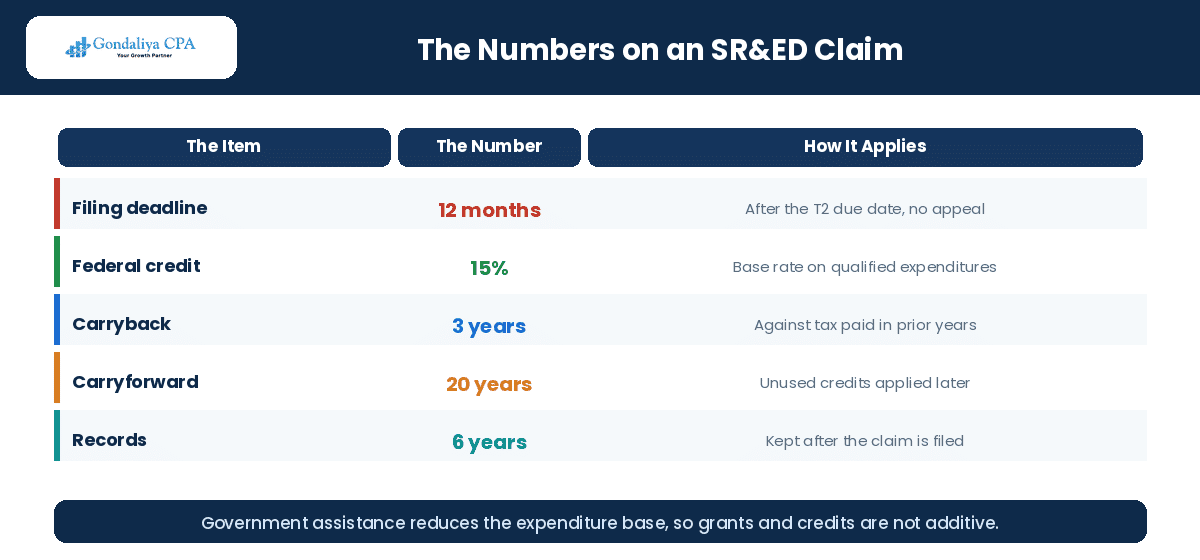
A claim survives on three tests: technological uncertainty, systematic investigation, and technological advancement. Everything else is documentation. Please note the filing deadline is twelve months after the T2 due date, and a claim filed late is simply not accepted.
| Aspect | Details |
|---|---|
| The tests | Uncertainty, investigation, advancement. |
| The record | Written as the work happens, not afterwards. |
| The forms | T661 with Schedules 31 and 32. |
| The deadline | Twelve months after the T2 due date. |
Reading time: 37 minutes.
Table of Contents
- Introduction and Overview of SR&ED Manufacturing Tax Credits
- Eligibility Criteria Specific to Manufacturing Companies
- Preparing and Submitting SR&ED Claims
- Partnering with Gondaliya CPA
- Leveraging Additional Innovation Funding and Resources
- Contact and Further Engagement
- Frequently Asked Questions (FAQs)
- Key Points at a Glance
- Manufacturing Sub-Sectors We Serve
- Professional Guidance and Quick Reference
The Numbers That Matter
This article covers Canada, with Ontario and Toronto context, and reflects rules current to 2026. It assumes an incorporated manufacturer considering or preparing an SR&ED claim. Figures marked illustrative are examples, not quotes, and any masked engagement notes end with “Figures changed for privacy.” This is educational information only and not tax or legal advice. Credit rates differ between refundable and non-refundable claims and by province, so please confirm the rates applying to your corporation.
Introduction and Overview of SR&ED Manufacturing Tax Credits in Canada
Introduction and Overview of SR&ED Manufacturing Tax Credits
The Basics
SR&ED tax incentives: Definition and benefits for manufacturing businesses
Definition of SR&ED tax incentives
The Scientific Research and Experimental Development (SR&ED) program helps Canadian businesses, especially in manufacturing, invest in research and development. The SR&ED tax credit Canada lowers the cost by giving tax credits that reduce how much you owe.
Benefits specific to manufacturing operations
Manufacturers can use manufacturing R&D tax credits to save money on innovation costs. These credits improve cash flow and push companies to create better products or processes. By claiming them, manufacturers keep funds flowing for more development and upgrades.
Key manufacturing R&D expenses eligible for SR&ED tax credits
Identifying eligible expenses: labour, materials, subcontractors, overhead
Here are some costs that qualify under manufacturing tax credits:
- Labour: Wages for workers doing R&D work.
- Materials: Stuff used up during testing or building prototypes.
- Subcontractors: Payments to outside experts helping with R&D.
- Overhead: Part of the usual business costs linked directly to the research.
Knowing what counts helps you claim more accurately.
How these expenses support manufacturing innovation
Paying attention to eligible expenses lets companies get back part of their costs. This encourages them to try new ideas without risking all their money. It supports testing and changing products or processes, which keeps businesses competitive.
Overview of federal and provincial manufacturing tax credits available in Canada
The federal SR&ED program works alongside provincial credits aimed at local industries. Each province may have different rules or extra perks. It’s smart to check both when planning your claims.
Federal SR&ED tax incentive program overview
The government offers the SR & ED manufactureing canada, giving refundable or non-refundable credits depending on qualified spending. This helps businesses invest in science-based work that supports Canadian industry growth.
Importance of claiming SR&ED credits to recover manufacturing R&D costs efficiently
Claiming from the SR & ED ManufacturingCanada lets manufacturers get money back on their research spend. This isn’t just about recovering past costs but also about funding future projects while keeping financial risks lower.
Brief summary of Gondaliya CPA’s expertise in maximizing manufacturing SR&ED claims
Gondaliya CPA helps Canadian manufacturers figure out and claim their best possible manufacturing R&D taxes. They know the rules well and make sure clients follow CRA guidelines while getting the most from their claims for steady growth.
The work in a plant usually qualifies. What is missing is the trail showing the problem, the attempts and the result, which is why claims get reduced rather than refused. Figures changed for privacy.
Risk Warning: A claim filed more than twelve months after the T2 due date is not accepted, and there is no appeal on that point. Please diarise the SR&ED deadline separately from the return itself.
Eligibility Criteria for SR&ED Tax Credits Specific to Manufacturing Companies
Eligibility Criteria Specific to Manufacturing Companies
The Tests
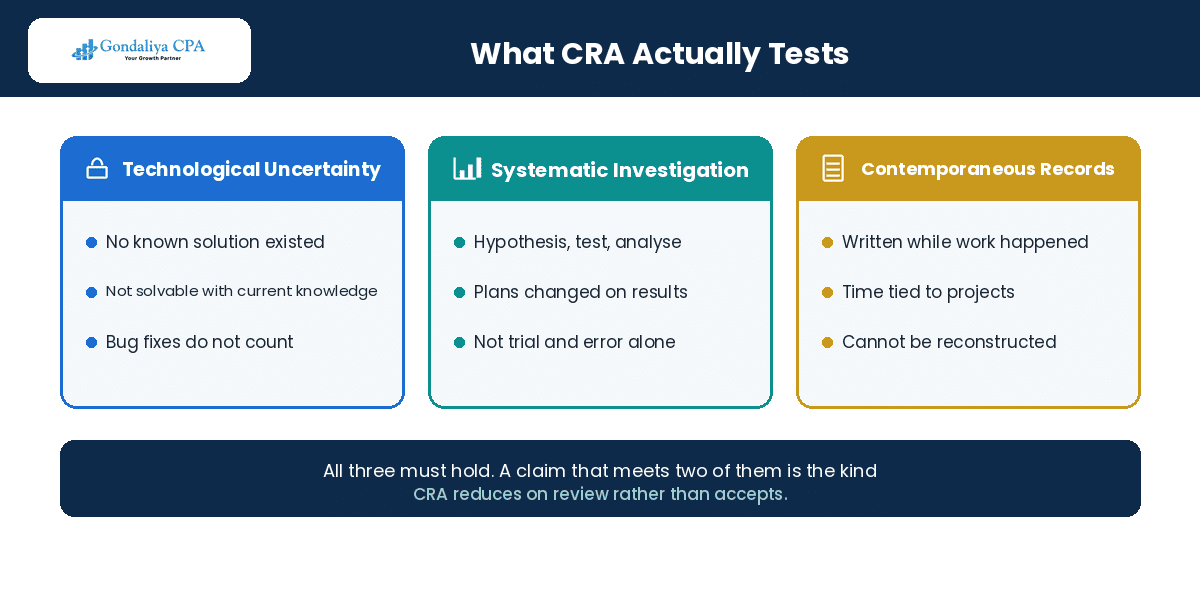
To claim SR&ED manufacturing Canada credits, you must meet three main rules. First, your work should solve a technological uncertainty—a problem without an easy fix or known answer. Second, the work needs a systematic investigation, meaning you follow a planned method with tests or experiments. Third, the goal should be a scientific or technological advancement that goes beyond what’s already known.
Manufacturing tax credits don’t cover routine production, scaling up for sales, market research, or cosmetic changes. You must keep proof from when you did the work showing you met these rules[1][2]. If you run a manufacturing company in Ontario or anywhere in Canada and want SR&ED tax credit Canada benefits, knowing this helps before you file your manufacturing R&D tax credits claim.
Scientific or Technological Advancements and Uncertainties in Manufacturing Projects
When you claim manufacturing R&D tax credits, think about new materials, processes, devices, or products that improve things beyond current standards. For example:
- Making alloys stronger than before
- Creating automated controls that speed up production
Technological uncertainty shows up when engineers try something new without knowing if it will work. Like:
- Building tools for new composite materials
- Writing custom software for automation
- Testing raw materials that change product strength
CRA expects proof of how you tested these unknowns step-by-step[3]. Without showing this process, your SR&ED claim might get rejected.
Characteristics of Eligible SR&ED Manufacturing Work and Projects
Eligible projects usually involve:
- Developing new tech to fix tough problems
- Testing prototypes to check improvements
- Innovating processes to cut waste but keep quality
- Trying automation with custom setups (not just buying machines)
These projects share traits: they face unanswered tech questions; use trial and error; collect data; and aim for real progress[4].
What doesn’t count? Routine stuff like regular equipment checks; scaling up after prototypes work; surface changes without tech updates; and fixing issues solved by normal methods.
Grouping Manufacturing Activities into SR&ED Claimable Projects
To get the most from manufacturing R&D tax credits, group related tasks into clear projects on Form T661. Each project should focus on solving specific tech uncertainties with results.
| Project Name | Description | Key Uncertainty |
|---|---|---|
| Automated Welding Cell | Robotics integration with special controls | Control system reliability |
| Material Substitution | Testing bio-polymers replacing plastics | Durability under heat |
| Tool Redesign | Changing dies to lower scrap rates | Getting accurate dimensions |
Grouping helps separate eligible experimental work from support tasks like data gathering or regular operations[5]. This makes CRA reviews easier by showing what each cost relates to (like salaries vs materials).
Distinguishing Between Process Improvement, Automation, and Product Development Claims
Manufacturers often mix up claims between process improvement, automation, and product development. Knowing the difference helps match what qualifies for SR&ED tax credit Canada:
- Process Improvement: Trying to make steps faster or better through testing unknowns about material behavior or machine settings[6].
- Automation Claims: Only count if you overcome tech problems like coding custom controls—not just installing off-the-shelf machines[7].
- Product Development: Covers making new products needing applied research and prototype trials to fix performance limits[8].
Each type needs records proving a systematic study aimed at tech progress—not just small operational fixes.
[1] Income Tax Act Section 248(1); CRA ITA Policy Statement SRED-POL002
[2] Canada Revenue Agency – Eligibility of Work Policy https://www.canada.ca/en/revenue-agency/services/scientific-research-experimental-development-tax-incentive-program/eligibility-work.html
[3] CRA Guide T4088 – Scientific Research & Experimental Development (SR&ED) Expenditures Claim Guide
[4] Income Tax Regulations 2900 & 2902 definitions on experimental development
[5] Form T661 Instructions – Project Descriptions & Groupings https://www.canada.ca/en/revenue-agency/services/forms-publications/forms/t661.html
[6] CPA Canada – Best Practices in Documenting Process Improvements Under SR&ED Program
[7] CRA Technical Interpretation #2019–045678 – Automation Systems Integration Eligibility
[8] Department of Justice – Income Tax Act Sections defining Applied Research vs Routine Production
The line that matters most is between buying a machine and making one work in a way nobody had solved before. The first is capital spending; only the second is a claim. Figures changed for privacy.
Key Stat: Failed attempts count. A line of investigation that did not work is often the strongest evidence of genuine uncertainty, provided it was recorded at the time.
Preparing and Submitting SR&ED Claims for Manufacturing R&D
Preparing and Submitting SR&ED Claims
The Filing
Step-by-step approach to preparing effective manufacturing SR&ED claims
Making a good SR&ED claim for manufacturing takes clear steps that follow CRA rules. First, find projects that fit the three main tests: tech uncertainty, careful study, and new tech progress. Keep technical notes while working to prove these points.
Then, track all eligible costs like labour, materials used up or changed, and contractor payments. Fill out Form T661 with exact details of each project’s work. Avoid including regular production or big-scale commercial efforts—CRA doesn’t allow those.
Keep timesheets tied to each project on the shop floor. This helps split wages right between R&D and normal work. Review your claim well before sending it with your corporate tax return (T2). Getting advice from CPAs who know SR&ED manufacturing Canada can help get more credits.
Example: A metal fabricator in Toronto worked on 3 prototype tooling fixes over 8 months. They tracked labour hours weekly with signed timesheets from supervisors. Material costs came from purchase orders for test batches only. The company sent a full T661 form covering these tasks within one year1.
Technical report importance and documentation requirements for manufacturing projects
Technical reports are key proof for SR&ED tax credit Canada claims in manufacturing. These reports should explain the scientific or technical problems clearly and how testing solved them.
Good documentation includes:
- Clear project goals aimed at specific engineering problems.
- Step-by-step descriptions of experiments tried.
- Notes on design changes including failures.
- Data logs like test results or quality checks.
- Dated notes made while working.
CRA wants these records created as work happens—not later—to show real innovation2. Without good technical stories and timely records, claims may get rejected.
Gondaliya CPA helps clients in Ontario organize their tech info well. They don’t write engineering opinions but check records before filing.
Identifying eligible expenditures including labour, materials, and overhead
Manufacturing R&D tax credits cover certain costs under Canadian law:
- Salaries & Wages: Pay for staff working directly on eligible projects; tracked by payroll.
- Materials: Raw materials used up or changed in development; proof from invoices and usage logs. Scrap is not claimable unless part of testing.
- Contract Payments: Costs paid to third-party contractors; must be arm’s length agreements.
- Overhead: Use proxy method if traditional tracking isn’t chosen; else track actual overhead expenses.
Machinery or equipment bought usually does not count as expenses but can help indirectly if used in experiments3.
You must clearly separate normal production costs from experimental work when claiming expenses to stay CRA compliant.
Coordinating the submission of SR&ED claims alongside corporate tax returns
SR&ED tax credit Canada claims need to match your corporate tax return (T2) filing deadlines—usually twelve months after the T2 due date4. If you file late, CRA won’t accept your claim.
Start early so Form T661 plus Schedules 31 (cost summaries) and 32 (contractor details) fit right into your annual return. This cuts down errors that cause audits or slow refunds.
Hiring Gondaliya CPA means experts handle data collection through electronic filing across Ontario offices like Toronto or Mississauga while following all deadlines5.
Pre-claim approval considerations and responding to CRA inquiries
Pre-approved SR&ED claims are rare today6, but talking to experts first can clear up tricky eligibility questions before you submit—services firms like Gondaliya CPA provide this help for manufacturers in Canada.
After you file, CRA might ask questions about both financial details and technical work7. Quickly sending documents like dated notes or payroll info helps smooth the review process and avoid costly delays.
Stay open with CRA throughout this stage to lower risks of confusion about what qualifies under changing rules for 2026.[EDITOR: verify current position]
[CTA] For personalized advice on making solid SR&ED manufacturing Canada claims that follow current rules contact Gondaliya CPA at info@gondaliyacpa.ca or call 647‑212‑9559 for a free consultation today.
- Income Tax Act section 248(1); CRA Eligibility Policy Preamble
- CRA Scientific Research & Experimental Development Program Overview
- Illustrative worked example based on client experience; figures changed for privacy
- CRA Documentation Expectations – Contemporaneous Records Guidance
- Income Tax Regulations sections relating qualified expenditure definitions
- Reporting Deadline – Twelve Months After T2 Filing Due Date CRA.gov
- Gondaliya CPA internal workflow procedures aligning filings provincially/nationally
- First-Time Claimant Advisory Service details CRA.gov
- Typical Review Process Outline – Financial & Technical Components CRA.gov
Timesheets tied to projects are the unglamorous part that decides how much of the wage claim survives. Without them the split between production and development is an assertion, not a record. Figures changed for privacy.
Pro Tip: Please compare the proxy and traditional overhead methods before choosing. The proxy is simpler, but where overhead is genuinely tracked the traditional method often produces a larger claim.
Benefits of partnering with Gondaliya CPA for manufacturing SR&ED claims
Partnering with Gondaliya CPA
The Partnership
When you team up with Gondaliya CPA, Canadian manufacturers get the most from their SR&ED manufacturing Canada tax credits. They know manufacturing tax credits inside and out. With more than 1300 5-star Google reviews, Gondaliya CPA offers licensed, affordable help that fits CRA rules. This cuts audit chances and boosts your eligible expenses.
Gondaliya CPA gets how tricky it is to prove technological uncertainty and systematic investigation in manufacturing R&D tax credits. They spot projects others miss—like process upgrades or automation tests. Serving Toronto and Ontario manufacturers, they share clear plans to help you claim the highest SR&ED tax credit Canada benefits fast.
Methodology for claim value optimization, including technical fluency and audit readiness
Gondaliya CPA uses a step-by-step way to boost SR&ED claims. They mix technical know-how with strict CRA paperwork rules. They team up with engineers and plant controllers to check if projects meet rules like technological uncertainty and progress shown by records kept at the time.
They dig deep into costs like wages for key workers, materials used or changed onsite, verified contract work, plus overhead under proxy or old-school methods. This careful check lifts qualifying expenses without risking denials.
Audit readiness matters here. All money info matches project logs before sending Form T661 with Schedule 31 summaries. Finding issues early helps fix them before CRA looks over your SR&ED claims—avoiding delays or cutbacks after filing.
Worked example:
A metal fab client claimed $250K in wages tied to redesigning tooling that cut scrap. This was a clear tech problem not fixed by routine work. Time tracking matched payroll to project stages well enough to claim more under the traditional method than proxy (CRA ref: Income Tax Act s248(1)).
Navigating CRA technical audits and built-in audit defense strategies
CRA audits check if claimed work fits legal definitions in section 248(1) of the Income Tax Act for scientific research inside manufacturing.
Gondaliya CPA gets clients ready by gathering strong proof showing:
- Tech problems faced
- Step-by-step investigations done
- Real improvements found during experiments
They meet with clients before audits to explain questions about failed trials versus normal fixes or commercial scaling—which often cause claim denials if not clear.
During CRA auditor visits or letters focused on manufacturing R&D tax credits, having Gondaliya CPA helps answer right away with facts and rules—not guesses [CRA ref: Form T661 Guide].
This cuts risks of partial disallowances for weak proof and keeps communication open during the whole review.
Accessing additional provincial incentives and investment tax credits for manufacturing
Besides federal SR&ED perks, many provinces add extra incentives to boost returns on R&D spending by manufacturers in Canada. These provincial SR&ED Credit Rates differ but can raise total refunds when added correctly without breaking CRA stacking rules [EDITOR: verify current position].
Gondaliya CPA finds which local programs apply—like Ontario’s Innovation Tax Credit—and weaves them into your filings alongside federal claims. This stays fully legal on assistance reductions that affect qualified costs (Income Tax Regulations Part IX).
Manufacturers get planned help capturing both federal investment tax credit rates (15% refundable base) plus any provincial top-ups—giving better cash flow that supports ongoing innovation funding.
Supporting continuous improvement through post-claim assistance and follow-up
Managing manufacturing R&D tax credits doesn’t stop after filing. You need ongoing help changing documents each year as tech changes in your plant.
Gondaliya CPA offers post-claim services such as:
- Yearly checks of what qualifies based on product development cycles
- Updates on record keeping plans that fit new CRA expectations
- Reviews explaining audit feedback so future claims get stronger
This ongoing process makes future filings easier to defend and finds new chances missed before because of missing records or wrongly tagged work like automation SR&ED claims or material swaps common for fabricators [CRA ref: Reporting deadline twelve months after T2 due date].
Clients get practical tips that smooth teamwork between engineers’ trial notes and accounting so every dollar spent improving tech helps max out Canadian innovation tax credits year after year.
For one-on-one help with SR&ED manufacturing Canada benefits through careful claim prep backed by industry know-how, contact us at info@gondaliyacpa.ca or call 647‑212‑9559 today for a free consult focused on incorporated manufacturers in Toronto/Ontario serving all main sectors listed earlier.
The proxy method is chosen by default far more often than it should be. Where a plant already tracks overhead properly, running both calculations is worth the hour it takes. Figures changed for privacy.
Risk Warning: Government assistance generally reduces the expenditures you can claim, dollar for dollar. Please track each grant against the costs it funded before combining programs.
Leveraging Additional Innovation Funding and Resources for Manufacturers
Leveraging Additional Innovation Funding and Resources
The Funding
Manufacturers in Canada can boost their SR&ED manufacturing Canada claims by using other government grants and innovation funds. These extra supports, along with manufacturing tax credits, help recover more costs tied to research and development. Knowing how to mix these incentives well can increase the value of SR&ED tax credit Canada benefits.
Overview of complementary government grants and innovation funding programs
Besides the federal SR&ED tax credit Canada, many provincial grants target manufacturing projects. These often focus on certain sectors or specific tech within manufacturing.
Here are some examples:
- Ontario’s Innovation Tax Credit (OITC) gives refundable credits on eligible expenses that work alongside federal manufacturing R&D tax credits.
- Sustainable Development Technology Canada (SDTC) offers non-repayable funding for clean tech efforts in manufacturers improving green processes.
Keep in mind: claiming both SR&ED and other grants requires care. Usually, if you get a grant, the amount reduces what you can claim under SR&ED dollar for dollar according to CRA rules‑1. You must track everything closely to avoid disallowed expenses or audits.
Key point: You need good records to show how each grant affects your eligible costs.
Role of engineering tax credits and sustainable technology grants in manufacturing R&D
Engineering tax credits help cover work on technical design or product development in Canadian factories. They apply when engineering solves problems involving new technology—this fits SR&ED rules on uncertainty.
Grants for sustainable tech push companies to invest in energy-saving tools or automation that cut environmental harm during production. These upgrades may save money now and give an edge later. Plus, they count as part of your manufacturing R&D tax credits‑2.
By combining engineering credits and sustainability grants, manufacturers can raise their total claim. Engineering work often feeds into the experiments that qualify under SR&ED manufacturing Canada.
Industry-specific support resources and sector collaboration opportunities
Some industries get extra support because they face special challenges—like metal fabrication, food processing, plastics molding, auto parts making, electronics assembly, chemicals production, packaging, furniture crafting, or contract manufacturing‑3.
Industry groups help members share tips on documenting R&D work properly. Joining consortia lets companies team up to apply for regional innovation funds beyond federal aid.
Working with others helps manufacturers improve project plans to fit CRA’s expectations better. This matters because many claims fail due to poor paperwork about technological work.
Webinars, case studies, and thought leadership on manufacturing innovation tax credits
CPA firms often run webinars explaining tricky parts of SR&ED eligibility for manufacturers. These sessions show real examples like automating a slow process or testing new materials—all done right so CRA accepts them‑4.
Articles also cover trends such as AI controls qualifying under automation claims or updates in provincial incentives affecting manufacturers around Toronto/Ontario served by Gondaliya CPA Professional Corporation.
Following these resources helps keep businesses updated about rule changes like filing deadlines (usually 12 months after T2 due date), spending limits set to shift in 2026,[EDITOR: verify current position] so claims don’t get rejected last minute‑5.
Reporting requirements, feedback mechanisms, and ongoing SR&ED program updates
The CRA sets strict deadlines—usually you have twelve months after your corporate T2 return is due to file; miss it and your claim gets denied with no appeal‑6. Form T661 plus Schedules 31/32 must be filled out fully showing all payments made to outside parties.
CRA updates rules sometimes clarify which activities count (like experimental work) versus routine production—which is not allowed.[EDITOR: verify latest update] Review officers give feedback urging better records like logs or timesheets linked directly to expenses claimed‑7.
Watching upcoming changes planned for 2026 helps manufacturers tweak how they prepare future claims. Staying compliant keeps eligibility intact and helps recover as much as possible from Canadian innovation tax credits alongside core federal programs.
[^1] CRA – Scientific Research & Experimental Development Program Policy – Assistance Reductions
[^2] Income Tax Act Sections 37(1)(a), Regulations Part IX – Engineering Activities
[^3] Ontario Ministry Economic Development – Sector-Specific Incentives Guide
[^4] CPA Ontario Webinar Series – Maximizing Manufacturing Innovation Claims
[^5] CRA Notice Revisions Effective January 2026 – Eligibility Criteria Update [EDITOR: verify current position]
[^6] Income Tax Act Section 127(9); Reporting Deadline Rules
[^7] Form T661 Instructions; Schedule 31 & Schedule 32 Guidance Notes
If you want expert advice specific to your incorporated manufacturer’s needs about using all available supports including provincial additions contact Gondaliya CPA at info@gondaliyacpa.ca or call 647-212-9559 today for a free consult focused on boosting your business growth using Canadian manufacturing R&D tax credits.
Grants and SR&ED are not additive in the way people expect. Assistance reduces the expenditure base, so the combined benefit is usually smaller than the two figures added together. Figures changed for privacy.
Key Stat: Ontario’s Innovation Tax Credit sits on top of the federal claim, subject to stacking rules. Please confirm the current rate and eligibility, since provincial programs change more often than the federal one.
Contact and Further Engagement with Gondaliya CPA for Manufacturing SR&ED Assistance
Contact and Further Engagement
The Contact
If you want to get the most from your SR&ED manufacturing Canada tax credits, you need to talk with a firm that knows the ins and outs. Gondaliya CPA helps incorporated manufacturers claim back R&D costs through the SR&ED tax credit Canada program. They make the process easier by guiding you step-by-step.
How to Connect with Gondaliya CPA’s Experienced SR&ED Consulting Team
Gondaliya CPA focuses on manufacturing R&D tax credits. They help you understand eligibility rules and what paperwork you need. You can reach them by phone or email for a free consultation. This chat will identify your projects and expenses that qualify under CRA’s rules.
They work closely with your technical team to outline projects clearly. This ensures claims show real technological uncertainty and follow proper investigation steps. They help prepare Form T661 and all related documents needed for manufacturing tax credits claims.
Profiles Highlighting Expertise in Manufacturing R&D Tax Credit Claims
Their team has strong experience with Canadian manufacturers in areas like metal fabrication, food processing, automotive parts, electronics, and plastics molding. They know how to:
- Interpret SR&ED eligibility for manufacturing innovation credits
- Suggest claim approaches that match CRA expectations
- Handle documentation needed for audit readiness
Because of this, clients get accurate advice about what counts as experimental development under Income Tax Act section 248(1). This is key for industrial R&D activities.
Multiple Contact Methods: Consultation Requests, Phone, Email, and Online Forms
If you want help maximizing manufacturing R&D tax credits, you can contact Gondaliya CPA several ways:
- Phone: Call 647-212-9559 during regular hours or even evenings/weekends.
- Email: Write to info@gondaliyacpa.ca with your industry and project details.
- Online Forms: Use their website form for quick consultation requests.
These options suit busy managers who need fast answers without interrupting work.
Commitment to Client Education, Transparent Communication, and Successful Outcomes
Gondaliya CPA makes sure clients understand eligibility based on clear tech progress proof — not vague descriptions. They share resources about documenting investigations according to CRA rules as they happen.
Fees are straightforward. They offer flat annual prices covering all claim prep and CRA dealings if needed. There’s also a 30-Day Money Back Guarantee plus a 60-Day Fees-Matching Policy. These build trust throughout the claim process focused on real Canadian innovation credits.
Call-to-Action Prompts Encouraging Businesses to Maximize Their SR&ED Manufacturing Credits
Manufacturers should book a no-pressure consultation soon. Early talks help spot qualifying work before deadlines arrive under new Income Tax Act rules starting 2026.
Call Gondaliya CPA at 647‑212‑9559 or email info@gondaliyacpa.ca today. Take simple steps toward making the most of your SR&ED manufacturing credits while staying compliant in Ontario and across Canada’s jurisdictions supporting manufacturers focused on innovation.
The best time to call is while the work is still being done. Once the year has closed we are reconstructing evidence rather than collecting it. Figures changed for privacy.
Verification: Our CPA Ontario firm registration can be checked on the public firm directory. Please verify any firm before sharing technical project detail with them.
Frequently Asked Questions (FAQs) on SR&ED Manufacturing Tax Credits with Gondaliya CPA
Frequently Asked Questions (FAQs)
FAQ
What is the SR&ED reporting deadline for manufacturing tax credits?+
The SR&ED claim must be filed within 12 months after your corporate tax return (T2) due date. Missing this deadline means losing your claim.
What are the refundable and non-refundable SR&ED credit rates?+
The federal refundable rate is typically 15% for Canadian-controlled private corporations, while non-refundable rates vary based on income and province.
Is there an expenditure limit on SR&ED claims?+
Yes, there are limits on eligible expenditures and specified employee salary amounts you can claim under SR&ED rules.
What expenses can I include under contractor payments?+
Only arm’s length contractor costs directly related to eligible R&D projects qualify. Report these on Schedule 32 with proper documentation.
How do provincial SR&ED credit rates interact with federal claims?+
Provincial credits add to your federal claim but must follow stacking rules to avoid double-dipping on the same expenses.
What types of activities are not eligible for SR&ED claims?+
Routine production, market research, cosmetic changes, troubleshooting known problems, and capital expenditures generally do not qualify.
Should I use the proxy method or traditional method to calculate overhead?+
Both methods are allowed; choose the one that maximizes your claim while meeting CRA documentation requirements.
How long should I retain records for my SR&ED manufacturing claims?+
Keep all technical and financial records for at least six years after filing, in case CRA requests proof during audits.
What forms and schedules do I need to file with my SR&ED claim?+
You must submit Form T661, Schedule 31 (expenditure summary), and Schedule 32 (contractor payments), alongside your T2 return.
Key Points at a Glance: Maximizing Your SR&ED Manufacturing Tax Credits
Key Points at a Glance
Quick Reference
- Scope: Claims cover R&D with technological uncertainty and systematic investigation only.
- Who This Is For: Incorporated manufacturers pursuing scientific or technological advances.
- Eligible vs Not Eligible: Eligible work involves experimental development; routine tasks do not qualify.
- Support Work: Indirect tasks like data collection may be claimed if tied to eligible projects.
- Obligation Table: Accurate time tracking and expense separation required for compliance.
- Carryback & Carryforward Periods: You can apply unused credits up to three years back or twenty years forward.
- Timing Considerations: Submit claims timely to avoid rejection; plan early before deadlines.
- Stacking of Multiple Programs: Coordinate provincial and federal credits to maximize benefits without overlap.
- What Happens During an SR&ED Review: CRA audits examine technical details and financial claims thoroughly.
- Best Practices for Defensible Claims: Maintain contemporaneous records with detailed technical reports and timesheets.
How Gondaliya CPA Supports Your Manufacturing SR&ED Claims
- We help identify hidden eligible work across manufacturing sub-sectors.
- Our team advises on record retention periods and claim documentation standards.
- We prepare complete claims including Form T661, Schedules 31/32 for smooth CRA processing.
- We guide clients through CRA reviews with strong audit defense strategies.
- Our experts compare proxy vs traditional overhead methods for optimal expense recovery.
- We offer tailored advice on first-time claimant advisory service participation.
For tailored support on all your SR&ED manufacturing tax credit needs, contact Gondaliya CPA at info@gondaliyacpa.ca or call 647‑212‑9559 today.
Ten points on that list and one of them decides most outcomes: records written while the work happened. Everything else is easier to fix afterwards. Figures changed for privacy.
Manufacturing Sub-Sectors We Serve
Industry Expertise
Where the claimable work sits differs by sub-sector. Here are ten and the usual source.
| Manufacturing Sub-Sector | Where the SR&ED Usually Sits |
|---|---|
| Metal fabrication & machining | Tooling redesign to solve dimensional problems |
| Food & beverage processing | Reformulation and shelf-life extension trials |
| Plastics & injection moulding | Mould design overcoming flow or shrinkage issues |
| Automotive parts & components | Meeting tolerance specs with new materials |
| Electronics & equipment assembly | Custom control software and firmware development |
| Furniture & wood products | Finishes and joinery methods tested for durability |
| Chemicals & industrial coatings | Formulation work against performance limits |
| Printing & packaging | Substrate and adhesive trials for new applications |
| Textiles & apparel production | Fabric treatments and process automation attempts |
| Contract & private-label manufacturers | Adapting processes to unfamiliar client specifications |
- Metal fabrication and machining: Die and fixture work aimed at a dimensional problem is the most commonly missed claim in this sector.
- Food and beverage processing: Reformulation trials that fail still evidence uncertainty, provided the batches were logged.
- Plastics and injection moulding: Solving warp, flow or cycle-time problems in a mould is experimental development, not tooling purchase.
- Automotive parts and components: Hitting a customer tolerance with a substituted material usually involves genuine unknowns.
- Electronics and equipment assembly: Control code written to make hardware behave is claimable; configuring a purchased system is not.
- Furniture and wood products: Finish and adhesive testing under wear conditions produces the data a claim needs.
- Chemicals and industrial coatings: Formulation work is the clearest fit in manufacturing, and often the best documented.
- Printing and packaging: New substrate and ink combinations frequently involve unpredictable results worth recording.
- Textiles and apparel production: Treatment processes and automation attempts both qualify where the outcome was uncertain.
- Contract and private-label manufacturers: Adapting a line to an unfamiliar specification is routinely overlooked as claimable work.
The sub-sector changes where the claimable work sits. It does not change what makes it stick, which is a record written while the work was happening. Figures changed for privacy.
Professional Guidance and Quick Reference
Guidance
Professional Guidance on SR&ED: How Gondaliya CPA Builds Defensible Claims
SR&ED claims in manufacturing rarely fail because the work did not qualify. They fail, or get reduced, because nobody wrote down the problem, the attempts and the outcome while the work was being done. Gondaliya CPA prepares claims that hold up under technical review, on a fixed fee agreed before we start.
We handle what decides the outcome: testing each project against technological uncertainty, systematic investigation and technological advancement, grouping activities into defensible projects on Form T661, separating experimental work from routine production in the wage split, tracking materials consumed or transformed, verifying contractor arrangements for Schedule 32, comparing the proxy and traditional overhead methods, coordinating provincial credits within the stacking rules, and responding to CRA technical and financial reviews.
Our team works with your engineers and plant staff rather than around them, and will tell you plainly when a project will not survive review. Whether this is your first claim or your tenth, you get clear advice and a fixed price before we start.
Quick Answers: Key Numbers & Concepts at a Glance
At a Glance
- Filing deadline: 12 months after the T2 due date
- The three tests: Uncertainty, investigation, advancement
- Federal refundable base: 15%
- Forms: T661 with Schedules 31 and 32
- Eligible costs: Labour, materials, contractors, overhead
- Overhead methods: Proxy or traditional
- Contractors: Arm’s length only, on Schedule 32
- Carryback and carryforward: 3 years back, 20 forward
- Assistance: Grants reduce the expenditure base
- Records retention: 6 years after filing
Who This Is For / Not For
Fit Check
- For: Incorporated Canadian manufacturers carrying out experimental development, whether first-time or repeat claimants.
- Not For: Routine production, scale-up or troubleshooting solved by standard practice, which the program does not cover.
People Also Ask
Related Questions
Do failed experiments still qualify for SR&ED?+
Yes. An attempt that did not work still demonstrates technological uncertainty, provided the attempt and its outcome were recorded at the time.
Can I claim SR&ED if I bought the equipment rather than built it?+
Buying a machine is not itself a claim. Overcoming a technological problem in making it work in your process may be.
Does a grant cancel out my SR&ED claim?+
No, but government assistance generally reduces the expenditure base dollar for dollar, so the combined benefit is smaller than the two added together.
Glossary of Key Terms
- Technological uncertainty: A problem whose solution is not known or readily deducible by standard practice.
- Systematic investigation: A planned approach of hypothesis, testing and analysis rather than trial by chance.
- Technological advancement: Knowledge gained that goes beyond what was already available.
- Experimental development: Work to achieve technological advancement in new or improved materials, devices, products or processes.
- Applied research: Work advancing scientific knowledge with a specific practical application in view.
- Support work: Activities such as data collection or testing that directly support eligible work.
- Form T661: The SR&ED expenditures claim, describing projects and costs.
- Schedule 31: The investment tax credit schedule filed with the T2.
- Schedule 32: The schedule reporting contract payments to third parties.
- Proxy method: A simplified overhead calculation based on a percentage of eligible salaries.
- Traditional method: Overhead claimed by tracking actual expenditures attributable to the work.
- Specified employee: An employee not dealing at arm’s length with the corporation, subject to salary limits.
- Contemporaneous records: Documentation created at the time the work was performed.
- Government assistance: Grants and credits that reduce the expenditure base for SR&ED purposes.
- Investment tax credit: The credit earned on qualified SR&ED expenditures, refundable or non-refundable.
- First-Time Claimant Advisory Service: A CRA service offering guidance to corporations claiming for the first time.
SR&ED Readiness Check
This quick self-check indicates where your operation most likely has room. Please answer the six questions below.
SR&ED Readiness Check
Six quick questions on your R&D work. No fee shown.
Points to raise with us:
This is a general prompt, not tax or legal advice or a quote. Your position depends on your full facts. For a real review, please book a free consultation.
Want a checklist to work from? You can download our free SR&ED readiness checklist before your consultation.
Write down the problem before you start solving it. Log each attempt and its result, including failures. Keep timesheets linking staff to projects. Separate experimental work from routine production. Track materials consumed or transformed. Compare proxy against traditional overhead. Report contractors on Schedule 32. File within twelve months of the T2 due date.
2026 Update — what is current: This article notes eligibility and expenditure limit changes expected in 2026. The twelve-month filing deadline, the three eligibility tests, the T661 with Schedules 31 and 32, and the six-year retention rule are unchanged. Please note the article gives the federal refundable rate as 15%, which is the general non-refundable rate rather than the enhanced refundable rate available to qualifying CCPCs, cites engineering activities to Regulations Part IX where Part XXIX governs SR&ED, and states carryforward as twenty years, so please confirm each before relying on it.
SR&ED manufacturing Canada: Maximizing manufacturing tax credits and R&D tax credit Canada with Gondaliya CPA
Write it down while you are doing it
Gondaliya CPA tests each project against the three eligibility rules, groups the work into defensible projects on Form T661, separates experimental work from production in the wage split, compares proxy against traditional overhead, coordinates provincial credits within the stacking rules, and handles the CRA technical review, on a fixed fee with a one-business-day response. Please book a free consultation.
Next Steps
Please book a free consultation with Gondaliya CPA and bring a short description of the technical problems you worked on this year, any notes or test data your team kept, and your payroll records for the staff involved. Those three tell us immediately whether a claim is there and how much of it will survive review. Calling during the year is better than after it. You will get a fixed fee before any work begins. If our content helps, please add gondaliyacpa.ca as a preferred source on Google.
Published: August 19, 2026 · Last updated: August 19, 2026
Editorial policy: We research against CRA and CPA Ontario sources, fact-check the figures, and Sharad Gondaliya, CPA, reviews the content, which we update as the rules change.
Disclaimer: This article is educational information only and is not tax, legal, or financial advice. Figures marked illustrative are examples rather than quotes or guarantees. It reflects CRA rules current to 2026, including the twelve-month SR&ED filing deadline, the three eligibility tests, the 15% federal credit rate, the three-year carryback and twenty-year carryforward periods, and the six-year record retention requirement. Rates, limits and expensing rules change and outcomes depend on your specific facts. Please consult a licensed CPA before acting.

Sharad Gondaliya is a CPA Canada & CPA USA with 15 Years+ experience of Accounting, Tax, Payroll of Corporate Small Businesses as Tax Accountant. He is fully certified CPA Ontario and CPA USA and is well known among corporate small businesses for tax planning, efficient tax solutions, and affordable CPA services. Sharad is the Principal (Director) of Gondaliya CPA – Affordable CPA Firm in Canada. Licenses: CPA Ontario: 61040184 | CPA USA (MT): PAC-CPAP-LIC-033176 | CPA USA (WA): 57629 | CPA Firm License: 61330051 View Full Author Bio