



Manufacturing Bookkeeping Guide: How Better Cost Tracking Can Improve Tax Planning and Profitability
Manufacturing bookkeeping Canada is essential for accurate financial reporting and cost accounting, and Gondaliya CPA offers expert services including manufacturing inventory accounting, job costing, and cash flow management. Their manufacturing bookkeeping services focus on expense tracking, profit analysis, and accounting controls to help manufacturers in Canada maintain precise records and improve business performance.
Quick Summary
Four things decide whether manufacturing books are useful: the overhead absorption base, the split between job and process costing, inventory valued at the lower of cost or net realizable value, and a monthly close that actually happens. Please note that records must be kept six years after the last tax year they relate to.
| Aspect | Details |
|---|---|
| The overhead | One base, applied consistently all year. |
| The costing | Job for custom work, process for volume. |
| The inventory | Lower of cost or net realizable value. |
| The close | Monthly, with variance analysis. |
Reading time: 38 minutes.
Table of Contents
- The Importance of Accurate Manufacturing Bookkeeping
- Addressing Manufacturing Industry Financial Challenges
- Specialized Manufacturing Accounting Services in Canada
- Transparent Pricing and Implementation Process
- Real-World Applications and Client Success Stories
- Serving Manufacturers Across Ontario
- Frequently Asked Questions (FAQs)
- Essential Manufacturing Bookkeeping Insights
- Manufacturing Sub-Sectors We Serve
- Professional Guidance and Quick Reference
The Numbers That Matter
This article covers Canada, with Ontario and Toronto context, and reflects rules current to 2026. It assumes an incorporated manufacturer, fabricator or processor. Figures marked illustrative are examples, not quotes, and any masked engagement notes end with “Figures changed for privacy.” This is educational information only and not tax or legal advice. Inventory and reporting standards change, so please confirm the current treatment before applying it to your books.
The Importance of Accurate Manufacturing Bookkeeping for Canadian Businesses
The Importance of Accurate Manufacturing Bookkeeping
The Basics
Accurate manufacturing bookkeeping helps Canadian businesses keep their financial records clear. It shows how well operations perform and supports smart decision-making. Good bookkeeping tracks expenses right, manages cash flow, and meets tax rules.
Manufacturing bookkeeping services bring expertise to this field. They cover tracking raw materials, labour costs, and overhead expenses. Keeping exact records lets manufacturers spot where they can save money and boost profits.
Also, accurate bookkeeping meets the Canada Revenue Agency’s rules. This means proper paperwork for Income Tax Act filings and GST/HST duties. Poor records might cause fines or audits—problems no company wants.
So, solid manufacturing accounting protects businesses from risks. It also gives clear financial insights that help companies grow.
Key Concepts in Manufacturing Cost Accounting and Expense Tracking
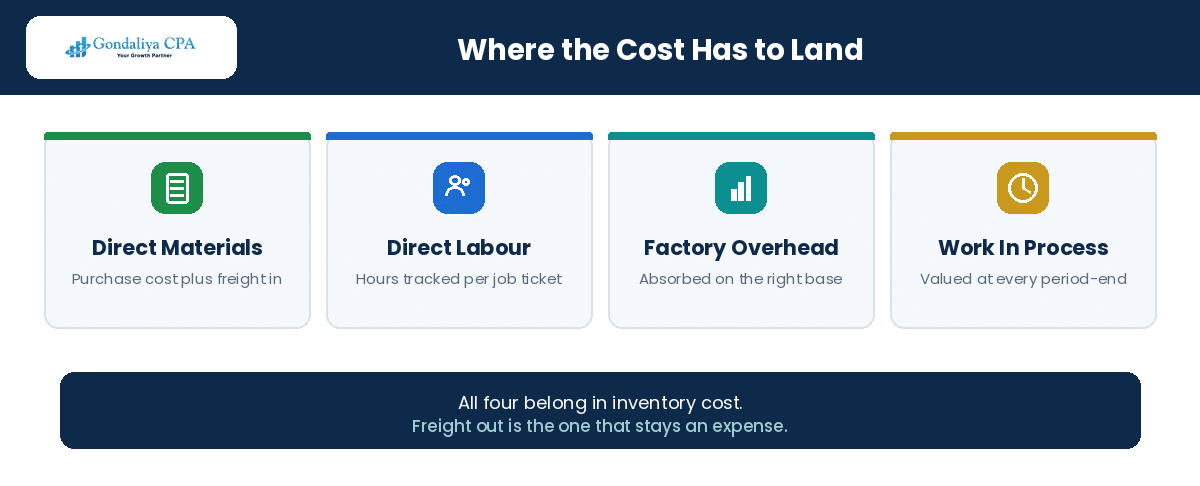
Manufacturing cost accounting breaks down expenses into key parts. These include direct materials, direct labor, and overhead absorption.
- Direct Materials: Raw materials used right in making products.
- Direct Labor: Pay for workers who build the items.
- Overhead Absorption: Indirect costs like utilities, rent, or equipment wear that can’t be tied to one product.
Tracking these costs carefully matters a lot. They affect profit calculations like gross margin or how you price products.
Knowing how these costs work together lets manufacturers plan budgets better. They can find waste and improve efficiency across their operations.
Manufacturing Inventory Accounting and Job Costing Explained
Manufacturing inventory accounting deals with stock at all stages—from raw materials to work in process (WIP) and finished goods ready to sell.
Choosing between job costing or process costing depends on your setup:
- Job Costing: Best for custom projects where each job has its own specs; costs tracked per job.
- Process Costing: Fits mass production of similar products; costs averaged over many units.
Starting 2026, inventory valuation rules update under ASPE standards. This affects how WIP accounts get handled. The goal is clearer records during CRA audits if they happen.
Managing inventory means checking updates often along the supply chain. This keeps recorded amounts matching physical counts. Doing this well helps financially and gives companies a strong edge against competitors.
The overhead base is chosen once and then rarely revisited. Plants that automate keep applying labour hours for years, and every product cost quietly drifts away from reality. Figures changed for privacy.
Risk Warning: Inventory valued without factory overhead understates the asset and overstates the expense. Please confirm what your system is absorbing before pricing off those numbers.
Addressing Manufacturing Industry Financial Challenges
Addressing Manufacturing Industry Financial Challenges
The Challenges
Common Accounting Challenges for Manufacturers: Inventory Valuation, Overhead Allocation, and Equipment Depreciation
Manufacturing bookkeeping Canada means dealing with some tricky accounting parts. Things like inventory valuation, overhead absorption, and equipment depreciation need careful attention. These affect how accurate your costs and reports turn out.
Inventory valuation decides the cost of goods sold (COGS) and how much stock you show on your books. Canadian rules say you must value inventory at the lower of cost or net realizable value. Cost covers direct materials, labour, and manufacturing overhead but not other expenses. If you don’t track this right, profits or taxes might be wrong.
Overhead allocation is another tough one. You have to pick a base—maybe machine hours or labour hours—and keep using it all year. Wrong rates can mess up product costing and profits. Checking regularly helps catch under- or over-absorption early. Then you fix it before year-end.
Equipment depreciation changes tax deductions through capital cost allowance (CCA) claims and affects asset values on your books. You should keep a clear asset list showing purchase dates, CCA classes from CRA Regulation 1100 Schedule II, disposals, plus repairs versus improvements. Mixing these up can cause trouble during CRA audits.
Here’s an example: A metal fabricator in Toronto forgot to add factory maintenance into their overhead pool. That missed $45,000 in product costs for the year ended December 31 [just an example]. Their gross margins looked better than they really were until they fixed this monthly by reconciling with ASPE rules.
Managing Manufacturing Cash Flow and Profit Analysis
Good cash flow needs accurate manufacturing bookkeeping services that catch costs as they happen versus sales. Job costing reports help here by breaking down each order’s profitability clearly.
They track raw materials used, labour hours per job ticket, scrap rates, rework expenses, and overheads allocated.
Cost tracking shows where money leaks happen:
- Material use variance points out buying inefficiencies.
- Labour efficiency variance flags overtime or slowdowns.
- Scrap rate trends show where quality needs fixing to cut waste.
Profitability management puts these insights into monthly reports showing gross margin by product line with comparisons between actual and expected costs.
Closing your month right means posting accruals like freight-in for landed cost properly. Also, watch receivables carefully to avoid cash shortages — many manufacturers juggle multiple contracts at once across Ontario’s markets.
Job Costing Report Components
| Component | Purpose | Impact on Cash Flow & Profitability |
|---|---|---|
| Raw Materials Usage | Tracks what’s used vs purchased | Helps control purchase budget |
| Direct Labour Hours | Measures time spent on each job | Spots overtime or efficiency problems |
| Overhead Allocation | Applies indirect costs | Makes sure full costs hit product pricing |
| Scrap & Rework Costs | Records losses and recoveries | Guides waste reduction efforts |
Compliance Risks and Regulatory Obligations for Canadian Manufacturing Companies
Canadian manufacturers face strict rules from CRA that impact bookkeeping tied to tax planning in this sector.
CRA says you must keep books and records for six years after the last tax year they cover. Electronic records are okay if systems keep data safe and intact over time.
GST/HST input tax credit rules require supplier invoices to show certain details like vendor registration numbers. Missing info means credits may get denied — so taxes go up.
Tax planning here also means knowing when repairs are deductible immediately versus when improvements must be capitalized. Watch out for the half-year rule when claiming CCA on new assets bought mid-year. Plus keep current SR&ED documentation if you do research work.
Not following these rules can lead to penalties based on record issues that often cause audits—especially if inventory numbers jump around without good reason or write-downs lack support.
Setting up checks in monthly closes helps reduce risks and keeps corporate income tax filings on time under T2 schedules across Ontario including Toronto jurisdictions.
For questions about improving your manufacturing bookkeeping services in Toronto/Ontario, reach out to Gondaliya CPA at info@gondaliyacpa.ca or call 647-212-9559 for a free chat about your specific needs.
Missing costs from the overhead pool is the error that flatters a plant most. Margins look strong right up until someone reconciles the pool and the whole year restates. Figures changed for privacy.
Key Stat: A supplier invoice missing the vendor’s GST/HST registration number can cost you the input tax credit. Please check invoice detail at entry rather than at filing.
Specialized Manufacturing Accounting Services in Canada
Specialized Manufacturing Accounting Services in Canada
The Services
Manufacturing-Focused Accounting and Bookkeeping Services
Manufacturers need bookkeeping that fits their complex processes. Manufacturing bookkeeping Canada means tracking raw materials, work in progress, finished goods, direct labour, overheads, and inventory carefully. This kind of manufacturing accounting ties all those parts together to help control costs and report finances properly.
Good manufacturing bookkeeping services keep clear records for inventory bookkeeping for manufacturers. They also handle manufacturing cost accounting records that meet CRA rules. This work covers expenses like tooling costs, maintenance fees, freight-in charges for production inputs, and even scrap recovery amounts.
A licensed Ontario CPA firm makes sure the chart of accounts suits industry needs. It separates factory overhead from admin costs. They use ASPE standards to measure inventory correctly. Monthly reconciliations check that manufacturing financial reports stay accurate and help prepare tax filings on time.
- Track raw materials and finished goods
- Record labour and overhead costs
- Maintain detailed expense logs
- Reconcile accounts monthly
Tax Preparation, Corporate Tax Planning, GST/HST Filing, and Year-End Financial Statements
Tax preparation for manufacturers involves gathering full data sets that reflect product costing under section 10 valuation rules. Corporate tax planning deals with timing gaps between cash flow recognition and taxable income caused by work in process or asset depreciation.
GST/HST filing demands precise input tax credit documentation on purchases. This includes imported items with duties or brokerage fees. Correct landed cost recording keeps you aligned with Excise Tax Act rules about eligible credits.
Year-end financial statements come from CSRS 4200 compilation engagements. These statements give owners clear views of profits by product line. They help guide pricing choices based on manufacturing profit figures.
- Collect accurate costing data
- Plan taxes around cash flow timing
- Document GST/HST input tax credits thoroughly
- Prepare clear year-end financial statements
Audit Resolution and CRA Rules Related to Manufacturing Profits
CRA audit risk rises when manufacturers show uneven margins or unsupported inventory write-downs without proof. Keeping strong records—including shop floor tickets that confirm job costing—is key to backing reported profits during reviews.
Manufacturing profit taxation follows Income Tax Act rules requiring a clear split between operating income and one-time items like obsolete stock disposals. Not keeping proper books can lead to penalties under subsection 230(1) ITA.
Monthly variance checks spot issues early. If an audit notice (AUT-01) arrives, a licensed Ontario CPA firm can represent the manufacturer for a smoother resolution that meets CRA standards.
- Keep detailed job costing tickets
- Separate normal income from unusual items
- Avoid penalties by maintaining proper books
- Use monthly variance analysis
CPA Compilation Reports and Incorporation Services for Manufacturers
Incorporated manufacturer bookkeeping Ontario clients get specialized compilation reports built for their complex needs. These reports convert trial balances into GIFI codes needed for T2 returns while highlighting key performance indicators useful to plant managers or owners.
Gondaliya CPA offers incorporation services fit for Canadian fabricators. They handle business number registration and set up program accounts needed for payroll remittance deadlines under current laws.
As a licensed Ontario CPA firm with many positive reviews, the team blends expertise with affordability. They work well with QuickBooks systems common in Canadian plants to speed up monthly closes essential for clean year-end packages used in corporate tax filings.
- Create tailored compilation reports
- Map accounts to GIFI codes accurately
- Register businesses and set up payroll accounts
- Support QuickBooks-based plant accounting systems
For help with your manufacturing accounting across Toronto/Ontario or Canada-wide, contact Gondaliya CPA at info@gondaliyacpa.ca or call 647-212-9559 for a free consultation focused on incorporated manufacturers’ cost tracking needs.
Shop floor tickets are what turn a job costing report from an estimate into evidence. Without them the numbers are a model, and a reviewer will treat them that way. Figures changed for privacy.
Pro Tip: Please separate factory overhead from administrative costs in the chart of accounts at setup. Untangling them later means restating product costs across every job.
Transparent Pricing and Affordable Packages for Manufacturing Businesses
Transparent Pricing and Implementation Process
The Packages
Manufacturing bookkeeping services in Canada need clear prices. Manufacturers want to avoid surprises when managing costs. Transparent pricing helps incorporated manufacturing businesses see exactly what they pay for manufacturing accounting. Affordable manufacturing bookkeeping services focus on the unique needs of Canadian manufacturers. This way, companies can control costs better and plan their taxes with more confidence.
Clear Pricing Structures and No Hidden Fees
We charge a flat annual fee that includes HST. It covers bookkeeping, cost accounting, GST/HST filing, payroll, and corporate tax prep. You won’t find hidden fees like with hourly billing or piecemeal services. Manufacturers get budget certainty with expert help designed for tough manufacturing setups.
Affordable manufacturing bookkeeping services need to balance quality and price. We fix core services under one fee so you avoid surprise costs during busy months or year-end tax time. This clear pricing builds trust. That’s important since financial records face strict CRA checks.
Flexible Packages Tailored to Manufacturing Needs
Manufacturers come in all types—metal fabricators needing job costing, or food processors tracking perishable stock. Our bespoke manufacturing bookkeeping services fit your business’s way of working. That means accurate data that matches how you operate.
Our packages can include extra manufacturing cost accounting features like:
- Labour and overhead allocation details
- Inventory valuation using ASPE standards
- Reports on scrap rates and work-in-progress balances
This flexibility helps track manufacturing costs closely. It gives better insight into margins and helps make smart decisions across Ontario’s varied industries.
The Implementation Process: Consultation, Customized Strategy, Execution, and Ongoing Support
We follow a clear process to onboard incorporated manufacturers all over Ontario and Canada-wide. It helps build bookkeeping systems that meet CRA rules and improve tax planning.
Initial Consultation and Needs Assessment
First, we check your records against CRA compliance rules for manufacturers. This includes the books-and-records rules under ITA section 230(1). We find missing inventory documents, payroll time-tracking errors, incomplete asset registers, and other key controls for your specific industry—like plastics moulding or automotive parts.
This check shows what needs fixing before we set up monthly close procedures.
Development of Customized Accounting Strategy
We create a custom plan based on what we find. The focus is on strong manufacturing cost tracking methods suited to your type of production—whether job costing or process costing—and how complex it is. We design charts of accounts from raw materials through finished goods flows; set overhead bases; include freight-in costs in inventory; add variance analysis steps; and match timing between shop floor reports and accounting records.
This setup improves product costing accuracy, which affects profits and tax deductions under ITA sections 10 & 18(1)(a).
Timely Execution and Regular Reporting
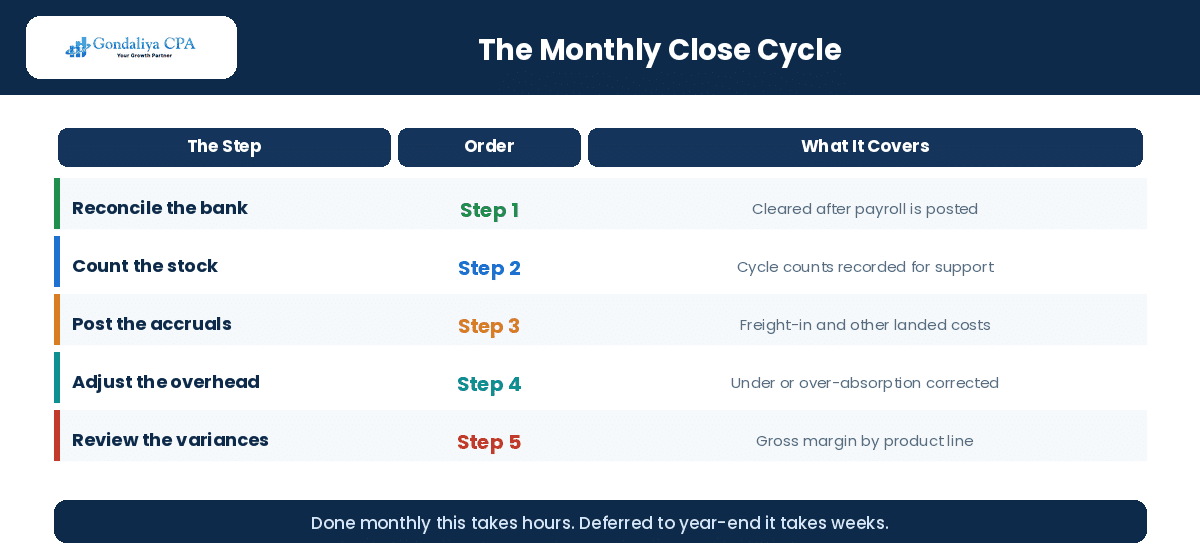
We work on a strict schedule that focuses on monthly close controls inside your plant: bank reconciliations after payroll; physical counts done with cycle counts recorded for audits; accruals posted alongside overhead adjustments; capital assets updated per CCA class rules found in Regulation 1100 Schedule II.
Reports give owners useful info like gross margin by product line plus variance reports highlighting issues needing attention. This supports better cash flow management required by Canadian corporate rules.[CRA source]
Continuous Support and Adjustments as Needed
Our CPAs provide ongoing help as regulations change—like the new 2026 rules on electronic record keeping or SR&ED documentation—that get added smoothly without messing up your workflow.[CRA update] We’re available evenings or weekends with replies within one business day backed by our 30-Day Money-Back Guarantee plus a 60-Day Fees-Matching Policy anywhere in Toronto, Ontario, or across Canada.
CPA Qualifications, Guarantees, and Trust Signals in Manufacturing Accounting
Choosing an experienced CPA firm focused on Canadian incorporated manufacturers matters because this sector has tricky inventory rules (section 10), capital asset classes (CCA), GST/HST credit rules,[Excise Tax Act]and special reporting standards (ASPE).[CPA Canada]
CPA Certification And Manufacturing Sector Expertise
Gondaliya CPA is a licensed Ontario CPA firm based in Toronto serving incorporated SMBs nationwide including Etobicoke, Vaughan, and Mississauga among other industrial hubs. Our lead Sharadkumar Gondaliya holds both CPA Ontario membership plus US licenses giving cross-border know-how while sticking to Canadian law. This lets us handle metal fabrication, millwork, electronics assembly, and contract manufacturers well with solutions that fit each client’s unique recordkeeping challenges.[CPA Ontario directory]
Service Guarantees And Satisfaction Policies
Clients get flat-fee pricing including HST with no surprise bills. We promise replies within one business day, a 30-Day Money Back Guarantee if not happy, and competitive fee matching valid for sixty days after starting. These promises rest on more than “1300+ five-star Google reviews” showing steady quality at prices rarely found at this expertise level.[Google Reviews snapshot]
Billing transparency means clear scopes too—no audits or customs advice but full corporate tax filing, T2 cleanups, GST/HST remittance, payroll admin, and compilation engagements following CSRS4200 standards for reliable statements lenders, covenant monitors, and shareholders trust.[CSRS4200 reference]
Client Testimonials And Case Studies
Our Canadian incorporated manufacturer clients report clearer profit views after switching to our bespoke cost accounting frameworks. Some saw less risk from unsupported write-down claims thanks to thorough evidence gathering matched to CRA needs. Others cut month-end backlog from six months down dramatically showing real gains in efficiency. Toronto-area food processors say adding freight duty into landed cost helped spot true margins leading smarter buying decisions. All stories show value beyond skills—ongoing advice builds long-term trust in changing rules.
For personalized help improving your manufacturing bookkeeping Canada setup contact us at info@gondaliyacpa.ca or call 647-212-9559 for a free consultation focused on better compliance & profits across Ontario & Canada-wide operations.
Landed cost is the item most often left out. Freight and duty sitting in an expense account rather than inventory makes every imported input look cheaper than it is. Figures changed for privacy.
Verification: Our CPA Ontario firm registration can be checked on the public firm directory. Please verify any firm you engage before sharing costing and production records.
Real-World Applications and Client Success Stories
Real-World Applications and Client Success Stories
The Results
Manufacturing bookkeeping Canada needs careful cost tracking and precise financial records. These help companies meet government rules and improve profits. Manufacturing accounting mixes inventory management, labour costs, overhead, and asset tracking. Together, these parts keep records clear for CRA and offer useful info for business choices.
Practical Benefits: Accurate Tax Compliance and Financial Decision-Making Support
Good manufacturing bookkeeping services are key to following Canadian tax laws. Keeping detailed cost accounting helps manufacturers prove their claims on inventory value, work in progress (WIP), and deductions like capital cost allowance (CCA). This lowers the chance of fines from bad record keeping or unsupported expenses.
Besides taxes, strong manufacturing bookkeeping Canada helps produce fast financial reports. These reports show where costs differ from what was planned. Plant controllers can then fix production or supplier deals quickly. Data on raw materials, scrap rates, labour hours, and overhead improves budgets across departments.
Monthly checks of inventory accounts stop errors in financial statements. They also help manage cash flow by predicting buying needs against sales cycles. Manufacturing accounting links tax duties with practical data that boosts profit margins.
Manufacturing Accounting Case Studies: Inventory Accuracy, Tax Deductions, and Cost Tracking
A metal fabrication company in Toronto hired Gondaliya CPA after finding big gaps between physical stock counts and records. The fix was a monthly close checklist plus electronic record storage. Inventory accuracy rose 15%, cutting write-downs from obsolete stock with proof under Income Tax Act section 10[1].
A food processor in Mississauga spotted extra overtime costs hidden in job costing. Fixing payroll to match shop floor timesheets signed by supervisors improved SR&ED documentation for research credits[2]. This helped taxes and internal profit checks.
A plastics injection moulder switched overhead rates from labour hours to machine hours because their process is mostly automated[3]. This change stopped overcharging that hid real unit costs. Monthly variance reports gave clearer pricing options without losing margin.
These stories show how manufacturing bookkeeping services aid CRA audits and boost business clarity needed for growth inside Canada’s rules.
Team Bios and Professional Expertise in Manufacturing Accounting
Gondaliya CPA’s team knows manufacturing bookkeeping Canada well. They’ve worked with car parts suppliers, electronics plants, chemical makers, contract manufacturers, and more. Sharadkumar Gondaliya leads as an Ontario CPA expert in corporate tax for incorporated small and medium manufacturers across Canada.
Vandana Goel supports by reviewing work carefully to follow ASPE standards for inventory under CSRS 4200 compilations[4]. Their team uses tools like QuickBooks with Hubdoc for document automation. This makes month-end closing faster while keeping control of asset registers and landed cost calculations including freight per Excise Tax Act rules[5].
Clients get quick answers with policies like a 30-Day Money-Back Guarantee plus weekend help options. This builds trust while handling complex manufacturing accounting systems facing updated CRA rules through 2026[6].
References:
[1]: Income Tax Act Section 10 – Inventory Valuation
[2]: CRA SR&ED Documentation Requirements
[3]: CPA Canada Guidance on Overhead Absorption Methods
[4]: CSRS 4200 Compilation Engagement Standards
[5]: Excise Tax Act Sections Regarding Input Tax Credit Documentation
[6]: CRA Electronic Records Retention Rules Update (2026)
Switching from labour hours to machine hours is the single change that most often reveals a plant was pricing its automated work wrongly. Figures changed for privacy.
Risk Warning: Inventory write-downs without supporting evidence are among the first items questioned on review. Please keep the obsolescence assessment alongside the entry.
Serving Manufacturers Across Ontario: Locations and Contact Information
Serving Manufacturers Across Ontario
The Coverage
Gondaliya CPA offers manufacturing bookkeeping Canada services for incorporated manufacturers, fabricators, and processors all over Ontario. We know manufacturing accounting inside out, so your costs stay accurate and you comply with CRA rules. Our clients come from places like Toronto, Etobicoke, Vaughan, Mississauga, Brampton, Scarborough, Ottawa, Oshawa, Guelph, Hamilton, North York, and Windsor.
Because we are local, we support plant controllers and office managers right when they need it. Whether your metal shop runs in Hamilton or you assemble electronics in Toronto’s industrial zone, our affordable manufacturing bookkeeping services fit well with your setup. We help you get better financial reports without hassle.
Reach out at 647-212-9559 or info@gondaliyacpa.ca to chat about improving your manufacturing cost accounting while following Canadian tax laws.
Starting Up with Bookkeeping and Payroll Services for Manufacturing Businesses
Manufacturing bookkeeping services lay the groundwork for good money management in new Canadian manufacturers. You need to record raw materials and finished goods sales properly to keep manufacturing cost accounting solid for tax planning under the Income Tax Act (ITA).
We help startups build a chart of accounts that shows direct labour costs plus factory overheads like maintenance and tooling. Our payroll setups use trusted platforms like ADP or Wagepoint to track labour expenses correctly by job — just as manufacturing standards require.
Keeping close tabs on expenses early cuts down month-end mistakes common in growing plants without ERP systems. This also helps claim GST/HST input tax credits by keeping proper papers as the Excise Tax Act needs.
Starting with good bookkeeping protects cash flow and gives owners a clear look at what makes profits from day one.
Advisory and Additional Services for Canadian Manufacturers
Gondaliya CPA goes beyond basic bookkeeping with advice on tougher parts of manufacturing accounting for incorporated Canadian businesses. We cover:
- Manufacturing Cost Accounting: Adjust overhead rates using machine hours vs labour hours to make product costing more exact.
- Inventory Valuation Compliance: Help with section 10 valuation methods keeps inventory true to economic value and meets ASPE rules.
- Tax Planning Strategies: Corporate tax plans use capital cost allowance classes for machinery investments common in contract manufacturers.
- Financial Reporting Enhancements: Reports show scrap rates and work-in-process levels that matter for decisions on the floor.
Our advice works with your bookkeeping to spot problems early — cutting risks during CRA checks over unsupported write-downs or weird profit margins.
Expert help also tightens control over complex costs like landed costs (freight/duty included), which often get missed but affect taxable income under Excise Tax Act rules on imports.
Contact Gondaliya CPA at 647-212-9559 or info@gondaliyacpa.ca for advice tuned to Ontario’s business climate.
New plants underestimate how much depends on the chart of accounts built in the first month. Rebuilding it two years in means restating every comparative figure. Figures changed for privacy.
Key Stat: Records must be kept six years after the last tax year they relate to. Electronic storage is acceptable provided the data stays intact and readable for that whole period.
Frequently Asked Questions (FAQs)
Frequently Asked Questions (FAQs)
FAQ
What is included in a manufacturing bookkeeping flat annual fee including HST?+
Gondaliya CPA’s flat fee covers bookkeeping, cost accounting, GST/HST filing, payroll, and corporate tax preparation with no hidden charges.
When are payroll source deduction remittance due dates in Canada?+
Remittances are due monthly or quarterly depending on your business size. Gondaliya CPA ensures timely filings to avoid penalties.
How does the capital cost allowance half-year rule affect asset depreciation?+
The half-year rule allows only 50% of the CCA claim in the acquisition year for eligible assets, impacting tax deductions.
What is the records retention period required by CRA?+
CRA mandates retaining all books and records for six years after the last tax year they relate to.
What is the T2 corporate tax return filing deadline?+
T2 returns must be filed within six months after your fiscal year-end to avoid late filing penalties.
How do you clean up books that fell behind in manufacturing bookkeeping?+
Review all transactions, reconcile accounts, correct errors, update inventory and asset registers before resuming monthly closes.
What bookkeeping weaknesses trigger a CRA review for manufacturers?+
Weaknesses include missing invoices, inconsistent inventory counts, unsupported expense claims, and poor job costing documentation.
What does a clean monthly close look like in a manufacturing plant?+
It includes bank reconciliations, physical inventory counts, accrual postings, overhead adjustments, and variance analysis reports.
Which reports should an owner review every month for manufacturing businesses?+
Owners should check gross margin reports, job costing summaries, cash flow statements, and inventory reconciliation sheets.
How does bookkeeping feed the T2 return and financial statements?+
Accurate bookkeeping provides data for taxable income calculation and ensures financial statements reflect true costs and profits.
Bookkeeping: In-house vs CPA firm vs non-CPA provider – which route fits manufacturers best?+
CPA firms like Gondaliya CPA offer expertise with compliance assurance. In-house may lack specialization. Non-CPAs risk errors and audits.
What deliverables do you get from specialized manufacturing bookkeeping services?+
Deliverables include detailed job costing reports, inventory valuation summaries, monthly variance analysis, and tax-ready financial statements.
What are best practices to keep manufacturing records clean year-round?+
Maintain organized source documents, perform regular reconciliations, update fixed asset logs promptly, and conduct monthly variance reviews.
Which cost records matter most across 10 manufacturing sub-sectors served by Gondaliya CPA?+
Raw materials usage, labour hours per job, overhead absorption rates, scrap and rework costs are key records monitored closely.
A realistic numeric walkthrough of overhead absorption rate calculation in manufacturing:+
Divide total overhead costs by total machine or labour hours. Apply this rate uniformly to each product unit cost for accuracy.
How to choose the right CPA firm in Toronto/Ontario for manufacturing bookkeeping?+
Look for sector experience, transparent pricing, proactive communication, local CRA knowledge, and tailored service packages like Gondaliya CPA offers.
Why trust Gondaliya CPA for your manufacturing bookkeeping needs? (E-E-A-T)+
We hold Ontario CPA licenses with cross-border expertise. Our proven track record includes 1300+ five-star reviews ensuring quality and compliance.
Essential Bullet Points: Manufacturing Bookkeeping Insights
Essential Manufacturing Bookkeeping Insights
Quick Reference
- Manufacturing Bookkeeping Flat Annual Fee Including HST: Fixed pricing covers all core accounting services without hidden fees.
- Payroll Source Deduction Remittance Due Dates: Monthly or quarterly remittance schedules maintained per CRA requirements.
- Capital Cost Allowance Half-Year Rule: Limits first-year depreciation claims on new equipment purchases.
- Records Retention Period: Six years retention ensures audit readiness under Income Tax Act rules.
- T2 Corporate Tax Return Filing Deadline: Due six months post fiscal year-end to prevent penalties.
- Cleaning Up Books That Fell Behind: Systematic reconciliation of transactions and asset updates restore accuracy.
- Bookkeeping Weaknesses Triggering CRA Review: Incomplete records or unsubstantiated expenses raise flags during audits.
- Clean Monthly Close Steps in Plant: Bank reconciliations → Physical counts → Accruals → Overhead posting → Variance analysis.
- Monthly Owner Review Reports: Gross margin by product → Job costing → Cash flow forecast → Inventory adjustments.
- Bookkeeping Feeding T2 Returns & Financial Statements: Precise data input supports accurate taxable income reporting.
- In-house vs CPA Firm vs Non-CPA Provider: CPAs provide compliance assurance; other options carry higher risk of errors.
- Deliverables From Manufacturing Bookkeeping Services: Job costing detail → Inventory valuation → Variance reports → Tax-ready files.
- Best Practices To Keep Records Clean Year-Round: Organize documents → Monthly reconciliations → Asset register updates → Variance checks.
- Key Cost Records Across Manufacturing Sub-Sectors: Material usage data → Labour tracking → Overhead rates application → Scrap cost monitoring.
- Overhead Absorption Rate Calculation Example: Total overhead ÷ total labour or machine hours = absorption rate per unit hour.
- Choosing The Right CPA Firm For Manufacturing Bookkeeping: Industry expertise + transparent pricing + regulatory knowledge = optimal fit.
- Trust Factors For Gondaliya CPA (E-E-A-T): Licensed Ontario CPAs with extensive client satisfaction and proven CRA audit support history.
Seventeen points and one habit underneath them all: close the month properly. Everything else on that list follows from doing it, or fails from skipping it. Figures changed for privacy.
Manufacturing Sub-Sectors We Serve
Industry Expertise
Which cost record matters most differs by sub-sector. Here are ten and the usual focus.
| Manufacturing Sub-Sector | The Cost Record That Matters Most |
|---|---|
| Metal fabrication & machining | Machine hours driving the overhead rate |
| Food & beverage processing | Yield loss and shrinkage against batches |
| Plastics & injection moulding | Cycle time and scrap by mould |
| Automotive parts & components | Actual cost per unit against contract price |
| Electronics & equipment assembly | Work in process across long build cycles |
| Furniture & wood products | Raw material price movement in inventory |
| Chemicals & industrial coatings | Batch costing and waste treatment costs |
| Printing & packaging | Job-level costing on short runs |
| Textiles & apparel production | Obsolescence support for seasonal stock |
| Contract & private-label manufacturers | Customer-owned material kept off the books |
- Metal fabrication and machining: If the overhead base is labour hours in an automated shop, every job is costed wrongly.
- Food and beverage processing: Yield loss has to be costed deliberately rather than vanishing into variance.
- Plastics and injection moulding: Scrap by mould tells you which tools are actually losing money.
- Automotive parts and components: Fixed-price contracts only work where the true unit cost is known, not estimated.
- Electronics and equipment assembly: Long builds mean work in process carries real value at every close.
- Furniture and wood products: Material price swings make the FIFO or weighted average choice matter.
- Chemicals and industrial coatings: Disposal and compliance costs belong in product cost, not general overhead.
- Printing and packaging: Short runs hide unprofitable work unless costing happens at job level.
- Textiles and apparel production: Writedowns need an obsolescence assessment kept with the entry.
- Contract and private-label manufacturers: Customer-owned material on your balance sheet overstates inventory and distorts margin.
The sub-sector changes which record matters most. It does not change the discipline, which is closing the month properly every month. Figures changed for privacy.
Professional Guidance and Quick Reference
Guidance
Professional Guidance on Bookkeeping: How Gondaliya CPA Builds Reliable Cost Records
Manufacturing bookkeeping earns its cost in one place: knowing what each product actually costs to make. That depends on an overhead base matching how the plant runs, work in process valued at each close, and a monthly cycle that gets done rather than deferred. Gondaliya CPA handles the full cycle on a fixed annual fee including HST.
We handle what decides the outcome: designing the chart of accounts from raw materials through to finished goods, separating factory overhead from administrative costs, setting the absorption base against actual cost drivers, costing work in process at every period-end, bringing freight and duty into landed cost, running monthly reconciliations and variance analysis, keeping the fixed asset register current by CCA class, and preparing the year-end compilation and T2.
Our team produces the reporting that changes decisions on the floor, including gross margin by product line and variance against standard. Books current or months behind, you get clear advice and a fixed price before we start.
Quick Answers: Key Numbers & Concepts at a Glance
At a Glance
- Inventory basis: Lower of cost or net realizable value
- Cost includes: Materials, labour and factory overhead
- Freight-in: Inventory; freight-out is an expense
- Costing methods: Job for custom, process for volume
- Overhead base: Machine or labour hours, applied consistently
- Half-year rule: 50% of the normal first-year claim
- Records retention: Six years after the tax year
- T2 deadline: Six months after fiscal year-end
- Compilation standard: CSRS 4200
- Close cycle: Monthly, with variance analysis
Who This Is For / Not For
Fit Check
- For: Incorporated Canadian manufacturers, fabricators and processors needing reliable cost records and monthly reporting.
- Not For: Audit or review engagements, or customs advice, which sit outside our scope; we prepare compilations under CSRS 4200.
People Also Ask
Related Questions
Should I use machine hours or labour hours for overhead absorption?+
Whichever reflects what actually drives cost in your plant. Automated operations usually point to machine hours; labour-intensive work points to labour hours.
Does freight-in belong in inventory or in expenses?+
Inventory. Freight-in is part of the cost of getting goods to a saleable condition; freight-out is a period expense.
How often should a manufacturer count inventory?+
Cycle counts through the year are more reliable than one annual count, and they make the year-end figure far easier to support.
Glossary of Key Terms
- Direct materials: Raw materials used directly in making the product.
- Direct labour: Wages of the staff who build the product.
- Overhead absorption: The method allocating indirect factory costs into product cost.
- Absorption base: The driver, usually machine or labour hours, used to apply overhead.
- Under-absorption: Where applied overhead falls short of actual overhead incurred.
- Job costing: Costing tracked per individual job or order.
- Process costing: Costing averaged across units in continuous production.
- Work in process: Goods partly completed at period-end, carrying material, labour and overhead.
- Net realizable value: Estimated selling price less costs to complete and sell.
- Landed cost: Purchase price plus freight, duty and brokerage brought into inventory.
- Cycle count: A partial inventory count performed through the year.
- Variance analysis: Comparison of actual costs against standard or expected costs.
- Scrap and rework: Material lost or reprocessed, recorded against the job it relates to.
- GIFI: The General Index of Financial Information, filed with the T2.
- CSRS 4200: The Canadian standard governing compilation engagements.
- Fixed asset register: The record of assets, purchase dates, CCA classes and disposals.
Bookkeeping Readiness Check
This quick self-check indicates where your operation most likely has room. Please answer the six questions below.
Bookkeeping Readiness Check
Six quick questions on your records. No fee shown.
Points to raise with us:
This is a general prompt, not tax or legal advice or a quote. Your position depends on your full facts. For a real review, please book a free consultation.
Want a checklist to work from? You can download our free manufacturing bookkeeping checklist before your consultation.

Absorb factory overhead into inventory. Pick the base that matches what drives cost, and keep it all year. Cost work in process at every close. Put freight-in into landed cost. Run cycle counts through the year. Reconcile monthly and review variances. Keep the asset register current by CCA class. Keep everything six years.
2026 Update — what is current: This article notes ASPE inventory valuation updates and new electronic record keeping rules taking effect in 2026. The six-year retention rule, the lower of cost or net realizable value basis, the six-month T2 deadline, the half-year rule and CSRS 4200 compilation standards are unchanged. Please note the article cites books and records to subsection 230(1), refers to AUT-01 as an audit notice where it is the authorisation form for a representative, and describes payroll remittances as monthly or quarterly without noting accelerated remitter schedules, so please confirm each before relying on it.
Manufacturing Bookkeeping Canada: Expert Manufacturing Accounting and Cost Accounting Services by Gondaliya CPA
Fix the overhead base before anything else
Gondaliya CPA designs the chart of accounts around your production flow, sets the overhead absorption base against real cost drivers, values work in process at each close, brings freight and duty into landed cost, runs monthly reconciliations and variance reporting, keeps the asset register current, and prepares the compilation and T2, on a fixed annual fee including HST with a one-business-day response. Please book a free consultation.
Next Steps
Please book a free consultation with Gondaliya CPA and bring your last financial statements, your most recent inventory report including work in process, and a note of how overhead is currently applied. Those three tell us immediately whether your product costs are reliable and where the reporting gaps sit. You will get a fixed annual fee before any work begins. If our content helps, please add gondaliyacpa.ca as a preferred source on Google.
Published: August 19, 2026 · Last updated: August 19, 2026
Editorial policy: We research against CRA and CPA Ontario sources, fact-check the figures, and Sharad Gondaliya, CPA, reviews the content, which we update as the rules change.
Disclaimer: This article is educational information only and is not tax, legal, or financial advice. Figures marked illustrative are examples rather than quotes or guarantees. It reflects CRA rules current to 2026, including the six-year record retention requirement, the lower of cost or net realizable value inventory basis, the six-month T2 filing deadline, the half-year rule on new assets, and CSRS 4200 compilation standards. Rates, limits and expensing rules change and outcomes depend on your specific facts. Please consult a licensed CPA before acting.

Sharad Gondaliya is a CPA Canada & CPA USA with 15 Years+ experience of Accounting, Tax, Payroll of Corporate Small Businesses as Tax Accountant. He is fully certified CPA Ontario and CPA USA and is well known among corporate small businesses for tax planning, efficient tax solutions, and affordable CPA services. Sharad is the Principal (Director) of Gondaliya CPA – Affordable CPA Firm in Canada. Licenses: CPA Ontario: 61040184 | CPA USA (MT): PAC-CPAP-LIC-033176 | CPA USA (WA): 57629 | CPA Firm License: 61330051 View Full Author Bio