



Event Venue Tax Deductions: How Canadian Venue Owners Can Maximize Legitimate Business Expenses
Event venue tax deductions Canada help reduce costs on venue operating expenses, employee wages, and equipment purchases. Gondaliya CPA guides event venues like banquet halls, conference centres, and outdoor venues through CRA business expenses and GST/HST rules to maximize tax savings and ensure compliance.
Quick Summary
Four things decide what a venue can actually claim: whether a cost is current or capital, whether it is reasonable and tied to earning income, whether personal use has been separated out, and whether the paperwork exists. Please note that records must be kept six years after the tax year they relate to.
| Aspect | Details |
|---|---|
| The split | Repairs expensed, improvements capitalised. |
| The test | Reasonable, and tied to earning income. |
| The allocation | Personal use excluded, with a record. |
| The proof | Invoices, contracts, six-year retention. |
Reading time: 40 minutes.
Table of Contents
- Understanding Venue Expenses and Tax Deductibility
- Deductible Facility Costs and Insurance
- Staffing, Contractors and Employment Costs
- Event Production, Marketing and Administration
- Capital Cost Allowance Classes and Depreciation
- Tax Planning, Compliance and Financial Management
- Frequently Asked Questions (FAQs)
- Key Insights on Event Venue Tax Deductions
- Venue Types We Serve
- Professional Guidance and Quick Reference
The Numbers That Matter
This article covers Canada, with Ontario and Toronto context, and reflects rules current to 2026. It assumes an incorporated event venue such as a banquet hall, conference centre or outdoor property. Figures marked illustrative are examples, not quotes, and any masked engagement notes end with “Figures changed for privacy.” This is educational information only and not tax or legal advice. Licensing and zoning obligations differ by municipality and province, so please confirm the position where you operate.
Understanding Event Venue Business Expenses and Tax Deductibility in Canada
Understanding Venue Expenses and Tax Deductibility
The Basics
Event Venues Business Expenses: Overview of Deductible Categories
If you run an event venue, knowing which expenses you can deduct helps a lot. These deductions can save you money on your taxes. That means you keep more cash for your business or profits.
Here are some common deductible expenses for event venues:
- Rent or Lease Payments: What you pay to rent the space.
- Utilities: Bills for electricity, water, and gas.
- Insurance Premiums: Costs for property and liability insurance.
- Marketing Expenses: Money spent on ads and promotions.
- Employee Wages: Paychecks for your staff working at the venue.
Knowing these helps Canadian venues claim all their event venue business expenses right. It also keeps you safe with CRA rules.
Distinguishing Current Operating Expenses from Capital Expenditures
When claiming venue tax deductions, it’s key to tell apart current operating expenses from capital expenditures.
Current operating expenses happen regularly. Think of things like paying utilities, maintenance, or wages. You can deduct these fully in the year they occur.
Capital expenditures mean big purchases or improvements. Like buying new furniture or fixing up a ballroom. These usually aren’t deducted all at once. Instead, they get spread out over time through depreciation.
For example:
| Expense Type | Treatment | Class if Capital |
|---|---|---|
| Renovation of a ballroom | Capital expenditure | Class 1 (building) |
| Purchase of new chairs | Capital expenditure | Class 8 (furniture) |
Classifying expenses right makes sure you follow CRA’s Income Tax Act properly.
Criteria for Deductibility: Reasonableness and Income-Earning Purpose
Two main rules decide if an expense is deductible in Canada: it must be reasonable and tied to earning income.
First, reasonableness means the cost fits your business style. For instance:
- A fancy marketing campaign may be fair if you aim at high-paying clients.
- But spending too much on ads might seem unreasonable if your customers are budget shoppers.
Second, the expense must help make money. If you hold events just for fun with no profit plan, those costs don’t count as deductions under CRA rules.
Following these rules helps keep your tax filings honest and accurate.
Personal vs. Business Expenses: Allocations and Reporting Requirements
You need to separate personal from business costs when reporting event venue business expenses in Canada. Only the business-related ones should show up on tax forms.
Sometimes things get mixed — say you host a family party at your venue with catering costs involved. You can only claim the part used for actual client events as a deduction.
Keep solid records showing how much is personal versus business use. That way, CRA won’t question your claims during audits.
Experts like Gondaliya CPA know this stuff well and can guide you through it step-by-step.
Impact of Government Grants, Rebates, and Assistance on Expense Claims
Government grants or help programs for small businesses can affect your expense claims too. Many venues get these supports to ease cash flow or grow their business.
But here’s the catch: some grants might reduce how much of your expenses you can claim later on taxes. For example, if you received money that covered certain costs, those same costs might not be fully deductible again.
It can get tricky figuring out what applies when, so keeping detailed records is a must. Talking to professionals like Gondaliya CPA can save you headaches by clarifying local Ontario rules along with federal ones.
Their team knows how to help businesses use available funds correctly while keeping tax issues low every year.
Owners hosting a family event at their own venue is the allocation question we see most. Claim the client portion, document the split, and it stops being a problem. Figures changed for privacy.
Risk Warning: A grant that funded a cost generally reduces what you can claim on that same cost. Please track each grant against the expenses it covered.
Deductible Facility Costs: Rent, Mortgage Interest, and Property Taxes
Deductible Facility Costs and Insurance
The Facility
In Canada, event venue tax deductions let you write off costs like rent, mortgage interest, and property taxes if you use the space to make money. If your venue is incorporated, you can claim what you pay for leasing or owning the building you run your business from.
You can deduct rent fully if the lease shows the space is mainly for business[^1]. For properties you own, only mortgage interest counts—not the principal payments[^2]. Property taxes charged by your city are also deductible if they apply to your venue’s operations[^3].
Here’s a quick checklist:
- The expense must be needed and fair for running the venue.
- Exclude any personal use parts.
- You can only claim what you actually pay during the tax year. Prepaid rent might need spreading over time[^4].
- Keep leases, mortgage statements showing interest amounts, and property tax bills with proof of payment handy. No paperwork means no deduction.
Utilities and Related Services: Eligibility and Documentation
You can claim utilities like electricity, gas heating, water, and services such as HVAC maintenance under venue tax deductions. These keep your event space working day to day.
Only costs tied to business use count. If your place serves both personal and business needs, you have to split the costs fairly[^5]. Also, keep track of seasonal changes in usage with bills or meter readings.
Key points to remember:
- The expense must be only for earning income from events.
- There’s no set spending limit but don’t go crazy; high bills without reason could cause trouble.
- Save utility bills with the company name matching yours. Keep service invoices too.
Maintenance and Repairs: When to Expense Versus Capitalize
Maintenance means keeping things working without making them better or lasting longer—it’s a current cost you can fully deduct right away[^6]. Repairs fix damage or wear but don’t improve beyond how things were before.
If you do big upgrades that add value or extend life—like major renovations—you must treat these as capital expenses. These go into special categories like Class 1 (buildings) or Class 13 (lease improvements)[^7].
| Work Type | How To Treat | CCA Class | Records Needed | Source |
|---|---|---|---|---|
| Fix broken windows | Expense now | N/A | Invoice + before/after photos | CRA ITA s18(1)(a) |
| Upgrade ballroom fully | Capitalise | Class 1 / 13 | Contract + detailed scope | CRA ITA Reg110 Schedule II |
So basically: repairs get deducted right away; upgrades go into capital accounts with schedules[^8].
Groundskeeping, Landscaping, and Snow Removal Expenses
Taking care of lawns, landscaping, and snow removal helps keep your venue safe and nice looking outside.
These costs count as normal operating expenses if they just maintain land value without making it better[^9]. Contracts for seasonal services work fine if they cover areas open during events.
It helps to keep records showing when services happened compared to event dates. This helps explain expenses if CRA asks about seasonal patterns[^10].
Insurance Premiums: Types Eligible as Business Deductions
- Property insurance for buildings and equipment damage.
- Liability insurance including coverage for alcohol-related incidents.
- Business interruption insurance to cover lost earnings if something forces closure.
- Event cancellation coverage guarding against income loss from canceled bookings.[^11]
These premiums count as event venue tax savings since they protect your operations[^12]. But life insurance premiums are not deductible unless part of employee benefits according to CRA rules[^13].
Keep policy papers that show coverage periods plus receipts for premiums paid. These documents back up your claims during audits[^14].
Licenses, Permits, and Professional Fees Affecting Venue Operations
Your venue pays fees for licenses and permits from groups like provincial liquor boards, city licensing offices, fire safety inspectors, plus music tariffs like SOCAN/ReSound. You might also pay accountants or other pros for compliance help.
You can claim these as venue tax deductions if they relate directly to running a legal business in Canada15. But fines or penalties don’t count—they’re never deductible16.
Always keep invoices that say what each fee is for along with letters from regulators. This paper trail makes it easier if CRA checks your files17.
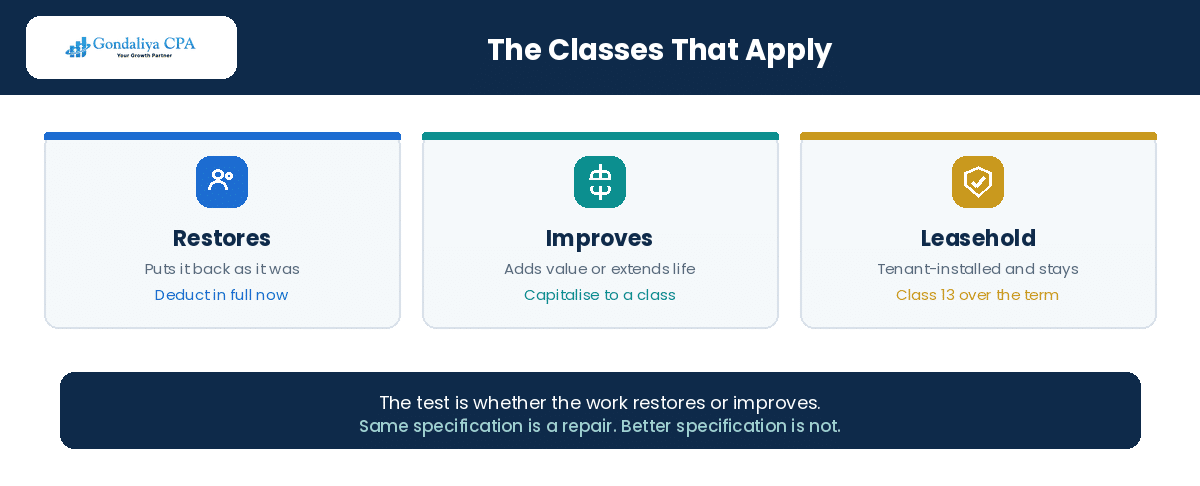
The repair-or-improvement line gets crossed most often on flooring and lighting. Replacing what was there is a repair; upgrading the specification is not. Figures changed for privacy.
Key Stat: Only the interest portion of a mortgage payment is deductible. Please make sure your bookkeeping splits interest from principal rather than expensing the whole payment.
Staffing, Contractor Payments, and Related Employment Costs
Staffing, Contractors and Employment Costs
The People
Running an event venue in Canada means dealing with staff pay, contractor fees, and other employment costs. These costs usually count as event venue business expenses if they are reasonable and tied to making money. It’s really important to figure out who is an employee and who’s a contractor for proper event venue tax deductions Canada.
Salaries, Wages, and Employer Contributions Deductibility
When you pay staff wages or salaries for working at your venue, those payments are deductible if they relate to running the business or hosting events. You can also deduct employer contributions like Canada Pension Plan (CPP), Employment Insurance (EI), and Workers’ Compensation fees according to CRA rules[^1].
To claim these deductions:
- Keep clear payroll records.
- Make sure payments match what the work is worth.
- Only count money actually paid during the tax year.
For example, if a banquet hall pays $120,000 in wages and $10,800 in employer CPP/EI contributions, both amounts can be deducted if documented well.
Remember: CRA wants you to keep payroll records and T4 slips for six years after filing[^2].
Payroll Source Deductions, CPP/EI Rules, and Employment Status Considerations
You must take income tax, CPP, and EI from employees’ paychecks and send this money to CRA on time[^3]. For incorporated venues in places like Ontario or Toronto:
- Payments usually must go in within 15 days after each month ends.
- Late payments mean daily interest charges.
Knowing who counts as an employee matters here. If you wrongly call employees contractors, you might lose deductions or face penalties[^4]. CRA checks things like control over work hours and who provides tools.
Example: If a conference centre treats servers as contractors but CRA says they’re employees, the venue could lose wage deductions.
Deductibility of Contractor Payments and Reporting Obligations (e.g., T4, T4A)
Paying true independent contractors is deductible as event venue business expenses. But if contractors give labour instead of being real contractors:
- You must give them T4A slips by February 28 after the year ends[^5].
- Missing this could mean losing deductions or fines.
Venues should have signed contracts that explain the service terms clearly. A common mistake is calling someone a contractor when they act like an employee.
Example: A nightclub paying $25,000 yearly for security through a third party can deduct that fully if they issue T4As properly.
Employee Benefits, Training, and Job-Related Expenses Eligible for Deduction
Benefits that help employees do their jobs—like employer-paid health plans—and training costs tied to their work count as deductible expenses under Canadian tax laws[^6]. This covers things like certification courses needed for liquor service or safety rules required by provinces.
Keep in mind:
- Benefits should not be mainly personal perks.
- Training bills must clearly link to job skills.
For example: An outdoor estate venue spends $7,500 each year on staff first-aid courses; this is deductible with good records.
Rules Regarding Meals Provided to Staff and Client Entertainment Expenses
Meals given to staff during work hours—say lunch at an event—usually are fully deductible. They don’t fall under the usual meals-and-entertainment limits because they support operations[^7]. But client entertainment meals get only 50% deducted unless special exceptions apply (like trade shows where attendance is required)[^8].
For example: Free tastings before weddings don’t automatically count unless they tie directly to making money per CRA guidance.
Keep records showing dates, times, and reasons for meal expenses. This helps avoid denial by CRA over personal benefits or excess costs.
- Income Tax Act sections 18(1)(a), 20(1)(a); CRA Payroll Deductions Online Calculator Guide
- CRA Record Keeping – https://www.canada.ca/en/revenue-agency/services/tax/businesses/topics/payroll/recordkeeping.html
- Excise Tax Act section 169; CRA Payroll Remittance Deadlines
- Income Tax Act section 248(1); CRA Employee vs Contractor Tool
- T4/T4A Filing Guide – https://www.canada.ca/en/revenue-agency/services/forms-publications/publications/t4001/employer-guide-payroll-deductions-contributions.html#t4010c01e04
- CPA Canada – Employee Benefit Plans Guidance
- Income Tax Act section 67.2(3); Meals & Entertainment Limit Exception
- CRA Interpretation Bulletin IT221R3 – Business Meal Expenses
Worker classification is the single largest exposure a venue carries. Bar staff scheduled by the venue, using the venue equipment, are usually employees whatever the invoice says. Figures changed for privacy.
Risk Warning: Calling an employee a contractor does not just cost the deduction. It brings back-dated source deductions and penalties. Please review the arrangements before an auditor does.
Event Production, Marketing, and Administrative Expenses
Event Production, Marketing and Administration
The Operations
Event venue business expenses cover many costs needed to keep a venue running smoothly. These expenses can qualify for venue tax deductions if they are reasonable, linked directly to making money, and well documented. Knowing which production, marketing, and admin costs you can deduct helps Canadian venue owners save on taxes.
Deductible Costs for Event Supplies and Cost of Goods Sold
Expenses for event supplies like linens, decorations, or tableware count as deductible if they tie directly to your business income. For incorporated venues in Canada:
- Supplies used during events are current expenses.
- Cost of goods sold (COGS) includes food and drinks served.
- Only costs paid or payable in the fiscal year count.
- Any personal use parts must be left out.
You’ll need receipts and inventory records to back up your claims with the CRA1. Categorize costs carefully so you don’t lose deductions over personal use or unreasonable amounts.
Advertising and Marketing Expenses Including Digital and Referral Commissions
Advertising costs that promote your venue are usually fully deductible in Canada2. This includes:
- Online ads on Google or social media.
- Website work related to booking.
- Photos or videos of your space.
- Trade show fees aimed at clients.
- Referral commissions paid to planners or agents.
The expense must make sense compared to your expected income. Spending too much could raise flags with CRA auditors3. Keep contracts with referral partners plus invoices for all marketing costs.
Booking, Software, and Payment Processing Fees for Venue Management
Fees for software managing bookings count as deductible if they help run your business. This covers:
- Subscription fees for booking systems like online calendars.
- Payment processing fees from credit cards or providers like Stripe.
CRA expects proof these services support earning income—not just convenience4. Hold on to monthly bills showing usage linked to booked events.
Office, Telephone, Utilities, and Administrative Overhead Expenses
| Expense Type | Deductibility Notes |
|---|---|
| Office rent | Fully deductible if office space is separate; allocate if shared |
| Telephone & internet | Portion tied directly to business calls and internet use |
| Utilities | Hydro/gas/water bills allocated based on space used by the venue |
| General supplies | Stationery or cleaning products linked directly |
Keep utility bills with the corporate name as proof5.
Documenting and Tracking Business Expenses for Accurate Tax Reporting
Good recordkeeping backs every tax deduction claim under event venue tax deductions Canada rules. To stay on CRA’s good side:
- Save original receipts/invoices with dates and supplier info.6
- Use accounting software like QuickBooks or Xero with bank feeds.7
- Separate each expense type: marketing vs utilities vs equipment.8
- Split mixed-use items fairly between personal/business using logs.9
Proper tracking lowers audit risks and makes sure you claim only what you really spent in Toronto/Ontario venues serving different clients.
References:
- CRA – Business Expenses Guide
- Income Tax Act Section 18(1)(a) – Advertising Expense Deduction
- CRA Audit Manual – Reasonableness Tests
- GST/HST Input Tax Credit Rules – Excise Tax Act Sections 169–170
- Property Taxes & Utilities Guidance – Canada Revenue Agency Publications
- Record Keeping Requirements – Income Tax Folio S4-F16-C1
- CPA Ontario Accounting Tools Recommendations
- Corporate Bookkeeping Best Practices – Gondaliya CPA Internal Guidelines
- Allocation Methods per ITA Regulation 1100 Schedule II
For personalized advice about your event venue tax deductions Canada, contact Gondaliya CPA at info@gondaliyacpa.ca or call 647‑212‑9559 for a free consultation tailored to incorporated venues across Toronto/Ontario.
Referral commissions to planners are the most commonly unclaimed venue expense we find. They are deductible; they just never make it out of the personal chequing account. Figures changed for privacy.
Pro Tip: Please make sure utility and phone accounts carry the corporate name. A bill in a personal name invites a question that a corporate one never raises.
Capital Cost Allowance Classes Applicable to Event Venue Assets
Capital Cost Allowance Classes and Depreciation
The Assets
In Canada, event venue tax deductions rely on putting assets in the right Capital Cost Allowance (CCA) classes. This affects how you claim expenses for buildings, equipment, and furnishings on your taxes. The Income Tax Act lists several CCA classes that matter to event venues:
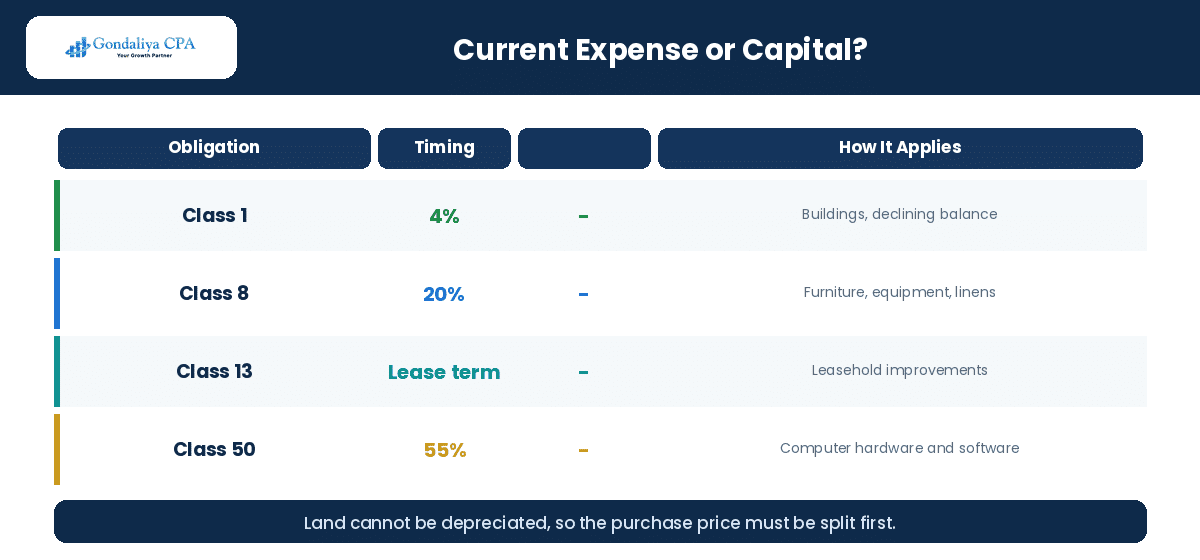
- Class 1: Buildings, with a depreciation rate of 4% declining balance
- Class 8: Furniture and equipment, like tables and chairs, at 20% declining balance
- Class 13: Leasehold improvements amortized over the lease term
If you get these classes wrong, you might lose out on venue tax deductions or face CRA audits. It’s best to classify assets carefully so your incorporated Canadian event venue stays within the rules and claims all it can.
Distinction Between Repairs and Capital Improvements Including Leasehold Upgrades
You need to know if a cost is a repair or a capital improvement to get the best event venue tax savings. Repairs fix things back to how they were without adding value or making them last longer. These are fully deductible right away.
Capital improvements increase value or extend life, so you have to add them to the right CCA class instead of deducting immediately.
Here’s an example:
- Fixing a leak in the roof = repair (expense now)
- Replacing the whole roof = capital improvement (capitalize under Class 1)
Leasehold upgrades work similarly but follow lease terms for amortization through Class 13. This covers things like tenant-installed lighting or built-in cabinets that stay after you leave.
Keep good records showing what’s a repair vs improvement. CRA auditors often check this and can deny claims if it’s unclear.
Immediate Expensing Options and Restrictions (Section 179 Equivalent in Canada)
Canada doesn’t have an exact Section 179 like the U.S., but it has some immediate expensing options for event venues. Since late 2020, you may be able to deduct full costs upfront for eligible assets bought and put into use before January 1, 2027.
This applies mostly to tangible assets in certain CCA classes, such as:
- Class 8: Equipment like AV systems
- Class 50: Computer hardware and software
- Some clean energy gear
Buildings (Class 1) don’t qualify here; they use regular depreciation.
Note that land costs aren’t deductible since land can’t be depreciated by CRA rules. Also, personal-use parts of mixed properties don’t count unless allocated properly.
This accelerated write-off helps with cash flow but requires clear proof of purchase date and when the asset became ready for use.
Depreciation Methods for Buildings, Equipment, and Furnishings
The way you depreciate assets depends on what they are:
- Buildings (Class 1): Use declining-balance at about 4% yearly until fully depreciated or sold
- Equipment & Furnishings (Class 8): Includes tables, chairs, linens; also declining-balance at 20%
- Leasehold Improvements (Class 13): Straight-line amortization over remaining lease term plus any renewal options expected
Declining-balance means each year you apply the rate to what’s left of the asset’s cost after previous deductions — so deductions get smaller over time. Straight-line spreads expense evenly across years.
Using these methods fits actual wear-and-tear better and follows Canadian tax laws for event venues anywhere in Ontario or Canada.
Application of Half-Year and Available-For-Use Rules on Asset Deductions
Two main rules affect when you can claim CCA deductions:
- The Half-Year Rule says you only claim half of normal depreciation in the first year an asset is available-for-use — no matter when during that year you bought it.
- The Available-for-Use Rule means an asset counts as ready when it can be used physically to earn income — even if it’s not actually used yet.
For instance, if your AV system is set up December 15th, it’s available-for-use that year but you can only claim half of one year’s depreciation because of the half-year rule—even if you paid earlier.
Leasehold improvements start amortizing only after they’re ready based on lease terms. This stops expenses from being claimed too early before business use begins.
Knowing these rules helps Canadian incorporated event venue owners file taxes right and match expenses with real activity under CRA standards.
[^1] Income Tax Regulations Schedule II – Class 1 CRA
[^2] Ibid., Schedule II – Class 8
[^3] Ibid., Schedule II – Class 13
[^4] Income Tax Act s18(1)(a), CRA ITA Interpretation Bulletin IT–339R2
[^5] CRA Guide T4002 – Business Expenses
[^6] Income Tax Regulations s1100(17)
[^7] Budget Implementation Act SOR/2023, Temporary Full Expensing Provisions CRA
[^8] Income Tax Act s18(1)(b)
[^9] See note [Ⅰ]
[^10] See note [Ⅱ]
[^11] See note [Ⅲ]
[^12] ITA Regulation section1100(19)
[^13] ITA Regulation section248(31)
#14: Example adapted from Gondaliya CPA client case study Toronto area.
#15: Lease agreement effective date documentation required per CRA audit guide
An AV system commissioned on 15 December still only earns half a year of capital cost allowance. Buying earlier does not help; being ready to use earlier does. Figures changed for privacy.
Key Stat: Land cannot be depreciated at all. Please make sure the purchase price of a property is split between land and building before any Class 1 claim is made.
Tax Planning, Compliance, and Financial Management for Event Venues
Tax Planning, Compliance and Financial Management
The Compliance
Tax planning helps event venues save money by using event venue tax deductions Canada allows. Knowing which event venue business expenses you can deduct lowers your taxable income. You should separate costs that last long from everyday expenses. Keep detailed records and follow Income Tax Act rules to avoid trouble.
GST/HST Input Tax Credits and Compliance for Venue Expenses
If your venue is registered for GST/HST, you can get back some of the tax paid on business purchases through input tax credits (ITCs). To claim ITCs on venue tax deductions like buying equipment or renovation supplies, the purchase must support your commercial activities.
You need invoices showing vendor GST/HST numbers to back up claims. Capital items like sound systems fall under special classes but still let you claim ITCs if they’re used commercially. Personal-use parts or exempt items don’t qualify.
Claiming ITCs properly cuts down the GST/HST you owe. If you miss paperwork or mix personal and business use without clear splits, the CRA may deny your claim.
Selecting Business Bank Accounts and Implementing Expense Tracking Systems
Keeping business money separate from personal accounts makes it easier to track event venue business expenses. Use a dedicated bank account to handle cash from tickets, rentals, or catering fees.
Use digital expense tracking tools that connect with software like QuickBooks or Xero. These help sort spending into categories like utilities, repairs, or marketing. Doing this right supports your deductions during CRA checks.
Clear categories also help avoid mistakes in reporting what counts as deductible vs capital costs. This info helps manage taxes and plan for payments like employee payroll too.
Monthly Bookkeeping Practices to Maintain Defensible Deductions
Doing bookkeeping every month helps catch missed deductions and stops errors with event venue business expenses. Reconcile bank statements against your ledger regularly to make sure everything matches.
Keep expenses grouped well — for example, repairs separate from leasehold improvements; wages apart from contractor fees. This helps apply limits correctly such as meals-and-entertainment caps or capital cost allowance rules.
Gondaliya CPA suggests reviewing documents monthly using receipts, contracts, and electronic records like Hubdoc. This builds an audit-ready file that proves your deductions when needed.
Qualified Business Income (QBI) Deduction Relevance and Limitations
Canadian incorporated event venues don’t get a Qualified Business Income deduction like US businesses do. But knowing about QBI can help if you deal with cross-border issues.
Canadian corporations focus on deductions allowed under sections 18(1)(a)–(e) of the Income Tax Act for reasonable expenses needed to earn income at the venue in Canada. Talk to a CPA Ontario member if you have international matters that might affect similar benefits outside Canada.
Managing Holiday and Special Event Spending Within CRA Guidelines
When hosting holiday parties or special events, watch how you spend because CRA limits meal-and-entertainment deductions to 50%. Some exceptions apply — like meals given during regular service hours mainly for paying guests — those might be fully deductible.
Keep spending reasonable compared to income earned at those times. Big or unusual costs could be denied if you can’t show guest counts or invoices proving the expense relates directly to those events.
Navigating Licensing, Zoning, and Regulatory Compliance for Deductibility
Fees for licenses such as liquor permits and zoning usually count as deductible business costs if they are required for running your venue legally. Gondaliya CPA doesn’t provide advice on regulatory compliance itself[6] but it’s important you document how these fees link directly to making rental income.[7]
Penalties for breaking rules can’t be deducted but proper license fees do add up as allowable costs recognized by the CRA.[8]
Key Documentation Requirements and Record-Keeping Best Practices
Good records are key when claiming any event venue business expenses in Canada.[9] Keep receipts showing vendor names and dates that match payments in your ledgers aligned with your events’ schedules.
Contracts with service providers—from cleaners to security—and detailed invoices help show what’s repair versus improvement when renovating.[10]
Gondaliya CPA advises keeping originals plus digital copies stored safely per CRA retention rules (usually six years).[11] Proper records let you respond fast during audits while proving all claims relate only to earning income—not personal use parts.
- Canada Revenue Agency – Guide RC4022 – General Information About GST/HST
- Canada.ca – Keeping Records
- Gondaliya CPA internal best practices
- Department of Justice – Income Tax Act Sections 18(1)(a)-(e)
- Canada Revenue Agency – Meals & Entertainment Expenses
- Ontario Alcohol & Gaming Commission
- Municipal Licensing Authorities Ontario
- Canada Revenue Agency – Allowable Business Expenses
- Canada Revenue Agency – Books & Records Retention
- Department of Justice Regulations Schedule II Classes
- Canada.ca – Record Keeping Requirements
For specific help with Toronto-area incorporated venues aiming to maximize event venue tax deductions across Canada, call Gondaliya CPA at 647-212-9559 or email info@gondaliyacpa.ca. Get advice focused on legal financial management made for your needs.
Input tax credits get denied on paperwork far more often than on eligibility. A supplier invoice with no registration number is simply not claimable, however real the purchase was. Figures changed for privacy.
Verification: Our CPA Ontario firm registration can be checked on the public firm directory. Please verify any firm before granting access to your accounting file.
Frequently Asked Questions (FAQs) on Event Venue Tax Deductions Canada
Frequently Asked Questions (FAQs)
FAQ
What is the record retention period for event venue tax documents in Canada?+
You must keep all tax records for six years after the tax year they relate to. This includes receipts, invoices, and contracts supporting deductions.
When is the payroll remittance deadline for incorporated event venues?+
Generally, payroll remittances are due within 15 days after each month ends. Late payments may incur interest or penalties from CRA.
What are the key Income Tax Act references relevant to event venue expenses?+
Important sections include ITA §13(7) on capital cost allowance, and ITA §67.1(2) covering meals and entertainment deduction limits.
How does leasehold improvement amortization work for event venues?+
Leasehold improvements are amortized over the lease term using Class 13 CCA, spreading deductions evenly across years.
What is the meals and entertainment deduction limit for client events?+
Generally, only 50% of meals and entertainment expenses qualify as deductible unless specific exceptions apply.
Which additional Capital Cost Allowance classes apply to event venue assets?+
Besides Classes 1, 8, and 13, Classes 12 (tools), 50 (computer software/hardware), and 53 (clean energy equipment) may apply.
How should landlord allowances affect tax deduction claims?+
Landlord allowances received may reduce deductible expenses or affect income reporting; proper allocation is essential.
What are abandonment and terminal loss claims in venue asset depreciation?+
If you dispose of or abandon assets early, you can claim terminal losses or adjust depreciation accordingly under CRA rules.
Can smallwares under $500 be expensed immediately?+
Yes, small items costing under $500 often qualify for immediate expensing without requiring CCA class treatment.
What documentation threshold applies for GST/HST input tax credit claims?+
GST/HST input credits require valid vendor invoices with GST numbers regardless of amount claimed to meet CRA standards.
How are client gratuities and service charges treated for tax purposes?+
Gratuities paid directly to staff usually aren’t taxable income for the business; service charges included in revenue must be reported properly.
Do deposits and prepayments affect income and GST/HST calculations?+
Yes, deposits can be taxable upon receipt. Prepaid expenses may need to be allocated over periods in both income reporting and GST/HST filings.
What triggers CRA reviews of deduction claims in event venues?+
Large or unusual expense amounts, inconsistent records, or mixing personal/business costs often trigger CRA audits.
Can prior-year incorrect deductions be fixed by event venues?+
Yes, you can amend prior year returns to correct errors but must provide supporting documentation and follow CRA procedures.
What best practices help capture every legitimate tax deduction?+
Keep thorough records, separate personal expenses, use accounting software, review expense categories monthly, and consult experts like Gondaliya CPA.
Key Insights on Event Venue Tax Deductions with Gondaliya CPA
Key Insights on Event Venue Tax Deductions
Quick Reference
- Deduction Reviews: Gondaliya CPA offers professional reviews comparing your expenses against CRA rules. They identify missed deductions and risky claims.
- DIY vs CPA Review: DIY saves cost but risks errors. Non-CPA providers lack full regulatory knowledge. Gondaliya CPA ensures compliance and maximizes savings.
- Deliverables from Deduction Review: You receive a detailed report with actionable recommendations, risk assessments, and optimized expense categorization.
- Cost of Deduction Review: Pricing depends on venue size and complexity but typically ranges from $1,000 to $3,000 CAD for comprehensive analysis.
- Top Mistakes & Prevention: Common errors include misclassifying capital vs expense costs and incomplete payroll remittances; Gondaliya CPA trains clients on avoiding these pitfalls.
- Preparation Before Review: Organize receipts by category, gather lease agreements, payroll records, insurance policies, and bank statements beforehand.
- Deductions Across Venue Sub-Sectors: Different venues like banquet halls or outdoor sites face unique deductible expenses; expert guidance tailors strategies per sector needs.
- Realistic Numeric Walkthrough: Gondaliya CPA provides sample calculations demonstrating typical savings from common deductible items versus capital assets depreciation.
- Choosing Right CPA Firm in Toronto/Ontario: Select firms with proven experience in event venues, strong local knowledge, clear pricing models—Gondaliya CPA fits these criteria perfectly.
- Why Trust Gondaliya CPA: Sharad Gondaliya’s team combines Canadian & US CPA credentials with deep industry expertise ensuring precise advice aligned with your business goals.
For tailored guidance on your event venue tax deductions Canada, contact Gondaliya CPA at info@gondaliyacpa.ca or call 647‑212‑9559 today. Maximize your savings while staying fully compliant with Canadian tax laws.
Ten insights and one that decides the rest: knowing which costs are current and which are capital. Everything downstream is a consequence of that call. Figures changed for privacy.
Venue Types We Serve
Industry Expertise
Which deductions matter most differs by venue type. Here are ten and the usual focus.
| Venue Type | The Deduction Focus |
|---|---|
| Banquet halls | Cost of goods sold on food and beverage |
| Conference & meeting centres | AV equipment under Class 8 and Class 50 |
| Wedding & outdoor estate venues | Groundskeeping, landscaping and snow removal |
| Nightclubs & live music venues | Liquor licensing and SOCAN music tariffs |
| Hotel & ballroom event spaces | Class 1 building depreciation on the property |
| Leased event spaces | Class 13 leasehold improvements over the term |
| Community & cultural halls | Grant funding reducing the expense base |
| Sports & recreation facilities | Equipment replacement, repair or improvement |
| Studio & photography spaces | Personal use allocation on mixed-use property |
| Multi-purpose venues with catering | Staff meals against client entertainment limits |
- Banquet halls: Food and beverage sits in cost of goods sold, which needs inventory records rather than receipts alone.
- Conference and meeting centres: AV gear splits across classes, and some of it may qualify for immediate expensing.
- Wedding and outdoor estate venues: Seasonal grounds work is a current expense provided it maintains rather than improves the land.
- Nightclubs and live music venues: Licence fees are deductible; the fines that sometimes follow them are not.
- Hotel and ballroom event spaces: The purchase price has to be split between land and building before any claim.
- Leased event spaces: Tenant improvements amortise over the lease term, not the asset’s useful life.
- Community and cultural halls: Grant money that funded a cost generally reduces what can be claimed on it.
- Sports and recreation facilities: Replacing like for like is a repair; upgrading the specification is capital.
- Studio and photography spaces: Mixed personal and business use needs a documented allocation, not an estimate.
- Multi-purpose venues with catering: Staff meals during service and client entertainment are treated differently.
The venue type changes which deductions carry the most value. It does not change the test, which is reasonable, income-earning and documented. Figures changed for privacy.
Professional Guidance and Quick Reference
Guidance
Professional Guidance for Venues: How Gondaliya CPA Protects Your Deductions
Venue deductions get denied on one distinction more than any other: current expense against capital improvement. Fixing the roof is deductible now. Replacing the roof goes into Class 1 and comes back over decades. Every other rule sits on top of that call. Gondaliya CPA handles the full cycle on a fixed annual fee.
We handle what decides the outcome: classifying each cost as current or capital, assigning assets to the right capital cost allowance class, applying the half-year and available-for-use rules, separating personal use with a documented allocation, testing worker classification before the CRA does, applying meals and entertainment limits correctly, claiming GST/HST input tax credits with invoices that carry a registration number, and tracking grant funding against the costs it covered.
Our team builds an audit-ready file month by month rather than assembling one under pressure. Banquet hall, conference centre or outdoor property, you get clear advice and a fixed price before we start.
Quick Answers: Key Numbers & Concepts at a Glance
At a Glance
- Current expenses: Deducted in the year incurred
- Capital costs: Claimed over time through CCA
- Class 1: Buildings, 4% declining balance
- Class 8: Furniture and equipment, 20%
- Class 13: Leasehold improvements over the term
- Half-year rule: Halves the first-year claim
- Meals and entertainment: 50% on client entertainment
- Payroll remittance: Within 15 days of month-end
- Input tax credits: Need the vendor’s registration number
- Records retention: Six years after the tax year
Who This Is For / Not For
Fit Check
- For: Incorporated Canadian event venues including banquet halls, conference centres and outdoor properties.
- Not For: Regulatory or licensing advice, which sits outside our scope; we handle the tax treatment of the fees you pay.
People Also Ask
Related Questions
Is a new ballroom floor a repair or an improvement?+
Replacing worn flooring with the same specification is usually a repair. Upgrading to a better material or extending the room is a capital improvement.
Can I deduct the whole mortgage payment on my venue?+
No. Only the interest portion is deductible. The principal reduces the loan and is not an expense.
Do staff meals at an event fall under the 50% limit?+
Meals provided to staff during work hours are generally fully deductible. The 50% limit applies to client entertainment.
Glossary of Key Terms
- Current expense: A cost fully deductible in the year it is incurred.
- Capital expenditure: A cost added to an asset class and claimed over time.
- Capital cost allowance: The tax deduction for depreciation on eligible assets.
- Class 1: The CCA class for buildings, at 4% declining balance.
- Class 8: The CCA class for furniture and equipment, at 20%.
- Class 13: The CCA class for leasehold improvements, amortised over the lease term.
- Declining balance: Depreciation applied to the remaining undepreciated cost each year.
- Half-year rule: The restriction limiting first-year capital cost allowance.
- Available for use: The point at which an asset is ready to earn income.
- Terminal loss: A deduction where an asset is disposed of below its remaining cost.
- Reasonableness test: The requirement that an expense fits the scale of the business.
- Personal use allocation: The documented split between business and private use.
- Input tax credit: GST/HST recoverable on purchases used in commercial activities.
- Source deductions: Income tax, CPP and EI withheld from pay and remitted to the CRA.
- T4A: The slip reporting payments to certain contractors and service providers.
- Cost of goods sold: The direct cost of food, beverage and consumables served.
Venue Deduction Readiness Check
This quick self-check indicates where your operation most likely has room. Please answer the six questions below.
Venue Deduction Readiness Check
Six quick questions on your records. No fee shown.
Points to raise with us:
This is a general prompt, not tax or legal advice or a quote. Your position depends on your full facts. For a real review, please book a free consultation.
Want a checklist to work from? You can download our free venue deduction checklist before your consultation.
Split every cost into current or capital before posting it. Assign assets to the right CCA class. Apply the half-year rule on first-year claims. Document personal use rather than estimating it. Check vendor invoices carry a GST/HST number. Classify staff correctly before an auditor does. Keep the 50% limit on client entertainment. Please retain everything six years.
2026 Update — what is current: This article notes immediate expensing available for eligible assets put into use before January 1, 2027. The 4% Class 1 rate, the 20% Class 8 rate, Class 13 amortisation over the lease term, the 50% meals and entertainment limit and the six-year retention rule are unchanged. Please note the article cites the meals exception to section 67.2(3) where section 67.1 governs the limit, cites payroll remittance to Excise Tax Act section 169 which concerns input tax credits, describes Class 13 as spreading deductions evenly while the calculation is prescribed rather than simply straight-line, and refers to a $500 smallwares expensing threshold which is an administrative practice rather than a statutory rule, so please confirm each before relying on it.
Event Venue Tax Deductions Canada: Maximize Your Business Expenses and Tax Savings with Gondaliya CPA
Get the current or capital call right first
Gondaliya CPA classifies every cost as current or capital, assigns assets to the correct CCA class, applies the half-year and available-for-use rules, documents personal use allocations, checks worker classification, applies the meals and entertainment limits, and secures your GST/HST input tax credits, on a flat annual fee including HST with a one-business-day response. Please book a free consultation.
Next Steps
Please book a free consultation with Gondaliya CPA and bring your last financial statements, your fixed asset listing, and any renovation contracts from the year. Those three tell us immediately whether your costs are landing in the right place and which deductions are being left behind. You will get a flat annual fee including HST before any work begins. If our content helps, please add gondaliyacpa.ca as a preferred source on Google.
Published: · Last updated:
Editorial policy: We research against CRA and CPA Ontario sources, fact-check the figures, and Sharad Gondaliya, CPA, reviews the content, which we update as the rules change.
Disclaimer: This article is educational information only and is not tax, legal, or financial advice. Figures marked illustrative are examples rather than quotes or guarantees. It reflects CRA rules current to 2026, including the 4% Class 1 building rate, the 20% Class 8 furniture and equipment rate, the 50% meals and entertainment limit, the 15-day payroll remittance deadline, and the six-year record retention requirement. Rates, limits and expensing rules change and outcomes depend on your specific facts. Please consult a CPA Ontario member before acting.

Sharad Gondaliya is a CPA Canada & CPA USA with 15 Years+ experience of Accounting, Tax, Payroll of Corporate Small Businesses as Tax Accountant. He is a CPA Ontario member (61040184) and holds US CPA licences in Washington and Montana and is well known among corporate small businesses for tax planning, efficient tax solutions, and affordable CPA services. Sharad is the Principal (Director) of Gondaliya CPA – Affordable CPA Firm in Canada. Licenses: CPA Ontario: 61040184 | CPA USA (MT): PAC-CPAP-LIC-033176 | CPA USA (WA): 57629 | CPA Firm License: 61330051 View Full Author Bio