



How Millwork Companies in Canada Can Reduce Taxes and Improve Cash Flow With Strategic Tax Planning
Millwork company tax planning: Effective tax strategies for millwork contractors in Canada to reduce business taxes
Millwork company tax planning is key for millwork contractors in Canada looking to reduce business taxes legally and efficiently. Gondaliya CPA offers expert advice on tax strategies for millwork companies, helping to lower taxable income and manage deductions tailored to the millwork business.
Quick Summary
Millwork sits between manufacturing and construction, so the tax file has to work on both sides at once: the manufacturing and processing rate and capital cost allowance on shop machinery, and T5018 reporting and worker classification on the installation side. Equipment timing, the passive income grind and the owner pay mix decide most of the outcome.
Reading time: 46 minutes.
Table of Contents
- Introduction and Overview of Millwork Company Tax Planning in Canada
- Year-End Tax Planning Strategies Relevant to Millwork Companies
- Income Management and Family Remuneration Tactics
- Small Business Deduction, Passive Income, and Investment Management
- Tax planning based on business structure and corporate considerations
- Practical Tax Planning Tips and Compliance for Millwork Contractors
- Summary of Actionable Steps for Reducing Taxes in Millwork Operations
- Frequently Asked Questions About Millwork Company Tax Planning
- Essential Tax Planning Tips for Millwork Companies: Owner Pay & Compliance
- Professional Guidance and Quick Reference
The Numbers That Matter
This article covers Canada, with Ontario and Toronto context, and reflects rules current to 2026. It applies to incorporated millwork companies including custom cabinetry shops, architectural woodwork fabricators, store fixture builders, closet and casework manufacturers and shops running their own installation crews. Figures marked illustrative are examples, not quotes, and any masked engagement notes end with “Figures changed for privacy.” This is educational information only and not tax or legal advice. Construction lien legislation, shop licensing and trade certification sit outside accounting scope.
Introduction and Overview of Millwork Company Tax Planning in Canada
Introduction and Overview of Millwork Company Tax Planning in Canada
The Essentials
Millwork company tax planning matters a lot for contractors in Canada. It can help cut down taxes and keep more money flowing in. Good planning lets millwork businesses stay ahead by using smart tax steps made just for them. This guide looks at how contractors can use strategic tax planning to their advantage.
Millwork Company Tax Planning Essentials for Contractors in Canada
Knowing the basics of millwork contractor tax planning helps you avoid problems and save money. Here are some key points:
- Corporate Tax Filing Deadline: If your business is incorporated, you must file your T2 return within six months after your fiscal year ends.
- T5018 Reporting Deadline: Millwork companies working in construction must file form T5018 yearly. This reports payments to subcontractors.
Following these deadlines closely keeps you clear of fines and helps manage your finances better.
At a Glance: Key Tax Strategies to Reduce Millwork Business Taxes
Here are some simple strategies that can lower taxes for millwork companies:
| Strategy | Description |
|---|---|
| Small Business Deduction Limit | Make sure your company qualifies as a Canadian-controlled private corporation (CCPC). This lets you pay less federal corporate tax on income up to $500,000. |
| Manufacturing and Processing Profits Rate Reduction | You might qualify for a lower tax rate under Section 125 of the Income Tax Act if your work involves manufacturing or processing. |
These moves need proper records and knowing the rules from CRA to work right.
The two strategies above are where almost every millwork file starts, and the second one is the one most shops have never claimed. Figures changed for privacy.
Importance of Proactive Tax Planning for Millwork Contractors
Taking charge with strategic tax planning helps millwork contractors stay successful. Consider these tips:
- Year-End Planning Moves: Check your inventory, work-in-progress, and think about buying equipment before the year ends.
- Owner Remuneration Mix: Decide the best way to pay yourself—salary or dividends—to get the most benefit while keeping taxes low. This also affects your RRSP contribution room.
- Cash Flow Management: Time your spending on big buys like equipment carefully to keep cash moving smoothly during projects.
Focusing on these plans keeps you following rules and might give you an edge over others who miss out on these tax-saving chances.
Year-End Tax Planning Strategies Relevant to Millwork Companies
Year-End Tax Planning Strategies Relevant to Millwork Companies
Year-End Moves
Year-end tax planning helps millwork companies save on taxes. It focuses on smart capital investments and timing income right. Also, you must stay within CRA rules before the Corporate Tax Filing Deadline. Good planning now can reduce taxes for your millwork business and improve cash flow.
Timing depreciable asset purchases and sales for tax benefits
When you buy or sell assets, timing matters because of the Capital Cost Allowance (CCA) half-year rule. This rule limits CCA claims to half the normal rate in the year you get the asset. How you schedule purchases and sales changes when income counts as taxable. You can choose to recognize income now or push it off to a later year.
Maximizing capital cost allowance (CCA) through year-end asset purchases
Millwork shops should know these key CCA classes for their equipment:
- Class 8: General tools and small equipment — 20% declining balance
- Class 29: Clean energy manufacturing equipment — 50% declining balance, accelerated by immediate expensing
- Class 43/43.1: Clean energy generation or zero-emission vehicle charging stations — up to 30% declining balance
- Class 50 & 53: Computer hardware/software and specific machinery like CNC machines, edgebanders, saws — rates vary between 55%-100%, often accelerated
If you buy qualifying assets before year-end and make them “available for use” within that fiscal period, you get maximum CCA deductions that year. Waiting means losing those immediate benefits.
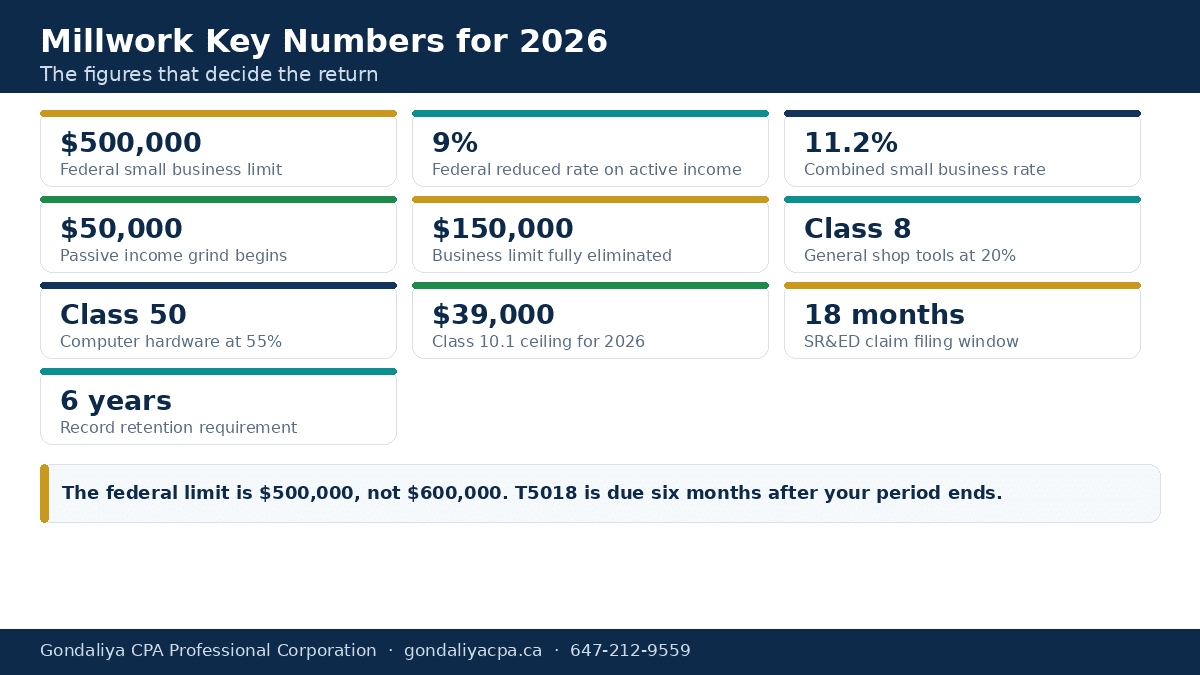
Class 8 runs at 20%, Class 50 at 55% and Class 53 at 50%. Class 10 covers trucks and trailers at 30%, and the Class 10.1 passenger vehicle ceiling is $39,000 before tax for 2026.
Strategic timing for selling depreciable assets to defer taxes
Selling or trading assets can cause recapture or terminal loss on your taxes. If you wait to sell until after year-end, you delay recognizing any gains until next year. But selling early might let you claim losses faster.
For example: If you trade an old edgebander (Class 53) late December and proceeds exceed its undepreciated cost, recapture applies immediately. Waiting past year-end avoids that tax hit now.
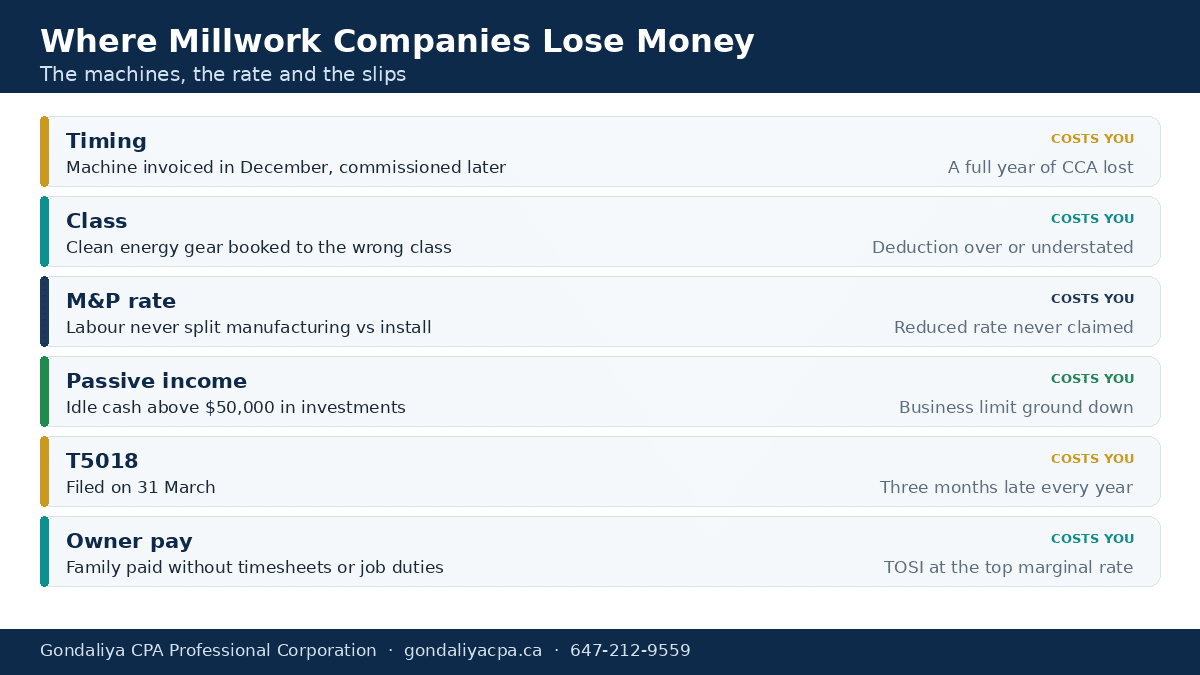
Please check the class before you claim. Class 29 is manufacturing and processing equipment, not clean energy equipment. Clean energy generation property sits in Class 43.1 and 43.2, and zero-emission vehicles sit in Class 54 and 55 rather than Class 43.
Utilizing Manufacturing & Processing (M&P) building deductions
The M&P profits deduction cuts federal corporate tax rates on income from manufacturing activities. This applies to income from active fabrication work done by your company.
Deductions specific to M&P buildings and equipment
If your building is mainly used for manufacturing, part of its expenses — including depreciation — can be deducted against M&P profits. Keep in mind:
- The Small Business Deduction limit is $500,000 federally
- Passive income thresholds affect eligibility when passive investment income goes above $50,000 yearly
You must keep clear records showing how much of the building is used for manufacturing versus other uses. This helps if CRA audits your claim.
Bill C-15 received Royal Assent on 26 March 2026, reinstating the accelerated investment incentive. For most depreciable property acquired after 2024 and available for use before 2030 the half-year rule is effectively suspended and an enhanced first-year deduction applies, phasing down after 2029. Leasehold improvements are excluded.
Immediate expensing for M&P machinery, clean energy equipment, and zero-emission vehicles
Recent laws allow immediate expensing — meaning you can write off full cost at once — on new machines bought after March, including clean energy equipment in Classes 29 and 53. This speeds up tax savings compared to slow depreciation.
Eligibility for immediate expensing of qualifying assets
To qualify:
- The asset must be new and bought by a Canadian-controlled private corporation doing active manufacturing or processing
- It must fall into classes like Class 29 (clean energy), Class 50/53 (machinery), or zero-emission vehicles under Classes 43/43.1
- The asset needs to be ready-to-use before your fiscal year ends
Immediate expensing lowers your taxable income right away, helping cash flow more than regular depreciation schedules.
Available for use is the test, not delivery. A CNC router invoiced in December but not commissioned until February belongs to the following fiscal year.
Applying accelerated investment incentive property rules
The Accelerated Investment Incentive lets you claim triple the usual first-year CCA amount minus any half-year rule cutback. For millwork businesses investing in automation tools like CNC routers or finishing lines—often Class 8 or 53—this means bigger upfront deductions.
This applies automatically but track purchase dates carefully. Align buying with your fiscal year’s end to get full benefits matching your financial reports.
Deferring taxes by delaying asset sales with accrued gains
You can hold onto assets past year-end to delay taxable gains. Gains from disposing depreciable property count fully as business income with no special exemptions. So timing when you sell makes a big difference in tax bills.
Example scenarios:
| Scenario | Effect | Records Needed |
|---|---|---|
| Sell machine Dec vs Jan | Recognize gain sooner vs later | Sale agreement; invoice |
| Trade-in old equip after fiscal | Delay recapture inclusion | Disposal documents |
Balancing tax deferral with keeping efficient equipment is important since older gear might slow production.
Leveraging enhancements in the Scientific Research and Experimental Development (SR&ED) program
Millwork firms working on jig designs or process improvements may claim SR&ED credits if projects meet ITA Section 37 definitions:
“Systematic investigation in science or technology involving technological uncertainty…”
Simple custom work doesn’t qualify. But developing unique fixtures with new methods could count. Eligible costs include salaries directly tied to projects, materials, and overhead allocated properly based on detailed project files.
Claims must be filed within eighteen months after your fiscal year ends. Keep scientific records proving technological progress per CRA’s SR&ED Guide.
A client once claimed $45K related to jig development solving tough technical problems with solid documentation — showing how proper filing works.
Jig and fixture development is the SR&ED claim millwork shops most often miss, and contemporaneous project notes are what make it stand up. Figures changed for privacy.
Accessing clean technology investment tax credits (ITCs)
Clean tech ITCs support eco-friendly equipment by offering refundable credits alongside accelerated CCA deductions:
- Class 29: Clean energy manufacturing machinery gets accelerated CCA plus ITC reducing federal corporate taxes
- Classes 43 / 43.1: Zero-emission vehicle infrastructure qualifies similarly
To qualify, assets must meet Schedule II rules in the Income Tax Act about type and use location across provinces. These credits stack with other incentives making modern millwork machinery more affordable while cutting taxes.
For Toronto-area millwork clients wanting advice before deadlines, Gondaliya CPA offers text-only consultations—contact info@gondaliyacpa.ca or call 647-212-9559 any time during weekdays/evenings/weekends.
A CCPC pays a reduced federal rate of 9% on active business income up to the federal business limit of $500,000, shared across associated corporations.
Income Management and Family Remuneration Tactics
Income Management and Family Remuneration Tactics
Owner Pay
Managing income and paying family members the right way plays a big part in millwork company tax planning. Deciding between salary, bonus, or dividends for a shop owner affects both corporate taxes and personal taxes. It also influences RRSP room and CPP contributions. When you pay family members reasonable salaries, you have to follow CRA rules closely. Ignoring these can lead to penalties, especially under the Tax on Split Income (TOSI) rules.
Key points to remember:
- Salary reduces corporate taxable income but increases personal tax and CPP.
- Dividends don’t create RRSP room or require CPP but may have lower personal tax rates.
- Paying family members must match actual work done.
Strategies for paying family members reasonable salaries under tax compliance
You should pay family members based on real work they do, at fair market rates. CRA requires salaries to be justifiable by job duties within your incorporated millwork business. This helps you claim payroll deductions and avoids TOSI penalties.
Owners should keep records showing:
- Job descriptions
- Hours worked
- Pay rates similar to what others get for like work (admin help or installers)
Bonuses can add to base salary but must meet CRA’s reasonableness test that looks at profits and cash flow.
Dividends differ from salaries because they don’t create RRSP contribution room or need CPP premiums. But dividends do not lower corporate taxable income since they aren’t an expense.
Trade-off: Salaries cut company taxes but increase personal taxes and CPP costs. Dividends skip payroll taxes but offer no deductions.
The salary and dividend mix set once and never revisited is the most common planning gap we see on an owner-managed millwork file. Figures changed for privacy.
Reasonable salary guidelines for family employees
CRA wants family employee salaries in incorporated millwork companies to:
- Match the work done
- Be close to market wages for similar tasks
- Have solid records like timesheets or contracts
If you pay too much or without proof, CRA might treat it as shareholder benefits under section 15(1) of the Income Tax Act, leading to extra taxes.
For example, if a spouse does part-time bookkeeping, pay an hourly wage that fits local market rates—not just a random amount.
Keep up-to-date timesheets, invoices if any, and written job agreements. This makes audits easier to handle.
Understanding tax on split income (TOSI) rules affecting millwork businesses
TOSI stops income sprinkling tricks by taxing certain passive or split income at top rates when paid to related people over 18 unless exceptions apply.
For example, if your spouse or adult kids get dividends without real involvement in the business above certain hours, those payments get taxed heavily.
Exceptions include:
- Family members actively working set hours per year in the business
- Payments that fit their actual labour value
Millwork owners need to check if their family’s pay qualifies before giving out profits as dividends. Otherwise, big tax bills can result.
Compliance basics and tax planning around TOSI
To avoid TOSI issues, all payments must reflect real work backed by time tracking — especially in project-based manufacturing like millwork shops.
Payments without proof risk reassessment plus interest charges from CRA.
Generally, salaries are better because they don’t fall under TOSI restrictions if justified properly. Dividends require closer review against active engagement rules before distribution in cabinetry or woodwork businesses across Ontario areas like Toronto.
Review your pay plans yearly. Laws change; keeping up protects your bottom line.
Dividends paid to a spouse or adult child who does not meaningfully work in the business can be caught by the tax on split income at the top marginal rate. Please test the exclusions before declaring.
Impact of the 1% federal personal tax cut on salary planning
The federal government cut personal income tax rates by about 1% starting in 2026. This shift changes how owners decide their mix of salary versus dividends.
Lower personal taxes mean net pay from salaries looks better now than before when dividends seemed more attractive due mainly to integration effects.
Millwork shop owners might lean toward raising salaries slightly while still taking some dividends for balance. This helps keep RRSP room growing—a big deal for retirement savings over time.
Incorporating personal tax changes into salary strategy
After tax changes, you’ll need new calculations using updated withholding tables that reflect lower source deductions. This can boost monthly cash flow since less tax is held back at payroll.
Many use payroll software common among Canadian manufacturers to keep payroll smooth and compliant with CRA rules.
Timing matters too: paying bonuses within set deadlines lets you claim deductions fully and manage working capital without penalties per subsection 78(4).
A mix of adjusted salary plus measured dividends often works best—keeping cash flow steady while saving on taxes thanks to provincial incentives around Ontario cities like Mississauga and Vaughan.
Ontario reduced its small business rate to 2.2% effective 1 July 2026, giving a blended provincial rate near 2.7% for a calendar-year corporation and a combined rate near 11.7% rather than the 12.2% that applied before.
Managing withholdings and reporting obligations for family remuneration
You must deduct correct amounts for CPP and income tax when paying any employee—including family members. EI premiums may not always apply but check carefully each case with current CRA tables.
Mistakes here can invite audits—especially if installers are wrongly called employees instead of subcontractors.
You have to issue T4 slips showing all wages plus deductions every year using certified electronic systems on time per CRA standards.
Subcontractors who only install need separate reports with form T5018 so you avoid classification problems common in cabinetry shops with mixed workers.
CPA Gondaliya often advises clients on checking contractor status properly—that’s key to avoid costly mistakes involving workers who look like employees but are actually contractors.
CRA requirements for salary payments to family
CRA expects strong proof that salaries paid internally are fair—like signed contracts detailing job duties plus attendance records or timesheets kept regularly.
Keep monthly payroll registers accurate; this makes audits smoother especially if your operations spread over multiple sites in Toronto metro area.
Send source deductions quarterly so no arrears build up causing fines during busy production seasons typical for store fixture builders serving commercial clients.
Yearly reconciliations paired with professional accounting checks confirm everything is complete. This helps protect eligibility for small business deductions even as regulations around associated corporations shift often.
Payroll remittance timing follows your remitter type, not a quarterly default. A regular remitter must remit by the 15th day of the month following the month the employees were paid.
Balancing dividends versus salaries for optimal tax outcomes in millwork firms
| Method | Corporate Deduction | Personal Taxes | RRSP Room Created | CPP Contributions Required | Slip Issued |
|---|---|---|---|---|---|
| Salaray | Yes | Taxed at marginal rate | Yes | Yes | T4 |
| Bonus | Yes | Marginal rates apply | Yes | Yes | Included in T4 |
| Eligible Dividend | No | Lower effective rate | No | No | TD1 Slip |
Usually, mixing moderate salaries with eligible dividends offers the best after-tax results. You get good cash flow now plus future retirement savings via RRSP room—all while staying within Canada’s laws carefully spelled out by CRA regulations.
Adding considerations like timing CCA claims or using SR&ED credits further improves this strategy—especially handy when investing in equipment such as CNC machines that qualify under accelerated incentives common across Ontario manufacturing hubs.
For help with your specific millwork company tax planning questions contact info@gondaliyacpa.ca or call 647-212-9559.
Small Business Deduction, Passive Income, and Investment Management
Small Business Deduction, Passive Income, and Investment Management
The Deduction
If you run a millwork company in Canada, tax planning means watching your small business deduction closely. This helps reduce taxes millwork businesses pay. Knowing how passive income and investment moves affect your SBD status matters a lot. Incorporated millwork contractors want to keep their tax bills low and smart.
Key Features of the Small Business Deduction (SBD) for Millwork Contractors
The small business deduction cuts your federal tax rate on the first $500,000 of active business income. This applies to Canadian-controlled private corporations (CCPCs), including millwork firms in Ontario or elsewhere. The $500K limit covers all connected companies as one group under Income Tax Act rules.
Here’s what you need to keep that deduction:
- Your combined taxable active business income stays at or below $500,000.
- You avoid accidentally linking with related businesses or family holdings that trigger association rules.
- Passive investment income stays under limits that can shrink your SBD.
Also, it’s smart to keep clear records proving your manufacturing work is active business — not passive income. This helps if the CRA ever asks questions.
| Feature | Details | Source |
|---|---|---|
| Small Business Limit | $500,000 per CCPC/associated group | Income Tax Act s.125(1) |
| Federal Reduced Rate | 9% on first $500K | CRA Corporate Rates |
| Provincial Variation | About 2.2% in Ontario | Ontario Ministry of Finance |
| Association Rules | Groups affect deduction limit | ITA s.256 & CRA Guidance |
Effects of Passive Investment Income Restrictions on SBD Eligibility
Passive investment income means money from interest, dividends from unrelated firms, rental income not tied to business use, and some capital gains. Since 2019, if a CCPC earns over $50,000 in adjusted passive income yearly, it starts losing the SBD.
For every dollar over $50K up to $150K, your small business limit drops by one dollar. Once passive income hits $150K, the deduction goes away entirely. This cutback can push up your corporate tax a lot.
Millwork companies holding big investments not tied directly to their operations risk losing this valuable tax break. Planning ahead by adjusting these investments is key.
The business limit is reduced by $5 for every $1 of adjusted aggregate investment income above $50,000 and is eliminated entirely at $150,000.
Techniques to Preserve Access to the SBD Through Investment and Expense Tracking
- Track material costs and inventory buying carefully.
- Avoid piling up excess inventory; expense materials when used.
- Use proper accounting rules for inventory valuation so assets don’t get overstated.
- Time expenses wisely: do repairs before year-end if you can; delay optional purchases if cash flow allows.
- Regularly review your investments and separate operational assets from purely passive ones like interest or dividend-generating funds.
- Keep good documentation to show which activities are active vs passive if CRA asks.
Adjusting Corporate Investment Mixes for Tax Efficiency in Millwork Businesses
Try moving funds away from high-yield but passive investments into assets that support your millwork operations:
- Invest in new equipment eligible for accelerated capital cost allowance (like Class 43.1). These let you write off costs faster and lower taxable profits while boosting production.
- Watch out for shareholder loans used for personal expenses—they create taxable benefits under section 15(2). Keep personal spending separate with clear loan agreements that follow CRA rules.
Doing this balances reducing taxes without risking penalties or lost deductions.
Winter cash parked in interest-bearing investments is how a millwork corporation loses part of its small business deduction without ever feeling wealthy. Figures changed for privacy.
Exploring Alternative Investment Methods to Reduce Taxable Income
Retained earnings aren’t just sitting money; they can cut taxes too:
- Set up an equipment fund using retained earnings to spread out big future purchases instead of one huge hit.
- Consider safe investments like government bonds that may count less toward your adjusted passive income limits. Ask your CPA about options legal under Canadian law.
- You could also use careful intercorporate loans structured well to avoid personal tax trouble while keeping solid records for audits.
For guidance on millwork company small business deductions and tax planning across Toronto and Canada-wide areas, reach Gondaliya CPA at info@gondaliyacpa.ca or call 647-212-9559 today.
Tax planning based on business structure and corporate considerations
Tax planning based on business structure and corporate considerations
The Structure
Tax planning for millwork companies starts with picking the right business structure. It’s key to know how each structure impacts taxes and cash flow. Whether you run an incorporated millwork company or a sole proprietorship, understanding your options helps reduce taxes millwork businesses face in Canada.
Overview of common business structures for millwork companies in Canada
Millwork businesses often run as sole proprietorships, partnerships, or incorporated firms like Canadian-controlled private corporations (CCPCs). Incorporated millwork companies enjoy tax perks like the small business deduction (SBD) and lower manufacturing and processing profit rates under the Income Tax Act. Incorporation also allows better control over income splitting and deciding how to pay yourself.
Besides tax benefits, incorporation separates personal assets from business risks. This matters when making custom cabinets or woodwork. But incorporation means more paperwork. For example, corporations must file T2 returns by certain deadlines, or they face penalties.
Tax planning implications for sole proprietorships, partnerships, and CCPCs
Sole proprietors report all profits on their personal tax returns. They miss out on lower corporate tax rates and SBD advantages. Partnerships pass income through partners but give some leeway in splitting profits.
Incorporated millwork companies get a federal small business deduction limit of $600,000 starting 2026. This reduces federal taxes on active business income below that amount. Watch out though:
The federal small business deduction limit is $500,000, not $600,000. The higher figure belongs to the provincial limits in Saskatchewan, Prince Edward Island and Nova Scotia. Please plan against $500,000 federally.
- Passive income over $50,000 causes a “grind” reducing SBD benefits.
- Related corporations share these limits together.
Smart tax strategies keep passive investments in holding companies separate from the operating business to keep full SBD access.
Advantages of incorporating a millwork business in Canada
Here’s why incorporating helps manufacturing businesses:
- You can access lower manufacturing and processing profit rates that cut combined federal-provincial taxes when activities meet rules.
- Corporations let you defer personal taxes by keeping earnings inside the company.
- You can balance owner pay between salary and dividends to boost RRSP room while managing CPP payments.
All this supports growing your millwork business with better after-tax cash flow than unincorporated ones.
Optimal timing considerations for changing business structures
Switching from sole proprietor or partnership to corporation takes timing care. The corporate tax filing deadline is six months after fiscal year-end. Incorporate early before hitting big revenues to grab deductions like new accelerated capital cost allowance rules from 2026.
Delaying incorporation means losing part-year deductions. But changing too soon might add unnecessary admin work. When switching, watch how inventory and work-in-progress get valued since it affects year-end accounting.
Practical corporate tax planning including record-keeping and compliance essentials
Good records make tax planning smoother. You should keep:
- Job costing files showing labor and material use
- Equipment invoices with “in-use” dates for capital cost allowance (CCA)
- Payroll details proving salary and bonus payments
- Contracts showing holdbacks under construction lien laws
- Subcontractor payment reports for T5018 filings by March 31 yearly
The T5018 return is not due on 31 March. It is due within six months of the end of your chosen reporting period, which may be the calendar year or your fiscal period, applied consistently. February and March are T4 and T5 dates and the three get conflated constantly.
Keeping accurate documents helps if CRA audits you or if you claim credits like SR&ED research credits.
| Record Type | Why You Need It | Keep For | Source |
|---|---|---|---|
| Job Costing Files | Support profit & labor expenses | At least 6 years | Income Tax Act s230 |
| Equipment Invoices | Prove CCA claims | At least 6 years | ITA Part LII |
| Payroll Records | Validate salaries/bonuses | At least 7 years | CRA payroll guidelines |
| Contracts & Holdbacks | Revenue & lien compliance | Project end + retention | Provincial laws |
Managing shareholder loans and private pension plans in millwork corporations
Shareholder loans must be repaid within one year after the company’s fiscal year-end or they become taxable benefits under Section 15(2) of the Income Tax Act. Missing this raises your personal taxable income and might bring CRA interest charges.
Private pension plans like Individual Pension Plans (IPPs) offer an alternative to RRSPs. They tie benefits to salary levels and work well when balanced with paying dividends vs salary.
Setting up an IPP or RRSP for owner-operators
Deciding between funding an IPP or maxing RRSP depends on age and retirement goals. Salaries add CPP contributions but increase RRSP room; dividends do not affect either but can lower total taxes based on integration rules.
Here’s a simple comparison:
| Pay Method | Corporate Deduction | Personal Taxes | CPP Contributions | Creates RRSP Room |
|---|---|---|---|---|
| Salary | Yes | Taxed at marginal rate | Yes | Yes |
| Dividends | No | Depends on type | No | No |
Finding the right mix each year helps defer taxes while building retirement savings safely.
Understanding integration, tax deferral, and corporate investment tax costs
Integration aims so that combined corporate plus personal taxes equal what you’d pay if income was earned personally. Millwork firms holding earnings need to watch passive income closely because going over $50K triggers SBD reductions—called the “grind”—that hike effective tax rates.
If retained earnings go into equipment buying, accelerated CCA lowers current taxable income. But idle investments face higher taxes hurting cash flow. Planning withdrawals around dividend timing cuts risks of double taxation when money moves out of the corporation.
Record retention is six years from the end of the last tax year the records relate to. That applies to payroll records as much as to job costing files.
Practical Tax Planning Tips and Compliance for Millwork Contractors
Practical Tax Planning Tips and Compliance for Millwork Contractors
The Practice
Millwork contractors have some specific tax challenges. They invest heavily in equipment and have complex labour setups. Smart millwork company tax planning helps spot often missed deductions, avoid errors that raise audit risks, and time capital cost allowance (CCA) claims right. It also includes income splitting salary strategies designed for incorporated millwork businesses across Canada.
Common Tax Deductions and Mistakes to Avoid in Millwork Businesses
Many millwork companies miss key tax breaks. One is the manufacturing and processing rate reduction under Section 125(5.1) of the Income Tax Act. Claiming this can lower your corporate tax rate quite a bit. The small business deduction (SBD) limit is $500,000 but can shrink if passive income goes over $50,000 a year. Lots of businesses don’t watch this passive income threshold closely and lose some benefits.
Here are other common issues:
- Late or incorrect T5018 reporting on subcontractor payments can cause penalties.
- Some companies wrongly treat employees as subcontractors, which boosts audit chances.
- You need good records proving labour hours spent on manufacturing vs installation.
- Keep an eye on related corporations’ activities—they affect your deductions.
Making sure these things are done right helps you qualify for tax breaks and keeps CRA off your back.
Installers on subcontractor slips who work the shop schedule in shop vehicles is the classification pattern that draws a payroll review. Figures changed for privacy.
Strategies to Maximize Capital Cost Allowance (CCA) Through Asset Purchase and Sale Timing
Timing matters a lot when claiming CCA on assets. The half-year rule limits first-year CCA to 50% of the normal amount. For example, if you buy a CNC machine late December, you only claim half the usual CCA that year. Buy it earlier? You get more deductions sooner.
Choosing how to get shop equipment matters too:
- Buying lets you claim accelerated write-offs in classes like Class 29 with extra incentives.
- Leasing spreads costs evenly but doesn’t build ownership or offer big deductions upfront.
- Financing mixes features from both; choose based on your cash flow needs.
When you sell or trade equipment, like upgrading edgebanders, watch out for recapture rules. If sale proceeds are less than the depreciated cost, you might get a terminal loss. Otherwise, you must report recaptured amounts as income. Keep solid records of these deals to avoid surprise taxes.
Larger first-year deductions make recapture more likely on disposal, because the class balance falls faster than the machine loses value. Please model it before trading a fleet of shop equipment.
Income Splitting Salary Strategies Tailored for Millwork Companies
| Method | Corporate Deduction | Personal Tax Impact | RRSP Room Effect | CPP Contributions Required |
|---|---|---|---|---|
| Salary | Yes | Progressive | Increases | Employer & Employee Paid |
| Bonus | Yes | Similar To Salary | Increases | Same As Salary |
| Dividend | No | Eligible/Non-Eligible Rates Apply | None | Not Applicable |
Dividends follow special tax rules under Parts I Division B of the Income Tax Act.
If you pay a spouse or family member, their work must be real and paid at fair market value. Otherwise CRA can call these payments shareholder benefits and tax them extra under Section 15(2).
Importance of Professional Advice for Effective Millwork Tax Planning
Doing tax planning yourself can miss critical details about millwork taxes—like manufacturing rate calculations or holdback accounting under provincial laws. Non-CPA advisors might not grasp all federal and provincial rules that affect incorporated millwork firms in Ontario or nationwide.
At Gondaliya CPA, we start with interviews to understand your business. Then we review bookkeeping and job costing carefully to find every possible deduction including manufacturing rate benefits. We also check if you qualify for programs like SR&ED. Our fixed-fee service includes ongoing help plus CRA representation backed by over 1450 five-star Google reviews.
Summary of Actionable Steps for Reducing Taxes in Millwork Operations
Summary of Actionable Steps for Reducing Taxes in Millwork Operations
The Summary
To keep your millwork taxes down:
- Watch your passive investment income against SBD limits.
- Track labour hours properly for manufacturing rate claims.
- Time equipment buys before year-end to beat half-year rule limits.
- Pick payment methods that balance company deductions with personal taxes.
- File T5018 slips on time with accurate info about subcontractors.
- Use professional advisors who know Canadian millwork company tax rules well.
These tips help incorporated millwork businesses across Ontario—from Toronto to Ottawa—to keep more cash after tax within legal bounds.
Plan against a $500,000 federal business limit. Watch adjusted investment income against the $50,000 grind. Buy and commission equipment before year end, and check the class before claiming. File T5018 six months after your reporting period ends. Pay family members for real work at market rates with timesheets. Please keep six years of records.
Calls to Action: Request a Personalized Tax Consultation With Gondaliya CPA
Need advice built around your millwork company’s structure? Call Gondaliya CPA at 647-212-9559 or email info@gondaliyacpa.ca. Get straightforward guidance based on Canadian law made just for incorporated millworkers in Toronto, Ontario, and beyond.
Frequently Asked Questions About Millwork Company Tax Planning
Frequently Asked Questions About Millwork Company Tax Planning
FAQ
What are the best practices for owner remuneration in millwork companies?+
Owners should balance salary, bonuses, and dividends to optimize taxes and RRSP room. Salary payments require payroll source deductions and proper documentation like employment agreements and timesheets.
How can capital equipment investment timing reduce taxes?+
Purchasing capital assets before year-end allows claiming immediate expensing or accelerated investment incentives. Timing affects capital cost allowance claims and tax deferral opportunities.
What compliance steps ensure adherence to CRA rules for millwork contractors?+
Maintain accurate payroll slips, T4 and T5018 filings, detailed labour records, job costing files, and proper reporting of subcontractors. Follow ITA Section 78(4) deadlines for payment windows.
Why is accurate job costing critical in millwork company tax planning?+
Precise labour and material cost tracking ensures correct revenue recognition. It supports manufacturing deductions and prevents audit risks from inaccurate profit margins.
How should millwork businesses manage labour and material costs effectively?+
Use timesheets, fixed asset registers, supplier rebate tracking, and inventory valuation methods that include scrap management to control costs and maximize deductions.
What are key strategies for managing passive investment income tax grind?+
Limit passive income below $50,000 to retain the small business deduction. Separate holding company investments from active business income to avoid deduction reductions.
How do shareholder loans impact personal taxable income in millwork firms?+
Unpaid shareholder loans after one year trigger taxable benefits under ITA Section 15(2). This increases personal income and may lead to CRA interest charges.
What role do private pension plans (IPP) play for millwork owners?+
IPPs offer higher pension contributions linked to salary levels. They complement RRSPs and aid long-term retirement savings when balanced with salary versus dividend payouts.
How does holdback accounting affect revenue recognition in millwork contracts?+
Proper holdback schedules and contract documentation ensure accurate progress billings. This controls cash flow timing and complies with provincial lien laws.
What is the federal small business deduction limit?+
$500,000 of active business income for an eligible Canadian-controlled private corporation, shared across associated corporations. The $600,000 figure belongs to the provincial limits in Saskatchewan, Prince Edward Island and Nova Scotia.
What class does shop machinery belong in?+
Class 8 at 20% for general tools and small equipment, Class 29 for manufacturing and processing machinery, Class 50 at 55% for computer hardware and Class 53 at 50% for the machinery that qualifies. Clean energy generation property sits in Class 43.1 and 43.2.
What is the passenger vehicle ceiling for 2026?+
$39,000 before tax under Class 10.1, up from $38,000 in 2025. The Class 54 zero-emission ceiling is $61,000, the lease cap is $1,100 per month and deductible interest is $350 per month.
Did the capital cost allowance rules change in 2026?+
Yes. Bill C-15 received Royal Assent on 26 March 2026, reinstating the accelerated investment incentive with an enhanced first-year deduction for most property acquired after 2024 and available for use before 2030.
What is the combined small business tax rate in Ontario?+
Ontario reduced its small business rate to 2.2% effective 1 July 2026, giving a blended provincial rate near 2.7% for a calendar-year corporation and a combined rate near 11.7% with the federal 9%.
When is the corporate tax balance due?+
Three months after year end for a CCPC claiming the small business deduction, and two months after year end otherwise. This is earlier than the six-month filing deadline.
How long do I have to object to an assessment?+
A notice of objection must generally be filed within 90 days of the date on the notice. Missing that window costs the right to object.
Sixteen questions and two underneath most of them: when is the machine available for use, and is the installer an employee. Those two settle most millwork files. Figures changed for privacy.
Essential Tax Planning Tips for Millwork Companies: Owner Pay & Compliance
Essential Tax Planning Tips for Millwork Companies: Owner Pay & Compliance
Quick Reference
- Choose the right mix of salary, bonus, and dividends to optimize taxes.
- Keep detailed employment agreements and timesheets for family remuneration compliance.
- File T4 slips accurately; differentiate between installers paid via T5018 or T4A based on classification.
- Monitor shareholder loan repayments timely to avoid taxable benefits or CRA interest.
- Use fixed asset registers to track capital equipment acquisition dates for CCA claims.
- Apply ITA Section 78(4) rules when making bonus payments within required windows.
- Maintain thorough job costing with labor hours, material use, offcuts, scrap inventories, and supplier rebates recorded.
- Separate holding company ownership of buildings from operating business assets for creditor protection.
- Track passive investment income carefully to prevent loss of small business deduction eligibility.
- Manage payroll source deductions accurately to avoid audits or penalties from CRA.
Professional Guidance and Quick Reference
Guidance
Who This Is For
- For: Incorporated millwork companies across Canada, including custom cabinetry shops, architectural woodwork fabricators, store fixture builders, closet and casework manufacturers and shops running their own installation crews.
- Also for: Shops re-equipping with CNC routers, edgebanders or finishing lines, shops several years behind on filings, and owners preparing statements for a lender or bonding company.
- Not for: Unincorporated sole proprietors and partnerships, whose filing obligations run through a personal return rather than a T2.
- Not for: Shop licensing, trade certification and workplace safety registration, which sit with the relevant authority rather than accounting.
- Not for: Construction lien interpretation and contract drafting, which are legal questions for counsel.
People Also Ask
How much does accounting cost for a millwork company in Canada?+
Our fee is fixed, quoted annually and includes HST. It is set before work begins based on transaction volume, payroll headcount and whether the shop runs its own installation crews.
Do I need a CPA or is a bookkeeper enough?+
A bookkeeper maintains the ledger. A CPA firm is required for compilation financial statements a lender or bonding company will accept, manufacturing rate calculations, SR&ED support and representation on a CRA review.
What financial statements will a lender or bonding company expect?+
A balance sheet, an income statement and notes covering work in progress and holdbacks, prepared as a compilation engagement under CSRS 4200.
Glossary of Key Terms
- T2 Return: The corporation income tax return filed annually by an incorporated business.
- SBD (Small Business Deduction): The reduced federal rate on active business income up to the business limit.
- Business Limit: The $500,000 of active business income eligible for the reduced rate, shared across associated corporations.
- Passive Income Grind: The reduction of the business limit by $5 for every $1 of adjusted aggregate investment income above $50,000.
- M&P: Manufacturing and processing, the activity that qualifies income for the reduced manufacturing rate.
- CCA (Capital Cost Allowance): The tax depreciation claimed on capital assets.
- UCC (Undepreciated Capital Cost): The remaining tax value of a capital cost allowance class.
- Half-Year Rule: The rule limiting first-year capital cost allowance to half the normal amount.
- Accelerated Investment Incentive: The enhanced first-year deduction reinstated by Bill C-15 in 2026.
- Available for Use: The point at which an asset can first earn capital cost allowance.
- Recapture: Income added back when an asset is sold above its undepreciated capital cost.
- Terminal Loss: The deduction arising when the last asset in a class is sold below its undepreciated capital cost.
- Class 8: The 20 percent class covering general shop tools and small equipment.
- Class 29: The manufacturing and processing equipment class.
- Class 50: The 55 percent class covering computer hardware and system software.
- Class 53: The 50 percent class covering qualifying manufacturing machinery.
- SR&ED: The Scientific Research and Experimental Development credit programme.
- TOSI: The tax on split income, which taxes certain amounts paid to related people at the top rate.
- Shareholder Loan: Company funds used personally, taxable if not repaid within the period the Act allows.
- IPP: An Individual Pension Plan, a registered pension alternative to an RRSP for an owner-manager.
- Integration: The principle that corporate plus personal tax should approximate tax paid on income earned personally.
- T5018: The contract payment information return for construction activity.
Millwork Readiness Check
This quick self-check indicates where your shop most likely has room. Please answer the six questions below.
Millwork Readiness Check
Six quick questions on your company. No fee shown.
Points to raise with us:
This is a general prompt, not tax or legal advice or a quote. Your position depends on your full facts. For a real review, please book a free consultation.
Want a checklist to work from? You can download our free millwork company tax checklist before your consultation.
This article reflects rules current to 2026. The federal small business limit of $500,000, the federal reduced rate of 9%, the $50,000 to $150,000 passive income grind, the Class 8 rate of 20%, the Class 50 rate of 55%, the six-month T2 filing deadline, the eighteen-month SR&ED filing window, the 90-day objection window and the six-year retention requirement are unchanged. The Class 10.1 capital cost ceiling rose to $39,000 before tax for vehicles acquired on or after 1 January 2026, with the Class 54 zero-emission ceiling at $61,000, deductible lease cost at $1,100 per month and deductible interest at $350 per month. Ontario reduced its small business rate to 2.2% effective 1 July 2026, giving a combined rate near 11.2%. Bill C-15 received Royal Assent on 26 March 2026, reinstating the accelerated investment incentive. Please note that the federal business limit is $500,000 rather than $600,000; that the T5018 return is due six months after your reporting period ends rather than on 31 March; that records are retained for six years rather than seven; and that an eligible dividend is reported on a T5 rather than a TD1.
Millwork Company Tax Planning Canada: How Gondaliya CPA Supports Shops
Start with the fixed asset register
Gondaliya CPA reviews the capital cost allowance classes on your shop machinery and the available-for-use dates, applies the reinstated investment incentive where it fits, tests the manufacturing and processing rate against your labour records, checks adjusted investment income against the grind, sets the owner pay mix against the tax on split income rules, and prepares T5018 on the correct period and deadline, on a flat annual fee including HST with a one-business-day response. Please book a free consultation.
Next Steps
Please book a free consultation with Gondaliya CPA and bring your fixed asset register with acquisition and commissioning dates, a sample of subcontractor invoices, and your last filed corporate return. Those three tell us immediately what remains to claim on the machinery, whether T5018 is being handled, and whether the manufacturing rate has been applied. You will get a flat annual fee including HST before any work begins. If our content helps, please add gondaliyacpa.ca as a preferred source on Google.
Published: · Last updated:
Editorial policy: We research against CRA and CPA Ontario sources, fact-check the figures, and Sharad Gondaliya, CPA, reviews the content, which we update as the rules change.
Disclaimer: This article is educational information only and is not tax, legal, or financial advice. Figures marked illustrative are examples rather than quotes or guarantees. It reflects CRA rules current to 2026, including the $500,000 federal business limit, the passive income grind, the half-year rule and its 2026 suspension, and the six-year retention requirement. Rates, limits and expensing rules change and outcomes depend on your specific facts. Please consult a CPA Ontario member before acting.

Sharad Gondaliya is a CPA Canada & CPA USA with 15 Years+ experience of Accounting, Tax, Payroll of Corporate Small Businesses as Tax Accountant. He is a CPA Ontario member (61040184) and holds US CPA licences in Washington and Montana and is well known among corporate small businesses for tax planning, efficient tax solutions, and affordable CPA services. Sharad is the Principal (Director) of Gondaliya CPA – Affordable CPA Firm in Canada. Licenses: CPA Ontario: 61040184 | CPA USA (MT): PAC-CPAP-LIC-033176 | CPA USA (WA): 57629 | CPA Firm License: 61330051 View Full Author Bio