



The Ultimate Guide to Accounting and Tax Services for Masonry Contractors in Canada
Masonry Contractor Accountant Canada | Gondaliya CPA – Expert Accounting & Tax Services for Masonry Contractors
Masonry contractor accountant Canada services by Gondaliya CPA offer precise bookkeeping, tax planning, and financial reporting designed specifically for masonry contractors across Canada. Their expertise in masonry contractor accounting services ensures compliance and maximizes tax benefits for contractors seeking reliable support.
Quick Summary
Masonry sits inside construction, so the tax file turns on timing rather than rate: statutory holdbacks and when they become receivable, work in progress at the fiscal year end, brick and stone inventory with breakage costed to the job, the capital cost allowance class on scaffolding against trucks, and T5018 reporting on subcontracted crews.
Reading time: 38 minutes.
Table of Contents
- What We Do for Masonry Contractors in Canada
- About Gondaliya CPA
- Who We Work With in the Construction and Masonry Industry
- Challenges Faced by Masonry Contractors in Accounting and Tax Management
- How Gondaliya CPA Supports Masonry Contractors with Accounting Services
- Benefits of Professional Accounting Services for Masonry Contractors
- Contact Gondaliya CPA to Discuss Your Masonry Contracting Accounting Needs
- Frequently Asked Questions About Masonry Contractor Accounting in Canada
- Essential Accounting Tips for Masonry Contractors by Gondaliya CPA
- Professional Guidance and Quick Reference
The Numbers That Matter
This article covers Canada, with Ontario and Toronto context, and reflects rules current to 2026. It applies to incorporated masonry contractors including bricklayers, stone masons and restoration specialists, chimney repair companies, parging and heritage trades, commercial and residential masons and subcontracted crews. Figures marked illustrative are examples, not quotes, and any masked engagement notes end with “Figures changed for privacy.” This is educational information only and not tax or legal advice. Construction lien interpretation, municipal licensing, WSIB classification and Skilled Trades Ontario apprenticeship rules sit outside accounting scope, so please confirm those with the relevant authority or with counsel.
What We Do for Masonry Contractors in Canada
What We Do for Masonry Contractors in Canada
What We Do
Overview of Services
We offer services as a masonry contractor accountant in Canada. Our focus is on accounting and tax help made just for masonry businesses. At Gondaliya CPA, we know the details of handling money in this field. You might need help with corporate tax filing or setting up bookkeeping. Our team, acting as your masonry contractor CPA, makes sure your finances stay on track.
Comprehensive Accounting and Tax Support
Masonry contractors often face issues with taxes and money management. Here’s what we provide:
- Corporate Tax Filing: We file your T2 returns on time to avoid penalties and find deductions you can claim.
- GST/HST Compliance: We explain GST/HST rules, registrations, and input tax credits for your business.
- Bookkeeping Setup Suited to Your Business: We create bookkeeping systems that fit how your business runs.
- Payroll Remittance Deadline Management: We help you keep up with payroll remittance deadlines so you don’t miss payments.
These services let masonry contractors focus more on work and less on money problems.
A regular remitter must send CPP, EI and income tax withheld to the CRA by the 15th day of the month following the month the employees were paid. Penalties start at 3% and rise to 10%, with 20% for repeat failures in the same year.
Tailored Solutions for Masonry Businesses
Each masonry business has unique needs for job costing and cash flow. At Gondaliya CPA, we provide solutions like:
- Job Costing Systems: We set up job costing so you can see exact project costs and improve profit checks.
- Cash Flow Management Between Progress Draws: We help you manage cash flow during progress draws to keep money moving.
- Financial Statements Expected by Bonding Companies or Lenders: We prepare financial reports that lenders or bonding companies require when you seek loans or bonds.
We do more than basic accounting; we give your business tools to grow steady and meet Canada’s construction market needs.
About Gondaliya CPA
About Gondaliya CPA
About the Firm
Gondaliya CPA is a CPA Ontario Registered Firm. We work with masonry contractors all over Canada. Our team helps businesses like bricklayers, stone masons, chimney specialists, and subcontractors with their taxes and accounting. We know the construction world and its special needs.
Handling taxes for masonry businesses in Canada can be tricky. We offer services like corporate tax filing and bookkeeping just for masonry contractors. We make sure your paperwork meets CRA rules. We also help you manage money better. As your masonry contractor accountant Canada-wide, we focus on accuracy, meeting deadlines, and giving solid advice that helps your business grow.
- Licensed CPA firm serving Canadian masonry contractors
- Tax and bookkeeping help tailored to construction
- Support for incorporated masonry businesses
Firm Background
Gondaliya CPA is a CPA Ontario Registered Firm with registration through CPA Ontario. We specialize in accounting services for masonry companies. Our clients come from Toronto and nearby cities like Etobicoke, Vaughan, Mississauga, Brampton, Scarborough, Ottawa, Oshawa, Guelph, Hamilton North York, and Windsor.
We know the Income Tax Act rules for Canada well. Also, we understand GST/HST laws that apply to construction services. We follow provincial holdback laws, payroll rules, and T5018 contract payment reporting requirements. We keep up with how local licenses affect record-keeping.
Our pricing is simple—a flat fee covers many tasks like:
- Setting up or fixing bookkeeping with cloud accounting software
- Filing GST/HST returns
- Processing payroll through certified payroll software
- Planning corporate taxes
- Preparing compilation reports under CSRS 4200 standards
- Catching up on late filings when needed
- Representing you if CRA audits happen
Expertise with Masonry Contractor Accounting
Our CPAs have certified status with CPA Ontario. They keep learning about issues specific to construction businesses. Here’s what they focus on:
- Recognizing revenue correctly using methods like percentage-of-completion or completed contract that follow CRA rules
- Handling holdbacks as required by provincial Construction Acts
- Separating labor costs from material inventory including breakage allowances
- Classifying capital costs properly for scaffolding (Class 8) and equipment (Classes 8 & 10)
- Managing payroll deductions for apprenticeships that meet Skilled Trades Ontario requirements
Scaffolding is recorded in Class 8 at 20%, not Class 16. Class 16 covers taxis, rental vehicles, coin-operated machines and certain freight trucks, and the misallocation appears in a good deal of contractor guidance.
We’ve worked with over 1450 clients who gave us five-star reviews. This experience helps us avoid problems like misclassifying employees versus subcontractors or missing T5018 reports.
Choosing a dedicated masonry contractor CPA means you get more than just bookkeeping. You gain tax planning aligned to seasonal cash flows common in Toronto-area projects. Our goal is clear financial info so you can make smart choices without confusion.
Revenue recognition, holdbacks, material waste and the scaffolding class are the four items above, and they are the four we open every masonry file with. Figures changed for privacy.
Who We Work With in the Construction and Masonry Industry
Who We Work With in the Construction and Masonry Industry
Who We Serve
Gondaliya CPA helps masonry contractors all over Canada with their accounting needs. We work with incorporated masonry contractors who want financial help that fits their specific work. As a masonry contractor accountant Canada trusts, we keep them within Canadian tax rules. We also find ways to save on corporate taxes for bricklayers, stone restorers, chimney repair pros, and their subcontractors.
Industry Segments Served
We serve different groups in the masonry construction world. Each has its own accounting issues that we handle carefully:
Commercial Masonry Contractors
These companies build big projects like schools and office buildings. They juggle many crews and contracts that need careful billing and tracking. They deal with holdbacks under laws like the Ontario Construction Act. Keeping detailed job costs is a must to get work-in-progress right for year-end reports.
Residential Masonry Contractors
These masons focus on smaller jobs, such as home bricklaying or fixing chimneys. They often use fixed-price or time-and-material billing. Our help ensures they follow CRA rules when recognizing income from contracts. Many find value in affordable masonry accountants who handle GST/HST filings for their supply-and-install services.
Subcontractors and Specialty Trades
Subcontracted crews working for general contractors face special reporting rules like T5018 contract payment forms. They also must deal with CRA tests to decide if workers are employees or contractors. Specialty trades—like heritage restorers or parging experts—need close tracking of material costs, including stone or mortar waste, following Income Tax rules.
We adjust our support to fit each client’s size—from single crews to companies working across regions. We prepare financial statements under ASPE standards through compilation engagements done by licensed CPAs.
For incorporated businesses looking for a reliable masonry contractor CPA Canada, Gondaliya CPA offers simple flat-fee annual plans. These cover bookkeeping for masonry contractors, corporate tax returns (T2), payroll including apprenticeships if needed, and GST/HST returns following construction tax rules under the Excise Tax Act. Plus, we provide help with CRA when questions come up.
Reach out at info@gondaliyacpa.ca or call 647-212-9559 for a free chat about your segment’s accounting needs anywhere in Toronto, Ontario, or across Canada.
Challenges Faced by Masonry Contractors in Accounting and Tax Management
Challenges Faced by Masonry Contractors in Accounting and Tax Management
The Challenges
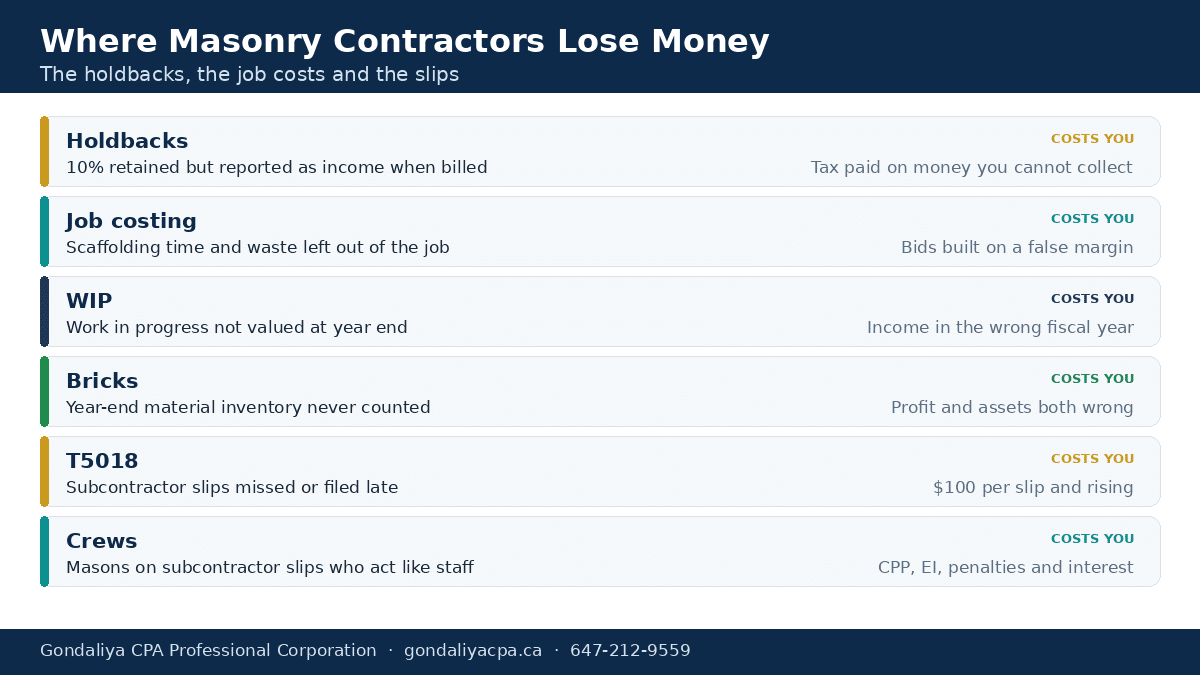
Masonry contractors deal with some tricky money issues. Their cash flow isn’t steady because of irregular payment schedules. They get paid based on project progress, and sometimes the payments get held back because of laws like the Ontario Construction Act. Plus, seasonal work means income can dip at certain times.
The statutory holdback under Ontario construction lien legislation is 10% of the value of the work. Where an amount is held back under lien legislation it is excluded from income until it becomes receivable, which is a genuine deferral and not a reporting choice.
Tracking costs is another challenge. Contractors have to keep tabs on:
- Labour hours for each crew or task
- Amounts of materials used, including waste
- Time spent on scaffolding
- Equipment usage and depreciation
- Payments to subcontractors
All these details must be accurate for job costing and tax reasons. Equipment like mixers or scaffolds needs the right depreciation treatment according to tax rules. Mistakes here might cause problems with tax returns or audits. Also, subcontractor expenses need proper paperwork and timely reporting to avoid penalties.
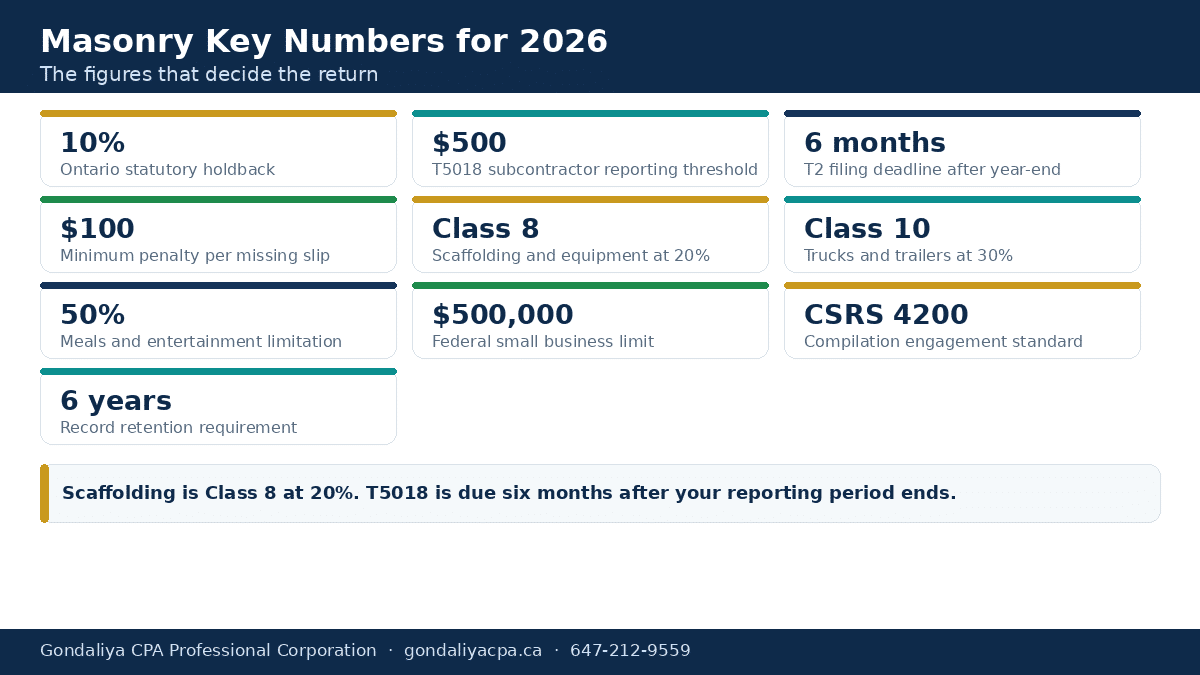
Mixers, saws and hand equipment sit in Class 8 at 20%. Trucks and trailers sit in Class 10 at 30%, and the Class 10.1 passenger vehicle ceiling is $39,000 before tax for 2026.
Common Accounting Pain Points
Many masonry contractors find GST/HST rules confusing. They have to figure out if a service is just labour or includes supplies, since this affects how they handle taxes and credits. Getting this wrong could lead to denied input tax credits or audits.
Payroll is another tricky area. Employers must correctly calculate deductions for CPP, EI, and income tax for all workers — including apprentices. Preparing T4 slips properly is key too; otherwise, CRA might hit them with fines.
Setting up bookkeeping that fits a masonry business isn’t simple either. A good system should:
- Separate direct labour from overhead costs
- Track materials inventory (like counting bricks at year-end)
- Handle overheads such as site trailers and safety gear
Using cloud accounting software helps, but contractors need to stay on top of reconciling supplier statements every month.
Regulatory and Tax Issues
Incorporated masonry companies must file corporate tax returns (T2). These returns need to reflect work still in progress at fiscal year-end correctly. Missing deadlines or filing errors can cause penalties plus interest charges.
CRA also expects firms to report payments to subcontractors over $500 using T5018 slips, filed within six months of the end of the chosen reporting period. Missing these reports leads to fines — starting at $100 per missing slip and increasing based on company size.
The T5018 return is due within six months of the end of your chosen reporting period, which may be the calendar year or your fiscal period, applied consistently. February is the T4 deadline and the two are conflated constantly. There is no separate 2026 change to that timing.
Having a CPA who understands masonry business details is helpful. For example, knowing when holdbacks count as income or how payroll works with provincial apprenticeship rules can save headaches down the line. Skilled Trades Ontario oversees some of these rules but checking current regulations is wise.
For expert guidance tailored specifically for incorporated masonry businesses across Toronto/Ontario/Canada-wide jurisdictions contact Gondaliya CPA’s team via info@gondaliyacpa.ca or call 647-212-9559 for a free consultation focused on your accounting accuracy and regulatory compliance needs today.
How Gondaliya CPA Supports Masonry Contractors with Accounting Services
How Gondaliya CPA Supports Masonry Contractors with Accounting Services
The Services
Gondaliya CPA offers accounting services made for masonry contractors all over Canada. We focus on incorporated masonry businesses. Our team makes sure you follow CRA rules. We also help with tax planning and money management that fit the unique needs of your masonry company.
Recommended Accounting and Tax Services for Masonry Contractors
We provide a full range of services to cover all your accounting needs. From corporate tax filing to job costing and cash flow, we have you covered. We aim for accuracy and timely work while keeping you within the law. Whether you’re in Toronto, Ontario, or anywhere else in Canada, our services support your growth.
Corporate Tax Planning
Corporate tax planning matters a lot for masonry contractors. It helps you meet the T2 Corporate Tax Return Deadline without trouble. Our team knows the CRA compliance rules for construction businesses well. We advise on how to report income using methods like percentage-of-completion or completed contract under the Income Tax Act. This way, you can report income in line with project timelines.
We also help claim capital cost allowances for scaffolding or equipment (Classes 8 and 10), following half-year rules. We make sure filings happen on time to avoid penalties and interest fees.
Bill C-15 received Royal Assent on 26 March 2026, reinstating the accelerated investment incentive. For most depreciable property acquired after 2024 and available for use before 2030 the half-year rule is effectively suspended and an enhanced first-year deduction applies, phasing down after 2029.
Bookkeeping Services
Good bookkeeping keeps your finances under control. Gondaliya CPA sets up bookkeeping systems that fit incorporated masonry contractors. We use cloud accounting tools with job costing codes per contract. These codes track:
- Labour hours
- Materials used
- Subcontractor costs
- Overhead expenses
This info helps check profits and claim GST/HST input credits. Monthly reconciliations keep records up-to-date and follow CRA retention rules, lowering audit risks.
Please keep purchase invoices rather than credit card slips. A statement alone does not meet the documentary requirements and is the most common reason input tax credits are denied on review.
Payroll Services
Payroll must meet strict CRA deadlines. It includes calculating payroll source deductions like CPP and EI correctly. We simplify payroll so employees—including apprentices—get proper T4 slips every year on time. We also handle workers’ compensation payments if required by local safety agencies.
Financial Statements Preparation
Lenders or bonding companies want financial statements prepared under CSRS 4200 standards based on ASPE. These include schedules like work-in-progress values, which are key for financing or bonds.
Gondaliya CPA prepares clear reports with GIFI codes (Schedules 100/125/141). This shows your company’s financial health clearly and follows Canadian accounting standards.
GST/HST Filing Support
Masonry contractors must register for GST/HST if revenues pass set limits in the Excise Tax Act. We explain when supply-and-install contracts charge GST/HST fully versus labour-only parts that may be exempt based on place-of-supply rules.
We handle annual GST/HST filings before deadlines. This helps claim input tax credits on materials, equipment rentals, and subcontractor invoices properly, backed by correct documents as per section 169.
For a corporation with an annual GST/HST reporting period the return and any balance are generally due three months after the fiscal year end, not one month. Please confirm your own assigned filing deadline before relying on the shorter period stated below.
Job Costing and Project Tracking
Properly costing a masonry job means tracking labour hours by unit installed plus material amounts including waste allowances set by provinces. You must also count scaffolding time and depreciation expenses in each project’s cost centre. Subcontractor fees go into contracts but need correct allocation.
Detailed job costing helps analyze profit margins and set prices right. It also supports revenue recognition at year-end closeout.
Material waste is the layer masonry contractors most often leave out of the job. Breakage on brick and stone is a real cost and it belongs in the cost centre, not in overhead. Figures changed for privacy.
Cash Flow Management
Managing cash flow between progress draws needs careful timing matched with supplier payment terms. Holdbacks release times depend on provincial Construction Acts. Winter shutdowns require budgeting reserves plus line-of-credit costs when needed.
Deposit policies should prevent risk but not record income too soon, following Income Tax Regulations section 248(1). Forecasting keeps receivables and payables balanced to maintain liquidity during seasonal business swings.
Money received before the work is performed is a liability. Deposits sit as deferred revenue until earned, and work performed but not yet billed is accrued revenue at the fiscal year end.
Business Advisory Services
We don’t just do routine tasks; we help with risk management too. This covers things like avoiding employee misclassification audits or late instalment penalties. Succession planning advice helps with smooth ownership handovers keeping your company’s value safe.
For growth, we assess new markets using solid financial models made just for incorporated masonry businesses across Ontario including Toronto.
Solutions to Common Financial Concerns
We tackle common problems such as:
- Underbilling that hurts cash flow
- Overbilling that causes client disputes
- Slow receivable collections lowering working capital
- Spending too much without good returns
Our invoicing controls plus proactive account reconciliation solve these issues while fitting your business operations perfectly.
Sharad Gondaliya, CPA, has over 10 years helping Canadian business owners with their accounting needs.
Benefits of Professional Accounting Services for Masonry Contractors
Benefits of Professional Accounting Services for Masonry Contractors
The Benefits
Professional accounting services help masonry contractors in Canada handle their money right. A masonry contractor accountant Canada keeps your books accurate and handles taxes on time. They also help with cash flow so your business runs smooth. These experts know construction tax rules and can find ways to save you money.
Here are some benefits:
- They deal with tricky stuff like holdbacks, progress billing, and capital cost allowance.
- They follow CRA rules like T5018 contract payment reports made for construction.
- They customize bookkeeping to track labor hours, materials, subcontractor payments, and equipment wear.
- They plan taxes smartly for busy seasons, especially in places like Ontario.
Using a masonry contractor CPA Canada stops costly mistakes about employees versus subcontractors or GST/HST credits. This kind of help keeps your business safe and growing.
Crews on subcontractor slips who work the company schedule with company scaffolding is the classification pattern that draws a payroll review. Figures changed for privacy.
Why Choose an Expert Masonry Contractor Accountant
Picking a masonry contractor tax accountant means hiring someone who knows your industry’s quirks. They understand things like lien holdbacks under local Construction Acts and wage credits for apprentices. These pros get Income Tax Act rules for bricklayers or restoration masons working in Toronto or Ontario.
They offer expertise like:
- Correctly reporting income with methods like completed contract or percentage of completion.
- Properly sorting workers as employees or subcontractors to avoid CRA problems.
- Advising on capital cost allowance classes for equipment owners or renters.
A good masonry contractor CPA Canada firm often uses flat-fee yearly pricing. That covers cleaning up books through filing corporate taxes. It makes budgeting easier and ensures deadlines aren’t missed.
Experts lower risks from missed T5018 filings or untracked holdbacks — common mistakes in this field. Plus, they offer peace of mind with thousands of positive reviews.
Client Experiences with Gondaliya CPA’s Masonry Contractor Accounting Services
Clients working with Gondaliya CPA say their finances became clearer thanks to detailed job costing reports. These reports separate material costs from labor well. Incorporated bricklaying contractors like how Gondaliya communicates about payment deadlines and GST/HST filings made just for Canadian masonry firms.
What clients say:
- Quick replies within one business day, plus weekend help during busy times.
- Clear fees backed by a 30-Day Money Back Guarantee build trust across Mississauga, Vaughan, Brampton, Scarborough, and nearby areas.
- Skilled handling of payroll for multi-crew jobs including apprenticeships following Skilled Trades Ontario rules.
These stories show how working with a licensed Ontario CPA helps reduce tax troubles so contractors can focus on work instead of paperwork.
Records are retained for six years from the end of the last tax year they relate to. Where you disagree with an assessment, a notice of objection must generally be filed within 90 days of the date on the notice.
Contact Gondaliya CPA to Discuss Your Masonry Contracting Accounting Needs
Contact Gondaliya CPA to Discuss Your Masonry Contracting Accounting Needs
Getting Help
If you run an incorporated masonry contracting business in Toronto, Ontario, or anywhere in Canada, Gondaliya CPA is ready to help. Whether you want bookkeeping systems set up for construction work or need expert help with corporate taxes including T2 returns and T5018 slips — they offer flat fees that include HST.
Call 647-212-9559 or email info@gondaliyacpa.ca to get a free chat about your needs as a Canadian mason contractor.
Keep your business legal and running well all year with help only a trusted masonry contractor accountant Canada can provide.
Recognise revenue on the method that matches the work, and exclude statutory holdback until it becomes receivable. Carry deposits as a liability and accrue unbilled work at year end. Put scaffolding in Class 8, not Class 16. File T5018 six months after your reporting period ends. Count brick and stone at year end and cost the breakage. Please keep six years of records.
Frequently Asked Questions About Masonry Contractor Accounting in Canada
Frequently Asked Questions About Masonry Contractor Accounting in Canada
FAQ
What is the T2 Corporate Tax Return Deadline for masonry contractors?+
The T2 Corporate Tax Return must be filed within six months after your fiscal year-end. Gondaliya CPA helps you meet this deadline to avoid penalties.
How does T5018 Contract Payment Reporting affect masonry subcontractors?+
Masonry subcontractors must file T5018 slips for payments over $500, within six months of the end of the chosen reporting period. This ensures CRA compliance and avoids late filing penalties.
What is the Statutory Holdback Percentage in Ontario for masonry contracts?+
Ontario mandates a 10% holdback under the Construction Act. Proper accounting of holdbacks prevents cash flow issues and audit risks.
How does Capital Cost Allowance Class 8 Rate apply to masonry equipment?+
Class 8 covers machinery and equipment with a 20% declining balance rate. Gondaliya CPA applies the half-year rule for first-year claims correctly.
What is the Half-year Rule Fraction in capital cost allowance?+
This rule limits CCA claims in the acquisition year to half the usual amount, balancing tax benefits over time.
When is the Payroll Remittance Deadline for masonry contractors in Canada?+
Payroll deductions must be remitted to CRA by set deadlines based on your remitter type to avoid penalties.
What is the GST/HST Filing Deadline (Annual) for masonry businesses?+
Annual GST/HST returns are due one month after your fiscal year-end. Filing on time preserves input tax credit claims.
| Obligation | Deadline | Applies To | Consequence if Missed | Source |
|---|---|---|---|---|
| Annual GST/HST Return | Last day of month after year-end | Registered Masonry Firms | Late-filing penalty & interest | CRA |
How long must masonry contractors keep financial records (Record Retention Period)?+
CRA requires records retention for six years from the end of the last tax year they relate to.
What methods are used for construction contract revenue recognition?+
Gondaliya CPA applies percentage-of-completion or completed contract methods, matching income with project progress.
How should deposits received in advance be accounted for by masonry firms?+
Deposits are recorded as liabilities until earned, preventing premature income reporting per Income Tax Regulations.
What is change order accounting in masonry projects?+
Change orders adjust contract values and costs. Proper tracking ensures accurate revenue and cost recognition.
How do supply-and-install contracts differ from labour-only contracts in GST/HST treatment?+
Supply-and-install contracts generally attract GST/HST on full charges; labour-only contracts may qualify for exemptions.
What defines a completed contract method of revenue recognition?+
Income is reported only after project completion, useful when outcomes are uncertain or cash flow irregular.
Why is work in progress (WIP) important at fiscal year-end?+
WIP valuation reflects unbilled project work, ensuring accurate income and tax reporting.
What is cut-off discipline in masonry accounting?+
Cut-off discipline means recognizing income and expenses in correct periods, avoiding misstated financials.
How should holdback accounting treatment be handled?+
Holdbacks remain liabilities until released; proper tracking avoids overstated income or assets.
What regulations govern holdback timing under the Ontario Construction Act?+
Ontario law defines holdback release schedules; compliance ensures smooth cash flow and legal adherence.
What are common penalties related to construction contract payment reporting?+
Late or missing filings can trigger fines starting at $100 per slip, escalating with frequency or size of business.
How does workers’ compensation impact payroll for masonry contractors?+
Contractors must remit premiums based on payroll totals; proper calculation avoids penalties and coverage gaps.
Are apprentice wage rates subject to special rules or tax credits?+
Apprentices may qualify for lower wage rates and apprenticeship tax credits through Skilled Trades Ontario programs.
Twenty questions and two underneath most of them: when does the holdback become income, and is the crew member an employee. Those two settle most masonry files. Figures changed for privacy.
Essential Accounting Tips for Masonry Contractors by Gondaliya CPA
Essential Accounting Tips for Masonry Contractors by Gondaliya CPA
Quick Reference
- Track costs using detailed cost centres for labour, materials, and overheads.
- Account accurately for breakage and waste to avoid expense misstatements.
- Document supplier rebates separately to ensure correct revenue reporting.
- Monitor warranty cost tracking including callback repair expenses carefully.
- Set up provisions for warranty liabilities to reflect future repair costs realistically.
- Implement contractor risk management practices to reduce audit risks and financial losses.
- Recognize recapture events when disposing of depreciable assets to report taxable gains properly.
- Calculate terminal loss if asset disposition results in deductible losses on your tax return.
- Deduct lease payments fully when related directly to business operations under CRA guidelines.
- Claim rental fees immediately if payments relate solely to current business use without capital impact.
- Track expenses like safety clothing and small tools carefully, following CRA limits on deductibility.
- Apply meals and entertainment limits strictly; only 50% of these expenses qualify as deductions.
- Determine place of supply correctly when billing out-of-province clients for GST/HST purposes.
- Separate mixed activity transactions into taxable and exempt portions as per CRA rules.
- Maintain documentary requirements rigorously to support input tax credit claims during audits.
- Reconcile supplier statements monthly during close processes to catch discrepancies early.
- Prepare for winter shutdown by budgeting line of credit costs associated with seasonal cash needs.
- Use compilation engagement reports adhering to CSRS 4200 standards when submitting financials to lenders or bonding companies.
- Follow CRA compliance procedures closely regarding T4 slips, T4A slips, and source deduction remittances timely.
For expert help with these topics, contact Gondaliya CPA at info@gondaliyacpa.ca or call 647-212-9559 today.
Professional Guidance and Quick Reference
Guidance
Who This Is For
- For: Incorporated masonry contractors across Canada, including bricklayers, stone masons and restoration specialists, chimney repair companies, parging and heritage trades, commercial and residential masons and subcontracted crews.
- Also for: Contractors carrying holdbacks across a fiscal year end, contractors several years behind on filings, and owners preparing statements for a lender or bonding company.
- Not for: Unincorporated sole proprietors and partnerships, whose filing obligations run through a personal return rather than a T2.
- Not for: Municipal licensing, WSIB classification appeals and Skilled Trades Ontario apprenticeship registration, which sit with the relevant authority rather than accounting.
- Not for: Construction lien interpretation and contract drafting, which are legal questions for counsel.
People Also Ask
How much does accounting cost for a masonry contractor in Canada?+
Our fee is fixed, quoted annually and includes HST. It is set before work begins based on transaction volume, payroll headcount and the number of concurrent contracts requiring work in progress schedules.
Do I need a CPA or is a bookkeeper enough?+
A bookkeeper maintains the ledger. A CPA firm is required for compilation financial statements a lender or bonding company will accept, holdback and work in progress treatment, and representation on a CRA review.
What financial statements will a lender or bonding company expect?+
A balance sheet, an income statement and notes covering work in progress and holdbacks, prepared as a compilation engagement under CSRS 4200.
Glossary of Key Terms
- T2 Return: The corporation income tax return filed annually by an incorporated business.
- Statutory Holdback: The percentage of the value of the work retained under construction lien legislation, 10% in Ontario.
- Substantial Performance: The certification that starts the lien period running.
- Receivable: The point at which holdback income must be recognised.
- WIP (Work in Progress): Work performed but not yet billed at the fiscal year end.
- Deferred Revenue: Money received before the work is performed, carried as a liability.
- Percentage-of-Completion: Recognising contract revenue in proportion to the work performed.
- Completed Contract: Recognising contract revenue only once the project is finished.
- Cut-off Discipline: Recording income and expenses in the period they actually belong to.
- Change Order: A documented variation to contract scope, value or cost.
- Breakage Allowance: The expected waste on brick, block and stone, costed to the job.
- CCA (Capital Cost Allowance): The tax depreciation claimed on capital assets.
- Class 8: The 20 percent class covering scaffolding, mixers, saws and shop equipment.
- Class 10: The 30 percent class covering trucks and trailers.
- Half-Year Rule: The rule limiting first-year capital cost allowance to half the normal amount.
- Accelerated Investment Incentive: The enhanced first-year deduction reinstated by Bill C-15 in 2026.
- Recapture: Income added back when an asset is sold above its undepreciated capital cost.
- Terminal Loss: The deduction arising when the last asset in a class is sold below its undepreciated capital cost.
- T5018: The contract payment information return for construction activity, due six months after the reporting period ends.
- Place of Supply: The rules determining which province’s GST/HST rate applies to a supply.
- ITC (Input Tax Credit): The GST/HST recovered on business purchases supported by a supplier invoice.
- CSRS 4200: The Canadian standard governing compilation engagements.
Masonry Readiness Check
This quick self-check indicates where your operation most likely has room. Please answer the six questions below.
Masonry Readiness Check
Six quick questions on your company. No fee shown.
Points to raise with us:
This is a general prompt, not tax or legal advice or a quote. Your position depends on your full facts. For a real review, please book a free consultation.
Want a checklist to work from? You can download our free masonry contractor tax checklist before your consultation.
This article reflects rules current to 2026. The 10% Ontario statutory holdback, the $500 T5018 reporting threshold, the Class 8 rate of 20%, the Class 10 rate of 30%, the six-month T2 filing deadline, the $100 minimum slip penalty, the 90-day objection window and the six-year retention requirement are unchanged. The Class 10.1 capital cost ceiling rose to $39,000 before tax for vehicles acquired on or after 1 January 2026, with the Class 54 zero-emission ceiling at $61,000. Ontario reduced its small business rate to 2.2% effective 1 July 2026, giving a combined rate near 11.2%. Bill C-15 received Royal Assent on 26 March 2026, reinstating the accelerated investment incentive. Two figures in the original source have been corrected in this guide at the client’s instruction: scaffolding is Class 8 rather than Class 16, and the T5018 return is due six months after the chosen reporting period ends rather than under a 2026 change. Please also note that an annual GST/HST return for a corporation is generally due three months after the fiscal year end.
Masonry Contractor Accountant Canada: How Gondaliya CPA Supports Contractors
Start with the holdback schedule
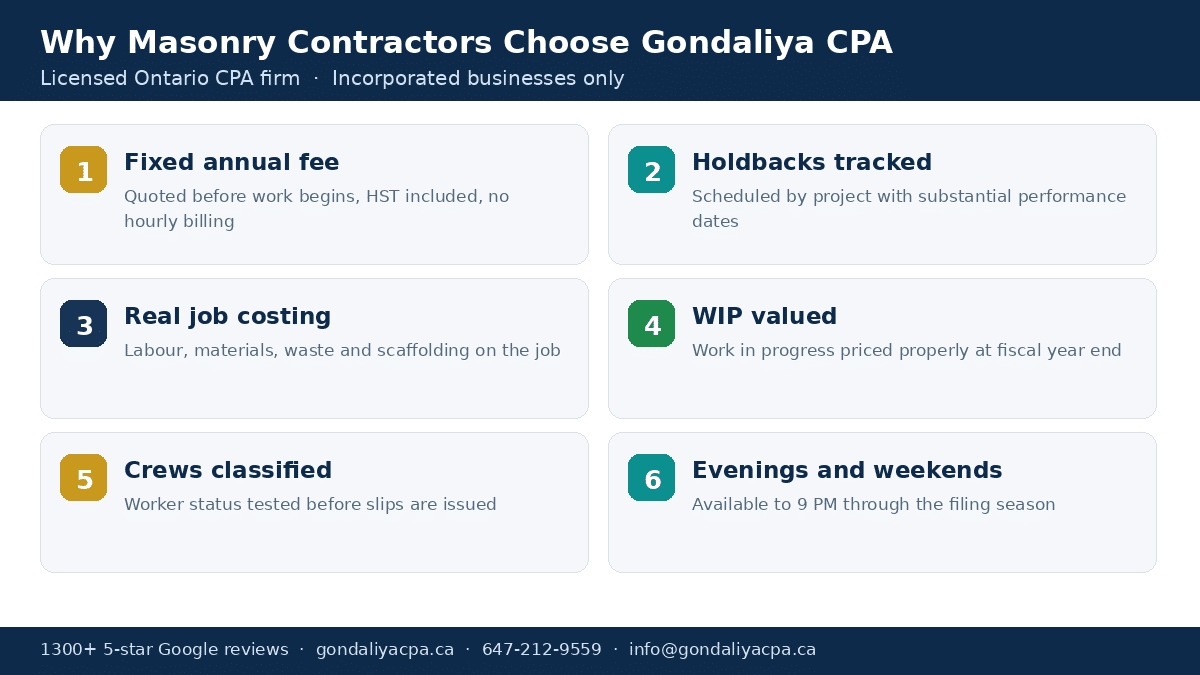
Gondaliya CPA builds the holdback schedule by project with substantial performance dates, excludes statutory holdback from income until receivable, accrues work in progress and defers deposits, counts brick and stone at year end with breakage costed to the job, applies the correct capital cost allowance class to scaffolding, mixers and vehicles, prepares T5018 on the correct period and deadline, and tests worker classification before slips are issued, on a flat annual fee including HST with a one-business-day response. Please book a free consultation.
Next Steps
Please book a free consultation with Gondaliya CPA and bring a holdback schedule or the project list it can be built from, a sample of subcontractor invoices, and your last filed corporate return. Those three tell us immediately whether the holdback deferral is being claimed, whether T5018 is being handled, and what remains to claim on the scaffolding and equipment. You will get a flat annual fee including HST before any work begins. If our content helps, please add gondaliyacpa.ca as a preferred source on Google.
Published: · Last updated:
Editorial policy: We research against CRA and CPA Ontario sources, fact-check the figures, and Sharad Gondaliya, CPA, reviews the content, which we update as the rules change.
Disclaimer: This article is educational information only and is not tax, legal, or financial advice. Figures marked illustrative are examples rather than quotes or guarantees. It reflects CRA rules current to 2026, including the 10% Ontario statutory holdback, the $500 T5018 threshold, the Class 8 rate, the half-year rule and its 2026 suspension, and the six-year retention requirement. Rates, limits and expensing rules change and outcomes depend on your specific facts. Please consult a CPA Ontario member before acting.

Sharad Gondaliya is a CPA Canada & CPA USA with 15 Years+ experience of Accounting, Tax, Payroll of Corporate Small Businesses as Tax Accountant. He is a CPA Ontario member (61040184) and holds US CPA licences in Washington and Montana and is well known among corporate small businesses for tax planning, efficient tax solutions, and affordable CPA services. Sharad is the Principal (Director) of Gondaliya CPA – Affordable CPA Firm in Canada. Licenses: CPA Ontario: 61040184 | CPA USA (MT): PAC-CPAP-LIC-033176 | CPA USA (WA): 57629 | CPA Firm License: 61330051 View Full Author Bio