



Common Tax and Accounting Mistakes Audiologists Make in Canada and How to Avoid Costly Problems
Audiologist Tax Mistakes Canada: Common Accounting and Bookkeeping Errors in Audiology Practices | Gondaliya CPA
Audiologist tax mistakes Canada often arise from errors in bookkeeping and accounting within audiology practices, leading to costly tax problems. Gondaliya CPA highlights key audiology accounting mistakes and audiologist bookkeeping mistakes to help practices maintain accurate records and avoid audits.
Quick Summary
An audiology clinic makes three kinds of supply at once, and the GST/HST treatment differs for each. Getting the revenue split right, apportioning input tax credits consistently, classifying clinic equipment and fit-out correctly, and running locums through the right slip is most of the work.
Reading time: 42 minutes.
Table of Contents
- The Cost and Impact of Tax and Accounting Errors in Audiology Practices
- Late Filing and Missed Deadlines: Causes, Consequences, and Avoidance
- Errors in GST/HST Registration and Filing Affecting Audiology Businesses
- Establishing Robust Financial Systems for Audiology Bookkeeping
- When and How to Seek Professional Help for Audiology Tax Problems
- Case Study: Improving Tax Compliance and Financial Accuracy in an Audiology Clinic
- Clear Contact Information for Expert Audiology Accounting Assistance
- FAQs on Audiologist Tax Compliance and Related Legal Requirements
- Essential Legal and Tax Considerations for Audiology Practices in Canada
- Professional Guidance and Quick Reference
The Numbers That Matter
The T2 return is due 6 months after the fiscal year end, and an objection must be filed within 90 days of the notice.
This article covers Canada, with Ontario and Toronto context, and reflects rules current to 2026. It applies to incorporated audiology practices including solo audiologists, hearing clinics dispensing devices, and multi-location clinic groups. Figures marked illustrative are examples, not quotes, and any masked engagement notes end with “Figures changed for privacy.” This is educational information only and not tax or legal advice. Professional regulation, scope of practice and college requirements sit with CASLPO rather than with your accountant, and assistive device programme rules sit with the administering ministry.
The Cost and Impact of Tax and Accounting Errors in Audiology Practices
The Cost and Impact of Tax and Accounting Errors in Audiology Practices
The Cost
Common pitfalls that lead to financial strain
Audiologists in Canada face tax challenges that often cause money problems. Some common mistakes are mixing up income sources, forgetting to track costs properly, and ignoring tax rules. These slip-ups hurt cash flow and can trigger CRA audits. Knowing these audiologist tax mistakes Canada helps keep the practice stable.
Overview of tax challenges unique to audiologists
Tax rules for audiologists can be tricky. Many services don’t need GST/HST, but items like hearing aids might be taxed or zero-rated depending on the case. Getting this wrong leads to wrong tax returns and missed deductions. These audiology accounting mistakes cost practices money and stress.
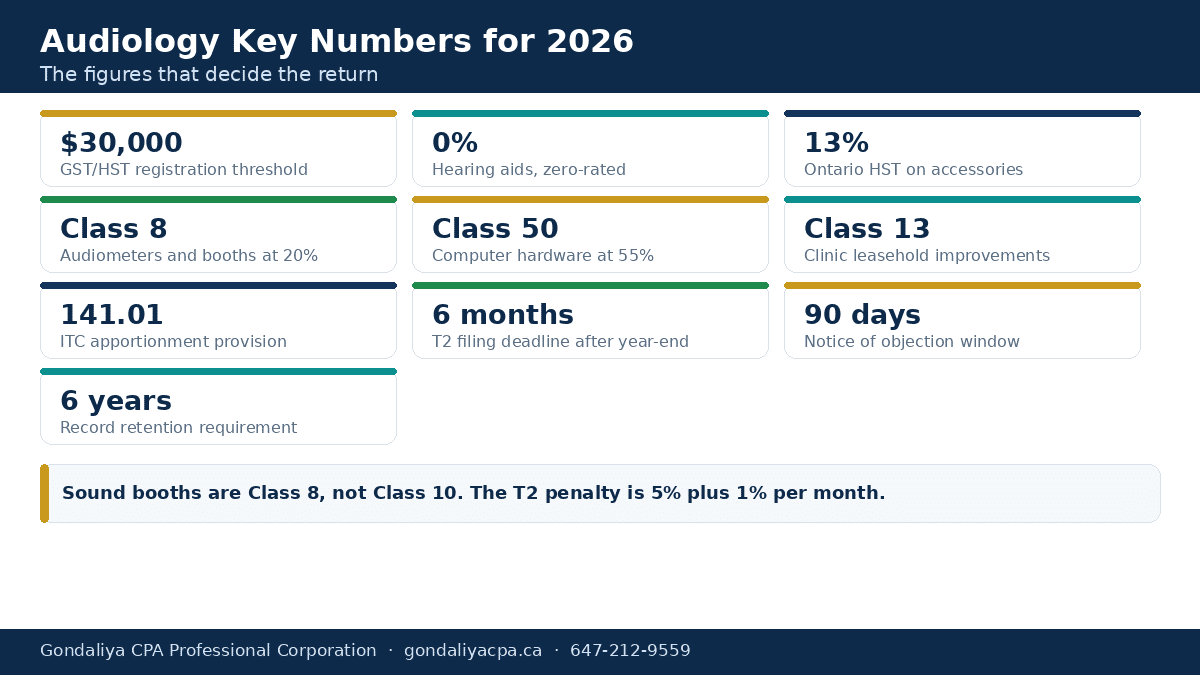
The three-way split decides most of an audiology file. Clinical assessment and therapy are exempt, hearing aids are zero-rated at 0%, and accessories, batteries and repair labour are taxable at 13% in Ontario.
Common Audiology Practice Tax Problems in Canada
Regulatory concerns for clinics
Many clinics struggle with CRA rules. For example, some don’t register for GST/HST when they should. Others mishandle input tax credits when they sell both taxable and exempt goods. These slips can mean fines or a bad reputation among patients.
Frequent compliance issues
Problems often come from poor bookkeeping or not keeping up with changing tax laws. Clinics may miss deadlines or file incorrect info because of this. Staying updated helps avoid audiology practice tax problems that can threaten the clinic’s future.
Why Accurate Bookkeeping Is Critical for Audiologists
Importance of reliable records
Good bookkeeping is the foundation of any audiology clinic. It tracks every dollar in and out, helping file taxes correctly and avoid errors during CRA checks. Without clear records, clinics risk cash flow problems and miss out on legal deductions—common audiologist bookkeeping mistakes.
Effects on financial decision-making
Bad accounting makes it hard to know how well the clinic is doing. When numbers are off or incomplete, owners can’t plan growth or spot money leaks easily. This leads to poor choices that hurt profits over time.
How Tax Mistakes Affect Profitability and Compliance in Audiology Practices
Risks to profit margins
Tax errors raise costs by triggering penalties or interest charges from the CRA after audits show income doesn’t match services provided. These extra expenses cut into profit margins sharply.
Potential CRA penalties and legal outcomes
Ignoring tax mistakes can lead to more than just fines. Repeated issues might cause legal trouble if not fixed early on. Audiologists should work hard to prevent these problems before they get worse.
Understanding these points will help audiologists across Canada reduce risks and improve their practice’s success over time!
Late Filing and Missed Deadlines: Causes, Consequences, and Avoidance
Late Filing and Missed Deadlines: Causes, Consequences, and Avoidance
Deadlines & Money
Late filing and missed deadlines are common audiologist tax mistakes Canada clinics make. They often delay T2 corporate income tax filings, GST/HST returns, payroll remittances, or slip submissions like T4s and T4As. This leads to penalties and interest charges from the CRA.
Penalties start at 5% of the amount owing plus 1% for each full month late, up to 12 months. Interest builds up on unpaid balances. Input tax credits may be lost if GST/HST filings come late. These costs can strain cash flow for small audiology businesses.
Bill C-15 received Royal Assent on 26 March 2026, reinstating the accelerated investment incentive. For most depreciable property acquired after 2024 and available for use before 2030 the half-year rule is effectively suspended and an enhanced first-year deduction applies. Leasehold improvements are excluded, so Class 13 is unaffected.
To avoid trouble:
- File T2 returns within six months after fiscal year-end.
- Pay balances within three months after year-end for most private corporations.
- Submit GST/HST returns monthly or quarterly based on revenue.
- Remit payroll deductions on prescribed dates depending on monthly withholding.
Using a calendar with automated reminders helps keep track. Outsourcing bookkeeping to CPAs familiar with audiology tax issues lowers risk. Regularly checking your filing status stops accidental misses that trigger CRA audits or reassessments.
The T2 filing deadline and the balance due date are different. The return is due six months after the year end. The balance is due three months after year end for a CCPC claiming the small business deduction, and two months otherwise.
Mixing Personal and Business Finances: Risks and Solutions for Audiologists
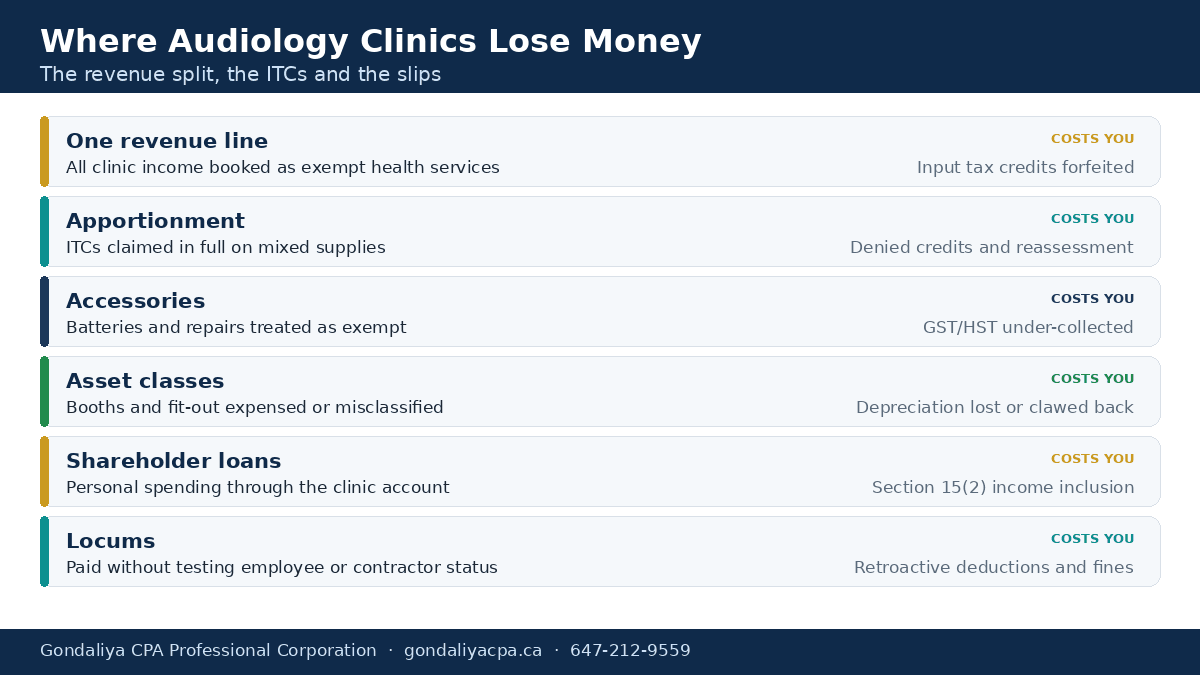
Many audiologists mix personal spending through their corporation accounts. This causes problems under section 15(2) of the Income Tax Act when funds are withdrawn without clear records or repayment plans.
This can create taxable benefits added to shareholder income. It invites audit attention and possible double taxation on unreported amounts. Reconciling these mixed transactions is a hassle. It also clouds financial reports needed for proper corporate tax filing.
To manage this:
- Keep business and personal bank accounts separate.
- Never pay personal expenses directly from clinic funds without proper documentation.
- Record personal withdrawals as shareholder loans with clear repayment terms.
- Use bookkeeping software that flags non-business transactions early.
Reconcile corporate ledgers with shareholder loan accounts regularly. A CPA experienced in Ontario’s regulations helps avoid taxable benefit errors while keeping compliance clean.
A shareholder loan that grows quietly through the year is the most common finding on a first review of a professional corporation. It is cheap to fix in month two and expensive to fix in month fourteen. Figures changed for privacy.
Inadequate Record Keeping and Its Effect on Tax Compliance
Leaving books until year-end is a frequent audiologist bookkeeping mistake. It risks errors in financial statements the CRA needs. Delayed entries cause missed sales tracking, especially between exempt and taxable supplies in mixed-revenue practices.
This leads to misstated income affecting GST/HST calculations, overlooked deductible expenses, wrong payroll records, and higher audit risk. Lack of proper documents may result in denied claims or reassessments with extra taxes and penalties.
Good record keeping means:
- Closing books monthly to enter receipts promptly.
- Using cloud accounting linked with receipt capture for automatic invoice entry.
- Keeping digital files organized per CRA rules (keep records at least six years).
Regular checks ensure consistent revenue splits between clinical services (exempt) and hearing devices (zero-rated). Correctly matching funding payments avoids costly year-end fixes handled by specialized accountants familiar with healthcare SMBs in Canada.
Overlooking Legitimate Tax Deductions Specific to Audiology Practices
Audiologists often miss deductions on equipment purchases and clinic build-outs. This mistake costs incorporated practices thousands yearly.
Typical items overlooked include:
- Diagnostic audiometers (Class 8)
- Sound booths (Class 8/10)
- Real-ear measurement systems (Class 50)
- Business-use computers (Class 50)
- Leasehold improvements (Class 13 amortization)
Please check the class before you claim. Sound booths and audiometers sit in Class 8 at 20%. Class 10 covers vehicles rather than clinic equipment. Computer hardware and system software sit in Class 50 at 55%, and leasehold improvements sit in Class 13, amortised over the lease term plus one renewal period with a five-year minimum and a forty-year maximum.
Mistaking repairs for improvements or vice versa causes lost CCA opportunities or wrong expense claims. Assets should be capitalized properly per Income Tax Act rules instead of expensed outright.
Recent accelerated investment incentives allow bigger write-offs through 2026 when done right. CPAs familiar with medical device classes help maximize deductions while following federal guidelines to avoid CRA red flags.
Incorrect Income and Expense Classification in Audiology Accounting
Treating all clinic income as exempt health care services is a big audiology accounting mistake. Hearing aids sold are zero-rated but not exempt under GST/HST rules.
Misclassifying accessory sales like batteries or repair fees as exempt inflates exempt supply figures incorrectly. This reduces input tax credit claims, risking reassessments with penalties.
Correct revenue classification should be:
- Clinical assessments & therapy: Exempt
- Hearing aids: Zero-rated
- Accessories & repairs: Taxable supplies subject to standard GST/HST rates
Invoices must reflect this split clearly using detailed point-of-sale reports to avoid post-filing adjustments. Expense misclassification also distorts profit margins, so routine chart reviews aligned with CASLPO standards help keep accounts clear across clinics serving Ontario patients.
Treating the whole clinic as exempt is the error that costs the most, because it quietly forfeits input tax credits on rent, equipment and device purchases for every period it runs. Figures changed for privacy.
Errors in GST/HST Registration and Filing Affecting Audiology Businesses
Errors in GST/HST Registration and Filing Affecting Audiology Businesses
GST/HST
Many Canadian audiologists get GST/HST registration wrong by claiming full input tax credits on mixed supplies involving exempt services plus taxable device sales. For example, fitting fees bundled improperly cause issues under Excise Tax Act rules.
Consequences include denied ITCs causing cash flow losses, reassessments, plus interest charges that grow if unresolved quickly.
Good practice means:
- Registering for GST/HST once taxable sales exceed $30K annually even if most income is exempt.
- Applying apportionment methods yearly based on turnover percentages or direct tracing.
- Keeping thorough records supporting allocation choices per CRA rules.
Frequent reconciliations along with CPA advice prevent overclaims that hurt sustainability. This matters especially since Excise Tax Act changes through 2026 clarify health service exemptions more clearly.
Registration is mandatory once worldwide taxable supplies exceed $30,000 in a single calendar quarter or across four consecutive calendar quarters. Zero-rated hearing aid sales count toward that threshold. Exempt clinical services do not.
Payroll Tax Mistakes and Their Penalties for Audiology Practices
Paying staff or locum audiologists incorrectly creates big problems financially and legally. Misclassifying workers can trigger retroactive source deduction demands plus heavy fines under federal payroll laws.
Common errors include:
- Skipping required slips like T4s or T4As
- Confusing contractors vs employees
- Late payroll remittances leading to daily penalties starting at $100 minimum
- Ignoring family member wage reasonableness tests causing taxable benefits per section 15(2)
Keep detailed work records showing hours worked to support salary levels matching market rates. Following strict remittance deadlines helps maintain good standing and avoid government interruptions—especially important when clinics expand services around Ontario regions.
The payroll remittance penalty is not a daily $100 minimum. It is a percentage of the amount remitted late, 3% up to three days, 5% up to five, 7% up to seven, and 10% beyond that, rising to 20% on a repeat failure made knowingly.
Capital Cost Allowance Misapplications for Audiology Equipment and Assets
CCA mistakes happen when audiology equipment is either fully expensed too soon or ignored entirely delaying depreciation claims that reduce profits during incorporation phases.
Issues arise from misunderstanding half-year rule limits which cap first-year deductions regardless of purchase timing. Overstating immediate write-offs leads to future clawbacks needing complex fixes disrupting cash flow plans—common in multi-location expansions around Toronto/Ontario areas where rules vary slightly but matter a lot.
Maintaining an up-to-date asset register supports accurate CCA scheduling using recent accelerated investment incentives available through 2026 that boost write-off options compared to older static models lacking active oversight found only via expert professional help specialized in hearing instrument retail clinics.
Available for use is the test, not the invoice date. A booth delivered in December but not commissioned until February belongs to the following fiscal year.
Choosing the Wrong Business Structure for Tax Efficiency and Liability
Assuming forming a professional corporation fixes all liability issues while optimizing taxes is a common misconception among Canadian audiologists risking poor outcomes like exposure under personal services business rules that cut small business deduction access sharply raising effective tax rates unexpectedly.
Professional corporations need careful design following provincial share ownership limits plus strict naming rules ensuring activities stay authorized by CASLPO regulations avoiding sanctions that impact accounting treatments too. Dividend payouts get taxed differently than salaries requiring careful planning balancing compensation within legal constraints plus meeting CRA’s reasonable remuneration tests together helping preserve wealth steadily over time—especially key when franchises span multiple provinces with different regulations involved.
Expert advice from Ontario CPA firms specializing in this field ensures structure fits both tax planning goals and governance needs perfectly handling incorporation setup plus ongoing monitoring seamlessly closing gaps otherwise left open harming intended protections assumed elsewhere across Canada including Toronto-area clinics benefiting from flat-fee annual pricing covering all needed support backed by strong reputations confirmed by thousands of positive reviews independently verified over years working deeply inside the sector itself.
Establishing Robust Financial Systems for Audiology Bookkeeping
Establishing Robust Financial Systems for Audiology Bookkeeping
Financial Systems
Audiologists often make bookkeeping and accounting mistakes that can lead to costly tax issues in Canada. Setting up strong financial systems made for audiology helps avoid errors and keeps records accurate.
Key components of effective systems
Good audiology bookkeeping means sorting income clearly and tracking expenses well. Mixing exempt clinical fees with taxable device sales is a common mistake. Creating a chart of accounts made just for hearing clinics keeps exempt therapy fees separate from taxable product sales.
Other must-haves are regular bank reconciliations, recording invoices on time, and handling payroll properly. Also, keeping a capital asset register helps claim the right depreciation for clinic gear under Income Tax rules.
Manual vs. automated solutions
Manual bookkeeping brings risks like typos and late error spotting, which can trigger audits for audiologists. Using automated cloud accounting tools makes recording transactions easier and handles GST/HST math automatically.
Automation cuts down repetitive work like making invoices and matching payments but needs setup to fit clinic needs (like tracking hearing device stock). Still, manual checks are needed because software can’t replace expert judgment on tricky stuff like splitting exempt and taxable supplies.
Best Practices for Record Retention and Documentation
Keeping good records lowers audit risks tied to audiologist tax mistakes in Canada. The CRA requires proof to back input tax credits (ITCs) and income reporting.
Document storage tips
Audiology clinics should keep all source documents safe in cloud storage linked to their accounting system. This means saving invoices, receipts, payroll info, lease deals, billing reports, inventory lists, trial contracts, deposit records, and CRA letters.
Organize files by type so they’re easy to find during audits or reviews. Following document management rules stops lost paperwork caused by staff changes or system crashes—a common audit problem.
Retention timelines
CRA says keep business records supporting corporate filings (like T2 returns) for six years after the tax year ends. For incorporated audiologists under CASLPO rules, this also applies even if clinical files follow other rules.
Backing up files beyond legal minimums helps avoid data loss from accidental deletes or hacking—important when facing reassessments or relief requests.
Records are retained six years from the end of the last tax year they relate to, and that includes electronic records and point-of-sale data.
Managing Separate Accounts to Avoid Personal and Business Mix-ups
Using corporate accounts for personal spending creates trouble under ITA section 15(2). Personal use not paid back on time counts as corporate income, causing unexpected taxes plus interest.
Keep business bank accounts only for clinic money—patient payments and funding programs separate from owner withdrawals. Set clear rules against non-business spending to avoid crossovers that cost big corrections later during CRA checks.
Review shareholder loan accounts often to spot unauthorized draws before problems grow. This protects both company taxes and shareholder obligations.
Using Technology and Software Tools to Support Accurate Financial Tracking
Tech designed for small healthcare businesses can cut typical audiologist bookkeeping mistakes caused by manual work while boosting accuracy.
Recommended software
Cloud accounting is popular in Canada due to its ease of use plus features handling mixed exempt-and-taxable sales seen in hearing clinics. Other choices include platforms with receipt capture that automate document entry and speed up reconciliations when dealing with various revenue sources like assistive device grants or insurer payments.
Payroll tools link smoothly ensuring correct T4/T4A slip issuing—avoiding locum classification errors often missed otherwise.
Integration benefits
Connecting point-of-sale systems that track device sales directly into accounting software removes double entries. This cuts audit discrepancies common in multi-clinic groups lacking strict revenue separation.
Real-time syncing helps calculate GST/HST remittances promptly, stopping late-filing fines tied to missing instalments reported at T2 deadlines.
Automatic alerts before due dates help meet deadlines better—important since leaving books till year-end causes backlog flags during audits.
Developing a Tax Compliance Calendar to Meet Filing Deadlines
Missing filing dates leads to instant penalties plus interest that add up fast—one of the main audiology practice tax problems seen across Canada.
Tracking tools and reminders
Use digital calendars with key dates set such as:
- T2 Corporate Tax Return Due Date: Six months after fiscal year-end
- GST/HST Filing Deadline: Monthly or quarterly depending on registration
- Payroll Remittances & Slip Deadlines: Monthly payments; T4/T4A slips due Feb 28 following calendar year
Set email alerts combined with task apps so nothing slips through when busy running a clinic with little admin support.
Annual and quarterly schedules
Dates vary—confirm yearly per client
| Obligation | Frequency | Example Deadline |
|---|---|---|
| Corporate Income Tax Return | Annually | Six months post fiscal YE |
| GST/HST Returns | Monthly/Quarterly | Last day month after period |
| Payroll Source Deductions | Monthly | 15th next month |
| T4/T4A Slips | Annually | Feb 28 |
Following this stops penalty charges that sometimes reach thousands if left unpaid over years without fixing them.
Conducting Routine Reviews and Reconciliations for Financial Accuracy
Waiting till year-end to check books invites many errors tough to fix later—a classic “books left-to-year-end” mistake we see a lot around Toronto.
Monthly bank statement reviews against ledgers catch problems early letting you fix them before filing returns lowers risk a lot compared to ignoring CRA mail asking questions—which quickly ramps up penalties if left unanswered.
Regular internal checks focusing on splitting exempt services from taxable ones confirm ITC claims are right while lowering reassessment chances. Checking payroll classifications stops contractor misclassification traps causing retroactive deductions plus fines.
A monthly close beats a year-end scramble every time. The clinics that never get a CRA query are the ones reconciling in the first week of the following month. Figures changed for privacy.
When and How to Seek Professional Help for Audiology Tax Problems
When and How to Seek Professional Help for Audiology Tax Problems
Getting Help
Benefits of Specialized Accounting Services for Audiologists
Audiologists in Canada deal with tax rules that can get tricky fast. They often mix exempt and taxable revenues, handle complex inventories, and work with special funding programs. These factors lead to common audiologist tax mistakes Canada that many make without realizing it. Mistakes like treating GST/HST wrong on hearing devices or missing deductions on clinical gear are common. Plus, bookkeeping errors happen a lot—wrong revenue categories or weak payroll records raise audit risks and fines.
Specialized accountants know these pitfalls well. They tailor bookkeeping to audiology practices and keep things clean. Their expertise helps incorporated audiologists stay clear on what the law expects while improving how they report money. They spot issues early like input tax credit errors or wrong handling of third-party funds. This kind of help saves stress and money by keeping filings on time and accurate.
Here’s what they cover:
- Fix GST/HST treatment on hearing devices
- Catch missed equipment deductions
- Classify revenue correctly
- Maintain solid payroll records
Custom CPA Solutions Designed for Audiology Practice Needs
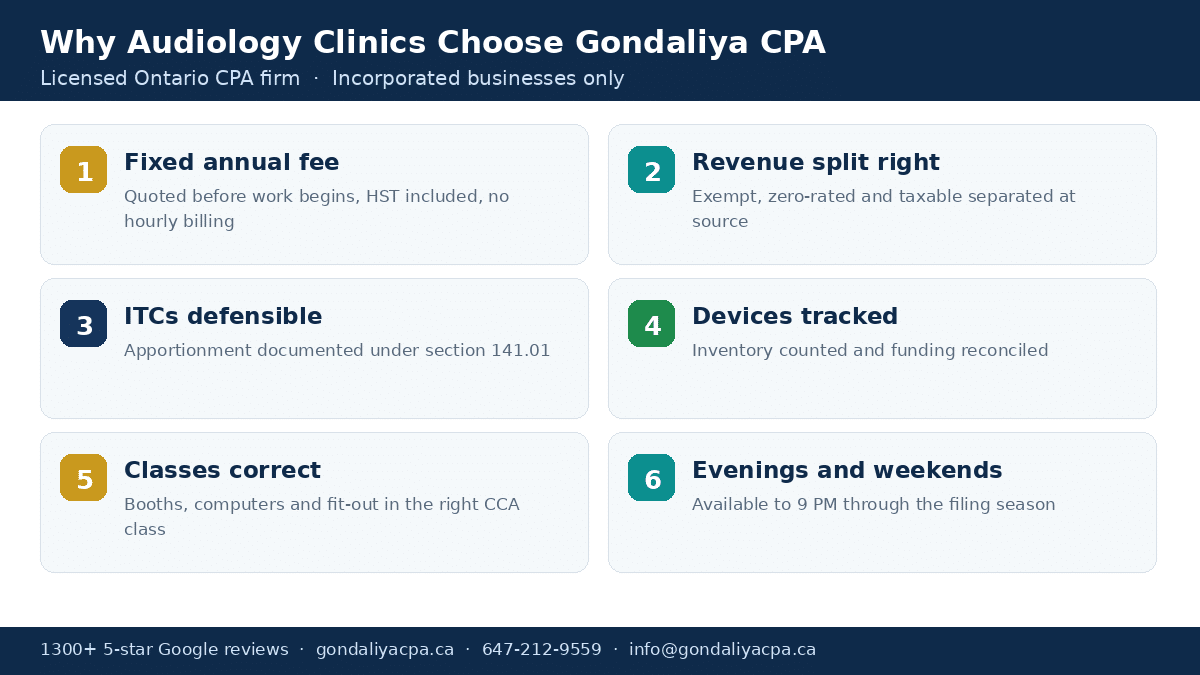
Gondaliya CPA works closely with audiology practices across Ontario and beyond. We know just having a professional corporation doesn’t fix everything. Our services dig into core audiology practice tax problems—from corporate tax plans to cleaning up books.
We find mistakes like incomplete device lists or mixed-up clinic revenues. Then, we apply controls that match CASLPO rules and provincial assistive device program regulations. That way, your clinic stays compliant without slowing daily work.
Our services fit any setup—from solo audiologists to groups running several clinics. We offer flat annual fees, weekend help, and ongoing support so you avoid last-minute T2 corporate return headaches or CRA audits.
What we do includes:
- Detailed reviews catching hidden errors
- Corporate tax planning specific to audiology needs
- Payroll checks to avoid misfiling
- Help with CRA communication when issues arise
Assessing the Value of Professional Tax Preparation versus DIY Software
Fixing mistakes DIY versus using a CPA firm depends on your clinic’s setup and risks. Smaller clinics might try software meant for general businesses but these tools often miss key audiology needs.
For example:
- Handling mixed supplies (exempt vs taxable) gets tricky in software
- Apportionment rules from the Excise Tax Act section 141.01 require care
- Capital cost allowance classes 8 and 12 matter for medical equipment
Non-CPA providers may cost less but don’t always offer expert advice on complex matters like shareholder loans under Income Tax Act section 15(2). Also, they usually can’t represent you before the CRA if disputes happen.
At Gondaliya CPA, we repair past mistakes carefully—from fixing old records to recalculating GST/HST credits. We set up monthly closes matching sales data using cloud accounting with receipt capture technology.
In short: professional CPAs lower reassessment chances much more than DIY routes for incorporated Canadian audiologists who face diverse errors.
Apportionment under section 141.01 has to be fair, reasonable and used consistently through the year. Pick the method, document it, and keep the working papers that support it.
Addressing Complex Tax Issues and CRA Audits with Expert Support
Ignoring mail from the CRA is risky—penalties can pile up fast. The late-filing penalty rate reaches $250 a day capped at $7,500. You must file your T2 corporate income tax return within six months after your fiscal year ends; missing this date means penalties plus interest compound daily.
The T2 late-filing penalty is not $250 a day capped at $7,500. It is 5% of the unpaid tax plus 1% per complete month to a maximum of twelve months, with higher rates on a repeat failure. This article states the correct rule earlier, so please plan on 5% plus 1%.
Experts help you respond quickly and properly. They prepare clear documents answering questions about mixed supply sales—like zero-rated hearing aids versus taxable accessories. Professionals guide you through filling out Represent a Client (AUT-01) authorizations so you can talk directly to CRA agents when needed.
Getting help early stops issues from growing into long objections or appeals which take more time and cost more than fixing problems right away.
Key points:
- Don’t ignore CRA letters or requests
- File T2 returns by deadline to avoid penalties
- Use expert guidance for audit questions
- Authorize trusted reps for smooth CRA contact
Understanding Costs and ROI of Hiring Professional Bookkeeping and Tax Experts
How much does it cost to fix audiology tax mistakes in Canada? Firms like Gondaliya CPA charge a flat annual fee. This covers everything from cleaning up bookkeeping to filing corporate taxes tailored to incorporated Canadian audiologists.
Several factors affect price:
- Number of clinics (solo vs multi-location)
- Patient volume (more transactions mean more work)
- Devices dispensed (inventory tracking complexity)
- Participation in funding programs (reconciliations required)
- Staff size (payroll workload)
- Outstanding returns needing catch-up work
- Condition of existing books (how much needs fixing)
Spending on expert accounting prevents costly misses—like thousands lost in unclaimed leasehold improvements under CCA class 13—or tens of thousands in late payment fines due to sloppy remittances.
This investment pays off by lowering audit risks and improving cash flow forecasts through consistent expense tracking that follows Income Tax Act rules on reasonable business expenses.
For questions anytime, contact info@gondaliyacpa.ca or call 647-212-9559.
Split revenue three ways from the chart of accounts up: exempt clinical, zero-rated devices, taxable accessories and repairs. Apportion input tax credits consistently and keep the working papers. Put booths and audiometers in Class 8, computers in Class 50 and fit-out in Class 13. Run locums through the correct slip. Please keep six years of records.
Case Study: Improving Tax Compliance and Financial Accuracy in an Audiology Clinic
Case Study: Improving Tax Compliance and Financial Accuracy in an Audiology Clinic
Case Study
Audiologists in Canada often deal with tricky tax issues. This happens because they have mixed income streams and special inventory to track. One clinic made audiologist bookkeeping mistakes that caused wrong GST/HST filings. They missed deductions, which raised audit risks and hurt cash flow.
Before and After Scenarios
Before help arrived, the clinic put all income under exempt health services. They didn’t separate taxable hearing device sales properly. Inventory checks were rare, so cost of goods sold was off. Payroll records for locum audiologists missed T4A slips, adding compliance problems.
After they fixed their audiology practice tax problems, things got better. They started tracking revenue by type, did regular inventory counts, and sorted payroll correctly. These bookkeeping controls matched CRA rules well.
Success Metrics
After cleanup, the clinic filed all taxes on time — corporate T2 and GST/HST included. Audit risk dropped a lot since input tax credits matched mixed supplies carefully. Cash flow forecasts became 15% more accurate, helping run operations smoother.
One clinic moved from a single exempt revenue line to a three-way split, reinstated its input tax credit apportionment, and corrected its locum slips. Filings came back on time and forecasting improved. Figures changed for privacy.
Managing High Costs Unique to Audiology: Devices, Repairs, and Staffing
Device inventory control issues hit Canadian audiologists often. Hearing aids cost a lot and need tight tracking under GST/HST laws. Payroll tax mistakes happen when locums or family members get wrongly labeled as contractors instead of employees.
Equipment capital cost allowance errors show up too. Some clinics expense items like booth build-outs instead of using correct CCA classes like Class 8 or Class 13. This causes lost depreciation or surprise reassessments.
Budgeting Tips
- Separate device purchases from repairs.
- Forecast payroll costs with taxes included.
- Budget leasehold improvements with right CCA rates.
Check spending regularly to catch overspending fast. This also keeps expenses legal under Income Tax Act ITA s18.
Expense Prioritization
Avoid these errors by classifying expenses right:
- Split clinic costs into operating vs capital spending.
- Keep personal expenses out of corporate books to avoid shareholder loan trouble (section 15(2)).
- Track business use carefully to stop disallowed claims in CRA reviews.
Integrating Software Tools for Streamlined Audiology Bookkeeping
Software helps fix audiologist bookkeeping mistakes by automating key tasks. It splits revenue between exempt services and taxable device sales without hassle.
Setup Overview
Cloud accounting setup for Canadian medical pros means:
- Creating separate income accounts for clinical services versus retail hearing devices.
- Connecting bank feeds for instant transaction updates that cut manual errors.
Key Features Leveraged
Look for:
- Inventory tracking tailored to healthcare products to match physical counts with cost reports.
- Automated GST/HST tools that apportion input tax credits based on revenue mix every period.
These tools stop common accounting slip-ups in hearing clinics and boost audit-ready accuracy.
Financial Benchmarks Relevant to Audiology Business Growth and Profitability
Bookkeeping errors mess with profits fast. Wrong numbers make expenses look higher or revenues lower, hurting decisions in Canadian hearing clinics.
Target Ratios and KPIs
Tracking these helps spot bad bookkeeping effects early on.
| KPI | Benchmark Range | Source |
|---|---|---|
| Gross Margin (%) | 55% – 65% | Industry standard analysis |
| Device Sales Revenue Ratio | ~30% of total income | Hearing industry reports |
| Operating Expense Ratio | <40% | CPA Ontario sector studies |
| Days Sales Outstanding (DSO) | <45 days | Healthcare finance benchmarks |
Industry Benchmark Data
Big clinic groups often have better net margins thanks to economies of scale. But they need strong accounting systems to avoid small-practice issues like untracked demo units or missed ITC claims on mixed supply sales.
CFO Perspectives on Strategic Tax Planning and Financial Reporting in Audiology
Strategic tax plans lower risks linked to professional corporation limits in Ontario’s healthcare world. They also maximize legal deductions based on current laws.
Expert Insights
CPAs say always follow ITC claim rules strictly when handling mixed supplies—clinical services exempt but devices zero-rated are tricky. CRA audits target these areas a lot.
Payroll paperwork matters too, especially in family-run clinics paying relatives. Keep clear work logs showing salaries make sense to avoid personal benefit problems under Income Tax Act section 67(1).
Actionable Planning Takeaways
CPA Ontario suggests monthly reconciliations plus quarterly payroll reviews. Checking completeness before annual filing cuts penalties big time.
For help fixing audiologist tax mistakes Canada or sorting out audiology accounting, contact Gondaliya CPA at info@gondaliyacpa.ca or call 647-212-9559 for a free consult made just for Toronto-area incorporated practitioners.
Where you disagree with an assessment, a notice of objection must generally be filed within 90 days of the date on the notice. Missing that window costs the right to object.
Clear Contact Information for Expert Audiology Accounting Assistance
Clear Contact Information for Expert Audiology Accounting Assistance
Contact
Avoiding audiologist tax mistakes in Canada takes specific knowledge. You need to understand the Income Tax Act and GST/HST rules that apply to audiology practices. Incorporated audiologists often face tricky audiology practice tax problems. Getting expert help can stop costly errors and keep you compliant. Gondaliya CPA offers accounting and tax services made just for hearing clinics in Toronto, Ontario, and across Canada.
Call 647-212-9559 or email info@gondaliyacpa.ca. Talk with people who know Canadian audiology taxation inside out.
Downloadable Checklist: Preventing Common Audiology Tax Filing Mistakes
Audiology accounting mistakes often come from small bookkeeping slip-ups. These errors can lead to audits or missed deductions. To avoid this, we put together a checklist. It covers things like:
- How to classify your revenue
- GST/HST on devices
- Payroll accuracy
- Keeping track of inventory
- Filing taxes on time
This checklist helps you spot common audiologist bookkeeping mistakes before they cause trouble. It points out the documents you need based on CRA rules and good expense tracking for hearing clinics.
Get the free checklist Preventing Common Audiology Tax Filing Mistakes here. Use it to improve your accounting right away.
Invitations to Schedule Consultations for Customized Audiology Tax Strategies
Incorporated audiologists have unique challenges. These include dealing with mixed exempt and taxable supplies, managing device inventories, reporting funding programs, and setting up corporate structures. Facing these issues early cuts down risks from audiologist tax mistakes in Canada.
Gondaliya CPA invites you to book a consultation. We’ll look at your bookkeeping and find any audiology accounting mistakes that could cause problems. Then we suggest ways to fix them based on your clinic’s size—whether you’re a solo pro or run several locations.
Contact us at 647-212-9559 or info@gondaliyacpa.ca for a chat about improving your tax setup without interrupting daily work.
Links to Related Articles on Audiology Practice Financial Management
If you want more tips on managing your clinic’s finances, check these out:
- Common Hearing Clinic Bookkeeping Errors — See how wrong sales records affect GST/HST returns.
- Effective Expense Tracking Techniques — Learn about handling equipment depreciation under Canadian capital cost allowance rules.
- Navigating Payroll Compliance in Healthcare Settings — Understand when locum payments count as employee wages or contractor fees.
These articles cover issues like missed input tax credits and incorrect shareholder loan handling often found in Canadian hearing clinics that struggle with record keeping.
Find more articles linked under Corporate Tax Cleanup and Bookkeeping Services sections, aimed at healthcare providers in Toronto and Ontario.
Legal Disclaimer and Privacy Information Relevant to Tax Advisory Content
This content is for learning only. It’s not legal advice or a promise about CRA audits or assessments. Gondaliya CPA works within its license as a registered Ontario CPA firm following CPA Ontario rules.
Information matches laws as of 2026 but may change later. Always check with qualified pros before making decisions based on this info. Gondaliya CPA does not give clinical advice nor interpret health profession rules like those from CASLPO.
We respect client privacy strictly. Personal data shared during consults is kept safe under Ontario/Canada privacy laws. You can reach Gondaliya CPA securely by phone (647-212-9559) or email (info@gondaliyacpa.ca).
FAQs on Audiologist Tax Compliance and Related Legal Requirements
FAQs on Audiologist Tax Compliance and Related Legal Requirements
FAQ
What is the prescribed rate method and how does it apply to audiologists?+
The prescribed rate method sets interest rates on shareholder loans under Income Tax Act section 15(2). It helps audiologists avoid taxable benefit inclusion by properly managing loan repayments.
How do personal services business rules affect incorporated audiology practices?+
Personal services business rules can limit small business deduction eligibility. Audiologists must ensure their corporation meets criteria to avoid higher tax rates under these rules.
What are zero-rated supplies in the context of audiology?+
Zero-rated supplies include hearing aids and related devices that are taxed at 0% GST/HST. Proper classification is crucial to claim input tax credits accurately.
How long should audiology clinics retain records as per CRA guidelines?+
Records retention period is six years after the end of the tax year. This applies to all corporate filings including T2 returns and GST/HST documentation.
When is the T2 Corporate Tax Return due for an audiology practice?+
T2 returns must be filed within six months after the fiscal year-end. Late filing triggers late-filing penalty rate charges and interest.
What are audit reassessment penalties audiologists should avoid?+
Penalties arise from errors or omissions found during audits, often due to misclassified income, missed deductions, or incorrect GST/HST claims.
How does lease term amortization impact capital cost allowance claims?+
Leasehold improvements must be amortized over the lease term under CCA Class 13, allowing gradual tax deductions aligned with asset use.
What payroll remittance deadlines apply to audiology clinics?+
Payroll source deductions must be remitted monthly or more frequently depending on total withholding amounts to avoid CRA penalties.
What happens if shareholder loans exceed the shareholder loan repayment window?+
Loans outstanding beyond this window trigger taxable benefit inclusion under Income Tax Act section 15(2), increasing personal income tax liabilities.
Nine questions and one underneath most of them: is the revenue split into three streams. Almost everything else follows from that. Figures changed for privacy.
Essential Legal and Tax Considerations for Audiology Practices in Canada
Essential Legal and Tax Considerations for Audiology Practices in Canada
Quick Reference
- Comply with Excise Tax Act provisions when calculating GST/HST on mixed supplies.
- Classify assets correctly under Income Tax Act Schedule II for accurate CCA claims.
- Avoid shareholder benefit inclusion by tracking personal withdrawals separately from business funds.
- Use CRA GST/HST Memorandum GI-131 and Bulletin B-097 for guidance on health care supplies taxation.
- Monitor WSIB and DVA compliance if applicable to staff or locum audiologists.
- Issue T4/T4A slips timely to prevent payroll-related penalties and audits.
- Apply Income Tax Act s18 on reasonable business expenses to maximize deductible costs legally.
- Understand Excise Tax Act s.169 implications on bundled sales and GST/HST calculations.
For tailored advice on these matters, contact Gondaliya CPA—experts in audiology accounting compliance across Canada.
Professional Guidance and Quick Reference
Guidance
Who This Is For
- For: Incorporated audiology practices across Canada, including solo audiologists, hearing clinics dispensing devices, and multi-location clinic groups.
- Also for: Clinics opening a second location, clinics several months behind on the books, and owners preparing statements for a landlord, lender or buyer.
- Not for: Unincorporated sole proprietors and partnerships, whose filing obligations run through a personal return rather than a T2.
- Not for: CASLPO registration, scope of practice and professional conduct questions, which sit with the college.
- Not for: Assistive device programme eligibility and clinical billing rules, which sit with the administering ministry or insurer.
People Also Ask
How much does accounting cost for an audiology clinic in Canada?+
Our fee is fixed, quoted annually and includes HST. It is set before work begins based on patient volume, devices dispensed, number of locations, payroll size and whether prior years need catch-up work.
Do I need a CPA or is a bookkeeper enough?+
A bookkeeper maintains the ledger. A CPA firm is required for compilation financial statements a landlord or lender will accept, input tax credit apportionment on mixed supplies, and representation on a CRA review.
Are hearing aids exempt or zero-rated?+
Zero-rated. That distinction matters, because zero-rated supplies count toward the registration threshold and support input tax credit claims, while exempt supplies do neither.
Glossary of Key Terms
- T2 Return: The corporation income tax return filed annually by an incorporated business.
- Exempt Supply: A supply carrying no GST/HST and giving no right to claim input tax credits.
- Zero-Rated Supply: A taxable supply at 0%, such as a hearing aid, which does support input tax credit claims.
- Taxable Supply: A supply carrying GST/HST at the provincial rate, such as accessories and repair labour.
- Mixed Supplies: A business making exempt and taxable supplies together, requiring apportionment.
- Apportionment: The fair and reasonable method used to split input tax credits across mixed supplies.
- ITC (Input Tax Credit): The GST/HST recovered on business purchases supported by a supplier invoice.
- Small Supplier: A person under the $30,000 taxable supply threshold and not required to register.
- CCA (Capital Cost Allowance): The tax depreciation claimed on capital assets.
- Half-Year Rule: The rule limiting first-year capital cost allowance to half the normal amount.
- Accelerated Investment Incentive: The enhanced first-year deduction reinstated by Bill C-15 in 2026.
- Class 8: The 20 percent class covering audiometers, sound booths and clinic equipment.
- Class 50: The 55 percent class covering computer hardware and system software.
- Class 13: Leasehold improvements, amortised over the lease term plus one renewal period.
- Shareholder Loan: Company funds used personally, taxable if not repaid within the period the Act allows.
- PSB (Personal Services Business): A corporation treated as an incorporated employee, losing the small business deduction.
- Professional Corporation: A corporation permitted by the college and governed by its share ownership and naming rules.
- T4A: The slip reporting certain other amounts, including some locum and contractor payments.
Audiology Practice Readiness Check
This quick self-check indicates where your clinic most likely has room. Please answer the six questions below.
Audiology Practice Readiness Check
Six quick questions on your company. No fee shown.
Points to raise with us:
This is a general prompt, not tax or legal advice or a quote. Your position depends on your full facts. For a real review, please book a free consultation.
Want a checklist to work from? You can download our free audiology practice accounting checklist before your consultation.
This article reflects rules current to 2026. The $30,000 GST/HST registration threshold, the zero-rating of hearing aids, the 13% Ontario HST rate on taxable accessories and repairs, section 141.01 apportionment, the Class 8 rate of 20%, the Class 50 rate of 55%, Class 13 treatment of leasehold improvements, the six-month T2 filing deadline, the objection window of 90 days and the six-year retention requirement are unchanged. Bill C-15 received Royal Assent on 26 March 2026, reinstating the accelerated investment incentive, with leasehold improvements excluded. Please note that the T2 late-filing penalty is 5% plus 1% per month rather than $250 a day, that the payroll remittance penalty is percentage based rather than a daily minimum, and that sound booths sit in Class 8 rather than Class 10.
Audiology Practice Accounting Canada: How Gondaliya CPA Supports Hearing Clinics
Start with the revenue split
Gondaliya CPA rebuilds the chart of accounts to separate exempt clinical services, zero-rated hearing devices and taxable accessories and repairs, sets a defensible input tax credit apportionment under section 141.01, reconciles assistive device and insurer funding, counts device inventory, classifies audiometers, booths, computers and fit-out into the right capital cost allowance classes, and tests locum and family payroll before slips are issued, on a flat annual fee including HST with a one-business-day response. Please book a free consultation.
Next Steps
Please book a free consultation with Gondaliya CPA and bring your last filed GST/HST return, a month of point-of-sale reports showing the revenue split, and your capital asset list. Those three tell us immediately whether the three streams are separated, whether the input tax credit apportionment holds up, and what remains to claim on the clinic equipment. You will get a flat annual fee including HST before any work begins. If our content helps, please add gondaliyacpa.ca as a preferred source on Google.
Published: · Last updated:
Editorial policy: We research against CRA and CPA Ontario sources, fact-check the figures, and Sharad Gondaliya, CPA, reviews the content, which we update as the rules change.
Disclaimer: This article is educational information only and is not tax, legal, or financial advice. Figures marked illustrative are examples rather than quotes or guarantees. It reflects CRA rules current to 2026, including the $30,000 GST/HST threshold, the zero-rating of hearing aids, section 141.01 apportionment, Class 8, Class 13 and Class 50 treatment, and the six-year retention requirement. Rates, limits and expensing rules change and outcomes depend on your specific facts. Please consult a CPA Ontario member before acting.

Sharad Gondaliya is a CPA Canada & CPA USA with 15 Years+ experience of Accounting, Tax, Payroll of Corporate Small Businesses as Tax Accountant. He is a CPA Ontario member (61040184) and holds US CPA licences in Washington and Montana and is well known among corporate small businesses for tax planning, efficient tax solutions, and affordable CPA services. Sharad is the Principal (Director) of Gondaliya CPA – Affordable CPA Firm in Canada. Licenses: CPA Ontario: 61040184 | CPA USA (MT): PAC-CPAP-LIC-033176 | CPA USA (WA): 57629 | CPA Firm License: 61330051 View Full Author Bio