



How Restaurant Franchisees in Canada Can Reduce Taxes and Improve Cash Flow With Strategic Tax Planning
Tax planning for restaurant franchisees in Canada: How Gondaliya CPA Helps Maximize Franchise Restaurant Tax Savings
Tax planning for restaurant franchisees in Canada focuses on maximizing franchise restaurant tax savings through careful expense tracking and understanding of tax regulations. Gondaliya CPA provides dedicated franchise restaurant tax accountant services that help franchisees optimize their financial position while staying compliant with Canadian tax laws.
Quick Summary
A franchise file turns on three things: the initial and renewal fees capitalised into Class 14.1 rather than expensed, one small business limit shared across every associated corporation in the group, and intercompany charges supported by written agreements at defensible rates. Everything else is bookkeeping.
Reading time: 45 minutes.
Table of Contents
- Franchise Accounting Fundamentals for Restaurant Franchisees in Canada
- Essential Tax Planning Strategies for Restaurant Franchise Owners
- GST/HST and Provincial Tax Considerations Specific to Canadian Restaurant Franchises
- Key Financial Performance Metrics for Multi-Location Restaurant Franchises
- Financial Planning and Scaling Guidance for Growing Restaurant Franchises
- Compliance, Audits, and Reporting Requirements for Franchisees
- Exit Planning and Valuation Strategies for Restaurant Franchise Owners
- Frequently Asked Questions on Restaurant Franchise Tax Planning in Canada
- Additional Key Points on Restaurant Franchise Tax Planning
- Professional Guidance and Quick Reference
The Numbers That Matter
This article covers Canada, with Ontario and Toronto context, and reflects rules current to 2026. It applies to incorporated restaurant franchisees including single-unit operators, multi-unit groups, quick service brands and full service brands. Figures marked illustrative are examples, not quotes, and any masked engagement notes end with “Figures changed for privacy.” This is educational information only and not tax or legal advice. Franchise agreement interpretation, Arthur Wishart Act disclosure obligations and franchisor disputes are legal questions for counsel rather than for your accountant.
Franchise Accounting Fundamentals for Restaurant Franchisees in Canada
Franchise Accounting Fundamentals for Restaurant Franchisees in Canada
The Fundamentals
Franchise accounting matters a lot for restaurant franchisees in Canada. Proper tax planning can save money and keep cash flowing well. So, knowing the basics of financial management here helps a lot.
Understanding Chart of Accounts
A clear chart of accounts (COA) helps track money moving in and out. Franchise restaurant tax accountants use it to spot income and expenses clearly. The COA breaks down into:
- Revenue accounts: sales from food, drinks, and other services.
- Expense accounts: costs like rent, utilities, payroll, supplies.
- Asset accounts: what the business owns, such as equipment or stock.
- Liability accounts: debts or bills that need paying.
Keeping your COA tidy meets CRA rules about record keeping. It also helps meet payroll source deduction deadlines. Plus, having records ready supports every tax planning position you take.
Initial Franchise Fee Accounting
The first franchise fee is a big part of starting up. Tax rules say you can’t write it off right away. You must amortize it over time under Class 14.1 rules.
- Amortization means spreading the cost over several years.
- CRA sets the Class 14.1 amortization rate at 7% per year on a declining balance basis.
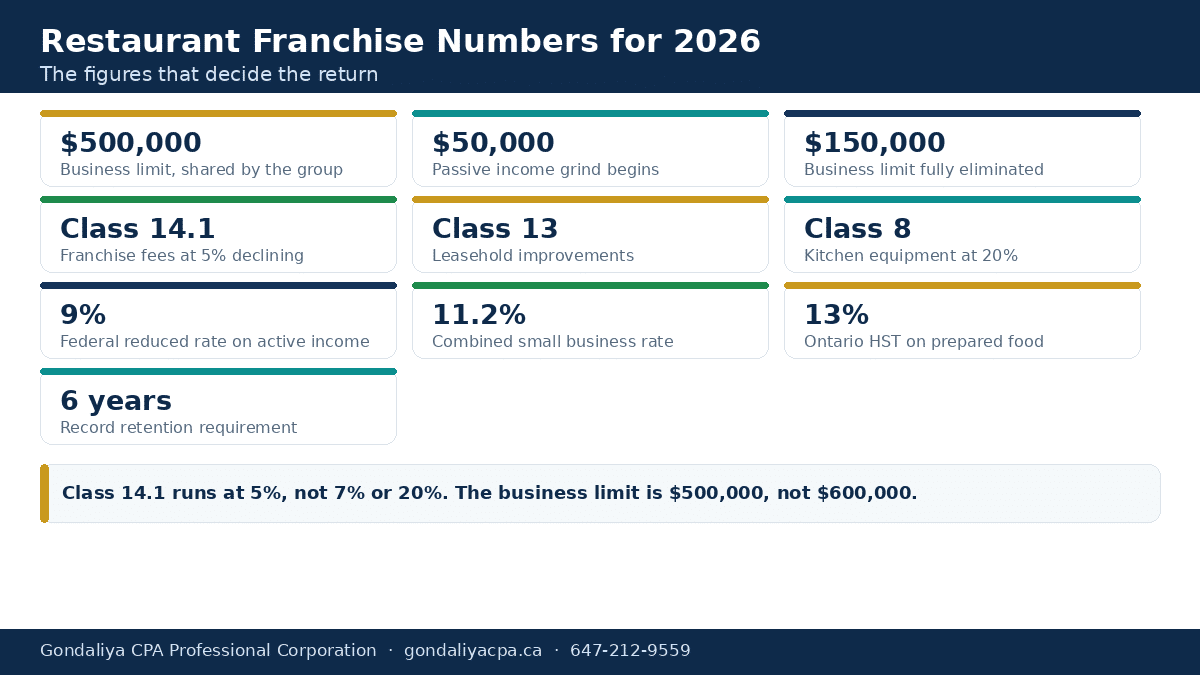
Class 14.1 is a 5% declining balance class. This article gives 7% here, about 20% further on, and straight-line over five years in three other places. All four differ. Please use 5% declining balance, with the half-year rule and the reinstated investment incentive applied to the addition.
Knowing this helps you plan your taxes better and avoid surprises.
Ongoing Royalty and Marketing Fund Payments
You often pay royalties and marketing fees after starting your franchise. Are these costs deductible? Usually, yes—if they fit certain rules.
- These payments count as business expenses under Section 20(1)(a) of the Income Tax Act.
- Keep good records for each payment toward royalties or advertising funds.
This record keeping helps with compliance and can improve your overall tax strategy.
Royalties and advertising fund contributions are deducted as ordinary business expenses under section 9 and section 18(1)(a). Section 20(1)(a) is the provision that permits capital cost allowance, which is a different thing.
Core Components of Multi-Location Financial Management
Running many locations adds complexity. You need to think about structure and how to track performance well.
Location-Level Performance Tracking
Focus on key financial numbers at each spot:
- Revenue per location shows where money flows.
- Cost control points out where spending gets high.
- Cash flow keeps operations running smoothly.
Watching these metrics helps avoid risky moves while making smart decisions.
Consolidation of Financial Statements
If your units are different corporations:
- CRA says associated corporations share one small business limit.
- Combining financial statements gives a clear picture of total performance.
This approach ensures you follow rules when structuring multiple franchises under one group.
Associated corporations share one federal business limit of $500,000 of active business income, and that limit is reduced by $5 for every $1 of adjusted aggregate investment income above $50,000 across the group.
Shared Services vs Decentralized Operations
Decide if you want centralized or decentralized systems:
- Centralizing can simplify tasks but needs strict transfer pricing rules compliance by CRA.
- Decentralizing offers more freedom per unit but requires solid records everywhere.
Either way, clear documentation is key during CRA audits or reviews of related-party transactions.
Role of Accounting Systems and Technology in Franchise Operations
Tech now plays a big role in franchise accounting. Using good systems boosts efficiency.
Benefits of Cloud Accounting for Franchises
Cloud accounting lets you access data anytime from any location. It cuts down costs on old software setups. This helps franchise owners make faster decisions without losing accuracy or control expected by accountants familiar with restaurant franchises like Gondaliya CPA’s team does.
Integration with POS and Payroll Systems
Linking POS with payroll cuts down errors from manual entry. This matters with tight payroll source deduction deadlines set by Canadian law. Knowing employer and employee CPP contribution rates also helps keep things smooth for daily finance work across your locations!
Good strategies built on these basics lead to steady operations and happier customers who get consistent service every time they visit!
Essential Tax Planning Strategies for Restaurant Franchise Owners
Essential Tax Planning Strategies for Restaurant Franchise Owners
The Strategies
Restaurant franchise tax planning Canada means thinking ahead to pay less tax and keep more cash. If you own a franchise, you can find ways to save by managing your costs, pay, and big purchases smartly. Incorporated franchises especially need to plan carefully to follow CRA rules and still keep profits.
Here are some good steps to take:
- Use allowed deductions wherever possible.
- Time when you buy big items to get better tax benefits.
- Organize multiple units so you make the most of the small business deduction limit.
- Choose the right mix of salary and dividends for owners.
Getting advice from someone who knows franchise taxes well helps you avoid mistakes and get better results.
Tax Deductibility of Franchise Fees
You can’t deduct the initial franchise fee all at once. Instead, treat it like a capital cost in Class 14.1 and spread out the deduction over about five years. This is called amortization.
Other fees like ongoing royalties? You can usually deduct those as regular expenses right when you pay them. The same goes for contributions to advertising funds if your agreement allows it.
Sometimes, training fees count too—but only if they relate directly to running your business, not buying the franchise. Keep good records like invoices and contracts so CRA can see you’re honest.
Here’s a quick overview:
- Initial Franchise Fee: Capital cost, amortize over 5 years
- Royalties: Deductible as current expense when paid
- Advertising Fund Contributions: Deductible if allowed by agreement
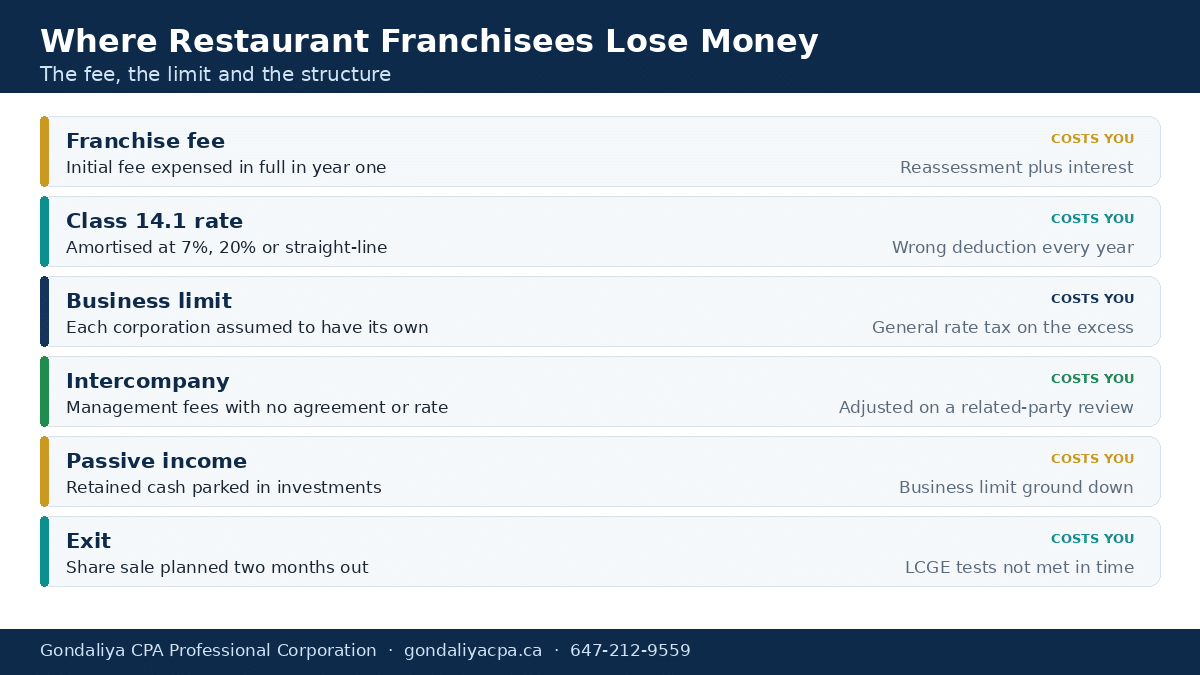
The initial franchise fee expensed in full in year one is the most common finding on a first franchise file. It is a capital outlay and the reassessment carries interest. Figures changed for privacy.
Depreciation & Capital Cost Allowance (CCA) Rules
Franchise fees go into Class 14.1 with about a 20% amortization rate yearly on a declining balance. But many accountants use straight-line amortization over five years for simplicity.
Leasehold improvements fall under Class 13. The depreciation rate depends on your lease length but is capped by CRA rules. Kitchen equipment belongs in Classes 8 or 43, with rates from 20% up to faster write-offs if eligible.
Remember the half-year rule: In the year you buy an asset, you can only claim half the normal CCA amount unless special rules apply.
Good planning means buying assets just before year-end to make your tax deductions work better without risky moves.
Bill C-15 received Royal Assent on 26 March 2026, reinstating the accelerated investment incentive. For most depreciable property acquired after 2024 and available for use before 2030 the half-year rule is effectively suspended and an enhanced first-year deduction applies. Leasehold improvements in Class 13 are excluded.
Summary table:
| Asset Type | CCA Class | Rate (%) | Half-Year Rule Applies? |
|---|---|---|---|
| Franchise Fee | 14.1 | ~20 (declining) | No |
| Leasehold Improvements | 13 | Based on lease | Yes |
| Kitchen Equipment | 8 / 43 | 20-30 | Yes |
Tax Deferral Opportunities
You can improve cash flow by delaying some taxes — legally, of course. For example, choosing bonuses or dividends at certain times changes how much tax you owe now versus later.
Near year-end, try these moves:
- Pay deductible expenses early like repairs or training.
- Delay recognizing some income within legal limits.
- Time big purchases just before year-end for bigger first-year claims (half-year rule applies).
Also, calculate instalments right so you avoid penalties but spread out payments evenly—this helps franchises with busy and slow seasons manage money better.
Keeping good records is key if CRA ever checks your books.
Two entries in the table above need correction. Class 14.1 additions are subject to the half-year rule, so the answer is yes rather than no. Class 13 leasehold improvements are amortised over the lease term plus one renewal period, with a five-year minimum and a forty-year maximum, not on a percentage rate.
Optimizing Corporate Structure for Tax Efficiency
If you run several units, decide whether each should be its own corporation or all in one company. Each way has pros and cons:
- Separate Corporations per Unit: Keeps liabilities separate, but shares one small business deduction limit across all units.
- Single Corporation with Multiple Units: Easier admin, but all units share the deduction limit, and there is no loss-sharing between units like in partnerships.
Choose what fits your goals best—either simpler setup or better risk control—and talk to a professional because provincial laws also affect this decision.
The federal small business deduction limit is $500,000, not $600,000. The higher figure belongs to the provincial limits in Saskatchewan, Prince Edward Island and Nova Scotia. Please plan against $500,000 federally across the whole associated group.
Holding Companies vs Operating Companies
Owning property through a holding company keeps it safe from risks in day-to-day business operations. The holding company can charge rent to the operating company at fair market rates based on appraisals. This rent must be reasonable or CRA might challenge it.
Holding companies let you keep earnings safe from operating risks and reinvest them wisely. Meanwhile, operating companies handle daily business but hold fewer assets directly.
For families running franchises together, splitting property ownership this way protects assets better while helping with income splitting strategies under CRA rules.
Income Splitting Strategies
When paying yourself or family members working in the franchise, consider salary versus dividends carefully:
- Salary creates RRSP room and counts towards CPP benefits but needs payroll deductions.
- Dividends don’t require payroll taxes but don’t build RRSP room or CPP credits.
Paying spouses or adult children is okay only if they actually do real work — backed by timesheets or payroll documents — to meet CRA’s reasonableness test and avoid “tax on split income” penalties.
Keep employment contracts clear about duties and pay fair market rates so everything stays above board during audits.
Preferred Share Structures and Family Trusts
Family trusts help divide income among family members in ways that may lower overall family tax bills if done right under trust law rules.
Preferred shares give priority on dividends so owners can plan payments for retirement or other needs without causing problems with shareholder loans.
When family members get salaries through trusts, their roles must be real jobs with fair pay—otherwise CRA may question it as avoidance. Clear records of trustee decisions about distributions also help show everything is proper.
This setup works well for multi-generational family franchises who want flexibility but must stick closely to tax rules.
Managing Inter-Company Transactions and Transfer Pricing in Franchises
Transactions between companies related by ownership need careful paperwork like board minutes approving deals and shareholder agreements explaining pricing policies. These prices must follow arm’s-length rules set by CRA under transfer pricing laws so profits aren’t shifted unfairly among entities.
Keep solid reasons documented for management fees, rent charges, royalties shared between holding and operating companies—or any inter-company billing—to avoid reassessments later on.
Strong internal controls plus regular outside reviews help keep everything legit during CRA checks—important when separate companies hold real estate versus run operations inside franchises across Canada.
GST/HST and Provincial Tax Considerations Specific to Canadian Restaurant Franchises
GST/HST and Provincial Tax Considerations Specific to Canadian Restaurant Franchises
GST/HST
Running a restaurant franchise in Canada means keeping a close eye on GST/HST registration, provincial sales taxes, and payroll deductions. You need to know your tax duties well. Doing so helps avoid penalties and keeps cash flowing smoothly across your incorporated locations.
Correct Registration per Franchise Location
Each franchise spot must register for GST/HST based on where it physically operates. The Excise Tax Act says businesses making over $30,000 a year in taxable sales have to register in the province they work in. For franchises with multiple sites across provinces, you might need separate registrations.
Payroll source deduction deadlines differ by province. You have to send CPP contributions, EI premiums, and withheld income tax on time. If not, CRA can add fines and interest.
Keep good records showing each location’s registration. Franchise agreements usually mention royalties that attract HST. Make sure those invoices carry the right registration numbers for every spot.
GST/HST registration is federal and one business number covers the corporation across every province. There is no separate provincial GST/HST registration. Quebec QST and British Columbia PST are separate provincial registrations, and those are the ones that need adding when you cross a border.
Navigating Different Provincial Sales Tax Regimes
Canada has various sales tax setups besides the federal GST/HST:
Ontario, Nova Scotia, New Brunswick, Newfoundland & Labrador, Prince Edward Island use HST — a combined federal-provincial rate.
Quebec handles QST separately from GST.
British Columbia charges PST alongside GST.
Alberta has no provincial sales tax.
If you run restaurants in more than one province, follow each region’s filing rules. You must charge the right tax rate on food sales — some are taxable; others are zero-rated.
Provinces also change how you claim input tax credits (ITCs). ITCs cover business costs linked to taxable supplies but exclude expenses tied only to exempt items like some retail food sales without prep.
Registration is mandatory once worldwide taxable supplies exceed $30,000 in a single calendar quarter or across four consecutive calendar quarters. In Ontario the HST rate is 13%.
Place of Supply Rules for Delivery & Takeout
Place of supply rules decide which province’s taxes apply when delivering or offering takeout meals. According to the Excise Tax Act:
- If delivery stays within one province by the franchise or its agent, apply that province’s tax rate.
- For deliveries crossing provincial lines (say Ontario to Quebec), the supply place is where the customer takes possession.
- For takeout orders picked up at stores, tax depends on the store’s location — not the customer’s address.
Getting this right avoids charging twice or missing taxes. Keep delivery receipts with addresses as proof during audits.
Maximizing Input Tax Credits and Navigating Place of Supply Rules
Many franchise owners miss claiming all eligible input tax credits because of weak documentation or confusion about what expenses qualify.
You can claim ITCs on things like:
- Royalty fees under franchise agreements if invoices show valid HST numbers
- Advertising fees tied directly to business activities
- Tech service charges that support operations
Claim timing matches your fiscal year. Late claims may get denied unless you prove a good reason.
Keep detailed records like royalty invoices with extracts from franchise agreements. This helps when CRA checks your claims. Digital accounting tools can link expenses to supplier docs neatly.
Avoid audit risks by regularly matching reported revenue from HST/GST taxable sales against claimed credits for consistency.
The input tax credit claim period is generally four years for most registrants, and two years for large businesses and certain listed financial institutions. It is not tied to a discretionary relief request.
Inventory and Cash Flow Management Across Multiple Franchise Locations
Good inventory control matters for cost-saving and cash flow forecasts in multi-site franchises.
Focus on:
- Inventory Purchasing Controls — Centralize buying but track usage by location.
- Regular Reconciliation — Do monthly physical counts; compare with records to spot shrinkage early.
- Shrinkage & Write-Off Policies — Keep records of spoilage; only write off what you can prove per CRA rules.
- Cash Flow Forecasting Tools — Use software covering payroll dates, lease or owned real estate payments, royalties due dates plus capital expense plans for better 12-month cash visibility.
Year-end physical inventory counts confirm your cost-of-goods-sold accuracy and income reporting. Tracking waste well stops expense claims from being too high and rejected later.
For specific advice on managing provincial filings and cash flow across your restaurant franchise locations, contact Gondaliya CPA at 647-212-9559 or info@gondaliyacpa.ca for a free chat about incorporated Canadian restaurant franchises serving Toronto/Ontario clients nationwide.
Key Financial Performance Metrics for Multi-Location Restaurant Franchises
Key Financial Performance Metrics for Multi-Location Restaurant Franchises
The Metrics
If you run multi-location restaurant franchises in Canada, watching key financial numbers helps a lot. These numbers guide your restaurant franchise tax planning Canada. They show where you can make smart tax moves and find restaurant franchise tax savings without problems.
Same-Store Sales Growth
Same-store sales growth looks at revenue from stores open during both periods. It shows if your business is really growing or just adding new stores. For multi-unit owners, steady same-store sales means stable cash flow. That cash flow pays royalties and staff on time.
A franchise restaurant tax accountant can spot trends here and suggest tax moves that fit your sales. You can improve cash flow without tricky tax tricks by timing big expenses when sales are strong. Also, watch instalment payments to avoid CRA charges.
Here’s an example:
A Toronto operator had 5% same-store sales growth on $3 million per store yearly. By buying leasehold improvements before year-end during busy months, they claimed more capital costs. This let them keep more cash after taxes by delaying payments the right way.
Same-store sales tell you whether the group is growing or just getting bigger. They also tell you which unit can carry a bonus and which cannot. Figures changed for privacy.
Labour, Food Cost, and Occupancy Ratios
Labour eats up about 25–35% of costs; food runs 28–32%; rent plus utilities take around 8–12%. These ratios shape taxable income and what you can claim as expenses.
Good inventory planning cuts food waste, lowering costs. Keep track of spoiled food to back up expense claims under CRA rules. Tips and gratuities paid through payroll count as pensionable earnings needing CPP contributions. Undeclared tips can bring audits.
Staff meals need records too. Only meals mainly for employer’s convenience count as deductible expenses under certain limits.
Also, track hours worked carefully if family or related staff get paid. This keeps things clean for tax checks.
Contribution Margin by Location
Contribution margin means sales minus variable costs like labour and food. It shows profit before fixed bills like rent or royalties.
Knowing each location’s margin helps pick the best pay mix for owners—salary or dividends? Salaries build RRSP room but add CPP costs; dividends don’t create RRSP room but lower CPP premiums.
Owners should set pay based on each unit’s results using clear bookkeeping that splits revenues and expenses per location.
Best Practices for Franchise Royalty and Marketing Fund Accounting
Counting royalties and marketing fund payments right matters for tax deductibility and GST/HST rules on food sales across Canada.
Tracking Remittances
Payroll source deductions must be paid monthly or quarterly depending on employer size. Missed deadlines bring penalties plus interest calculated daily. Corporate tax instalments also come quarterly after each fiscal quarter ends.
Using cloud accounting with automatic reminders helps avoid late fees and keeps cash flow in check.
| Payment Type | Deadline | Applies To | Penalty If Late |
|---|---|---|---|
| Payroll Source Deductions | Within 3 working days after pay | All employers | Penalties + Interest |
| Corporate Tax Instalments | Quarterly (15th day post-quarter) | Incorporated franchises | Interest + Possible penalty |
Reconciling Royalty Expenses
Royalties usually count as deductible expenses if you keep good records matching your contract terms. Advertising fund fees work the same unless restricted by law or contract rules like those in the Arthur Wishart Act.
Initial franchise fees are not current expenses. They go under Class 14.1 intangible assets and amortize evenly over five years. Keep amortization records yearly; renewals may need separate treatment based on their type — capital or current expense.
Two deadlines in the table above are wrong for most operators. A regular remitter pays source deductions by the 15th of the month following the month the employees were paid, not within three working days. Corporate instalments are monthly or quarterly against your own fiscal year, not on fixed calendar dates.
Complying with Franchisor Reporting Standards
The Arthur Wishart Act sets rules for disclosure including invoice approvals linked to royalties. Using cloud accounting connected to POS systems helps track sales automatically and cut errors in royalty calculations.
Integrating payroll systems with bookkeeping tools records employee costs accurately across units.
Common Franchise Accounting Mistakes and How to Avoid Them
Mistakes in franchise accounting cost money and cause tax problems if not caught early.
Incorrect Classification of Franchise Fees
Some treat initial franchise fees as regular expenses instead of amortizing over five years. This error triggers CRA reassessments with added interest. Correctly capitalizing these fees matches reports with reality easing audits.
Errors in Allocating Head Office Costs
In companies with multiple units sharing small business deduction (SBD) limits under associated corporation rules, overhead must be split properly. Wrong allocation inflates one entity’s income causing lost SBD benefits elsewhere and bigger taxes overall.
Use formal intercompany billing backed by meeting notes to prove fair allocations. This reduces transfer pricing risks during CRA reviews in Ontario/Toronto regions where Gondaliya CPA works a lot.
Lack of Documentation for Related-Party Loans
Shareholder loans without proper paperwork risk being taxed twice if repayments aren’t supported under section 15(2) rules. Keep loan agreements showing purpose, repayment terms, plus board approvals to stay clear of CRA issues on related-party deals.
Sharad Gondaliya, CPA, has helped many Canadian incorporated restaurant franchises manage finances within legal limits using strategies fit for Ontario including Toronto areas served by Gondaliya CPA Professional Corporation.
Records are retained six years from the end of the last tax year they relate to, and an objection must be filed within 90 days of the date on the notice.
Financial Planning and Scaling Guidance for Growing Restaurant Franchises
Financial Planning and Scaling Guidance for Growing Restaurant Franchises
Scaling
Restaurant franchise tax planning Canada needs a clear plan. You want to grow, but also keep your cash flow strong. Using solid strategies that follow the rules helps you save on taxes while expanding. Documenting everything well is key.
Cash Flow Planning for Expansion
Tax planning for restaurant franchisees means handling retained earnings and extra cash smartly. Keeping money in the corporation can delay personal taxes. But watch out for passive income rules that can cause trouble. Putting money back into assets or new stores usually works better than taking dividends.
- You can improve cash flow without risky tax moves by:
- Timing big expenses like leasehold improvements or new equipment before year-end.
- Managing instalment payments carefully.
- Keeping payroll deductions accurate.
This keeps you compliant and frees up money without risk.
Some tips:
- Hold enough working capital inside the business to fund growth.
- Use holding companies to separate investment income from operating profits.
- Plan spending near the fiscal year-end to get more deductions.
- Keep an eye on passive investment income limits; going over reduces small business tax benefits.
Financing Options for New Units
How you set up a multi-unit franchise group matters. You can run all units under one corporation or create separate corporations for each location linked as associated corporations under tax law.
One corporation means simpler books but risks are all together. Separate corporations spread risk but share the small business deduction limit. Financing depends on whether you use intercompany loans or outside debt, based on interest deductions and creditor protection.
Here’s a quick look:
| Structure Type | Best For | Tax & Cash Flow Effects | Required Records | Reference |
|---|---|---|---|---|
| Single Corporation | Small groups with low risk | Uses full SBD; easier admin | Consolidated financial statements | ITA s125(7), CRA |
| Separate Corporations | Larger multi-unit operators | SBD limit shared; isolates liabilities | Intercompany agreements, minute books | ITA s256(1) |
Your choice depends on size, risk, financing plans, and tax goals.
Selecting the Right Financial Controls
Good record keeping backs every planning choice. It shows proof for deductions and helps if CRA audits you.
Make sure to keep:
- Franchise agreements with royalty details.
- Payroll records showing fair wages paid.
- Lease contracts with occupancy terms.
- Inventory counts matching cost of goods sold.
- Capital asset lists tracking amortization like Class 14.1 rules for initial fees.
Using subledgers tied to POS systems helps keep revenue data accurate and speeds up invoice approvals. This cuts errors that cause tax issues or penalties.
Separate corporations protect one unit from another, but they do not create a second business limit. Owners usually learn that in the year the second location turns profitable. Figures changed for privacy.
Preparing for Franchise Renewal Costs and Agreements
Renewal fees work much like initial franchise fees. The tax rules say these costs belong in Class 14.1 as capital property. You can’t expense them right away. Instead, you amortize these fees over time, just like you do when buying the original franchise rights.
Budgeting for Renewal Fees
Initial franchise fee accounting treats those upfront costs as intangible assets you write off gradually. Renewal fees are no different since they extend your rights under the original deal instead of being regular expenses.
Plan your budget so it reflects these deferred costs every year until fully written off—usually about five years unless your contract says otherwise.
Accounting for Lease Renegotiations
Leasehold improvements count as depreciable assets eligible for Capital Cost Allowance (CCA). Usually, if a lease is less than 50 years, improvements fall into Class 13.
Timing is important because of the half-year rule limiting CCA claims if you buy late in your fiscal year. Kitchen equipment often fits into Classes 8 or 43 depending on energy efficiency.
Try scheduling renovations near year-end so you maximize CCA without triggering losses when leases end or assets sell.
Kitchen equipment generally sits in Class 8 at 20%. Class 43 is manufacturing and processing equipment at 30%, and clean energy property sits in Class 43.1 and 43.2, so please confirm before using the higher rate.
Modeling ROI on Renewals
When you model renewal returns, include expected royalties and advertising fund payments only if your franchisor agreement clearly allows deductions. Your model should have:
- Amortization schedules reducing profits affected by renewal fee capitalization.
- Royalty projections linked to sales trends influencing tax rates through deductible vs non-deductible expenses.
This approach helps decide if renewing makes sense financially or if other locations might offer better returns.
Capitalise the initial and renewal franchise fees into Class 14.1 at 5% declining balance. Plan against one $500,000 business limit for the whole associated group and watch the $50,000 grind. Support every intercompany charge with an agreement and a rate. Remit payroll by the 15th for a regular remitter. Please keep six years of records.
Compliance, Audits, and Reporting Requirements for Franchisees
Compliance, Audits, and Reporting Requirements for Franchisees
Compliance
Restaurant franchises face regular CRA checks focusing on Income Tax Act compliance, payroll source deductions, GST/HST filings, instalment payments, and record keeping standards.
Periodic CRA Compliance Audits
CRA reviews look closely at records backing your tax claims—royalties deducted under franchise contracts, payroll wages paid fairly, capital asset additions with correct class treatment, plus shareholder loan compliance per section 15(2).
Well-kept minute books with board resolutions help prove decisions during audits.
Franchisor Financial Reporting Requests
Franchisees must often reconcile royalty payments and advertising fund contributions against what franchisors expect. Any mismatches raise questions that affect both sides’ reputations and may trigger reassessments.
Automation tools linking POS data streamline this reconciliation by reducing manual errors.
Maintaining Accurate Subledgers
Linking POS with payroll software captures sales instantly, helping track commission pay and withholding correctly shown in annual T4 slips. Invoice approval automation speeds input tax credit claims vital under Excise Tax Act rules.
These systems support reliable reports needed throughout operations—not just at filing—so problems get spotted early before audits start.
Contact Gondaliya CPA at info@gondaliyacpa.ca or call 647-212-9559 for guidance focused on Canadian restaurant franchises wanting smart tax planning that supports steady growth while staying within the rules.
Management fees between a holding company and an operating company without a written agreement and a defensible rate is the item most often adjusted on a related-party review. Figures changed for privacy.
Exit Planning and Valuation Strategies for Restaurant Franchise Owners
Exit Planning and Valuation Strategies for Restaurant Franchise Owners
Exit Planning
Exit planning plays a big role in restaurant franchise tax planning Canada. It focuses on cutting down taxes while preparing to hand over the business. Knowing how to value your assets and shares helps you decide the best time and way to sell. A franchise restaurant tax accountant can guide you through Canadian tax rules and help you keep as much cash as possible after taxes.
Why exit planning matters:
- Helps you choose the right sale type
- Minimizes taxes owed on sale
- Keeps cash flow steady during the process
Asset Sale vs. Share Sale Tax Implications
You can sell a restaurant franchise by selling its assets or its shares. Each way has different tax effects, especially in Canada.
- Asset Sale: You sell equipment, inventory, goodwill separately; triggers recapture of capital cost allowance (CCA) on assets sold; buyers get better depreciation benefits.
- Share Sale: You sell ownership by transferring corporation shares; may qualify for lifetime capital gains exemption (LCGE) if conditions apply; risks double taxation if not structured right.
A franchise restaurant tax accountant helps you:
- Decide between income inclusion from asset sales or capital gains from shares
- Understand GST/HST duties based on sale type
- Keep proper records like asset lists or shareholder agreements
Example: Selling shares of a multi-unit company valued at $2 million might reduce taxable gain using LCGE, compared to an asset sale that triggers full CCA recapture plus income inclusion.
The lifetime capital gains exemption applies to qualified small business corporation shares and requires the asset, holding period and control tests to be met. Purification often has to start well before a sale, so please plan two years out rather than two months.
Retirement and Succession Planning
Planning for retirement means more than stopping work. For restaurant franchisees, it involves tax planning for restaurant franchisees and setting up who takes over next.
Salary or dividends? It depends on:
- RRSP contribution room left
- CPP contributions needed
- How much profit the company makes
- Personal income needs
Salary creates RRSP room but adds payroll costs. Dividends skip CPP but don’t build pension benefits.
When paying a spouse, adult child, or working relative:
- Payments must reflect real work done
- Document hours with contracts and timesheets
- Follow CRA rules to avoid “tax-on-split-income” penalties
Example: Paying a spouse $30,000 for part-time work with proof can increase household RRSP room without triggering split-income tax penalties.
Maximizing After-Tax Proceeds
Saving taxes is important but must stay within legal limits. You want restaurant franchise tax savings without risky moves that CRA rejects.
Try these approaches:
- Calculate instalments accurately to avoid interest charges
- Buy capital items before year-end to use half-year CCA rules well
- Use holding companies smartly to invest retained earnings instead of letting passive income cut small business deductions
Good records back all moves and help if CRA asks questions.
Tip: Check supplier financing terms regularly. It can free up cash flow while keeping expenses controlled per accounting standards.
How Gondaliya CPA Supports Tax Planning and Financial Management for Franchisees
At Gondaliya CPA, we build franchisee tax plans that fit incorporated restaurant franchises in Toronto, Ontario, and across Canada.
Our process includes:
- Reviewing your business structure against associated corporations rules affecting small business deductions
- Setting up bookkeeping using cloud accounting so each unit’s numbers are clear
- Reporting unit-level profits including royalty fees versus revenue
- Modelling owner pay mixing salary and dividends for best personal-tax results considering CPP/RRSP impacts
- Advising when to buy capital assets before fiscal year-end to reduce CCA recapture
- Year-end planning covering bonus accruals and instalment true-ups timed with CRA filing deadlines (T2 returns, slips)
- Support through implementation plus ongoing reviews keeping up with new small business limit rules
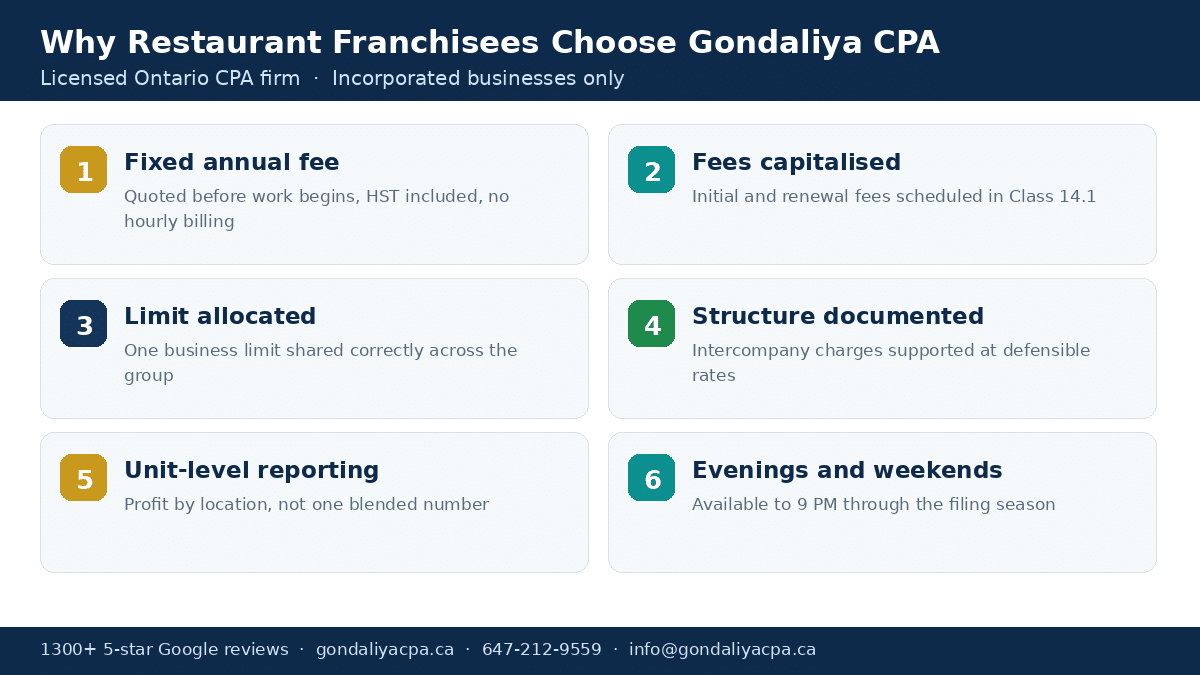
You get deliverables like: structure memos explaining entity setups; pay models forecasting incomes; profit reports by unit; amortization schedules; checklists for year-end steps—all for a flat annual fee including HST.
With over 1450+ 5-star Google reviews plus weekend/evening support options, Gondaliya CPA sticks closely to legal requirements offering solid experience in Canadian franchising.
Steps to Get Started with Professional Franchise Tax Planning Assistance
Choosing DIY vs CPA vs non-CPA help can shape your tax plan’s accuracy—especially when your structure has many moving parts.
DIY may miss details like associated corporation limits or passive income traps that cause costly audit problems. Non-CPA providers might cost less upfront but usually lack rights to represent you fully before CRA or offer all needed filings compliant in Ontario/Toronto.
To speed up your engagement, prepare these documents first:
| Item | Why It Matters |
|---|---|
| Past T2 corporate returns | Shows filing history |
| Personal income notices | Aligns shareholder pay |
| Current franchise agreement | Confirms royalties/advertising terms |
| Lease agreements | Supports leasehold improvements |
| Trial balance & payroll records | Verifies expenses & salaries |
| Equipment purchase papers | Supports CCA class choices |
| Minute book | Documents key corporate decisions |
Start with a no-pressure chat at info@gondaliyacpa.ca or call 647-212-9559. We focus on your unique needs across Toronto and Ontario areas ready to help every step of the way.
Frequently Asked Questions on Restaurant Franchise Tax Planning in Canada
Frequently Asked Questions on Restaurant Franchise Tax Planning in Canada
FAQ
What is the Small Business Deduction limit starting in 2026?+
The Small Business Deduction limit for associated corporations is $600,000 starting in 2026. This limit applies collectively to all associated entities.
How does Class 14.1 amortization rate apply to franchise fees?+
Initial franchise fees must be amortized over five years using straight-line amortization under Class 14.1.
What is the Capital Cost Allowance rate for leasehold improvements under Class 13?+
Leasehold improvements are depreciated based on the lease term plus 10%, applying Class 13 rules.
How does the Half-Year Rule affect capital purchases?+
You can only claim 50% of the normal CCA amount in the first year of an asset purchase due to the Half-Year Rule.
What are the current CPP contribution rates for employer and employee?+
Both employer and employee contribute 5.95% each (scheduled to fall to 5.75% on January 1, 2027) to CPP on applicable earnings.
When are payroll source deduction deadlines in Canada?+
Employers must remit payroll source deductions within seven days after each pay date.
What is the Tax on Split Income threshold for 2026?+
The threshold for Tax on Split Income is $422,777 in 2026.
When are corporate instalment payments due?+
Corporate tax instalments are payable on March 15, June 15, September 15, and December 15 annually.
How does the Arthur Wishart Act impact franchise disclosure?+
The Arthur Wishart Act requires full disclosure of financial terms, including royalties and fees, ensuring transparency between franchisors and franchisees.
What documentation is required for reasonable salary payments to family members?+
Maintain employment contracts, timesheets, and pay records proving actual work done at fair market value.
Are technology fees deductible for restaurant franchises?+
Technology fees are deductible if they are operating expenses and not capital expenditures.
How does passive income affect Small Business Deduction eligibility?+
High passive income reduces the Small Business Deduction limit, known as the passive income grind effect.
What impact does specified corporate income have on SBD?+
Specified corporate income reduces available SBD by sharing among associated corporations.
How do preferred share structures and family trusts help tax planning?+
They enable income splitting and flexibility while complying with CRA rules to reduce family tax burdens.
What tax issues arise from shareholder loans and personal spending?+
Improperly documented loans may be taxed as personal income or cause penalties under section 15(2).
Three answers above need correction. The federal business limit is $500,000, not $600,000. There is no $422,777 tax on split income threshold; TOSI applies the top marginal rate to caught amounts and works through exclusions rather than a dollar threshold. Corporate instalments follow your own fiscal year rather than fixed calendar dates, and those four dates are the personal instalment dates.
Additional Key Points on Restaurant Franchise Tax Planning
Additional Key Points on Restaurant Franchise Tax Planning
Quick Reference
- Renovation and Rebrand Terminal Loss Rules: Terminal losses from closed locations can offset taxable income if properly documented.
- Transfer Pricing Concerns: Transactions between holding and operating companies must follow arm’s-length principles to avoid CRA adjustments.
- GST/HST Filing Frequency: Depends on annual taxable supplies; large franchises may file monthly or quarterly.
- Financial Statements Consolidation: Combine statements of associated corporations to accurately track small business deduction limits.
- Salary vs Dividends Choice: Salary builds RRSP room and CPP credits; dividends reduce payroll costs but do not build benefits.
- Payroll Slips Issuance: T4 slips report employment income; T5 slips report dividends or investment income.
- Tax Planning Service Options: DIY risks missing key deductions; CPA professionals offer comprehensive compliance support; non-CPA services lack full representation rights.
- Year-End Planning Moves: Time expenses, bonuses, and capital purchases before fiscal year-end to maximize deductions.
- Typical Deliverables from Gondaliya CPA: Structure memos, pay models, profit reports by unit, amortization schedules, checklists.
- Common Planning Mistakes: Misclassifying fees, poor documentation of related-party transactions, ignoring associated corporation rules.
For professional help with restaurant franchise tax planning in Canada, contact Gondaliya CPA at info@gondaliyacpa.ca or call 647-212-9559.
Professional Guidance and Quick Reference
Guidance
Who This Is For
- For: Incorporated restaurant franchisees across Canada, including single-unit operators, multi-unit groups, quick service brands and full service brands.
- Also for: Operators opening a second or third unit, operators approaching a renewal, and owners preparing for a sale or a transfer to family.
- Not for: Unincorporated sole proprietors and partnerships, whose filing obligations run through a personal return rather than a T2.
- Not for: Franchise agreement interpretation, Arthur Wishart Act disclosure obligations and franchisor disputes, which are legal questions for counsel.
- Not for: Municipal licensing, food safety certification and liquor licensing, which sit with the relevant authority.
People Also Ask
How much does accounting cost for a restaurant franchise in Canada?+
Our fee is fixed, quoted annually and includes HST. It is set before work begins based on the number of units, transaction volume, payroll headcount and how many corporations sit in the group.
Do I need a CPA or is a bookkeeper enough?+
A bookkeeper maintains the ledger. A CPA firm is required for compilation financial statements a franchisor or lender will accept, associated corporation planning, and representation on a CRA review.
What is the Class 14.1 rate for a franchise fee?+
5% on a declining balance. The half-year rule applies to the addition, and the reinstated accelerated investment incentive may enhance the first-year deduction on a fee paid after 2024.
Glossary of Key Terms
- T2 Return: The corporation income tax return filed annually by an incorporated business.
- Class 14.1: The 5 percent declining balance class covering franchise rights, goodwill and other intangibles.
- Class 13: Leasehold improvements, amortised over the lease term plus one renewal period.
- Class 8: The 20 percent class covering kitchen equipment and fixtures.
- Half-Year Rule: The rule limiting first-year capital cost allowance to half the normal amount.
- Accelerated Investment Incentive: The enhanced first-year deduction reinstated by Bill C-15 in 2026.
- Recapture: Income added back when an asset is sold above its undepreciated capital cost.
- Terminal Loss: The deduction arising when the last asset in a class is sold below its undepreciated capital cost.
- SBD (Small Business Deduction): The reduced federal rate on active business income up to the business limit.
- Business Limit: The $500,000 of active business income eligible for the reduced rate, shared across associated corporations.
- Associated Corporations: Related companies that must share one business limit between them.
- Passive Income Grind: The reduction of the business limit by $5 for every $1 of adjusted aggregate investment income above $50,000.
- Specified Corporate Income: Income from an associated corporation that reduces the amount eligible for the reduced rate.
- Holdco: A holding company that owns assets or shares rather than running the operation.
- Opco: The operating company that runs the restaurant day to day.
- Transfer Pricing: The requirement that charges between related parties reflect arm’s length terms.
- TOSI: The tax on split income, which taxes certain amounts paid to related people at the top rate.
- LCGE: The lifetime capital gains exemption available on qualified small business corporation shares.
- Shareholder Loan: Company funds used personally, taxable if not repaid within the period the Act allows.
- ITC (Input Tax Credit): The GST/HST recovered on business purchases supported by a supplier invoice.
Franchise Readiness Check
This quick self-check indicates where your group most likely has room. Please answer the six questions below.
Franchise Readiness Check
Six quick questions on your company. No fee shown.
Points to raise with us:
This is a general prompt, not tax or legal advice or a quote. Your position depends on your full facts. For a real review, please book a free consultation.
Want a checklist to work from? You can download our free restaurant franchise year-end checklist before your consultation.
This article reflects rules current to 2026. The Class 14.1 rate of 5% declining balance, the Class 8 rate of 20%, Class 13 treatment of leasehold improvements, the federal business limit of $500,000, the federal reduced rate of 9%, the $50,000 to $150,000 passive income grind, the $30,000 GST/HST registration threshold, the 13% Ontario HST rate, the six-month T2 filing deadline, the objection window of 90 days and the six-year retention requirement are unchanged. Ontario reduced its small business rate to 2.2% effective 1 July 2026, giving a combined rate near 11.2%. Bill C-15 received Royal Assent on 26 March 2026, reinstating the accelerated investment incentive, with Class 13 excluded. Please note that the business limit is $500,000 rather than $600,000, that Class 14.1 runs at 5% rather than 7% or 20%, that GST/HST registration is federal rather than per province, and that there is no dollar threshold for the tax on split income.
Restaurant Franchise Tax Planning Canada: How Gondaliya CPA Supports Franchisees
Start with the franchise agreement and the group structure
Gondaliya CPA capitalises initial and renewal fees into Class 14.1 and schedules the amortisation, tests royalty and advertising fund deductibility against the agreement, allocates one business limit across every associated corporation, measures adjusted investment income against the grind, prices intercompany rent and management fees with written support, splits leasehold improvements and kitchen equipment into the right classes, and models the owner pay mix against RRSP room and CPP cost, on a flat annual fee including HST with a one-business-day response. Please book a free consultation.
Next Steps
Please book a free consultation with Gondaliya CPA and bring your franchise agreement, your corporate structure showing every related company, and your last filed corporate return. Those three tell us immediately how the fees were treated, how the business limit is being shared, and what the intercompany charges look like. You will get a flat annual fee including HST before any work begins. If our content helps, please add gondaliyacpa.ca as a preferred source on Google.
Published: · Last updated:
Editorial policy: We research against CRA and CPA Ontario sources, fact-check the figures, and Sharad Gondaliya, CPA, reviews the content, which we update as the rules change.
Disclaimer: This article is educational information only and is not tax, legal, or financial advice. Figures marked illustrative are examples rather than quotes or guarantees. It reflects CRA rules current to 2026, including the $500,000 federal business limit, the passive income grind, Class 14.1, Class 13 and Class 8 treatment, and the six-year retention requirement. Rates, limits and expensing rules change and outcomes depend on your specific facts. Please consult a CPA Ontario member before acting.

Sharad Gondaliya is a CPA Canada & CPA USA with 15 Years+ experience of Accounting, Tax, Payroll of Corporate Small Businesses as Tax Accountant. He is a CPA Ontario member (61040184) and holds US CPA licences in Washington and Montana and is well known among corporate small businesses for tax planning, efficient tax solutions, and affordable CPA services. Sharad is the Principal (Director) of Gondaliya CPA – Affordable CPA Firm in Canada. Licenses: CPA Ontario: 61040184 | CPA USA (MT): PAC-CPAP-LIC-033176 | CPA USA (WA): 57629 | CPA Firm License: 61330051 View Full Author Bio