



Tax Deductions for Air Cargo Businesses in Canada: Aircraft, Fuel, Maintenance, Airport Fees, and More
Air Cargo Tax Deductions Canada: A Complete Guide to Aviation Business Expenses and Freight Costs with Gondaliya CPA
Air cargo tax deductions Canada are essential for reducing costs related to freight handling, fuel, and maintenance in aviation businesses. Gondaliya CPA highlights key expenses like air freight tax deductions, insurance premiums, and professional fees that can help businesses manage their tax liabilities effectively.
Before any of the operating deductions matter, one question decides more tax than the rest combined: which capital cost allowance class your aircraft sits in. Air cargo accounting and tax services start there.
Quick Summary
Air cargo tax turns on four things: classifying aircraft and components correctly, substantiating fuel by tail number and leg, getting crew classification and meals right, and applying the zero-rating rules to international freight with the evidence to support it.
Reading time: 53 minutes.
Table of Contents
- The Class Most Guidance Gets Wrong
- Engines, Spares and Overhauls
- Fuel, Excise and Carbon Charges
- Crew, Meals and Classification
- GST/HST on Air Freight
- Operating Costs, Records and Working With Us
- Frequently Asked Questions
- The Air Cargo Deduction Checklist
- Aviation Businesses We Serve
- Professional Guidance and Quick Reference
The Numbers That Matter
This article covers Canada, with Ontario and Toronto context, and reflects rules current to 2026. It applies to incorporated air cargo operators including scheduled and charter freight carriers, northern and remote resupply operators, courier and express air services and ground handlers. Figures marked illustrative are examples, not quotes, and any masked engagement notes end with “Figures changed for privacy.” This is educational information only and not tax or legal advice. Excise and carbon charge rates differ by fuel type and change, so please confirm the rate applying to your operation. Air operator certificates, airworthiness, maintenance approvals and licensing sit with the aviation regulator rather than with accounting.
The Class Most Guidance Gets Wrong
The Class Most Guidance Gets Wrong
The Foundation
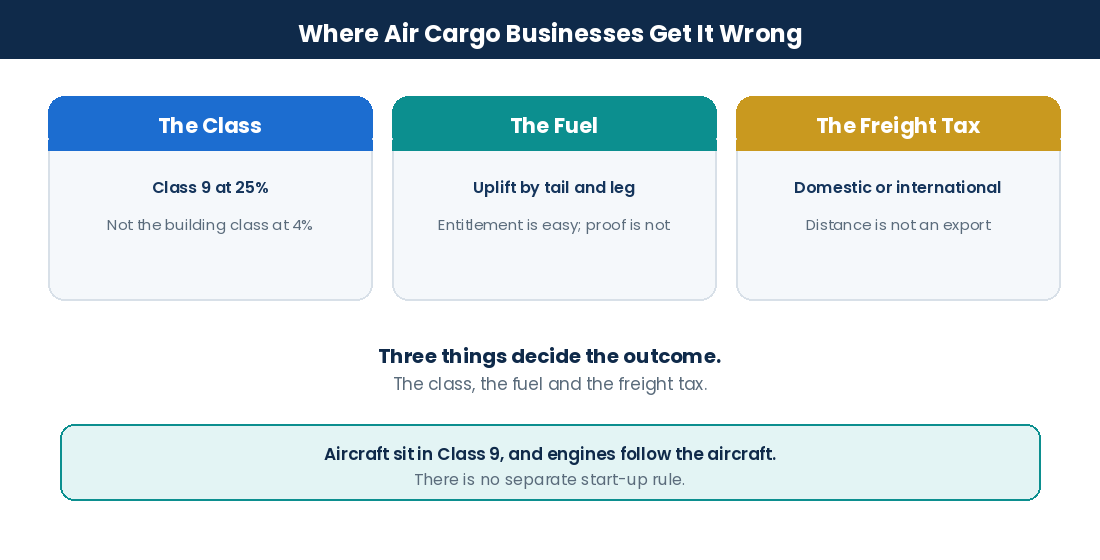
Aircraft Are Class 9
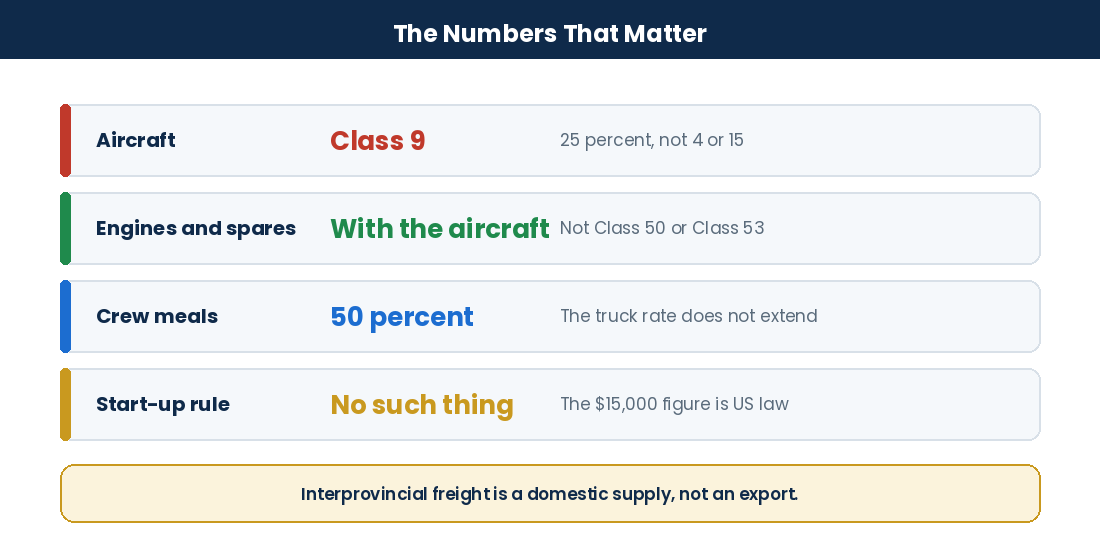
Aircraft belong in Class 9, at 25% declining balance. The class also covers aircraft furniture, fittings, equipment and spare parts.
Aviation tax guidance frequently places aircraft in Class 1 at 4%. Class 1 is the building class. Some of the same guidance then states a 15% rate elsewhere in the same document, which tells you the figure was never checked against the schedule.
| Claimed Treatment | What It Actually Is |
|---|---|
| Aircraft in Class 1 at 4% | Class 1 is buildings. An aircraft is not a building |
| Aircraft at 15% | Not the aircraft rate under any class |
| Aircraft in Class 9 at 25% | Correct |
Why This Matters More Than Anything Else Here
An operator capitalises a $3,000,000 freighter. At the correct 25% rate the second-year claim on the remaining balance is materially larger than at 4%. Over the first several years of ownership the difference between the two treatments runs into hundreds of thousands of dollars of deductions, deferred rather than lost, but deferred for a very long time. Figures changed for privacy.
Nothing else in this article moves that kind of money. Fuel, airport fees and crew costs are all real deductions, but they are annual operating costs. The class decides how quickly the single largest asset on your balance sheet turns into deductions.
The Separate Class Election
Ordinarily all assets of a class pool together. There is an election allowing certain assets to be placed in a separate class of their own.
For an operator with several aircraft this is worth considering, because a pooled class hides individual asset positions. With separate classes, disposing of one aircraft produces a clean recapture or terminal loss on that aircraft rather than simply adjusting a shared pool.
- The election affects how disposals are treated, sometimes favourably and sometimes not
- Separate classes make asset-level tracking far clearer
- It has to be made properly, and it is not automatic
- Consider it before the fleet grows rather than afterwards
Please have the election considered against your own fleet plans rather than applied by default, since the answer differs depending on whether you expect to dispose of aircraft above or below their remaining balances.
That assessment belongs in the planning conversation before your fiscal year closes, not at filing, because the election and the disposal timing are both decisions rather than reporting. Our guide to corporate year-end accounting and filings sets out what remains open at each stage.
The 2026 Change
Bill C-15 received Royal Assent on 26 March 2026, reinstating the accelerated investment incentive for most depreciable property acquired after 2024 and available for use before 2030, with leasehold improvements among the excluded classes.
For an operator that acquired or is acquiring aircraft, this lifts the first-year claim above the plain half-year rule. Any return prepared on the half-year basis alone for a recent acquisition is worth revisiting.
A claim begins when the aircraft is available for use, which in aviation means after acceptance, any required modification and the certification steps that let it fly commercially, not on the delivery date.
Aircraft in the building class at 4% is the most expensive single error we correct in this sector, and it is repeated in guidance everywhere. Figures changed for privacy.
Risk Warning: Aircraft are Class 9 at 25%, not Class 1 at 4%. Please check your asset register before anything else in this article.
Engines, Spares and Overhauls
Engines, Spares and Overhauls
The Components
Where Components Actually Sit
| Asset | Usual Class | Rate |
|---|---|---|
| Aircraft | Class 9 | 25% |
| Aircraft furniture, fittings and equipment | Class 9 | 25% |
| Aircraft spare parts and engines held as capital | Class 9 | 25% |
| Ground support equipment, tugs and loaders | Class 8 or 38 | Depends on the equipment |
| Cargo containers, pallets and nets | Class 8 | 20% |
| Hangar or warehouse you own | Class 1 | 4% |
| Fit-out in leased hangar or terminal space | Class 13 | Over the lease term |
| Computers and ground systems hardware | Class 50 | 55% |
| Application software | Class 12 | 100%, subject to the rules |
Several corrections belong here, because aviation guidance mishandles each one.
- Engines and life-limited components are aircraft parts, so they follow the aircraft class rather than the general equipment class
- Rotable spares are not Class 50 or Class 53; Class 50 is computer hardware and Class 53 is manufacturing machinery
- Class 13 is leasehold improvements, not a home for engine overhauls
- Class 50 is 55% declining balance covering hardware; application software is Class 12
- Class 1 at 4% is where your hangar goes, not your aircraft
Rotable Spares Against Consumables
The distinction matters and it is genuinely fact-specific.
| Item | Usual Treatment |
|---|---|
| Rotable spare held to be installed, removed, overhauled and reinstalled | Capital, following the aircraft class |
| Consumable parts used and not recovered | Inventory, expensed as used |
| Spares held for sale to third parties | Inventory of goods for resale |
| Core exchange with a cash difference | Generally the net cost is capitalised |
| Warranty recovery on a part | Reduces the cost or the expense claimed |
Track rotables separately from consumables in the stores system from the outset. Reconstructing which parts were rotable three years later, from a single inventory account, is close to impossible and it is exactly what an auditor asks.
Repairs Against Betterments
Routine maintenance restoring an aircraft to working condition is a current expense. Work that materially improves it or extends its life beyond restoration is capital.
- Scheduled inspections and line maintenance are current
- A component replacement in the ordinary course is generally current
- A major overhaul substantially extending a life-limited component leans capital
- Avionics upgrades adding capability are generally capital
- Cargo conversion of a passenger airframe is capital
- Repainting and interior refresh is generally current
Guidance presents this only as a risk of over-claiming. It runs the other way too. Capitalising routine maintenance defers a deduction you were entitled to take now, and nobody ever queries that.
Where the amount is large, decide deliberately and record the reasoning with the work order. That note settles the question years later far more cheaply than reconstructing it.
Disposal, Recapture and Terminal Loss
Selling an aircraft above its remaining pool balance creates recapture, which is income. Selling the last asset in a class below its balance can create a terminal loss, which is a deduction.
A faster class means the pool falls quickly, and well-maintained aircraft hold value, so recapture on sale is a realistic outcome rather than a theoretical one. Model it before the sale.
This is also where the separate class election shows its effect, since it determines whether a disposal is measured against that aircraft alone or against a shared pool.
Engines sitting in the general equipment class at a lower rate is common. They are aircraft parts and follow the aircraft. Figures changed for privacy.
Key Stat: Aircraft engines and spare parts follow the aircraft class. Please do not place them in the general equipment class or in Class 50 or 53.
Fuel, Excise and Carbon Charges
Fuel, Excise and Carbon Charges
The Largest Operating Cost
Fuel Is Deductible; Proving It Is the Work
Fuel burned in commercial operations is fully deductible. The difficulty is never entitlement, it is substantiation, and aviation has the tools to do it properly if anyone connects them.
- Record uplift by tail number, date and location
- Tie each uplift to the flight leg it fuelled
- Reconcile supplier and into-plane invoices to uplift records monthly
- Keep fuel card statements alongside the uplift tickets
- Account for fuel already aboard and for defuelling
- Separate any non-commercial or positioning flights explicitly
The monthly reconciliation is the control worth building in. Fuel that does not tie to flight activity is the first thing tested, and it is also how an operator discovers a billing error in its own favour.
Excise and Carbon Charges
Federal excise tax applies to aviation fuel, and the rate differs by fuel type. Aviation gasoline and aviation turbo fuel are not charged at the same rate, so a single figure quoted for “aviation fuel” is unreliable.
Carbon and fuel charge treatment has also changed materially in recent years and continues to differ by fuel, by use and by jurisdiction. Certain aviation uses have had relief or exemption at various points.
Both excise and any carbon charge embedded in the price are ordinary deductible costs where they form part of what you paid. Where your supplier itemises them, record the components separately. It costs nothing at the time and makes any future relief claim straightforward.
Please confirm the rates and any relief applying to your fuel type and operation rather than relying on a figure quoted in an article, because this is one of the fastest-moving areas in the sector.
International Operations
Fuel uplifted outside Canada is recorded at the exchange rate on the transaction date, with the payable translated at period end if still outstanding. Inventory and other non-monetary items are not retranslated.
Operating into other jurisdictions can raise questions about taxable presence there, particularly where you maintain a base, staff or a facility. Occasional flights generally do not; a station can. That question is worth answering before it becomes a filing obligation you did not know about.
Airport and Navigation Charges
| Charge | Treatment |
|---|---|
| Landing and terminal fees | Current expense, allocate by flight where useful |
| Air navigation service charges | Current expense |
| Parking, hangarage and ramp fees | Current expense |
| De-icing and ground handling | Current expense |
| Security and screening charges | Current expense |
| Slot and gate arrangements with lasting value | Fact dependent; may be capital |
| Fines and penalties imposed under law | Not deductible |
Allocating airport charges by flight rather than lumping them into one account is worth the effort. It supports the deduction, and it also tells you what each route actually costs to operate, which a single annual total never will.
Fuel entitlement is never the issue. Tying uplift to tail number and leg is, and the data usually exists in three systems that nobody has connected. Figures changed for privacy.
Key Stat: Excise rates differ by aviation fuel type. Please confirm the rate for your fuel rather than using a single quoted figure.
Crew, Meals and Classification
Crew, Meals and Classification
The People
Pilot and Crew Classification
Contract pilots are common in this sector, and classification is where the largest payroll exposure sits.
The test looks at control over how the work is performed, who supplies the aircraft and equipment, whether the individual carries a chance of profit and risk of loss, and how integrated they are in your operation. A pilot flying your aircraft, on your routes, under your operating certificate, on your schedule, looks like an employee whatever the agreement says.
The operating certificate point is worth dwelling on. Flying under your certificate means operating within your control framework, which is a strong indicator on the control test. That is a sector-specific factor most general guidance does not reach.
Misclassification means the CRA can assess the source deductions that should have been withheld, plus penalties and interest, and directors are personally liable for unremitted source deductions.
What Crew Costs Are Deductible
- Wages, employer contributions and accrued vacation
- Duty and layover accommodation, deductible in full
- Crew transport to and from aircraft and hotels
- Recurrent training and simulator time required for the operation
- Medical certification and licence renewal costs
- Uniforms and required safety equipment
- Reasonable travel allowances, subject to the conditions
Note the accommodation point, which is regularly confused. Lodging is not subject to the meal limitation. Only food and beverage is.
Meals: What Rate Actually Applies
The general limitation on meals and entertainment is 50%, and that is the rate applying to most air cargo crew costs.
There is an enhanced rate in the transport sector, but it is drafted around long-haul truck drivers and eligible travel periods measured from a home terminal. It does not automatically extend to flight crew. Guidance implying a blanket transport-sector enhancement is overstating it.
| Cost | Position |
|---|---|
| Crew meals on duty | Generally subject to the 50% limitation |
| Crew accommodation | Deductible in full |
| A reasonable per diem paid to crew | The limitation applies to the meal portion |
| Entertainment of clients | Subject to the 50% limitation |
| Meals at a required training course | Generally subject to the limitation |
Please have your own crew arrangements reviewed rather than assuming an enhanced rate applies, because the conditions were not written with flight operations in mind.
Training Costs
Recurrent training, type ratings and simulator time required to keep crew current for your operation are ordinary deductible business costs where the corporation incurs them.
Initial licensing paid for an individual before they were employed is a different question and generally personal to them. Where the company funds initial training, the arrangement should be documented, since a benefit can arise.
Guidance suggesting flight training students can claim employment expenses is describing a narrow situation. In most cases the tuition credit rules and the employment expense rules are separate regimes, and neither turns a personal licensing cost into a corporate deduction.
Payroll Timing
Remittance deadlines follow your remitter type, which is set by average monthly withholding. A regular remitter pays by the 15th of the following month, not within fifteen days of each pay run. Accelerated remitters pay more frequently, in the largest category within a few working days of the pay date.
Growing operators cross into an accelerated category and keep remitting on the old schedule, which produces a late remittance every period until somebody notices.
Pilots flying under your operating certificate, on your schedule, treated as contractors is the exposure that follows a director personally. Figures changed for privacy.
Risk Warning: The enhanced transport meal rate is drafted around long-haul truck drivers. Please do not assume it extends to flight crew.
GST/HST on Air Freight
GST/HST on Air Freight
The Sales Tax
Domestic Against International
| Movement | General Position |
|---|---|
| Freight moving entirely within Canada | Taxable, on the destination rules |
| Freight from Canada to a destination outside Canada | Generally zero-rated as international freight |
| Freight from outside Canada into Canada | Generally zero-rated as international freight |
| A domestic leg forming part of a continuous international movement | May be zero-rated where the conditions and documentation are met |
| Freight between two Canadian points | Domestic and taxable, not an export |
The last row catches operators out. Flying cargo from Toronto to Yellowknife is a domestic taxable supply. Zero-rating for international freight is about leaving the country, not about distance or remoteness.
The fourth row is where documentation earns its place. A domestic feeder leg can qualify as part of a continuous international movement, but it depends on the arrangement and on holding the evidence, including the shipper’s declaration where required.
Interlining
Where more than one carrier moves a single shipment under a continuous freight arrangement, specific interlining rules apply so the shipment is not taxed repeatedly through the chain.
Air cargo interlines constantly, with feeder operators, line-haul carriers and ground legs on one waybill. Broadly, where you are not the invoicing carrier, the service you supply to the other carrier can fall outside the ordinary treatment.
Establish in writing which carrier is invoicing the shipper before the shipment moves, because that determines the treatment for everyone in the chain. Getting it wrong means either taxing a movement that should not carry it, or failing to charge where you were the invoicing carrier and then being assessed for tax you never collected.
Being in a Refund Position
An operator with substantial zero-rated international freight collects little tax while paying it on fuel, maintenance, parts, ground handling and equipment. That puts the business permanently in a refund position.
- Your reporting period is assigned on taxable supplies
- You can generally elect a more frequent period
- For a refund business, filing more often releases working capital
- Filing annually while sitting in refund means lending money interest-free
- Keep the input documentation assembled, since refund claims get reviewed
This is one of the most under-used levers in air cargo. It changes nothing about the tax position and moves months of cash.
Input Tax Credits
Input tax credits recover tax on fuel, maintenance, parts, ground handling, hangarage, insurance where taxable, equipment and professional fees, each supported by an invoice showing the supplier’s registration number.
Tax paid at the border on imported parts is recovered on the customs accounting document rather than a broker’s summary invoice, which is a distinction that trips up operators importing components regularly. Credits generally have to be claimed within four years.
Lease Structures
| Arrangement | Broad Tax Character |
|---|---|
| Purchase, financed or not | Capital asset with capital cost allowance, interest deductible |
| Dry lease, aircraft without crew | Generally lease payments, but the terms decide |
| Wet lease, aircraft with crew and services | Generally a service cost rather than an asset |
| Lease with a bargain purchase option | May be characterised as a purchase in substance |
The last row is the one to watch. A lease that is a financing arrangement in substance can be treated as an acquisition, which changes the deduction from lease payments to capital cost allowance plus interest. Please have significant lease terms reviewed before signing rather than after the first return.
Air cargo operators sitting on annual filing while permanently in refund is the quickest cash improvement available. Nothing about the tax changes. Figures changed for privacy.
Risk Warning: Toronto to Yellowknife is domestic and taxable, not an export. Please reserve zero-rating for freight genuinely leaving Canada.
Operating Costs, Records and Working With Gondaliya CPA
Operating Costs, Records and Working With Us
The Rest of It
The Other Deductible Costs
- Insurance: hull, liability, cargo, war risk and business interruption
- Freight and courier charges paid to third-party carriers
- Warehouse and terminal rent, and hangarage
- Professional fees for accounting, tax and regulatory advice
- Marketing, advertising and customer acquisition
- Industry association and trade body dues
- Operator certificate and licence renewal costs
- Office costs, systems and communications
Two exclusions to note. Fines and penalties imposed under law are not deductible. And lobbying expenditures are restricted, which matters where an association membership includes an advocacy component.
Where the corporation is a Canadian-controlled private corporation earning active business income, the reduced small business rate applies to income up to the federal business limit, as set out in our guide to corporate tax planning for small and medium businesses. Capital-intensive operators should watch the taxable capital grind, since a large fleet lifts the balance sheet quickly.
Prepaid Costs
Annual hull insurance, maintenance programme payments and support contracts are frequently paid up front and frequently deducted in full when paid. That is wrong in both directions across two years.
A prepaid cost belongs to the periods it covers. An annual hull policy paid two months before year end belongs mostly to the following year, and deducting it all immediately overstates one year’s expense and understates the next.
Start-Up Costs, and a Correction Worth Making
Some aviation guidance states that Canada permits a start-up deduction of up to $15,000. There is no such rule in Canada. That figure comes from United States legislation and has been carried into Canadian-facing articles.
The Canadian position is different. Expenses incurred before a business has commenced are generally not deductible, and the question is when the business actually began rather than how much a special allowance permits. Once the business has commenced, ordinary deduction rules apply.
Incorporation costs have their own treatment, and pre-commencement costs that create an asset may be capitalised. Please have the commencement date and the treatment reviewed rather than relying on a threshold that does not exist here.
Where earlier returns applied a treatment drawn from foreign guidance, amending within the reassessment period is usually straightforward. Where something was reported in a way that carries a penalty, the Voluntary Disclosures Program may help, provided you come forward before the CRA raises it.
Records
Records must be kept for six years from the end of the tax year they relate to. For an air cargo operator that means:
| Record | Why It Matters |
|---|---|
| Flight logs by tail number, date and leg | Links fuel and operating costs to revenue activity |
| Fuel uplift tickets and into-plane invoices | Substantiates the largest operating deduction |
| Maintenance work orders and logbook entries | Separates current repairs from capital work |
| Aircraft purchase, lease and financing documents | Establishes cost, class and lease character |
| Waybills and shipper declarations | Supports zero-rating and interlining positions |
| Crew contracts, payroll and training records | Supports classification and deductions |
| Parts and stores records distinguishing rotables | Supports capital against inventory treatment |
Electronic records are acceptable provided they stay readable and retrievable for the whole period and the system prevents alteration without trace. The trap is a maintenance or operations system migration that leaves years of history unreadable, which is a retention failure even though the data technically exists.
Deadlines
| Obligation | Deadline |
|---|---|
| T2 corporate return | Six months after fiscal year-end |
| Balance owing | Three months for an eligible CCPC, otherwise two |
| GST/HST return | Per your assigned reporting period |
| Payroll remittances | Per your remitter type |
| T4 and T4A slips | Last day of February |
The balance is due two or three months after year end, not at the six-month filing deadline, so an operator filing on time can still owe interest.
How We Work With Air Cargo Operators
We support incorporated operators on a flat annual fee covering bookkeeping with fuel and flight reconciliation by tail number, an asset register with class and separate class elections documented, capital cost allowance with the reinstated incentive applied, rotable and consumable stores treatment, repairs against betterment decisions recorded, recapture modelling before disposals, crew classification review, payroll and slips, GST/HST including zero-rating and interlining evidence, reporting period optimisation for refund positions, financial statements and the corporate return.
Pricing is quoted before any work begins, including HST, with a one-business-day response and evening and weekend availability. Our engagements carry a 30-day money-back arrangement and a 60-day fee-matching arrangement. Our CRA audit guide covers what a review involves if one arrives.
Getting Started
Bring three things: your aircraft and major component register with costs and in-service dates, one month of fuel and flight records, and your last filed corporate return. Those show us whether the classes are right, whether fuel ties to activity, and what needs fixing.
Contact Gondaliya CPA at info@gondaliyacpa.ca, call 647-212-9559, or send us a message.
The asset register answers most of an aviation file in twenty minutes. If the aircraft is in the building class, everything downstream needs revisiting. Figures changed for privacy.
Pro Tip: There is no $15,000 Canadian start-up deduction. Please treat that figure as United States guidance that has drifted into Canadian articles.
FAQs on Air Cargo Tax Deductions
Frequently Asked Questions
FAQ
What capital cost allowance class do aircraft go in?+
Class 9, at 25% declining balance. The class also covers aircraft furniture, fittings, equipment and spare parts.
Is the aircraft rate 4% or 15%?+
Neither. Class 1 at 4% is the building class, and 15% is not the aircraft rate under any class. Guidance quoting either, sometimes both in one document, has not been checked against the schedule.
Where do engines and life-limited components sit?+
They are aircraft parts and follow the aircraft class rather than the general equipment class. They are not Class 50 or Class 53, which cover computer hardware and manufacturing machinery.
How are rotable spares treated?+
Generally as capital following the aircraft class where they are installed, removed, overhauled and reinstalled. Consumables are inventory, and spares held for resale are inventory of goods.
Should I make a separate class election?+
It is worth considering for a multi-aircraft fleet, because it produces a clean recapture or terminal loss per aircraft on disposal rather than adjusting a shared pool. Have it assessed against your fleet plans.
Is an engine overhaul a repair or capital?+
A major overhaul substantially extending a life-limited component leans capital. Routine inspections and line maintenance are current. Capitalising ordinary maintenance defers a deduction you could take now.
Did the depreciation rules change in 2026?+
Yes. Bill C-15 received Royal Assent on 26 March 2026, reinstating the accelerated investment incentive for property acquired after 2024 and available for use before 2030.
When does an aircraft start earning capital cost allowance?+
When it is available for use, meaning after acceptance, any required modification and the certification steps that let it fly commercially, not on the delivery date.
What is the excise rate on aviation fuel?+
It differs by fuel type, and aviation gasoline and aviation turbo fuel are not charged at the same rate. A single figure quoted for aviation fuel generally is unreliable.
How should I substantiate fuel?+
Record uplift by tail number, date and location, tie each uplift to the flight leg it fuelled, and reconcile supplier and into-plane invoices monthly.
What meal rate applies to my flight crew?+
Generally the 50% limitation. The enhanced transport rate is drafted around long-haul truck drivers and eligible travel periods from a home terminal, and does not automatically extend to flight crew.
Is crew accommodation subject to the meal limit?+
No. Lodging is deductible in full. Only food and beverage carries the limitation.
Can I treat pilots as contractors?+
Only if the relationship supports it. Flying your aircraft under your operating certificate on your schedule is a strong indicator of control, and directors are personally liable for unremitted deductions.
Is a flight from Toronto to Yellowknife zero-rated?+
No. That is a domestic taxable supply. Zero-rating for international freight is about leaving Canada, not about distance or remoteness.
How does interlining work for air cargo?+
Where several carriers move one shipment under a continuous arrangement, specific rules prevent repeated taxation. Establish in writing which carrier invoices the shipper before the shipment moves.
Is there a $15,000 Canadian start-up deduction?+
No. That figure comes from United States legislation. In Canada, pre-commencement expenses are generally not deductible, and the question is when the business actually began.
Sixteen questions and one underneath most of them: which class is that asset in. Get it right and the operating deductions follow easily. Figures changed for privacy.
The Air Cargo Deduction Checklist
The Air Cargo Deduction Checklist
Quick Reference
Aircraft and Components
- Confirm aircraft sit in Class 9 at 25%, not the building class.
- Keep engines and life-limited components with the aircraft class.
- Do not place aircraft parts in Class 50 or Class 53.
- Put hangars in Class 1 and leased fit-out in Class 13.
- Separate rotable spares from consumables in the stores system.
- Capitalise the net cost on core exchanges.
- Reduce claims by any warranty recovery received.
- Assess the separate class election against your fleet plans.
- Review whether the reinstated incentive applies to recent acquisitions.
- Date claims from availability for use, after certification.
- Model recapture before selling or trading an aircraft.
- Record the reasoning on every large repair or overhaul decision.
Fuel and Operations
- Record uplift by tail number, date and location.
- Tie each uplift to the flight leg it fuelled.
- Reconcile into-plane invoices to uplift records monthly.
- Confirm the excise rate for your specific fuel type.
- Record excise and carbon components separately where itemised.
- Allocate airport and navigation charges by flight.
- Never claim fines or penalties imposed under law.
- Spread prepaid insurance and support contracts across the periods covered.
Crew, Freight Tax and Filing
- Test every contract pilot against the classification factors.
- Note that flying under your certificate is a control indicator.
- Apply the 50% limitation to crew meals unless a rate is confirmed.
- Deduct crew accommodation in full.
- Confirm your remitter type whenever payroll grows.
- Treat flights between Canadian points as domestic and taxable.
- Hold shipper declarations supporting any zero-rated movement.
- Settle the invoicing carrier before an interlined shipment moves.
- Elect a more frequent GST/HST period if you sit in refund.
- Claim import tax from the customs accounting document.
- Review significant lease terms before signing.
- Keep six years of flight logs, uplift tickets and maintenance records.
For a review of your fleet’s classifications and claims, contact Gondaliya CPA at info@gondaliyacpa.ca, call 647-212-9559, or book a free consultation.
Thirty-two points and one underneath them: the asset register. Fix that and most of the rest of an aviation file becomes routine. Figures changed for privacy.
Aviation Businesses We Serve
Industry Expertise
Which issue dominates differs by the operation. Here are ten and the usual focus.
| Aviation Business | Where the Money Concentrates |
|---|---|
| Scheduled freight carriers | Aircraft class and the separate class election |
| Charter and ad hoc cargo operators | Fuel substantiation by tail number and leg |
| Northern and remote resupply | Domestic treatment despite the distance flown |
| Courier and express air services | Interlining and who invoices the shipper |
| Operators with international routes | Zero-rating evidence and the refund position |
| Fleets running contract pilots | Classification under your operating certificate |
| Operators carrying large spares inventories | Rotables against consumables |
| Businesses due a major overhaul | Repair against betterment on the work order |
| Operators leasing rather than buying | Dry, wet or a financing lease in substance |
| Ground handlers and terminal operators | Equipment classes and facility fit-out |
- Scheduled freight carriers: Class 9 at 25%, not the building class.
- Charter and ad hoc cargo operators: Tie uplift to the leg.
- Northern and remote resupply: Distance is not export.
- Courier and express air services: Settle it before the shipment.
- Operators with international routes: File more often, not less.
- Fleets running contract pilots: The certificate is a control factor.
- Operators carrying large spares inventories: Split them from day one.
- Businesses due a major overhaul: Decide it, then record why.
- Operators leasing rather than buying: Substance over the label.
- Ground handlers and terminal operators: Different classes entirely.
The operation changes which item costs the most. It does not change the order, which is fix the asset register, then substantiate the fuel, then settle the freight tax. Figures changed for privacy.
Professional Guidance and Quick Reference
Guidance
Professional Guidance: How Gondaliya CPA Handles Your Aviation File
Air cargo operators lose money in a predictable set of ways: capitalising aircraft into the building class at 4% when they belong in Class 9 at 25%, placing engines and life-limited components in the general equipment class rather than with the aircraft, treating rotable spares as computer or manufacturing assets, claiming fuel without tying uplift to tail number and leg, assuming an enhanced transport meal rate applies to flight crew when it is drafted around long-haul truck drivers, treating a long domestic sector as though distance made it an export, sitting on annual sales tax filing while permanently in a refund position, and relying on a start-up deduction threshold that exists in United States law and not in Canada. Gondaliya CPA handles air cargo accounting on a fixed annual fee.
We handle what decides the outcome: correcting the asset register so aircraft, components and spares sit in the right classes, assessing the separate class election against your fleet plans, applying the reinstated investment incentive and dating claims from availability for use, splitting rotables from consumables, recording repair against betterment decisions on the work order, reconciling fuel uplift to flight activity monthly, testing crew classification and settling zero-rating and interlining evidence before shipments move.
Our team starts with your aircraft and component register, a month of fuel and flight records and your last filed return. Those three answer the biggest questions quickly. Scheduled, charter, courier or resupply, you get clear advice and a fixed price before we start.
Quick Answers
- Aircraft: Class 9 at 25%
- Not: Class 1 at 4%, which is buildings
- Engines and spares: Follow the aircraft class
- Rotables: Capital; consumables are inventory
- Fuel: Uplift tied to tail number and leg
- Excise: Rates differ by fuel type
- Crew meals: Generally the 50% limit
- Accommodation: Deductible in full
- Domestic sectors: Taxable regardless of distance
- Refund position: File more often
Who This Is For
- For: Incorporated air cargo operators including scheduled and charter freight carriers, northern and remote resupply operations, courier and express air services and ground handlers across Canada.
- Not For: Air operator certificates, airworthiness, maintenance approvals and licensing, which sit with the aviation regulator rather than with accounting, and foreign tax obligations, which require local advice.
People Also Ask
Should I file GST/HST more often?+
If substantial international freight puts you permanently in a refund position, yes. Filing more frequently releases working capital rather than leaving it with the government.
Is a wet lease treated like buying an aircraft?+
Generally not. A wet lease provides aircraft with crew and services and is usually a service cost. A lease that is a financing arrangement in substance can be treated as an acquisition.
Where do hangars and ground equipment sit?+
A hangar you own is Class 1 at 4%. Ground support equipment is generally Class 8 or 38, and cargo containers and pallets are usually Class 8.
Glossary of Key Terms
- T2: The corporation income tax return.
- Class 9: Aircraft, components and spare parts at 25 percent.
- Class 1: Buildings at 4 percent, not aircraft.
- Class 8: Ground equipment and containers at 20 percent.
- Class 13: Leasehold improvements over the lease term.
- Separate class election: Placing an asset in a class of its own.
- Available for use: When an asset becomes eligible for depreciation.
- Rotable spare: A component removed, overhauled and reinstalled.
- Consumable: A part used and not recovered, treated as inventory.
- Betterment: Work improving an asset beyond restoring it.
- Recapture: Income arising where proceeds exceed the pool balance.
- Uplift: Fuel loaded, recorded by tail number and location.
- Zero-rated freight: International movement taxed at nil with credits recoverable.
- Interlining: Several carriers moving one shipment under a continuous arrangement.
- Dry lease: Aircraft supplied without crew.
- Wet lease: Aircraft supplied with crew and services.
Air Cargo Deduction Check
This quick self-check indicates where your operation most likely has room. Please answer the six questions below.
Air Cargo Deduction Check
Six quick questions on your fleet. No fee shown.
Points to raise with us:
This is a general prompt, not tax or legal advice or a quote. Your position depends on your full facts. For a real review, please book a free consultation.
Want a checklist to work from? You can download our free air cargo deduction and logbook checklist before your consultation.
Confirm aircraft sit in Class 9 at 25%, not the building class. Keep engines and spares with the aircraft. Split rotables from consumables. Tie fuel uplift to tail number and leg. Apply the 50% limit to crew meals and deduct accommodation in full. Treat domestic sectors as taxable regardless of distance. File GST/HST more often if you sit in refund. Please keep six years of records.
2026 Update — what is current: This article reflects rules current to 2026. The Class 9 rate of 25% on aircraft, components and spare parts, the Class 1 rate of 4% on buildings, the Class 8 rate of 20%, the Class 50 rate of 55%, the general 50% limitation on meals and entertainment, the six-month T2 filing deadline, the end-of-February slip deadline, the four-year window to claim input tax credits and the six-year retention requirement are unchanged. Bill C-15 received Royal Assent on 26 March 2026, reinstating the accelerated investment incentive for most depreciable property acquired after 2024 and available for use before 2030. Please note that aircraft belong in Class 9 rather than Class 1, so guidance quoting 4% or 15% for aircraft is incorrect in both cases; that engines and life-limited components are aircraft parts following the aircraft class rather than the general equipment class, and are not Class 50 or Class 53; that the enhanced transport meal rate is drafted around long-haul truck drivers and eligible travel periods from a home terminal and does not automatically extend to flight crew; that a flight between two Canadian points is a domestic taxable supply regardless of distance; that payroll remittance deadlines follow your remitter type, a regular remitter paying by the 15th of the following month rather than within fifteen days of each pay run; and that there is no $15,000 Canadian start-up deduction, that figure being drawn from United States legislation.
Air Cargo Tax Deductions Canada: How Gondaliya CPA Supports Aviation Operators
Start with the asset register
Gondaliya CPA corrects the asset register so aircraft, components and spares sit in the right classes, assesses the separate class election against your fleet plans, applies the reinstated investment incentive and dates claims from availability for use, splits rotables from consumables, records repair against betterment decisions on the work order, reconciles fuel uplift to flight activity monthly, tests crew classification and settles zero-rating and interlining evidence before shipments move, on a flat annual fee including HST with a one-business-day response. Please book a free consultation.
Next Steps
Please book a free consultation with Gondaliya CPA and bring your aircraft and major component register with costs and in-service dates, one month of fuel and flight records, and your last filed corporate return. Those three tell us whether the classes are right, whether fuel ties to activity, and what remains to claim on the equipment, and where the documentation is thin. You will get a flat annual fee including HST before any work begins. If our content helps, please add gondaliyacpa.ca as a preferred source on Google.
Published: · Last updated:
Editorial policy: We research against CRA and CPA Ontario sources, fact-check the figures, and Sharad Gondaliya, CPA, reviews the content, which we update as the rules change.
Disclaimer: This article is educational information only and is not tax, legal, or financial advice. Figures marked illustrative are examples rather than quotes or guarantees. It reflects CRA rules current to 2026, including the $30,000 GST/HST threshold, the Class 8 rate, Class 13 leasehold treatment, the half-year rule, and the six-year retention requirement. Rates, limits and expensing rules change and outcomes depend on your specific facts. Please consult a licensed CPA before acting.

Sharad Gondaliya is a CPA Canada & CPA USA with 15 Years+ experience of Accounting, Tax, Payroll of Corporate Small Businesses as Tax Accountant. He is fully certified CPA Ontario and CPA USA and is well known among corporate small businesses for tax planning, efficient tax solutions, and affordable CPA services. Sharad is the Principal (Director) of Gondaliya CPA – Affordable CPA Firm in Canada. Licenses: CPA Ontario: 61040184 | CPA USA (MT): PAC-CPAP-LIC-033176 | CPA USA (WA): 57629 | CPA Firm License: 61330051 View Full Author Bio