



Publisher Tax Deductions in Canada: Royalties, Editing, Printing & Publishing Expenses
Publisher tax deductions Canada help reduce taxes through claims on publishing expenses like editing, printing costs, and author royalty expenses. Gondaliya CPA offers expertise in managing publishing royalties tax deduction, publisher payroll expenses, and accurate publishing company accounting Canada for smooth tax filing.
Quick Summary
Publisher tax deductions cover royalties, editing, printing, marketing, payroll, and office costs, each classified as a current expense, inventory, or a capital cost. Getting the classification and the supporting paperwork right is what keeps a claim standing up to a CRA review — and a few of the citations and deadlines circulating in this space are worth double-checking before you rely on them.
- Publisher tax deductions Canada help reduce the money a publisher owes to the government.
- Common expenses include royalties paid to authors, editing fees, printing charges, and marketing costs.
- Publishing company tax deductions lower the taxable income when properly documented.
- Knowing which expenses count as deductible under Canadian law matters a lot.
Reading time: 26 minutes.
Table of Contents
- What Circulates Versus the Rule
- Understanding Publisher Tax Deductions
- Eligibility Criteria & Qualifying Expenditures
- Common Deductible Publishing Expenses
- Claiming Deductions & Credits
- Capital Expenditures & Amortisation
- Legal Framework & Government Resources
- Frequently Asked Questions
- Additional Important Points
- Professional Guidance & Quick Reference
The Numbers That Matter
This article covers Canada, with Ontario and Toronto context, and reflects rules current to 2026. It is written for incorporated Canadian publishers, including book and magazine publishers, academic presses, hybrid and digital-first publishers, and audiobook producers. This is educational information only and not tax or legal advice. Provincial rules differ, so please confirm the position where you operate.
What Circulates Versus the Rule
What Circulates Versus the Rule
The Corrections
Three items in this guide are the kind of detail that circulates widely in publishing-tax guidance generally. Each is stated below exactly as it appears in our own guidance, then corrected against the rule.
| What Circulates | The Rule |
|---|---|
| Royalties table cites “ITA Part XIII [EDITOR: verify]” as the source for royalties being a deductible current expense | Part XIII governs non-resident withholding tax — a separate question. The deductibility of royalties as a current expense rests on sections 9 and 18(1)(a) of the Act. |
| Withholding Remittance deadline given as “Within 30 days after month-end payment” | Part XIII withholding is due by the 15th day of the month following the month the amount was paid or credited — a fixed calendar date, not a 30-day window, and the two can differ by more than two weeks depending where in the month the payment falls. |
| Eligible Capital Property (ECP) described as replaced by “intangible property rules effective post-March 2026” | The ECP regime was repealed and replaced by CCA Class 14.1, effective 1 January 2017 — not a 2026 change. This has been the rule for publishing rights, copyrights, and other eligible capital property for close to a decade. |
Royalties: the Right Citation
The general deductibility of a royalty as a current business expense flows from sections 9 and 18(1)(a) — the same provisions that govern editing fees and most other operating costs. Part XIII is a different chapter of the Act entirely: it deals with the 25% withholding tax a Canadian payer must collect when the royalty is paid to a non-resident author. A royalty paid to a Canadian-resident author is deductible under s.9/18(1)(a) with no Part XIII withholding involved at all. The two questions — can you deduct it, and do you need to withhold on it — are separate, and the source table’s own “[EDITOR: verify]” note is a fair flag that the citation needed a second look.
The Withholding Deadline, Precisely
CRA states the remittance rule plainly: non-resident tax deductions must reach CRA on or before the 15th day of the month following the month the amount was paid or credited. A royalty credited to a non-resident author on 3 October is due by 15 November; one credited on 28 October is due by that same 15 November date — both fall in the same remittance month regardless of where in October the payment landed. “30 days after month-end” would push some payments later than the actual deadline and is not a substitute for the fixed 15th-of-the-month rule.
Risk Warning: Treating the Part XIII remittance date as a rolling 30-day window rather than a fixed calendar date is exactly the kind of gap that produces a late-remittance penalty on an otherwise well-run file. Diarise the 15th of each month for any royalties paid to non-resident authors the month before.
Eligible Capital Property, Correctly Dated
The ECP-to-Class 14.1 transition is not a 2026 development. It took effect on 1 January 2017, following the 2016 federal budget: eligible capital expenditures — goodwill, publishing rights, copyrights, incorporation costs, and similar intangibles — moved from the old cumulative eligible capital pool into CCA Class 14.1, a depreciable-property class with its own declining-balance rate. Any publishing rights or copyrights a corporation holds today, and any it acquires going forward, fall under Class 14.1 as it has operated since 2017 — not under a rule newly arriving in 2026.
A Toronto academic press came to us treating a set of acquired backlist titles as though the capitalization rules were about to change, and delayed a straightforward Class 14.1 addition waiting for guidance that had, in fact, been in force since 2017. The rights went on the books at the correct class and rate once we walked through the actual transition date. Figures changed for privacy.
Professional guidance. Where a publishing-tax citation names a section of the Act or a date for a rule change, check it against the primary source before relying on it for a filing position. All three corrections above are citation or date errors, not disputes about what the underlying rule actually requires — which is exactly the kind of error that’s easy to carry forward unnoticed.
Understanding Publisher Tax Deductions and Business Expenses in Canada
Understanding Publisher Tax Deductions
Foundations
Overview of Publisher Tax Deductions
Publisher tax deductions Canada help reduce the money a publisher owes to the government. These deductions cover costs publishers face when running their business. Common expenses include royalties paid to authors, editing fees, printing charges, and marketing costs.
Publishing company tax deductions lower the taxable income. This means companies pay less tax if they keep good records and claim these costs correctly. Well-kept paperwork proves these expenses when filing taxes.
Knowing which expenses count as deductible under Canadian law matters a lot. Publishers must save receipts and documents for all claims on their tax returns. Doing so avoids trouble with tax authorities later.
Here are some typical deductible items:
- Author royalties
- Editing and proofreading fees
- Printing and production costs
- Marketing and advertising expenses
- Office supplies used in publishing
Importance of Understanding Business Expenses for Publishing Companies in Canada
Understanding publisher business expenses Canada lets companies claim what they should on taxes. This includes payroll for staff and costs tied to creating books or magazines. Missing or mislabeling an expense might cause fines or audits by tax officials.
Knowing which expenses fall under publishing company tax Canada rules helps with budgeting too. When businesses know what they can write off—like marketing spends or royalty payments—they plan their money better for the year ahead.
Being clear on expenses keeps companies safe from errors during tax time. It also means publishers can use their cash smarter without surprises later on. Keeping track of legitimate costs makes managing finances easier overall.
Some key reasons to track these expenses:
- Prevent tax mistakes or penalties
- Improve financial planning and cash flow
- Maximize allowable deductions to lower taxes owed
- Stay compliant with Canadian tax rules
In short, learning about publisher tax deductions and business expenses keeps publishing firms on firm financial ground while following Canadian law closely.
Eligibility Criteria for Publisher Tax Deductions and Credits
Eligibility Criteria & Qualifying Expenditures
Who Qualifies
In Canada, incorporated publishing companies can claim tax deductions if they meet certain rules. These rules come from the Income Tax Act and guidelines by the CRA. The deductions cover costs tied directly to earning money through publishing. This includes books, magazines, digital content, and audiobooks. To get these tax breaks, a company must be actively publishing in Canada or Ontario when regional credits apply.
Eligible corporations are usually incorporated businesses registered under Canadian laws. They must do real publishing work. This covers independent book publishers, academic presses, hybrid publishers, digital-first producers, and audiobook makers. Even though their expenses may differ, they all follow similar rules for claiming deductions based on business income and proper paperwork.
Definitions of Eligible Corporations and Publishing Activities
In Canada, a publishing company must be active to qualify for tax benefits. The CRA defines an eligible corporation as one that handles key publishing tasks like editing, coordinating printing, managing marketing or distribution, or licensing rights.
Publisher business expenses Canada accepts include:
- Costs for producing printed books or magazines
- Digital content creation
- Editing and design fees
- Royalties paid to authors
- Printing runs
- Warehousing inventory
- Marketing aimed at readers or retailers
- Payroll for staff directly involved in publishing
- Software licenses used only for production
The CRA wants these costs to clearly connect to making taxable income from published works (see Income Tax Act sections 9 & 18). Companies that just hold copyrights but don’t operate won’t get full deduction treatment under publishing company tax Canada rules.
Qualifying Expenditures for Publishing Tax Deductions
Qualifying publisher business expenses include everyday costs essential to producing sellable publications. Examples are:
- Royalties paid under contracts
- Editing fees charged by freelancers or employees
- Printing costs related to print runs meant for sale
- Design services like cover art and layout
- Marketing efforts targeting sales growth
- Payroll for editorial or production staff
Each expense must pass a reasonableness test—it should match fair market value—and have good records like contracts and invoices per project (see CRA ITA sections 18(1)(a), 20(1)(a)). Mistakes like listing capital purchases as current expenses may cause audits.
| Expense Category | Deductible Type | Condition/Limit | Required Record | Source |
|---|---|---|---|---|
| Royalties | Current expense | Deductible when payable/accrued | Royalty contract & statement | ITA Part XIII [EDITOR: verify] |
| Editing Fees | Current expense | Must be reasonable amount | Freelancer invoice | ITA s.18(1)(a) |
| Printing Costs | Inventory | Cost counted on sale | Printer invoice + sales report | CRA Business Expenses Guide |
| Marketing Expenses | Current expense | Personal part excluded | Advertising invoices | _ITA s.67 |
The Royalties row’s source citation is addressed in section one above: general deductibility rests on ss.9 and 18(1)(a), with Part XIII applying separately to non-resident withholding.
Overview of Ontario Book Publishing Tax Credit and Other Regional Programs
Ontario offers the Ontario Book Publishing Tax Credit (OBPTC) to support local publishers who make Canadian-authored books that meet cultural rules set by the province. This refundable credit reduces corporate taxes based on eligible labor costs during book production like editing and design done inside Ontario.
Other provinces might have their own programs aimed at educational publishers or niche markets but these vary in scope and rules (Canada.ca – Provincial Incentives).
These regional credits add to general publisher tax deductions across Canada but need separate applications backed by audited financial statements showing qualified spending within the region.
Key Stat: The OBPTC is a refundable credit, meaning an eligible publisher can receive it even in a loss year. Confirm the current rate and per-title caps with Ontario Creates before budgeting a specific dollar figure into a production plan.
Distinction Between Personal and Business Expenses
Publishing company tax deductions do not cover personal costs unrelated to making money from publishing—even if they happen during business activities. For example:
- Trips mixing personal time with promo work require splitting deductible days from non-deductible ones.
- Meals at author events are usually only 50% deductible unless stated otherwise.
- Home office claims need exact calculations showing only the space used solely for managing publishing tasks.
The CRA watches closely for mixed-use claims under Income Tax Act section 67 that tests if expenses are reasonable across all types of publisher business expenses Canada-wide.
See CRA’s “Business Use of Home” guide: https://www.canada.ca/en/revenue-agency/services/tax/businesses/topics/business-expenses.html#homeoffice
If you run an incorporated publisher wondering about your eligibility or how best to keep track of qualifying expenses—talking with a licensed CPA firm in Toronto that knows publishing taxes helps reduce audit risks and get the most from your deductions.
Common Deductible Publishing Business Expenses
Common Deductible Publishing Expenses
By Category
Editing, Printing, and Production Costs Tax Treatment
Editing, proofreading, printing, and production costs usually count as deductible expenses for incorporated publishing companies in Canada. These expenses must be fair and linked directly to earning income. Freelance editing fees are deductible when you have invoices and the expense happened during the fiscal year.
Printing costs for print runs start as inventory because they’re tied to goods for sale. You deduct these costs as cost of goods sold (COGS) when books sell or become outdated. Unsold books stay in inventory until sold or written down CRA: Income Tax Folio S4-F3-C1.
Production costs cover layout design, typesetting, cover art, and digital formatting. If these services create a finished product ready to sell within the tax year and don’t create intangible assets like rights, you can deduct them as current expenses. Just keep contracts or invoices.
If you claim printing costs paid upfront as immediate expenses, CRA may reassess you. They want matching revenue with COGS timing. Keep detailed printer bills and track costs by title to stay safe.
Examples of deductible items:
- Freelance editor fees with invoices
- Printing cost recorded as inventory
- Design and formatting fees
A Toronto academic press pays $15,000 in Dec 2025 for 2,000 copies printed. They record this as inventory at year-end. Then, they expense only the copies sold each year through COGS CRA S4-F3-C1.
Author Royalty Expenses and Publishing Royalties Tax Deductions
Author royalties are deductible business expenses if payable under contract terms specifying amounts earned or accrued in the fiscal period Income Tax Act s18(1)(a). Advances against royalties that aren’t earned yet stay capitalized until the author “earns out” per contract rules.
Royalty payments need statements showing how they were calculated (sales numbers or net receipts). You can deduct royalties accrued but unpaid if well documented. If not, CRA might reject those claims.
Paying non-resident authors means withholding 25% tax unless a treaty reduces it ITA Part XIII. Publishers must send withheld tax on time and file NR4 slips by March 31 after calendar-year payment CRA T4061 Guide.
If you don’t withhold tax on foreign royalties, CRA can hold you responsible personally for unpaid amounts plus penalties—big risk here. It’s best to get help from Canadian CPA firms experienced in cross-border publishing taxes.
An Ontario hybrid publisher owes a US author $20,000 CAD royalties in Dec 2025 under contract confirming earnings that month. They deduct $20K on their T2 return but also withhold $5K (25%) and remit it by March 31 along with filing an NR4 slip ITA Part XIII; CRA T4061.
Pro Tip: The $5K withheld in the example above is due to CRA well before the March 31 NR4 filing date — by the 15th of the month following the December payment, so mid-January, per the correction in section one. The NR4 slip is the annual information return; the withholding remittance runs on its own monthly clock.
Publisher Payroll and Accounting Expenses in Canada
Payroll costs such as editor salaries count fully as deductible operating expenses if they’re reasonable compared to local market pay Income Tax Act s67. Employer CPP contributions and EI premiums also qualify under Ontario payroll rules.
Wages paid to family members get extra attention; CRA looks at whether pay matches duties performed. Overpaying might cause partial disallowance unless good job descriptions back up the salary.
Accounting fees paid to licensed pros handling publishing taxes are legitimate business expenses too. This includes bookkeeping reviews done yearly alongside corporate tax filings by firms like Gondaliya CPA Professional Corporation in Toronto/Ontario.
Keep good payroll records including timesheets so you can prove employee status if CRA audits—this matters especially for distinguishing employees vs freelancers for source deductions.
A Mississauga magazine pays an editor $60K salary plus about $7K employer CPP/EI yearly—all expensed fully because there’s a signed agreement outlining editorial duties that fit local standards CRA Payroll Compliance Guide.
Marketing and Promotional Expenses Considerations
Marketing costs like ads for book launches or tours are deductible if they’re reasonable and aimed at making income—not personal benefit Income Tax Act s18(1)(a).
Promotional freebies like review copies count as marketing expenses if tracked carefully per title showing clear links between spending and expected revenue gains. Ontario publishers must follow updated rules after 2026 affecting meal and entertainment limits:
- Meals & entertainment claims remain capped at 50%, meaning only half of meal-related promotional event costs count after excluding any personal portions CRA ITA s67(2); Meals Entertainment Policy Update.
Travel strictly for marketing events qualifies unless mixed with personal use—in which case publishers must keep logs showing how much is business versus personal to avoid overclaims that might trigger penalties.
Publishers managing multi-city author tours across Ontario/Canada often work with specialists familiar with these rules—experts like Gondaliya CPA’s Sharadkumar Gondaliya & Vandana Goel who handle these specifics well.
A Brampton kids’ book publisher spends $10K on launch event catering ($6K meals + $4K venue). Only half ($3K) of meals are deductible while full venue cost counts toward marketing deduction backed by vendor invoices plus guest lists proving legit PR activity aimed at sales growth next quarter CRA Meals Limit.
Office Expenses, Home Office Deductions, and Related Limits
Monthly office rent for commercial spaces used solely for publishing counts fully as operating expense deductions. Lease agreements should clearly say the space is for business use—valid across all provinces including Ontario CRA Business Expense Guidelines.
Home office deductions apply only when publishers use a part of their home regularly & exclusively for work or it’s their main business place. Recent COVID adjustments let remote workers claim some expenses starting fiscal years after Jan 2026 CRA Interpretation Bulletin IT-514R.
You can deduct utility shares based on floor space ratio compared to total house size. Keep utility bills showing split calculations clearly done every year so you avoid problems during audits—common among small GTA publishers who get professional help balancing federal-provincial rules with personal-use limits set by section 67 tests ITA ss18(1)(h), Reg II.
An Ottawa scholarly press works partly from a basement studio taking one-third of home space. Their yearly utilities bill is about CAD$9k combined electricity + heating; they claim about CAD$3k prorated deduction supported by floor plan documents kept digitally plus separate lease copy for onsite rented storage outside home workspace area.
The COVID-era simplified home-office method was specific to the 2020 through 2022 tax years for employees claiming a home office — it isn’t a rule that newly starts applying in fiscal years after January 2026. Whatever a publisher’s home-office position is for 2026 and after, it should rest on the general s.18(1)(h) reasonable-allocation test described above, not on the temporary pandemic-era method. Figures changed for privacy.
Claiming Publishing Company Tax Deductions and Credits
Claiming Deductions & Credits
The Process
Publishing companies in Canada can lower their taxes by claiming certain deductions and credits. Common publisher business expenses Canada covers things like royalties, editing fees, printing costs, marketing, payroll, and software subscriptions. To deduct these under the Income Tax Act (ITA), expenses must be reasonable and directly tied to earning income from publishing. They also need proper proof and must be classified as either current expenses or capital costs. This classification affects when you can claim them on your corporate tax return filed with the CRA.
You need to know the rules for each expense type to claim publishing company tax deductions Canada properly. For example, royalty payments are deductible when you owe them per contract terms. But if royalties go to non-residents, you have to withhold tax under ITA Part XIII. Printing costs for unsold stock count as part of cost of goods sold, not an immediate expense. Also, check if there are federal or provincial credits for producing books or digital content.
Claiming the right deductions cuts your tax bill while following Canadian tax laws. Publishers benefit by tracking all publisher business expenses Canada carefully according to CRA rules.
Step-by-Step Process for Filing Publishing Tax Deductions
- Gather all relevant documents: author contracts, printer and editor invoices, royalty statements, payroll records including source deductions.
- Classify expenses clearly: decide if costs are current expenses (deduct now), inventory-related (cost of goods sold when sold), or capital expenditures subject to Capital Cost Allowance rules.
- Calculate deductible amounts: apply limits like reasonableness tests on salaries or meals; remove any personal use; adjust advances against royalties based on how much was earned.
- Prepare info returns: issue T4As for freelance editors; file NR4 slips for non-resident author royalties with withheld taxes; meet slip filing deadlines.
- Complete your T2 corporate tax return: list all eligible publisher business expenses Canada correctly in schedules attached to your T2 form filed electronically on time.
- Keep records ready for audit: organize supporting documents by title and category following CRA’s six-year retention rule.
Doing these steps right helps your publishing company tax deductions match CRA expectations and lowers audit risk. You’ll also improve cash flow with timely refunds or smaller instalment payments.
Required Forms, Documentation, and Publications
To back up publishing company tax deductions in Canada, keep these handy:
- Author contracts & royalty statements — show amounts earned vs paid; key for timing royalty deduction claims.
- Invoices & receipts — from printers detailing print runs; freelancer invoices stating services done.
- Payroll records — including T4 summaries showing editor salaries and source deductions taken.
- T4A issued yearly for freelancers like editors.
- NR4 slips needed when paying royalties to non-resident authors after withholding taxes.
- T2 Corporation Income Tax Return, including Schedule 125 listing advertising/marketing costs.
- Schedules covering Capital Cost Allowance if you have capital purchases.
- RC4070 “Deducting Business Expenses” explains general deduction rules.
- Bulletins clarifying advances against royalties and inventory valuation methods important for publishers.
Having full documentation helps make reporting easier during filing season and strengthens your position if CRA audits your files in Toronto or anywhere else in Canada served by Gondaliya CPA.
Timeframes and Deadlines for Claims and Tax Returns
| Obligation | Deadline | Applies To | Consequence | Source |
|---|---|---|---|---|
| Corporate Income Tax Return (T2) | Six months after fiscal year-end | All incorporated publishers | Late penalties plus interest | ITA s150(1); CRA |
| Balance Due Date | Two months after fiscal year-end* | Most corporations | Interest charges | ITA s156(1) |
| NR4 Slip Filing | Last day February following calendar year | Non-resident payees | Penalties up to $100 per slip | ITA Part XIII |
| Withholding Remittance | Within 30 days after month-end payment | Royalties paid to non-residents | Penalty plus interest | ITA Part XIII |
| T4/T5018 Slip Filing | Last day February following calendar year | Freelancers/editors employed | Penalties apply | CRA Guidelines |
*Two-month balance due applies unless you’re a small CCPC qualifying otherwise. A qualifying CCPC generally gets three months instead.
Risk Warning: The Withholding Remittance row above states “within 30 days after month-end payment.” As corrected in section one, the actual deadline is the 15th day of the month following the month the amount was paid or credited — a fixed date, not a floating 30-day count. Diarise it as the 15th, not as “30 days from month-end.”
Missing these deadlines risks reassessments with penalties that add up fast beyond what you owe originally. Meeting deadlines keeps cash flow steady—something important given fluctuating sales common in book or magazine markets across Toronto/Ontario where Gondaliya CPA specializes in publishing company accounting Canada.
Record-Keeping and Audit Preparedness for Publishers
Good recordkeeping matters a lot under Canadian law for claiming publisher business expenses Canada:
- Keep separate files by book title showing: author contracts, royalty statements, printing invoices noting quantities printed vs sold
- Sort every transaction clearly into current expense, inventory, or capital groups matching CRA guidance
- Save electronic copies plus physical originals stored safely
- Track advance payments separately until fully earned out backed by contracts
- Document write-downs on unsold stock using verifiable sales info
You must keep records at least six years from the end of the related taxation year so they’re ready if CRA audits you Income Tax Act section 230. Audits may happen randomly or triggered by missing slips or odd accruals seen during reviews.
Being prepared means regular checks between bookkeeping tools like QuickBooks or Xero—popular among Canadian small publishers—and professional compilations done yearly before filing. This catches mistakes early so adjustments later during assessments cost less. Firms like Gondaliya CPA serving Toronto clients nationwide handle this well.
Capital Expenditures, Depreciation, and Amortisation in Publishing
Capital Expenditures & Amortisation
CCA & ECP
Capital expenditures in Canadian publishing are costs to buy or upgrade long-term assets. These aren’t like daily expenses. They help the business over many years. So, knowing how to claim capital cost allowance (CCA) on publishing assets is key for publisher tax deductions Canada.
Overview of Capital Cost Allowance (CCA) and Accelerated CCA Provisions
Capital Cost Allowance lets incorporated publishers write off the cost of capital assets bit by bit. This is instead of deducting the full cost right away. Income Tax Regulations Schedule II shows that Class 8 covers most publishing equipment, like computers and office machines.
Publishers claim CCA each year. They use the class rate on the asset’s remaining value at the fiscal year-end. The half-year rule applies in the first year. It means you can only claim half the normal amount then. Sometimes, accelerated CCA applies to certain productivity-enhancing investments, but CRA rules must be followed carefully.
Example: A Toronto digital publisher buys computer gear for $30,000 (Class 8). In Year 1, they claim $3,000 as CCA ($30,000 × 20% × 50%). Next years without changes let them claim $5,400 ($27,000 × 20%).
Keep invoices and asset lists with dates and costs to back up claims.
Classes and Rates Applicable to Publishing Assets
Publishing company tax deductions often involve these CCA classes:
- Class 8 (Equipment): Includes furniture and general electronics; rate: 20%.
- Class 12 (Software): Covers software with limited lifespan; rate: 100%. You can expense it all in one year.
- Other Classes: Leasehold improvements fall under Class 13 with straight-line amortization.
Digital tools like audiobook editors usually count as Class 12 if you buy them outright. Subscription fees usually count as regular business expenses and don’t get capitalized.
Keep paperwork like licenses or receipts to show whether something’s a current expense or a capital cost.
Treatment of Eligible Capital Property (ECP) and Productivity-Enhancing Assets
Publishing rights like copyrights or licences get treated differently based on type. They used to fall under Eligible Capital Property rules. But recent Income Tax Act changes after March 2026 treat them as intangible property now.
As corrected in section one, the ECP-to-intangible-property shift is not a 2026 change. Effective 1 January 2017, the ECP regime was repealed and replaced by CCA Class 14.1. Publishing rights and copyrights acquired at any point are treated as Class 14.1 depreciable property under the rules as they have stood since 2017, generally at a 5% declining-balance rate for post-2016 additions.
If publishing rights bring income over several years, you must capitalize them. Then amortize according to their expected life or contract terms.
Assets that improve productivity—say new printing tech—might qualify for faster write-offs if CRA criteria fit. But you need clear proof showing they help your book production or distribution directly.
Claiming deductions too soon can cause trouble if you mix revenue with capital accounts wrongly.
Start-Up Expenses and Incorporation Costs for Publishing Businesses
Incorporated book publishers can deduct start-up expenses before they begin operations. The CRA allows this up to a reasonable limit. These expenses might be legal fees for incorporation or early marketing research focused on earning income.
You usually deduct these costs over five years unless you pick another option when filing corporate taxes. Keep lawyer letters and payment records handy in case of an audit.
Costs unrelated directly to income—like personal training—even if loosely tied to publishing won’t qualify.
Handling Interest Expenses, Doubtful Accounts, and Bad Debts
Interest on money borrowed just for running your Canadian publishing business is mostly deductible if used only for earning income. If loans mix personal use with business funds, you must split costs clearly using loan agreements or proof.
Doubtful accounts happen when customers don’t pay what they owe—for example from distributors or retailers holding your books. Publishers need to show real efforts to collect before writing off bad debts. This includes sending demand letters and keeping aged receivables reports via software like QuickBooks or Xero.
You can deduct bad debts only after recording them properly under accrual accounting rules during your fiscal period close aligned with T2 filing deadlines in Ontario.
If your publishing company needs help sorting out capital expenditures or royalty advances under Canadian tax law, contact Gondaliya CPA at info@gondaliyacpa.ca or call 647-212-9559 for advice made for Toronto-based publishers.
Legal Framework and Government Resources
Legal Framework & Government Resources
Sources
Relevant Legislation Governing Publishing Tax Deductions in Canada
Publisher tax deductions in Canada mainly come from the Income Tax Act (ITA). This act explains what business expenses you can claim, how to treat capital costs, royalties, and withholding taxes. Sections 18(1)(a) and 20(1)(a) show which expenses you can deduct now and which count as capital expenses. Royalties paid to authors are covered under Part XIII for non-resident withholding taxes. The Excise Tax Act controls GST/HST rules on publishing sales.
Publishing company tax Canada rules say you must clearly separate your publisher business expenses as either current costs or capital ones. Keep your contracts, invoices, royalty reports, and inventory info handy. If you mix these up, CRA might reject your deductions or ask for more taxes.
The timing to record royalty expenses depends on your contracts. You record them when payable or when accrued. Also, if you get advances on royalties, watch out—don’t write them off too soon CRA IT-533R2.
Government Partners and Official Tax Publications for Publishers
Publishers have several gov partners to help with publishing company tax deductions:
- Canada Revenue Agency (CRA): They offer guides like T4002 Business and Professional Income Guide. It explains what printing costs, marketing, salaries, and other expenses count as deductions.
- CRA’s GST/HST Info Sheets: These explain when publishers can claim input tax credits for buying supplies or software.
- Department of Finance Canada: Shares updates on corporate tax laws that affect incorporated publishers.
These official sources say only reasonable publisher business expenses linked to making money qualify for deductions CRA T4002; CRA GST/HST GI-131. Using these helps stay legal with changing rules across provinces like Ontario where many Canadian publishers work.
Corporate Loss Carryforward, Loss Trading Rules, and Other Limitations
If a Canadian publisher has losses during startup or slow sales, the Income Tax Act lets them carry those losses forward up to 20 years ITA 111 & 111.5. But there are limits:
- Losses must come from the same continuous trade.
- If ownership changes a lot, you can’t just apply old losses due to anti-loss trading laws.
You can’t use business losses against personal income unless your company is set up right. Even in loss years, publisher business expenses need proof but won’t lower taxes until profits return.
Other limits include meal claims capped at 50% and fines or penalties aren’t deductible ITA section 67.6.
Contact Information for CRA and Provincial Tax Authorities
| Authority | Contact Details | Notes |
|---|---|---|
| Canada Revenue Agency (CRA) | Phone: 1‑800‑959‑5525 | General questions; check Toronto office online |
| Ontario Ministry of Finance | Phone: 416‑325‑7529 | Handles provincial corporate taxes |
| Quebec Revenu Québec | Phone: 514‑864‑6299 | For publishers based in Quebec |
Publishers should talk directly with CRA staff who know about industry stuff like royalty reporting (T4A slips due by Feb end after fiscal year). Provinces collect their own corporate taxes too, working with the federal T2 returns filed within six months after fiscal year end.
Support Services from Gondaliya CPA for Publishing Businesses
Gondaliya CPA helps book and magazine publishers in Toronto/Ontario with tough publishing company tax deductions. They focus on things like making sure royalties are recorded right and handling payments to non-resident authors following Part XIII withholding rules.
They also guide inventory valuation using CRA cost-of-goods-sold methods. Their bookkeeping uses tools like QuickBooks or Xero for clear title-level costing needed for correct deduction claims.
They prepare required forms like NR4 slips on time while advising clients about changes affecting publisher business expenses in Canada.
With over “1300+ 5-star Google reviews,” Gondaliya CPA offers flat-fee yearly pricing plus weekend/evening support. Reach out at info@gondaliyacpa.ca or call 647-212-9559 — they help you manage publishing company taxation without fuss.
Frequently Asked Questions on Publisher Tax Deductions
Frequently Asked Questions
FAQ
What is the royalty lock principle in Canadian publishing tax?+
The royalty lock principle ensures royalties are deducted only when they are earned or payable. It prevents premature deduction of advances not yet earned by authors.
When is the NR4 slip filing deadline for non-resident author royalties?+
The NR4 slip must be filed by the last day of February following the calendar year in which royalties were paid. Missing this can cause penalties.
What is the T4A slip filing deadline for freelance editors or contractors?+
T4A slips should be filed by the last day of February following the calendar year of payment to freelancers or contractors. Late filings may incur fines.
What penalties apply for late slip filings like NR4 or T4A?+
CRA imposes fines starting at $100 per late slip, increasing with delay and number of slips missed, affecting your publishing company’s compliance record.
How does publishing rights amortization work under Canadian tax law?+
Publishing rights must be capitalized as intangible assets and amortized over their useful life based on contract terms or income generation periods.
When should cost of goods sold (COGS) timing be recognized for printing expenses?+
Printing costs count as inventory until books are sold, then expensed as COGS to match revenue recognition properly per CRA guidelines.
Can costs related to publishing tours be claimed as business expenses?+
Yes, travel and event costs directly tied to promoting publications are deductible if properly documented and separated from personal expenses.
How are freight-in and freight-out costs treated for publishing companies?+
Freight-in costs (shipping inventory to warehouse) add to inventory cost, while freight-out (shipping goods to customers) are deductible marketing or distribution expenses.
Are digital production tool subscriptions capitalized or expensed?+
Subscriptions are typically expensed as current business costs, while outright purchases of software licenses may qualify for capital cost allowance claims.
How are meals and entertainment deductions handled regarding personal portions?+
Only 50% of meals and entertainment expenses related to publishing promotion are deductible; personal portions must be excluded from claims.
What standards apply to wages paid to family members in publishing businesses?+
Wages must be reasonable and reflect actual duties performed; CRA scrutinizes overpayments lacking proper documentation or job descriptions.
How are leasehold improvements classified for tax purposes in publishing companies?+
Leasehold improvements fall under Class 13 with straight-line amortization over the lease term or useful life according to CRA rules.
What is Eligible Capital Property (ECP) in the context of publishing rights?+
ECP refers to intangible assets like copyrights but is now replaced by new intangible property rules effective post-March 2026 under Canadian tax law. Correction: that transition took effect 1 January 2017, when ECP was replaced by CCA Class 14.1, not in 2026 — see section one for the full correction.
Can start-up expenses and incorporation costs be deducted by a new publishing company?+
Yes, reasonable start-up costs including incorporation fees can be deducted over a period, typically five years, with proper records retained.
How should doubtful accounts and bad debts be handled for tax deductions?+
Publishers can deduct bad debts only after demonstrating genuine collection efforts and recording them according to accrual accounting rules.
What are loss trading rules affecting corporate loss carryforward in Canada?+
Loss trading rules prevent using prior losses if ownership changes significantly; losses must come from continuous trade without major shareholder shifts.
Is a royalty paid to a Canadian-resident author subject to Part XIII withholding?+
No. Part XIII withholding applies only to payments to non-residents. A royalty to a Canadian-resident author is deducted under sections 9 and 18(1)(a) with no withholding involved — see section one for the full correction on this point.
Additional Important Points on Publishing Company Tax Deductions in Canada
Additional Important Points
Quick Reference
- Royalty Lock Principle: Deduct royalties only when payable or earned per contract terms to comply with ITA rules.
- NR4 Slip Filing Deadline: File NR4 slips by February 28 annually for payments to non-resident authors; avoid penalties by timely submission.
- T4A Slip Filing Deadline: Submit T4As by February 28 yearly for freelancers’ income; late filing risks CRA fines impacting your records.
- Penalty for Late Slip Filing: Penalties begin at $100 per slip; repeated delays increase penalties and audit risk with CRA scrutiny.
- Publishing Rights Amortization: Capitalize rights as intangible assets and amortize systematically based on lifespan or contract duration post-2026 law changes.
- Cost of Goods Sold (COGS) Timing: Match printing costs expense with sales revenue by classifying as inventory until sold according to CRA guidelines.
- Publishing Tour Costs: Claim travel, accommodation, meals (50%), and promotional event expenses only when clearly related to marketing activities.
- Freight-in vs Freight-out Costs: Include freight-in in inventory valuation; treat freight-out as selling expense deductible in the year incurred.
- Digital Production Tools – Subscription vs Capital: Expense subscription fees immediately; capitalize software purchases eligible under CCA Class 12 rates.
- Meals & Entertainment Personal Portions Excluded: Deduct only business-related portions; keep detailed records separating personal expenses per CRA rules.
- Family Member Wages Reasonableness: Ensure salaries paid reflect market value duties performed; document roles thoroughly to satisfy CRA audits.
- Leasehold Improvements Class 13 Treatment: Amortize leasehold improvements evenly over lease length using Class 13 straight-line method per Income Tax Regulations.
- Eligible Capital Property (ECP): Old ECP rules replaced after March 2026 with intangible asset provisions requiring capitalization and amortization of rights income streams.
- Start-Up Expenses & Incorporation Costs Deduction: Deduct legal fees, consulting, market research related directly to starting publishing operations over five years unless otherwise elected.
- Doubtful Accounts & Bad Debts Deduction Rules: Write off uncollectible receivables only after exhausting collection attempts documented properly aligned with accrual accounting principles.
- Loss Trading Rules Compliance: Maintain consistent ownership structure; major changes may invalidate carryforward losses affecting taxable income calculations.
The “Publishing Rights Amortization” and “Eligible Capital Property” points above both date the ECP-to-Class 14.1 transition to 2026. As corrected in section one, that transition took effect 1 January 2017.
For expert assistance tailored for publishers across Canada, contact Gondaliya CPA at info@gondaliyacpa.ca or call 647‑212‑9559 today!
Professional Guidance, Glossary and Next Steps
Professional Guidance & Quick Reference
Guidance
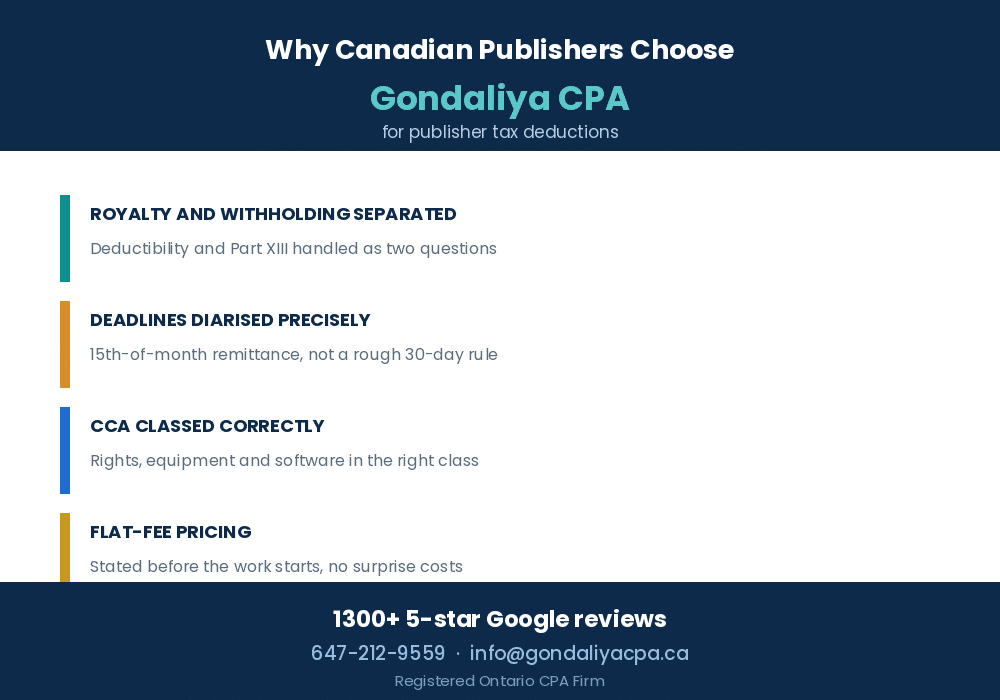
Publishers get into difficulty in a predictable set of ways: citing Part XIII as the authority for deducting a royalty when the real question is deductibility under ss.9/18(1)(a), treating the non-resident withholding remittance as a rolling 30-day window instead of a fixed 15th-of-the-month deadline, and dating the ECP-to-Class 14.1 transition to 2026 when it has been the rule since 2017. Gondaliya CPA handles publishing company accounting on a flat annual fee.
We handle what decides the outcome: separating the deductibility question from the withholding question on every royalty payment, diarising the fixed 15th-of-the-month remittance date for non-resident royalties, classifying printing and production costs correctly between current expense and inventory, assigning publishing rights and equipment to the correct CCA class, and confirming the Ontario Book Publishing Tax Credit position before it’s assumed.
Our team starts with your last filed corporate return, your author and royalty contracts, and a summary of any non-resident royalty payments made this year. Whatever your publishing house, you get clear advice and a fixed price before we start.
Quick Answers
| Question | Answer |
|---|---|
| Royalty deductibility authority | ITA ss.9 and 18(1)(a), not Part XIII |
| Non-resident royalty withholding rate | 25%, unless reduced by treaty |
| Withholding remittance deadline | 15th of the month following payment |
| NR4 / T4A annual filing deadline | Last day of February |
| ECP replaced by Class 14.1 | 1 January 2017, not 2026 |
| Meals & entertainment deduction | 50%, personal portion excluded |
| Printing costs, pre-sale | Inventory, expensed as COGS on sale |
| Record retention | Six years from taxation year-end |
Who This Is For
- For: Incorporated Canadian publishers, including book and magazine publishers, academic presses, hybrid and digital-first publishers, and audiobook producers, especially those paying royalties to non-resident authors or claiming the Ontario Book Publishing Tax Credit.
- Not For: Unincorporated sole-proprietor authors or publishers, whose filing mechanics differ, and corporations that merely hold copyrights without active publishing operations, which don’t get full deduction treatment under these rules.
Glossary of Key Terms
- Royalty lock principle: Royalties are deducted only when earned or payable, not on premature advances.
- Part XIII: The section of the Income Tax Act governing withholding tax on payments to non-residents, including royalties.
- NR4 slip: The annual information return reporting payments and withholding on amounts paid to non-residents, due by the last day of February.
- Class 14.1: The CCA class that replaced Eligible Capital Property (ECP) effective 1 January 2017, covering intangibles such as publishing rights and goodwill.
- Class 8: The CCA class covering most publishing equipment, at 20%.
- Class 12: The CCA class covering purchased software, at 100%.
- OBPTC: The Ontario Book Publishing Tax Credit, a refundable credit for eligible Canadian-authored book production costs in Ontario.
- COGS: Cost of goods sold — the point at which inventory-classified printing costs become deductible, on sale.
This quick self-check indicates where your publishing file most likely has room. Please answer the five questions below.
Publisher Tax Position Check
Five quick questions on your publishing house. No fee shown.
Points to raise with us:
This is a general prompt, not tax or legal advice or a quote. Your position depends on your full facts. For a real review, please book a free consultation.
Separate the deductibility question from the withholding question on every royalty. Diarise the fixed 15th-of-the-month Part XIII remittance date, not a floating 30-day window. Treat the ECP-to-Class 14.1 transition as settled law since 2017, not a change on the horizon. Classify printing costs as inventory until sold. Confirm the OBPTC position with Ontario Creates before budgeting a figure into a production plan.
Publisher Tax Deductions Canada: How Gondaliya CPA Supports You
Publishing house behind on royalty or CCA classification?
We separate the deductibility question from the withholding question, diarise the fixed remittance dates, and classify printing, rights, and equipment correctly — on a flat annual fee stated before the work starts.
Next Steps
Please book a free consultation with Gondaliya CPA and bring your last filed corporate return, your author and royalty contracts, and a summary of any non-resident royalty payments made this year. Those three show where the real position sits and what remains to be classified. You will get a flat fee stated before any work begins.
Published: · Last updated:
Editorial policy: Every rule stated here is checked against the Income Tax Act, CRA publications, or CRA information circulars current at the date above. Where a statement in the original guidance was incomplete or imprecise, the original wording has been preserved and corrected alongside it rather than removed.
Disclaimer: This article is educational information only and is not tax, legal, or financial advice. Tax rules change and outcomes depend on your specific facts. Please speak with a CPA before acting.

Sharad Gondaliya is a CPA Canada & CPA USA with 15 Years+ experience of Accounting, Tax, Payroll of Corporate Small Businesses as Tax Accountant. He is fully certified CPA Ontario and CPA USA and is well known among corporate small businesses for tax planning, efficient tax solutions, and affordable CPA services. Sharad is the Principal (Director) of Gondaliya CPA – Affordable CPA Firm in Canada. Licenses: CPA Ontario: 61040184 | CPA USA (MT): PAC-CPAP-LIC-033176 | CPA USA (WA): 57629 | CPA Firm License: 61330051 View Full Author Bio