



Private Lenders Tax Guide in Canada: Income, Expenses, Loans & Tax Rules
Understanding private lenders taxes Canada is essential for anyone involved in private lending, and Gondaliya CPA provides detailed information on tax treatment, income reporting, and allowable deductions. This private lender tax guide highlights important points about private lending taxes that every lender should know to handle their tax responsibilities effectively.
Quick Summary
Private lending tax turns on timing and characterisation. Interest accrues into income whether or not it is paid, fees are recognised on their own schedule, bad debts need proof before they come off, and foreclosure is a deemed disposition with its own rules.
- Accrue interest to your fiscal year-end, paid or not.
- Recognise fee income by contract, not by cash receipt.
- Write off a debt only once it is established to have become bad.
- Test each non-resident payment against the arm’s length exemption before withholding.
Reading time: 26 minutes.
Table of Contents
The Numbers That Matter
This guide covers Canada, with Ontario and Toronto context, and reflects rules current to 2026. It is written for incorporated private lenders — individual lenders, mortgage investment corporations, syndicates and partnerships. This is educational information only and not tax or legal advice. Provincial mortgage broker licensing varies, so confirm your obligations locally before acting.
What is Private Lending and How Does It Function in Canada?
What Private Lending Is
Foundations
Private lending means when people or groups loan money directly to borrowers. They skip banks or big lenders. This way is getting popular in Canada. Why? It offers more flexibility and faster access to cash.
Definition and Common Structures
In Canada, private lenders work in different ways. Some are individuals, others run partnerships or companies. Usually, they give short-term loans. These loans often use property or other assets as security. The main reason borrowers like them is speed. Private lenders can act faster than banks.
Types of Loans Facilitated by Private Lenders
Private lenders provide various loan types:
- Residential mortgages for homes when banks say no.
- Commercial loans for business spaces that don’t fit bank rules.
- Bridge loans to cover money gaps between deals.
- Construction loans for building projects.
These loans suit many needs but usually charge higher interest than banks.
Market Size and Use Cases
Canada’s private lending market grew a lot in recent years. More folks want options outside normal banks. Many are self-employed or have unusual incomes that banks don’t like. This pushes demand up and makes the market bigger.
The Canadian Tax System as it Applies to Private Lenders
Taxes come from two places: federal and provincial governments.
- Federal taxes follow rules in the Income Tax Act about how to report lending income.
- Provinces may add their own taxes that affect how much money lenders keep.
So, lenders must know both levels before paying tax.
The CRA has clear rules for private lender income:
- Report interest earned as it accrues, not when you get paid.
- Deduct expenses only if they relate directly to making that money and keep proof.
- Rules change if you lend alone or through a company, so get advice from an expert.
Key Stat: The single most consequential question for a private lender is whether the activity is a money-lending business or merely income from property. A moneylender can deduct a bad loan principal under subparagraph 20(1)(p)(ii); a passive investor generally cannot, and is left with a capital loss deductible only against capital gains. Section 9 brings business income into account, but the business-versus-property characterisation turns on the facts: volume, organisation, and how actively the portfolio is managed.
Types of Private Mortgage Lenders Operating in Canada
Individual Lenders. Individuals lend their own money with some collateral like property deeds. This gives them control over loan terms but also risks if the borrower can’t pay back without solid security.
Mortgage Investment Corporations (MICs). MICs pool money from many investors to fund bigger projects together. They must meet the conditions in section 130.1 of the Income Tax Act and follow provincial securities rules.
Syndicated Investors and Partnerships. Groups join forces and put money into one big loan project together, sharing risk across all investors. This helps protect their money especially when times get tough.
Who Qualifies as a Private Lender and Typical Borrower Profiles
To be a private lender, you need enough funds ready to lend out plus basic knowledge of lending laws in your area. Many start by working with pros before going solo.
Most clients are self-employed people or small businesses who can’t get bank loans easily. They need quick cash to grow or manage finances while waiting on longer approvals elsewhere.
Private Lenders, Banks, and B Lenders Compared
Banks, B-lenders, and private lenders all help borrowers but differ quite a bit.
Banks pick safer borrowers with good credit histories only. B-lenders approve more people but charge higher fees since risk is bigger there compared to banks.
Private lenders focus on those who can’t meet either bank’s or B-lender’s standards but still promise repayment, often with higher costs due to extra risk involved.
Reporting Interest Income from Private Lending Activities
Reporting Interest Income
Income
If you’re a private lender in Canada, you need to report all interest income earned during the fiscal year. It doesn’t matter if you actually received the cash yet. Subsection 12(3) of the Income Tax Act requires a corporation to include interest accrued to the end of the year. Keeping detailed loan ledgers showing accrued interest helps you report correctly and avoid audits.
Here’s what to keep in mind:
- Report interest earned, not just received
- Follow the accrual rule in subsection 12(3) of the Income Tax Act
- Maintain clear records of monthly accrued interest
T4A and T5 Slips
Incorporated private lenders must file slips to report payments to investors or partners. Usually:
- A T5 slip reports interest paid or credited to shareholders or arm’s-length investors
- A T4A slip applies if payments are fees for services, not pure interest
Choosing the right slip is key because wrong reporting can cause penalties or reassessments. T5 slips must be filed by the last day of February for the previous calendar year’s payments. NR4 returns for amounts paid or credited to non-residents are due by 31 March. Also, keep all related records for six years as CRA requires.
Risk Warning: The information return penalty is charged per return, not per slip, and the difference matters. For a first failure covering 1 to 50 slips, the penalty is $10 per day late, with a $100 minimum and a $1,000 maximum. A second failure within three years raises the rate to $25 per day to a maximum of $2,500. Budgeting “$100 a slip” overstates the exposure for a small lender and understates it for a large one.
How Interest is Recognized for Tax Purposes
Canada’s tax system requires incorporated private lenders to use an accrual method. You include any unpaid but earned interest at your fiscal year-end as taxable income. Prepaid or capitalized interest gets spread out over time based on loan terms.
Even if loans are in default or arrears, interest still counts as income unless you write it off after trying to collect it fairly. Keeping detailed loan ledgers that track monthly accrued interest helps when CRA reviews your returns.
Key points:
- Use the accrual method for recognizing interest
- Include unpaid interest at fiscal year-end
- Write off bad debts only after collection efforts
Pro Tip: Accruing interest you are not collecting is the cash-flow problem that defines this business — you pay tax on money that has not arrived. The relief valve is paragraph 20(1)(l): a reserve for doubtful debts, claimed on Schedule 13, which reduces income now on a loan that is genuinely at risk. It must be added back to income the following year and re-claimed if the doubt persists, so it is a rolling annual judgement supported by arrears history — not a one-time write-off.
Tax Treatment of Fees and Other Income Sources
Fees and Other Income
Fee Income
Private lenders charge different fees that get treated differently for taxes. Brokerage fees, setup charges, renewal fees, and penalties each follow their own rules under Canadian tax law.
Brokerage, Setup, and Renewal Fees
Fees like brokerage commissions, loan setup charges, commitment fees, and renewal costs usually count as business income when earned. These aren’t repayments of principal—they’re service income.
The timing of when you recognize these fees matters:
- Upfront fees before funding are recognized over the loan term unless refundable
- Renewal fees match the date contracts renew
Make sure your agreements clearly explain how fees work. This helps during audits to show proper tax treatment.
Penalties and Default Charges
Penalties charged because borrowers default—like late payment penalties or collection costs—are taxable business income right away when charged. They don’t count as capital gains.
Proper documentation is important here too:
- Keep notices sent to borrowers
- Track penalty amounts assessed
This stops disputes over when you recorded penalty income.
A private lender in Toronto gives a $500,000 mortgage at 8% annual interest. The borrower pays a $5,000 commitment fee upfront. The lender reports $40,000 of interest for the year and takes the $5,000 fee into income as earned — immediately where it compensates for a service already performed, or over the loan term where the contract ties it to the advance itself. Figures changed for privacy.
Deductible Expenses Related to Private Lending
Deductible Expenses
Deductions
Expenses that directly relate to earning lending income can reduce your taxable profits if documented properly under tax rules.
Legal Fees and Appraisals
Legal fees tied to setting up loans—like drafting mortgage documents—are deductible current expenses. But legal costs involved in acquiring property after default usually get added to the property’s cost instead of being deducted immediately.
Appraisal fees needed before lending money also count as current deductible expenses if invoices clearly state their purpose. Getting this right avoids mistakenly treating these costs as capital expenses.
Accounting, Administration, and Collection Costs
Bookkeeping costs (including software like QuickBooks), accountant fees for preparing returns, salaries for staff managing loans, and collection agency commissions qualify as deductible operating expenses.
Keep vendor invoices tied directly to loan activities with internal codes or notes. This makes it easier during CRA checks to prove these expenses relate to your lending business.
Pro Tip: Interest on money you borrow to re-lend is deductible under paragraph 20(1)(c), and it is often the largest deduction a leveraged lender has. What protects it is tracing: the borrowed funds must be traceable to the income-earning loan. Money that runs through a general operating account alongside personal funds becomes difficult to trace, and CRA will disallow what cannot be followed. A dedicated lending account solves this at no cost.
Handling Bad Debt and Loan Defaults
Bad Debt and Defaults
Defaults
Dealing with bad debts for tax means proving a debt is truly uncollectible and keeping proper records of attempts made to recover money owed.
Claiming Bad Debt Deductions
You can claim a bad debt deduction under paragraph 20(1)(p) once the debt is established to have become bad in the year and was previously included in income. Where the lender carries on a money-lending business, subparagraph 20(1)(p)(ii) also allows the uncollectible principal to be deducted. Alternatively you can set up a doubtful debt reserve under paragraph 20(1)(l), which adjusts yearly and must be added back to income the following year.
Choosing which approach affects your financial statements a lot so plan carefully. Keep detailed logs of arrears communications and collection steps before claiming bad debts on your return.
| Approach | Provision | Effect | What It Needs |
|---|---|---|---|
| Doubtful debt reserve | 20(1)(l) | Reduces income now; added back next year and re-claimed if still doubtful | Arrears history and a reasoned estimate, Schedule 13 |
| Bad debt write-off, interest | 20(1)(p)(i) | Permanent deduction of the amount previously included in income | Debt established to have become bad in the year |
| Bad debt write-off, principal | 20(1)(p)(ii) | Permanent deduction of uncollectible principal | Lender must carry on a money-lending business |
Documentation Requirements
To support bad debt claims, keep all these documents:
- Signed loan agreements
- Security registrations showing collateral rights
- Precise records of missed payments
- Letters sent demanding payment or court actions taken
- Internal notes about borrower talks or restructuring offers
CRA expects you to keep these records for at least six years after the end of the tax year. Without good docs, claims might get denied during audits involving private lenders taxes Canada topics.
An incorporated bridge lender writes off a $50,000 loan after six months of missed payments despite many notices. They record this with letters from collection agencies. Because the lender carries on a money-lending business, both the accrued interest and the uncollectible principal come off under paragraph 20(1)(p). Figures changed for privacy.
Taking Over Properties After Default
When a borrower defaults and you take over the property through foreclosure or power of sale, section 79 of the Income Tax Act governs the surrender. The debtor is treated as having disposed of the property, and the creditor’s cost of the property acquired is generally measured by the outstanding claim plus the costs of acquiring it — not simply by fair market value on the takeover date.
How you then hold the property matters. Classifying it as inventory held for resale gives a different answer from holding it as capital property, and only the latter attracts capital cost allowance and possible recapture on sale.
You can deduct holding expenses like maintenance or insurance while the property is held to earn income. After sale, calculate gains or losses carefully based on that cost plus holding period adjustments. Accurate records help avoid unexpected tax issues common with property repossession.
Risk Warning: Section 80 is not the foreclosure rule — it is the debt forgiveness rule, and it is a separate exposure that lenders rarely see coming. If you settle a loan for less than the full amount owing without taking the property, the borrower faces forgiven-debt consequences under section 80, which can turn a negotiated discharge into a tax bill for them and a dispute for you. Surrender of property runs on section 79; seizure of property by a creditor runs on section 79.1.
After foreclosing on a $400K construction loan balance, a lender takes title through power of sale with the property appraised at $380K. They spend $10K maintaining it until selling the following year. The acquisition cost is measured against the outstanding claim under section 79, and the $10K of holding costs is tracked separately for the eventual gain or loss calculation. Figures changed for privacy.
For questions about private lenders tax Canada, including how to report interest properly, handle fee income right, manage losses smartly, or keep solid books tailored for mortgage lending companies, contact Gondaliya CPA Professional Corporation at info@gondaliyacpa.ca or call 647‑212‑9559 for free advice built around your needs across Toronto and Ontario.
Tax Planning, Structure and Compliance Strategies
Tax Planning & Structure
Planning
Choosing the Appropriate Investment Structure
Picking the right investment setup matters a lot for private lenders. It changes how taxes hit you, how you report income, and even your liability. You can hold loans personally, through a corporation, or using a trust.
Corporations let you plan your taxes better under the Income Tax Act. You might keep earnings inside to defer personal taxes. Trusts give some freedom in sharing income but need careful handling to avoid extra tax problems [ITA s.104].
Also, think about how you pay yourself—salary or dividends? Salary counts as an expense for the company but comes with payroll rules. Dividends don’t lower company tax but might save on your personal tax bill. Keeping good paperwork like shareholder agreements and payroll records is key.
Here’s what to keep handy:
- Incorporation papers
- Loan registers showing who owns what
- Employment contracts or dividend notes
Risk Warning: Interest earned inside a corporation is passive investment income unless the lending amounts to an active business. That has two consequences most new lenders miss. It is taxed at roughly 50% up front, with part refundable through the RDTOH mechanism only when dividends are paid out. And once adjusted aggregate investment income exceeds $50,000, it grinds the small business deduction by $5 for every $1, eliminating it at $150,000 — including for any associated operating company. A lending corporation sitting beside a family business can quietly cost that business its small business rate.
Tax-Advantaged Accounts in Private Lending
When you invest through RRSPs or TFSAs, your money usually grows tax-free. But lending inside these accounts can get tricky if it breaks the qualified and prohibited investment rules.
Risk Warning: Holding a private mortgage inside an RRSP or TFSA is where registered-plan lending goes badly wrong. A non-qualified investment attracts a 50% penalty tax on its fair market value, plus tax on the income it earns. A prohibited investment — broadly, debt of a person connected to the plan holder — attracts the same 50% charge plus a 100% advantage tax on the income. Lending your own RRSP money to yourself, a relative or your own corporation is the classic trap. An arm’s length mortgage administered by an approved lender can qualify; a handshake loan to a family member does not.
Maintaining Accurate Records and Documentation
Good record keeping saves headaches if CRA audits you. Your loan agreements should spell out terms: principal, interest rates, schedules, and any security registered with provinces. Track arrears carefully to back up any doubtful debt claims under paragraph 20(1)(l).
Use an organized ledger and sync it monthly with accounting software like QuickBooks. This helps show income correctly based on when it’s earned, not just when cash hits your account. Keep emails or letters about missed payments or changes too—they help prove losses.
| Record Type | Purpose | How Long To Keep | Reference |
|---|---|---|---|
| Loan Agreements | Terms & conditions | At least 6 years after year-end | ITA s.230(1) |
| Arrears Tracking | History of collections | Same as above | Supports 20(1)(l) and 20(1)(p) |
| Security Registrations | Proof of collateral | Until collateral is released | Provincial Land Titles Acts |
| Accounting Ledgers | Interest & fees recording | At least 6 years after year-end | ITA s.230(1) |
Annual Tax Reviews and Professional Advice
Doing yearly tax reviews helps catch new laws that affect private lenders across Canada. Some things are tough to do alone — like figuring out loss rules or non-resident withholding.
A licensed CPA firm brings structure to your filings. They check your numbers from start to finish and make sure everything fits CRA rules. That lowers audit risk because they match accruals to actual cash flow. They also confirm expenses follow the rules in sections 18(1)(a) and 20(1)(c).
At Gondaliya CPA, we focus on incorporated private mortgage lenders in Toronto and Ontario. We combine bookkeeping updates with full T2 return prep tailored for lenders like you.
Common Tax Mistakes to Avoid
Many private lenders slip up on taxes. Watch out for these:
- Reporting interest only when paid instead of accruing yearly means less income shown.
- Treating lender fees as capital instead of current revenue messes up timing.
- Claiming doubtful debt losses without proof of collection risks penalties.
- Forgetting to issue slips like T5 or NR4 leads to fines.
- Not withholding taxes where they are actually required triggers interest plus reassessments.
- Missing documentation on related-party loans invites adjustments under subsection 15(2).
To avoid trouble:
- Keep detailed files proving every deduction with signed agreements.
- Reconcile ledgers with bank statements regularly.
- Issue all required slips before deadlines.
- Follow clear tracing methods on borrowed funds used for lending.
- Check in with professionals who know private lender taxes often.
Need help with private lenders tax Canada-wide? Reach out to Gondaliya CPA at info@gondaliyacpa.ca or call 647‑212‑9559 for a free chat focused on incorporated SMB clients in Ontario including Toronto.
Legal and Regulatory Considerations Affecting Private Lending Taxes
Legal & Regulatory
Regulatory
Money-Lending Business Regulations and Tax Compliance
Private lending in Canada follows certain rules that affect taxes. The Income Tax Act distinguishes income from property from income from a money-lending business. This affects how private lenders report earnings and claim expenses. If you’re an incorporated lender, you need to see whether your activity amounts to a money-lending business, because that changes what deductions you can take and how losses are handled. Section 9 brings business and property income into account; the characterisation itself turns on the facts of your operation. Provinces may also require licenses for mortgage brokers or lenders depending on where you operate. Good records help prove your tax treatment is correct. These include loan agreements, interest calculations, fees charged, and collection efforts. If you don’t follow these rules, the CRA might reassess your taxes.
- Income from property and income from a money-lending business are treated differently.
- Money-lender status unlocks the principal write-off in subparagraph 20(1)(p)(ii).
- Provincial licensing might apply.
- Keep clear records: loans, interest, fees, collections.
- Non-compliance risks CRA reassessment.
GST/HST Considerations and Exemptions
Most private lending services are exempt financial services. “Financial service” is defined in subsection 123(1) of the Excise Tax Act, and the exemption itself is listed in Schedule V, Part VII. This means GST/HST usually doesn’t apply to interest or fees directly tied to loans. But some extra services like admin or consulting may be taxable if billed separately. Input tax credits aren’t allowed for costs related only to exempt supplies. So, if your expenses cover both taxable and exempt parts—like software or rent—you must allocate them properly before claiming ITCs. Getting this right keeps your GST/HST filings clean and avoids triggering an audit.
- Interest income usually exempt from GST/HST.
- Admin or consulting fees might be taxable.
- ITCs limited on exempt supply expenses.
- Allocate mixed-use expenses carefully.
Pro Tip: Bill taxable ancillary services separately from exempt loan-related fees. Where a single invoice mixes an exempt arrangement fee with a taxable administration service, CRA can treat the whole amount under a single supply analysis, and which way that falls is not always in your favour. Separate line items, or separate invoices, preserve the distinction and support your ITC allocation.
Penalties, Instalment Payments, and CRA Audit Triggers
Corporations doing private lending generally pay monthly instalments under section 157, due the last day of each month of the tax year, based on last year’s taxes or estimated current year taxes. Quarterly instalments are available only to an eligible small CCPC meeting the taxable income, taxable capital and compliance tests. Missing instalments means interest charges until you pay up.
CRA audits often look at mismatches between accrued interest and collections, unsupported doubtful debt claims without proof of collection attempts, misclassified lender fees as capital instead of income, late or missing slip filings, and missing withholding remittances where they were actually required.
Common audit triggers include:
- Accrued interest not matching collections.
- Doubtful debts claimed without collection evidence.
- Fees wrongly treated as capital gains instead of income.
- Late or missing T5 and NR4 filings.
- Missing withholding remittances on non-resident payments that were subject to Part XIII.
Record Retention and Documentation Standards
CRA wants you to keep all books and records supporting what you report on taxes for six years after the end of the tax year [Income Tax Act section 230]. This includes:
- Signed loan agreements
- Security registrations (proof of collateral)
- Ledgers tracking monthly accrued but unpaid interest
- Files showing overdue payments
- Collection correspondence
- Investor statements
Using digital tools like QuickBooks or Xero can help keep things organized and ready in case of an audit.
Clear records plus timely slips cut down costly mistakes common among incorporated private lenders in Toronto and Ontario markets. Loan ledgers showing accrued but unpaid interest are what back up annual income before corporate returns get filed, and writing off bad loans without proof of collection attempts risks denial plus penalties.
Non-Residents, Withholding and Cross-Border Reporting
Non-Residents & Withholding
Cross-Border
Part XIII of the Income Tax Act imposes a 25% withholding tax on certain Canadian-source payments made to non-residents — that is, on interest a Canadian payer pays to a non-resident lender or investor, not on interest received from a non-resident borrower.
Risk Warning: Since 1 January 2008, interest paid to a non-resident with whom the payer deals at arm’s length is generally exempt from Part XIII tax altogether, unless it is participating debt interest under subsection 212(3). The 25% rate applies to non-arm’s length interest and to participating debt interest. Withholding 25% from an arm’s-length foreign investor who owes nothing sends CRA money that was never due, and recovering it requires that investor to file a Canadian return. Equally, assuming the exemption applies to a related-party loan leaves the payer strictly liable under section 215 for tax it failed to withhold.
| Payment | Part XIII Treatment | Slip |
|---|---|---|
| Interest to an arm’s length non-resident, ordinary debt | Generally exempt | NR4 still reported |
| Participating debt interest | 25%, treaty may reduce | NR4 |
| Interest to a non-arm’s length non-resident | 25%, treaty may reduce | NR4 |
| Interest to a Canadian resident investor | No withholding | T5 |
Where withholding does apply, the tax must be remitted by the 15th day of the month following the month the amount was paid or credited. NR4 information returns reporting amounts paid or credited to non-residents and tax withheld are due by 31 March. Treaty rates vary by country and can reduce the 25% — under the Canada–US treaty, ordinary interest is generally reduced to nil — but the reduction depends on the recipient qualifying for treaty benefits, which you must be able to evidence.
Keep these records:
- Residency proof from all parties
- NR4 slips filed each year
- Proof of any tax treaty benefits
Missing slip deadlines or failing to withhold where it was required can cause penalties. Keeping detailed investor information with residency status makes compliance easier.
Practical Guidance and Resources from Gondaliya CPA
Practical Guidance
Practical
Optimizing Tax Reporting and Minimizing Liabilities
When you’re a private lender in Canada, understanding how to report your income right matters a lot. You need to know if your lending income counts as business income or property income, because that changes what expenses you can claim. Keep detailed records of loans—like interest earned, fees charged, repayments made, and any defaults. This helps follow the rules about when to report income, especially for corporations.
Here’s what you should do:
- Record lender fees like commitment or renewal fees at the right time
- Account properly for discounts if loans are given below face value
- Set up doubtful debt reserves only with real proof of collection efforts
- Consider using a corporation for lending but make sure it fits how you operate
- Test non-resident interest against the arm’s length exemption before withholding
- File info slips like T5s or NR4s on time using electronic systems
These steps help cut down taxes owed and lower the chance of an audit.
Bookkeeping Software and CPA Firm Services
Using bookkeeping software like QuickBooks or Xero makes tracking private lending easier. They can automatically handle monthly interest accruals. But it’s smart to have someone review this too. A CPA firm can check your books for mistakes before tax season.
What this combination does:
- Keeps loan ledgers up-to-date with balances, fees, arrears, and capitalized interest
- Makes sure expenses claimed relate to earning lending income under tax law
- Prepares supporting documents in case CRA asks for them
- Uses cloud tools so you can share loan agreements and registrations securely
This setup cuts errors and saves time on compliance. It works well especially for lenders operating in Toronto or Ontario who want smooth filing.
How Gondaliya CPA Supports Private Lenders
Gondaliya CPA helps private mortgage lenders in Ontario through every tax step. We start by reviewing your loan portfolio carefully. Then we prepare T2 corporate returns with all the right schedules focused on private lending taxes.
Here’s how we help:
- Validate interest accruals following the subsection 12(3) rule
- Make sure fees get recognized according to contracts
- Assess doubtful debt reserves with proper documentation
- Trace borrowed funds used for re-lending to confirm deductible interest claims
We offer flat fees that cover bookkeeping fixes if needed, plus GST/HST filings related to exempt financial services lenders provide. We also prepare information slips on time to avoid penalties.
You’ll get fast replies—usually within one business day—and weekend help during busy periods.
Broker Collaboration and Mortgage Documentation
Working closely with mortgage brokers keeps your records solid for tax purposes. Brokers need to provide:
- Fully signed loan agreements showing fees and renewal terms
- Amortization schedules including any capitalized interest clauses
- Security registration certificates proving lien priority
This paperwork helps decide when revenue is reported and how losses get treated under the write-off and reserve rules.
Lenders should also get regular borrower payment histories showing arrears status. This information supports correct doubtful debt reserve amounts.
Clear communication between brokers and accountants makes year-end reviews smoother. It avoids problems when figuring out private lenders taxes Canada-wide.
Staying Compliant and Preparing for Deadlines
Staying on top of deadlines matters. Corporate T2 returns are due six months after your fiscal year ends. Any balance owing is due two months after year-end, or three months for an eligible CCPC claiming the small business deduction.
Watch out for monthly instalments if your prior taxes were high enough. Issuing correct T5 or NR4 slips on time avoids penalties, which run at $10 per day with a $100 minimum and a $1,000 maximum for a first failure on 1 to 50 slips.
Keep complete loan ledgers that show accrued but unpaid interest and fees clearly recorded. Store these records safely for at least six years since CRA might ask later.
Start preparing early each year so you can fix any issues like missing arrears interest or misclassified expenses before the final filing date comes up.
For expert help designed around your portfolio needs, contact Gondaliya CPA today at 647‑212‑9559 or info@gondaliyacpa.ca for a no-pressure consultation focused on optimizing your private lender taxes Canada-wide.
FAQs on Private Lenders Taxes Canada
Frequently Asked Questions
FAQ
What is the interest withholding rate on payments to non-residents?+
Part XIII imposes 25% on interest paid to a non-resident, but since 1 January 2008 interest paid to an arm’s length non-resident on ordinary debt is generally exempt. The 25% applies to non-arm’s length interest and to participating debt interest, and a treaty may reduce it. Note the direction: the tax applies to interest you pay to a non-resident lender or investor, not to interest you receive from a non-resident borrower.
When is interest income recognized for private lenders?+
When earned, not when received. Subsection 12(3) requires a corporation to include interest accrued to the end of its taxation year.
Over what period must a corporation accrue interest income?+
To the corporation’s fiscal year-end. Monthly or quarterly ledger entries are good bookkeeping practice, but the statutory inclusion is measured at year-end.
What is the T2 corporate tax filing deadline?+
Six months after the fiscal year-end. The balance owing is due two months after year-end, or three months for an eligible CCPC claiming the small business deduction.
What penalties apply for late T5 slip filing?+
For a first failure on 1 to 50 slips, $10 per day late with a $100 minimum and a $1,000 maximum for the return. A second failure within three years raises this to $25 per day to a maximum of $2,500.
How long is the records retention period?+
At least six years after the end of the tax year, under section 230 of the Income Tax Act.
What is the doubtful debt reserve limit?+
A reserve under paragraph 20(1)(l) must be a reasonable amount supported by arrears history and collection evidence. It is added back to income in the following year and re-claimed if the doubt persists. Speculative or general reserves are disallowed.
When are tax instalments due for incorporated private lenders?+
Generally monthly, on the last day of each month of the tax year, under section 157. Quarterly instalments are available only to an eligible small CCPC meeting the taxable income, taxable capital and compliance conditions.
What happens when a loan goes into default?+
Interest continues as taxable income until it is written off after reasonable collection efforts and documentation, or reduced by a doubtful debt reserve in the meantime.
What if you take possession of the property on default?+
Section 79 governs the surrender of property to a creditor. The creditor’s cost of the property is generally measured by the outstanding claim plus acquisition costs, and gain or loss is calculated on eventual sale. Section 80 is the debt forgiveness rule, which is a different matter.
Can you deduct interest on money borrowed to lend privately?+
Yes, under paragraph 20(1)(c), provided the borrowed funds are traceable to the income-earning loan. A dedicated lending account makes tracing straightforward.
Which operating expenses can a private lender deduct?+
Expenses directly related to earning lending income, such as legal fees on loan documentation, appraisals, bookkeeping and accounting, staff salaries and collection agency commissions.
Are broker, appraisal and legal fees current or capital expenses?+
Brokerage and appraisal fees on originating a loan are generally current expenses. Legal fees may be current or capital depending on purpose — drafting loan documents is current, while costs of acquiring property after default are added to the property’s cost.
Do you charge GST/HST on interest and lender fees?+
Interest and fees integral to the loan are exempt financial services under Schedule V Part VII of the Excise Tax Act. Ancillary administration or consulting services billed separately may be taxable, and input tax credits are restricted on exempt supplies.
Which information slips must private lenders issue annually?+
T5 slips report interest paid or credited to Canadian investors, due by the last day of February. NR4 returns report amounts paid or credited to non-residents and any tax withheld, due by 31 March.
How are Mortgage Investment Corporations taxed?+
A MIC meeting the conditions in section 130.1 deducts dividends paid to shareholders, so income distributed annually is effectively taxed in the shareholders’ hands rather than the corporation’s. Dividends from a MIC are generally taxed as interest to the recipient.
How do you handle loans to shareholders and related parties?+
Loans must be on commercial terms. A loan to a shareholder can be included in their income under subsection 15(2) unless it falls within an exception and is repaid within the prescribed period, and below-market terms can trigger imputed interest benefits.
How do you report syndicated and participating loans?+
Income and expenses are reported based on each investor’s share, with proper agreements to support the allocation. Note that participating debt interest paid to a non-resident does not benefit from the arm’s length exemption.
Can I hold a private mortgage inside an RRSP or TFSA?+
Only within the qualified investment rules, and never where it would be a prohibited investment — broadly, debt of a person connected to the plan holder. A non-qualified investment attracts a 50% penalty tax on its fair market value; a prohibited investment attracts that plus a 100% advantage tax on the income earned.
Professional Guidance and Quick Reference
Professional Guidance & Quick Reference
Guidance
Private lenders get into difficulty in a predictable set of ways: interest reported on receipt rather than accrual, doubtful debt reserves claimed without arrears evidence, withholding applied to arm’s length foreign investors who owe nothing, and foreclosures run through the wrong section of the Act. Gondaliya CPA handles private lender accounting on a flat annual fee.
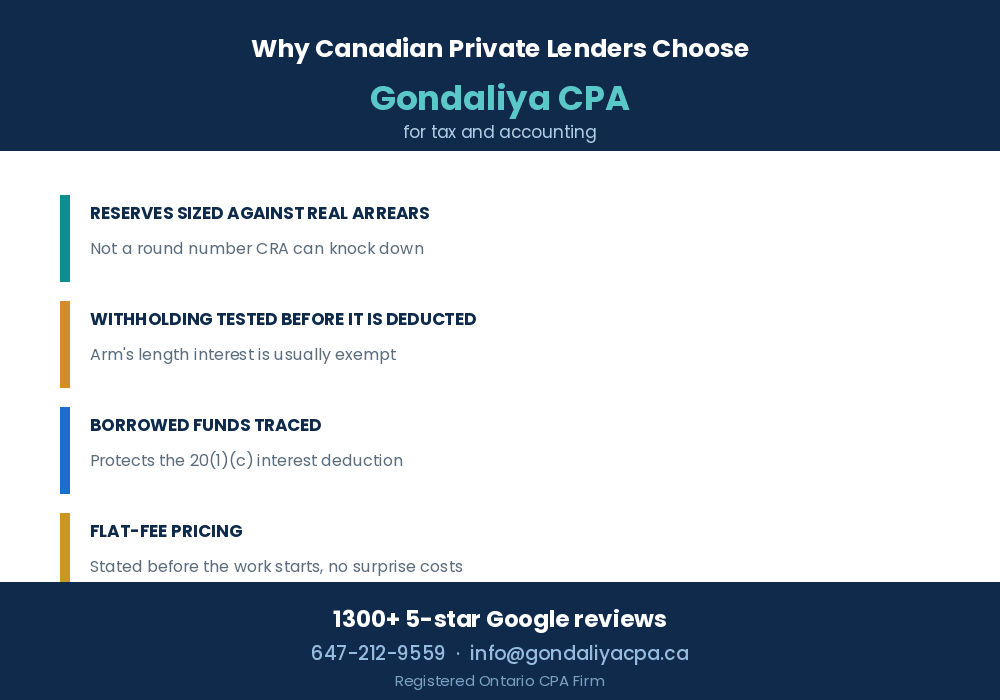
We handle what decides the outcome: validating accruals to your year-end, sizing the doubtful debt reserve against real arrears, tracing borrowed funds to protect the interest deduction, testing each non-resident payment before any tax is withheld, and issuing T5 and NR4 returns on their own separate deadlines.
Quick Answers: Key Numbers & Concepts at a Glance
At a Glance
| Question | Answer |
|---|---|
| Interest recognition | Accrued to year-end, s.12(3) |
| Doubtful debt reserve | 20(1)(l), added back the following year |
| Bad debt write-off | 20(1)(p); principal under 20(1)(p)(ii) for moneylenders |
| Foreclosure and power of sale | Section 79 — not section 80 |
| Arm’s length interest to a non-resident | Generally exempt since 1 January 2008 |
| Non-arm’s length or participating interest | 25%, treaty may reduce |
| Withholding remittance | 15th of the month following payment |
| T5 deadline | Last day of February |
| NR4 deadline | 31 March |
| Slip penalty, 1–50 slips | $10/day, $100 minimum, $1,000 maximum |
| Corporate instalments | Monthly under s.157; quarterly for eligible small CCPCs |
| Interest on funds borrowed to re-lend | Deductible under 20(1)(c), subject to tracing |
Who This Is For / Not For
Fit Check
- For: Incorporated Canadian private lenders — individual lenders, mortgage investment corporations, syndicates and partnerships — particularly those carrying arrears, borrowing to re-lend, or paying non-resident investors.
- Not For: Occasional lenders whose income is purely passive property income with no business character, and non-resident lenders with no Canadian establishment.
People Also Ask
Quick Answers
Is private lending income taxable in Canada?+
Yes. Interest, fees and penalties earned from lending are fully taxable. Interest is included in income at 100%, unlike a capital gain where only half is taxed. Where the lending amounts to a business, the income is business income and a wider range of expenses becomes deductible.
How much interest can a private lender legally charge in Canada?+
Section 347 of the Criminal Code caps interest at 35% APR for most loans, reduced from 60% effective annual rate on 1 January 2025. Two commercial exceptions apply: loans between $10,000 and $500,000 to a borrower that is not a natural person, for a business purpose, may go to 48% APR, and commercial loans above $500,000 are not subject to a cap. “Interest” is defined broadly and includes fees, commissions and penalties, so a lender close to the line should have the rate calculated properly rather than estimated.
Do you need a licence to be a private lender in Canada?+
It depends on the province and what you are doing. Lending your own money on a mortgage is treated differently from brokering or administering mortgages for others, which generally requires registration — in Ontario, under the Mortgage Brokerages, Lenders and Administrators Act. Raising money from investors can also engage provincial securities law. Tax compliance and licensing are separate obligations, and meeting one does not satisfy the other.
Is interest income taxed more heavily than capital gains?+
Yes. Interest is included in income in full, while only half of a capital gain is taxable at the 50% inclusion rate. That is one reason the business-versus-property characterisation matters so much: it determines whether a loss on a failed loan is a fully deductible bad debt or a capital loss usable only against capital gains.
Is a mortgage investment corporation taxed like a regular company?+
Not quite. A MIC meeting the conditions in section 130.1 can deduct dividends it pays to shareholders, so income distributed each year is effectively taxed in the shareholders’ hands rather than in the corporation. Those dividends are generally taxed as interest to the recipient, not as eligible dividends, so there is no dividend tax credit.
Can you lend money privately without incorporating?+
Yes, but the tax outcome differs. A personal lender reports the income on their T1 at personal marginal rates and has a narrower path to deducting a lost principal amount. A corporation defers personal tax on retained earnings but pays roughly 50% up front on passive interest income, with part refundable when dividends are paid, and may affect the small business deduction of an associated company.
Glossary of Key Terms
Plain-English Definitions
- Accrued interest: Interest earned to the fiscal year-end, included in income whether or not it has been received.
- Doubtful debt reserve: A deduction under paragraph 20(1)(l) for a debt at risk, added back the following year.
- Money-lending business: A lending operation with sufficient business character to access the principal write-off in subparagraph 20(1)(p)(ii).
- Section 79: The rule governing surrender of property to a creditor on default.
- Participating debt interest: Interest contingent on revenue, profit or similar criteria, outside the arm’s length exemption.
- Part XIII: The withholding regime on Canadian-source passive payments to non-residents.
- Prohibited investment: Broadly, debt of a person connected to a registered plan holder, attracting a 50% penalty tax plus advantage tax.
- Exempt financial service: A supply defined in ETA subsection 123(1) and exempted under Schedule V Part VII, carrying no GST/HST and no input tax credits.
Additional Key Points
Reference
- Sale or Assignment of a Loan: Treated as a disposition; gain or loss is the difference between sale price and adjusted cost base.
- Salary vs Dividends: Salary is an expense to the corporation with payroll obligations attached; dividends do not reduce corporate income.
- Records Proving Lending Deductions: Signed agreements, payment histories, arrears communications, security registrations and collection evidence.
- Filing Requirements: T2 within six months; T5 by the last day of February; NR4 by 31 March; withholding remitted by the 15th of the following month.
- Common CRA Review Triggers: Mismatched accrued versus received interest, unsubstantiated bad debts, missing slips, unremitted withholding.
- Catching Up When Records Are Behind: Reconcile bank statements to loan ledgers, then consider the Voluntary Disclosures Program where income went unreported.
- Pre-Engagement Preparation: Gather loan registers, agreements with fee schedules, and arrears logs before your accountant starts.
This quick self-check indicates where your lending operation most likely has room. Please answer the five questions below.
Private Lender Tax Check
Five quick questions on your business. No fee shown.
Points to raise with us:
This is a general prompt, not tax or legal advice or a quote. Your position depends on your full facts. For a real review, please book a free consultation.
Interest accrues into income at your year-end whether the borrower pays or not, so the doubtful debt reserve under 20(1)(l) is the tool that keeps tax aligned with reality on a loan in arrears — and it needs arrears evidence, refreshed every year. Write-offs run on 20(1)(p), with the principal available only to a genuine money-lending business. Foreclosure is section 79; section 80 is debt forgiveness and a different problem entirely. And before withholding anything from a foreign investor, check the arm’s length exemption: since 2008 most ordinary interest to arm’s length non-residents carries no Part XIII tax at all.
2026 Update — what is current: The criminal rate of interest has been 35% APR since 1 January 2025, down from a 60% effective annual rate, with commercial carve-outs at 48% APR for business loans of $10,000 to $500,000 to a non-natural-person borrower and no cap above $500,000. The capital gains inclusion rate remains 50%; the proposed increase to two-thirds was cancelled on 21 March 2025 and never received Royal Assent. Unchanged for 2026: the arm’s length exemption from Part XIII withholding on ordinary interest, in place since 1 January 2008; the 25% rate on non-arm’s length and participating debt interest; remittance by the 15th of the month following payment; T5 by the last day of February and NR4 by 31 March; the $10 per day slip penalty with its $100 minimum and $1,000 maximum for 1 to 50 slips; and the six-year record retention requirement under section 230.
Private Lender Taxes: How Gondaliya CPA Supports You
Carrying arrears, or paying foreign investors?
We validate accruals to your year-end, size the doubtful debt reserve against real arrears history, trace borrowed funds to protect the interest deduction, test each non-resident payment before tax is withheld, and file T5 and NR4 on their separate deadlines — on a flat annual fee stated before the work starts.
Next Steps
Please book a free consultation with Gondaliya CPA and bring your last filed corporate return, a loan register showing balances, rates and arrears status, and a list of investors with their residency. Those three settle most of what this guide covers. You will get a flat fee stated before any work begins.
Published: · Last updated:
Editorial policy: Figures, deadlines and statutory references are verified against the Income Tax Act, the Excise Tax Act, their Regulations and CRA publications before publication, and updated when the rules change.
Disclaimer: This article is educational information only and is not tax, legal, or financial advice. Rules change and outcomes depend on your specific facts. Please speak with a CPA before acting.

Sharad Gondaliya is a CPA Canada & CPA USA with 15 Years+ experience of Accounting, Tax, Payroll of Corporate Small Businesses as Tax Accountant. He is fully certified CPA Ontario and CPA USA and is well known among corporate small businesses for tax planning, efficient tax solutions, and affordable CPA services. Sharad is the Principal (Director) of Gondaliya CPA – Affordable CPA Firm in Canada. Licenses: CPA Ontario: 61040184 | CPA USA (MT): PAC-CPAP-LIC-033176 | CPA USA (WA): 57629 | CPA Firm License: 61330051 View Full Author Bio