



Equipment Finance Company Tax Planning in Canada: Leases, Interest & Financing Costs
Equipment finance company tax planning Canada involves understanding key tax benefits and implications that can help businesses reduce their taxable income through depreciation, interest deductions, and lease accounting. Gondaliya CPA specializes in guiding companies on equipment financing tax Canada strategies, ensuring compliance while maximizing tax savings.
Quick Summary
Four things decide an equipment finance company’s tax position: how each contract is characterised, whether the leasing property restriction caps your CCA, how much interest you can actually deduct after EIFEL, and when an asset becomes available for use. Each is settled by the paperwork, not by the label on the agreement.
- Characterise every contract as a true lease or a financing before the return is prepared.
- Test CCA against the leasing property restriction, which applies to lessors and not lessees.
- Trace borrowed funds, then test the interest against the EIFEL fixed ratio.
- Charge GST/HST on each lease payment as it becomes due, not at lease end.
Reading time: 27 minutes.
Table of Contents
- Equipment Financing and Leasing Options
- Tax Benefits and Implications
- Capital Cost Allowance and Immediate Expensing
- Interest Deductibility and EIFEL
- Loans Versus Leases Compared
- Application Process and Requirements
- Tax Reporting and GST/HST
- Bookkeeping and Working with a CPA
- Frequently Asked Questions
- Professional Guidance and Quick Reference
The Numbers That Matter
This article covers Canada, with Ontario and Toronto context, and reflects rules current to 2026. It is written for incorporated equipment finance companies, lessors, vendor finance programs and the businesses that lease from them. Capital cost allowance and immediate expensing rules have changed repeatedly since 2024 and further proposals are outstanding, so please confirm the position for your acquisition date. This is educational information only and not tax or legal advice.
Understanding Equipment Financing and Leasing Options in Canada
Equipment Financing and Leasing Options
Foundations
What is Equipment Financing?
Equipment financing means getting money to buy or lease the tools a business needs. It helps companies get equipment without paying a big chunk all at once. This way, they can keep more cash handy. In Canada, this can be loans or leases with certain tax rules that affect how you pay taxes.
The equipment financing tax rules let businesses deduct some costs tied to financed equipment. For example, interest paid on loans might count as a business expense. That lowers the amount of income you pay tax on.
Common Types of Equipment Loans and Leases
Businesses usually pick from two main ways to finance equipment: loans or leases.
- Equipment Loans: You borrow money to buy the equipment yourself. Then, you pay back over time with interest.
- Leases: You rent the equipment instead of buying it. You pay regularly during the lease period. Afterward, you might be able to buy it for its leftover value or keep leasing.
Each option works differently when it comes to taxes. Knowing this helps with good equipment finance company tax planning in Canada. For instance, you can claim different deductions or capital cost allowances (CCA) depending on your choice.
Industries Benefiting from Equipment Financing
Many Canadian industries rely on equipment financing because they need special machines:
- Construction uses heavy gear but prefers leasing to spread costs.
- Healthcare needs costly medical devices; financing helps manage budgets.
- Transportation companies lease vehicles for smooth operations.
- Manufacturing depends on advanced tech, often financed through leases.
These financial options help businesses run better and lower their tax bills by using smart plans around equipment financing taxes in Canada.
How Equipment Finance Companies Operate in Canada
In Canada, equipment finance companies create plans that fit different industries while following tax laws about equipment finance company taxes.
They check what a client needs and then offer options that match business goals and tax rules. They stick to regulations from bodies like the CRA (Canada Revenue Agency). This includes making sure clients claim things like CCA properly and keep good records about leased gear.
Knowing how these companies work in Canada’s market helps businesses pick the right equipment finance accountant. Such experts guide them to smart tax moves that match what the company wants financially.
Key Stat: The decision that moves the most money is not loan versus lease — it is whether a contract is a true lease or a financing in substance. On a true lease the lessor owns the asset, claims CCA subject to the leasing property restriction, and reports rent. On a financing, the lessee is treated as owner and the lessor reports interest on a receivable. Getting it wrong moves the CCA claim to the other side of the deal entirely.
Tax Benefits and Implications of Equipment Financing
Tax Benefits and Implications
Deductions
If you run a business in Canada, knowing how equipment finance company tax planning Canada works can save you money. Equipment financing tax Canada deals with interest, lease payments, and capital cost allowance (CCA). Using smart strategies can cut your taxable income by getting the most from deductions on interest and lease payments. Also, applying the right CCA rates on equipment purchases matters.
Deductibility of Interest and Lease Payments
You can usually deduct interest expenses on loans for equipment financing. This only applies if the loan money is used to get or lease equipment. Lease payments are also deductible but depend on GST/HST rules and leasing property limits.
- Interest on loans related to equipment buying or leasing is deductible under paragraph 20(1)(c).
- Lease payments count as business expenses if made to earn income.
- GST/HST applies separately to lease payments unless exempt.
- Leasing property rules in Regulation 1100(15) to (20) limit lessors but don’t affect lessees much.
Interest Expense Deductions for Loans
Can you deduct interest on money borrowed to fund deals? Yes, as long as the funds pay for business income purposes. The Income Tax Act lets companies spread borrowing costs over time rather than all at once. This includes interest on warehouse lines or term loans used for leases or buys.
You must keep good records tracing borrowed money to the actual deal. If you don’t, some deductions might be denied. Fees like standby or guarantee fees linked to borrowing are deductible over five years under paragraph 20(1)(e) rather than in the year paid.
A finance company borrows $500,000 at 6% yearly from a bank warehouse line just to buy new trucks. It claims $30,000 in yearly interest expenses, supported by a drawdown schedule tying each advance to a specific deal. Figures changed for privacy.
Lease Payment Deductions
Lessee lease payments usually qualify as business expenses if made solely to earn income. GST/HST applies on each lease payment unless financial service rules say otherwise.
Lessors face restrictions under the leasing property rules that limit CCA claims, but lessees can still deduct their lease payments fully. Lessees need proper documents proving rental agreements—not sales contracts—because tax and GST/HST treatment depends on this.
A medical practice in Toronto pays monthly rent plus HST for equipment. It deducts all these costs as operating expenses and claims input tax credits accordingly. Figures changed for privacy.
Risk Warning: The leasing property restriction in Regulation 1100(15) is the rule lessors most often discover after the fact. CCA on leasing property is capped at the net rental income from that property — you cannot use CCA on a leased asset to create or increase a loss that shelters other income. There are carve-outs, and a section 16.1 election can be made jointly with an arm’s length lessee to treat the lease as a financing instead. Both need deciding at the outset, not at filing.
Capital Cost Allowance and Immediate Expensing
Capital Cost Allowance and Immediate Expensing
CCA
Capital Cost Allowance helps businesses write off assets over time using specific classes and rates found in Income Tax Regulations Schedule II.
| Asset Type | CCA Class | Rate | Notes |
|---|---|---|---|
| General machinery, furniture and fixtures | Class 8 | 20% declining balance | The default class for equipment not listed elsewhere |
| Vehicles and most trucks | Class 10 | 30% declining balance | No cost ceiling |
| Passenger vehicles above the limit | Class 10.1 | 30% declining balance | Capped at $39,000 before tax for 2026 acquisitions |
| Computer hardware and systems software | Class 50 | 55% declining balance | Acquired after 18 March 2007 |
| Application software | Class 12 | 100% | Subject to the half-year rule, so two years in practice |
| Manufacturing and processing machinery | Class 53, then Class 43 | 50%, then 30% | Class 53 for acquisitions after 2015 and before 2026; Class 43 thereafter |
| Leasehold improvements | Class 13 | Straight line | Over the lease term plus first renewal, minimum 5 and maximum 40 years |
Depreciation Methods
Canada’s tax rules use declining balance depreciation for most equipment. Straight-line treatment applies to a small number of classes rather than to particular technologies — Class 13 leasehold improvements and Class 14 limited-life intangibles are the main examples. Zero-emission vehicles in Classes 54 and 55 remain declining balance, with an enhanced first-year allowance rather than a different method.
This method lowers the asset’s undepreciated cost each year until it’s fully written off through sale or loss claims.
Businesses should keep clear records of purchase dates and costs, including installation charges. Records should also establish when the asset became available for use, because that is what starts the CCA claim.
The Half-Year Rule
The half-year rule in Income Tax Regulations subsection 1100(2) means only half the normal CCA claim can be taken in the year an asset becomes available for use. It does not halve the purchase price, and it does not apply where the accelerated investment incentive or an immediate expensing measure is available.
Accelerated CCA and Immediate Expensing
These rules have moved repeatedly, so the acquisition date decides the answer:
- The accelerated investment incentive applies to eligible property acquired after 20 November 2018. It suspends the half-year rule and gives an enhanced first-year allowance, phased down for property available for use from 2024 through 2027.
- Immediate expensing at 100% is available for Class 53 manufacturing and processing machinery, Class 43.1 and 43.2 clean energy equipment, and zero-emission vehicles in Classes 54, 55 and 56, reinstated by Bill C-15, the Budget 2025 Implementation Act.
- Productivity-enhancing assets — patents in Class 44, data network infrastructure in Class 46 and computers in Class 50 — qualify for immediate expensing where acquired on or after 16 April 2024 and available for use before 1 January 2027.
- Manufacturing and processing buildings acquired on or after 4 November 2025 and available for use before 2030 qualify for immediate expensing, phased out over four years from 2030.
Elections and timing matter. Missing the window means reverting to the ordinary declining balance schedule and paying more tax in the current year.
Pro Tip: For an equipment finance company the accelerated rules cut both ways. As a lessor, a 100% first-year write-off is worth little if the leasing property restriction caps your claim at net rental income from that asset anyway. As a vendor finance partner, the same rules are your strongest selling argument to a lessee who will own the asset. Knowing which side of the deal the deduction lands on is the planning, not the rate itself.
Keep solid records linking borrowed funds directly to financed deals. This helps protect your interest expense deductions from CRA scrutiny.
Interest Deductibility and the EIFEL Rules
Interest Deductibility and EIFEL
Interest Limits
Interest paid on borrowed funds used to buy or lease equipment can usually be deducted in Canada. This deduction lowers the taxable income by balancing out the interest cost against the income from leases.
Rules for Deducting Interest Related to Equipment Financing
Interest is deductible only if the borrowed money goes directly to eligible expenses, like buying leased equipment or funding vendor financing. Paragraph 20(1)(c) of the Income Tax Act says borrowing costs are deductible when the money is borrowed for the purpose of earning income from a business or property.
Finance companies must keep clear records that show loans or credit lines—like warehouse lines—are used to get equipment. Interest on unused funds cannot be deducted until those funds are actually spent.
Two Separate Limits, Often Confused
There are two distinct restrictions on interest, and they test completely different things:
| Rule | Provision | What It Tests | Who It Catches |
|---|---|---|---|
| EIFEL — excessive interest and financing expenses limitation | Sections 18.2 and 18.21 | Net interest and financing expenses against a fixed ratio of 30% of adjusted taxable income | Tax years beginning on or after 1 October 2023. Exempt: CCPCs whose group taxable capital is under $50 million, and groups with $1 million or less of net interest |
| Thin capitalisation | Subsection 18(4) | Debt to equity ratio of 1.5 to 1 on debt owed to specified non-residents | Corporations financed by significant non-resident shareholders |
EIFEL is an earnings-based test and is the one most likely to bite a leveraged equipment finance company. Thin capitalisation is a balance sheet test and only engages where the lender is a specified non-resident. Denied EIFEL amounts can generally be carried forward, and excess capacity can be carried forward or transferred within a group, so the position is worth modelling rather than discovering at filing.
Risk Warning: A finance company is exactly the profile EIFEL was built to catch: heavy borrowing set against lease income. The $50 million taxable capital exemption for CCPC groups is the shelter most Canadian lessors rely on, and it is measured across the associated group, not the single company. A growing book, or an acquisition that adds an associated corporation, can push a group over the line without anything changing in the lending itself.
Financing and Arrangement Fees
Standby charges, guarantee fees, loan arrangement fees and similar borrowing costs are not deducted in the year paid. Under paragraph 20(1)(e) they are deducted over five years on a straight-line basis, accelerated where the debt is repaid early.
Comparing Equipment Loans and Leasing for Tax Planning
Loans Versus Leases Compared
Comparison
If you run an equipment finance company in Canada, knowing the tax differences between loans and leases is key. Both options affect your taxable income and capital cost allowance (CCA) claims differently. You also need to think about GST/HST and when expenses show up on your books.
Equipment Loans and Immediate Ownership
When you take an equipment loan, you usually own the asset right away or soon after buying it. This means you can claim CCA on it once it is available for use, based on rules in Income Tax Regulations Schedule II. The asset goes on your balance sheet at its purchase price plus any non-recoverable taxes.
The interest you pay on the loan counts as a deductible expense but spreads out over time under paragraph 20(1)(c). Because you own and use the equipment yourself, the leasing property restriction does not apply. But watch the half-year rule where no accelerated measure is available.
A Toronto business buys office machines for $100,000 using a bank loan. They put the machines in Class 8 with a 20% declining balance CCA rate, starting when they’re ready to use. Interest costs get deducted each year as they are incurred. Figures changed for privacy.
Tax Treatment of Equipment Leases
Leases don’t give immediate ownership. Instead, lease payments count as rental income for lessors or expenses for lessees. On a true lease the whole payment is rent to the lessor; on a lease treated as a financing under a section 16.1 election, the payment is split between principal recovery and interest income.
Where the split applies, amortization schedules are what make the reporting defensible. Getting this wrong can cause tax problems later.
GST/HST applies each time a lease payment becomes due or is paid, whichever is earlier, under subsection 168(2) of the Excise Tax Act. Lessors have to track provincial rules closely if equipment moves around Canada.
A fleet vehicle is leased for five years. Monthly payments are $2,000 rent plus $500 interest. Under a financing treatment the lessor reports $24,000 rental income and $6,000 interest yearly, with CCA restricted because the asset is leasing property. Figures changed for privacy.
Capital Versus Operating Leases
There are two main lease types: capital (finance) leases and operating leases. Canadian tax rules treat these on their substance rather than on the accounting label, and there is no statutory bright line such as a percentage of useful life — that test comes from accounting standards, not the Income Tax Act.
Contracts that transfer ownership at the end, contain a bargain purchase option, or run for substantially all of the asset’s economic life are more likely to be treated as a sale with financing. Where that is the intended result, the section 16.1 election lets an arm’s length lessee and lessor agree to treat the lease as a loan for tax, moving the CCA to the lessee.
Operating leases lack these features. They stay true rentals where lessees deduct lease payments as expenses but don’t own or claim depreciation.
A tech financier leasing equipment on three-year operating leases reports all payments as rental income, with the leasing property restriction capping depreciation claims, but avoids the election filings needed where a lease is treated as a financing. Figures changed for privacy.
End-of-Term Purchase Options
What happens at lease end matters too. Purchase options impact taxes depending on whether they are bargain buys or fair market value sales.
If an option price is much lower than expected residual value, the arrangement looks less like a lease and more like a sale from the outset, which affects characterisation rather than simply the timing of a later gain.
If the buyout price matches fair market value after the lease ends, it counts as a separate sale transaction. GST/HST applies on that sale in addition to the tax already charged on each lease payment.
An agricultural equipment financier has a five-year lease with a $25K end-option while residual value is $30K. Exercising it produces proceeds of disposition, with recapture or a terminal loss depending on the undepreciated capital cost of the class. Figures changed for privacy.
Trade-Ins and Asset Swaps
Unlike U.S. like-kind exchange rules, Canada treats a trade of depreciable property as a disposition at fair market value, recognised immediately.
Because of this:
- Lessors cannot defer gains by swapping one asset for another.
- Fair market values need clear records at exchange time.
The one meaningful exception is the replacement property rule in section 44 and subsection 13(4), which can defer a gain and recapture where a property is stolen, destroyed or expropriated, or where a former business property is replaced within the prescribed period. It is not a general swap relief.
Maintenance, Repairs, and Financial Control
Who pays for upkeep differs between leasing and buying—and that matters for taxes.
When you buy gear using loans, you handle maintenance costs yourself. These are usually deductible business expenses right away, provided they are genuine repairs rather than betterments that should be capitalised.
Leases often pass maintenance duties to lessees through contracts—or sometimes share responsibilities—changing what financiers can deduct versus what costs get passed along.
Financial control also shifts: lenders owning title hold certain rights affecting risk during audits; pure lessors focus more on cash flow tied to revenue recognition rules.
Contact Gondaliya CPA today at info@gondaliyacpa.ca or call 647-212-9559 if you want help optimizing your equipment finance company taxes across Toronto and Ontario.
Application Process and Requirements for Equipment Financing
Application Process and Requirements
Applications
Getting equipment financing in Canada takes some paperwork and attention to tax rules. Equipment finance companies need to plan their taxes carefully, following CRA rules about income, capital cost allowances, and GST/HST. Knowing these helps avoid trouble later.
You’ll need to provide things like financial statements, a clear business plan, and details about your assets. These should match what the Income Tax Act says about leasing property and finance costs. The info you send has a big effect on how equipment finance company taxes get calculated. Talking to a CPA early on can help you set things up right.
Documentation by Loan Amount
For loans less than $100,000 CAD, lenders usually ask for:
- Recent corporate tax returns (T2)
- Balance sheets made with Canadian ASPE standards
- Proof of ownership or lease for current assets
- Credit history reports
If you need over $100,000 CAD, the list grows. You may have to give:
- Amortization schedules showing principal and interest breakdown
- Proof supporting residual value estimates
- Copies of borrowing agreements proving funds are just for buying equipment
- GST/HST registration certificates to claim input tax credits
Submit all paperwork on time. Late filings can slow approval or raise questions about when you deduct financing costs under paragraph 20(1)(c).
| Loan Amount Range | Required Documents | Key Tax Considerations |
|---|---|---|
| Under $100K | T2 returns; basic financials; credit report | Capital cost allowance class identification |
| Over $100K | Amortization schedule; borrowing agreements | Leasing property restriction calculations |
| Over $500K | Asset valuations; detailed cash flow | Section 16.1 election where leases are treated as financings |
Factors Affecting Approval and Terms
Lenders look at many things before they say yes or no. They check credit risk but also tax treatments that come with leases.
- Substance of the arrangement: Contracts transferring ownership, containing bargain options, or running for substantially all of the asset’s life are more likely to be treated as sales with financing, which moves the CCA claim to the lessee.
- Ownership transfer options: If ownership can pass, payments might be split between principal and interest under a section 16.1 election. This affects taxable income reporting.
- Tracing borrowed funds: You must show borrowed money goes straight to equipment costs so interest is deductible under paragraph 20(1)(c).
- Interest limitation exposure: Heavily leveraged books need testing against the EIFEL fixed ratio, and against thin capitalisation in subsection 18(4) where a specified non-resident is funding the company.
Progress Payments and Project Financing
Progress payments matter when buying big or custom equipment with project financing — common in construction or heavy gear leasing.
Tax-wise:
- Progress payments count as rental income only if tied to enforceable lease periods; otherwise, they may be treated like advance payments which change GST/HST timing.
- Proper milestone documents show when the equipment is “available for use,” which starts capital cost allowance claims subject to the first-year restriction.
- Project financing often includes standby fees or guarantees that are deducted over five years under paragraph 20(1)(e).
Keeping good records for each payment stage makes tax reporting easier and more transparent.
Key Stat: The available for use rules in subsections 13(26) to 13(32) decide when CCA can start, and they are stricter than most operators expect. An asset delivered but not yet installed, commissioned or capable of producing a commercially saleable output generally is not available for use, which defers the deduction to a later year regardless of when the invoice was paid.
Tax Reporting Requirements and GST/HST
Tax Reporting and GST/HST
Reporting
Equipment finance companies in Canada must report their income and expenses clearly to follow tax laws. Rental income, interest, and fees all count as taxable under the Income Tax Act. When you include this income depends on accrual accounting rules that apply to corporations. You have to classify rental and interest income properly because it affects how taxes get reported.
Corporations file T2 returns every year. These include details about leasing and financing activities. Keeping good records on lease types, payment splits, capital cost allowance claims, and financing cost deductions helps if the CRA ever checks your books.
A Toronto equipment lessor with $120,000 in yearly lease payments reports the whole amount as rental income on a true lease. Where a section 16.1 election applies instead, the same payments are split between principal recovery and interest income, which changes both the corporate tax position and the GST/HST treatment. Figures changed for privacy.
GST/HST on Equipment Financing Transactions
GST/HST applies to equipment leases on each payment. Subsection 136(1) of the Excise Tax Act deems the lease of tangible personal property to be a supply of property, and subsection 168(2) makes the tax payable on the earlier of the day the payment is due and the day it is paid.
Input tax credits need proper paperwork like invoices showing GST/HST amounts paid or charged. Without correct records meeting the documentary requirements in section 169 and the Input Tax Credit Information Regulations, ITCs might get denied.
The place of supply decides which rate applies. Place of supply for leased tangible personal property is determined under Schedule IX of the Excise Tax Act and the New Harmonized Value-added Tax System Regulations, generally by reference to where the property is ordinarily located for each lease interval. Ontario leases carry 13% HST. If leased gear moves between provinces, the rate can change part-way through a lease.
| Lease Payment Date | Amount Charged | GST/HST Rate | Tax Collected |
|---|---|---|---|
| Jan 1 | $10,000 | 13% | $1,300 |
| Feb 1 | $10,000 | 13% | $1,300 |
You cannot delay charging GST/HST until the lease ends. This keeps you ready for regular filings.
Risk Warning: Interest is an exempt financial service, but a true lease is not — it is a taxable supply of property. A lessor that treats a whole lease payment as exempt because part of it represents a financing return is under-collecting GST/HST, and the liability for the uncollected tax sits with the lessor. Where equipment moves provinces mid-lease, the rate for each interval follows the place of supply for that interval, not the rate at inception.
Bookkeeping and Working with a CPA
Bookkeeping and Working with a CPA
Records
Good bookkeeping backs up your tax claims about leases and losses. Keep these important records:
- Signed contracts showing who owns what
- Amortization schedules splitting principal and interest
- Asset lists tracking capital cost allowance classes
- Calculations for residual values
- Files about repossessions
- Fee invoices
- Borrowing papers
- Detailed collections logs
Keeping these organized lowers audit risk by proving your numbers are right. Try these tips:
- File all signed contracts neatly
- Update lease schedules with payment breakdowns
- Track when assets become available for use
- Record end-of-term events like buyouts or early terminations
- Save letters about doubtful accounts or write-offs
Check books monthly so errors don’t pile up before tax time. Well-kept records make T2 returns and GST/HST filings easier for equipment finance firms across Canada.
Working with CPAs for Accurate Tax Planning
Choosing to do equipment finance tax planning yourself or hiring a CPA depends on how complex things are and how much time you have. Doing it yourself may work if your setup is simple but risks mistakes in key decisions like how leases count for capital cost allowance or limits on financing costs.
CPA firms know the tricky parts of the Income Tax Act around leases versus sales financed over time. These details change when you report taxable income. At Gondaliya CPA, we use clear steps from getting information to reviewing everything.
Our process includes:
- Checking contracts against the characterisation factors
- Making amortization schedules separating rent and interest
- Applying the leasing property restriction properly
- Testing interest against the EIFEL fixed ratio and thin capitalisation
- Matching GST/HST input credits with supporting documents
Using professionals reduces risks of wrong choices that could mean costly reassessments later.
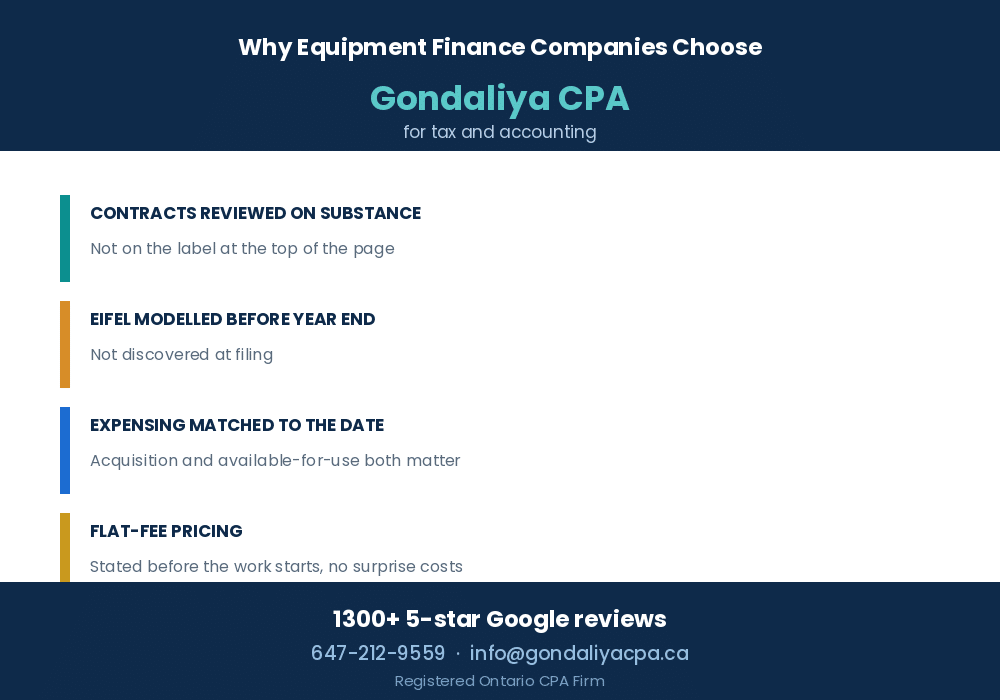
If you’re an incorporated lessor needing help with Canadian tax rules — including Ontario — Gondaliya CPA offers solid support backed by more than 1300 five-star Google reviews. Reach out at 647‑212‑9559 or email info@gondaliyacpa.ca for a free consultation.
Frequently Asked Questions
Frequently Asked Questions
FAQ
What is lease characterisation and why does it matter?+
Characterisation decides whether a contract is a true lease or a financing in substance. On a true lease the lessor owns the asset, claims CCA subject to the leasing property restriction, and reports rent. On a financing the lessee is treated as owner and the lessor reports interest on a receivable. It determines who claims the capital cost allowance.
How are origination fees and borrowing costs deducted?+
Standby charges, guarantee fees and loan arrangement fees are deducted over five years on a straight-line basis under paragraph 20(1)(e), accelerated if the debt is repaid early. They are not deducted in full in the year paid.
When should GST/HST be charged on lease payments?+
On each payment, on the earlier of the day it becomes due and the day it is paid, under subsection 168(2) of the Excise Tax Act. Delaying collection to the end of the lease leaves you under-remitting and liable for the tax.
What is the leasing property restriction?+
Regulation 1100(15) caps CCA on leasing property at the net rental income from that property, so a lessor cannot use it to create or increase a loss against other income. It applies to lessors, not lessees, and has carve-outs worth checking against your asset mix.
What is the EIFEL rule and does it apply to my company?+
Sections 18.2 and 18.21 limit net interest and financing expenses to a fixed ratio of 30% of adjusted taxable income, for tax years beginning on or after 1 October 2023. CCPC groups with taxable capital under $50 million are excluded, as are groups with $1 million or less of net interest. It is separate from thin capitalisation.
How is thin capitalisation different?+
Subsection 18(4) tests a 1.5 to 1 debt to equity ratio on debt owed to specified non-residents. It is a balance sheet test aimed at non-resident financing, whereas EIFEL is an earnings-based test that applies regardless of who lends.
Which CCA class does computer hardware go in?+
Class 50 at 55% for hardware and systems software acquired after 18 March 2007. Application software goes to Class 12 at 100%, subject to the half-year rule. Neither belongs in Class 8.
Does the half-year rule halve the purchase price?+
No. It halves the CCA claim in the first year the asset is available for use, not the cost of the asset. It is also suspended where the accelerated investment incentive or an immediate expensing measure applies.
Can I defer tax by trading in old equipment for new?+
Generally no. Canada has no like-kind exchange rule, and a trade is a disposition at fair market value recognised immediately. The replacement property rules in section 44 and subsection 13(4) offer limited relief where property is stolen, destroyed or expropriated, or where a former business property is replaced in time.
How do residual values and buyout options affect the tax position?+
Residual values affect the undepreciated capital cost and the gain or loss at lease end. A bargain option suggests the arrangement was a sale from the outset, affecting characterisation. A fair market value buyout is a separate taxable sale.
How are uncollectible leases deducted?+
Under paragraph 20(1)(p) once the amount is established to have become bad in the year and was previously included in income. A doubtful debt reserve under paragraph 20(1)(l) is available in the meantime, added back the following year.
When can CCA start on a newly delivered asset?+
Once the asset is available for use under the rules in subsections 13(26) to 13(32). Delivery alone is usually not enough — installation, commissioning and capability of producing a saleable output generally matter.
Professional Guidance and Quick Reference
Professional Guidance and Quick Reference
Guidance
Equipment finance companies get into difficulty in a predictable set of ways: contracts characterised by their label rather than their substance, CCA claimed without testing the leasing property restriction, interest deducted without testing EIFEL, and GST/HST charged at the rate in force at inception when the equipment has since moved provinces. Gondaliya CPA handles lessor accounting on a flat annual fee.
We handle what decides the outcome: reviewing each contract against the characterisation factors, applying the leasing property restriction and the section 16.1 election where it helps, tracing borrowed funds and modelling the EIFEL fixed ratio before it bites, matching acquisitions to the right immediate expensing window, and reconciling GST/HST by lease interval and province.
Quick Answers: Key Numbers & Concepts at a Glance
At a Glance
| Question | Answer |
|---|---|
| Interest deduction | Paragraph 20(1)(c), subject to tracing |
| Financing and arrangement fees | Paragraph 20(1)(e), over five years |
| EIFEL fixed ratio | 30% of adjusted taxable income |
| EIFEL exemption | CCPC group taxable capital under $50 million |
| Thin capitalisation | 1.5 to 1 debt to equity, specified non-residents |
| Leasing property restriction | Regulation 1100(15), capped at net rental income |
| Lease treated as a loan | Section 16.1 joint election |
| Half-year rule | Regulation 1100(2), halves the claim not the cost |
| Computer hardware | Class 50, 55% |
| M&P machinery | Class 53 before 2026, Class 43 after |
| GST/HST on lease payments | Subsection 168(2), earlier of due and paid |
| Place of supply | Schedule IX, by lease interval |
Who This Is For / Not For
Fit Check
- For: Incorporated Canadian equipment finance companies, lessors, vendor finance programs and captive finance arms, particularly those carrying leveraged books or leasing assets across provinces.
- Not For: Lessees looking only at their own deduction, whose position runs on lease payment deductibility rather than these lessor rules, and non-resident lessors with no Canadian establishment.
People Also Ask
Quick Answers
Is it better to lease or buy equipment for tax purposes in Canada?+
Neither is universally better. Buying gives you CCA and an interest deduction but ties up capital and defers the write-off across years unless an immediate expensing measure applies. Leasing gives a full deduction for each payment as incurred, which is simpler and often better for cash flow, but you never own the asset. The deciding factor is usually whether you can actually use the CCA in the year it arises.
Can a lessor claim CCA on equipment it leases out?+
Yes, but the leasing property restriction in Regulation 1100(15) caps the claim at the net rental income from that property. You cannot use it to create a loss against other income. Certain property is carved out, and a section 16.1 election can move the treatment to a financing instead.
Is equipment leasing subject to GST/HST in Canada?+
Yes. A lease of tangible personal property is a taxable supply of property, not an exempt financial service, so GST/HST applies to each lease payment. Only genuine interest on a financing is exempt, which is one reason the characterisation of the contract matters.
What happens if my equipment finance company exceeds the EIFEL threshold?+
Net interest and financing expenses above 30% of adjusted taxable income are denied in the year, though generally carried forward. Excess capacity can be carried forward or transferred within a group. The point is to model the ratio before year end rather than discover the denial at filing.
Do I need to charge a different GST/HST rate if leased equipment moves provinces?+
Potentially yes. Place of supply for leased tangible personal property is determined for each lease interval under Schedule IX, generally by where the property is ordinarily located for that interval. A machine relocated from Ontario to Alberta mid-lease can change the rate applying to later payments.
Glossary of Key Terms
Plain-English Definitions
- Lease characterisation: Deciding whether a contract is a true lease or a financing in substance, which determines who claims CCA.
- Leasing property restriction: Regulation 1100(15), capping a lessor’s CCA at net rental income from the leased property.
- Section 16.1 election: A joint election letting an arm’s length lessee and lessor treat a lease as a loan for tax purposes.
- EIFEL: The excessive interest and financing expenses limitation in sections 18.2 and 18.21, a 30% fixed ratio test.
- Thin capitalisation: The 1.5 to 1 debt to equity limit in subsection 18(4) on debt owed to specified non-residents.
- Available for use: The point at which CCA may begin, under subsections 13(26) to 13(32).
- Half-year rule: Regulation 1100(2), halving the first-year CCA claim where no accelerated measure applies.
- Accelerated investment incentive: An enhanced first-year allowance that also suspends the half-year rule, phasing down through 2027.
- Immediate expensing: A 100% first-year write-off on qualifying property within a defined acquisition window.
- Recapture: Previously claimed CCA brought back into income where proceeds exceed undepreciated capital cost.
- Terminal loss: The deduction where a class is emptied and undepreciated capital cost exceeds proceeds.
- Place of supply: The rules in Schedule IX determining which province’s GST/HST rate applies to each lease interval.
Essential Compliance Tips
Reference
- Always follow filing deadlines to avoid penalties and interest charges from CRA.
- Keep records for six years after the end of the taxation year under section 230.
- Separate rental income from interest income when reporting on T2 returns.
- Use detailed amortization schedules for all blended payments on leases and loans.
- Document all fees such as origination and documentation fees, and deduct them over five years.
- Apply the leasing property restriction carefully when claiming capital cost allowance.
- Charge GST/HST on each lease payment as it becomes due — do not delay collection.
- Track sale-leasebacks accurately to recognise taxable events on time.
- Model the EIFEL fixed ratio and, where relevant, thin capitalisation before year end.
- Prepare catch-up records promptly if accounting or tax reporting was delayed previously.
This quick self-check indicates where your book most likely has room. Please answer the five questions below.
Equipment Finance Tax Check
Five quick questions on your book. No fee shown.
Points to raise with us:
This is a general prompt, not tax or legal advice or a quote. Your position depends on your full facts. For a real review, please book a free consultation.
Characterise every contract on its substance before anything else, because that single decision moves the CCA claim between lessor and lessee. Test your CCA against the leasing property restriction, which caps it at net rental income and is the rule lessors most often miss. Trace borrowed funds, then model the EIFEL fixed ratio rather than assuming the deduction is safe. Deduct arrangement fees over five years, not in the year paid. And charge GST/HST on each lease payment as it becomes due, at the rate for that interval’s place of supply.
2026 Update — what is current: Bill C-15, the Budget 2025 Implementation Act, reinstated immediate expensing at 100% for Class 53 manufacturing and processing machinery, Class 43.1 and 43.2 clean energy equipment, and zero-emission vehicles in Classes 54, 55 and 56. Class 53 closed to acquisitions after 2025; M&P machinery acquired from 2026 falls into Class 43 at 30%, while remaining eligible for the expensing measures. Immediate expensing for productivity-enhancing assets in Classes 44, 46 and 50 covers property acquired on or after 16 April 2024 and available for use before 1 January 2027, and for M&P buildings acquired on or after 4 November 2025 and available for use before 2030. The government has also announced a proposed Productivity Mega Deduction extending permanent immediate expensing to a broad range of depreciable property; it is a proposal, so confirm its status before relying on it. Unchanged for 2026: the EIFEL fixed ratio of 30% and its $50 million taxable capital exemption, thin capitalisation at 1.5 to 1, the leasing property restriction, the five-year deduction for financing fees, and the six-year record retention requirement.
Equipment Finance Tax Planning: How Gondaliya CPA Supports You
Leveraged book, or leasing across provinces?
We review each contract against the characterisation factors, apply the leasing property restriction and the section 16.1 election where it helps, trace borrowed funds and model the EIFEL ratio before year end, match acquisitions to the right expensing window, and reconcile GST/HST by lease interval — on a flat annual fee stated before the work starts.
Next Steps
Please book a free consultation with Gondaliya CPA and bring your last filed corporate return, a sample of lease agreements across your product types, and a schedule of borrowings with drawdown dates. Those three show where the real position sits. You will get a flat fee stated before any work begins.
Published: · Last updated:
Editorial policy: Figures, deadlines and statutory references are verified against the Income Tax Act, the Excise Tax Act, their Regulations and CRA publications before publication, and updated when the rules change. Capital cost allowance and immediate expensing measures have changed repeatedly since 2024, so the acquisition date governs.
Disclaimer: This article is educational information only and is not tax, legal, or financial advice. Rules change and outcomes depend on your specific facts. Please speak with a CPA before acting.

Sharad Gondaliya is a CPA Canada & CPA USA with 15 Years+ experience of Accounting, Tax, Payroll of Corporate Small Businesses as Tax Accountant. He is fully certified CPA Ontario and CPA USA and is well known among corporate small businesses for tax planning, efficient tax solutions, and affordable CPA services. Sharad is the Principal (Director) of Gondaliya CPA – Affordable CPA Firm in Canada. Licenses: CPA Ontario: 61040184 | CPA USA (MT): PAC-CPAP-LIC-033176 | CPA USA (WA): 57629 | CPA Firm License: 61330051 View Full Author Bio