



Wedding Venue Tax Planning in Canada: Deposits, Cancellations, Seasonal Revenue & Cash Flow
Wedding venue tax planning Canada requires careful management of accounting, cash flow, and tax strategies to optimize business expenses and revenue recognition. Gondaliya CPA provides expert guidance on wedding venue bookkeeping, cancellation revenue, seasonal income, and tax deductions to support venue owners in Canada.
Quick Summary
Money arrives eighteen months before the event and sometimes never becomes an event at all. Both halves of that carry rules venues routinely get wrong.
- Deposits are income on receipt, deferred by the 20(1)(m) reserve.
- A forfeited deposit is deemed to include GST/HST under ETA s.182.
- No GST/HST arises on a deposit until it is applied or forfeited.
- Food and drink you sell is cost of goods sold, not a 50% meals item.
Reading time: 30 minutes.
Table of Contents
- Wedding Venue Tax Planning and Accounting Challenges in Canada
- Core Wedding Venue Tax and Accounting Services
- Wedding Venue Cash Flow Management Strategies
- How We Work with Wedding Venues at Gondaliya CPA
- Client Success Stories and Testimonials
- Additional Resources and Contact Information
- Frequently Asked Questions
- Essential Insights and Quick Reference
The Numbers That Matter
This article covers Canada, with Ontario and Toronto context, and reflects rules current to 18 September 2026. It is written for incorporated wedding venues, banquet halls, estates, barns and similar event properties. Provincial liquor licensing, consumer protection rules on deposits and municipal event permits vary and are outside its scope. This is educational information only and not tax or legal advice.
Wedding Venue Tax Planning and Accounting Challenges in Canada
Tax Planning and Accounting Challenges
Foundations
Deposits for future weddings are brought into income when received under paragraph 12(1)(a), because they are amounts received for services not yet rendered. The deferral comes from claiming the reserve in paragraph 20(1)(m), not from leaving the money off the return.
GST/HST runs on a different track. Under subsection 168(9) of the Excise Tax Act, a deposit is not consideration until the supplier applies it against the price, so no tax arises when it is taken.
Risk Warning: When a couple cancels and you keep the deposit, section 182 of the Excise Tax Act treats the amount you retain as already including GST/HST. You do not charge tax on top — you remit the tax out of what you kept, at 13/113 in Ontario. On a forfeited $5,000 deposit that is roughly $575 owing to CRA. A venue that books the full $5,000 as revenue and remits nothing has understated net tax on every cancellation it has ever had.
How Proper Tax and Cash Flow Management Supports Wedding Venue Success
Revenue arrives in a narrow season while costs run all year. Instalments should be planned against that curve, and deposit timing managed so cash is available through the quiet months.
Booking and cancellation history is the most useful forecasting input you have, because it tells you both what is coming and what share of it historically does not.
Key Benefits of Specialized Accounting Services for Wedding Venues
Clean bookkeeping reduces audit exposure because every deposit, application and forfeiture is traceable. A licensed CPA firm can also test whether the reserve you are claiming is supported by the bookings behind it.
Core Wedding Venue Tax and Accounting Services
Core Tax and Accounting Services
Core
Accurate Handling of Booking Deposits and Deferred Revenue Recognition
A deposit is included in income when received under paragraph 12(1)(a). You then claim a reserve under paragraph 20(1)(m) for the amount reasonably regarded as relating to services still to be provided after year-end. The reserve is added back to income the following year and re-claimed if the event still has not happened.
The reserve is not automatic and cannot be recovered later if a year is missed. To support it:
- Keep booking schedules listing every deferred event and its date
- Record each event date against your fiscal year-end
- Add released reserves back into income as events are completed
A barn venue near Toronto held $30,000 of deposits at 31 December for weddings booked through the following year. The full $30,000 was included in income, and a $25,000 reserve was claimed for the events still to be delivered, supported by signed contracts and dates. As each wedding took place, that portion came back into income. Figures changed for privacy.
Managing Cancellation Revenue and Tax Implications Under Canadian Tax Law
A forfeited deposit and a separately charged cancellation fee are both income when the right to them arises, and neither is deferrable by reserve because nothing further is owed to the client.
| Event | Income tax | GST/HST |
|---|---|---|
| Deposit received | Included on receipt, 12(1)(a); reserve under 20(1)(m) | No tax until applied, ETA s.168(9) |
| Deposit applied to the final invoice | Reserve released into income | Tax accounted for on the supply |
| Deposit forfeited on cancellation | Income; no reserve available | Deemed tax-inclusive, ETA s.182 — remit 13/113 |
| Cancellation fee for breach of contract | Income | Deemed tax-inclusive, ETA s.182 |
| Deposit refunded in full | No income | No tax; adjust with a credit note under s.232 if tax was accounted for |
GST/HST Compliance for Deposits, Service Charges, and Forfeited Fees
The deposit rule sits in subsection 168(9), not 168(1). Subsection 168(1) is the general timing rule that tax is payable on the earlier of the day consideration is paid and the day it becomes due.
On service charges: a mandatory service charge you add to the invoice is part of the consideration for the supply and is taxable, whatever you do with it afterwards. A voluntary gratuity a guest chooses to add is not consideration and carries no tax.
Payroll Setup and Event Staff Compensation Including WSIB and T4 Filing
| Remitter Type | Average Monthly Withholding | Due |
|---|---|---|
| Regular | Under $25,000 | 15th of the month following |
| Accelerated, Threshold 1 | $25,000 to under $100,000 | Twice monthly |
| Accelerated, Threshold 2 | $100,000 or more | Within three working days of the pay period ending |
Most single-site venues are regular remitters paying by the 15th. The three-working-day rule applies only at $100,000 or more of average monthly withholding.
Controlled tips — amounts you collect and distribute, including mandatory service charges paid on to staff — are pensionable and insurable and run through payroll onto the T4. Direct tips handed to a server are the employee’s income to report but are generally not pensionable or insurable. Contractors receive a T4A where required, with status decided on control, tools, chance of profit and risk of loss.
Workplace safety coverage is provincial. In Ontario, WSIB registration obligations depend on the industry classification of the business, and should be confirmed with WSIB rather than assumed.
Property Asset Classification, Capital Cost Allowance Claims, and Incorporation Advantages
| Asset Type | CCA Class | Rate |
|---|---|---|
| Buildings and barn conversions | Class 1 | 4%, with 6% or 10% enhanced rates where eligible |
| Furniture, equipment, tents and marquees | Class 8 | 20% |
| Leasehold improvements | Class 13 | Straight line, lease term plus first renewal, 5 to 40 years |
| Vehicles | Class 10 | 30%, subject to the passenger vehicle ceiling where applicable |
| Computers and systems software | Class 50 | 55% |
| Driveways, parking areas and walkways | Class 17 | 8% |
Note two points the industry commonly gets wrong: tents are Class 8, not Class 10, which is automotive equipment; and an addition to a building, such as putting washrooms into a barn, follows the building into Class 1 rather than Class 17, which covers surfaces.
Repairs that restore are current under paragraph 18(1)(a); work improving the property beyond its original condition is capital under paragraph 18(1)(b).
Risk Warning: Where an owner lives on the property, the personal portion must be carved out on a defensible basis — floor area, or floor area weighted by use. Where the corporation bears personal costs of a shareholder, subsection 15(1) includes the value in that shareholder’s income and the corporation gets no deduction for it. On an estate property with a residence attached, that asymmetry is the expensive part: the benefit is taxed once with nothing to offset it.
Customized Financial Reporting and Bookkeeping for Seasonal Income Cycles
Separate deposits held from revenue earned in the ledger, so the reserve calculation falls out of the books rather than being reconstructed at year-end. Quarterly reporting against the instalment schedule keeps the cash position visible in a business that earns most of its money in five months.
Reconcile monthly, matching bank deposits to bookings and event dates. Compilation engagements are performed under CSRS 4200 and express no assurance; limited assurance requires a review engagement.
Transparent Pricing Models and What Our Packages Include
Our flat annual fee, quoted before work begins, covers bookkeeping, deposit and reserve working papers, cancellation review, package allocation across rental, catering and bar, payroll setup, and the trial balance and T2 filing.
Wedding Venue Cash Flow Management Strategies
Cash Flow Management Strategies
Cash Flow
Revenue falls away in the off-season while fixed costs continue. Matching instalments to the deposit and final-payment curve smooths the year, and getting the deposit treatment right keeps taxable income aligned with when events actually happen.
Tracking and Controlling Expenses: From Fixed Costs to Decoration and Unexpected Fees
Utilities, insurance, wages, marketing, decorations, repairs and licences are deductible where incurred to earn income. Insurance paid in advance is caught by subsection 18(9): the portion relating to the following year is deducted in that later year.
Fixed costs are recorded as they accrue. Unexpected costs such as emergency equipment rental are recorded when incurred, not when paid.
Revenue Segmentation: Differentiating Catering, Bar, and Event Income Streams
| Revenue Component | Recognition | GST/HST |
|---|---|---|
| Venue rental | As supplied | Taxable at the place-of-supply rate |
| Catering Services | As delivered | Taxable; food sold to customers is cost of goods sold, not a 50% item |
| Bar Sales | At point of sale | Taxable; provincial liquor levies apply separately |
| Mandatory service charge | With the supply | Taxable as part of consideration |
| Voluntary gratuity | Not consideration | No tax |
Pro Tip: Splitting the package matters less for the rate — rental, catering and bar are all taxable at the same rate — and more for everything else. It drives your cost of goods sold, your margin by line, your liquor reporting, and the reserve calculation where only part of a package remains undelivered at year-end. Liquor licensing does not affect deductibility; what it affects is the separate provincial levy and your reporting obligations. Build the split into the invoice template rather than reconstructing it later.
Tax Planning Techniques to Minimize Liability and Optimize Profit Retention
Deposit income is reported on receipt with the reserve claimed where services remain undelivered. Forfeited deposits and cancellation fees are income when retained, with the GST/HST consequence under section 182.
A cancellation fee you receive is business income. It is not a fine or penalty — section 67.6 denies a deduction for fines and penalties a taxpayer pays, and has no bearing on amounts you collect.
On losses: a non-capital loss can be carried back three years and forward twenty years, not indefinitely. Net capital losses carry back three years and forward indefinitely, against capital gains only.
Input tax credits require documentation meeting the Input Tax Credit Information Regulations under section 169, including the supplier’s registration number.
Reinvestment Strategies to Support Venue Growth and Maintain Profitability
Distinguish capital from current. Renovations adding value go into the class and are recovered over time; routine repairs reduce income now.
| Measure | Effect on a 2026 purchase |
|---|---|
| Half-year rule, Regulation 1100(2) | Normally halves the first-year claim |
| Reaccelerated Investment Incentive | Suspends the half-year rule for eligible property acquired after 31 December 2024 and available for use before 2034 |
| Productivity-enhancing assets | Classes 44, 46 and 50 acquired on or after 16 April 2024 and available for use before 1 January 2027 may be written off at 100% |
Where an owner’s residence forms part of the property, the allocation determines how much of each cost is a business expense. Small business deduction eligibility depends on earning active business income; a venue letting space passively with few services and five or fewer full-time employees risks being a specified investment business under subsection 125(7), which would remove the deduction entirely.
How We Work with Wedding Venues at Gondaliya CPA
How We Work with Wedding Venues
Process
Step 1: Comprehensive Document Collection and Initial Assessment
We collect deposit receipts, contracts showing event dates and services, journal entries and reconciliations, then test that the reserve claimed under paragraph 20(1)(m) matches the outstanding booking obligations.
Step 2: Setup and Cleanup of Accounting Records Tailored for Venues
Where books are behind, we match deposits against bookings, rebuild the deferred position, and prepare a corrected trial balance. Compilation reports are prepared under CSRS 4200.
Step 3: Monthly Close Process and Regular Financial Review
Each month we confirm income is recorded against event schedules and adjust the deferred position as weddings occur or cancel, so the year-end reserve is a rollforward rather than a reconstruction.
Step 4: Quarterly Tax Planning and Compliance Monitoring
We monitor instalments against the seasonal curve and check the GST/HST position on deposits, applications and forfeitures. Late GST/HST filing attracts the section 280.1 penalty of 1% of the amount owing plus 0.25% per complete month, to a maximum of 12 months — not a daily charge.
Step 5: Year-End Financial Statements Preparation and Tax Filing
We prepare statements under ASPE and file the T2 within six months of fiscal year-end. The balance of tax is due two months after year-end, or three for a CCPC claiming the small business deduction.
Late T2 filing costs 5% of the unpaid tax plus 1% per complete month to a maximum of 12, under subsection 162(1). Year-end deliverables cover deposit treatment, cancellations, capital cost allowance, payroll slips and the GST/HST reconciliation.
Client Success Stories and Testimonials
Client Success Stories
Case Studies
Case Study 1: Resolving Deposit Accounting Errors to Comply with CRA Requirements
A Toronto venue had treated every deposit as deferred income and never brought it into the return, so no reserve was ever claimed. Roughly $120,000 across several years sat outside income. We brought deposits into income under paragraph 12(1)(a) and claimed the reserve under 20(1)(m) only for events still to be delivered, supported by booking schedules. Figures changed for privacy.
The correction also fixed the GST/HST position under subsection 168(9), and identified forfeitures that should have been treated as tax-inclusive under section 182.
Case Study 2: Optimizing GST/HST Filing on Cancellation Revenues
An estate venue near Ottawa recorded cancellations inconsistently, sometimes as non-taxable refunds and sometimes not at all, across roughly $45,000 a year of forfeited deposits and fees. We separated refunds from retained amounts and applied section 182 to the retained ones, remitting the embedded tax. On $45,000 retained, that is about $5,177 of HST in Ontario that had not been remitted. Figures changed for privacy.
Case Study 3: Property Structuring for Maximizing Small Business Deduction Benefits
A banquet hall near Mississauga occupied a property with both a residence and event space. We allocated utilities, interest, insurance and grounds care by floor area weighted for use, assigned assets to Class 1, Class 8 and Class 10, and reviewed salary against dividends alongside shareholder loan balances before year-end. Figures changed for privacy.
Client Testimonials Highlighting Service Quality, Responsiveness, and Results
- “Gondaliya CPA changed how we see booking deposits’ tax impact — we finally feel compliant.” — Banquet Hall Owner, Vaughan
- “They answer questions within one business day — huge help meeting tight deadlines.” — Estate Venue Manager, Guelph
- “Their planning saved us thousands by breaking down packages into taxable parts.” — Winery Event Coordinator, Niagara Region
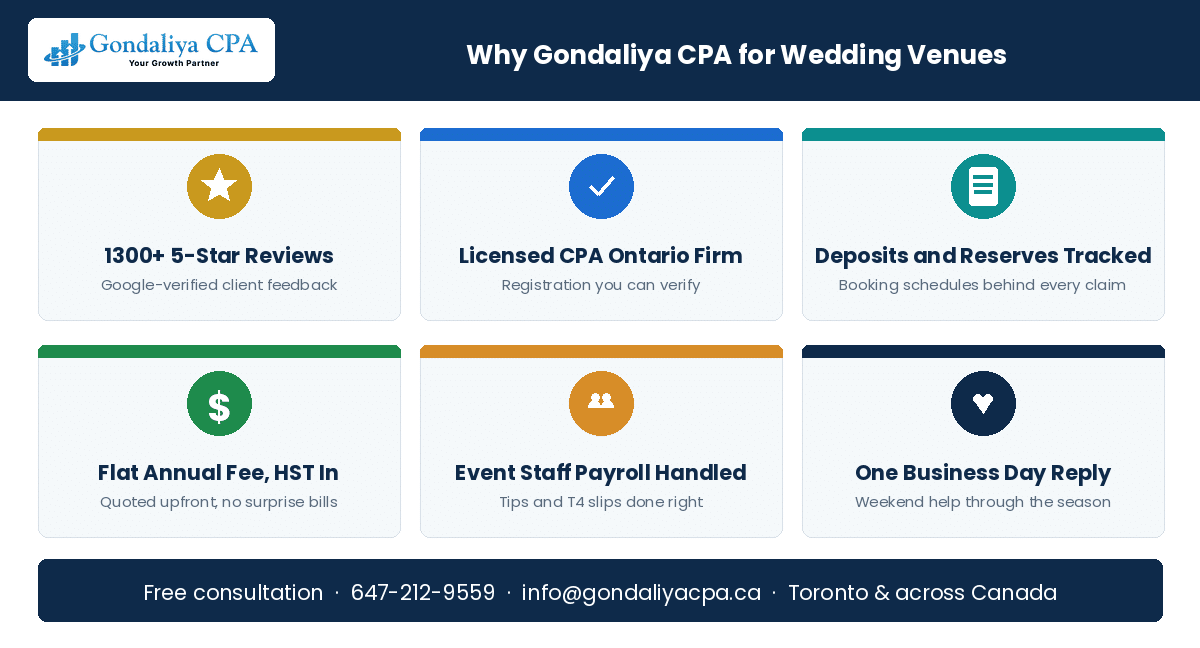
Over 1300 five-star Google reviews, with clear pricing and weekend support through the busy season.
Professional Credentials and Accreditations Supporting Our Expertise
- Registered Ontario CPA firm, verifiable on the CPA Ontario public firm directory
- CPA in Canada and the United States, licensed in Washington and Montana, supporting cross-border questions
- 15+ years advising incorporated small and medium businesses in hospitality and event property
Additional Resources and Contact Information
Additional Resources and Contact Information
Resources
Common Questions About Wedding Venue Taxes, Incorporation, and Deductible Expenses
Deposits are reported when received, with a reserve under paragraph 20(1)(m) where services remain undelivered at year-end. Forfeited deposits are income in the year retained, with GST/HST embedded under section 182.
Incorporation gives limited liability and access to the small business deduction on active business income, provided the operation is genuinely a service business rather than passive property rental.
Related Industries Served: Event Venues, Banquet Halls, and Audio Visual Providers
The same rules apply to banquet halls and audio visual suppliers working weddings:
- No GST/HST on a deposit until applied or forfeited
- Forfeited amounts and breach payments deemed tax-inclusive under section 182
- Bundled packages itemised so cost of goods sold and margins are visible
Contact Details: Office Locations in Ontario, Phone Numbers, Email, and Business Hours
Gondaliya CPA is a licensed Ontario firm serving Toronto, Etobicoke, Vaughan, Mississauga, Brampton, Scarborough, Ottawa, Oshawa, Guelph, Hamilton, North York and Windsor, working with incorporated venues including barns, estates, banquet halls, resorts, wineries, golf clubs and outdoor tented properties.
- Phone: 647‑212‑9559
- Email: info@gondaliyacpa.ca
- Business hours: Monday to Friday, 8:30 AM to 6 PM; weekend and evening support by appointment
We reply within one business day.
Interactive Deposit and Tax Readiness Checklist to Assess Your Venue’s Compliance
| Checklist Item | Description |
|---|---|
| Deposit income recognition | Deposits included in income when received, ITA 12(1)(a) |
| Reserve support | Reserve limited to services still to be delivered, ITA 20(1)(m), with booking schedules behind it |
| Reserve claimed annually | Not recoverable if a year is missed |
| GST/HST on deposits | No tax until applied or forfeited, ETA s.168(9) |
| Forfeitures | Tax extracted at 13/113 under ETA s.182, not added on top |
| Package allocation | Rental, catering and bar split on the invoice |
| Personal use | Allocated, with shareholder benefit considered under s.15(1) |
| Records | Six years from the end of the taxation year |
Frequently Asked Questions on Wedding Venue Tax Planning Canada
Frequently Asked Questions
FAQ
What is the Capital Cost Allowance and which classes apply to wedding venues?+
CCA recovers the cost of capital property over time. The classes that matter here are 1 for buildings at 4%, 8 for furniture, equipment and tents at 20%, 10 for vehicles at 30%, 13 for leasehold improvements, 17 for driveways and parking at 8%, and 50 for computers at 55%.
When is the payroll source deduction remittance deadline?+
It follows your average monthly withholding amount. Under $25,000 you remit by the 15th of the following month. From $25,000 it is twice monthly, and at $100,000 or more within three working days of the pay period ending.
What is the corporate tax T2 filing deadline?+
Six months after fiscal year-end. The balance of tax is due earlier, two months after year-end or three for a CCPC claiming the small business deduction.
How long must statutory records be retained?+
Six years from the end of the last taxation year to which the records relate, under subsection 230(4), and longer where an objection or appeal is outstanding.
What penalties apply for late filings?+
Late T2: 5% of unpaid tax plus 1% per complete month, maximum 12, under subsection 162(1). Late GST/HST: 1% plus 0.25% per complete month under section 280.1. Late slips: $10 per day, $100 minimum, $1,000 maximum for 1 to 50 slips. Late payroll remittance: 3% to 10% by days late, 20% on repeat.
How should I prepare a booking schedule for tax purposes?+
List every confirmed booking with the event date, contract value, deposits received and amounts still to be delivered at year-end. That schedule is what supports the reserve under paragraph 20(1)(m) if it is questioned.
What is a retainer in wedding venue accounting?+
An upfront amount securing the date. For income tax it is included when received; for GST/HST the treatment depends on whether it is a true deposit under subsection 168(9) or a payment on account, which is why the contract wording matters.
How does bundled supply affect GST/HST on wedding packages?+
Rental, catering and bar are all taxable at the same rate, so bundling rarely changes the tax itself. Itemising matters for cost of goods sold, margin by line, liquor reporting and the reserve where only part of a package is undelivered.
What constitutes a shareholder benefit in venue operations?+
Value conferred on an owner or a non-arm’s length person, such as personal occupation of part of the property or a family event held at no charge. It is included in that person’s income under subsection 15(1), with no offsetting deduction to the corporation.
Can losses from previous years be carried over?+
Non-capital losses carry back three years and forward twenty years — not indefinitely. Net capital losses carry back three years and forward indefinitely, but only against capital gains.
How do input tax credits (ITCs) work for wedding venues?+
You recover GST/HST paid on inputs to commercial activity, with documentation meeting the Input Tax Credit Information Regulations under section 169. Claim within four years, or two years where annual taxable supplies exceed $6 million.
Are staff service charges and gratuities reportable as income?+
A mandatory service charge is part of your consideration, taxable for GST/HST, and where paid on to staff it is a controlled tip running through payroll onto the T4. A voluntary gratuity given directly to a server is the employee’s income to report and is generally not pensionable or insurable.
Should I pay myself salary or dividends before year-end?+
Salary creates RRSP room and CPP entitlement and reduces corporate income; dividends do neither but avoid payroll administration. Review the mix annually alongside shareholder loan balances, which must be repaid within one year of the year-end in which they arose to avoid subsection 15(2).
Do I charge GST/HST when a couple forfeits their deposit?+
You do not add tax on top. Section 182 of the Excise Tax Act deems the amount you retain to already include GST/HST, so you remit the embedded portion — 13/113 in Ontario. On a $5,000 forfeited deposit, roughly $575 is owing.
Can I claim the reserve on a deposit that was forfeited?+
No. The reserve under paragraph 20(1)(m) is for amounts relating to services still to be delivered. Once the booking is cancelled and you keep the money, nothing is owed to the client and the full amount is income that year.
Essential Insights: Managing Your Wedding Venue Taxes with Gondaliya CPA
Essential Insights and Quick Reference
Reference
- Statements, filings and penalties: file T2 and GST/HST on time; issue slips by the last day of February.
- Plan it yourself or use a CPA firm: the reserve, section 182 and the personal use allocation are where professional input pays.
- Triggers of CRA reviews: deposits absent from income, reserves without booking schedules, forfeitures with no tax remitted.
- Catching up: reconcile deposits against bookings first, then rebuild the deferred position and the reserve.
- Seasonal practice: match recognition to event dates, hold reserves for the quiet months, reconcile monthly.
- Deliverables: trial balance, working papers, statements, payroll slips and filed returns.
- Top mistakes: leaving deposits out of income, missing the reserve, treating forfeitures as tax-free, ignoring the personal portion.
- Preparation: contracts, booking schedules, deposit records, invoices and payroll data.
- Key decisions: property classification, expense allocation, income timing, incorporation, compensation, ITCs, payroll, reserves, audit readiness, cash flow.
Quick Answers: Key Numbers & Concepts at a Glance
At a Glance
| Question | Answer |
|---|---|
| Deposit for income tax | Included on receipt, ITA 12(1)(a) |
| Deferring it | Reserve under 20(1)(m), claimed annually |
| Deposit for GST/HST | Not consideration until applied, ETA s.168(9) |
| Forfeited deposit | Deemed tax-inclusive, ETA s.182 — 13/113 in Ontario |
| Cancellation fee received | Income; not a fine, s.67.6 does not apply |
| Mandatory service charge | Taxable consideration; controlled tip on the T4 |
| Voluntary gratuity | Not consideration; no tax |
| Buildings and barn conversions | Class 1, 4% |
| Tents, furniture, equipment | Class 8, 20% — not Class 10 |
| Driveways and parking | Class 17, 8% |
| Half-year rule | Suspended for property acquired after 2024 |
| Non-capital losses | Back 3 years, forward 20 years |
| Payroll remittance | 15th of the following month under $25,000 AMWA |
| Record retention | Six years, ITA s.230(4) |
Who This Is For / Not For
Fit Check
- For: Incorporated wedding venues, banquet halls, estates, barns and tented properties taking deposits well ahead of events and running catering or bar service.
- Not For: Operators seeking advice on provincial liquor licensing or consumer protection rules governing deposit refunds, which are legal rather than tax questions, and pure property landlords letting space with no services, whose position runs on the specified investment business rules instead.
People Also Ask
Quick Answers
Do wedding venues charge GST/HST on deposits?+
Not when the deposit is taken. Subsection 168(9) provides that a deposit is not consideration until the supplier applies it against the price. Tax is accounted for when it is applied — or, if the booking is cancelled and you keep the money, under section 182 instead.
Is a forfeited wedding deposit taxable?+
Yes, twice over. It is business income in the year you keep it, with no reserve available because nothing is owed to the client. And section 182 deems it to include GST/HST, so you remit 13/113 of it in Ontario rather than treating the whole amount as yours.
When can a wedding venue claim a reserve on deposits?+
Where the amount relates to services still to be delivered after year-end, under paragraph 20(1)(m), supported by booking schedules showing event dates. It is added back the following year and re-claimed if the event still has not occurred, and a year missed cannot be recovered.
Which CCA class do event tents and marquees go in?+
Class 8 at 20%, as equipment not described in another class. Class 10 is automotive equipment and does not apply. Adding washrooms or similar structure to a barn follows the building into Class 1.
What happens if the owner lives at the venue?+
The personal portion is carved out of every shared cost on a defensible basis such as floor area. Where the corporation bears personal costs, subsection 15(1) includes the value in the shareholder’s income and the corporation gets no deduction — the benefit is taxed with nothing to offset it.
Glossary of Key Terms
Plain-English Definitions
- Deposit: An amount securing a date, not consideration until applied, ETA s.168(9).
- Forfeited deposit: An amount retained on cancellation, deemed to include tax under ETA s.182.
- Paragraph 12(1)(a): The rule including prepaid amounts for services not yet rendered in income.
- Paragraph 20(1)(m): The reserve deferring the undelivered portion.
- Controlled tip: An amount the employer collects and distributes, pensionable and insurable.
- Bundled package: Rental, catering and bar sold together, itemised for costing and reserves.
- Shareholder benefit: Value conferred on an owner, taxed under subsection 15(1) with no deduction.
- Class 8: The 20% class covering tents, furniture and equipment.
- Non-capital loss: A business loss carried back three years and forward twenty.
This quick self-check indicates where your venue most likely has room. Please answer the five questions below.
Wedding Venue Tax Check
Five quick questions on your business. No fee shown.
Points to raise with us:
This is a general prompt, not tax or legal advice or a quote. Your position depends on your full facts. For a real review, please book a free consultation.
Two halves, two different rules. On the way in, a deposit is income the day it arrives and only a claimed 20(1)(m) reserve pushes it out again, so the booking schedule is the working paper that matters most. On the way out, a forfeited deposit is worse than it looks: it is income with no reserve available, and section 182 treats what you kept as already containing the tax, so 13/113 of it belongs to CRA in Ontario. Then keep the ordinary things straight — tents are Class 8, an addition to the barn follows the building into Class 1, and the portion of the property an owner lives in is carved out before anything else is claimed.
2026 Update — what is current as at 18 September 2026: First-year capital cost allowance has changed, which matters for venues renovating between seasons. Bill C-15 received Royal Assent on 26 March 2026, introducing the Reaccelerated Investment Incentive for property acquired after 31 December 2024, which suspends the half-year rule for eligible property available for use before 2034. Additions to Classes 44, 46 and 50 acquired on or after 16 April 2024 and available for use before 1 January 2027 qualify for immediate expensing at 100%. On 15 September 2026 Finance released draft legislation for a Productivity Mega Deduction extending permanent immediate expensing to a broad range of property acquired and available for use after 14 September 2026; it remains a proposal. Unchanged for 2026: inclusion of deposits under paragraph 12(1)(a) with the reserve under 20(1)(m); the deposit rule in ETA subsection 168(9); the tax-inclusive treatment of forfeited deposits and breach payments under ETA section 182; shareholder benefits under subsection 15(1); the twenty-year carryforward for non-capital losses; payroll remitter thresholds at $25,000 and $100,000; slips by the last day of February; the T2 six-month deadline with the 162(1) penalty; and six-year record retention under subsection 230(4).
Wedding Venue Tax Planning: How Gondaliya CPA Supports You
Deposits on the books and a cancellation file nobody has looked at?
We rebuild the deposit and reserve position from your booking schedules, test every forfeiture against section 182 and remit what is owed, split packages across rental, catering and bar, allocate the owner-occupied portion defensibly, plan instalments against your season, and prepare the T2, GST/HST and payroll filings — on a flat annual fee stated before the work starts.
Next Steps
Please book a free consultation with Gondaliya CPA and bring your last filed corporate return, a booking schedule showing deposits held against event dates around your year-end, and a list of cancellations where you kept the deposit. Those three settle the reserve and the section 182 exposure in one sitting. You will get a flat fee stated before any work begins.
Published: · Last updated:
Editorial policy: Figures, classes and statutory references are verified against the Income Tax Act, the Excise Tax Act, their Regulations and CRA publications before publication, and updated when the rules change.
Disclaimer: This article is educational information only and is not tax, legal, or financial advice. Provincial liquor licensing and consumer protection rules on deposits are outside its scope. Please speak with a CPA before acting.

Sharad Gondaliya is a CPA Canada & CPA USA with 15 Years+ experience of Accounting, Tax, Payroll of Corporate Small Businesses as Tax Accountant. He is fully certified CPA Ontario and CPA USA and is well known among corporate small businesses for tax planning, efficient tax solutions, and affordable CPA services. Sharad is the Principal (Director) of Gondaliya CPA – Affordable CPA Firm in Canada. Licenses: CPA Ontario: 61040184 | CPA USA (MT): PAC-CPAP-LIC-033176 | CPA USA (WA): 57629 | CPA Firm License: 61330051 View Full Author Bio