



Land Surveying Company Tax Planning in Canada: Strategies to Manage Income, Equipment & Business Taxes
Land surveying company tax planning Canada: equipment classes, income timing and GST/HST
Land surveying company tax planning Canada requires careful attention to deductions, GST/HST rules, and income reporting to reduce liabilities legally. Gondaliya CPA offers expert advice on managing land surveying business taxes Canada while ensuring compliance with Canadian tax laws.
Quick Summary
A surveying firm’s tax position turns on three things: which CCA class each instrument actually belongs in, when a job becomes income rather than work in progress, and whether a trade-in was recorded at fair market value. The equipment classes are where the largest errors live.
Reading time: 43 minutes.
Table of Contents
- Tax Obligations for Surveying Businesses
- Equipment, CCA Classes and Trade-Ins
- Income Reporting and Work in Progress
- Deductions, Vehicles and Limits
- GST/HST Compliance and Filing
- Payroll, Remitters and Crew Status
- Tax Strategies to Optimize Cash Flow
- Record-Keeping Best Practices
- Regulatory Framework and Land Use
- Our Approach and Audit Readiness
- Frequently Asked Questions
- Quick Answers, Glossary and Next Steps
The Numbers That Matter
This guide covers Canada, with Ontario and Toronto context, and reflects rules current to 2026. It is written for incorporated Canadian land surveying firms — boundary surveys, construction layout, drone mapping, laser scanning and legal survey work. Figures marked illustrative are examples rather than quotes, and masked engagement notes end with “Figures changed for privacy.” Worked examples assume an Ontario CCPC within the small business limit. CCA classification depends on the specific asset and its use, so confirm each item rather than applying a class by category. This is educational information only and not tax or legal advice.
Tax Obligations for Land Surveying Businesses in Canada
Tax Obligations for Surveying Businesses
Foundations
Land surveying companies in Canada face several tax rules. These rules help keep the business legal and manage money well. Here are the main points to know:
- GST/HST registration threshold: You must register once taxable supplies exceed $30,000 over four consecutive calendar quarters, or in a single calendar quarter. The single-quarter test ends small supplier status immediately on the supply that crosses it, with registration required within 29 days.
- Meals and entertainment, section 67.1: This provision limits the deduction for food, beverages and entertainment to 50%. The general reasonableness limit on all expenses is section 67, which is a separate rule.
- T2 corporate tax filing deadline: Incorporated survey firms have six months after their fiscal year ends to file the T2 return. Payment is due earlier — two months after year-end, or three months for an eligible CCPC claiming the small business deduction.
- Payroll remittance deadlines: Employers must send payroll deductions like CPP, EI, and income tax by set dates. Those dates depend on your remitter type, which CRA assigns from your average monthly withholding amount.
What a late T2 actually costs
The penalty is formula-driven rather than a flat fee. Under subsection 162(1) it is 5% of the unpaid tax at the deadline plus 1% per complete month the return is late, capped at twelve months — a maximum of 17%. Where CRA has demanded the return and a penalty was assessed in one of the three preceding years, subsection 162(2) doubles it to 10% plus 2% per month to twenty months.
| Unpaid tax at the deadline | Six months late | Twelve months or more late |
|---|---|---|
| $20,000 | $2,200 | $3,400 |
| $60,000 | $6,600 | $10,200 |
| $120,000 | $13,200 | $20,400 |
Interest runs separately at the prescribed rate plus four percentage points, compounded daily, and it has no ceiling. A separate $250 penalty exists under subsection 162(7.2) for failing to file electronically where mandatory electronic filing applies — that is a different charge from the late-filing penalty and does not replace it.
Note that the payment deadline falls months before the filing deadline. A firm that files on time with the balance unpaid still accrues interest from the earlier date, and the late-filing penalty is calculated on the tax unpaid at the filing deadline. Diarise the two dates separately.
Equipment, CCA Classes and Trade-Ins
Equipment, CCA Classes and Trade-Ins
The Assets
A surveying firm’s balance sheet is mostly instruments, and instruments are where the largest tax errors in this sector live. Getting an asset into the wrong class does not merely shift timing — it produces a claim that reverses on reassessment with interest attached.
Where surveying assets actually sit
| Asset | Class | Rate | Note |
|---|---|---|---|
| Total stations, GNSS receivers, levels, tripods | Class 8 | 20% declining balance | General equipment not listed in a more specific class |
| Survey drones and payload sensors | Class 8 | 20% | Equipment, not manufacturing machinery |
| Laser scanners | Class 8 | 20% | Same treatment as other field instruments |
| Computers, data collectors, tablets | Class 50 | 55% | General-purpose electronic data processing equipment |
| Application software | Class 12 | 100% | Subject to the half-year rule, unlike most Class 12 |
| Systems software | Class 50 | 55% | Travels with the hardware |
| Tools costing under $500 each | Class 12 | 100% | Exempt from the half-year rule |
| Field trucks at or below the ceiling | Class 10 | 30% | Pooled; terminal loss available |
| Passenger vehicles above the ceiling | Class 10.1 | 30% | Separate class each; no terminal loss |
Class 53 does not appear on that list, and it should not appear on yours. Class 53 covers machinery and equipment used primarily in the manufacturing or processing of goods for sale or lease, acquired after 2015 and before 2026. A drone that photographs a parcel boundary is not manufacturing equipment. Property that would have fallen in Class 53 and is acquired after 2025 moves to Class 43 at 30%.
What the wrong class costs
Take $80,000 of survey drones acquired in 2026 and available for use the same year, with the accelerated investment incentive applying.
| Treatment | Rate | First-year CCA with the incentive | Outcome |
|---|---|---|---|
| Claimed as Class 53 | 50% | $60,000 | Incorrect — the class does not apply |
| Correct as Class 8 | 20% | $24,000 | Supportable |
| Overclaim | $36,000 | ||
At the Ontario CCPC rate of 11.2% (from July 1, 2026), that overclaim is roughly $4,032 of tax that comes back on reassessment, plus compound daily interest from the original due date. The deduction was never lost — it is still available at 20% a year — but it was claimed in the wrong year on the wrong basis.
A firm expanding its drone fleet had grouped the aircraft, the controllers and the processing laptops into a single equipment account at one rate. Splitting them produced three different answers: the aircraft and sensors into Class 8 at 20%, the laptops into Class 50 at 55%, and the photogrammetry licences into Class 12. The total first-year claim barely moved. What changed was that each line could now be supported, and the undepreciated balances going forward were right. Figures changed for privacy.
Available for use, not invoice date
CCA starts when an asset becomes available for use, not when you pay for it. A GNSS receiver ordered in November and delivered, configured and calibrated in January falls in the later year. Buying equipment in the last week of the fiscal year does not accelerate anything if the equipment is still in a box.
Where the accelerated investment incentive applies, it suspends the half-year rule and provides an enhanced first-year deduction. Bill C-15 received Royal Assent on 26 March 2026, reinstating the incentive for most depreciable property acquired after 2024 and available for use before 2030, with a phase-out thereafter.
Trade-ins
Trade-ins are the second common error. When you trade an old total station against a new one, the trade-in allowance is proceeds of disposition at fair market value on the old asset, and the new asset is recorded at its full capital cost. It is not a discount on the purchase price.
| Step | Correct treatment | What goes wrong |
|---|---|---|
| Old instrument leaves | Proceeds of disposition at fair market value, credited to the class | Recorded as nothing, so the UCC stays overstated |
| New instrument arrives | Added to the class at full capital cost | Recorded net of the trade-in, understating the addition |
| Class balance goes negative | Recapture included in income under subsection 13(1) | Missed entirely, surfacing later on audit |
| Class balance remains with no assets | Terminal loss deductible under subsection 20(16) | Never claimed |
Netting the trade-in against the purchase produces the same cash outlay and a different tax result, because it hides both the disposition and the true cost of the new asset. On Class 10.1 vehicles it matters more still: each sits in its own class, and no terminal loss is available on disposal.
Freight, installation and initial calibration required to bring an instrument into service form part of its capital cost rather than a current expense. Subsequent recalibration to maintain accuracy is a repair and is deductible when incurred. The distinction is the first thing a reviewer tests on an equipment-heavy file.
Professional guidance. Keep an asset register with one row per instrument: description, serial number, class, capital cost including freight and initial calibration, available-for-use date, and on disposal the proceeds and date. Our capital cost allowance guide sets out the class mechanics in more detail. That register is the document that answers almost every equipment question an auditor will ask, and reconstructing it after the fact is where the cost lands.
Income Reporting and Work in Progress
Income Reporting and Work in Progress
Timing
Reporting income correctly is key for land surveyors to follow the rules and reduce taxes smartly.
Revenue timing, retainers and unpaid accounts
You report income when earned, not just when paid. That includes retainers collected before work starts, which are a liability until the work is performed, and unpaid invoices for work already done, which are income even though the cash has not arrived. Track unpaid accounts by year-end.
Work in progress is income
Partly finished jobs at year-end are work in progress and must be included in computing income. Section 34 of the Income Tax Act once allowed certain practitioners to elect to exclude work in progress, but that election is confined to the professional practice of an accountant, dentist, lawyer, medical doctor, veterinarian or chiropractor — land surveyors are not on that list, so the election has never been available to a surveying firm. The billed-basis rules that phased the election out are therefore beside the point here.
What this means in practice is that a December boundary survey, substantially complete but not yet invoiced, belongs in income for that year at an appropriate value. Deferring it to the following year because the invoice went out in January is not a timing choice.
Fixed-fee jobs
Fixed-fee contracts are reported as the work is performed and the amount becomes determinable, not simply when billed. Check your contract terms carefully — milestone-based agreements fix the points at which amounts become receivable, which is what drives the timing.
Shareholder loans in survey firms
Money drawn by shareholders needs close attention. Under subsection 15(2), a loan to a shareholder that remains outstanding at the end of two consecutive corporate year-ends is generally included in the shareholder’s income — not recharacterised as a dividend, and with no deduction to the corporation. Where the loan bears no interest, a separate benefit may arise under subsection 80.4(2).
A firm with four crews carried roughly $310,000 of substantially complete legal surveys at year-end that had not been invoiced because the plans were awaiting registration. Nothing was recorded. The owner’s view was that unbilled work is not income. On review, most of it was earned and determinable. Bringing it in was unwelcome in that year and it was also the correct answer, and it stopped the balance compounding into a much larger adjustment later. Figures changed for privacy.
Deductions, Vehicles and Limits
Deductions, Vehicles and Limits
Deductions
Knowing which deductions apply, and where they are capped, lowers what you owe without creating exposure.
Meals and entertainment
Section 67.1 limits the deduction for food, beverages and entertainment to 50% of the lesser of the amount paid and a reasonable amount. Specific exceptions apply at 100%, including a staff event open to all employees at a particular place of business, available up to six times a year. Keep clear records to back up these claims if asked.
Passenger vehicle ceilings
Depreciation on a passenger vehicle is capped at a prescribed capital cost, and the figure moves. For vehicles acquired on or after 1 January 2026 the ceiling is $39,000 before tax, announced by the Department of Finance on 14 January 2026, up from $38,000 in 2025 and $37,000 in 2024.
| Acquisition year | Class 10.1 ceiling, before tax |
|---|---|
| 2001 to 2021 | $30,000 |
| 2022 | $34,000 |
| 2023 | $36,000 |
| 2024 | $37,000 |
| 2025 | $38,000 |
| 2026 | $39,000 |
| Zero-emission passenger vehicle, Class 54 | $61,000 |
A truck costing at or below the ceiling goes into Class 10, where vehicles are pooled and a terminal loss is available on disposal. Above the ceiling it goes into Class 10.1, each in its own separate class, with no terminal loss. For a surveying firm running several field vehicles, that difference compounds over a replacement cycle.
Zero-emission vehicles have their own treatment: Class 54 for passenger vehicles with a $61,000 ceiling, and Class 55 otherwise, both eligible for enhanced first-year treatment under the reinstated incentive where the vehicle is acquired after 2024 and available for use before 2030. Monthly lease and interest deduction ceilings also apply and are set annually alongside the capital cost limit.
The $30,000 ceiling is widely quoted and has been out of date since 2021. A firm that bought a $52,000 crew truck in 2026 and capped it at $30,000 understated its depreciable base by $9,000. The error runs the other way from most — it costs you deductions rather than creating exposure — but it is just as wrong, and it repeats on every vehicle in the fleet.
Other deductible costs
- Professional liability insurance and association dues for licensed surveyors
- Field supplies, stakes, markers, safety equipment and protective clothing
- Vehicle operating costs, apportioned to business use on a logbook
- Interest on money borrowed to earn business income, deductible under paragraph 20(1)(c)
- Subcontracted survey crews, with the correct information return filed
- Software subscriptions and cloud processing, deductible as incurred where no asset is acquired
Professional guidance. Interest deductibility sits in paragraph 20(1)(c), not in paragraph 18(1)(a). Section 18 contains the general prohibitions — 18(1)(a) requires an income-earning purpose and 18(1)(b) bars deducting capital outlays. They are the gate; 20(1)(c) is the permission. Citing the prohibition as the authority for a deduction is a small thing that signals a file nobody has checked.
GST/HST Compliance and Filing Procedures
GST/HST Compliance and Filing
Sales Tax
If you run a land surveying company in Canada, tax planning means following GST/HST rules carefully. Incorporated surveying firms need to know when to register, how to claim input tax credits, and when to file and pay.
Registration and rates
A business doing land surveying in Canada must register once it exceeds $30,000 in taxable revenue over four consecutive calendar quarters, or in a single calendar quarter. This revenue comes from services like boundary surveys, construction layouts, drone mapping, or other surveying work.
Once registered, the company must:
- Charge GST or HST on taxable supplies made in Canada.
- Claim input tax credits on costs tied to commercial activity — instruments, drones, survey software, calibration, the business portion of rent, and other inputs.
- Keep records meeting the prescribed requirements. Documentary requirements are set under subsection 169(4) by the Input Tax Credit Information (GST/HST) Regulations, and above a modest threshold the supplier’s registration number must appear on the invoice.
If your firm works across provinces with different rates — Ontario’s 13% HST against Alberta’s 5% GST — the rate follows the place of supply rules.
For a service relating to real property, the place of supply is generally determined by where the real property is situated, not by where your office is or where the client is billed. A Toronto firm surveying a parcel in Alberta is making a supply in Alberta. For a firm working across provincial lines, that single rule drives the entire sales tax coding.
Payroll on the input tax credit list
Payroll costs do not carry GST/HST, so they generate no input tax credit. Wages are deductible for income tax; they are simply not an input on the sales tax side. Including them in an ITC calculation inflates the claim and is straightforward for CRA to spot.
Filing frequency and deadlines
| Annual taxable supplies | Assigned frequency | Return due |
|---|---|---|
| $1.5 million or less | Annual, with the option to elect more often | Three months after fiscal year-end |
| Over $1.5 million to $6 million | Quarterly, with the option to elect monthly | One month after the period end |
| Over $6 million | Monthly | One month after the period end |
An annual filer whose net tax for the previous year was $3,000 or more generally has to make quarterly instalments during the year, with the balance settled on filing. Interest accrues daily on late amounts.
Our GST/HST filing work covers registration, coding across provinces and the return cycle.
Payroll, Remitters and Crew Status
Payroll, Remitters and Crew Status
Payroll
Survey firms commonly run mixed crews — salaried party chiefs, seasonal instrument operators, and subcontracted crews during peak season. Each arrangement carries a different obligation.
Remitter types and due dates
CRA assigns your remitter type from your average monthly withholding amount, generally taken from two calendar years ago.
| Remitter type | Threshold | When to remit |
|---|---|---|
| Quarterly — new small employer | Monthly withholding under $1,000, with perfect compliance | Within one month after quarter-end |
| Quarterly — small employer | AMWA under $3,000, with perfect compliance | Within one month after quarter-end |
| Regular | AMWA under $25,000 | By the 15th of the following month |
| Accelerated, threshold 1 | AMWA $25,000 to $99,999.99 | Twice a month |
| Accelerated, threshold 2 | AMWA $100,000 or more | Up to four times a month, within three working days |
Note where $25,000 actually sits. It is the boundary between regular monthly remitting and accelerated remitting — it is not the quarterly threshold. Quarterly remitting requires an AMWA under $3,000 together with a perfect compliance record over the preceding twelve months, and CRA notifies you if you qualify rather than you electing into it.
Employees against subcontracted crews
It matters whether a crew member receives a T4 or a T4A, because the classification drives withholding, the employer’s CPP and EI contributions, and the reporting obligation. The determination is made on the facts — control over the work, who supplies the instruments and vehicle, chance of profit and risk of loss, and how far the worker is integrated into the firm. A crew member using the firm’s total station, on the firm’s schedule, under the firm’s party chief, is describing employment whatever the invoice says.
Where you are unsure, you can request a ruling from CRA on Form CPT1 rather than guessing.
A reassessment on worker classification is assessed against the corporation for both the employee and employer portions of CPP and EI, plus penalties and interest. The amounts are generally not recoverable from the workers, who have usually moved on. On a seasonal crew of six over two years this is routinely a five-figure assessment.
T4 and T4A slips are due by the last day of February following the calendar year, with penalties graduated by slip count: $100 flat for one to five slips, and $10 per day to a $1,000 maximum for six to fifty.
Tax Strategies to Optimize Cash Flow and Minimize Liabilities
Tax Strategies to Optimize Cash Flow
Planning
Good tax planning makes a real difference to a surveying firm. Managing when income is reported, how equipment costs are claimed, and which deductions are taken boosts cash flow while staying inside the rules.
Income splitting
Income splitting spreads earnings to family members, within limits. Since 2018 the tax on split income applies the top marginal rate to amounts received by family members unless an exception applies.
Here a surveying firm has an advantage that incorporated doctors and dentists do not. The excluded shares exception — available to a shareholder aged 25 or over holding at least 10% of the votes and value — is denied to a professional corporation, and that definition covers accountants, dentists, lawyers, medical doctors, veterinarians and chiropractors. A land surveying corporation is not a professional corporation for this purpose, so the excluded shares route is open to it where the share conditions are genuinely met.
| Exception | Test | Available to a surveying corporation? |
|---|---|---|
| Excluded shares | Aged 25+, holding 10% of votes and value, under the other conditions | Yes — not a professional corporation |
| Excluded business | Average 20+ hours a week in the business, this year or any five prior years | Yes |
| Age 65 spousal exception | The business owner is 65 or older | Yes |
| Reasonable return | Reasonable relative to labour, capital and risk contributed | Yes, on the facts |
Separately, a salary paid to a family member who genuinely works in the business is deductible to the corporation where the amount is reasonable for the work performed. Keep clear records of hours, duties and payments, and pay the amount rather than booking it.
Deferral
Deferral means delaying taxable income so you pay later. Surveying has pronounced seasons, and billing patterns can bunch income into one year.
What actually works:
- Retaining profits in the corporation rather than drawing everything out, deferring the personal tax layer.
- Timing equipment purchases so assets are genuinely available for use before year-end, not merely ordered.
- Claiming less than the maximum CCA in a loss year, since CCA is discretionary and the pool carries forward.
What does not work is deferring revenue on work already performed. Income follows the Act rather than the invoice date, and work in progress on substantially complete jobs belongs in the year it was earned.
CCA is a maximum, not an obligation. In a weak year, claiming nothing preserves the undepreciated balance for a year when the firm is profitable and the deduction is worth more. Firms that claim the maximum every year out of habit sometimes waste deductions against income that was already near nil.
Record-Keeping Best Practices
Record-Keeping Best Practices
Records
Good record keeping helps you sort expenses correctly, file on time, and stand up if CRA reviews your books.
- Track assets by CCA class separately — instruments, drones, data collectors, software licences.
- Treat trade-ins as dispositions at fair market value, not discounts on new gear, to avoid unrecorded recapture.
- Keep detailed job costing with contracts showing fixed fees or hourly rates.
- Separate employees from subcontractors clearly; issue T4 or T4A slips accordingly.
- Record freight and initial calibration as part of capital cost, and later recalibration as a repair.
Records must be kept for six years from the end of the last taxation year to which they relate, under subsection 230(4) of the Income Tax Act, and section 286 of the Excise Tax Act carries the equivalent obligation on the sales tax side. Provincial surveyor associations may require survey records to be retained longer for professional reasons — that is a separate obligation from the tax one, and the longer period governs the documents it covers.
Digital bookkeeping with receipt capture makes this manageable, and it is what makes a year-end review or a bookkeeping and accounting engagement efficient rather than archaeological.
Need help sorting tricky deductions or preparing returns? Contact Gondaliya CPA at info@gondaliyacpa.ca or call 647-212-9559 for advice.
Regulatory Framework and Land Use Considerations
Regulatory Framework and Land Use
Framework
Land surveying company tax planning in Canada sits on both federal and provincial rules. Incorporated firms face rules on income, equipment, and business taxes, and following them keeps the firm legal while managing money smartly.
The legislation that governs
| Legislation | Scope | Key impact on land surveyors |
|---|---|---|
| Income Tax Act | Federal and provincial corporate taxation | Sets taxable income rules and asset classifications |
| Income Tax Regulations, Schedule II | CCA classes | Decides the class and rate for each instrument |
| Excise Tax Act, Part IX | GST/HST administration | Registration, place of supply and input tax credits |
| Provincial corporate tax statutes | Varies by province | Provincial rate applied to the same taxable income |
| Employer Health Tax, Ontario | Provincial payroll levy | Payable on Ontario remuneration above the exemption |
Ontario’s Retail Sales Tax was replaced by the HST on 1 July 2010, so a surveying firm’s sales tax obligations run through the Excise Tax Act rather than a separate provincial sales tax. Ontario RST survives only in narrow areas such as certain insurance premiums and private vehicle transfers, neither of which affects ordinary survey billing.
Key terms
- Capital Cost Allowance: The deduction for the cost of depreciable property over time, at rates set in Schedule II of the Income Tax Regulations.
- Available for use: The point at which an asset is ready for its intended purpose, which starts the CCA clock.
- Proceeds of disposition: The amount received or deemed received on disposing of an asset, including a trade-in allowance at fair market value.
- Recapture: An income inclusion under subsection 13(1) where proceeds reduce the class balance below zero.
- Terminal loss: A deduction under subsection 20(16) where a class is emptied of assets with a balance remaining.
- Undepreciated capital cost: The class balance remaining after CCA claimed and dispositions credited.
Agricultural land and zoning
Surveying in regulated agricultural zones affects timing more than it affects tax treatment. Approvals can delay a project, which shifts when a job is complete and therefore when the revenue is earned. Specialised work may require instruments that fall in their own class. Municipal fees, permits and additional liability insurance tied to such work are ordinary deductible business expenses.
British Columbia’s Agricultural Land Commission Act governs land use in that province’s agricultural land reserve. It affects when surveying work can proceed and therefore when revenue is recognised, but it does not alter Canadian tax rules and it does not apply outside British Columbia.
A firm doing boundary work on land in an agricultural reserve carried several jobs across a year-end waiting on approvals. The question was not whether the delay changed the tax treatment — it does not — but whether each file was substantially complete at year-end. Three were and were brought into income; the rest genuinely were not. The analysis took an afternoon with the job files and settled a position that would otherwise have been argued on instinct. Figures changed for privacy.
CRA’s audit powers
Section 230 of the Income Tax Act requires books and records sufficient to determine tax payable, and sections 231.1 and 231.2 give CRA its inspection and demand powers. On an equipment-heavy file, the first requests are predictable: the asset register, the purchase invoices showing freight and calibration, and the disposition records for anything traded in.
Our Approach and Audit Readiness
Our Approach and Audit Readiness
Engagement
Tax planning for land surveying companies is not one-size-fits-all. Whether your firm does boundary surveys, runs construction layout crews, flies drones, or uses laser scanning gear, the work starts with the asset register and the job files.
We check assets against Schedule II class by class, review how income is reported on fixed-fee and milestone contracts, and confirm the trade-in history. Our pricing is a flat annual fee that includes GST/HST filings and payroll remittances based on how your crew is classified. Our pricing transparency promise sets out how a quote is built before any work begins.
A firm with several construction layout crews had been netting trade-in allowances against new instrument purchases for years, so no disposition was ever recorded and the class balances drifted upward. Rebuilding the register and recording each disposal at fair market value produced recapture in one year and larger supportable additions in others. The correction was roughly $25,000 of previously unrecorded taxable gains, offset by about $15,000 of additional first-year CCA once the assets were correctly classified and the incentive applied. Figures changed for privacy.
A drone mapping firm had grouped its entire fleet into one general equipment account. Separating aircraft and sensors into Class 8, processing hardware into Class 50 and photogrammetry licences into Class 12 changed the first-year claim by roughly $12,500 and, more importantly, gave each line a basis that could be explained. Figures changed for privacy.
Preparing for a review
- Keep invoices showing freight and initial calibration added to capital cost, separate from later recalibration booked as repairs.
- List trade-in proceeds at fair market value even where no cash changed hands.
- Hold signed contracts showing milestones completed before year-end, together with an accounts receivable aging for earned but unbilled amounts.
- Keep the payroll file showing why each crew member receives a T4 or a T4A.
Bringing in experienced help early keeps information requests answerable on time. Where statements are needed by a lender, that work is a compilation engagement under CSRS 4200, which produces a compilation engagement report rather than an audit or review opinion. Where a review has already started, our CRA audit support handles the correspondence.
Recent changes worth checking
- Accelerated investment incentive: Reinstated by Bill C-15, which received Royal Assent on 26 March 2026, for most depreciable property acquired after 2024 and available for use before 2030. It suspends the half-year rule and gives an enhanced first-year deduction.
- Passenger vehicle ceiling: Raised to $39,000 before tax for vehicles acquired on or after 1 January 2026, announced 14 January 2026.
- Class 53 sunset: Class 53 applies to qualifying manufacturing and processing equipment acquired before 2026; such property acquired after 2025 falls into Class 43 at 30%. Neither class applies to surveying instruments.
- Ontario small business rate: The 2026 Ontario Budget, tabled 26 March 2026, cut the provincial rate from 3.2% to 2.2% effective 1 July 2026, taking the combined rate on the first $500,000 of active business income from 12.2% to 11.2%.
Survey firms should check their asset registers and bookkeeping setups against these before the next filing season. Firms planning growth should also look at corporate tax planning alongside the equipment cycle, since the two decisions interact.
Frequently Asked Questions on Land Surveying Company Tax Planning
Frequently Asked Questions
FAQ
What is Capital Cost Allowance and which classes apply to surveying equipment?+
CCA deducts the cost of depreciable assets over time at rates in Schedule II. For a surveying firm the usual classes are Class 8 at 20% for instruments and drones, Class 50 at 55% for computers and data collectors, Class 12 at 100% for application software and tools under $500, and Class 10 or 10.1 at 30% for vehicles.
Do drones belong in Class 53?+
No. Class 53 covers machinery and equipment used primarily in manufacturing or processing goods for sale or lease, acquired before 2026. A survey drone is field equipment and generally falls in Class 8 at 20%. Putting $80,000 of drones in Class 53 claims $60,000 of first-year CCA instead of $24,000.
How does the half-year rule affect new equipment?+
It restricts first-year CCA to half the normal claim on net additions. Where the accelerated investment incentive applies the half-year rule is suspended and an enhanced first-year deduction replaces it. Small tools in Class 12 under $500 are exempt from the half-year rule; Class 12 software is not.
What is the first-year accelerated investment incentive?+
It provides an enhanced first-year CCA deduction in place of the half-year rule. It was reinstated by Bill C-15, which received Royal Assent on 26 March 2026, for most depreciable property acquired after 2024 and available for use before 2030.
When is the T2 filing deadline for an incorporated surveying firm?+
Six months after the fiscal year-end. Payment is due earlier: two months after year-end, or three for an eligible CCPC claiming the small business deduction.
What is the penalty for filing the T2 late?+
Under subsection 162(1) it is 5% of the unpaid tax plus 1% per complete month, capped at twelve months — a 17% maximum. The repeat rate under 162(2) is 10% plus 2% per month to twenty months. Interest is separate and uncapped. The $250 penalty some sources quote is the mandatory electronic filing penalty under 162(7.2), a different charge.
What limits apply to meals and entertainment?+
Section 67.1 limits the deduction to 50% of the lesser of the amount paid and a reasonable amount, with exceptions at 100% including a staff event open to all employees at a location, up to six times a year.
What is the passenger vehicle expense limit?+
For vehicles acquired on or after 1 January 2026 the Class 10.1 capital cost ceiling is $39,000 before tax. It was $38,000 in 2025 and $37,000 in 2024. The $30,000 figure applied from 2001 to 2021. Zero-emission passenger vehicles in Class 54 have a $61,000 ceiling.
How are trade-ins handled?+
The trade-in allowance is proceeds of disposition on the old asset at fair market value, and the new asset is recorded at full capital cost. Netting the two hides the disposition, overstates the class balance and conceals recapture that surfaces later.
What is the proper treatment for software?+
Application software is Class 12 at 100% but subject to the half-year rule, so 50% in the first year unless the incentive applies. Systems software goes to Class 50 with the hardware. A subscription where no asset is acquired is deducted as incurred.
Repairs, lease or buy — how do I choose?+
Repairs that maintain an asset are current expenses; work that improves it beyond its original condition is capital. Lease payments are deductible as incurred, subject to the monthly ceiling for passenger vehicles. A purchase creates a CCA claim and a future disposition. The answer turns on cash flow and how fast the equipment is replaced.
How should retainers and unpaid accounts be handled?+
A retainer is a liability until the work is performed. Income is recognised as earned, so unbilled work already performed is income even though no invoice has issued, and invoiced work is income even though no cash has arrived.
Can a surveying firm elect to exclude work in progress?+
No. The section 34 election is limited to the professional practice of an accountant, dentist, lawyer, medical doctor, veterinarian or chiropractor. Land surveyors are not included, so work in progress is included in income on ordinary principles.
When does a crew member get a T4 rather than a T4A?+
On the facts: control over the work, who supplies the instruments and vehicle, chance of profit and risk of loss, and integration into the firm. Where it is unclear, request a ruling from CRA on Form CPT1 rather than assuming.
What is the quarterly payroll remitting threshold?+
An average monthly withholding amount under $3,000 together with a perfect compliance record, or under $1,000 for a new employer. The $25,000 figure is the boundary between regular monthly remitting and accelerated remitting, not the quarterly threshold.
Can my surveying corporation split income with a spouse?+
Potentially, because a land surveying corporation is not a professional corporation for TOSI purposes, so the excluded shares exception is available where the conditions are met. The excluded business test, the age-65 spousal exception and reasonable return also remain open.
What happens to a shareholder loan left outstanding?+
Under subsection 15(2) a loan outstanding at the end of two consecutive corporate year-ends is generally included in the shareholder’s income, with no deduction to the corporation. An interest-free loan can also create a benefit under subsection 80.4(2).
How long must records be kept?+
Six years from the end of the last taxation year to which they relate, under subsection 230(4), with section 286 of the Excise Tax Act applying on the sales tax side. Provincial surveyor associations may require survey documents to be kept longer for professional reasons.
Which rate applies when I survey a parcel in another province?+
For a service relating to real property the place of supply generally follows where the property is situated. A Toronto firm surveying land in Alberta is making a supply in Alberta and charges 5% GST, not 13% HST.
Quick Answers
Reference
| Item | Answer |
|---|---|
| Instruments and drones | Class 8, 20% |
| Computers and data collectors | Class 50, 55% |
| Application software | Class 12, half-year rule applies |
| Tools under $500 each | Class 12, no half-year rule |
| Class 53 | Manufacturing equipment — not surveying gear |
| Passenger vehicle ceiling, 2026 | $39,000 before tax |
| Zero-emission passenger vehicle | $61,000, Class 54 |
| T2 late-filing penalty ceiling | 17% of unpaid tax |
| Quarterly payroll remitting | AMWA under $3,000, perfect compliance |
| Meals and entertainment | 50%, section 67.1 |
| Work in progress election | Not available to surveyors |
| Record retention | Six years |
Who This Is For
Fit
- For: Incorporated Canadian land surveying firms running boundary surveys, construction layout, drone mapping or laser scanning, including multi-crew firms replacing instruments on a cycle and firms working across provincial lines.
- Not For: Sole proprietor surveyors, whose filing mechanics and home-office treatment differ; firms needing an audit or review, which we do not perform; and professionals in the designated practices under section 34, whose work in progress rules are different.
People Also Ask
Related
Why did my CCA claim get reassessed?
Most often because an asset sat in a class it does not belong to, or because a trade-in was netted against a purchase so no disposition was recorded. Both are visible from the asset register, which is the first thing requested.
Does buying equipment in December save tax?
Only if the equipment is available for use before year-end. An instrument ordered in December and commissioned in February belongs to the later year regardless of when it was paid for.
Is calibration a repair or part of the cost?
Initial calibration required to bring a new instrument into service is part of its capital cost. Periodic recalibration to maintain accuracy is a repair, deductible when incurred.
Should the firm own the crew trucks?
It depends on cost and replacement cycle. Below the ceiling a truck pools in Class 10 with a terminal loss available. Above it, each vehicle sits alone in Class 10.1 with no terminal loss, which changes the answer on disposal.
Can I claim CCA on a year with no profit?
You can, but you need not. CCA is discretionary up to the maximum, and the pool carries forward. Claiming nothing in a loss year preserves the deduction for a profitable one.
Do I charge HST on a survey for an out-of-province client?
For a service relating to real property, the rate follows where the land is, not where the client is. The client’s billing address does not decide it.
Glossary
Terms
- Available for use: When an asset is ready for its intended purpose; the point CCA may begin.
- Accelerated investment incentive: Enhanced first-year CCA replacing the half-year rule, reinstated by Bill C-15.
- Class 8: General equipment at 20% declining balance, where most survey instruments sit.
- Class 10 and 10.1: Motor vehicles at 30%; 10.1 for passenger vehicles above the ceiling, each in its own class.
- Class 12: 100% class covering application software and tools under $500 each.
- Class 50: Computers and systems software at 55% declining balance.
- Class 53: Manufacturing and processing equipment acquired before 2026; not surveying equipment.
- Half-year rule: Regulation 1100(2), halving first-year CCA on net additions, with exceptions.
- Paragraph 20(1)(c): Permits deduction of interest on money borrowed to earn income.
- Place of supply: The rules fixing which rate applies; for real property services, generally where the land is.
- Proceeds of disposition: Amount received on disposal, including a trade-in allowance at fair market value.
- Recapture: Income inclusion under subsection 13(1) where a class balance falls below zero.
- Section 34: The work in progress election, available only to designated professions and not to surveyors.
- Section 67.1: The 50% limit on food, beverages and entertainment.
- Subsection 15(2): Includes a shareholder loan in income where outstanding across two year-ends.
- Subsection 162(1): The first-offence late-filing penalty, capped at 17%.
- Terminal loss: Deduction under subsection 20(16) when a class is emptied with a balance remaining.
- Undepreciated capital cost: The remaining balance in a CCA class.
- Work in progress: Partly completed jobs at year-end, included in income for a surveying firm.
Best Practices Checklist: Effective Land Surveying Business Tax Management
- Use the correct CCA class for each asset — Classes 8, 10, 10.1, 12 and 50 — rather than one general equipment account.
- Keep surveying instruments out of Class 53, which covers manufacturing and processing equipment.
- Apply the half-year rule, or the accelerated investment incentive where it applies, consistently on new purchases.
- Record the available-for-use date for every asset, not just the invoice date.
- Meet T2 filing deadlines, and diarise the earlier payment date separately.
- Track meals and entertainment at the 50% limit under section 67.1.
- Apply the current passenger vehicle ceiling of $39,000 for 2026 acquisitions, not the long-superseded $30,000.
- Record trade-in disposals at fair market value and let recapture or terminal loss fall where it falls.
- Split software between application and systems, and subscriptions from licences.
- Include work in progress on substantially complete jobs in income.
- Classify crew as employees or subcontractors on the facts; issue T4 or T4A by the last day of February.
- Confirm your payroll remitter type against your average monthly withholding amount.
- Document vehicle use with a logbook, and field and professional costs with receipts.
- Review shareholder loan balances before the second year-end passes.
- Keep the asset register, payroll registers, remittance slips, contracts and disposal documents for six years.
Want a checklist to work from? You can download our free land surveying tax checklist before your consultation.
Start with the asset register, because that is where the money is. Instruments and drones belong in Class 8 at 20%, computers and data collectors in Class 50 at 55%, software split between Class 12 and Class 50 — and nothing a surveying firm owns belongs in Class 53. Record every trade-in as a disposition at fair market value so recapture and terminal losses land in the right year. Use the current $39,000 vehicle ceiling rather than the figure that expired in 2021. Bring work in progress into income, because the section 34 election was never available to surveyors. And check your payroll remitter type against the real thresholds, where $3,000 and $25,000 do very different jobs.
What is current: The CCA classes for surveying equipment are unchanged, as are the 50% meals and entertainment limit under section 67.1, the six-month T2 filing deadline, six-year record retention under subsection 230(4), the $30,000 GST/HST small supplier threshold on both tests, and the subsection 162(1) penalty structure capped at 17%.
What changed: The Class 10.1 passenger vehicle ceiling rose to $39,000 before tax for vehicles acquired on or after 1 January 2026, announced by the Department of Finance on 14 January 2026. Bill C-15 received Royal Assent on 26 March 2026, reinstating the accelerated investment incentive for most depreciable property acquired after 2024 and available for use before 2030. Class 53 closed to property acquired after 2025, with such property moving to Class 43 at 30%. And the 2026 Ontario Budget, tabled 26 March 2026, cut the provincial small business rate from 3.2% to 2.2% effective 1 July 2026, taking the combined rate on the first $500,000 of active business income from 12.2% to 11.2%.
Start with the asset register
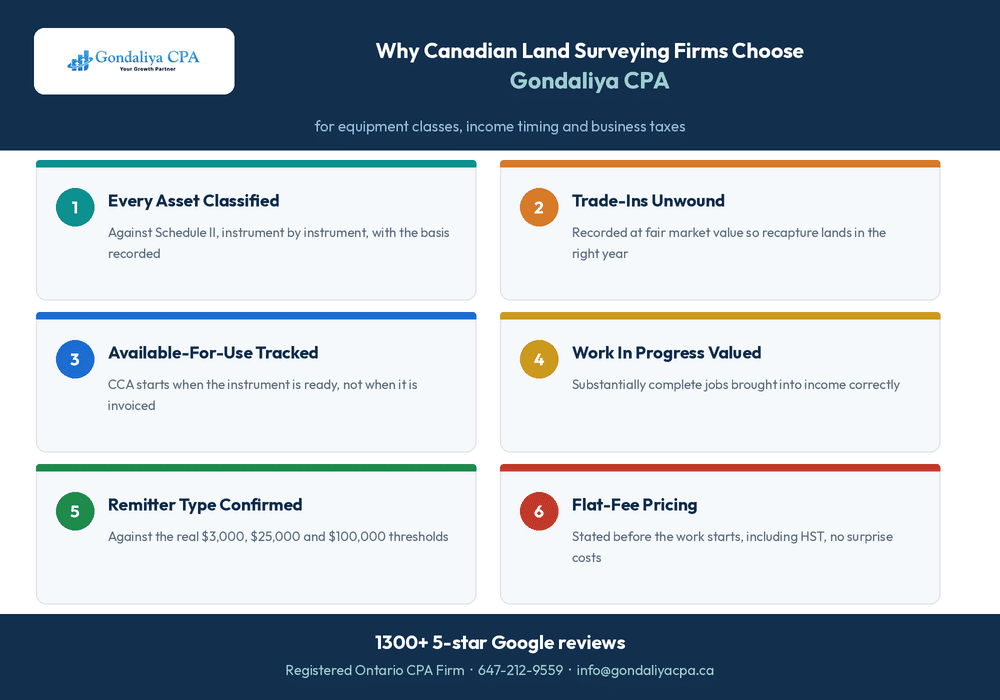
Gondaliya CPA checks every instrument against Schedule II, rebuilds the register where trade-ins were netted against purchases, records available-for-use dates so CCA starts in the right year, reviews work in progress on substantially complete jobs, and confirms your payroll remitter type against the real thresholds. Flat annual fee including HST, stated before the work starts, with a one-business-day response. Please book a free consultation.
Next Steps
Please book a free consultation with Gondaliya CPA and bring three things: your asset register or equipment purchase invoices, one recent trade-in agreement, and a list of jobs open at your last year-end. Those three show whether your classes are right, whether dispositions have been recorded, and whether work in progress has been brought into income. You will get a flat annual fee including HST before any work begins. To discuss your firm’s situation, contact Gondaliya CPA at 647-212-9559 or info@gondaliyacpa.ca for a free consultation focused on incorporated land surveying businesses across Ontario and nationwide, from Toronto areas like Etobicoke and Vaughan through to Windsor and beyond.
Published: · Last updated:
Editorial policy: We research against the Income Tax Act, the Income Tax Regulations, the Excise Tax Act, CRA publications and Department of Finance releases, fact-check the figures, and Sharad Gondaliya, CPA, reviews the content, which we update as the rules change.
Disclaimer: This article is educational information only and is not tax, legal, or financial advice. Figures marked illustrative are examples rather than quotes or guarantees. CCA classification depends on the specific asset and how it is used, and must be confirmed asset by asset. Rates, ceilings and incentives change annually. Please consult a CPA Ontario member before acting.

Sharad Gondaliya is a CPA Canada & CPA USA with 15 Years+ experience of Accounting, Tax, Payroll of Corporate Small Businesses as Tax Accountant. He is a CPA Ontario member (61040184) and holds US CPA licences in Washington and Montana and is well known among corporate small businesses for tax planning, efficient tax solutions, and affordable CPA services. Sharad is the Principal (Director) of Gondaliya CPA – Affordable CPA Firm in Canada. Licenses: CPA Ontario: 61040184 | CPA USA (MT): PAC-CPAP-LIC-033176 | CPA USA (WA): 57629 | CPA Firm License: 61330051 View Full Author Bio