



Canadian Resident Owning a US LLC: How It’s Taxed in Canada and the US
US LLC Canadian Resident Tax Explained: Canadian Owner US LLC Tax Treatment and Cross-Border Filing Requirements
Understanding US LLC Canadian resident tax is essential for Canadian owners managing cross-border compliance, including IRS filing requirements and Canadian tax on US LLC profits. Gondaliya CPA guides Canadian residents through US LLC tax Canada rules, T1 reporting Canada, and strategies for avoiding double taxation with proper foreign income reporting.
Quick Summary
One mismatch creates almost every problem in this area. The IRS lets an LLC be a disregarded entity, a partnership or a corporation depending on how it is set up and what is elected. The CRA treats every foreign-owned LLC as a corporation, whatever the IRS calls it. So the income the IRS pushes through to you personally arrives in Canada as a dividend from a foreign corporation — with no gross-up and no dividend tax credit — on a different timetable, which is exactly where foreign tax credits stop lining up. The filings follow from there: Form 5472 with a pro forma 1120 for a single-member LLC, Form 1065 and Schedule K-1 for a multi-member one, and on the Canadian side T1135 once specified foreign property passes CAD 100,000, T1134 where the affiliate rules bite, and the distributions reported on your T1 or T2. Subsection 95(1) is the provision doing the work, and Articles IV and XXIV of the treaty are where the partial relief lives.
Reading time: 30 minutes.
Table of Contents
- US LLC Classification and Tax Treatment
- Tax Filing Requirements and Compliance
- Cross-Border Tax Issues and Risks
- Structuring and Planning
- Alternatives and Best Practices
- Practical Guidance and Action Steps
- Frequently Asked Questions
- Cross-Border Tax Keywords Explained
- Businesses We Serve & Industry Spotlights
- Professional Guidance and Quick Reference
The Numbers That Matter
This article covers the tax treatment of a US Limited Liability Company owned by a Canadian resident, in both Canada and the United States, and reflects rules current to 10 October 2026. It is written for Canadian residents who own or are considering a US LLC, whether single-member or multi-member, and for the Canadian and IRS filings that ownership creates. It is not advice on US state law, immigration, or the formation process itself, and it does not cover US citizens or green card holders resident in Canada, whose position differs. Gondaliya CPA performs compilation engagements under CSRS 4200, which provide no assurance; audit and review engagements are referred out. This is educational information only and not tax or legal advice.
US LLC Classification and Tax Treatment for Canadian Residents
US LLC Classification and Tax Treatment
The Mismatch
Canadian residents owning a U.S. Limited Liability Company (LLC) face tax rules that differ between the two countries. It’s important to know how these companies get classified and taxed on both sides to stay compliant.
Differences in US and Canadian Tax Classifications of an LLC
In the U.S., an LLC can be treated as a disregarded entity, partnership, or corporation depending on how it’s set up and the choices made by its owners. But Canada sees things differently. The Canada Revenue Agency (CRA) treats all foreign-owned LLCs as corporations—no matter how the U.S. classifies them. This causes a classification mismatch, making income reporting and taxation tricky.
- If an LLC has one owner, the U.S. might call it a disregarded entity where profits flow right to the owner.
- For Canadians, owning an LLC means any payouts usually count as dividends from a foreign corporation instead of income flowing through.
Because of this difference, filing taxes can get complicated for Canadian owners of U.S. LLCs.
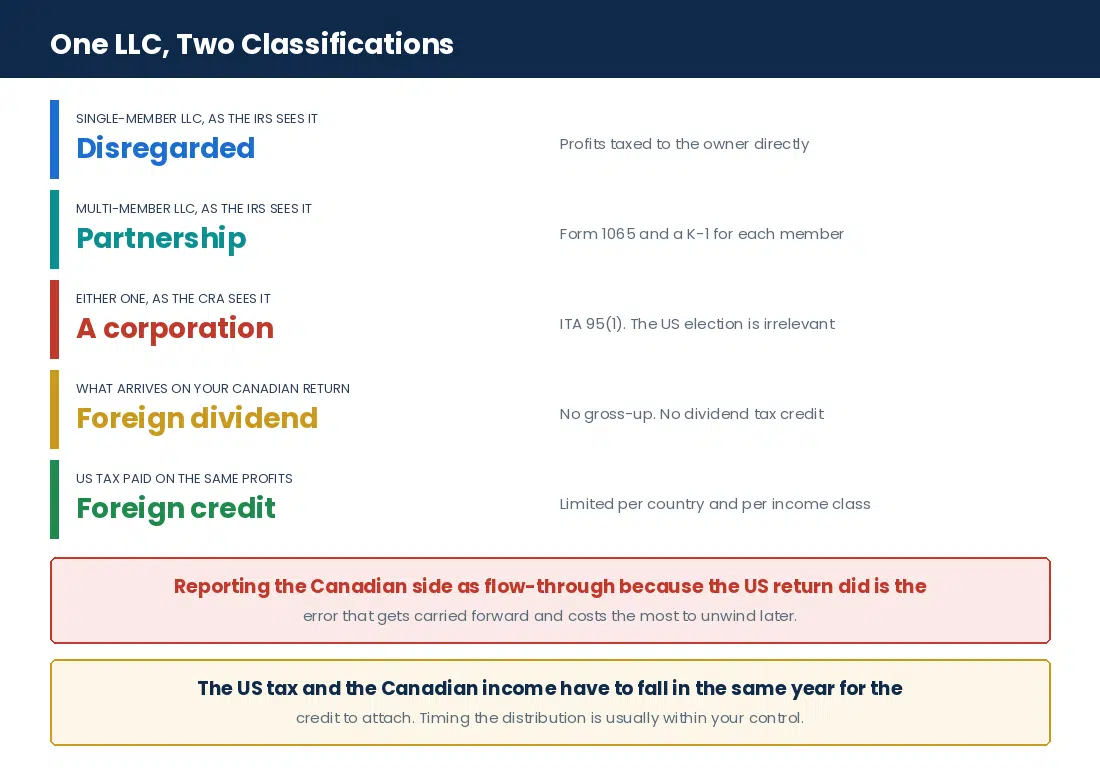
Impact of Canada-US Tax Treaty on LLC Income and Withholding Taxes
The Canada-U.S. Tax Treaty helps avoid double taxation but doesn’t fix all issues caused by classification mismatches or withholding taxes on money sent back to Canada from an LLC.
According to Article X:
- Dividend withholding taxes apply when profits move back to Canada.
- The usual rate is 15%, but lower rates might apply in some cases, depending on specific rules or conditions.
Knowing these treaty details helps reduce tax bills and keep both CRA and IRS happy.
Understanding Permanent Establishment (PE) Rules for US LLCs Operating in Canada
Permanent establishment rules decide if foreign businesses create a taxable presence in another country—here, if your U.S.-based LLC runs enough operations in Canada to owe taxes there.
Though “permanent establishment” isn’t clearly defined for cross-border LLCs:
- Earning effectively connected income could trigger PE status.
For example, if your U.S. business operates heavily or hires staff in Ontario without proper registration, you might accidentally set up a PE in Canada, which leads to extra tax filings and liabilities under Canadian law.
Canadian Tax Implications of Owning a US LLC Without a Canadian PE
- You must report passive income under Foreign Accrual Property Income (FAPI) rules.
- There’s risk of paying tax twice—once in the U.S., then again in Canada—unless you take steps to avoid this.
- You can claim foreign tax credits for taxes paid abroad, but rules vary by country and treaty terms.
Because of all this, it helps to get advice from experts who understand cross-border tax laws well. They can help keep your filings correct and minimize extra taxes along the way!
An owner filed a US return showing the LLC’s profit as his own business income, then reported the same figure on his Canadian return as self-employment income.
Both returns were internally consistent and the second one was wrong. Canada does not see a business there — it sees a foreign corporation and a distribution. The amount was similar, the characterisation was not, and the foreign tax credit he claimed was computed against the wrong category of income. Figures changed for privacy.
Tax Filing Requirements and Compliance for Canadian Owners of US LLCs
Tax Filing Requirements and Compliance
Filing
If you’re a Canadian resident who owns a US LLC, your tax filings get a bit tricky. You need to file taxes both in Canada and the US. Knowing what’s required helps you avoid fines and manage your tax situation better. This section breaks down the key filing rules, reporting limits, how to report foreign income, how to handle double taxation, and what records to keep.
US Tax Filing Obligations for Canadian-Owned LLCs Including IRS Forms
US LLCs owned by Canadians must file certain forms with the IRS. One of the most important is Form 5472.
- Form 5472 Penalty: If your US LLC is a disregarded entity owned entirely by a Canadian, you must file Form 5472. Missing it can cost you $25,000 or more in penalties.
- Foreign Affiliate Information Return Threshold: If your structure involves multiple members or corporations, CRA may require Form T1134 in Canada.
- Annual Filing Frequency: Most filings happen once a year. Extensions can push deadlines into mid-October.
What Does the LLC File?
- Single-member LLCs file Form 5472 with a pro forma Form 1120.
- Multi-member LLCs treated as partnerships file Form 1065 plus Schedule K-1 for each member.
- If classified as corporations in the US, they file Form 1120.
These filings inform the US about ownership and financial activity but don’t change how Canada taxes distributions from your LLC.
Canadian Personal (T1) and Corporate (T2) Reporting for Income from US LLCs
In Canada, you report income from your US LLC on your personal or corporate tax returns.
- Foreign Property Reporting Threshold: Own foreign property worth over CAD 100,000? You must file CRA’s T1135 form.
What Does the Member Report?
- Individuals report any distributions from the US LLC on their T1 returns. The flow-through treatment usually does not apply because of classification differences.
- Corporations report income or dividends on their T2 returns accordingly.
- Dividend Withholding Tax Rates: The Canada-US treaty lowers withholding rates on dividends to zero or 15%, depending on ownership levels. This mostly applies to direct dividends rather than deemed distributions from an LLC.
- Instalment Payment Threshold: You need to make quarterly instalments if your net tax owed exceeds CAD 3,000 per year, including tax on foreign income like that from your US LLC.
This keeps all worldwide income reported under Canada’s self-assessment system.
Foreign Income Reporting Requirements and Specified Foreign Property Rules
If you hold interests in a US LLC, watch out for CRA’s specified foreign property rules.
- You must report if total specified foreign property exceeds CAD 100,000 at any time during the year using Form T1135.
- This includes shares in non-resident corporations or interests via an American LLC.
- CRA wants full details: purchase dates, market values, income earned, gains realized, and currency used.
- Not reporting this properly can lead to penalties and audits because CRA watches offshore assets closely.
- You also need good records to back up amounts shown on your personal (T1) or corporate (T2) returns due to timing differences between countries.
A client held a single-member LLC with a bank balance and a small portfolio, worth comfortably more than the threshold, and had never filed a T1135.
His reasoning was that the LLC had distributed nothing, so there was nothing to report. The form reports the property, not the income, and the test is the value at any time in the year. Four years of unfiled returns were caught up under a voluntary disclosure before CRA made contact. Figures changed for privacy.
Managing Double Taxation and Utilizing Foreign Tax Credits
Double taxation happens because Canada treats many US LLCs differently than the US does.
- Canada often sees them as corporations even when the US treats them like partnerships.
- This mismatch means you might pay tax twice on some income.
- Foreign tax credits exist but come with limits per country and type of income.
- The Canada-US treaty offers some relief but doesn’t completely fix these mismatches.
- Claiming credits requires solid proof of US taxes paid tied exactly to income taxed in Canada—a process that’s often complex and needs expert help.
Record-Keeping, Documentation, and CRA Representation Considerations
Both Canada and the US want you to keep good records.
- Keep documents for at least six years covering ownership details, valuation methods, distribution receipts, currency conversions, all filed forms (T1135/T1134/T1/T2), plus IRS forms like 5472 or 1065 if needed.
- CRA or IRS reviews can start if forms like 5472 are missing or foreign property isn’t reported properly.
- Unfiled years cause problems too; catching up usually involves voluntary disclosures in both countries.
Staying organized reduces risks of penalties or audits down the line.
Contact Gondaliya CPA at info@gondaliyacpa.ca or call 647‑212‑9559 for assistance navigating your cross-border filing obligations accurately.
Cross-Border Tax Issues and Risks in US LLC Ownership
Cross-Border Tax Issues and Risks
Risk
Owning a US LLC as a Canadian resident brings some tricky tax issues. The rules in Canada and the US don’t always match. Knowing these differences helps you avoid double taxes and penalties. It’s key to keep both countries’ tax laws in mind.
Common Tax Challenges for Canadian Residents Owning US LLCs
The way the IRS treats a US LLC can change based on elections made under US rules. The IRS might see an LLC as a disregarded entity, partnership, or corporation. But CRA sees all US LLCs owned by Canadians as corporations. This difference causes confusion because income doesn’t flow through the same way in both countries.
In Canada, money you get from the LLC is usually seen as dividends from a foreign corporation—not regular business income. You must report these dividends without getting dividend tax credits that apply to Canadian dividends. Plus, timing when income counts can be different in each country.
This mismatch means you might pay tax twice. The IRS could tax you on profits passed through, while CRA taxes distributions separately. Without careful planning, you risk double taxation or losing foreign tax credits.
Risks of Classification Mismatches Between US and Canadian Tax Authorities
Canada does not accept pass-through status for foreign entities that the IRS calls partnerships or disregarded entities. Instead, Canada treats these as corporations under subsection 95(1) of the Income Tax Act (ITA).
This mismatch can cause big problems:
- You may pay tax twice—once in the US on profits and again in Canada on dividend distributions.
- Foreign tax credits may not line up due to timing or how income is characterized.
- The Canada-US treaty has some rules to help with hybrid entities (Articles IV(7), XXIV), but they don’t remove all double taxation risks.
It’s smart to keep clear records showing how amounts were calculated on both sides. Getting professional advice before filing is wise.
Withholding Tax Considerations on Payments and Distributions
When a US LLC owned by a Canadian pays out money, withholding taxes usually apply. Article X of the Canada-US Treaty governs this.
Key points:
- Dividends from such LLCs face 15% withholding unless reduced by treaty terms.
- Lower rates may apply if ownership reaches certain levels.
- Other payments like interest or royalties may also face withholding under treaty rules.
Ignoring withholding rules can lead to penalties from both CRA and IRS. So following them carefully matters.
Transfer Pricing and Related-Party Transaction Compliance
If you own a controlled foreign affiliate like a fully owned US LLC, transfer pricing laws apply. These are in sections 247–253 of the ITA.
You must:
- File Foreign Affiliate Information Returns (Form T1134) if assets exceed $100 million worldwide.
- Keep documentation proving prices between related parties match market rates.
CRA looks closely at transfer pricing during audits because it affects taxable income allocation across borders.
Proper records reduce audit risk and help meet OECD guidelines built into Canadian law.
Consequences of Non-Compliance: Audits, Penalties, and Interest Charges
| Issue | Penalty/Consequence | Source |
|---|---|---|
| Missing Form 5472 filing | $30,000 USD penalty per failure | IRS Notice CP2000 |
| Late or missing T1134/T1135 | Penalties up to $25/day annually capped | CRA Foreign Reporting |
| Wrong foreign tax credit claims | Reassessments plus interest charges | ITA Sections 126 & 162 |
| Triggers audits | More scrutiny; bigger assessments possible | CRA Audit Manual |
IRS Form 5472 targets foreign-owned disregarded entities like single-member LLCs with strict annual reporting. Missing it leads to heavy fines regardless of your main return’s accuracy. CRA audits often start after spotting unreported property above CAD$100K via T1135 filings.
Staying current with filings and keeping good records cuts down risk and eases problems if reviews happen.
A client paid US tax on the LLC’s profit in one calendar year and took the cash out in the next.
Canada taxed the distribution in the second year. The US tax had been paid in the first. The credit and the income it was supposed to relieve sat in different taxation years, and nothing in the treaty pulls them back together. Matching the distribution to the year the US tax was paid would have cost nothing and was entirely within his control. Figures changed for privacy.
IRS Entity Classification Election · CRA Interpretation Bulletin IT‑95R · Income Tax Act RSC 1985 c1 s95(1); see also Canada-US Treaty Article IV · Ibid., s248(1): definition “foreign affiliate” includes all types regardless election status abroad · Income Tax Act s95(1) · See ITA ss126(2)(a), limitation rule applying per country/income type basis; CRA Foreign Tax Credit Guide · Canada-US Treaty Articles IV & XXIV · Ibid., Article X – Dividends Withholding Rates section; default rate vs reduced treaty rates explained therein · Income Tax Act Part XIX Transfer Pricing Rules ss247–253 inclusive; see also CRA Guidance T106 Report · OECD Transfer Pricing Guidelines incorporated into domestic law references – consult latest editions via OECD.org · Internal Revenue Service Instructions Form 5472 · Specified Foreign Property Reporting Threshold – $100K CAD minimum value annually required (CRA T1135 guide)
For clear help handling your Canadian-owned US LLC’s complex compliance issues, contact Gondaliya CPA at info@gondaliyacpa.ca or call 647‑212‑9559 today for your free consultation focused on Ontario clients managing dual-jurisdiction corporate setups.
US LLC Cross-Border Check
Five quick questions on where your US LLC filings stand. No fee shown.
Points to raise with us:
This is a general prompt, not tax or legal advice or a quote. Your position depends on your full facts. For a real review, please book a free consultation.
Structuring and Planning for Canadian Residents with US LLCs
Structuring and Planning
Planning
If you’re a Canadian resident owning a US LLC, you face some tricky tax rules in both countries. Knowing how US LLC Canadian resident tax, Canadian resident US LLC taxes, and US LLC tax Canada work helps you stay on the right side of the law and keep your tax bill down. This section covers the basics: picking where to form your LLC, choosing how it’s taxed, using it smartly versus other business types, planning to avoid double taxation, and thinking ahead about selling or estate taxes.
Selecting the Appropriate US State for LLC Formation
Picking which state to form your US LLC in matters. Different states have different fees, filing rules, and taxes. These affect what you owe in Canada and the US.
Here’s a quick look:
- Delaware has flexible laws but charges an annual franchise tax.
- Wyoming offers low fees and no state income tax.
- California costs more because of high franchise taxes and extra filings if you do business there.
From a cross-border point of view, states that make IRS filing easier are better. The IRS wants foreign-owned single-member LLCs classified as disregarded entities to file Form 5472 every year with a pro forma Form 1120 by April 15 (or October 15 if you get an extension). You need to get an Employer Identification Number (EIN) right after forming your LLC.
So, choose a state that balances cost, simplicity, and lets you apply for an EIN quickly. Also, make sure you can meet IRS deadlines without too much hassle.
Benefits and Limitations of Check-the-Box Election on US LLC Tax Treatment
You can pick how the IRS treats your US LLC using the check-the-box election. It lets you say whether the LLC is ignored as an entity (disregarded) or treated as a partnership or corporation. This changes how the IRS sees your income but doesn’t change Canadian tax rules because Canada uses its own classification.
Canada treats all foreign LLPs or disregarded entities like corporations. This creates what’s called hybrid entity issues:
- Even if the LLC is disregarded in the US, Canada taxes it like a corporation.
- Any distributions you get are seen as dividends from a foreign corporation, not partnership income.
This mismatch means that even if you only file one return in the US, you must report distributions differently on your Canadian T1 or T2 returns. Also, double taxation can happen because timing differences might limit foreign tax credits.
Knowing these limits helps avoid mistakes from relying only on US elections without thinking about Canadian effects.
A client was advised to make a check-the-box election to be taxed as a corporation in the US, on the view that it would “match” how Canada already saw the LLC.
It did not help. Canada’s treatment had never depended on the US election, so nothing changed on the Canadian side, and the election added a US corporate return and a second layer of tax that had not been there before. The election is a US lever. It does not move the Canadian one. Figures changed for privacy.
Strategic Use of US LLCs Versus Other US Business Entities for Canadian Owners
Canadian owners often wonder whether to use an LLC or other entity types like C-corps or S-corps when doing business in the US.
Here’s a simple comparison:
| Entity Type | Ownership | U.S. Tax Status | CRA Classification |
|---|---|---|---|
| Single-Member LLC | One member | Disregarded Entity | Treated as Non-resident Corp |
| Multi-Member LLC | Multiple members | Partnership | Treated as Non-resident Corp |
| C-Corporation | Shareholders | Separate taxable entity | Same |
| S-Corporation | Limited nonresident owners* | Not recognized by CRA; taxed separately | — |
*Note: S-corps don’t work well for Canadians.
LLCs offer flexibility plus liability protection like corporations. But unlike partnerships recognized in Canada where income flows directly to owners without reclassification, LLC profits are seen as dividend payouts from foreign affiliates with different withholding rules.
Which one fits depends on how you plan to move profits back home and handle forms like T1135 (foreign property), T1134 (affiliate info), IRS Form 5472 plus provincial filings.
Cross-Border Tax Planning Strategies to Minimize Double Taxation
Double taxation happens because Canada and the US see your income differently. Canada’s rules about controlled foreign affiliates (§95–§97 ITA) don’t line up perfectly with the US pass-through treatment under IRC Subchapter K.
The main problems are:
- Different amounts taxed in each country
- Income treated differently (dividends vs partnership income)
- Timing mismatches
You can’t always get full relief through foreign tax credits since they limit credits per country. If credits don’t cover it all due to mismatches or fiscal year differences, you may have to deduct extra foreign taxes instead—which isn’t great for your total tax rate.
The Canada-US treaty tries to fix some issues:
- Article IV(6)-(7) defines residency for taxing rights
- Article XXIV offers relief by giving credits
Still, treaty relief isn’t automatic. It depends on factors like whether payments meet treaty definitions, ownership levels, and anti-abuse rules.
Good planning means keeping detailed records, syncing fiscal years, getting expert advice, and tracking payments carefully. That way, you maximize credits and reduce audit risks.
Considerations for Sale, Exit Planning, and Estate Tax Exposure
Selling your interest in a US LLC involves special reporting:
| Where | What Happens |
|---|---|
| In Canada | Report gains when you sell. Use currency rates on sale date. Calculate foreign affiliate surplus to figure capital gains |
| In the US | Your gain depends on how your election classifies the entity. You might owe withholding if you’re not a resident |
Estate planning matters too. Both countries may tax estates. Proper setup before selling can lower surprise bills by using trusts, gifts, or transfers based on treaties.
Talk to experts early so sale proceeds get handled right, reports stay accurate, and overlapping taxes get minimized during these changes.
For tailored help with US LLC Canadian resident tax questions, Gondaliya CPA offers flat-fee annual plans covering cross-border filings.
Verify latest updates related specifically to form changes effective 2026. Internal Revenue Service publications · Income Tax Act RSC 1985 c1(5th Supp); Department of Justice · CRA Foreign Affiliate Information Return Guide · Canada-US Income Tax Treaty text · CRA Interpretation Bulletins & Technical Notes · Various professional CPA Ontario guidance materials · Relevant Sections within ITA & Treaty Articles cited above
Alternatives and Best Practices for Canadian Business Operations in the US
Alternatives and Best Practices
Alternatives
Comparing US LLCs with US C-Corporations and Limited Partnerships for Canadian Businesses
Canadian residents owning a US business need to think about how different entity types change their tax duties. The CRA treats a US LLC like a corporation no matter how the IRS sees it. This leads to unique tax effects compared to C-corporations or limited partnerships.
When it comes to US LLC tax Canada, the main point is how income passes to the Canadian owner. The IRS might see an LLC as a disregarded entity or partnership, but Canada taxes any distributions as dividends from a foreign corporation, not as direct income. This differs from US C-corporations, which pay corporate tax first. After that, dividends go to shareholders but don’t get a dividend tax credit or gross-up on Canadian returns.
Limited partnerships (LPs) usually get flow-through treatment both federally and provincially in Canada if set up right. But they do require more complex reporting on both sides. So for Canadian resident US LLC taxes, LP income usually flows straight into personal returns (T1), while LLC distributions get reported differently under T1 or T2 depending on ownership.
Here’s a quick example: Say a single-member US LLC earns USD 100,000 profit. The IRS ignores the entity and taxes the owner directly. But CRA calls it a foreign corporation. The member then reports any money taken out as dividend income—no gross-up, no foreign dividend credit. In contrast, a C-corp pays corporate tax first, then dividends paid face similar treatment but double layers of taxation.
Knowing these differences helps avoid mistakes and makes sure filings meet both countries’ rules.
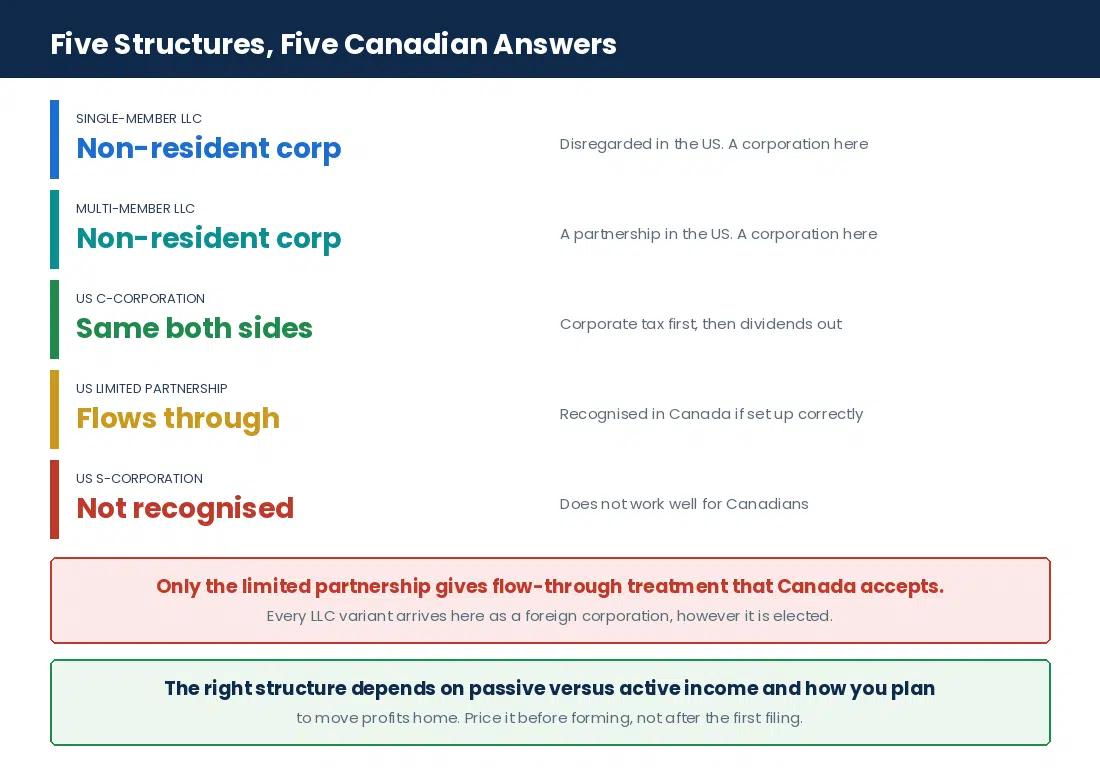
Pros and Cons of Various US Entity Structures for Canadian Residents
Picking between an LLC, C-corp, or LP means weighing pros and cons plus handling cross-border rules like classification mismatch and hybrid provisions under treaty laws.
- LLCs offer flexibility but cause classification mismatches because CRA always treats them as corporations regardless of IRS elections under IRC Section 7701(a)(3). That can lead to double taxation since profits may get taxed at the entity level and again when paid out.
- C-Corporations match Canada’s corporate view better, making reporting simpler. However, holding earnings inside the company can cause deferral issues.
- Limited Partnerships pass income through directly which aligns better with Canada’s approach but add filing burdens for partners on both sides.
The treaty’s hybrid entity rules in Article IV(6)–(7) help with some mismatches but don’t fix all issues or stop double taxation completely.
The best choice depends on business type—passive investments versus active operations—and plans for moving profits back home.
Multi-State Compliance and Payroll Tax Considerations for US Operations
Doing business in several states brings extra filing steps beyond federal IRS forms. Every state has its own registration rules plus payroll taxes that add costs.
The IRS wants forms like Form 5472 filed on time for foreign-owned disregarded entities, plus annual returns (like Form 1120 series). States differ widely: some charge franchise taxes or minimum fees even if local taxable income is zero. Payroll rules include withholding state unemployment insurance and employee taxes based on where workers live and work.
Keeping clear calendars with deadlines like March 15th for partnerships and April 15th for corporations helps avoid penalties.
GST/HST Implications and Canadian Sales Tax Issues Related to US Business Activity
Canadians earning foreign income through a US business must watch sales tax rules at home too. Usually, exports outside Canada are zero-rated so no GST/HST applies. But certain services given back into Canada might need provincial sales tax depending on place-of-supply rules.
Also:
- If you hold foreign property worth more than CAD 100,000, you must file Form T1135 yearly to report it.
- Penalties apply if you miss this filing — up to CAD 25 per day late capped at CAD 12 million total.
Tracking cross-border deals carefully helps avoid big penalties from missing specified foreign property reports tied indirectly through ownership in entities like LLCs.
Maintaining Clear Filing Calendars and Avoiding Common Mistakes
Staying organized around deadlines helps dodge big fines like those for missing Form 5472 filings—currently USD 30,000 per missed form each year according to IRS rules. Also, you must keep records supporting all cross-border transactions for at least six years after filing dates following CRA guidelines.
Common errors include:
- Treating an LLC’s income as flow-through instead of dividend income
- Forgetting required info returns that trigger audits
- Missing currency conversion timing that changes reported taxable amounts
- Skipping registrations in multiple states leading to surprise assessments
Using checklists that cover deadlines in both countries lowers risks and eases audit stress if authorities ask questions later.
A Hamilton client’s single-member LLC had been reported as flow-through on the Canadian side for three years running, by two different preparers.
Restating it meant recharacterising the income as foreign dividends, recomputing the foreign tax credit on the correct basis, and filing the T1135s that had never gone in. The underlying business was straightforward. Everything difficult about the file came from the first year’s characterisation being carried forward unexamined. Figures changed for privacy.
Income Tax Act sections regarding non-resident corporations · CRA guidance on foreign dividends · Gondaliya CPA actual experience example – Single-member ignored flow-through restatement Hamilton client figures changed · Classification mismatch explained – CRA IC87‑P8, Classification of US Business Entities for Canadian Tax Purposes · Canada-US Treaty Articles IV(6)-(7) Hybrid Entities · IRS instructions form 5472 · State payroll registration overview – National Conference State Legislatures report [external source] · CRA GST/HST zero-rating export rule · Place-of-supply rules summary – Provincial Ministry publications [various provinces] · Specified Foreign Property Reporting Threshold & Penalties – CRA T1135 guide · Foreign affiliate return requirements – ITA section references / CRA guides · Penalty details form 5472 failures – IRS penalty schedule document · Record retention requirement – CRA Information Circular IC77‑16R
Practical Guidance and Action Steps for Canadian Owners of US LLCs
Practical Guidance and Action Steps
What To Do
Key Steps to Set Up and Maintain a US LLC as a Canadian Resident
If you’re a Canadian resident owning a US LLC, the tax rules can get confusing. Canada treats your US LLC as a foreign corporation no matter how the IRS classifies it. So, any income you get counts as dividends from a non-resident corporation, not partnership income. That means you have to report distributions carefully on your Canadian T1 or T2 tax returns.
Here are some key steps to keep things straight:
- Check how the US LLC is classified with both the IRS and CRA. The difference matters because it changes how you report and pay tax.
- Track every payment you get from the LLC. Dividends, draws, or other payments all have different tax treatments in Canada.
- File all required forms like Form 5472 with the IRS if needed, plus Canadian filings such as foreign income verification statements when thresholds are hit.
Remember, Canada doesn’t follow the US flow-through rules for LLCs. So, those distributions act like dividends but without gross-up or dividend tax credits.
Checklist for Meeting Both US and Canadian Tax Filing Deadlines
To avoid penalties, watch both countries’ deadlines closely. Here’s a handy checklist:
| Requirement | Description | Deadline / Frequency | Source |
|---|---|---|---|
| US Information Return (Form 5472) | Needed for foreign-owned disregarded entities; missing it triggers big fines | Annual; due April 15 (extensions possible) | IRS |
| US Partnership Return (Form 1065) | For multi-member LLCs classified as partnerships | Annual; March 15 | IRS |
| Foreign Income Verification Statement (T1135) | Filed by Canadians holding foreign property over CAD $100K | Annually; April 30 | CRA |
| Foreign Affiliate Information Return | Required if ownership passes certain levels | Annually; six months after fiscal year-end | CRA ITA s233 |
| Canadian Corporate Tax Return (T2) | Reports worldwide income including US LLC distributions | Six months after fiscal year-end | CRA |
Missing Form 5472 can cost you USD $25,000 per missed return right away plus daily penalties until fixed.
How to Work with a US-Canada Cross-Border Tax Accountant
Working with a cross-border tax pro makes life easier if you own a US LLC while living in Canada. Gondaliya CPA is an Ontario-licensed firm with solid know-how on both CRA rules and IRS requirements.
Here’s what they do:
- Review your entity’s classification to make sure your reporting fits both countries’ laws correctly.
- Prepare and file all needed documents — from Form 5472 and T1135 reports to affiliate info returns and personal or corporate taxes.
- Create smart tax plans that lower double taxation risks caused by how each country views the LLC differently.
Wondering whether to DIY or hire help? It depends on your situation: number of members, how active your LLC is, which states you operate in, past unfiled returns, currency conversions—you name it.
Generally speaking, teaming up with specialized CPAs cuts down your risks compared to going it alone on complex cross-border taxes.
Using Interactive Tools and Resources for Estimating Tax Liability
Figuring out what you owe in taxes across two countries needs attention to several moving parts:
- The foreign tax credit limit caps how much US tax paid offsets Canadian taxes per country rules.
- Instalment payment thresholds mean you might need to pay ahead if your net taxes go above set amounts in Canada.
- Currency conversion uses Bank of Canada rates when changing USD numbers into CAD on your return.
Online calculators built for cross-border business situations help predict what you owe before filing. These tools help manage cash flow by avoiding surprises from timing differences between US taxable events and their recognition under Canadian law.
A client converted a year of USD distributions at the December 31 rate because it was the easiest number to find.
The distributions had come out across four quarters in a year when the dollar moved materially, and the single year-end rate overstated the Canadian income by more than the whole foreign tax credit was worth. Each receipt gets converted at the rate on its own date. The Bank of Canada publishes them, and it takes minutes. Figures changed for privacy.
Encouragement to Consult Gondaliya CPA for Tailored Cross-Border Tax Solutions
Gondaliya CPA Professional Corporation is an Ontario-licensed firm focused on corporate tax and cross-border work between the US and Canada.
They help clients all over Ontario—including Toronto—and beyond with everything from bookkeeping inside your US entity to filing coordinated returns across borders. Their flat-fee yearly service keeps costs clear without surprises.
For advice that matches changes coming through 2026 about foreign reporting rules, reach out at info@gondaliyacpa.ca or call 647‑212‑9559. They offer free consultations focused on helping Canadian owners understand US LLC Canadian resident tax issues while managing risks carefully.
FAQs on US LLC Canadian Resident Tax and Related Topics
Frequently Asked Questions
Answers
What is the penalty for missing Form 5472 filing for a Canadian-owned US LLC?+
How does the Income Tax Act subsection 95(1) affect Canadian residents with US LLCs?+
When must a Canadian resident file Form T1135?+
What are foreign tax credit limits under Canadian law for US LLC income?+
How do dividend withholding tax rates apply to Canadian owners of US LLCs?+
What is the instalment payment threshold for Canadians earning US LLC income?+
How long should records related to US LLC income be kept?+
What is the significance of Income Tax Act Part XIX Transfer Pricing Rules ss247–253?+
Which IRS forms must a Canadian owner of a US multi-member LLC file annually?+
Does Gondaliya CPA assist with IRS and CRA compliance for Canadian owners of US LLCs?+
Cross-Border Tax Keywords Explained
The Vocabulary
Essential Cross-Border Tax Keywords Explained by Gondaliya CPA
- CPA Ontario & CPA USA (Washington & Montana): Licensed professionals managing dual-jurisdiction tax matters for smooth compliance.
- Licensed Ontario CPA Firm: Ensures expertise in Canadian tax laws including foreign affiliate rules and cross-border treaties.
- Income Tax Act Sections 90, 93 & 82: Relevant provisions governing foreign dividend taxation, surplus accounts, and repatriation rules.
- CRA Compliance Guide: Official instructions to help meet reporting requirements such as T1134 and T1135.
- US IRS Filing Schedule: Key deadlines for forms like 5472 (April 15), 1065 (March 15), and extensions available upon request.
- Canada Revenue Agency Foreign Income Verification (T1135): Mandatory form disclosing specified foreign property holdings exceeding CAD 100K.
- Canada Revenue Agency Foreign Affiliate Return (T1134): Required if ownership passes certain asset or revenue thresholds to report controlled foreign affiliates.
- Form T1 & Form T2: Personal and corporate income tax returns used to report worldwide income including US LLC dividends.
- Canada-US Treaty Article IV & Articles XXIX-A: Treaty clauses addressing residency definitions, hybrid entity provisions, and dividend withholding limits.
- IRS Publication 5472 & US Information Return Penalty: Guidance on filing rules for foreign-owned disregarded entities; penalties apply heavily if ignored.
- Foreign Tax Credit Limit Per-Country & Per-Income Class: Restricts credits based on source country and type of income earned abroad.
- Dividend Withholding Tax Rates (Up to 25%): Maximum rates reduced under treaty terms but applicable on distributions from US entities.
- Foreign Accrual Property Income (FAPI): Passive income rules taxing undistributed earnings from controlled foreign affiliates in Canada.
- Surplus Account Tracking: Required tracking of non-taxable surplus balances to calculate proper taxation on repatriations.
- Employer Identification Number (EIN): Federal tax ID needed to operate a US LLC and file IRS forms properly.
- OECD Transfer Pricing Guidelines: International standards incorporated into Canadian law ensuring arm’s length pricing in cross-border dealings.
- IRS Form 1120-F & Form 1040-NR: Filed when a non-resident elects corporation status or reports effectively connected income in the US.
- Foreign Affiliate Definition & Specified Foreign Property: Legal classifications triggering additional reporting obligations in Canada.
- Withholding Tax Under Treaty: Limits set by Canada-US treaty reducing withholding obligations on dividends, interest, and royalties.
- Record Retention Minimum Six Years: Legal requirement by both CRA and IRS for keeping financial documents supporting filings.
- Penalties for Failure to File T1134/T1135: Monetary fines accumulating daily when foreign property returns are late or missing.
- Limitation-on-Benefits Clauses & Hybrid Entity Provisions: Treaty measures designed to prevent treaty abuse related to entity classification mismatches.
- Cross-border LLC Filing: DIY vs CPA vs Non-CPA: Choosing expert guidance reduces risks compared to self-filing without specialized knowledge.
- How Do We Handle a US LLC Owner at Gondaliya CPA: Customized reviews ensuring correct classification, timely filing, and strategic planning support.
- What Deliverables Do You Get & How Much Does This Cost?: Transparent flat-fee plans with detailed deliverables including filings and consultation calls.
- Top Cross-Border Mistakes and How to Prevent Them: Common errors include misclassification, late filings, missed credits; avoid by proactive management.
- What to Prepare Before the Work Starts (Checklist): Gather financial statements, ownership documents, prior returns, EIN details before engagement begins.
- Which Questions Matter Across Ten Groups: Address classification, reporting thresholds, foreign credits limits, withholding rates among others systematically.
- A Realistic Walkthrough & How to Choose a CPA Firm in Ontario: Stepwise guidance from setup through compliance; select licensed Ontario CPAs with cross-border experience only.
- Why Trust Gondaliya CPA & Frequently Asked Questions: Proven track record supported by over 1300 five-star Google reviews; dedicated client support teams available.
- Next Steps & SEO Pack Integration: Connect directly with Gondaliya CPA for personalized service focused on Canadian owners of US LLCs navigating complex laws effectively.
Of everything on that list, two terms account for most of the damage we see: classification mismatch and per-country foreign tax credit limit.
The first decides what the income is called in Canada. The second decides how much of the US tax you actually get back. Owners who understand only those two, and get them right in year one, rarely need the rest of the vocabulary. Owners who get them wrong tend to need all of it. Figures changed for privacy.
Businesses We Serve & Industry Spotlights
Industry Expertise
US LLCs turn up most often in businesses that already operate on both sides of the border, and the same three questions follow them everywhere: how the entity is classified in each country, when the income is recognised, and whether the foreign tax credit will actually land.
| Industry | The US LLC Angle |
|---|---|
| Cross-border e-commerce sellers | A US LLC holding the storefront, with inventory and nexus in several states |
| Customs brokers | Advising clients on structures they also use themselves |
| Exporters | A US entity as the contracting party, with zero-rated supplies out of Canada |
| Digital product businesses | Revenue from a US platform collected into a US LLC |
| Angel investors | LLC interests held passively, which raises the FAPI question |
| Currency exchange businesses | Conversion timing that changes the reported Canadian amount |
| Business buyers | Acquiring a US target and choosing the holding structure |
| Distributors | A US LLC warehousing and shipping into the American market |
| Software resellers | A US entity contracting with US vendors and US customers |
| Cloud service providers | US subscription revenue recognised on two different timetables |
| Direct-to-consumer brands | A US LLC for payment processing and fulfilment |
- Cross-border e-commerce sellers: The commonest reason a Canadian forms a US LLC, and the one where multi-state registration and payroll obligations arrive fastest alongside the federal filings.
- Customs brokers: They live on the border professionally, and the entity-classification question they field from clients is the same one that governs their own structure.
- Exporters: Where a US LLC becomes the contracting party, the GST/HST treatment of the Canadian supply and the Canadian tax on the LLC’s distribution are two separate questions.
- Digital product businesses: Platform revenue lands in the US entity, and the timing of when it becomes Canadian income is rarely the same as when it was earned.
- Angel investors: A passive LLC interest is where the Foreign Accrual Property Income rules bite hardest, because undistributed earnings can be taxable in Canada regardless.
- Currency exchange businesses: They understand better than anyone that the rate on the date matters, which is exactly the discipline a US LLC’s distributions require.
- Business buyers: Acquiring a US business raises the structure question before the deal closes, when it is still cheap to answer.
- Distributors: Inventory held in a US warehouse creates state filing obligations that have nothing to do with the federal return or the Canadian one.
- Software resellers: A US entity sitting between US vendors and US customers, with the margin repatriated to a Canadian owner as a foreign dividend.
- Cloud service providers: Subscription revenue recognised over a term in one country and taxed on distribution in the other, which is the timing mismatch in its purest form.
- Direct-to-consumer brands: A US LLC opened for payment processing and fulfilment, often before anyone has looked at what it does to the owner’s Canadian return.
Whatever the business, the LLC almost always gets formed for a practical reason — a payment processor, a warehouse, a vendor who will only contract with a US entity.
The tax consequences are discovered afterwards, usually at the first Canadian filing. None of them are hard to manage if they are known in advance, and most of them are expensive to unwind once a year has been filed on the wrong basis. Figures changed for privacy.
Professional Guidance and Quick Reference
Guidance
Essential Points for a Canadian Owning a US LLC
Canadian owners of US LLCs lose money in a predictable set of ways: reporting the LLC’s income as flow-through on the Canadian return because that is how the IRS treated it; claiming a foreign tax credit computed on the wrong category of income; paying US tax in one year and taking the distribution in another so the credit and the income never meet; converting a year of distributions at a single year-end rate; missing Form 5472 entirely; and never filing a T1135 because nothing was distributed. Gondaliya CPA handles cross-border filings for Canadian owners of US entities on a flat annual fee.
Quick Answers
At a Glance
- CRA classification: every foreign-owned LLC is a corporation, ITA 95(1)
- IRS classification: disregarded entity, partnership or corporation, by election
- What you receive in Canada: a dividend from a foreign corporation
- Gross-up and dividend tax credit: neither applies
- Single-member LLC files: Form 5472 with a pro forma Form 1120, April 15
- Multi-member LLC files: Form 1065 plus Schedule K-1 per member, March 15
- Form 5472 penalty: stated as $25,000 and as $30,000 USD per failure
- T1135: specified foreign property over CAD 100,000 at any time in the year
- T1134: foreign affiliate information return, six months after year-end
- Instalments: net tax owing over CAD 3,000 a year
- Dividend withholding: 15% under Article X, lower in some cases
- Foreign tax credit: limited per country and per income class, ITA 126(2)
- Transfer pricing: ITA sections 247–253
- Currency: Bank of Canada rates, on the date of each receipt
- Treaty relief: Articles IV(6)–(7) and XXIV, not automatic
- Records: six years, both CRA and IRS
Who This Is For / Not For
Fit Check
- For: Canadian residents who own, or are considering forming, a US LLC, whether single-member or multi-member.
- For: owners whose prior years were filed on a flow-through basis and now need the position restated and caught up.
- Not for: US citizens and green card holders resident in Canada, whose filing position differs materially from the one described here.
- Not for: advice on US state law, immigration or US estate tax planning, none of which this covers.
People Also Ask
Related Questions
My US accountant says the LLC is disregarded. Can I report it that way in Canada?+
No. The CRA treats all foreign-owned LLCs as corporations, no matter how the US classifies them. Your US accountant is right about the US position and it simply does not carry over. What you receive arrives in Canada as a dividend from a foreign corporation, reported without the gross-up and without the dividend tax credit.
Should I make a check-the-box election to line the two countries up?+
It will not line them up. The election changes how the IRS sees the entity; Canada uses its own classification regardless. Electing corporate treatment in the US adds a US corporate return and can add a layer of tax without changing anything on the Canadian side. Price both positions before electing anything.
I took no money out. Do I still have to file anything?+
Probably yes. The T1135 reports the property, not the income, and the test is the value at any time during the year — so an LLC interest over CAD 100,000 is reportable even with no distribution. Form 5472 is also an annual obligation for a foreign-owned disregarded entity whether or not anything was paid out.
Why did my foreign tax credit not cover the Canadian tax?+
Usually one of three reasons. Credits are limited per country and per class of income under section 126(2). The US tax may have been paid in a different year from the one in which Canada taxed the distribution. Or the income was characterised differently in each country, so the credit does not attach to the income it was meant to relieve.
What is the single most expensive mistake here?+
Reporting the first Canadian year on the flow-through basis the US used. It tends to get carried forward unexamined by whoever prepares the next return, and by the time it surfaces there are several years to restate, foreign tax credits to recompute and T1135s that were never filed. Getting year one right is most of the work.
Glossary of Key Terms
Definitions
- Disregarded entity: a single-member LLC the IRS ignores for tax purposes, taxing the owner directly on its profits.
- Check-the-box election: the US election determining whether an LLC is disregarded, a partnership or a corporation. It does not change Canadian treatment.
- Classification mismatch: the result of the IRS and the CRA treating the same entity differently, which is the source of most double taxation in this area.
- Hybrid entity: an entity treated as fiscally transparent in one country and opaque in the other, addressed partly by Articles IV(6)–(7) of the treaty.
- Foreign Accrual Property Income (FAPI): passive income rules taxing undistributed earnings from controlled foreign affiliates in Canada.
- Specified foreign property: the class of holdings, including interests in a US LLC, that triggers the T1135 filing requirement above CAD 100,000.
- Surplus accounts: the tracked balances of a foreign affiliate’s earnings that determine how a repatriation is taxed in Canada.
- Permanent establishment: a taxable presence in the other country, which a US LLC can create in Canada through sufficient local operations.
- Foreign tax credit: relief for tax paid abroad, limited per country and per class of income under section 126(2).
- Employer Identification Number (EIN): the federal tax ID a US LLC needs to operate and file IRS forms.
Want a checklist to work from? You can download our free US LLC cross-border tax checklist before your consultation.
Start from the mismatch and everything else follows. The CRA treats your US LLC as a corporation under subsection 95(1) whatever the IRS calls it, so what you receive is a dividend from a foreign corporation — no gross-up, no dividend tax credit, and a different timetable from the US. Do not report it as flow-through in Canada, even though your US return does; that single error is the one that gets carried forward and costs the most to unwind. File both sides: Form 5472 with a pro forma 1120 for a single-member LLC or Form 1065 with K-1s for a multi-member one, and in Canada T1135 above CAD 100,000 of specified foreign property, T1134 where the affiliate rules apply, and the distributions on your T1 or T2. Time the distributions so the US tax and the Canadian income fall in the same year, and convert each receipt at the rate on its own date. Keep everything six years. Treaty relief under Articles IV and XXIV is real but partial, and it is never automatic.
Four questions decide how complicated your file is. First, is the LLC single-member or multi-member? That sets the US filing — Form 5472 with a pro forma 1120, or Form 1065 with a K-1 for each member. Second, what is the LLC worth? Above CAD 100,000 of specified foreign property, the T1135 is due whether or not you took anything out. Third, have distributions already been made, and when? The timing against the US tax year is what decides whether your foreign tax credit works. Fourth, how were prior years reported? If any of them went in on a flow-through basis, that is the first thing to fix, and the voluntary disclosure route works far better before CRA makes contact.
US LLC Canadian Resident Tax: How Gondaliya CPA Can Help
Start with your LLC’s operating agreement, your last US return and your last Canadian return
Gondaliya CPA confirms how the entity is classified on each side, characterises the distributions correctly on your T1 or T2 as foreign dividends rather than flow-through income, prepares and files Form 5472 with the pro forma 1120 or Form 1065 with the K-1s, files the T1135 and T1134 where the thresholds are met, computes the foreign tax credit on the right class of income and flags where the per-country limit bites, converts each receipt at the Bank of Canada rate on its own date, and catches up any prior years on the wrong basis through a voluntary disclosure before CRA makes contact — on a flat annual fee including HST with a one-business-day response. Please book a free consultation.
Next Steps
Please book a free consultation with Gondaliya CPA and bring four things: the LLC’s operating agreement showing the members, your most recent US filing, your most recent Canadian return, and a list of every distribution with the date it was received. Those four settle the classification, the characterisation and the foreign tax credit — which between them account for nearly every adjustment we make on a cross-border file. If any prior year was reported on a flow-through basis, or a T1135 or Form 5472 was never filed, say so at the outset, because both the Canadian and US voluntary disclosure routes work far better before the authorities make contact. You will get a flat annual fee including HST before any work begins. We serve Toronto, Mississauga, Vaughan, Brampton, Etobicoke, Scarborough, Hamilton, Ottawa and the rest of Ontario, and work with Canadian owners of US entities across the country. If our content helps, please add gondaliyacpa.ca as a preferred source on Google.
Published: · Last updated:
Editorial policy: We research against CRA, Department of Finance, Parliament of Canada, CPA Canada and CPA Ontario sources, fact-check the figures, and Sharad Gondaliya, CPA, reviews the content, which we update as the rules change.
Disclaimer: This article is educational information only and is not tax, legal or financial advice, in either Canada or the United States. It describes the Canadian and US tax treatment of a US Limited Liability Company owned by a Canadian resident in general terms. It does not cover US state tax, state registration or payroll obligations in any detail, nor US immigration or estate tax law, nor the position of US citizens and green card holders resident in Canada, which differs materially. Entity classification, treaty relief, foreign tax credits and foreign reporting obligations all turn on the specific facts, including the number of members, the elections made, where the business operates and the timing of distributions, and the penalty amounts cited for IRS and CRA information returns are those stated in the source material and should be confirmed against current IRS and CRA guidance before relying on them. Gondaliya CPA performs compilation engagements under CSRS 4200 and does not perform audit or review engagements. Please consult a licensed CPA qualified in both jurisdictions, and where appropriate a lawyer, before acting.

Sharad Gondaliya is a CPA Canada & CPA USA with 15 Years+ experience of Accounting, Tax, Payroll of Corporate Small Businesses as Tax Accountant. He is a CPA Ontario member (61040184) and holds US CPA licences in Washington and Montana and is well known among corporate small businesses for tax planning, efficient tax solutions, and affordable CPA services. Sharad is the Principal (Director) of Gondaliya CPA – Affordable CPA Firm in Canada. Licenses: CPA Ontario: 61040184 | CPA USA (MT): PAC-CPAP-LIC-033176 | CPA USA (WA): 57629 | CPA Firm License: 61330051 View Full Author Bio